

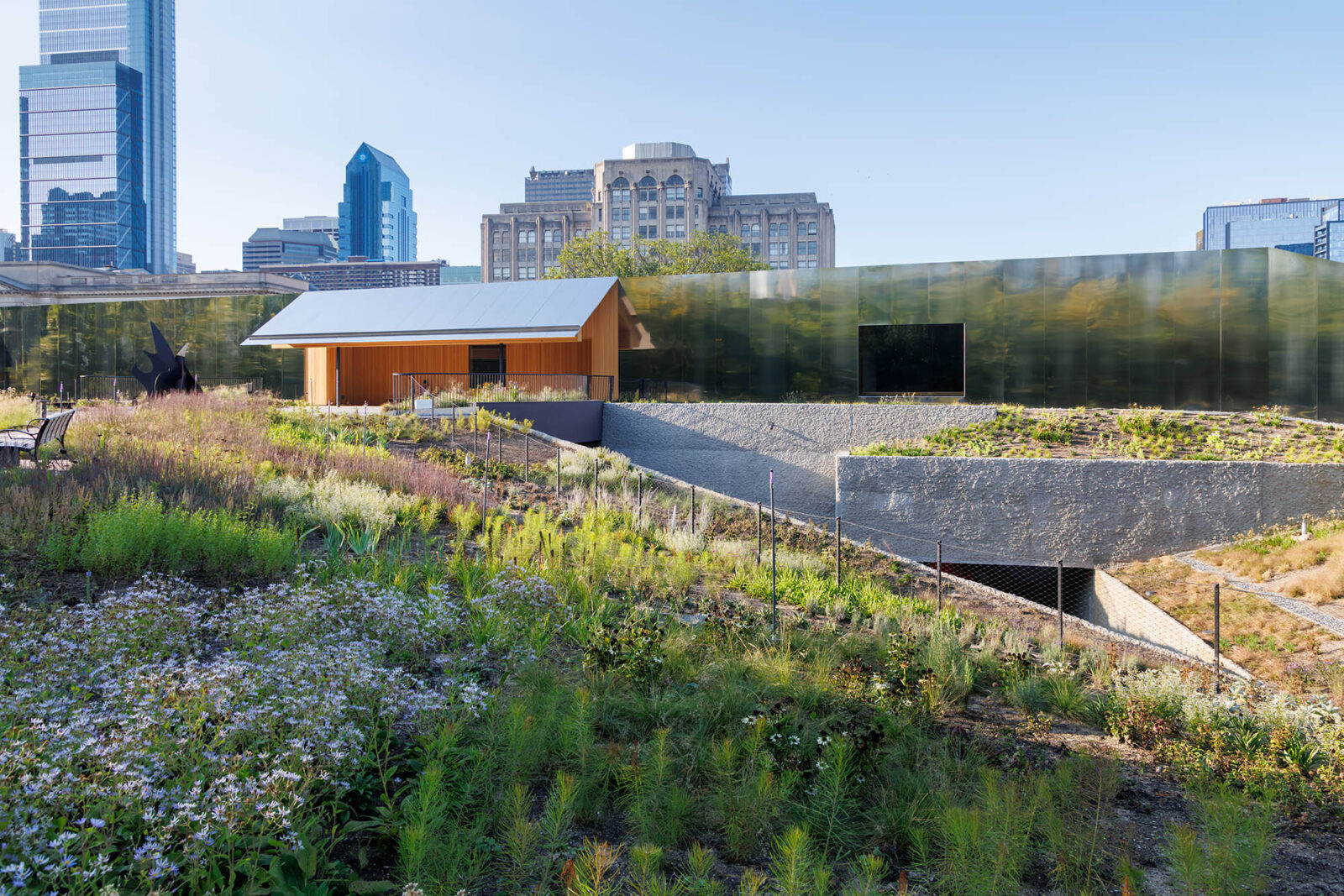
ヘルツォーク&ド・ムーロンによる庭が主役のアートスペース - フィラデルフィアの都市の余白に目的地を創出する〈カルダー・ガーデンズ〉
© Iwan Baan
アメリカ、フィラデルフィアに位置する〈カルダー・ガーデンズ(Calder Gardens)〉は、動く彫刻「モビール」の発明で知られる彫刻家アレクサンダー・カルダー(Alexander Calder)の作品を展示するアートスペースです。
建物ではなく庭園が主役のアートスペースとして、ヘルツォーク&ド・ムーロン(Herzog & de Meuron)が設計しました。
注目ポイント
- 道路によって生まれた都市の空白地帯に目的地を創出
- 騒音を和らげつつ庭園を都市に開く金属壁
- 作品に新たな文脈を与える個性豊かなギャラリー群
(以下、ヘルツォーク&ド・ムーロンから提供されたプレスキットのテキストの抄訳)
© Iwan Baan
芸術・建築・都市が交差する新しいアートスペース像
〈カルダー・ガーデンズ〉は、従来のアートスペースとは異なる存在である。当初からクライアントは、アレクサンダー・カルダーの作品と親密かつ変化に富む新しい出会いを提供できる空間を求めていた。
この建築は、アートスペースに必要とされる典型的な技術的要件を満たしながらも、芸術と共に「存在する」新しいタイプの場として構想されている。すなわち、芸術・建築・自然・人・都市が相互に作用し合う場所である。

© Iwan Baan
フィラデルフィアはカルダーの生まれ故郷であり、2世代にわたるカルダー家が居住し、芸術家としてこの街に痕跡を残した場所である。
彼らの彫刻は、19世紀の「シティ・ビューティフル運動」の成果として整備されたベンジャミン・フランクリン・パークウェイ沿いに点在している。この通りには、アメリカを代表する2つの美術館〈フィラデルフィア美術館〉と〈バーンズ財団(Barnes Foundation)〉が位置している。
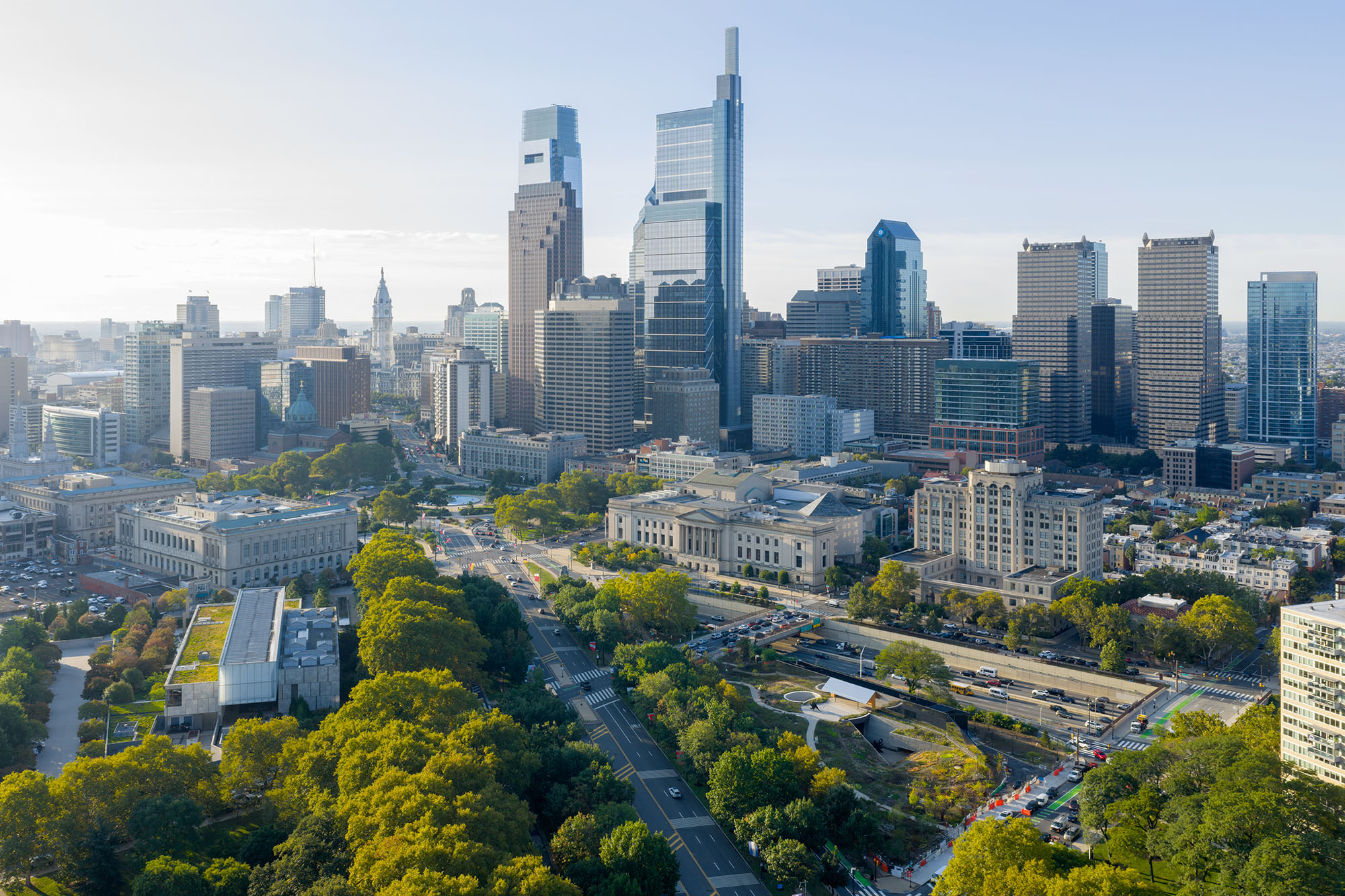
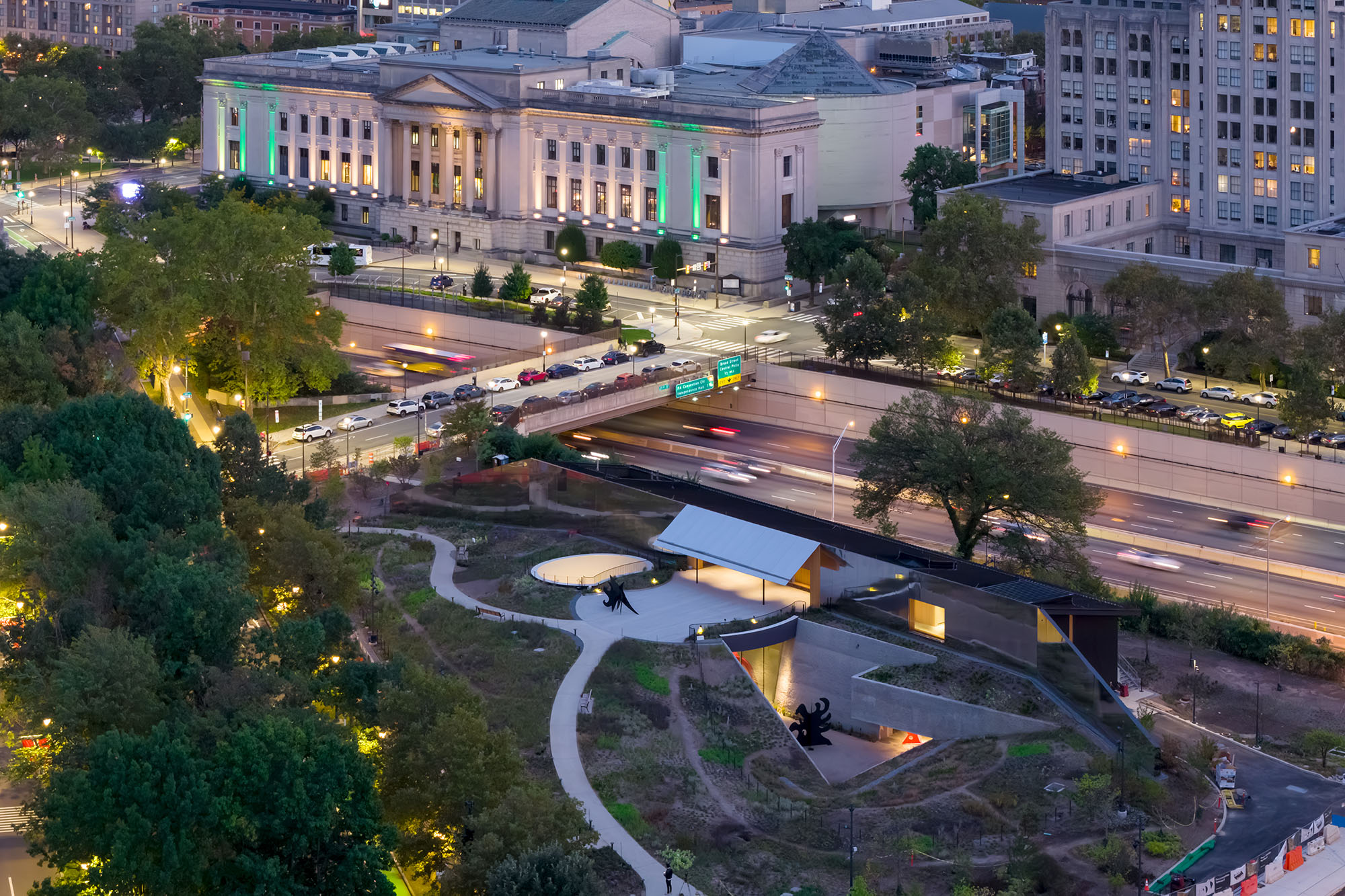
このパークウェイを横切るように、地下にはヴァイン・ストリート高速道路が走っており、20世紀半ばに多くのアメリカ都市で見られたように、既存の都市組織を分断した。〈カルダー・ガーデンズ〉は、この2つの主要動線が交わる要所に位置している。
© Iwan Baan
都市の空白地帯に創出する目的地
敷地は、〈ロダン美術館〉と〈バーンズ財団〉の向かい、パークウェイを挟んだ先にある平坦で先細りの土地である。南側の長い境界線に沿って高速道路の入り口が伸び、西側の22番街と東側の21番街は主に車両用幹線道路として利用されている。
この敷地は都市の中心部に位置しているにもかかわらず、あまり魅力のない残された空間となっており、高速道路の騒音が常に聞こえ、この場所を歩く人はほとんどいなかった。この都市の空白地帯に目的地をつくることは、このプロジェクトの中心的な課題であった。
© Iwan Baan
「建物」ではなく「庭園」が主役のプロジェクト
カルダーの芸術を特徴づけるのは、形・色彩・動きである。〈カルダー・ガーデンズ〉の設計にあたり、チームはこれらを模倣するのではなく、あえて直接的な引用を避けた。また、パークウェイ沿いに並ぶ他の美術館群のような記念碑的建築様式も採用していない。
こうした前提のもと、本プロジェクトでは「建物そのもの」ではなく、「建物を内包する庭園」を主役とし、訪問者が段階的に体験を深めていく連続的な空間構成を採用した。
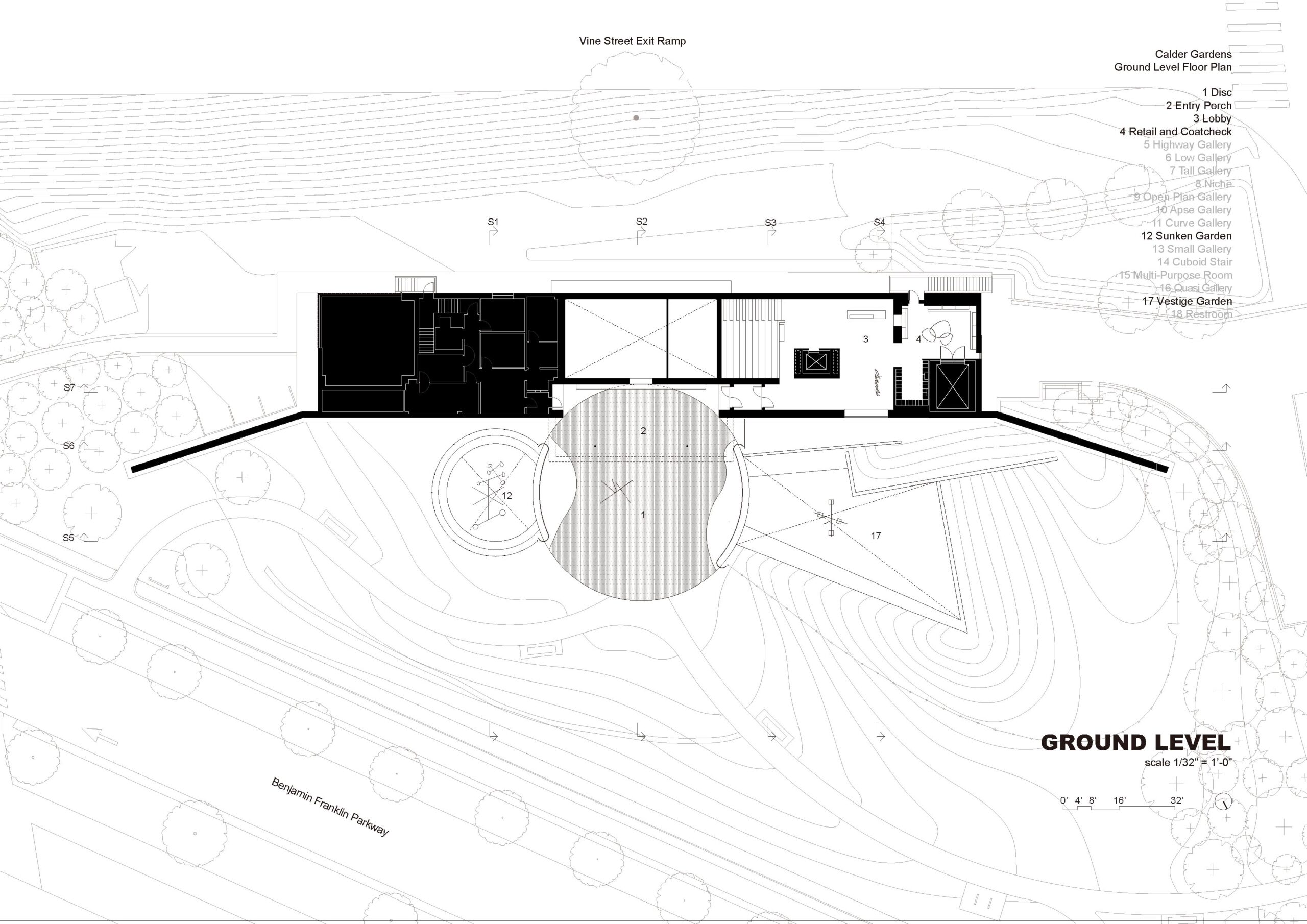
Ground Floor Plan
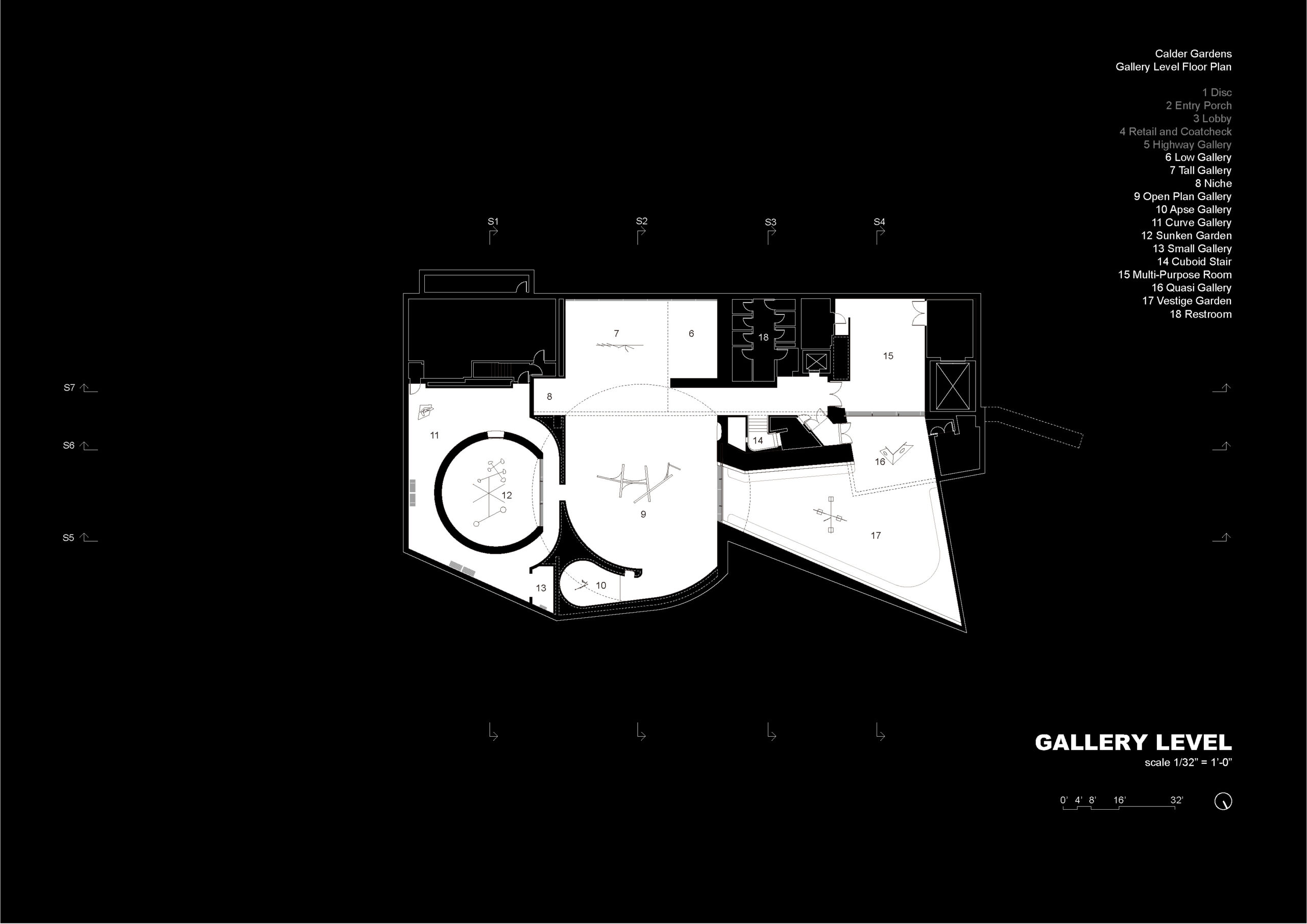
Gallery Floor Plan
壁と円盤 ― 都市と庭をつなぐ構成要素
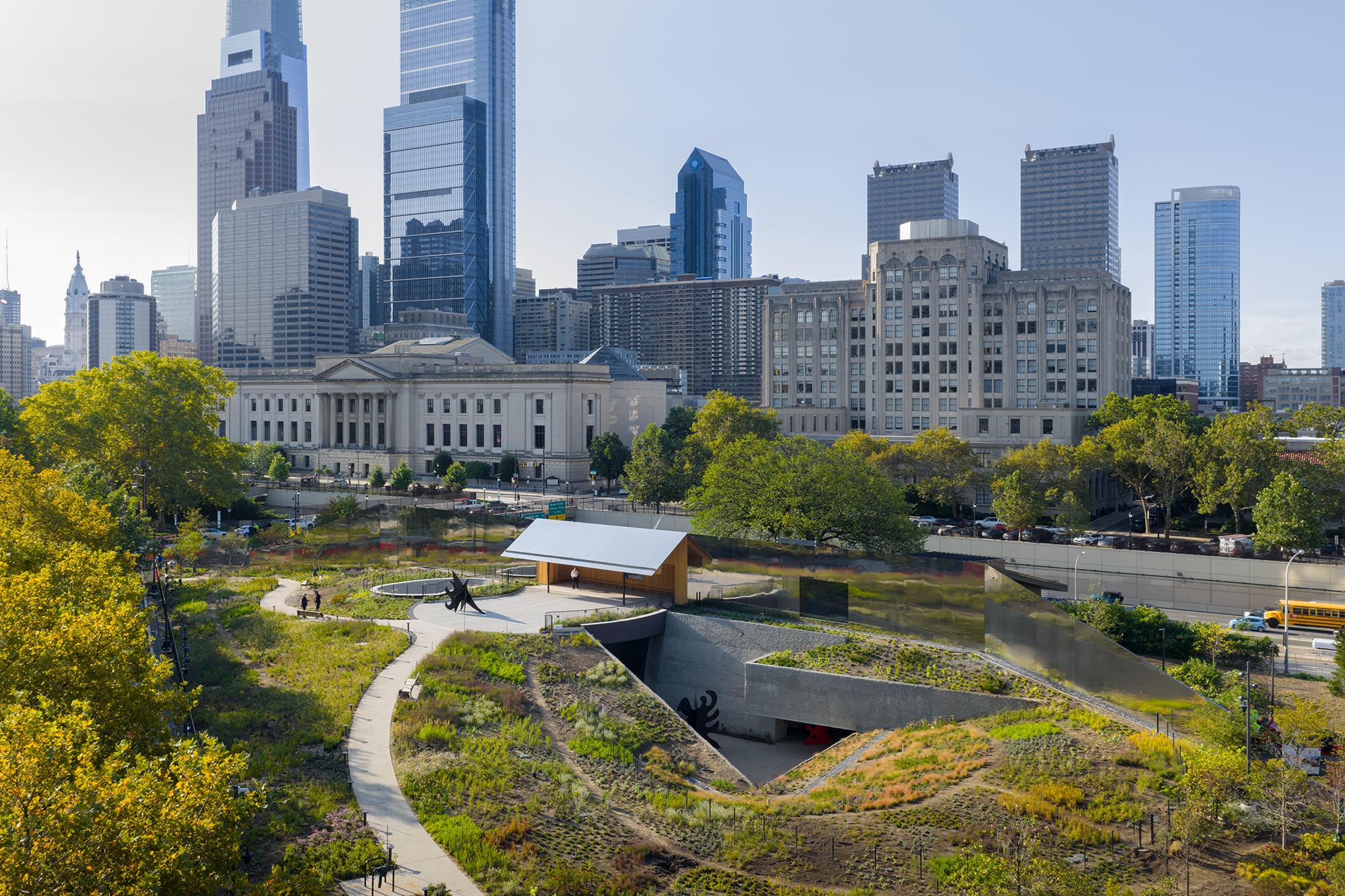
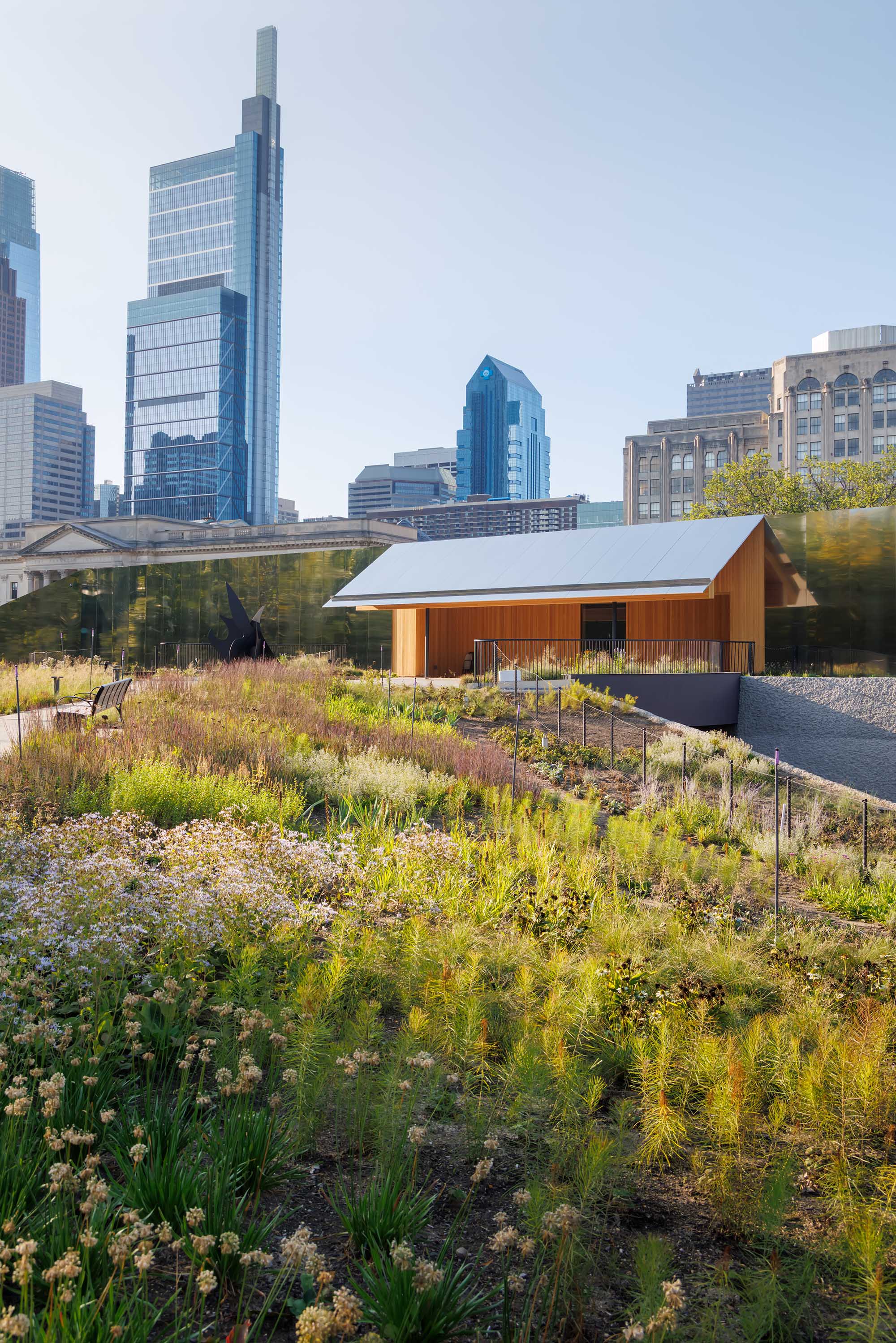
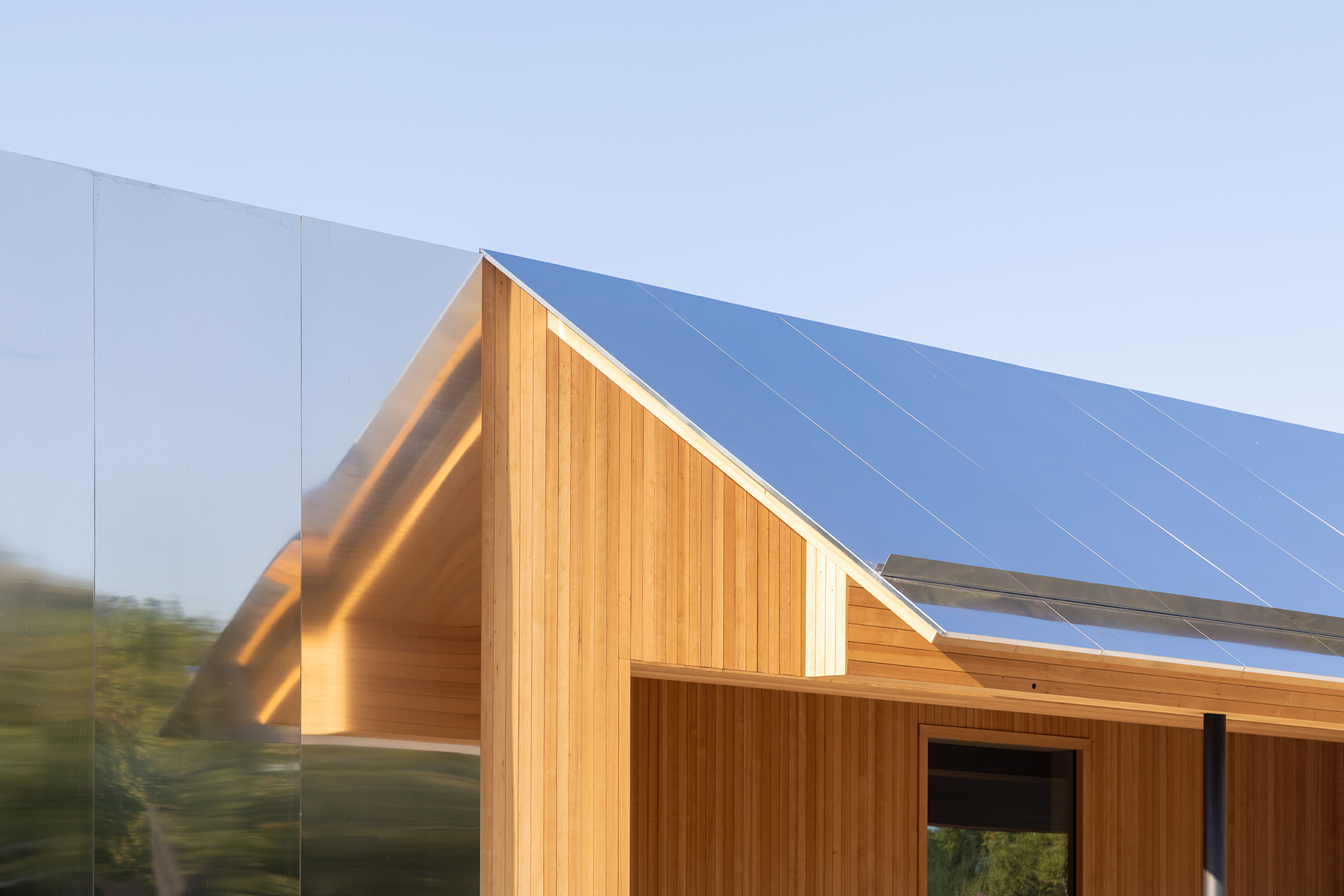
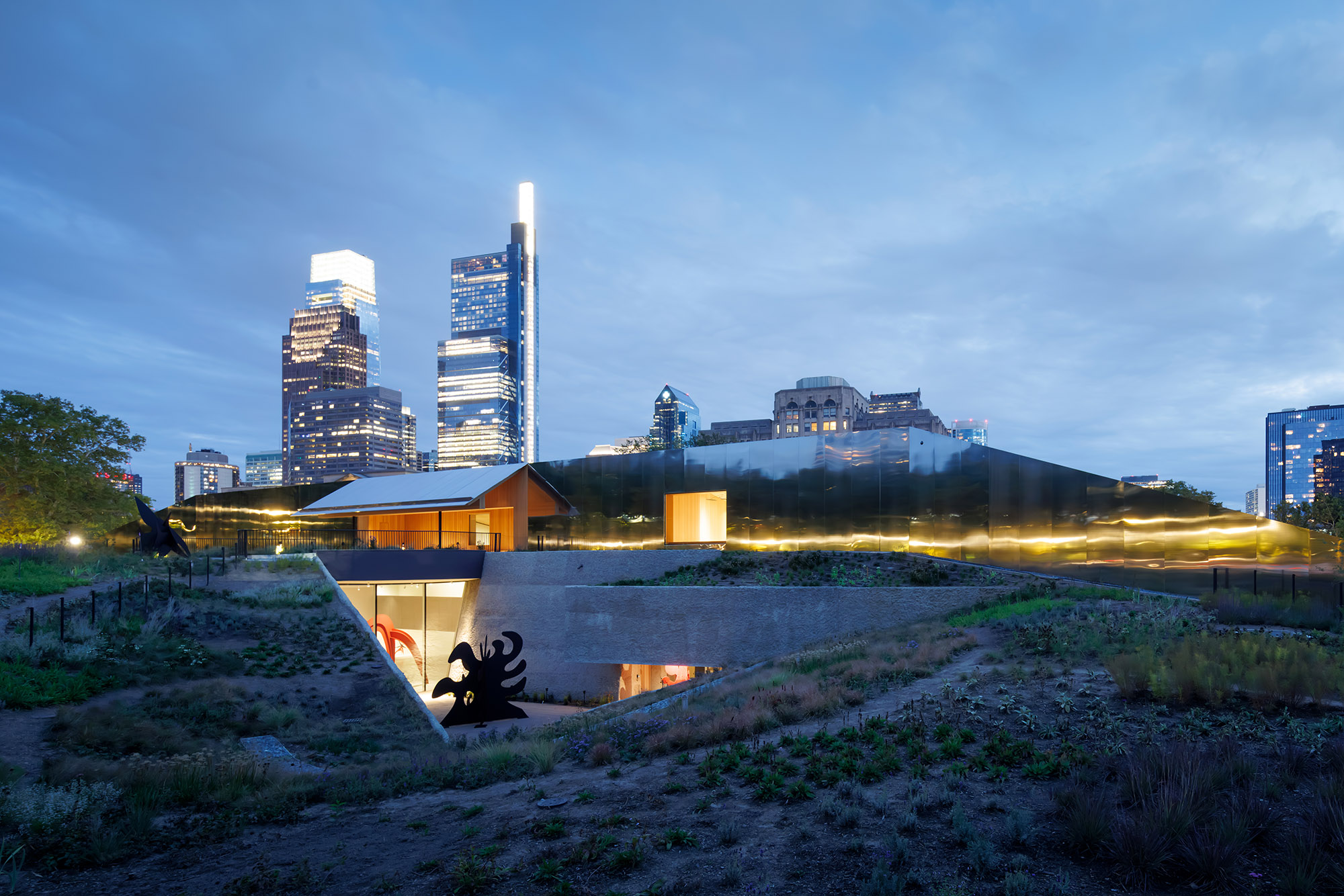
パークウェイから見ると、先細りの金属製の壁が草原のような公共庭園の背景を形成している。この壁は高速道路の騒音を和らげると同時に、庭園を都市側に開く役割をになっている。
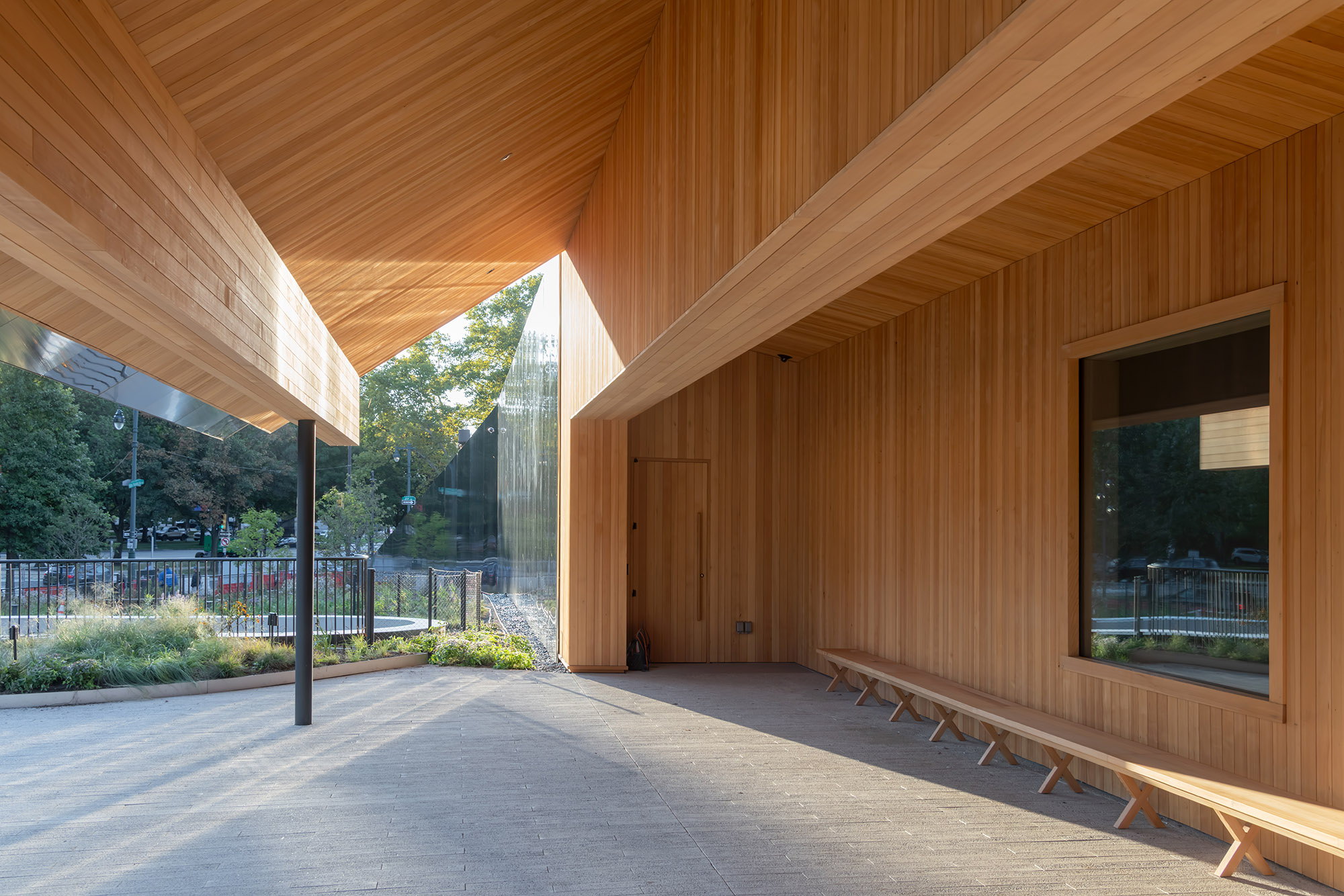
北東と北西の角から伸びる小道は、訪問者を庭園中央の1つの開口部へと導き、そこには折り畳まれた金属製キャノピーが木質のエントランス空間を覆っている。
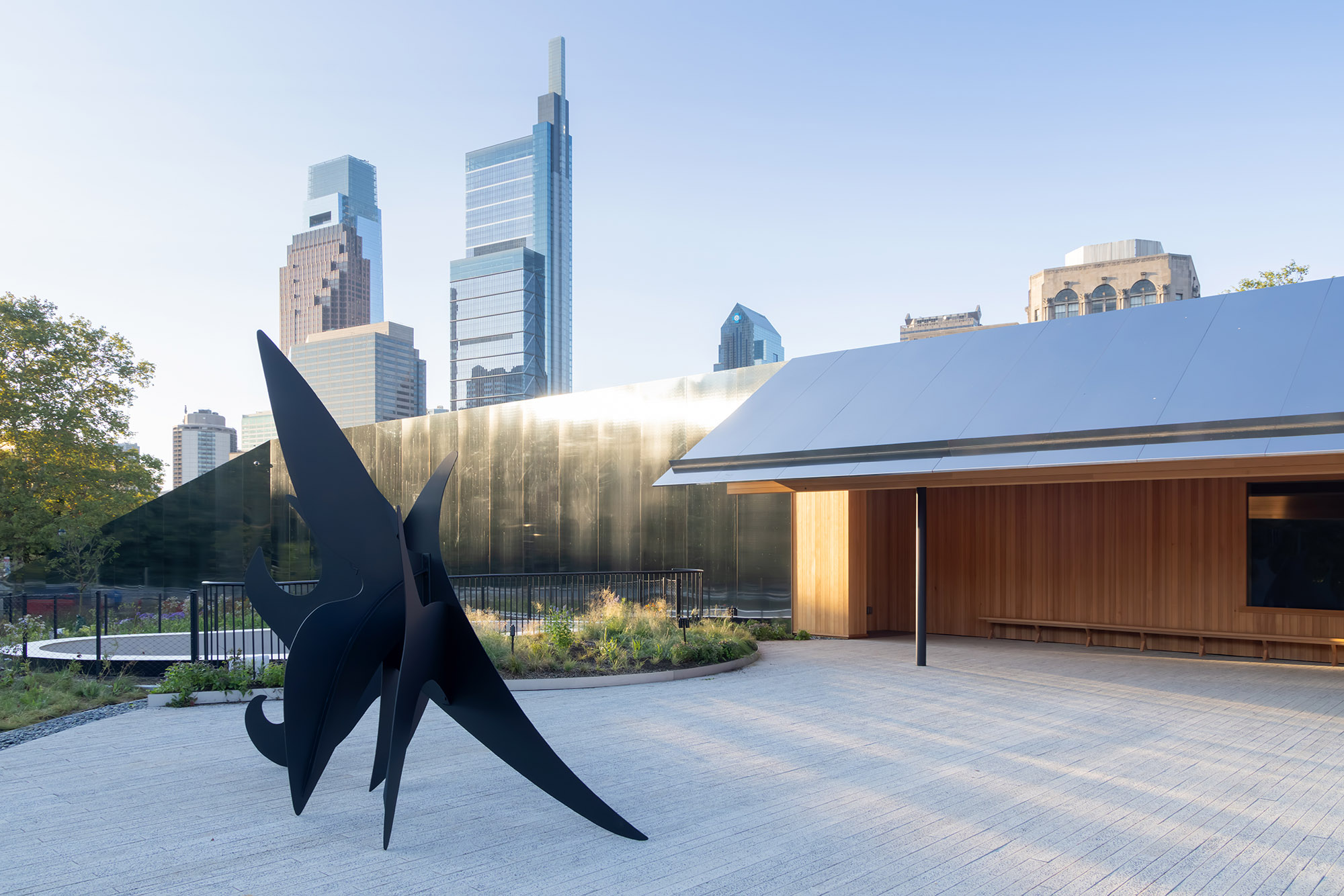
Photo © Iwan Baan. Artwork by Alexander Calder © 2025 Calder Foundation, New York
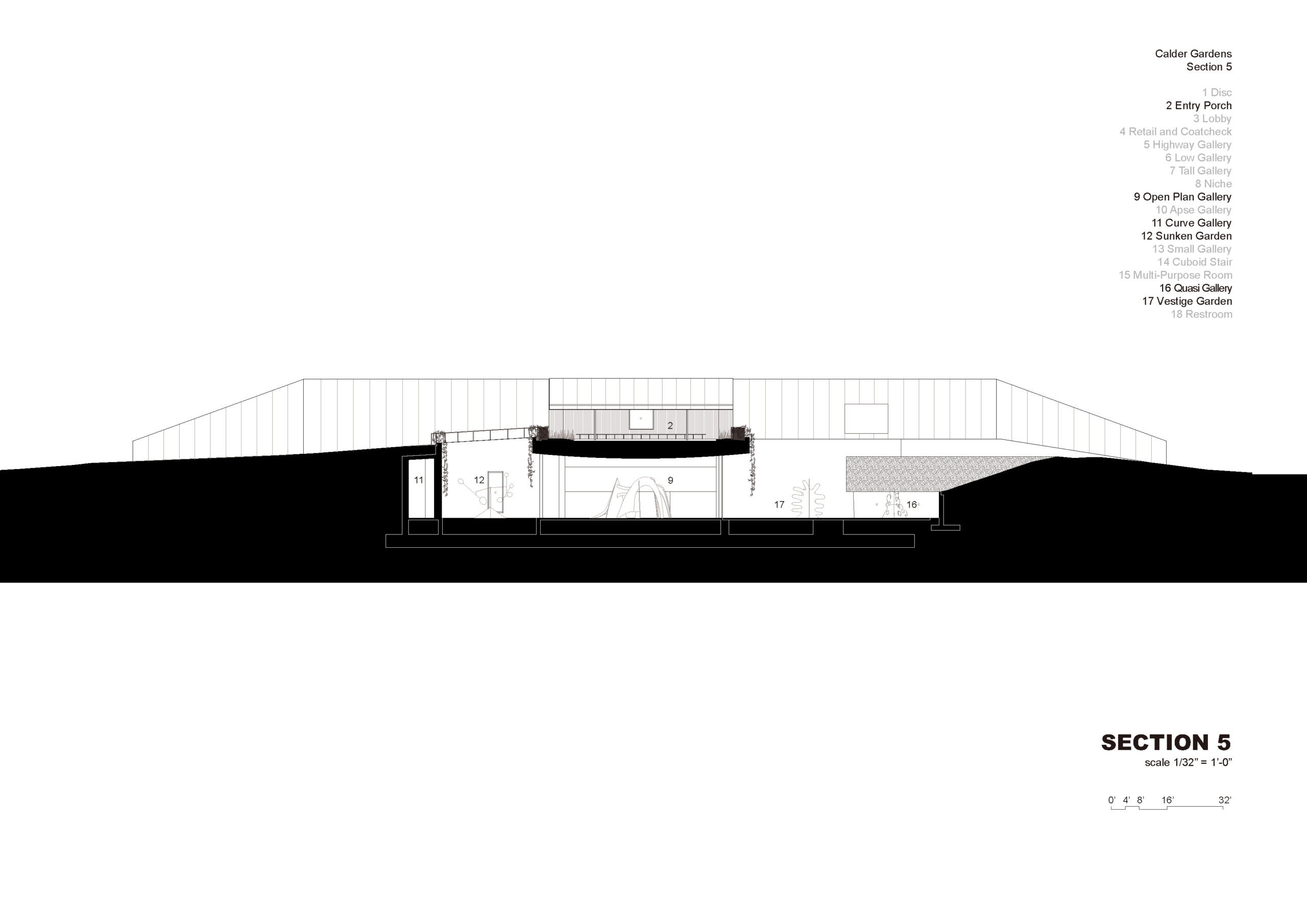
訪問者がエントランスに近づくと、建築の構造体が姿を現す。中央の大型円盤が広場を形成し、下層のギャラリーの屋根を兼ねている。
東側には幾何学的で純粋な「沈床式庭園(サンクンガーデン)」、西側には不規則な形状の「痕跡庭園(ヴェスティジ・ガーデン)」が地面に刻まれている。これらの庭園はカルダーの彫刻を展示する屋外空間であり、同時にギャラリーに自然光を導く装置でもある。円盤と壁の交点がエントランスを定義し、1つの窓が下階ギャラリーの様子を垣間見せる。
© Iwan Baan
金属壁の裏側は黒く焼かれた木材で覆われ、高速道路側から見ると納屋のように見える控えめな建物となっている。
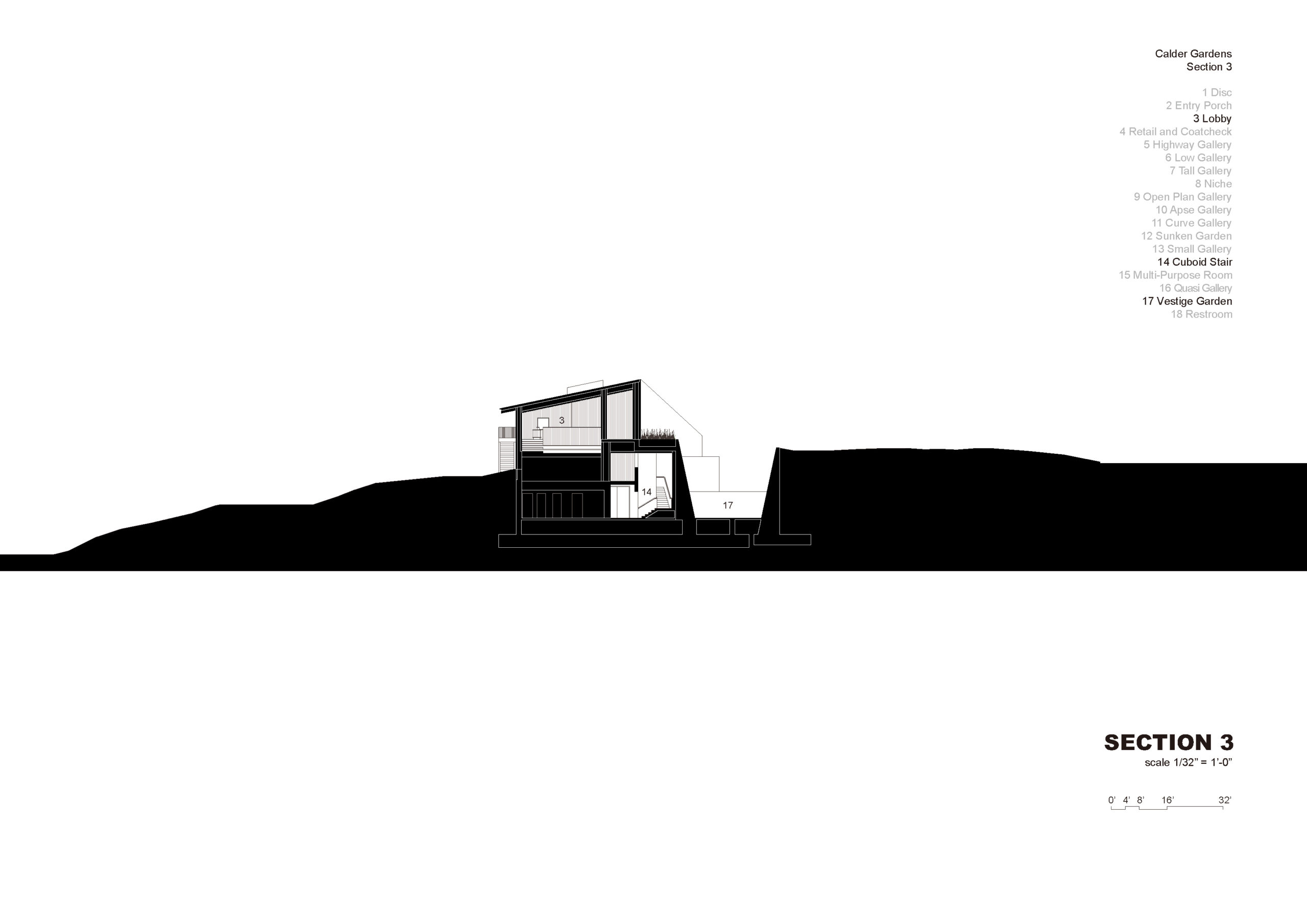
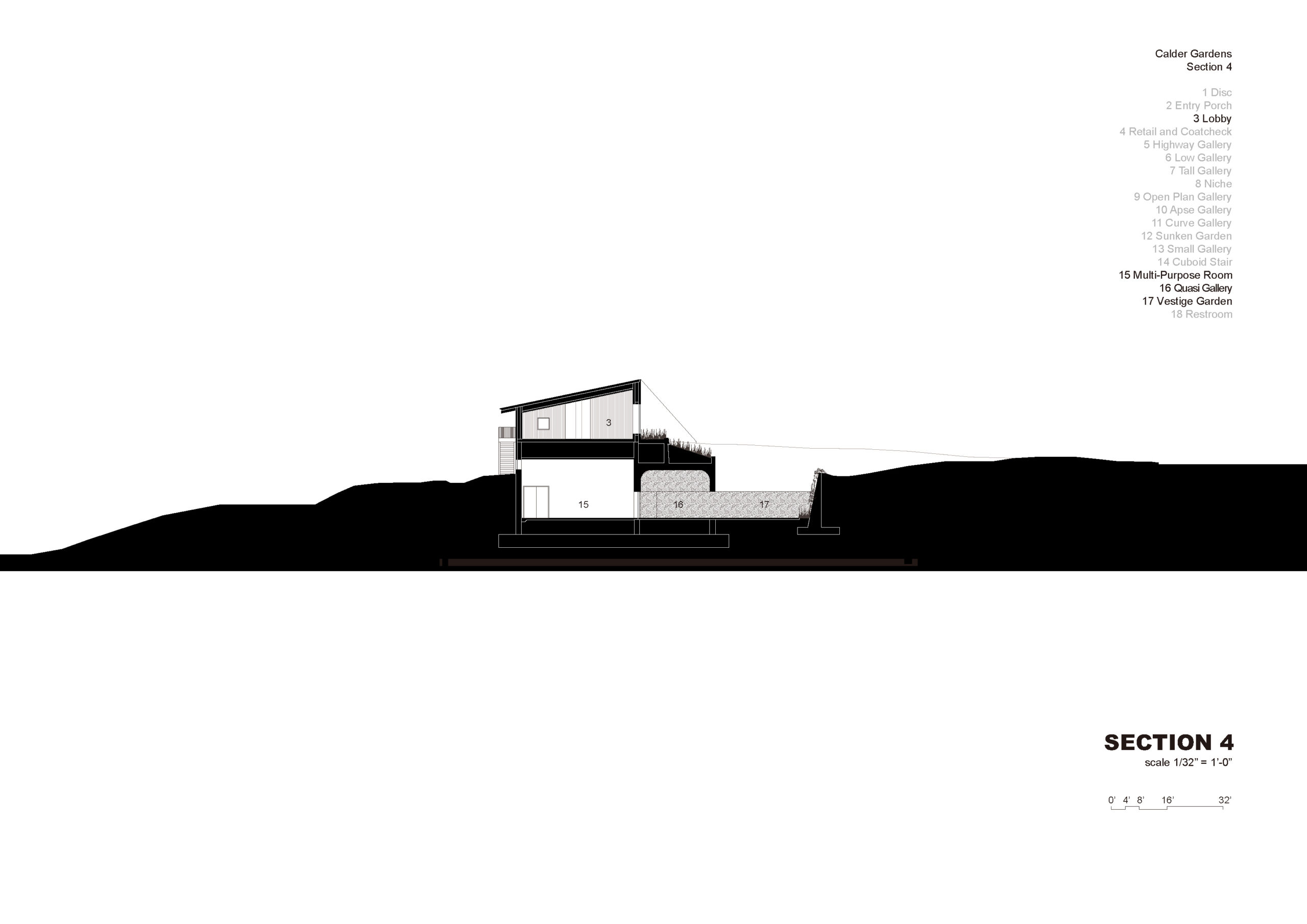
この低層部にはスタッフエリアや荷捌き場、小さな木質ロビーが設けられている。大空間のエントランスホールとは異なり、家庭的なスケールで訪問者を迎える空間である。
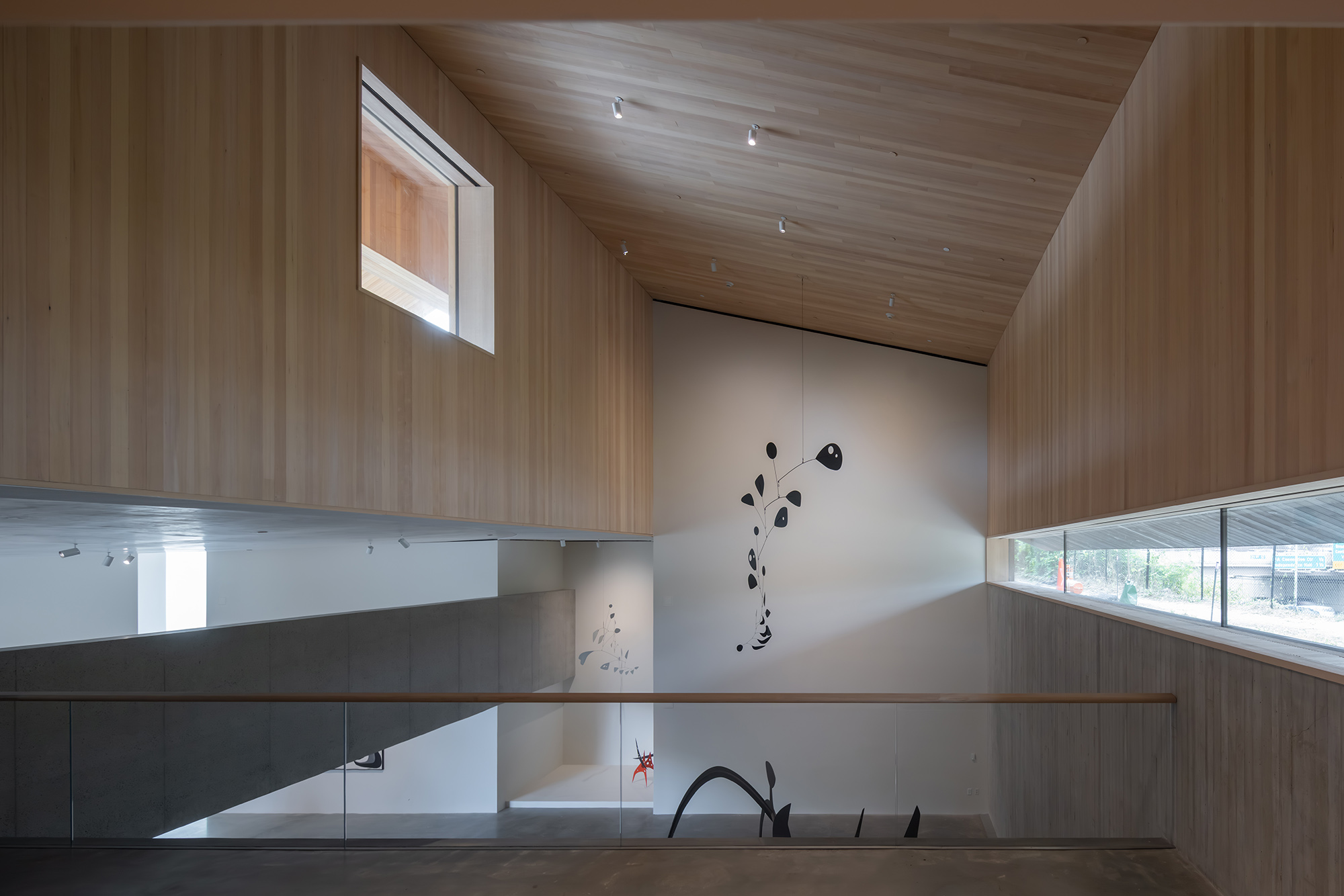
Photo © Iwan Baan. Artwork by Alexander Calder © 2025 Calder Foundation, New York
ステップ・バイ・ステップ ― 地下へと展開する空間体験
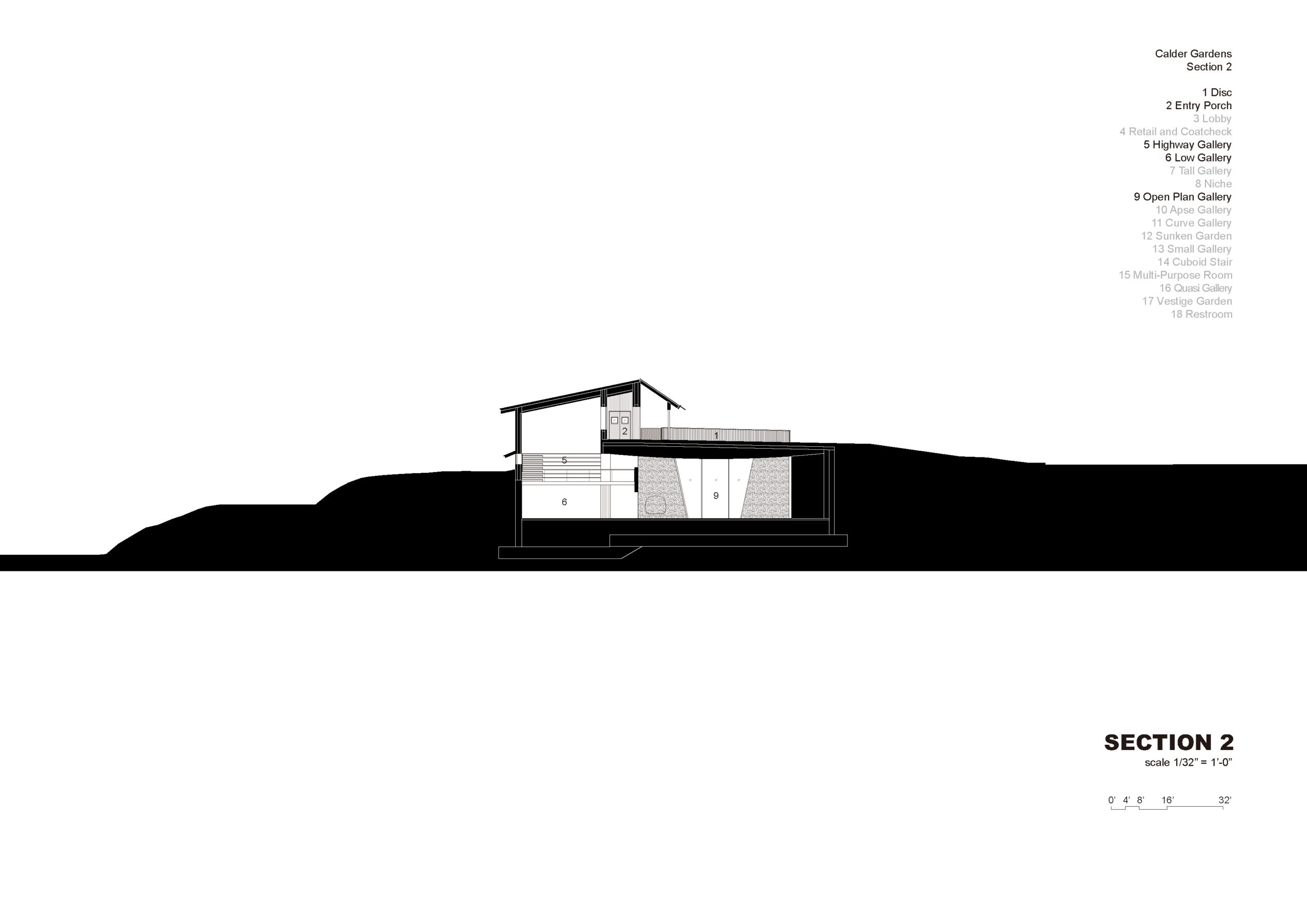
ロビーから訪問者は小規模な講堂としても機能する大階段を下る。長く低い直線窓が高速道路とその先のまち並みを額縁のように切り取り、下方には「ハイウェイ・ギャラリー」が見える。
ハイウェイ・ギャラリーは空間内の中2階にあたり、高所からカルダーのモビールを体験する機会を提供する。上部の壁に対応する梁がハイウェイ・ギャラリーと円盤下部の空間を分断し、梁上部の細いスリットからは、下階のギャラリーを垣間見ることができる。
ハイウェイ・ギャラリーから、通路と階段は暗く粗いコンクリート表面で覆われている。この「キューボイド階段」は人々を地上と、外庭を形成する遺跡のような空間へとつなぐ。あらゆる残された空間と同様に、この階段もまたカルダーの作品を展示する独特の機会を提供する。
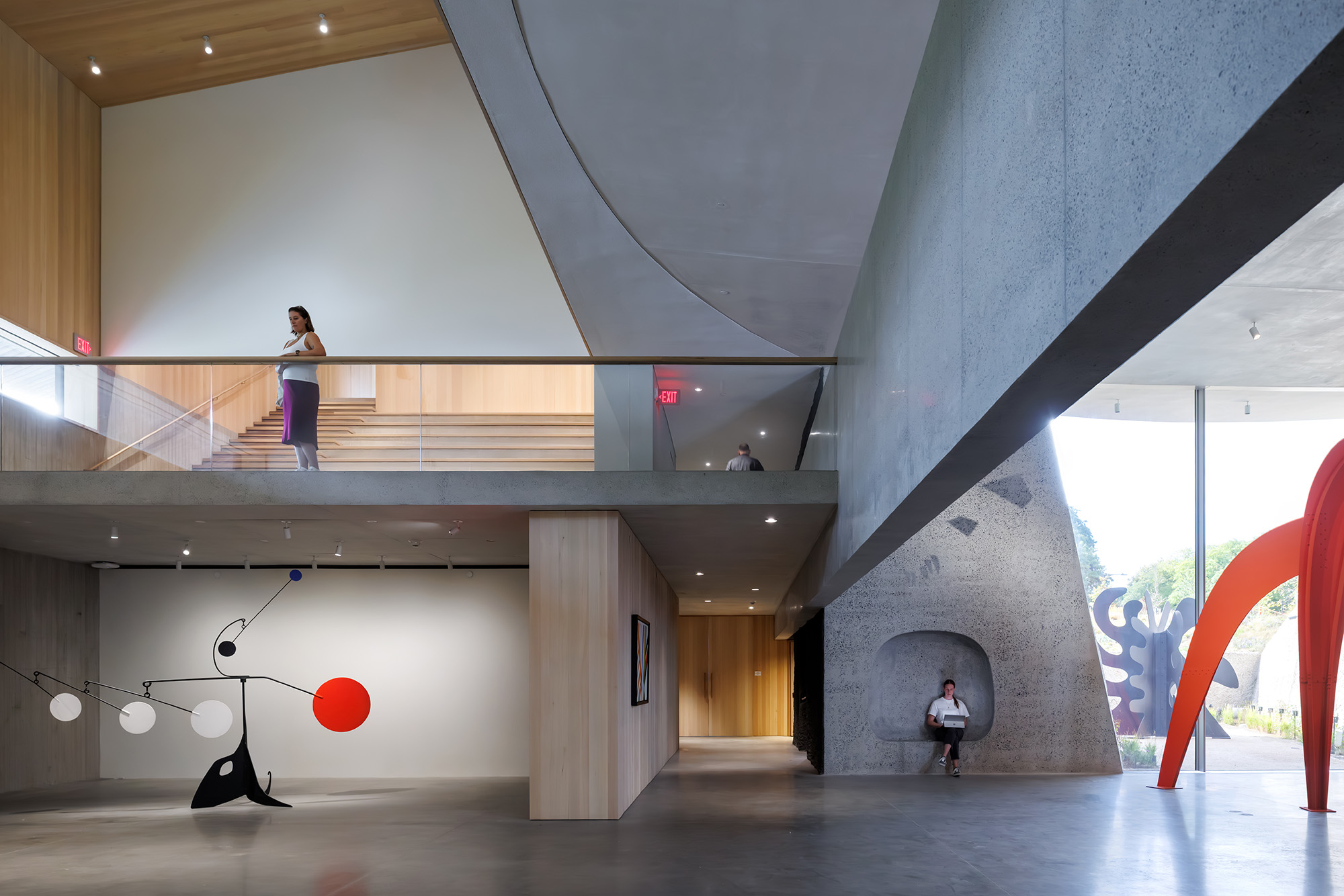
Photo © Iwan Baan. Artwork by Alexander Calder © 2025 Calder Foundation, New York
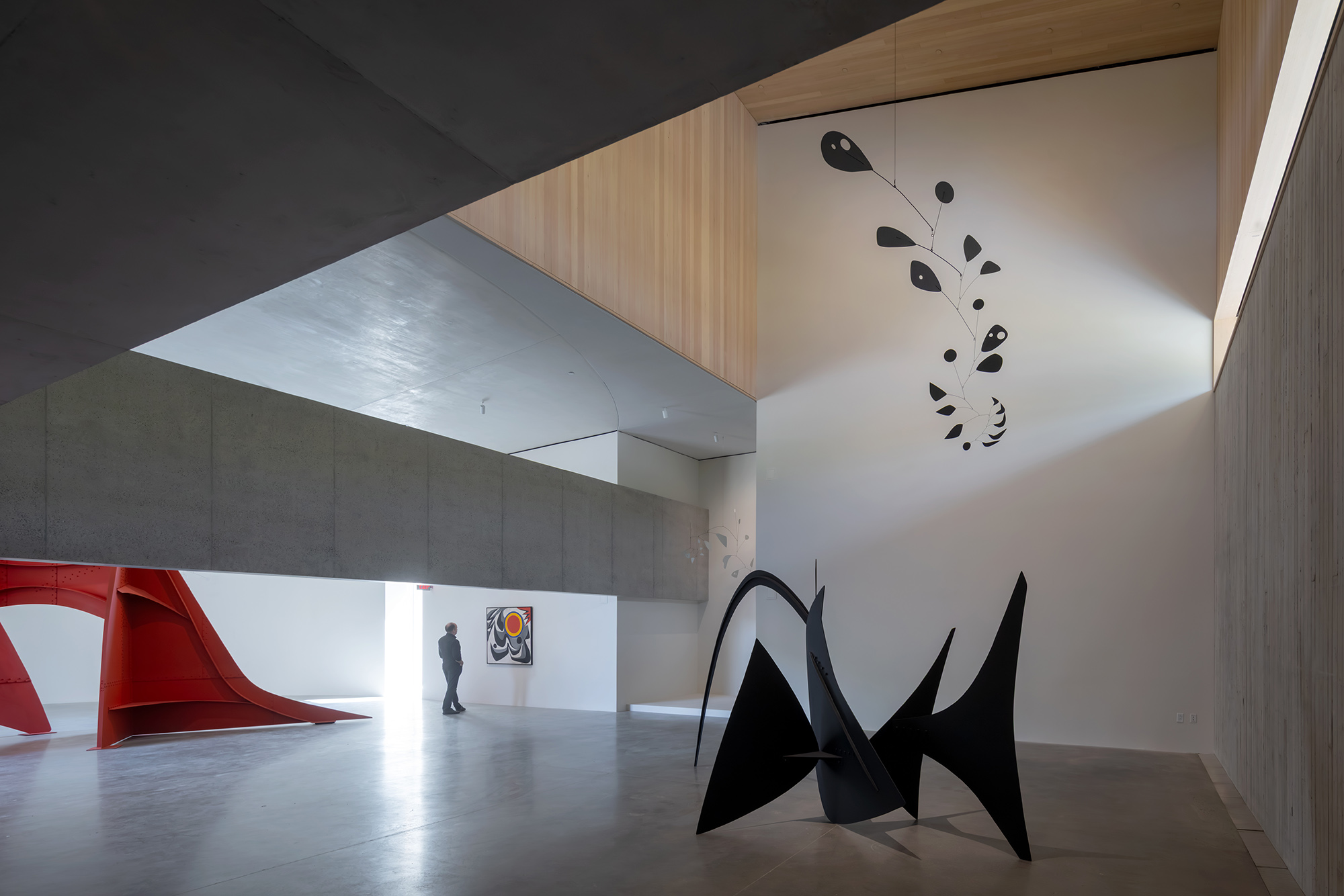
Photo © Iwan Baan. Artwork by Alexander Calder © 2025 Calder Foundation, New York
階段を下りきるとメインギャラリーフロアに到達する。高天井のギャラリーを抜けると、円盤下から光が降り注ぐ「オープンプラン・ギャラリー」に入る。この空間は東西方向に直交しながら北に向かって緩やかに曲線を描く構成で、上部の円盤形状を反映している。西側のヴェスティジ・ガーデンに面する大窓が自然光を導き、内部と外部をゆるやかにつなぐ。
2枚の曲面壁によって形成された「アプス・ギャラリー」には、視線を妨げる角がなく、作品に集中できる環境が整えられている。これら2つのギャラリーは一体的に構成され、カルダーの作品群を多様な視点から鑑賞することを可能にしている。
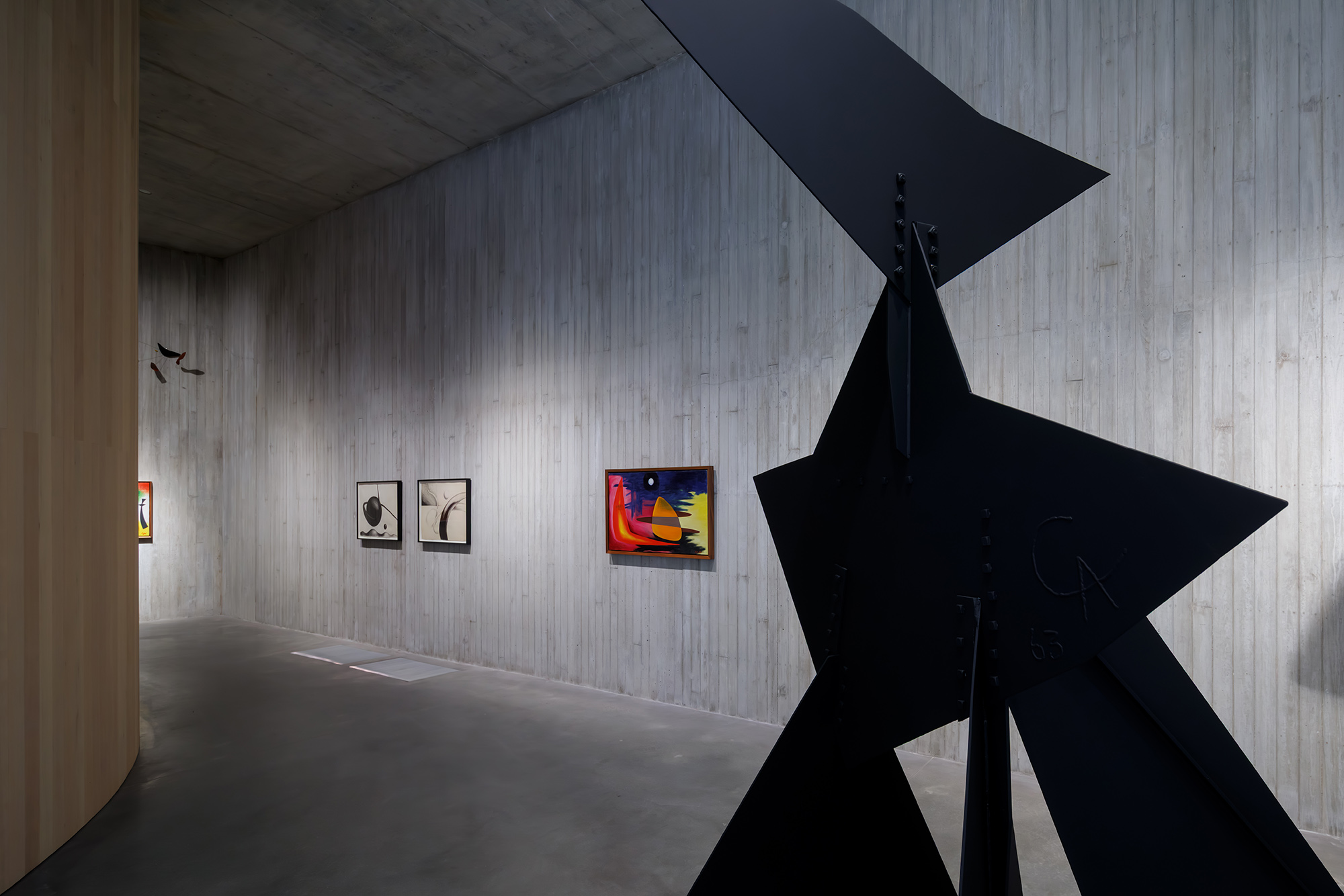
Photo © Iwan Baan. Artwork by Alexander Calder © 2025 Calder Foundation, New York
オープンプラン・ギャラリーの細長いスリット越しには、「サンクンガーデン」と「カーブドギャラリー」の入口が覗く。外光に満ちた前者に対し、カーブドギャラリーは内向的で、光を制御可能な打放しコンクリート壁に囲まれた空間である。
この空間にはカルダーの紙作品や光に敏感な彫刻、または彼の先祖の絵画などが展示されている。その中心には密植された曲線壁を背景に、カルダーの作品「stabile」が置かれ、作品に新たな文脈を与えている。
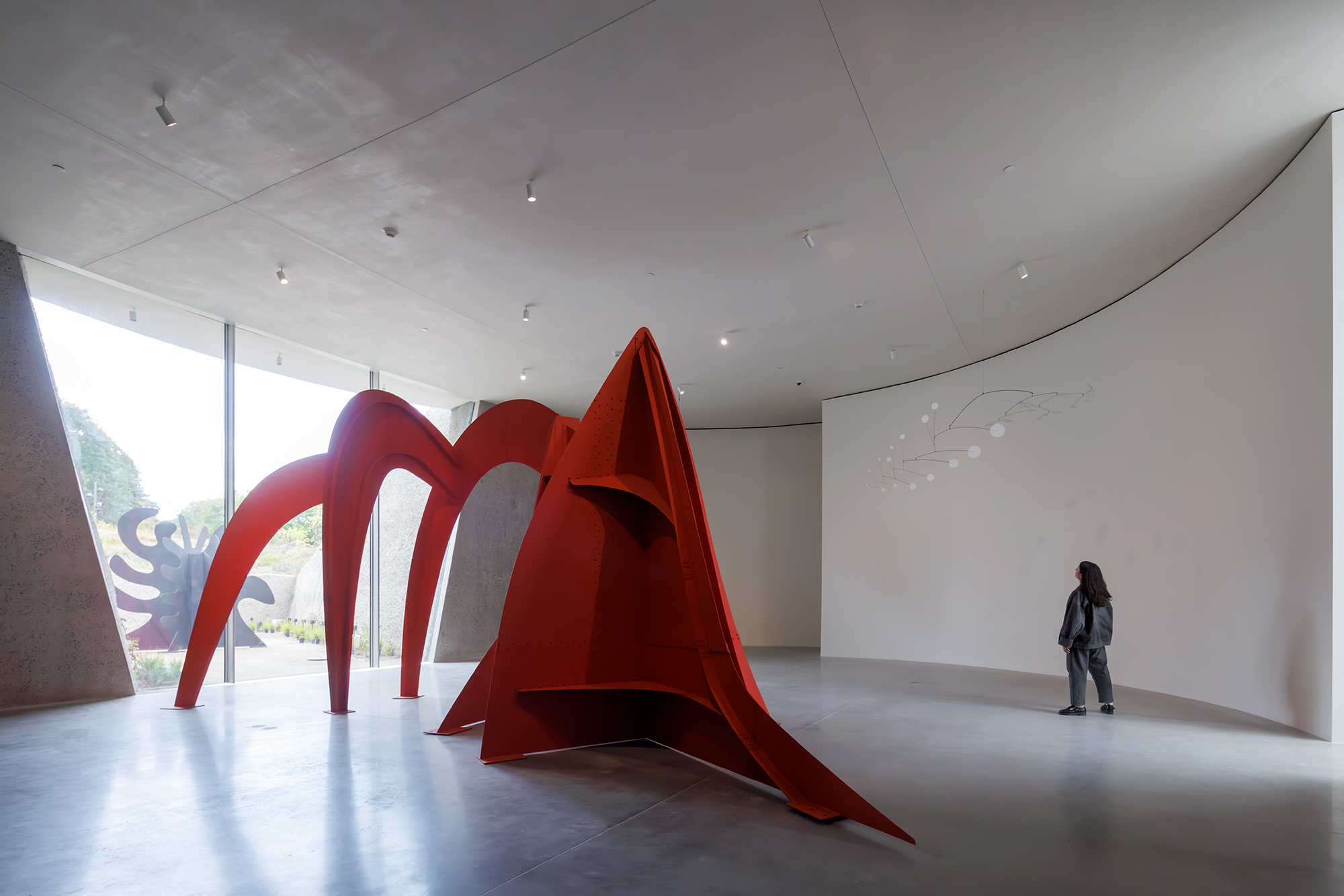
Photo © Iwan Baan. Artwork by Alexander Calder © 2025 Calder Foundation, New York
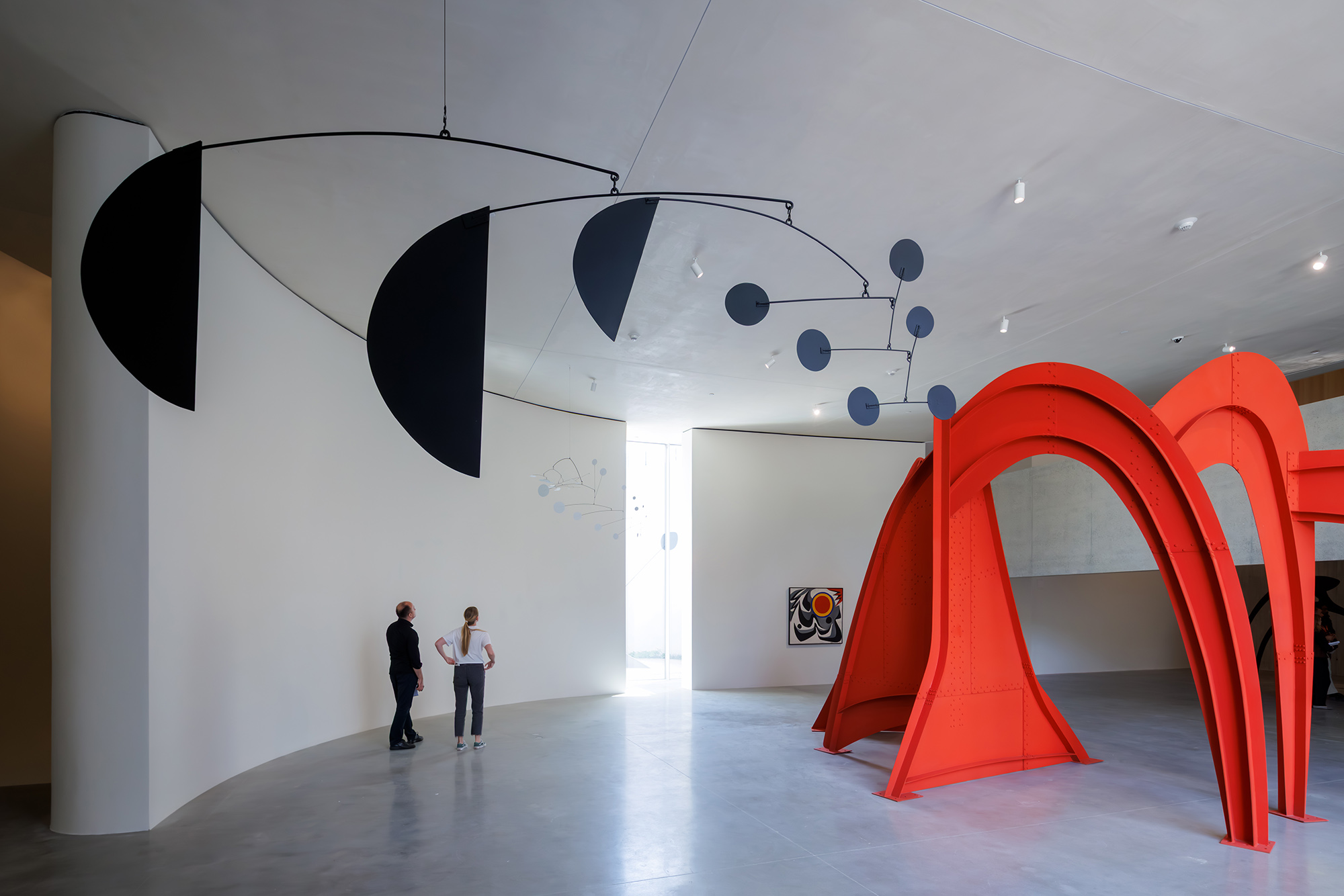
Photo © Iwan Baan. Artwork by Alexander Calder © 2025 Calder Foundation, New York
ヴェスティジ・ガーデン ― 都市の記憶を継承する庭
既存敷地がもつ歴史的条件は、内部平面の幾何学と庭園構成の両方に表れている。隣接する水道本管のオフセットが地下平面の屈曲した境界線を形成している。公園道路以前の都市グリッドに由来する歴史的基礎の痕跡が、ヴェスティジ・ガーデンの幾何学を形成している。
「クアジ・ギャラリー」は洞窟のような覆われた屋外空間を提供し、内部の高度に制御された展示空間と外部に開放された庭園空間との間を媒介する。
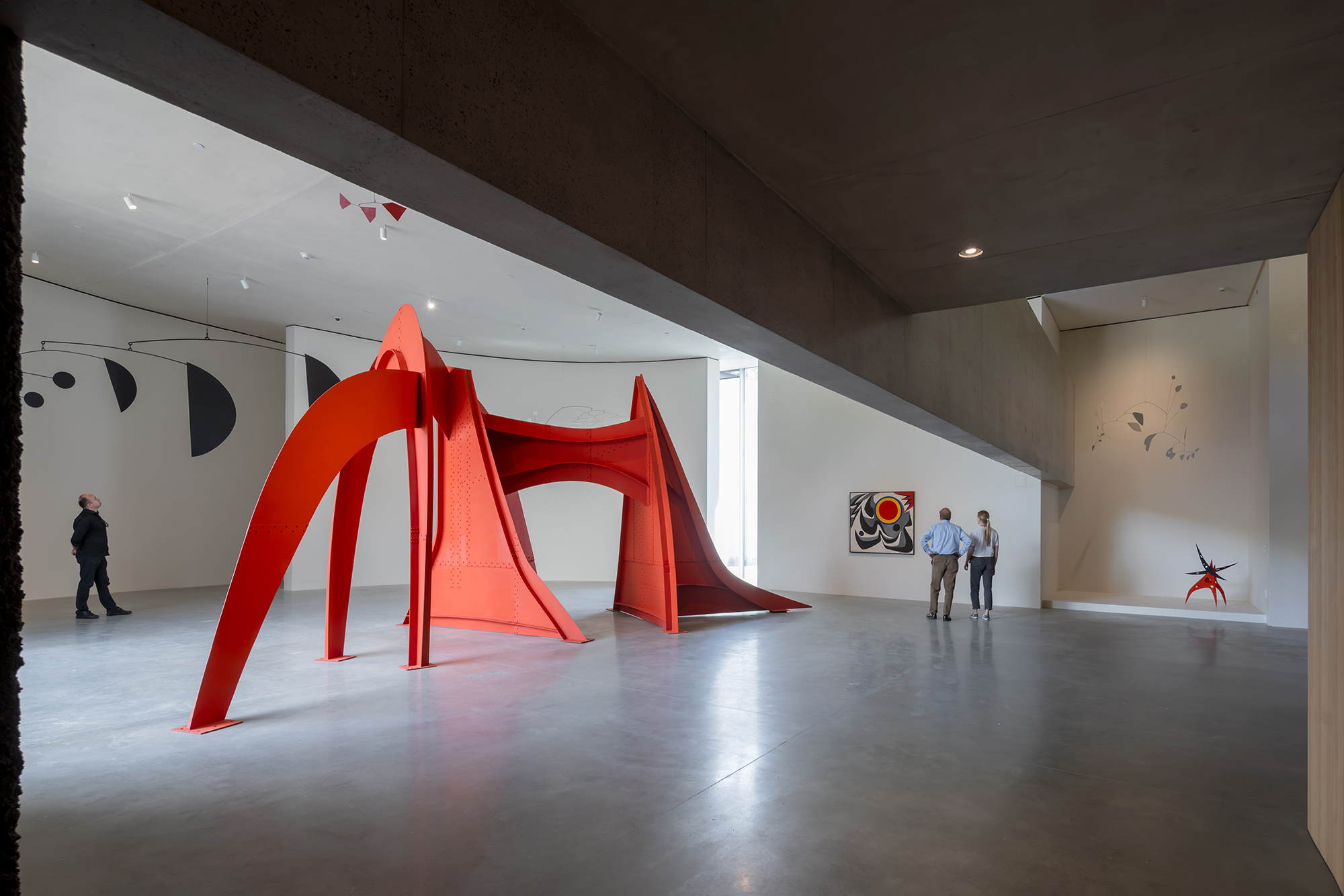
Photo © Iwan Baan. Artwork by Alexander Calder © 2025 Calder Foundation, New York
これらのさまざまな空間が一体となり、キュレーターがカルダーの多面的な作品を常に新しく予想外の方法で展示することを促す。それは瞑想と集中の場を提供し、古典的なギャラリー体験ではなく空間的な連続性を提示する。〈カルダー・ガーデンズ〉は扉をくぐることで展開する世界である。
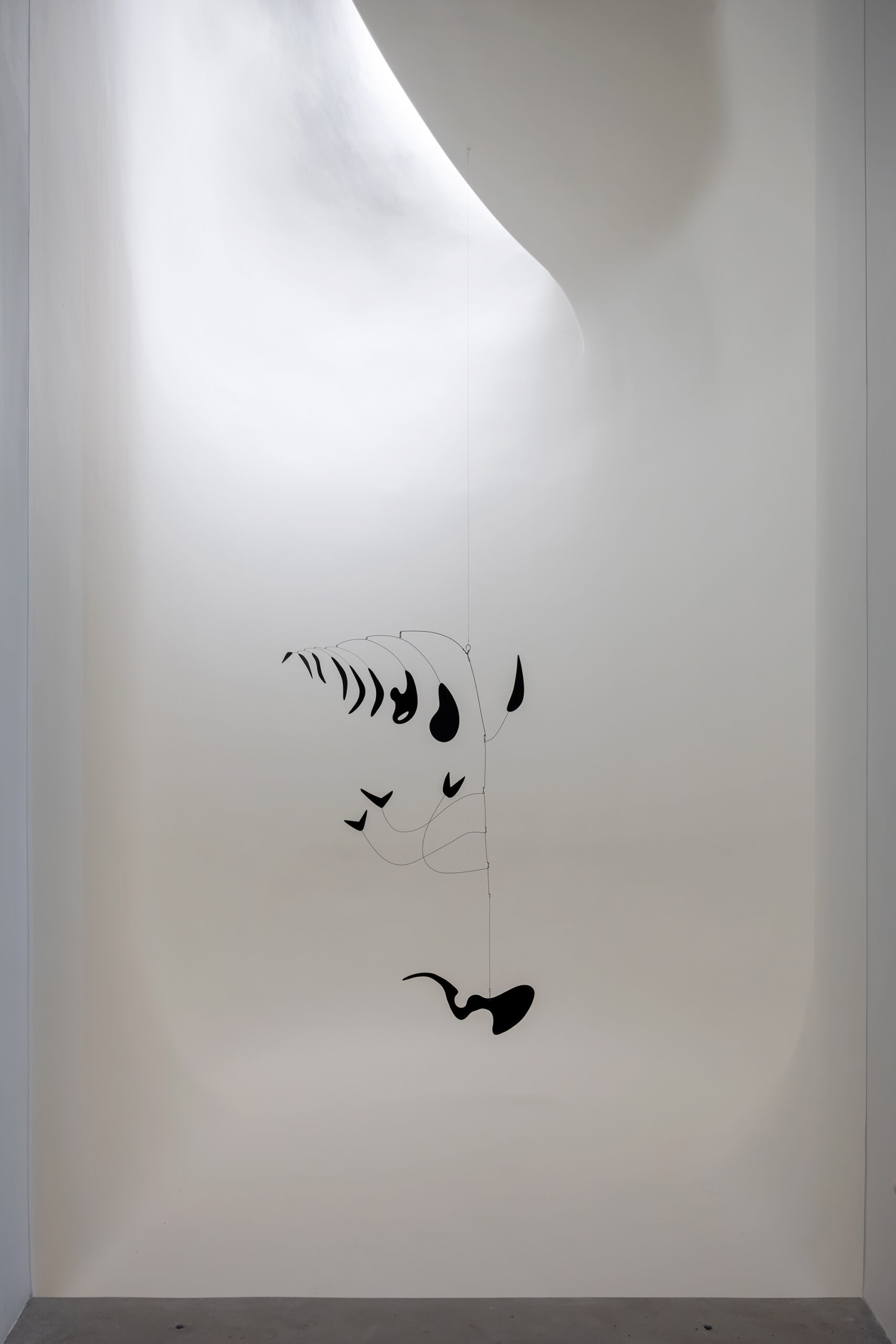
Photo © Iwan Baan. Artwork by Alexander Calder © 2025 Calder Foundation, New York
ヘルツォーク&ド・ムーロンの創設者の1人、ジャック・ヘルツォーク(Jacques Herzog)は次のように語る。
「フィラデルフィアにおける、敷地からオープンな設計要件、そして私たちのデザインプロセスに至るこのユニークな委託事業において、私は形態よりも空間に焦点を当て、地下空間を探求し構造を定義する空間を発見するに至った。」
「〈カルダー・ガーデンズ〉は一種の『No design』建築を体現し、数多くの異なる空間的文脈において芸術作品が多様性と曖昧性を表現することを可能にしている。自然であれ芸術であれ、木陰に座るような気軽さで、座り、歩き回り、観察できる場所なのである。」
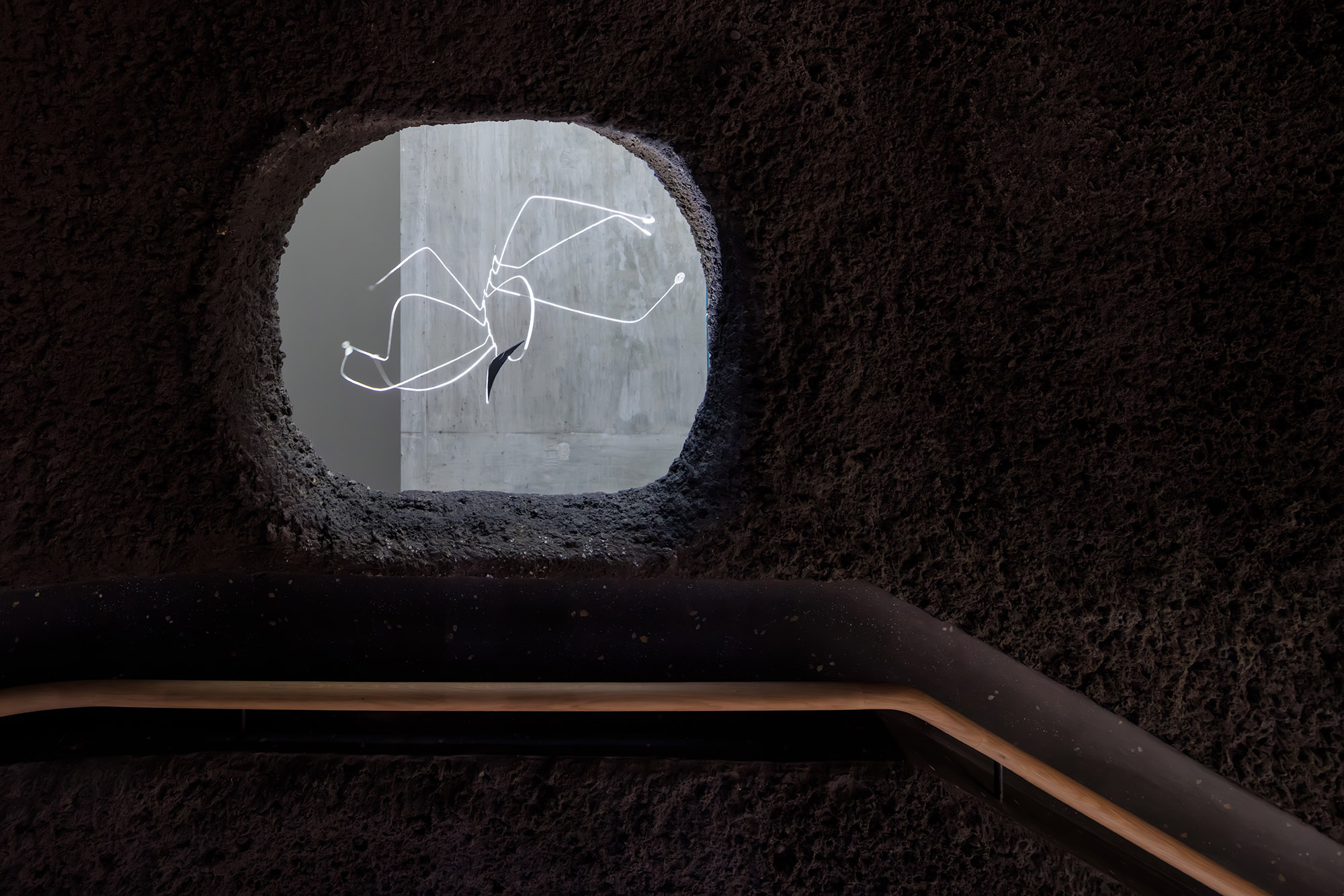
Photo © Iwan Baan. Artwork by Alexander Calder © 2025 Calder Foundation, New York
ヘルツォーク&ド・ムーロンのシニアパートナーであるジェイソン・フランツェン(Jason Frantzen)は次のように語る。
「〈カルダー・ガーデンズ〉は非凡なコラボレーションの結晶である。カルダー財団、バーンズ財団、そして設計・施工チームの多くのパートナーと共に、周囲の文脈とカルダーの芸術的遺産の両方に応えつつ、独自のアイデンティティをもつデザインを確立した。これは現実の庭園であると同時に概念的な庭園でもあり、フィラデルフィア市民と訪問者双方がカルダーの作品を繰り返し発見できる場を提供している。」
© Iwan Baan
© Iwan Baan
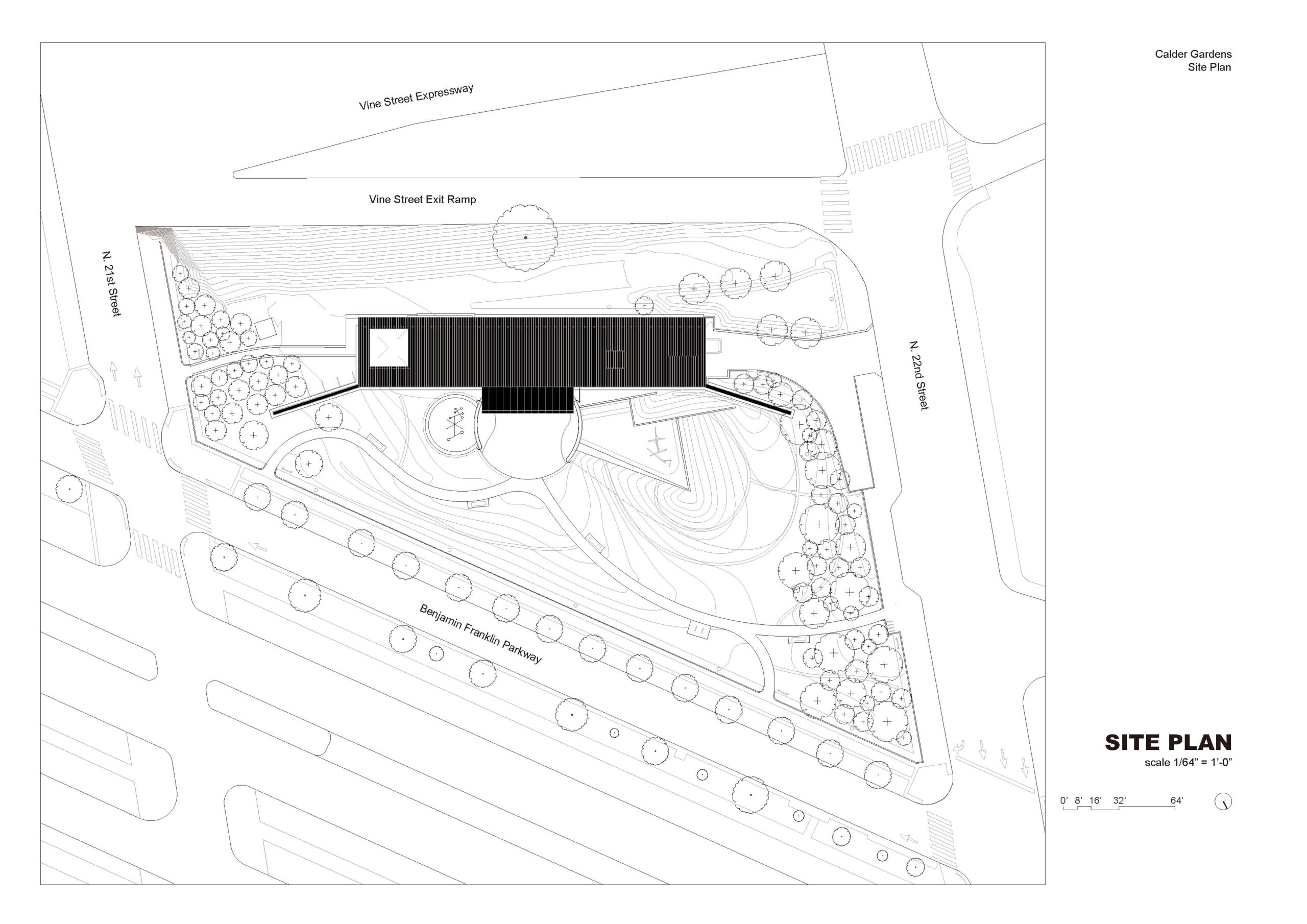
Site Plan
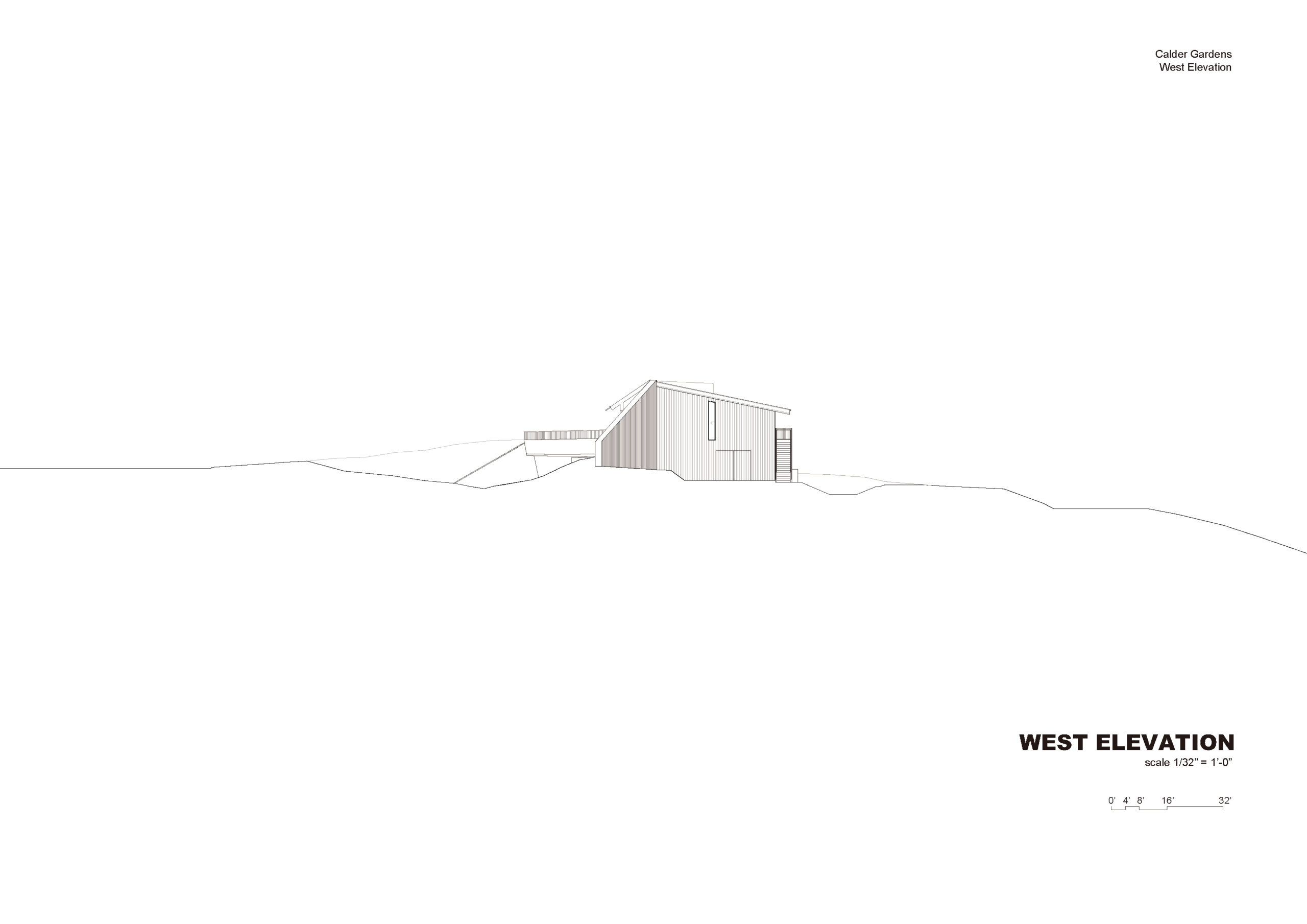
West Elevation
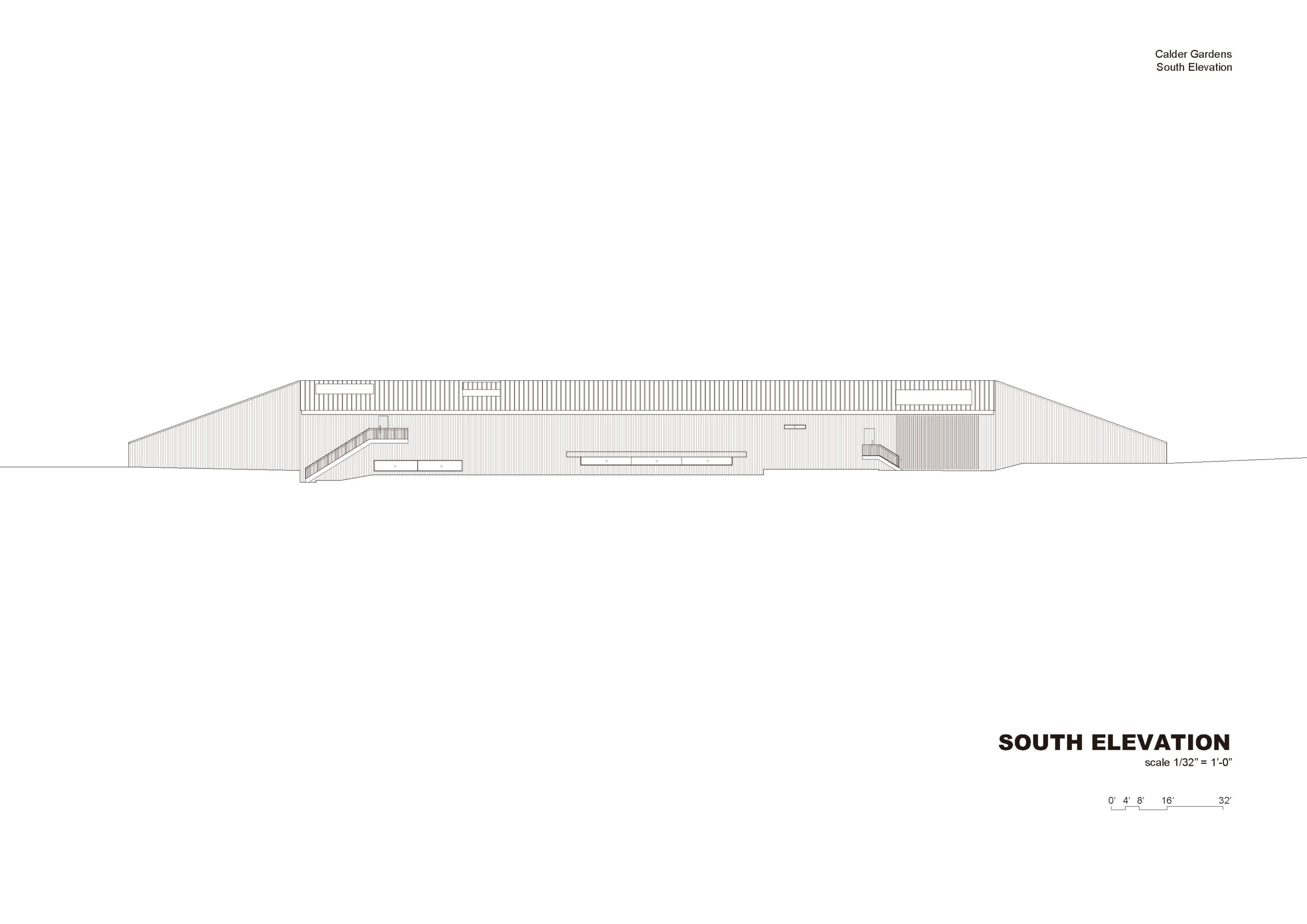
South Elevation
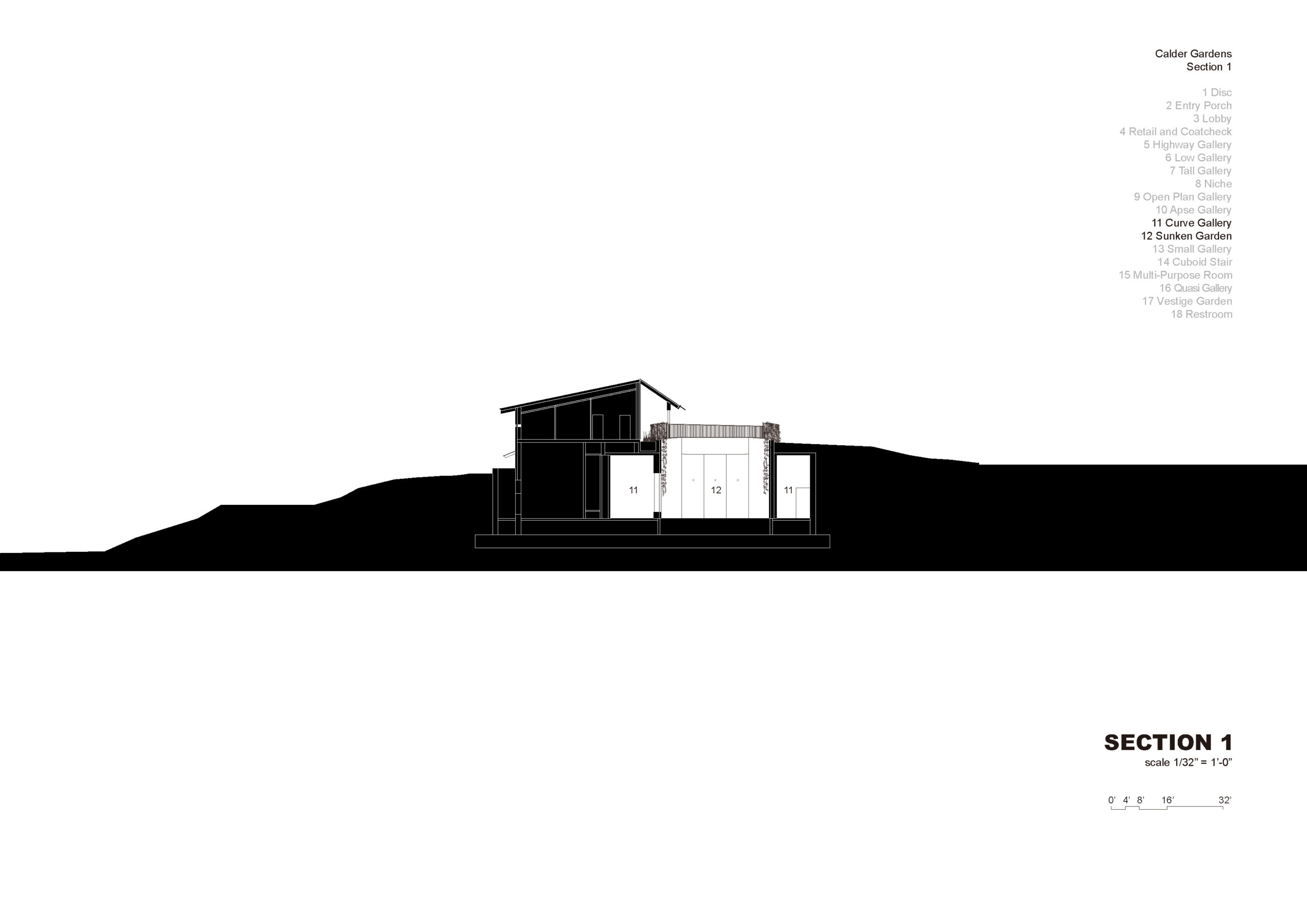
Section-1
Section-2
Section-3
Section-4
Section-5
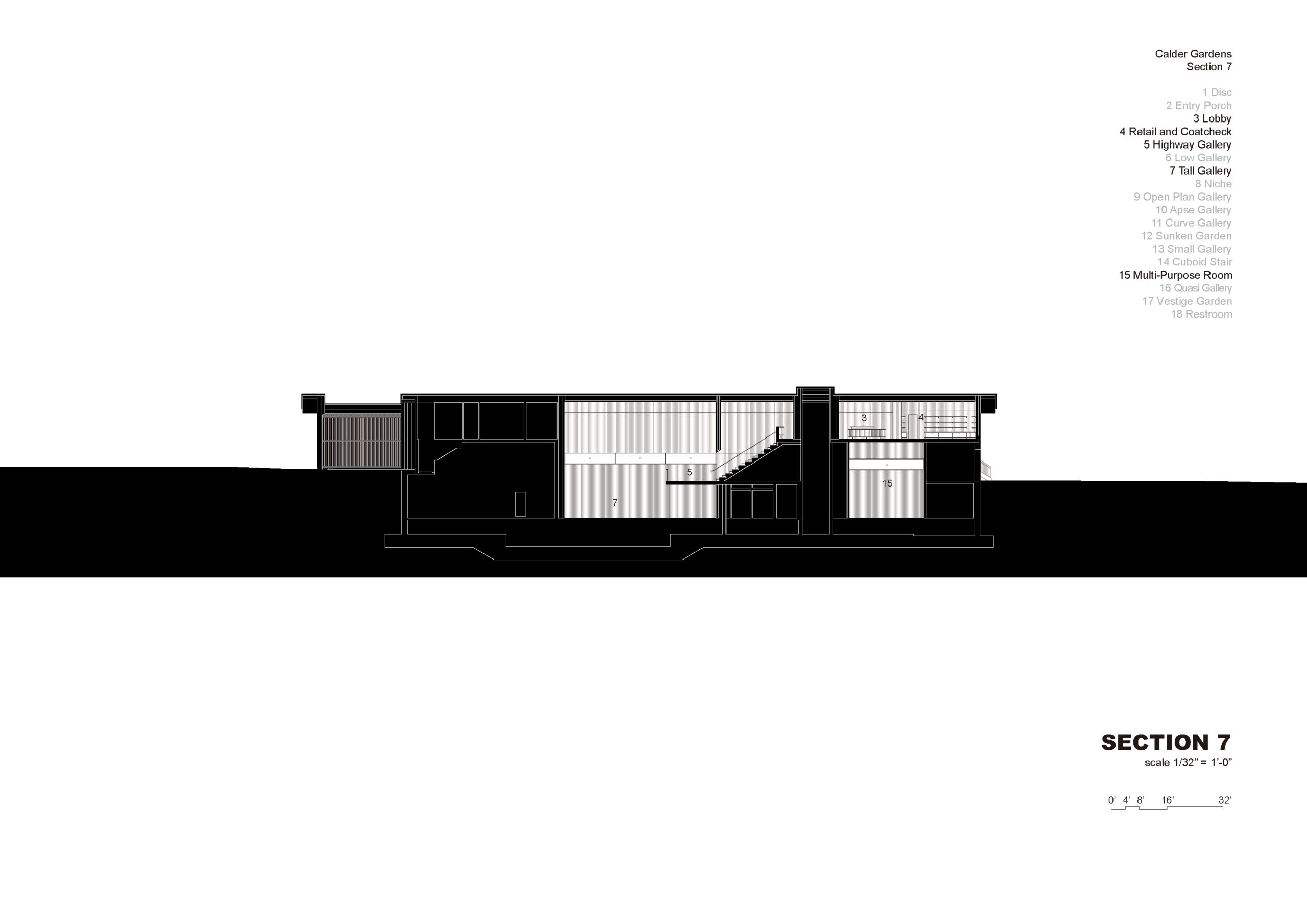
Section-7
以下、ヘルツォーク&ド・ムーロンのリリース(英文)です。
Calder Gardens
Philadelphia, USA
Project 2020 – 2025Calder Gardens is not a conventional museum. From the beginning the client wanted a space that would provide a totally new, intimate and ever-changing encounter with the work of Alexander Calder. While the building is still tasked with the typical technical requirements of a traditional museum, it is conceived as a new type of place for being with art: a place that provides an interplay between art, architecture, nature, people, and the surrounding city.
Philadelphia is Calder’s birth city and was the home of two previous generations of Calders who, as artists, left their own impressions on the city. Their sculptures can be found along the Benjamin Franklin Parkway, a boulevard that is a product of the 19th century ‘city beautiful’ movement and is anchored by two of America’s most remarkable museums, the Philadelphia Museum of Art and the Barnes Foundation. Cutting across this Parkway is the sunken Vine Street Expressway which, like many of its counterparts in other American cities, sliced through the existing city fabric in the mid-20th century. Calder Gardens is located at the intersection of these two significant streets.
The site of Calder Gardens is a flat, tapered piece of land located across the broad Parkway from the Rodin Museum and the Barnes Foundation. A highway offramp extends along its long southern edge while 22nd Street to the west and 21st Street to the east are primarily used as vehicular throughways. Despite its central location, the site is a leftover space without much obvious charm. The sound of the highway is always present, and few people have had reason to walk through the site. Creating a destination within this urban void was a central challenge for the project.
Form, color, and movement are the most obvious aspects in Calder’s art. When the concept for Calder Gardens was conceived, it sought to avoid rather than adopt the use of these characteristics as possible design elements. Likewise, the design avoids the monumental architecture of the already impressive collection of museums which line the Benjamin Franklin Parkway. With these parameters in mind, it was decided that the face of this project should not be a building. Instead, it is a garden with a building within that reveals itself step by step as a series of distinct, heterotopic spaces.
The Wall and The Disc
When viewed from the Parkway, a tapered metal wall forms a backdrop to a public meadow-like garden. The wall reduces the sound of the highway and frames the garden towards the Parkway. Pathways from the northeast and northwest corners draw visitors through the garden towards a single central opening where a folded metal canopy covers a wood-lined entry area.
As visitors approach the entry, the architecture comes into view. A large central disc forms a plaza at the center and provides a roof to the galleries below. A geometrically pure circular ‘Sunken Garden’ towards the east and an elongated irregular ‘Vestige Garden’ to the west are carved into the ground on either side of the disc. They create protected outdoor spaces for Calder’s sculptures and bring light into the surrounding galleries. The intersection of the disc and the wall define the entry. A single window offers a glimpse to the galleries below.
The backside of the metal wall is covered with blackened wood and forms a simple barn-like building towards the highway. The low building is only seen in passing from this vantage point and does not draw attention to the project. It contains a few necessary staff spaces, a loading area and a small wood-lined lobby. The lobby is different than the typical large-scale spaces that define most museum entryways. It is domestic in scale and engages the individual as they begin their Calder Gardens experience.
Step by Step
From the lobby, visitors descend to the galleries below. A large stair brings people down to the ‘Highway Gallery’. The stair functions as a small auditorium for gathering. A long, low linear window frames a view of the highway and city beyond; the ‘Tall Gallery’ is seen below. The Highway Gallery is a mezzanine within this tall space and gives the viewer an opportunity to experience a Calder mobile from an elevated position. A beam corresponding with the wall above separates the Tall Gallery from the space below the disc. A narrow slot above the beam offers a glimpse into the gallery below.
From the Highway Gallery mezzanine, a passage and stair are lined with a dark, rough concrete surface. This ‘Cuboid’ stair links people to the ground and the vestige-like spaces that form the outer garden. As with all leftover spaces, the stair offers another distinct opportunity to display Calder’s work.
The stair arrives on the main gallery level. Passing through the Tall Gallery, the visitor encounters the daylit ‘Open Plan Gallery’ below the disc. The geometry of the Open Plan Gallery is orthogonal on the east and west and curved towards the north, reflecting the disc above. A large window opens towards the Vestige Garden bringing in natural light and connecting the central space with the garden outside. A small ‘Apse Gallery’ is created from two offset curved walls – this gallery has no visible corners which could distract from the view of the art inside. Together, the Open Plan and Apse galleries allow a variety of Calder’s large and small works to be seen from multiple perspectives.
From the Open Plan Gallery, a narrow slot reveals the ‘Sunken Garden’ and the entry to the ‘Curved Gallery’. While the Open Plan Gallery offers a light-filled space with views to the outside, the Curved Gallery provides a fully internalized space with exposed concrete foundation walls and maximum control over light conditions. This space can be used to show Calder’s works on paper, light sensitive sculptures and the paintings done by Calder’s ancestors. The Sunken Garden is at the center of this space; A single stabile will be placed against a densely planted curved wall offering yet again a different background to experience Calder’s work.
Vestiges
The historical conditions of the existing site surface in both the interior plan geometry and garden configuration. An offset of an adjacent water main establishes the kinked boundary of the underground plan. Traces of the historical foundations from the city grid which pre-dated the Parkway inform the geometry of the Vestige Garden. A ‘Quasi Gallery’ provides a cave-like, covered outdoor space that mediates between the highly controlled gallery spaces on the interior and the exposed garden spaces outside.
Together, these spaces encourage curators to display Calder’s multifaceted work in ever new and unexpected ways. It provides a place of contemplation and focus and offers a spatial sequence rather than a classical gallery experience. Calder Gardens is a world that unfolds as you walk through the door.
Quotes
In this unique commission in Philadelphia —from the site, to the open brief, to our design process—I focused on space over form, leading me to explore below-grade areas and discover the defining spaces of the structure. Calder Gardens embodies a kind of ‘no-design’ architecture, allowing the works of art to express their diversity and ambiguity across numerous different spatial contexts. It’s a place where you can sit, wander, and observe, whether it’s nature or art, with the ease one has when one sits under a tree.
Jacques HerzogCalder Gardens is the result of an extraordinary collaboration. Together with the Calder Foundation, the Barnes Foundation and our many partners on the design and construction team, we developed a project that responds both to the surrounding context and to Calder’s artistic legacy with a design that has its own specific identity. It is both an actual and a conceptual garden that offers a space for all Philadelphian’s and visitors alike to discover Calder’s work again and again.
Jason Frantzen
ヘルツォーク&ド・ムーロン 公式サイト
https://www.herzogdemeuron.com/projects/541-calder-gardens-2/


![[Interview]iF Design代表のウヴェ氏に聞く、建築と都市の2026年メガトレンド](https://magazine-asset.tecture.jp/wpcms/wp-content/uploads/2026/07/23221054/iF_AwardCeremony_2026_AwardCeremony-82-900x600.jpg)
![[Report]激変する時代の中で、建築とデザインはどう拡張するか。「iF DESIGN AWARD 2026」授賞式&最新トレンド](https://magazine-asset.tecture.jp/wpcms/wp-content/uploads/2026/07/24010304/iFDesignTrendConference26-45-900x600.jpg)
![[Report]RUI Architectsが可動モジュールを設計して松竹のアートスペースをリニューアル、柿落とし展「継承のトランジション」の会場デザインも担当](https://magazine-asset.tecture.jp/wpcms/wp-content/uploads/2026/07/24141011/20260713shutl_press11-01309-c-900x629.jpeg)