

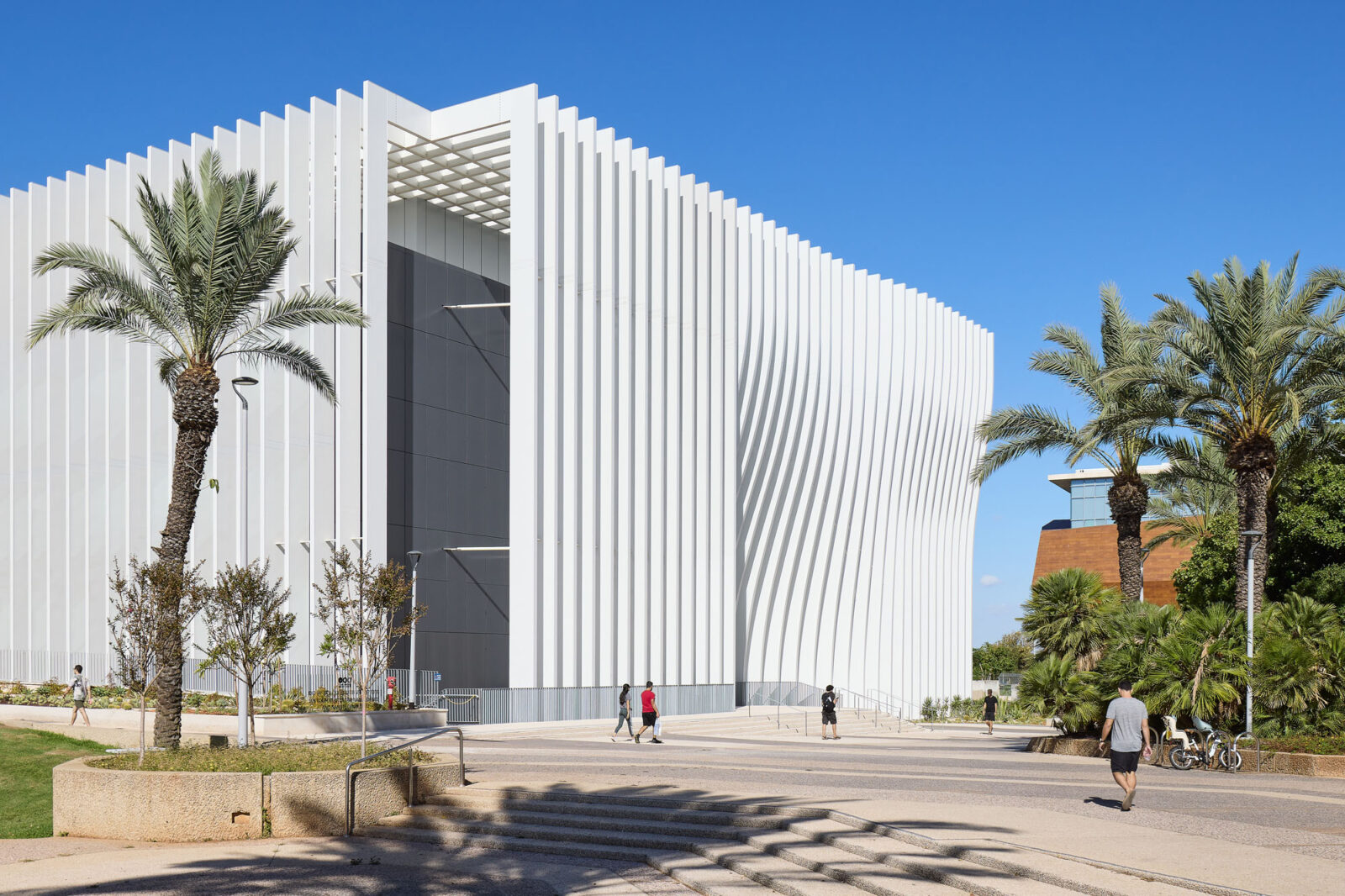
ナノ科学の世界を体現する純白の直方体 - 146枚の鋼製フィンが包む、テルアビブ大学の〈ヤン・クーム・ナノサイエンス&ナノテクノロジーセンター〉
© Atelier d’architecture Michel Rémon & Associés – Photographer Nimrod LEVY
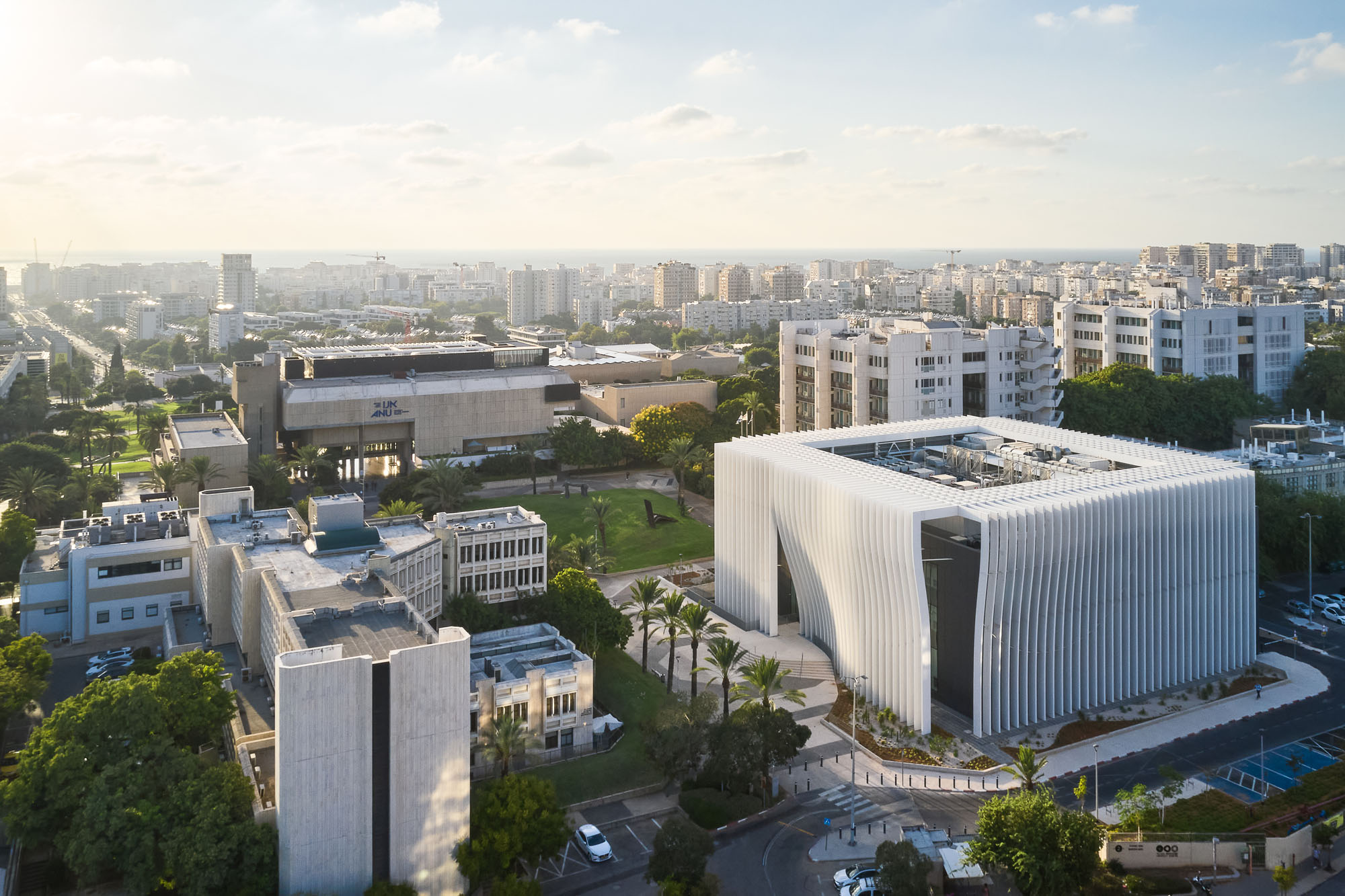
イスラエルのテルアビブ大学に建てられた〈ヤン・クーム・ナノサイエンス&ナノテクノロジーセンター(Jan Koum Center for Nanoscience and Nanotechnology)〉は、同大学の革新と卓越性を象徴する、最先端のナノ科学研究を行う施設です。
パリを拠点に活動するミシェル・レモン&アソシエイツ(MICHEL RÉMON & ASSOCIÉS)が設計しました。
注目ポイント
- 建築とナノサイエンスの共通言語であるコンセプト「スケール」
- 精密かつ革新的な施設を象徴する、白いフィンによるファサード
- 最先端の研究環境を実現する、極限まで制御された環境
(以下、ミシェル・レモン&アソシエイツから提供されたプレスキットのテキストの抄訳)
© Atelier d’architecture Michel Rémon & Associés – Photographer Nimrod LEVY
© Atelier d’architecture Michel Rémon & Associés – Photographer Nimrod LEVY
テルアビブ大学:緑のオアシスに建つイノベーションの拠点
イスラエル最大の大学であるテルアビブ大学(TAU)は、テルアビブ北部のラマト・アヴィヴ地区にある「スプリングヒル」に位置している。1953年に創立されたこの大学は、ユニークなキャンパス環境の中に3万人以上の学生を収容している。
緑豊かな庭園に佇むその姿は、モダンで現代的な建築群によって形成されている。学生生活は色とりどりの小鳥のさえずりと共に営まれ、穏やかな空気が流れる。20世紀半ば以降、イスラエルのランドスケープアーキテクトであるダン・ズル(Dan Zur)とリパ・ヤハロム(Lipa Yahalom)が、この独特な緑のオアシスをつくり上げてきた。
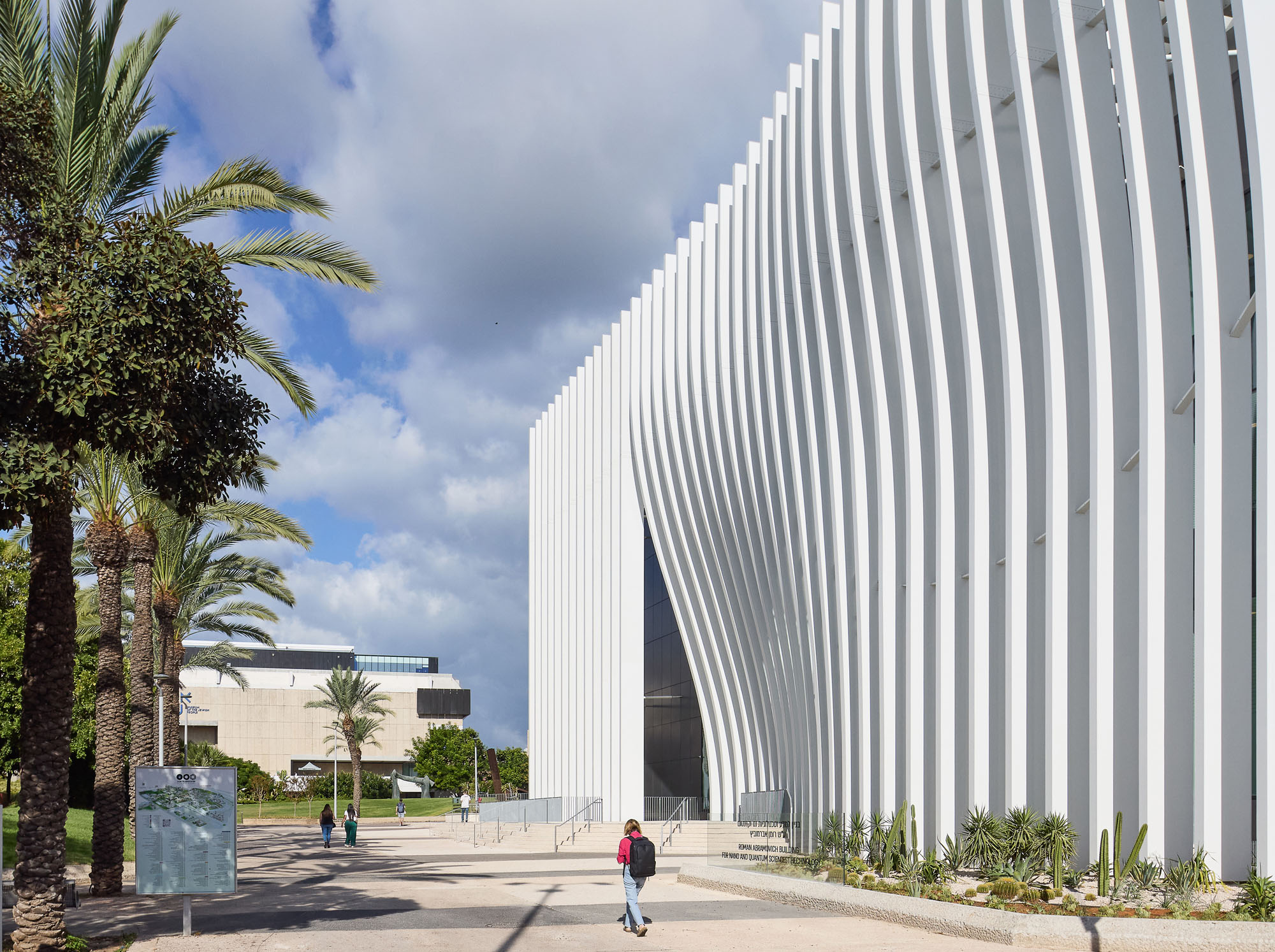
キャンパスの基本計画は、東西の二大区域に分かれている。西側には人文科学系、東側には自然科学系が配置され、その中心部にはユダヤ民族博物館が位置し、学生や家族、国内外からの訪問者を迎え入れている。東側、クラウスナー通り沿いの第2ゲート向かい、ナノセンターの近くには国立自然史博物館が立地しており、科学教育という大学の使命を体現している。
© Atelier d’architecture Michel Rémon & Associés – Photographer Nimrod LEVY
大学の革新と卓越性を象徴するナノセンター
自然と現代性の狭間に位置する〈ヤン・クーム・ナノサイエンス&ナノテクノロジーセンター〉は、キャンパスの中心部に立地している。高精度な施設として設計されたこの建築は、研究者たちにナノ世界の最前線を探求するための最先端環境を提供する。それは単なる建物にとどまらず、テルアビブ大学における革新と科学的卓越性を象徴する存在である。
© Atelier d’architecture Michel Rémon & Associés – Photographer Harel Gilboa
© Atelier d’architecture Michel Rémon & Associés – Photographer Harel Gilboa
© Atelier d’architecture Michel Rémon & Associés – Photographer Omri AMSALEM
国際デザインコンペで勝利した「従来のスケールの概念を超越する建築」
私たちは、この象徴的プロジェクトの開発を目的とした国際デザインコンペティションにおいて優勝を果たした。主催者によれば、私たちの提案は「科学・技術・革新の進歩」を体現しており、その文脈に完璧に適合するものであったという。
初期スケッチの段階から、私たちの設計意図は明確であった。それは、「従来のスケールの概念を超越する建築」を創出することである。
国際審査員は、当プロジェクトの以下の特性を高く評価した。
- キャンパスの建築環境と完璧に調和した、外部外装の優雅なデザイン
- シンプルでありながら洗練された平面計画による、内部動線の明快さ
- 実験室へのアクセス制御における独創的な解決策
謎めいた純白の外殻の奥には、高度に洗練された施設が潜んでいる。それは、非凡なるものを展示するために設計された、シンプルなボリュームなのである。
© Atelier d’architecture Michel Rémon & Associés – Photographer Omri AMSALEM
「スケール」という共通言語から着想したコンセプト
私たちのコンセプトは、建築とナノサイエンスが共有する唯一の属性である「スケール(縮尺)」から着想を得ている。
プロジェクト全体が建物の本質を表現している。それは無限に小さなものだけに捧げられた空間であり、断固として未来に焦点を当てたものである。その精密かつ革新的な幾何学は、他のランドマークとは一線を画し、唯一無二の象徴的な建築を生み出している。
基礎研究の新興分野であるナノサイエンスとナノテクノロジーは、2つの原子間の距離に匹敵するナノメートル(10⁻⁹メートル)スケールを探求する学問である。これらは、ナノ粒子の研究、ナノロボットの設計、グラフェンなどの革新的な材料の開発といった魅力的な研究への道を開く。その応用分野は医学、エネルギー、宇宙旅行など多岐にわたる。
今回の建築コンセプトは、複数のスケール次元を探求している。「無限小」、人間的な「ヒューマンスケール」、そして時に「スケール概念そのものの排除」である。外部スキンは垂直要素のマトリクスで構成され、従来の建築的参照を覆す。窓や扉は抽象的な背景へと移行し、構造体自体が言語となる。
無限小への敬意を払うことで、建物の幾何学はスケールを超越した建築の象徴的サインとなるのである。
© Atelier d’architecture Michel Rémon & Associés – Photographer Harel Gilboa
© Atelier d’architecture Michel Rémon & Associés – Photographer Harel Gilboa
見えない世界の探求:最先端の研究現場
ナノセンターの中核では、研究は未開拓のフロンティアに到達している。
ヤエル・ハネイン(Yael Hanein)教授は、神経インプラントの開発と改良に取り組んでいる。彼女のチームは神経系と相互作用可能な微小化システムを開発し、聴覚と人工視覚の分野で大きな可能性を開拓している。
タル・ドヴィル(Tal Dvir)教授は、マイクロ流体工学とナノテクノロジーを融合したヒト組織3Dプリントの限界を押し広げている。心臓・脊髄・脳といった複雑な臓器の再生と、幹細胞を全身に送達する革新的手法の開発がその研究目標である。
これらの革新的プロジェクトを遂行するため、研究者らは以下のような最先端技術設備を利用することができる。
- 電子顕微鏡
- 電子ビームリソグラフィ装置
- 高精度分光計
- ナノスケールレーザー
- ナノスケール操作装置
これらの設備を用いて、彼らはナノスケールの世界を探索し、新素材を開発し、新たな可能性を開拓する魅力的な応用をもつナノチューブやナノロボットを設計している。
© Atelier d’architecture Michel Rémon & Associés – Photographer Omri AMSALEM
© Atelier d’architecture Michel Rémon & Associés – Photographer Nimrod LEVY
© Atelier d’architecture Michel Rémon & Associés – Photographer Omri AMSALEM
クリーンルーム:建築的課題への挑戦
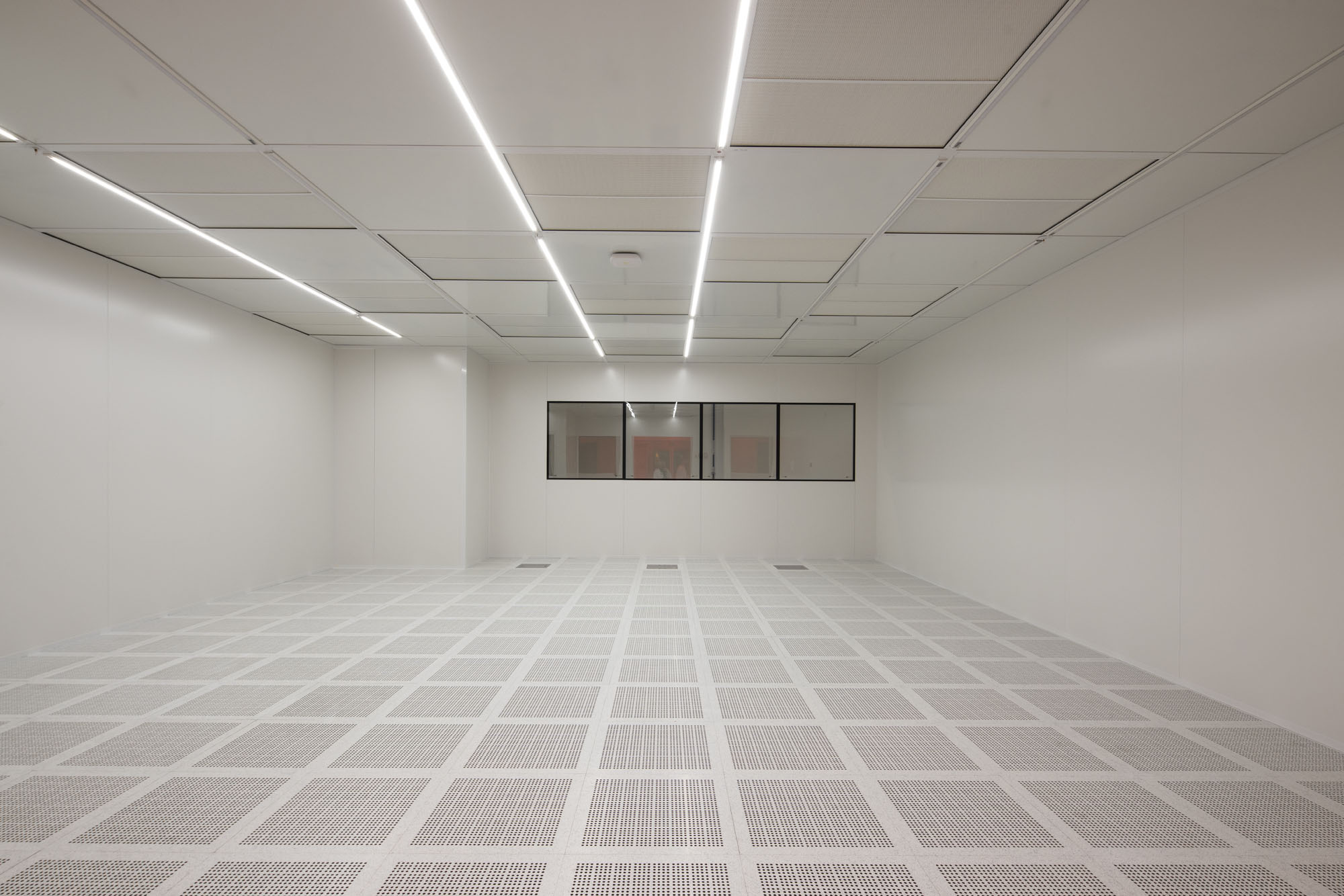
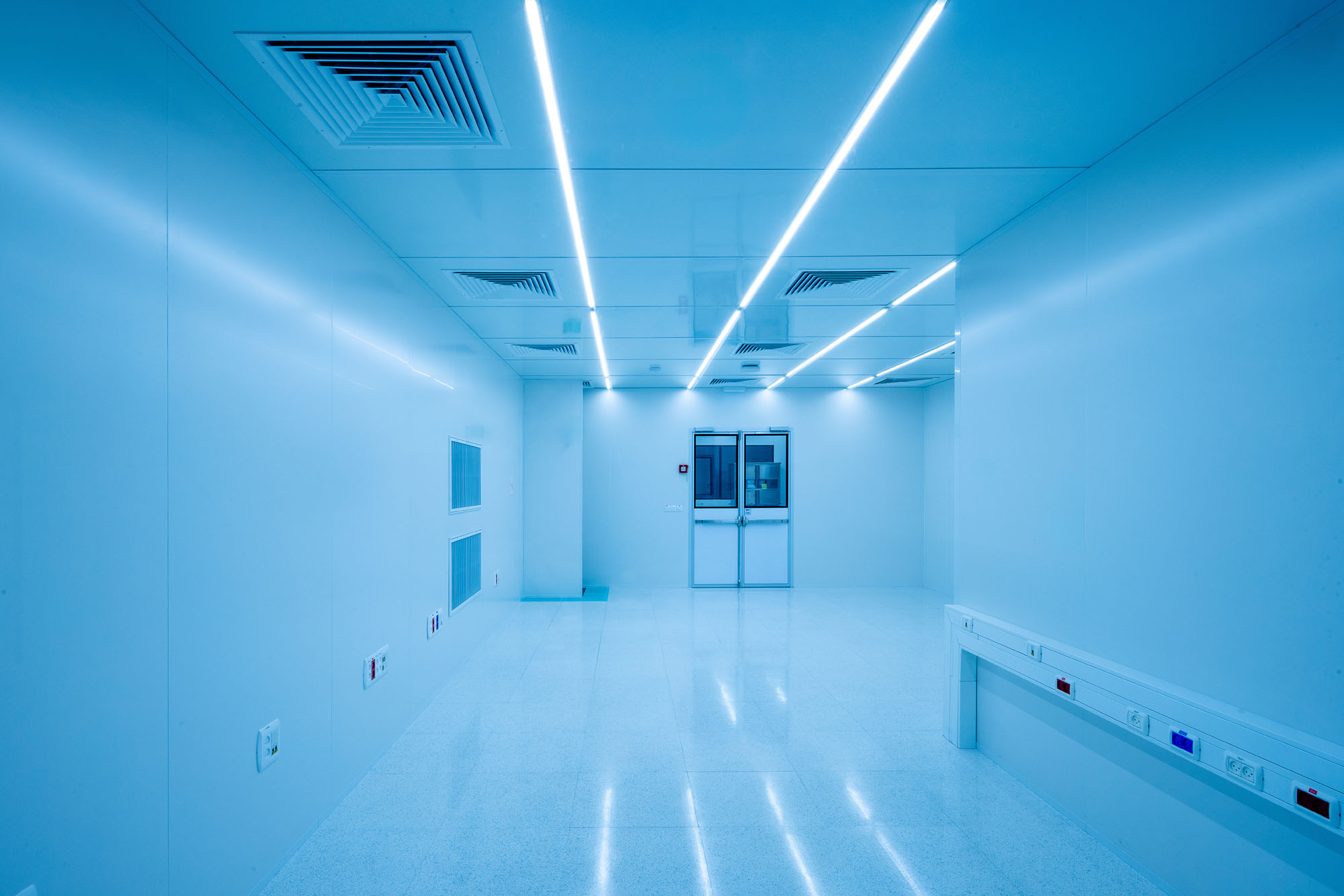
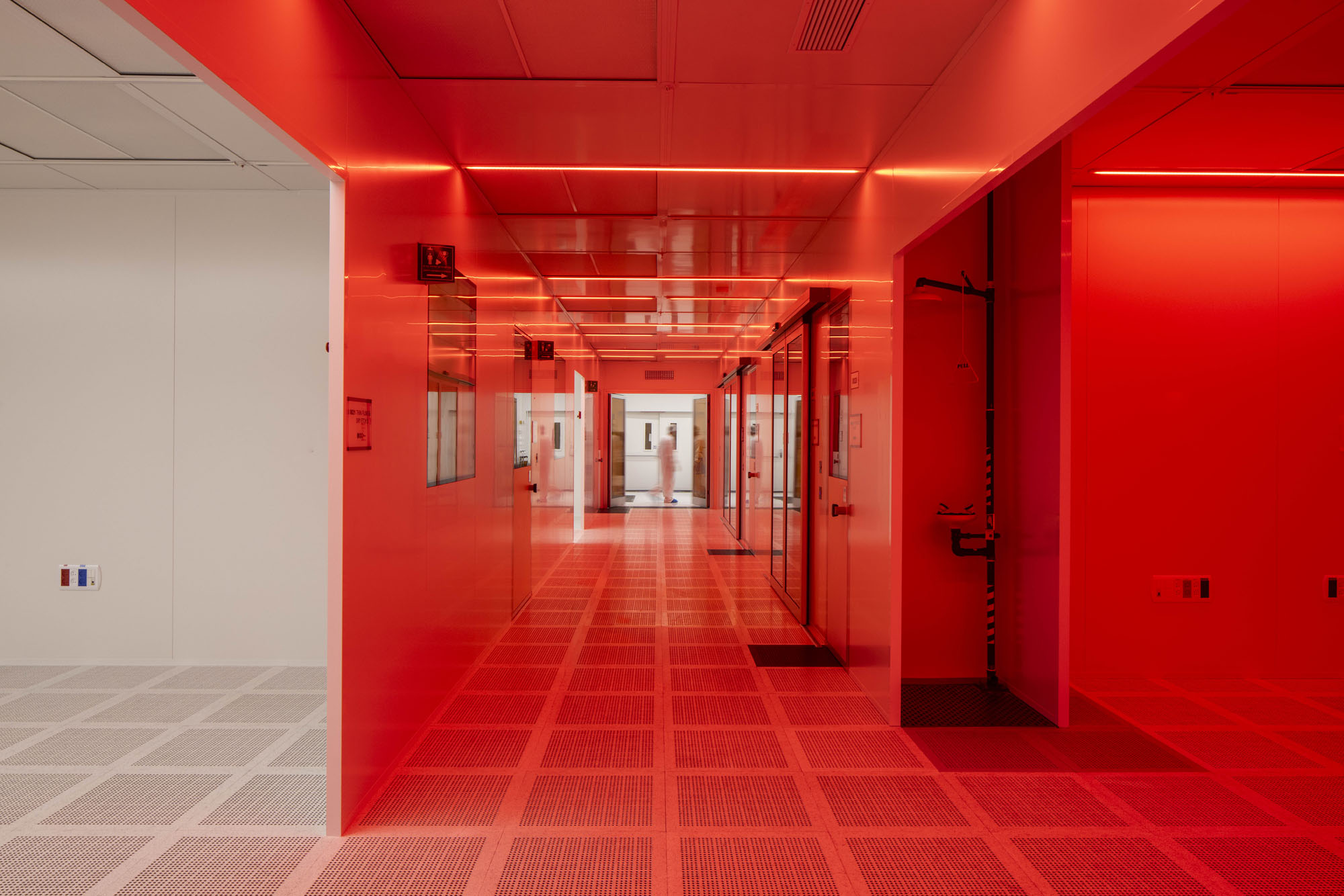
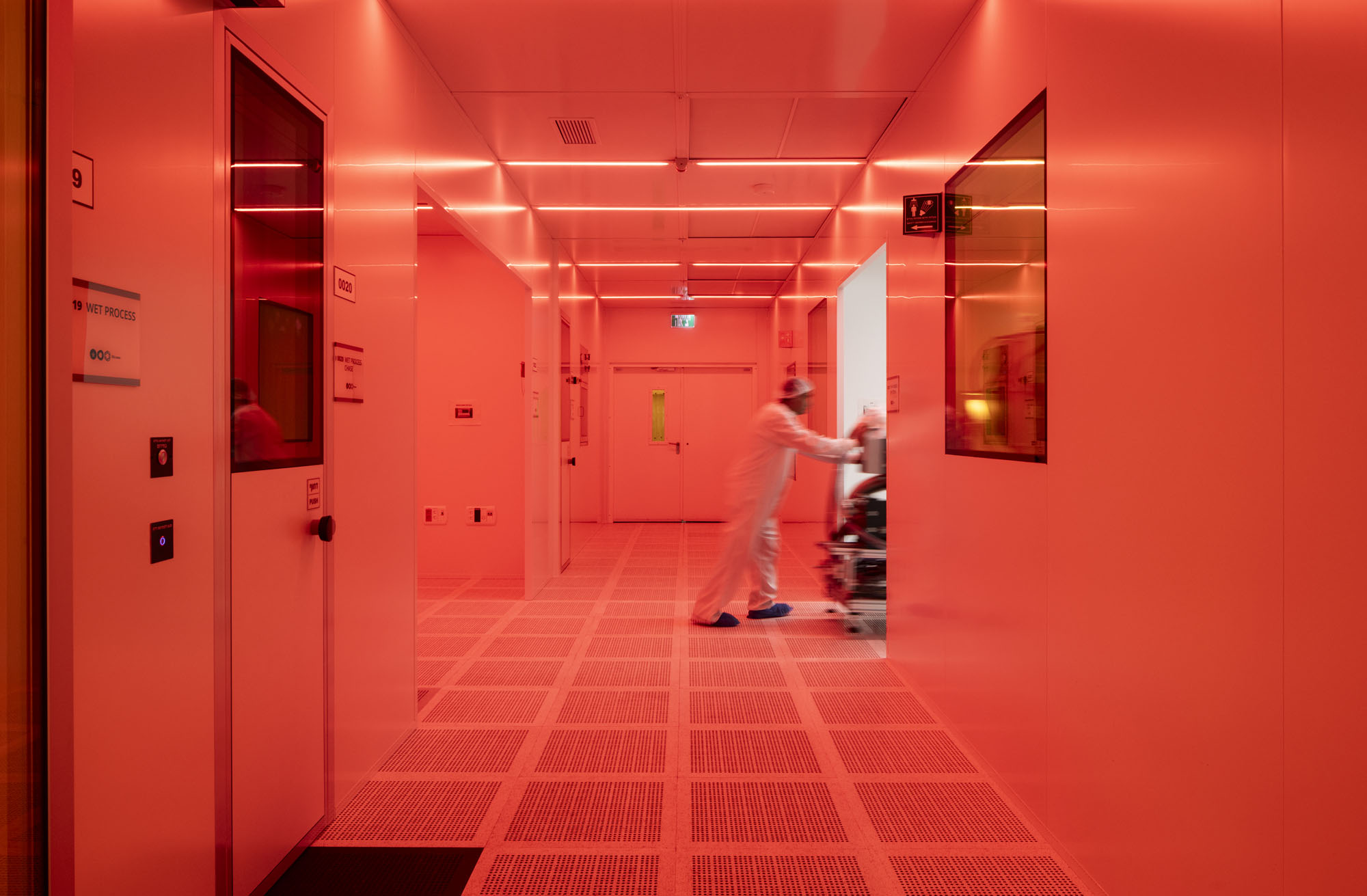
新設のナノセンターにとって、建築上の重大な課題となったのがクリーンルームである。最先端のナノ科学研究を行うには、塵粒子・電磁干渉・振動が完全に排除された「制御された環境」が必要不可欠であり、クリーンルームの整備は最優先事項となる。
ここでは、妨害要因とその「被害者」の興味深い図式が浮かび上がり、繊細な機器と環境的妨害との間に予期せぬ相互作用が明らかになることもある。極めて複雑な技術的構成を解決するため、あらゆる判断が重要となるチェスのような駆け引きが行われた。
科学機器の性能維持に不可欠な塵埃制御には、「マトリョーシカ」のように入れ子状に配置された連続空間が必要であり、各空間が最適なISO清浄度レベルを提供するよう設計されている。
本施設は大型科学機器の収容も想定している。部屋全体を運搬可能な巨大貨物用エレベーターなど特注ソリューションが導入されたほか、高精度レーザー用長尺光学テーブル設置のため、外装パネルは分解可能な設計となっている。
科学的使命を超え、この建物は強い建築的意図を帯びている。それは、キャンパスの東入口に象徴的な建造物として佇み、大学と支援者たちの科学的卓越性への取り組みを強調する存在となることである。
© Atelier d’architecture Michel Rémon & Associés – Photographer Nimrod LEVY
© Atelier d’architecture Michel Rémon & Associés – Photographer Nimrod LEVY
ファサードデザイン:スチールフィンによる「第2の皮膚」
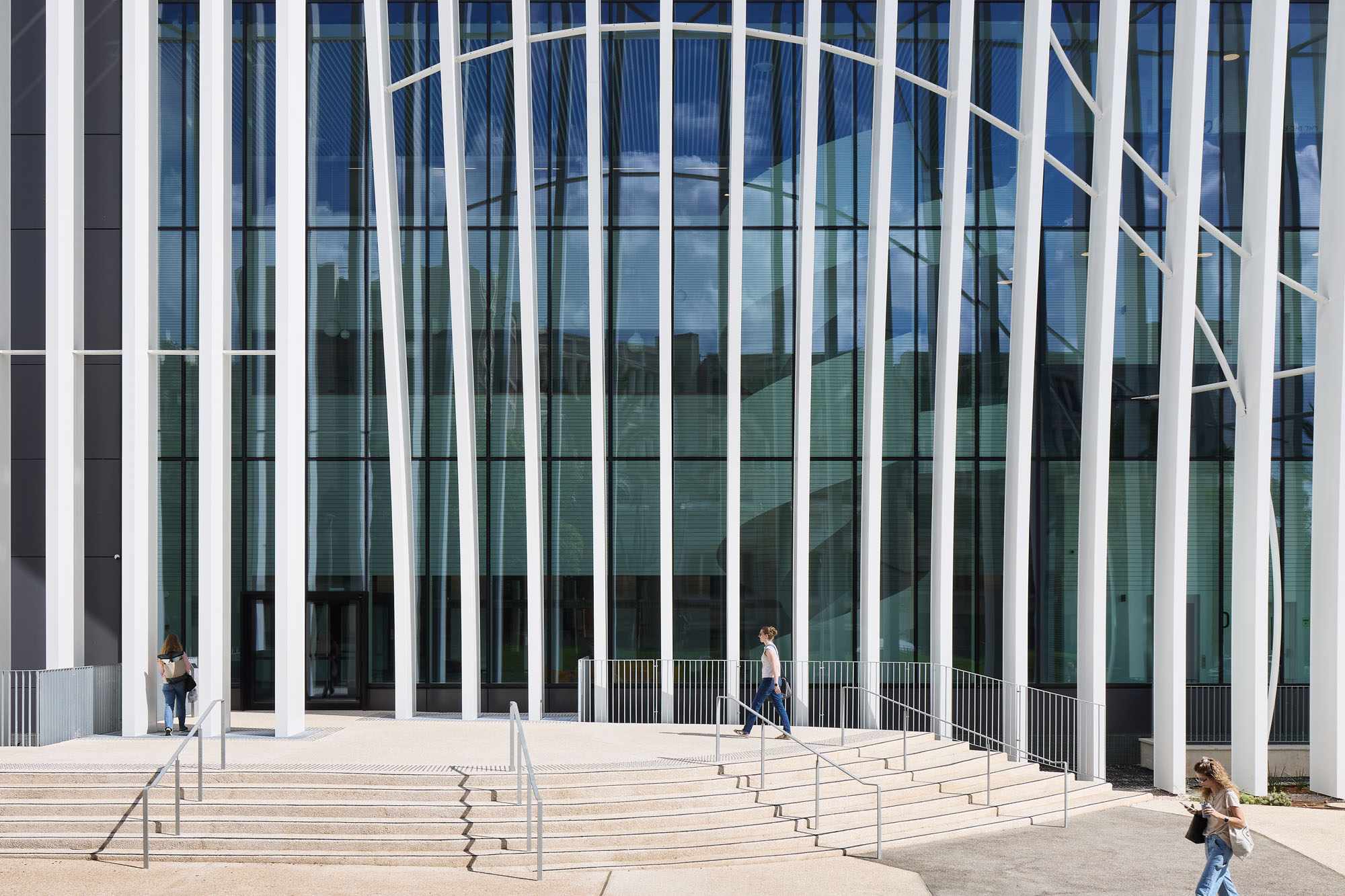
建築コンセプトはスケールの概念を駆使し、無限に微小なもの、人間的なスケール、そしてスケールの不在を探求することで独特の空間体験を創出する。垂直要素のマトリクスが建築的慣例を超越した外装を形成し、窓と扉は溶け込み、抽象的な幾何学的背景が生み出されている。
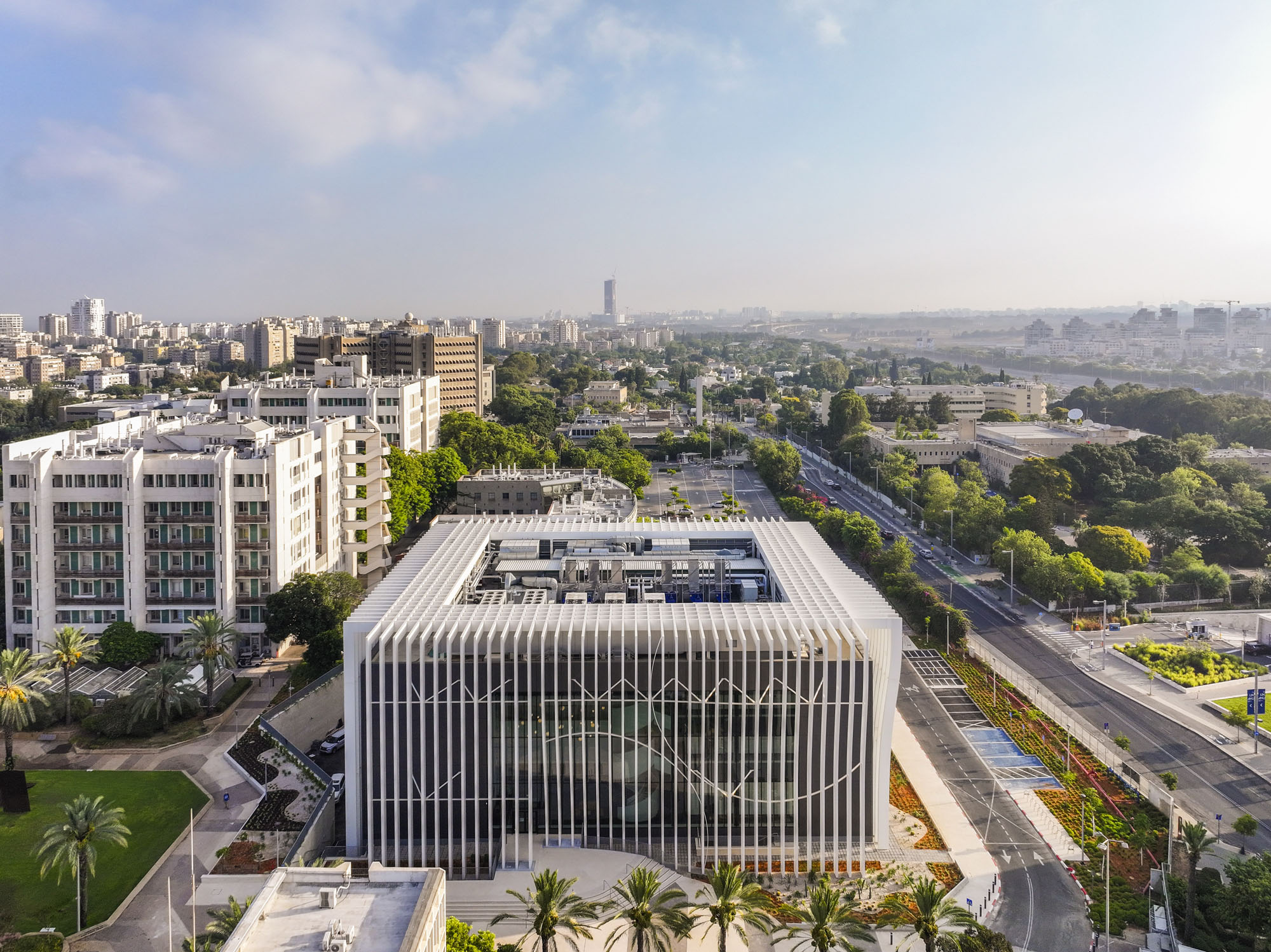
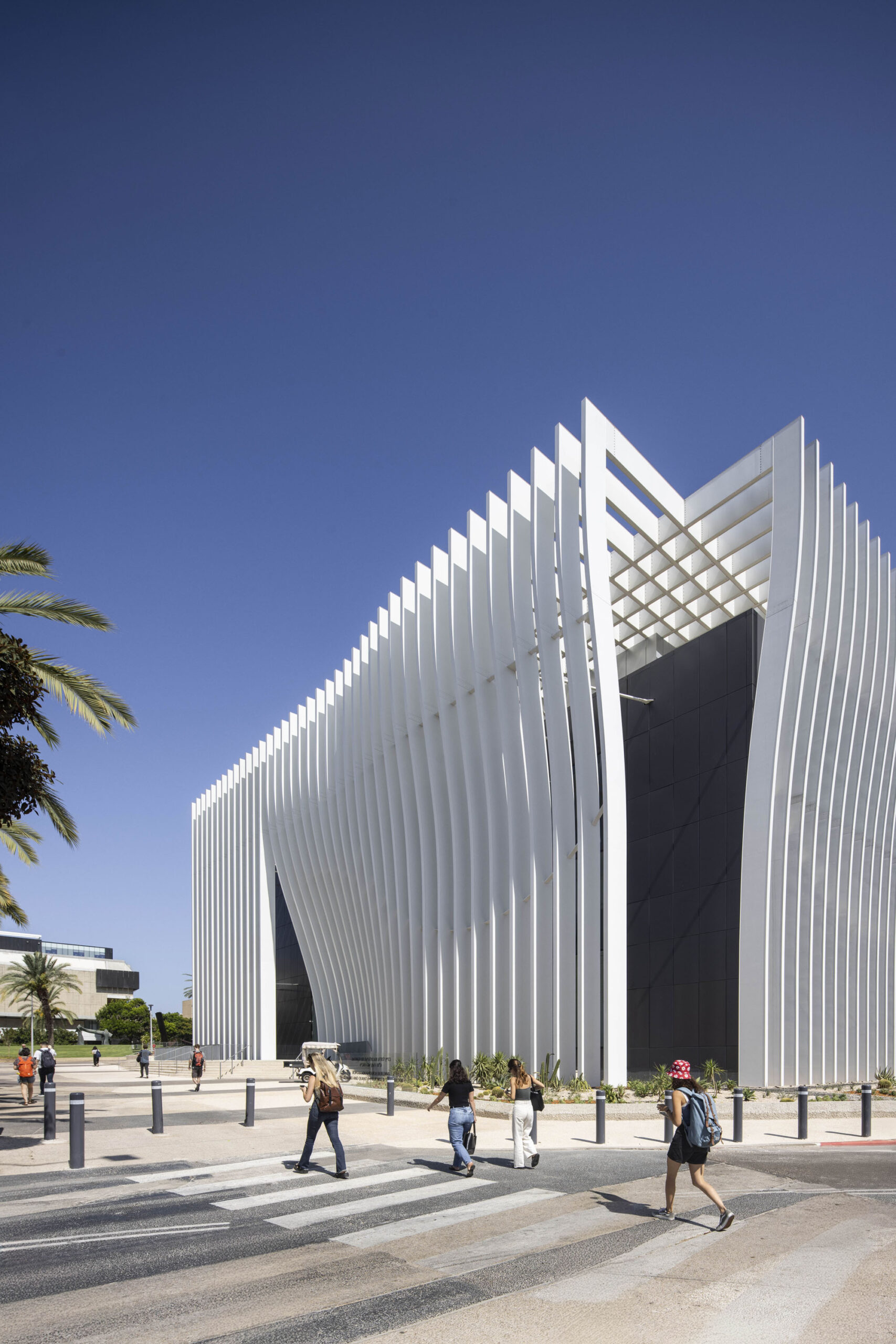
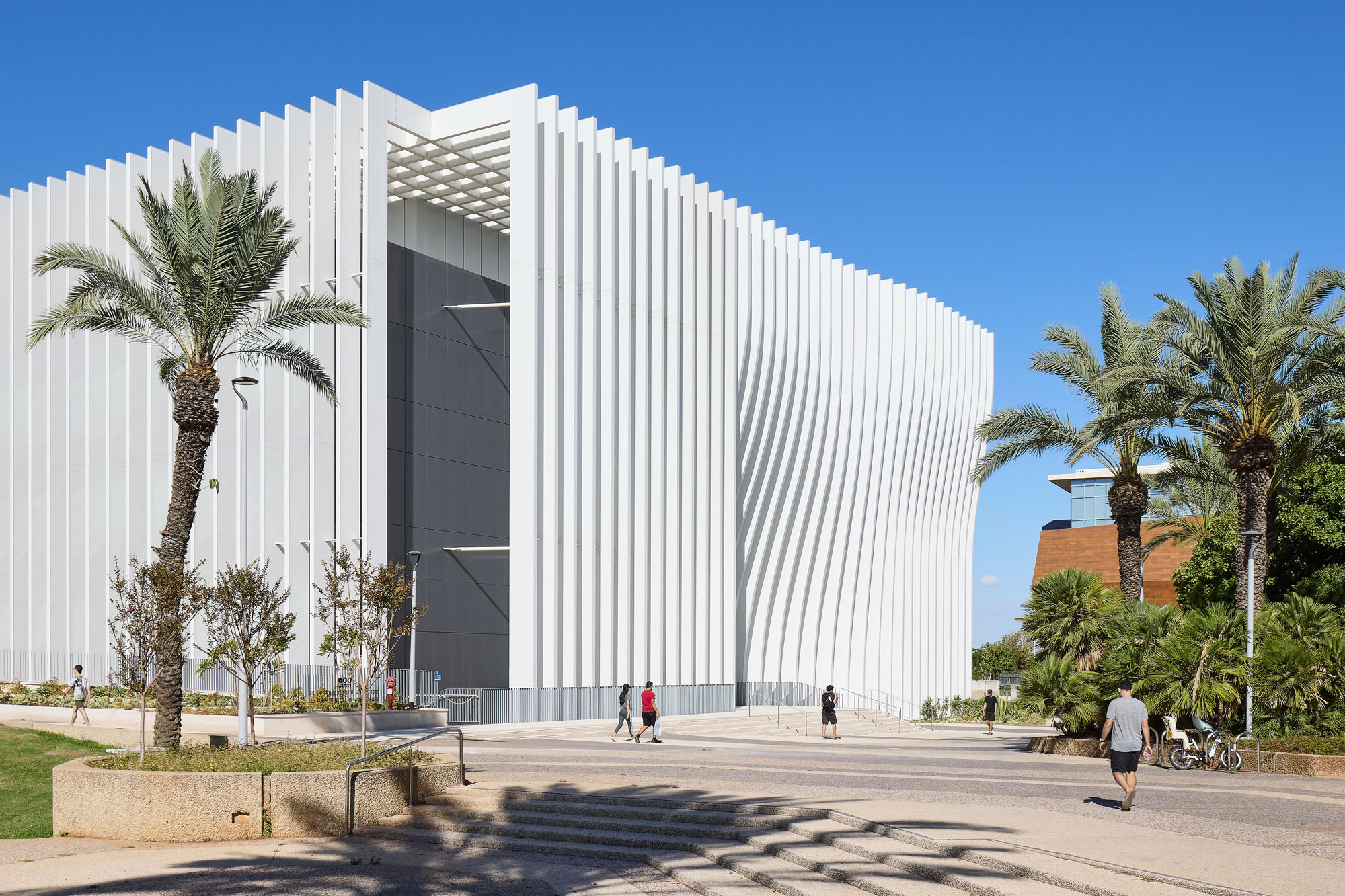
ナノセンターは一辺50mの正方形の基底と25mの高さから構成された直方体形状で、サービス用地下階の上に3層が立ち上がる構成となっている。さらに屋上階にはサービスフロアが設けられている。各階の特異な高さが、宮殿のような記念碑性を建物に与えている。
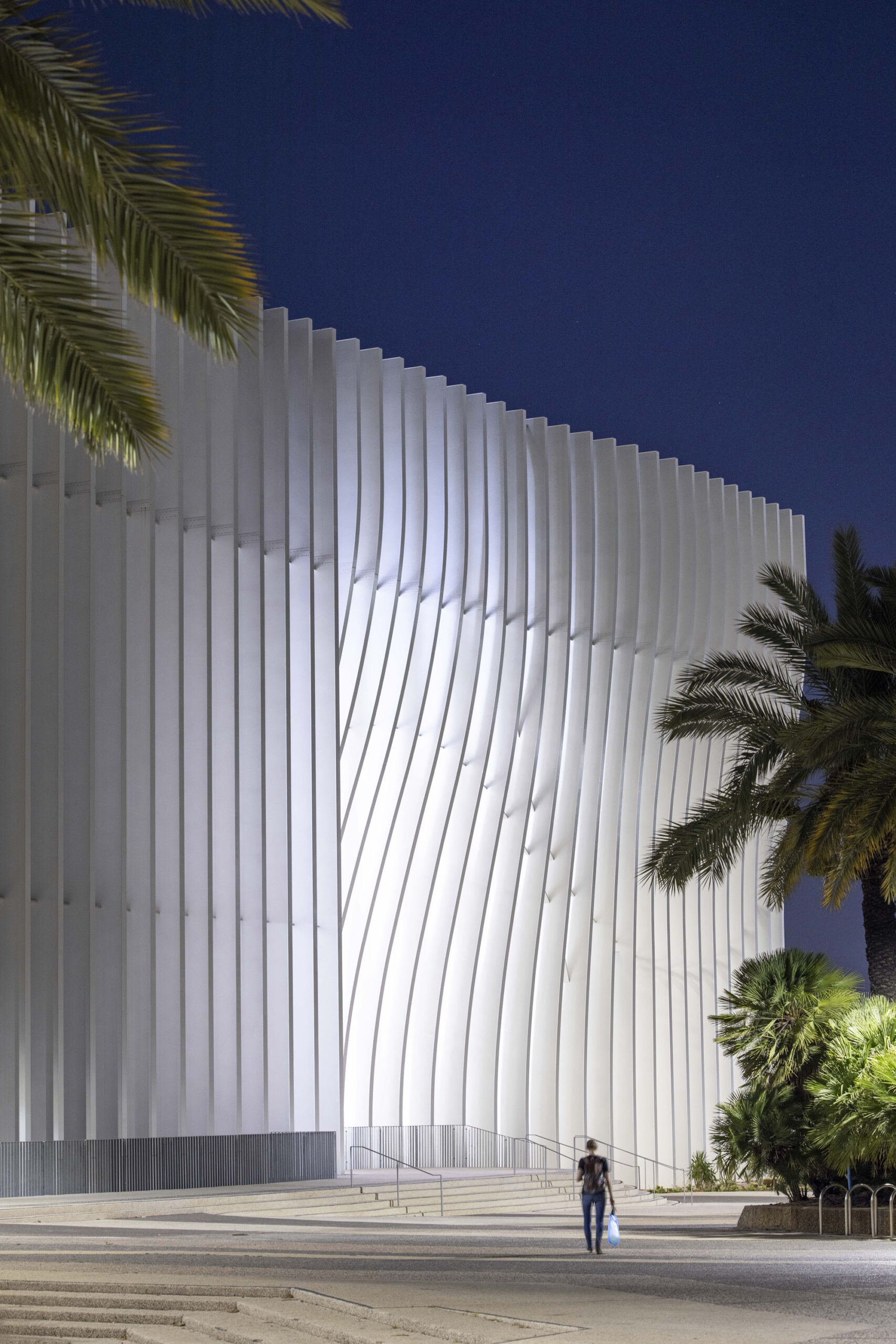
南面ファサードに控えめに配置された入口は、マトリクスに風の影響を模したうねりの遊びで示される。内外を隔てるフィルターとして機能するこの「第2の皮膚」は、採光を調節し、空間間に柔らかく動的なインターフェースを創出する。
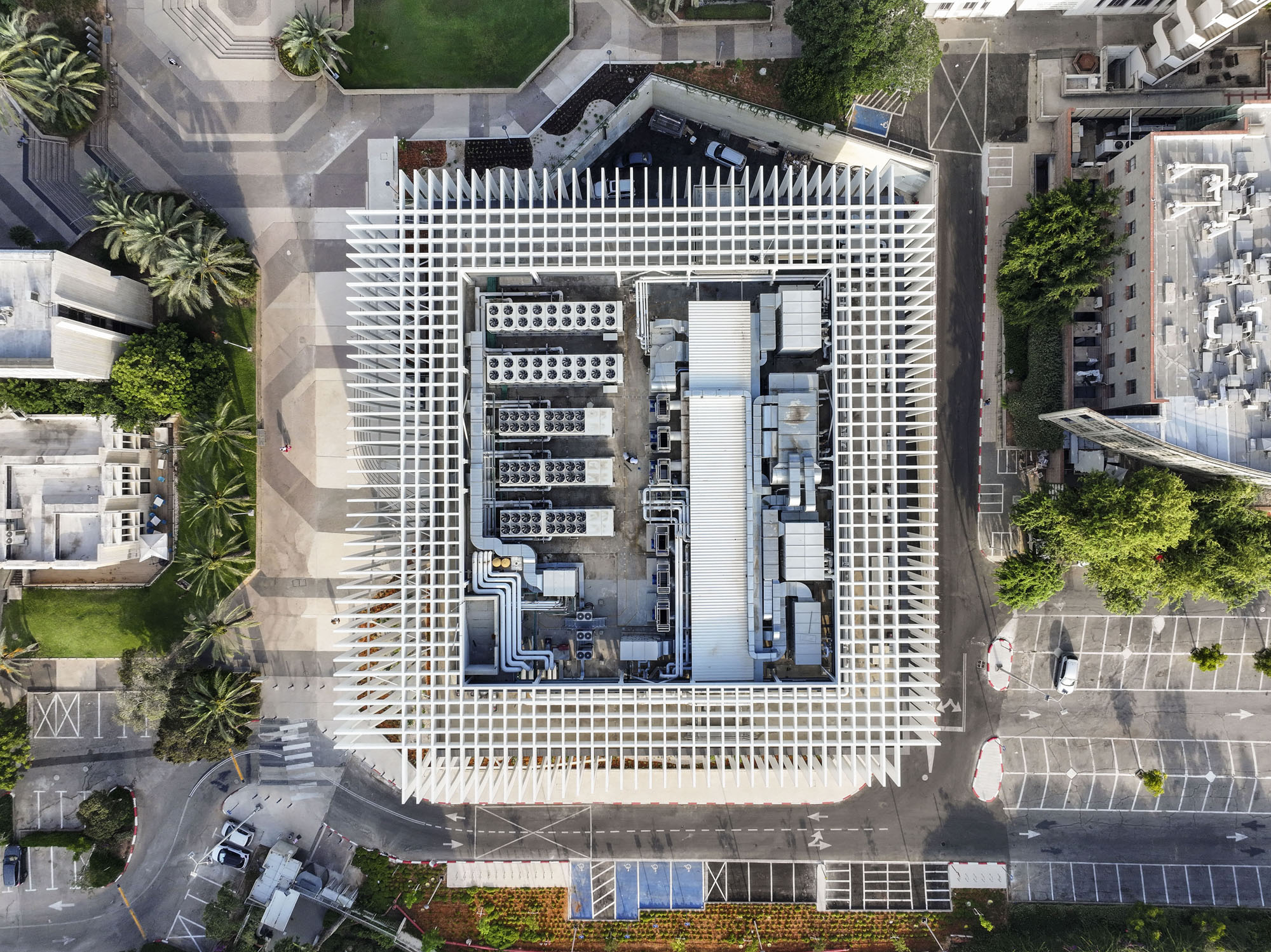
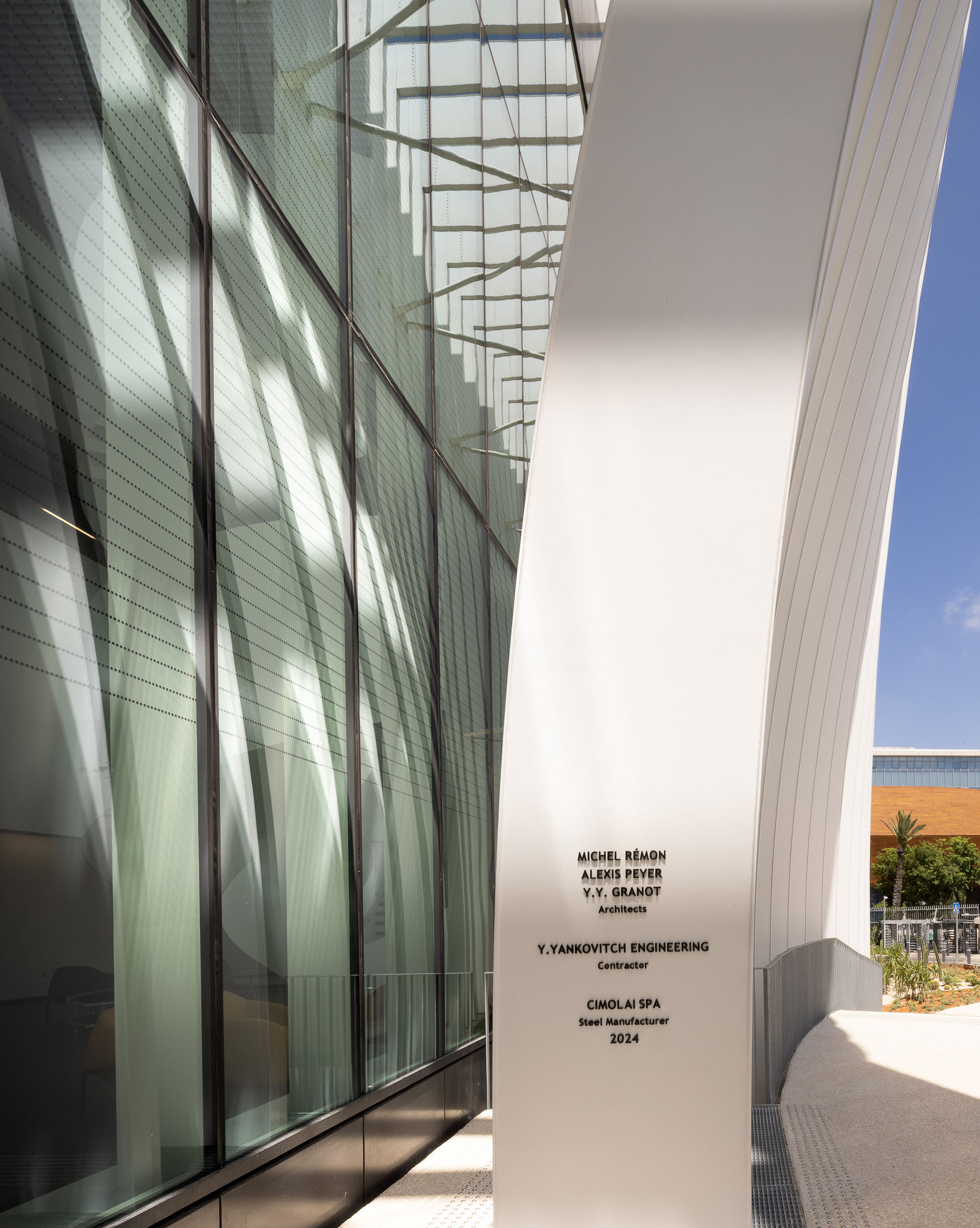
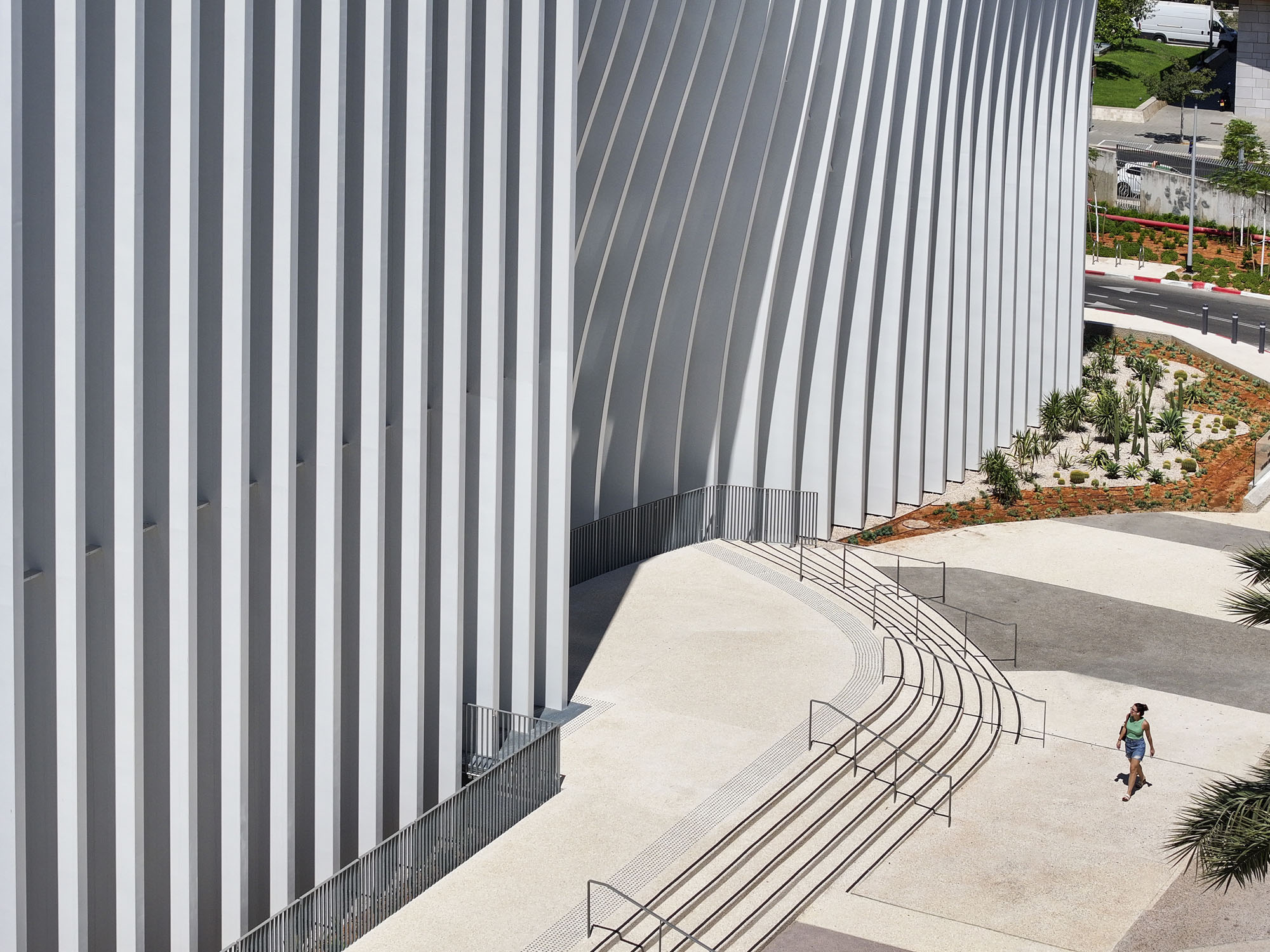
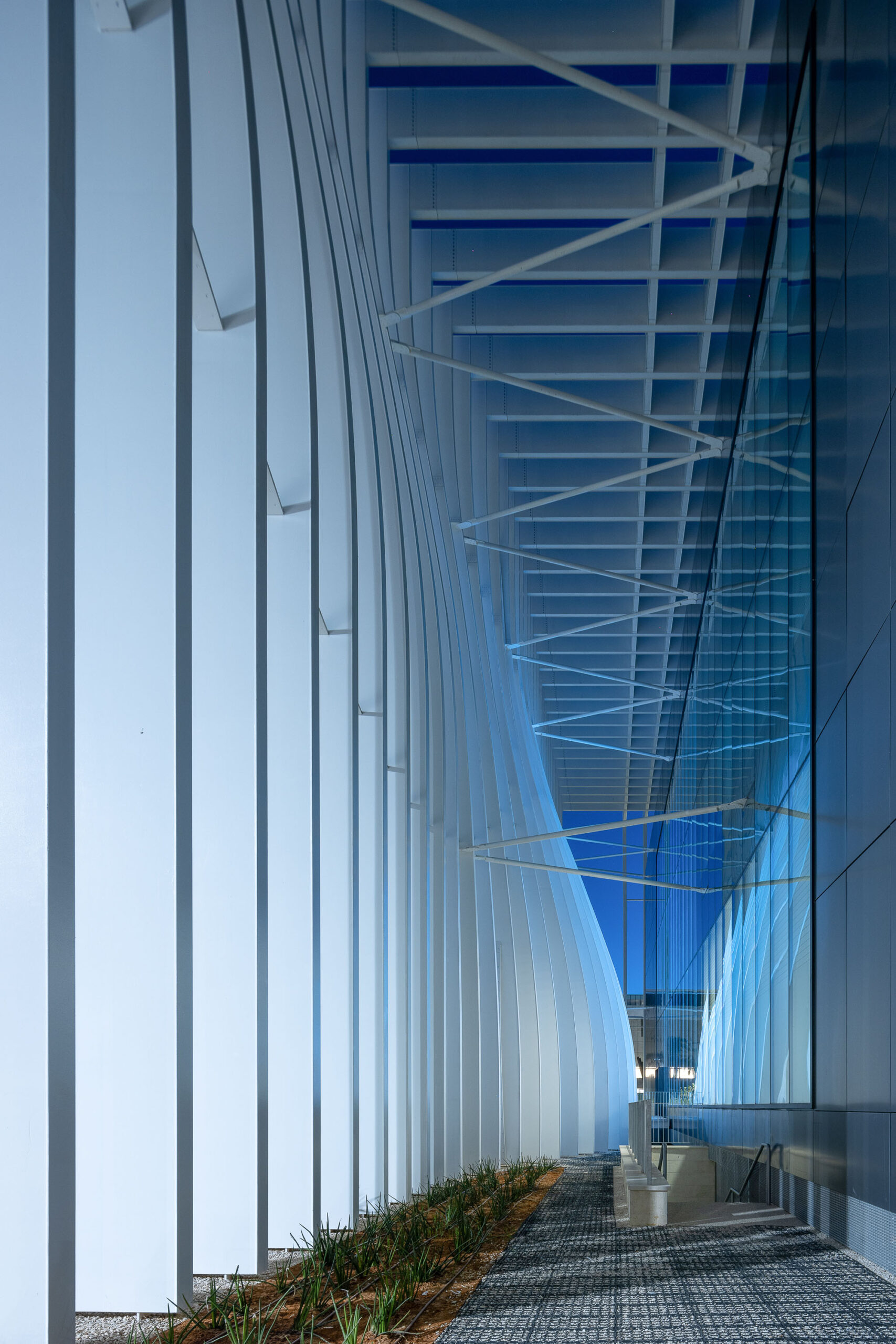
高さ25m、奥行き1m、厚さ20cmの垂直鋼製フィン146枚で構成されるこの保護スクリーンは、全体の構造グリッドを表現している。1.2m間隔で配置されたフィンは屋根レベルで上向きに曲がり、三次元の「ケージ」を形成し、設備室をアルミの外装で覆い隠している。
北・東・西面ではグリッドが本体に直接接続されるが、南面では鋼製フィンがさらに6m延長され、効果的な日除けを形成する。太陽の軌道を巧みに利用したこの構成により、内部空間の影を最適に調節しつつ、建築にエネルギーを与える奥行きが保たれている。
© Atelier d’architecture Michel Rémon & Associés – Photographer Nimrod LEVY
© Atelier d’architecture Michel Rémon & Associés – Photographer Harel Gilboa
極限まで制御された環境
高精度な科学環境をいかに構築するか。これは大きな課題であった。
十数棟の最先端科学施設に対し、極めて厳しい振動基準(VC-G)を満たすことは困難を極める。隣接駐車場のスピードバンプを通過する車両さえも干渉要因となり得る状況下での挑戦である。さらに、建物運営に必要な高電圧電流と、極度に敏感な機器との共存も求められる。
この性能レベルを達成するにはクリーンルームの設計が不可欠である。こうした高度に制御された空間は、使用可能床面積とサービスエリアの比率が通常とは異なる複雑な建築構造を要求する。
研究専用に使用可能な1m²あたりに必要となる設備スペースは以下の通りである。
- 環境サービス配管とプラント設備を収容するための深さのあるアクセスサービスフロア(高さ50cm)1m²。さらに重機設備を収容する地下の「サブファブ」フロアがこれを補完
- 空気循環とメンテナンス用の通行可能なプレナム(高さ1階分相当)1m²、および換気・濾過プラント・制御装置用の屋上設備階
したがって、運用面積1m²あたり4m²の構造・設備面積が必要となる。この建築的複雑性は、ナノサイエンス研究の特殊要件を満たすために不可欠であり、クリーンルーム設計、気流制御、電磁・振動干渉管理における高度な専門知識が要求された。
© Atelier d’architecture Michel Rémon & Associés – Photographer Omri AMSALEM
第6のファサード:振動なき基盤
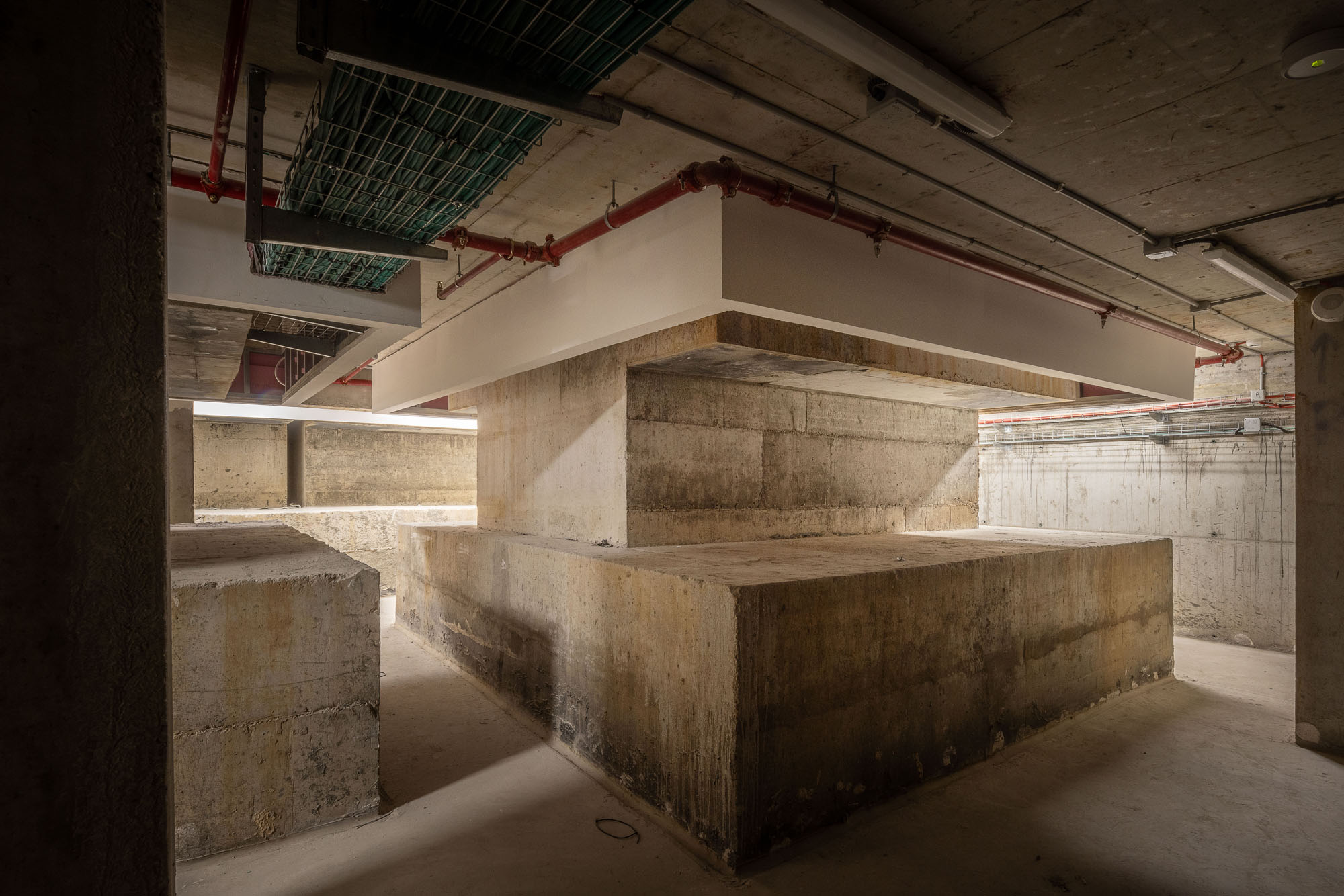
将来の最先端設備導入に備え、建物は厳しい科学的制約を満たす必要がある。振動ゼロ、電磁妨害ゼロ、そして塵埃による内部活動への干渉ゼロである。
外部からの振動を遮断するため、深層の堅固な基礎に固定された9つの巨大なコンクリートブロックが現場で打設された。これらのブロックには油圧システムを組み込むことが可能で、振動を完全に吸収し感知不能なレベルまで低減する。
この装置は、完全に安定した基盤を提供する建築設計を体現している。これこそが、この建物の「第6のファサード」を構成しているのである。
© Atelier d’architecture Michel Rémon & Associés – Photographer Omri AMSALEM
独自の性能を実現するスチールフィン
建物の外装は一連の垂直金属フィンで構成され、建物全体を包む連続した第2の皮膚を形成している。従来の開口部(窓、ドア)を一切持たないこの構造は、環境フィルターとして機能する。太陽光を制御して自然光を最適化し、熱制御を容易にする。精密な曲線に沿って配置されたフィンは、ファサードにうねりを生み出し、動的な外観を与えている。
これらの要素の製造と設置は、特注金属加工を専門とする企業CIMOLAIに委託された。契約内容には構造設計、特注部品の製造、現場組立が含まれ、寸法公差と性能要件は厳守された。
© Atelier d’architecture Michel Rémon & Associés – Photographer Omri AMSALEM
© Atelier d’architecture Michel Rémon & Associés – Photographer Nimrod LEVY
以下、ミシェル・レモン&アソシエイツのリリース(英文)です。
JAN KOUM CENTER FOR NANOSCIENCE AND NANOTECHNOLOGY
TEL AVIV UNIVERSITY
MICHEL RÉMON & ASSOCIÉS – ALEXIS PEYERPROJECT DATA SHEET
NEW BUILD
Client: TEL AVIV UNIVERSITY
Construction Cost: Confidential
Built Area: 6 800 sqm
Design Competition: 2016
Construction: 2019 – 2024
PROGRAM BRIEF: Research Laboratories, Cleanrooms, Offices, Shared workspacesPROJECT TEAM
Lead Architect: MICHEL RÉMON & ASSOCIÉS, ALEXIS PEYER
Associate Architect: Y.Y. GRANOT ARCHITECTS
Project Manager: BARAN GROUP
Consultants: WSP, BARAN GROUP KARBAN, AVLS, DYNAMICA
Landscape Architects: LAURE PLANCHAIS, MOSHE LANNER
Contractors: Y. YANKOVITCH, CIMOLAI SPAAWARDS
2024 : France-Israel Chamber of Commerce Trophy
2025 : One of the winners of the AFEX Grand Prix
2025 : Public Vote Winner – Laboratory Building of the Year – Archello AwardsTEL AVIV UNIVERSITY
The largest university in Israel is located north of Tel Aviv at «Spring Hill», within the Ramat Aviv neighborhood. Founded 1953, Tel Aviv University (TAU) accommodates more than 30,000 students on its unique campus.
A modern and contemporary edifice located within a lush garden, student life is accompanied by the singing of colorful birds. Since the mid-20th century, Israeli landscape architects Dan Zur and Lipa Yahalom developed this unique environment a haven of greenery.
The site plan divides the campus into two major sectors; humanities to the west, sciences to the east. In its center, the Museum of the Jewish People welcomes students, families and visitors from Israel and around the world. Further east, along Klausner Street in proximity to the NanoCenter opposite Gate 2, the National Museum of Natural History further affirms its scientific vocation.
Nestled between nature and modernity, the Jan Koum Center for Nanoscience and Nanotechnology is located in the campus center. Designed as a high-precision facility, it provides research scientists with a state-of-the-art environment that explores the frontiers of the nanoworld. More than a building, it embodies innovation and scientific excellence within the Tel Aviv University.
INTERNATIONAL DESIGN COMPETITION
Our Atelier d’Architecture won the international design competition to develop this iconic project. According to competition organizers, our proposal fits perfectly within its context and embodies «advances in science, technology and innovation».
At the end of 2015, we received a brief email, together with 128 international architectural firms – Strelka KB invited us to design a new research facility in Tel Aviv.
Three days after an initial selection, we were invited to interview on Skype – only ten minutes to present our design team and outline our initial concept before a selection panel located simultaneously in Tel Aviv, Moscow and London.
From the initial sketch, our design intent was clear – an architecture that transcends conventional notions of scale. Our approach was convincing and earned us a place in the final stage of the limited competition. Six design teams from Barcelona, Manchester, New York, Santiago, Geneva and Paris were shortlisted.
In December 2015, a site visit was organized for competitors. We were impressed both by its beauty and the high calibre of the scientists we met.
In 2016, after a tight finish between the final four competitors and a presentation in front of a jury in Tel Aviv, we won the competition.
The international jury praised several attributes of our project: the elegant design of the external envelope in perfect harmony within the architectural context of the campus; the clarity in plan, both simple yet sophisticated, facilitating internal circulation; and the ingenious solution to control access to laboratories.
Behind its enigmatic and pure white shell lies a highly sophisticated facility – a simple volume designed to showcase the extraordinary.
SCALE
Our concept draws its inspiration from the sole attribute architecture and nanoscience have in common scale.
The entire project expresses the building’s essence – a space entirely dedicated to the infinitely small, resolutely focused on the future. Its precise and innovative geometry surpasses other landmarks to generate a unique and emblematic architecture.
Emerging disciplines of fundamental research, nanoscience and nanotechnology explore the nanometer scale (10-9 meters), a dimension comparable to the distance between two atoms. They pave the way for fascinating research: the study of nanoparticles; the design of nanorobots; and the development of revolutionary materials such as graphene. Their applications span fields as diverse as medicine, energy and space travel.
Our architectural concept explores multiple dimensions of scale: the infinitely small; the human scale; and occasionally, the elimination of any reference to scale. The external skin is composed of a matrix of vertical elements that defy conventional architectural references. Windows and doors give way to an abstract background where the structure itself becomes its language.
By paying respect to the infinitely small, the geometry of the building becomes an iconic symbol an architecture beyond scale.
EVOLVING MATRIX
The NanoCenter project is based on a fundamental idea to develop a plan of exemplary simplicity in order to provide maximum flexibility. At the building center, a huge vertical services duct serves all levels up to the plant located on the roof. Each laboratory is free to reconfigure its facilities as its scientific development advances.
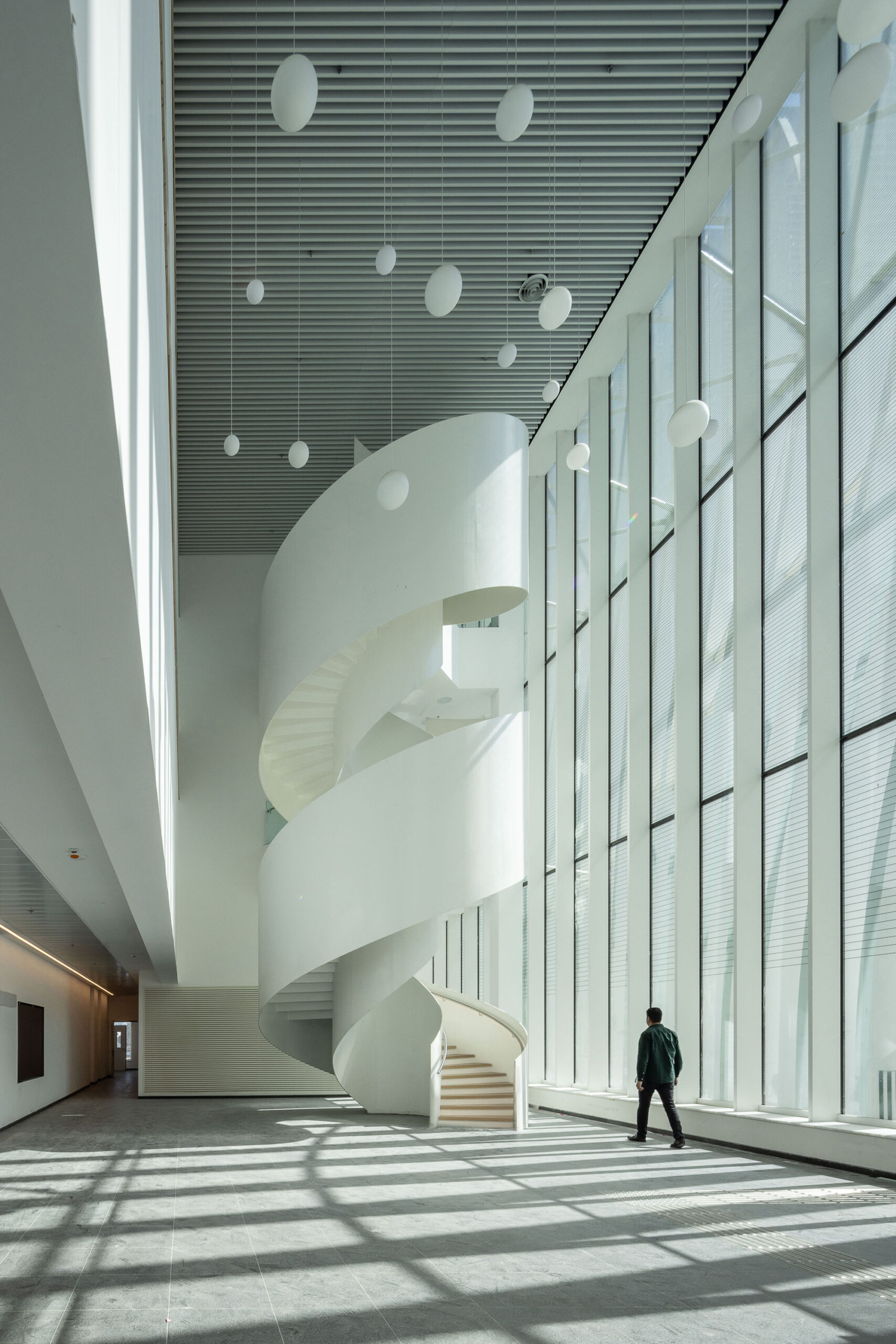
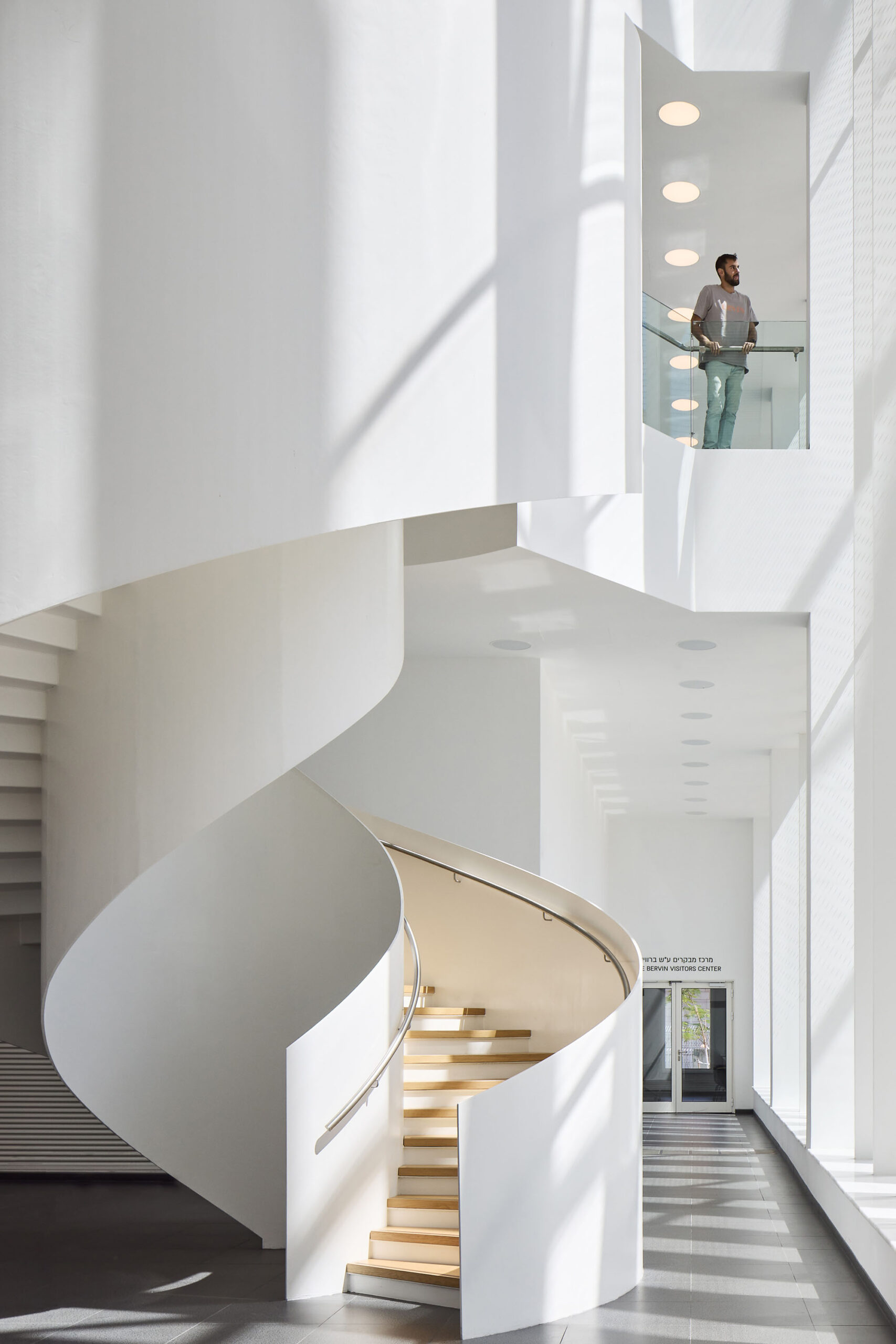
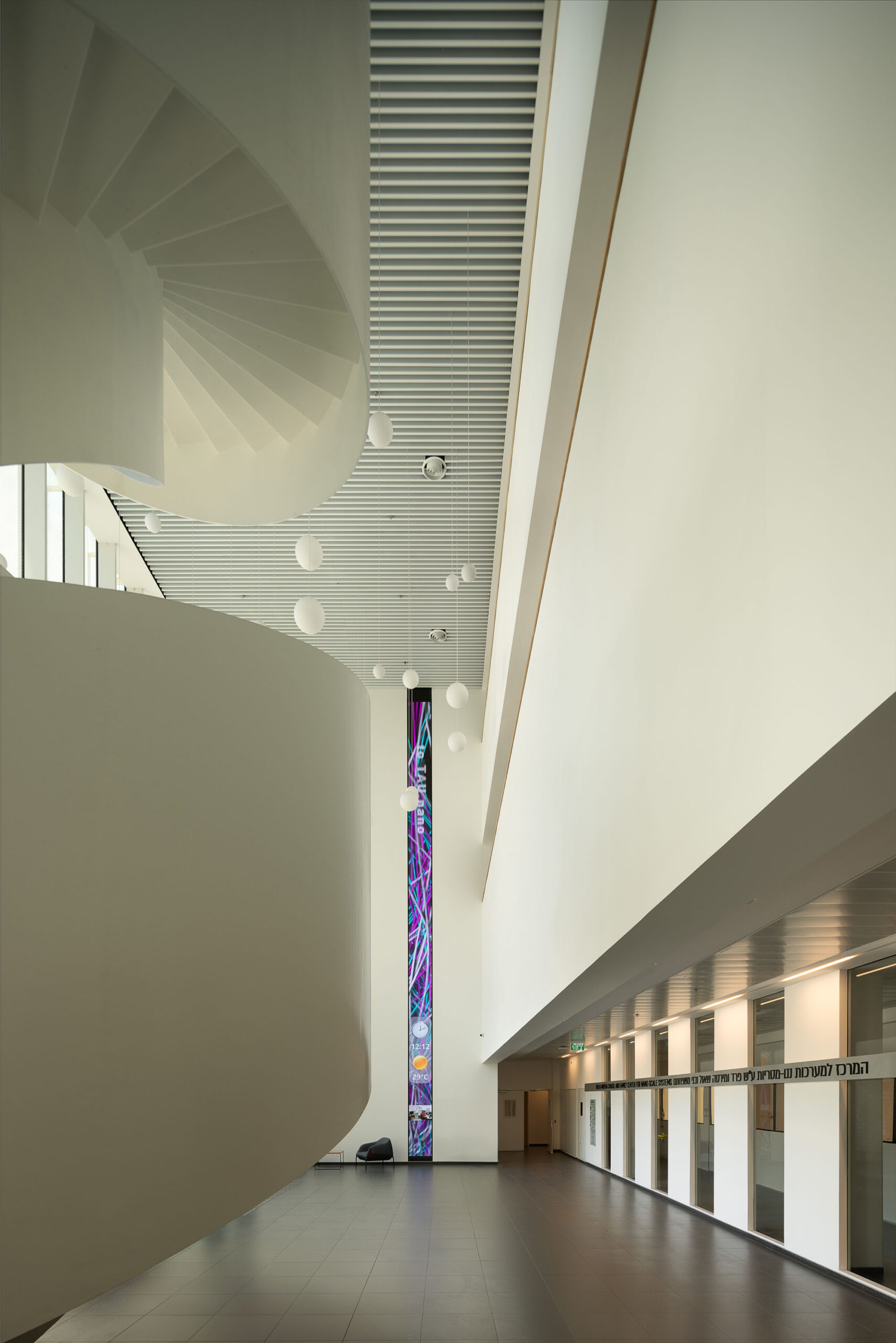
Around this central core is a large circulation ring bathed in daylight. A space where research scientists can exchange and meet.
An elegant sculptural white spiral staircase rising from the lobby conceals the elevators behind. It invites you to wander, symbolizing walking as the driving force behind scientific discovery.
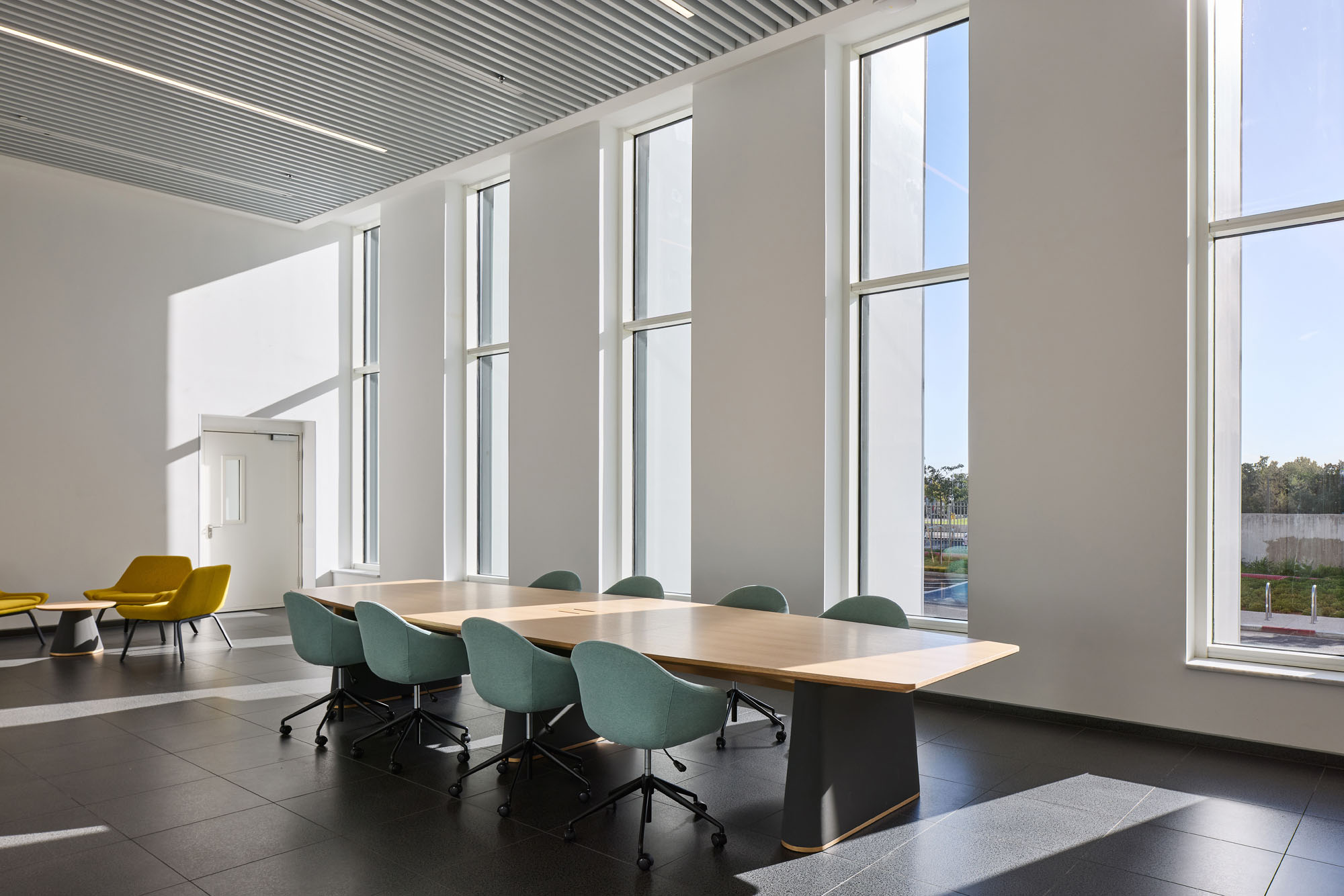
Office spaces give on to the outdoors by means of large floor-to-ceiling windows. Protected from sunlight by the external white-lacquered steel skin, they form deep returns that delicately filter the daylight.
Studied to provide optimal working conditions, the building is an adaptable matrix – an architectural and technical framework designed to meet the extraordinary challenges of a “science factory”.
EXPLORING THE INVISIBLE
At the heart of the NanoCenter, the research reaches unexplored frontiers.
Professor Yael Hanein commits to the development and improvement of neural implants. With her team, she develops miniaturized systems capable of interacting with the nervous system, developing major opportunities in the fields of hearing and artificial vision.
Her colleague at the Center, Professor Tal Dvir pushes the boundaries of human tissue 3D printing, a combination of microfluidics and nanotechnology. His research aims to regenerate complex organs – heart, spinal cord, brain – and to develop innovative methods for delivering stem cells throughout the body.
To carry out these innovative projects, research scientists have access to state-of-the-art technological equipment: electron microscopes, electron beam lithography devices, high-precision spectrometers, nanoscopic lasers and manipulators operating at the nanoscale.
With this equipment, they explore territories in the nanoscopic world, develop new materials and design nanotubes or nanorobots with applications that are fascinating since they develop new opportunities.
CLEANROOMS
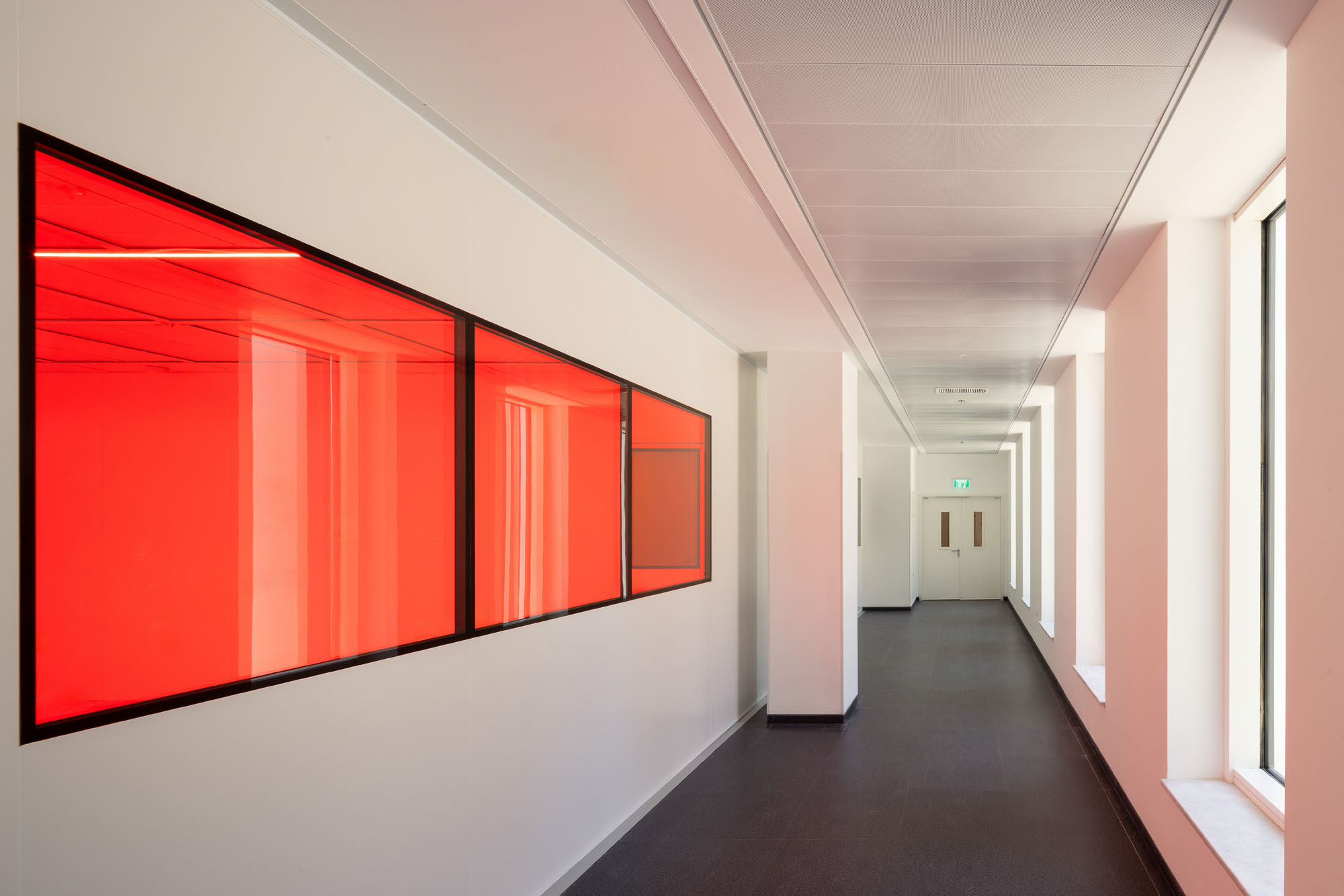
The new NanoCenter is a major architectural challenge. To carry out their state-of-the-art nanoscience work, research scientists have to operate within a «controlled atmosphere» that requires the complete absence of dust particles, electromagnetic interference and vibrations. Consequently, the provision of cleanrooms is a top priority.
A fascinating schema of the sources of nuisance and their «victims» emerges, sometimes revealing unexpected interactions between the sensitive equipment and environmental disturbances. A game of chess begins, where every decision counts in order to solve an extremely complex technical configuration.
Essential for the performance of scientific equipment, dust control requires successive spaces nested like “Russian dolls”, each providing an optimal ISO level of cleanliness.
The building is also designed to house large-scale scientific equipment. Custom-design solutions were integrated, such as a monumental freight elevator capable of transporting an entire room. Also, demountable panels in facade facilitate the installation of long optical tables for high-precision lasers.
Beyond its scientific vocation, the building carries a strong architectural intent – to become an emble- matic edifice at the eastern entrance to the campus that underscores the commitment of the university and its benefactors to scientific excellence.
STEEL FINS
The architectural concept plays with notions of scale – exploring the infinitely small, the human scale and the absence of scale to create a unique spatial experience. A matrix of vertical elements forms an external envelope that surpasses architectural conventions. Windows and doors blend in creating an abstract geometric background.
The NanoCenter is a parallelepiped form on a square base measuring 50 meters on each side, rising three levels over a services basement. An additional roof level services floor caps the building. The exceptional height of each floor (two-story 25 meter high building) gives the building the monumentality of a palazzo.
Discreetly located on the south facade, the entrance is marked by a play of undulations that simulates the effect of wind on the matrix. A filter between the interior and exterior, this second skin regulates daylight to create a soft and dynamic interface between the spaces.
Composed of 146 vertical steel fins each measuring 25 meters in height, 1 meter deep and 20cm thick, this protective screen expresses the overall structural grid. Spaced 1.2 meters apart, the fins turn up at roof level to form a three-dimensional «cage,» concealing the plant rooms behind an aluminum cladding.
On the north, east and west facades, the grid is directly attached to the main volume. To the south, the steel fins extend a further 6 meters to form an effective sunshade. By playing with the path of the sun, this configuration allows for optimal regulation of shadows within the interior spaces while maintaining a depth that gives the architecture energy.
CONTROLLED ATMOSPHERE
How to build a high precision scientific environment?
To meet an exceptional vibration criteria (VC-G) for a dozen state-of-the-art scientific facilities is a challenge, especially when even a car passing over a speed bump in the adjoining parking lot can be a disturbance.
Furthermore is the need to reconcile the high voltage electrical currents required for building operations, alongside extremely sensitive equipment.
To meet this level of performance requires the design of cleanrooms. These highly controlled spaces require a complex architecture with an unusual ratio between usable floor areas and services areas.
Each usable square meter dedicated to research requires:
– One square meter of deep access service floors (50cm high) to accommodate environmental services distribution and plant, supplemented by a «Sub-fab» floor in the basement to house heavy plant.
– One square meter of trafficable plenum, equivalent in height to one floor level, for air circulation and maintenance, as well as a services level on the roof for ventilation, filtration plant and controls.
Accordingly, four square meters of structure and services are required for every operational square meter.
This architectural complexity is required to meet the specific requirements of nanoscience research. It requires high-level expertise in cleanroom design, air flow control and management of electromagnetic and vibration interferences.
SIXTH FACADE
To accommodate future state-of-the-art equip- ment, the building has to meet demanding scientific constraints: no vibrations; no electromagnetic distur- bance; and no dust can interfere with the activities undertaken within.
To eliminate vibrations from outside, nine immense concrete blocks were poured on-site, anchored to the deep solid foundation. These blocks can be fitted with a hydraulic system that enables the complete absorption of vibrations, making vibrations imperceptible.
This device underscores a building design that provides a perfectly stable base. It constitutes a «sixth facade».
CONSTRUCTION
The building envelope is composed of a series of vertical metal fins, forming a continuous second skin around the volume. Devoid of conventional openings (windows, doors), it acts as an environmental filter: it controls sunlight; optimizes daylight; and facilitates thermal control. Following precise curves, the sections generate undulations in facade giving it a dynamic aspect.
The manufacture and installation of these elements were confided to CIMOLAI, a company specializing in bespoke metalwork. Their contract included structural engineering, custom-made elements and on-site assembly while respecting dimensional tolerances and performance requirements.
DESIGN TEAM
The Atelier d’Architecture MICHEL RÉMON & AS- SOCIÉS led by ALEXIS PEYER architect (partner and co-director) provided the architectural design and monitoring during construction stage. The client appointed the Haifa-based Y.Y. GRANOT ARCHITECTS firm to provide project management and consultant advice during the technical development stage.
Franco-Israeli engineering teams were formed to undertake this state-of-the-art scientific facility. WSP France and the BARAN GROUP combined their expertise in mechanical and electromagnetic engineering. WSP FRANCE and KARBAN collabo- rated on the building structure.
French vibration control specialists AVLS and DYNAMICA worked to ensure a perfectly stable environment for the study of the infinitely small, taking into account the immediate proximity of the regio- nal train linking Tel Aviv to Haifa, intense bus ser- vices and the daily on-campus activity.
The landscaping of the site was confided to lands- cape architects LAURE PLANCHAIS and MOSHE LANNEREN who designed the base facade inspired by trees species found in the neighboring botanical garden. Y. YANKOVITCH carried out construction.
MICHEL RÉMON & ASSOCIÉS
Under the leadership of Michel RÉMON and Alexis PEYER, for 40 years Atelier d’Architecture MICHEL RÉMON & ASSOCIÉS explores complex worlds: higher education buildings; research laboratories; hospitals; R&D centers and sports facilities.
Since the development of the Police Scientifique (INPS) laboratories in Écully in 2001, the Atelier has undertaken a number of High Tech projects particularly in the fields of nanotechnology, biology, microbiology, pathology and solar energy research, often distinguished by major technical constraints (vibration control, confined sites, controlled environments, etc.).
The Atelier designs for major French institutions and companies including CNRS, AIR LIQUIDE, AIRBUS, ÉCOLE POLYTECHNIQUE, CEA, NATIONAL INSTITUTE OF SOLAR ENERGY and APHP.
With a team of 30 staff, the Atelier has built nearly 100 buildings since 1984 with a 5 million euros before tax turnover in 2024. Its commitment to quality has been ISO 9001 certified since 2009.
ミシェル・レモン&アソシエイツ 公式サイト
https://www.michelremon.com/fr

![[Report]方丈庵から生き方を問う、21_21 DESIGN SIGHT 企画展「方丈記に学ぶ –生きるを編み直す小さな建築–」会場レポート](https://magazine-asset.tecture.jp/wpcms/wp-content/uploads/2026/09/01181900/20260828hojoki-ex_01_mag-endo4350-900x676.jpeg)