CULTURE
© Fernando Guerra FG+SG
中国・北京に建つ〈SPARK 761〉は、外部から隔絶されていた従来のデータセンターを都市にひらかれた公共的な場へと改修したAIデータセンターです。
不可視の「ブラックボックス」として存在してきたデジタルインフラを、人が触れることのできる建築的実体として位置づける試みであり、設計は上海・シュトゥットガルト・ポルトを拠点とする建築スタジオllLab.が手がけました。
注目ポイント
- 昼間は物理的な存在であり、夜間は仮想情報が躯体を演出するファサード表現
- AI・データ処理という不可視のプロセスを空間経験へ翻訳するアプローチ
- 都市に対して「計算能力の状態」をリアルタイムに表現
- 多機能な「コンピューティングパワー・シアター」を中心とした産業ハブ機能
(以下、llLab.から提供されたプレスキットのテキストの抄訳)
© Tian Fangfang
© Arch-Exist Photography
デジタル情報時代における「ブラックボックス」との共存
人類の文明は農耕時代を起点とし、産業革命による機械技術の革新を経て、情報時代のデジタル環境へと移行し、いまや人工知能と共存する時代に突入した。この長い歴史的プロセスにおいて、人類は絶えず世界の基盤的インフラを創造し、各時代のインフラの成果を通じて未来への新たな可能性を発見してきた。
デジタル情報時代に入ると、インフラは次第に目に見えない形で人間と共生するようになった。しかし、この潜在的な共存関係は、いつしか人間に隔たりを感じさせるようになった。人間はまるで、この「ブラックボックス」が世界にもたらした変化を、私たちの生活様式に再統合する新たな方法を模索しているかのようである。
一方的な入力と受動的な受容の関係から、変数を調整して合理的な結果を得ようとする試みへ、さらに発展して目に見えない入力と出力が人体と結合する方式へと至った。
© Arch-Exist Photography
「未知の進化との共生」という次なるステップ
おそらく私たちが今まさに理解しようとしていることは、すでに身近に存在する「ブラックボックス」環境にどのように適応するかという点である。目標は盲目的な拒絶ではなく、未知の進化によって生まれる産物と人間・環境が共生する機会を創出することにある。
そこで私たちは、この新たな人工知能インフラを創造する過程において、「ブラックボックス」の未知なる役割を解き放ち、本来触れることのできなかった世界を理解と交流の媒体へと変換し、さらに共進化と融合を試みることを目指した。
完全な隔離から、一方向の表現と受動的な受容を経て、身体と融合するウェアラブルなインタラクションモードへと至った現在、私たちはすでに想像し始めている。これらは将来、環境そのものとなり、目に見えない形で生活に溶け込み、いつでも交流する存在になるのではないかと。
© Arch-Exist Photography
© Arch-Exist Photography
物理と仮想が共存する〈SPARK 761〉 – 北京デジタルエコノミーAIDC(AI Data Center)
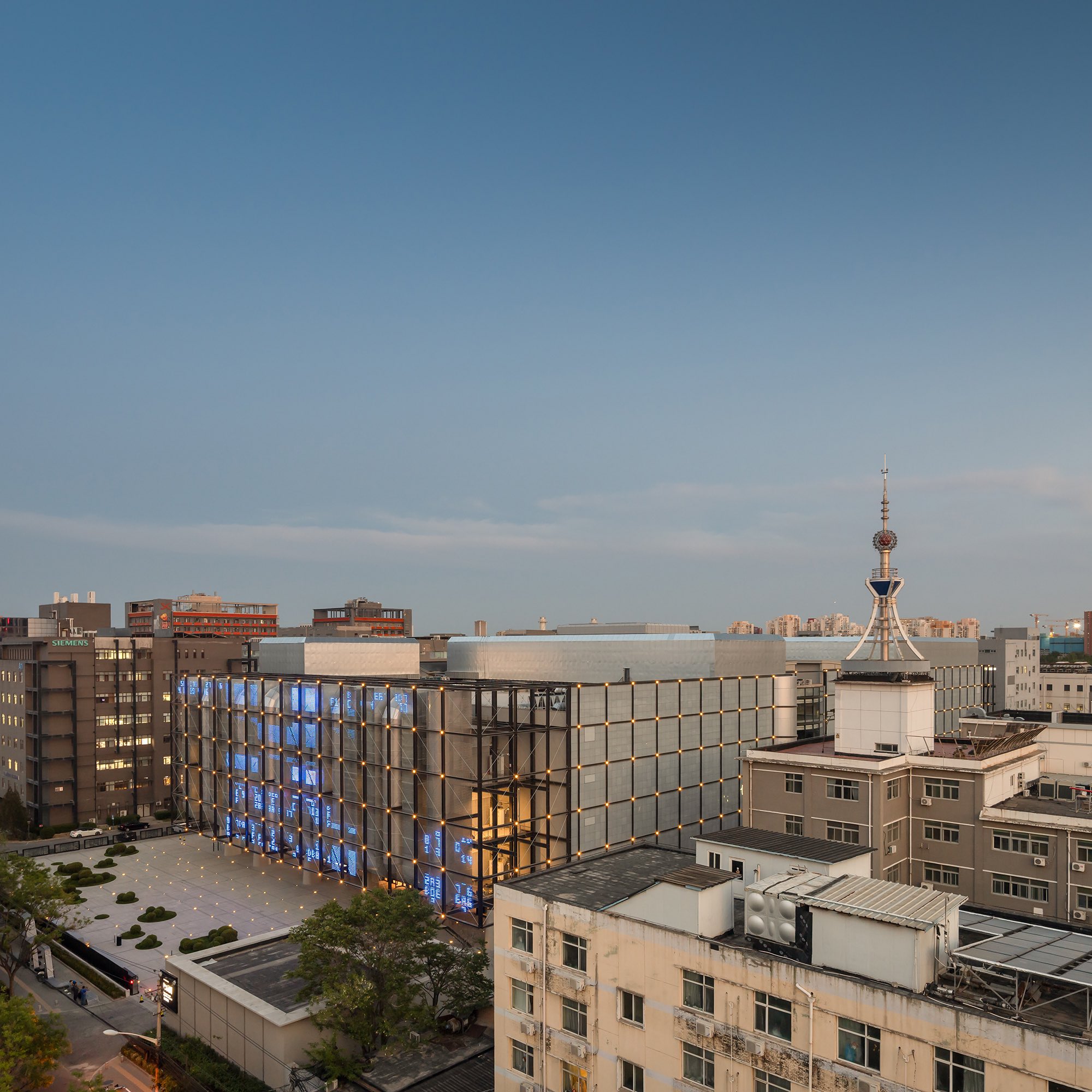
北京市朝陽区酒仙橋地区の中核エリアに位置する〈SPARK 761〉は、北京市中心部で唯一のAIコンピューティングパワー・パークである。
本建築の思想は、従来の閉鎖的なデータセンター建築システムを覆し、社会・人間・活動が建築・空間・仮想情報知能世界と共存する構造を描き出すものである。
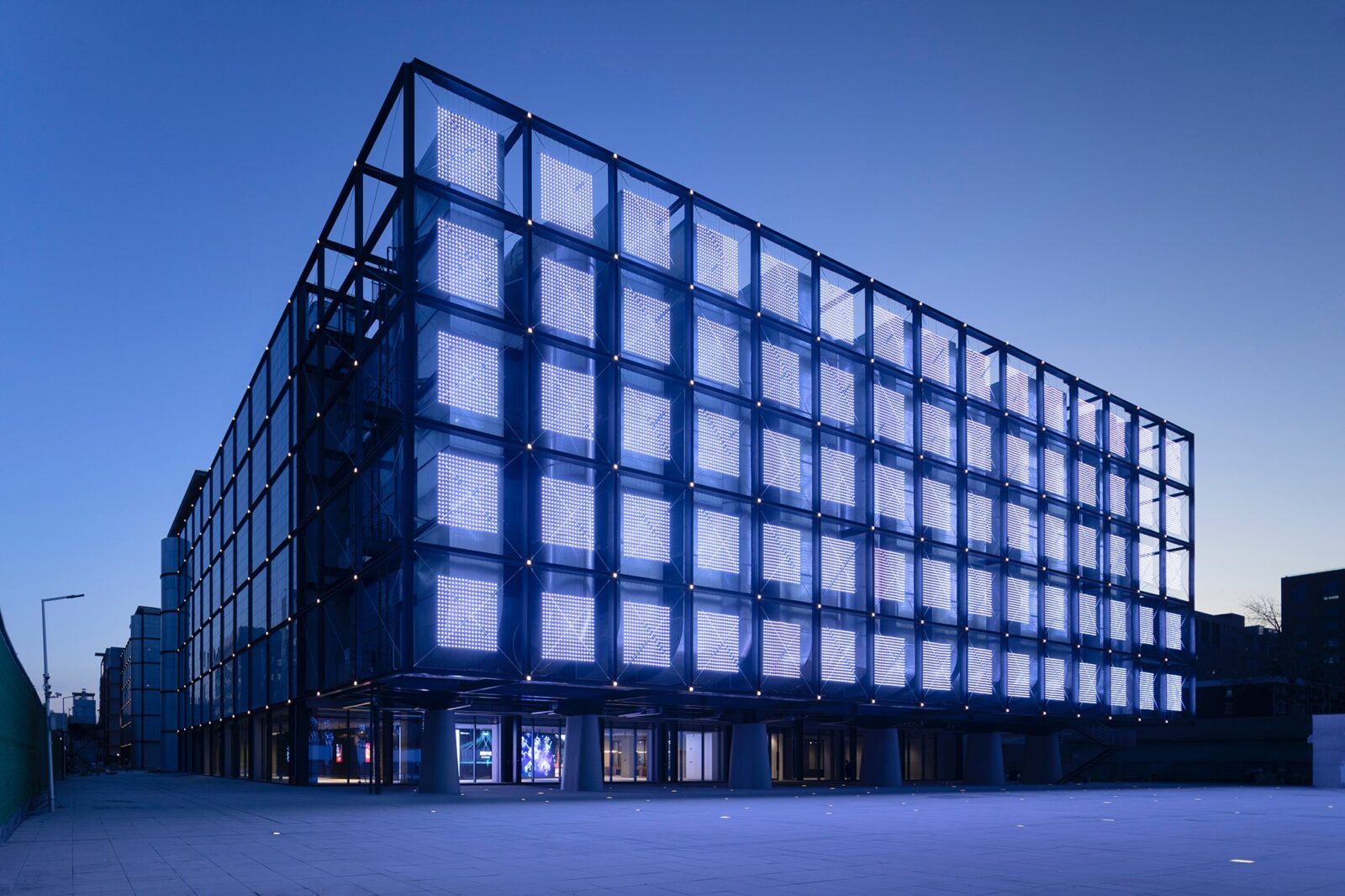
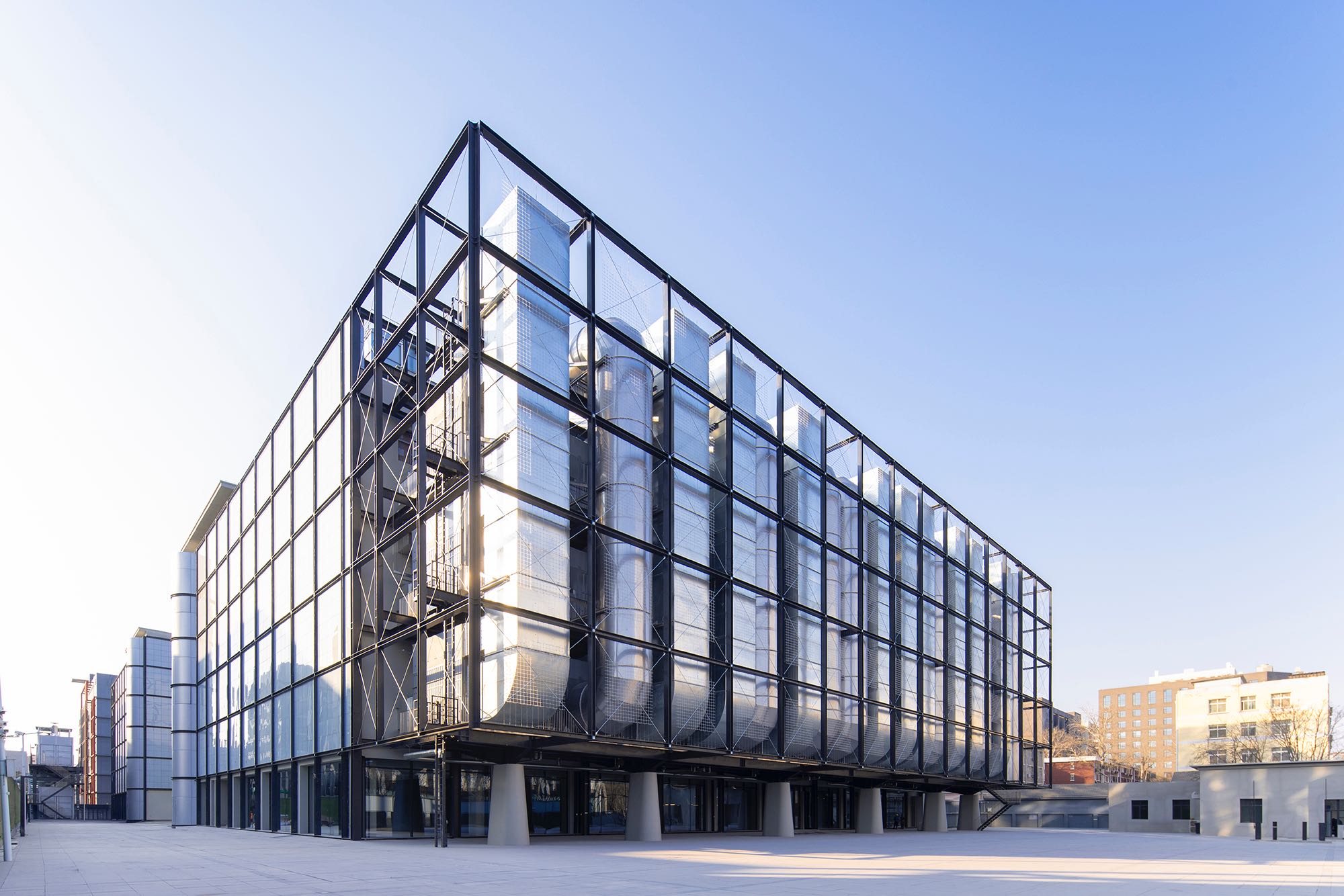
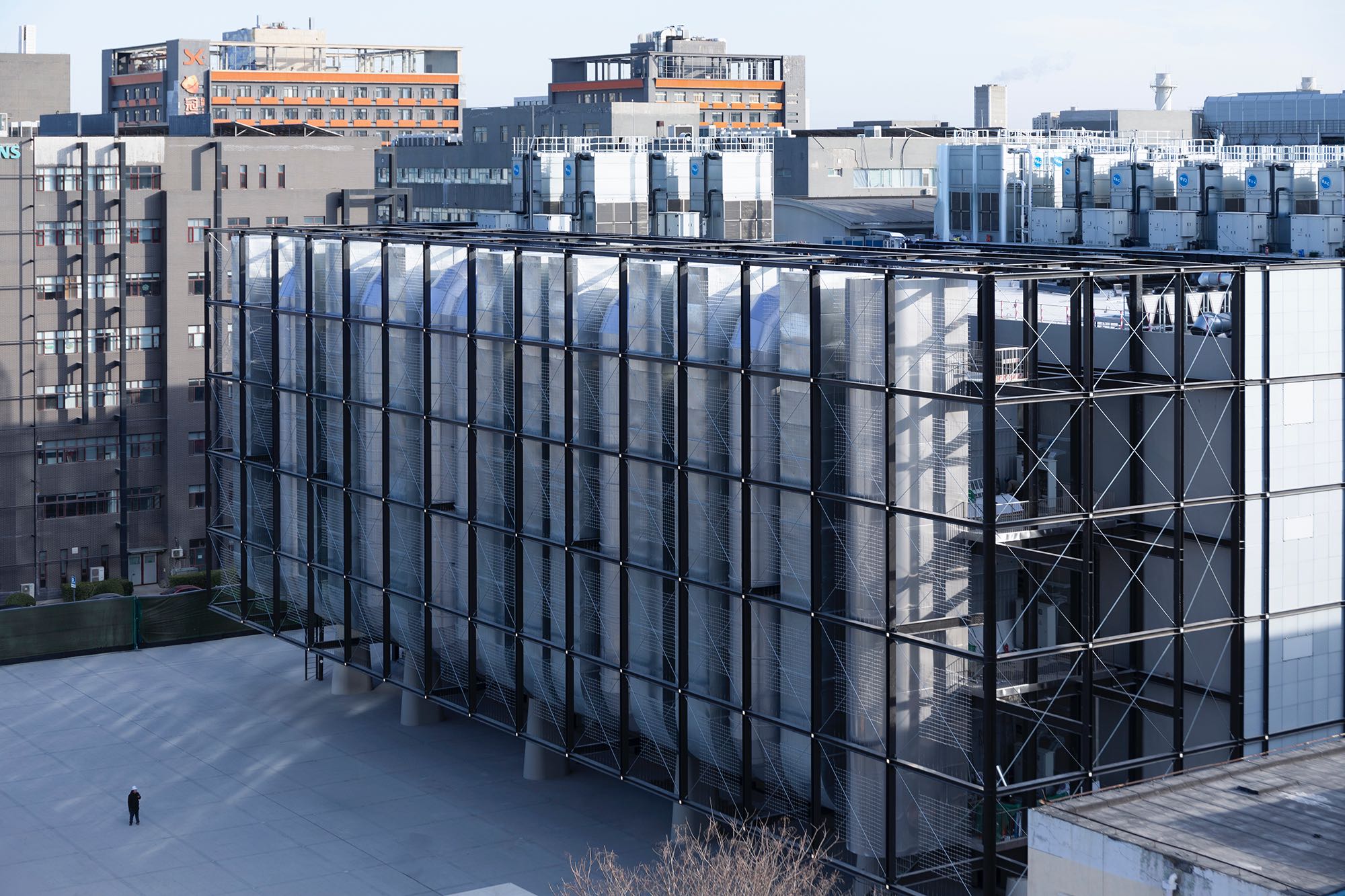
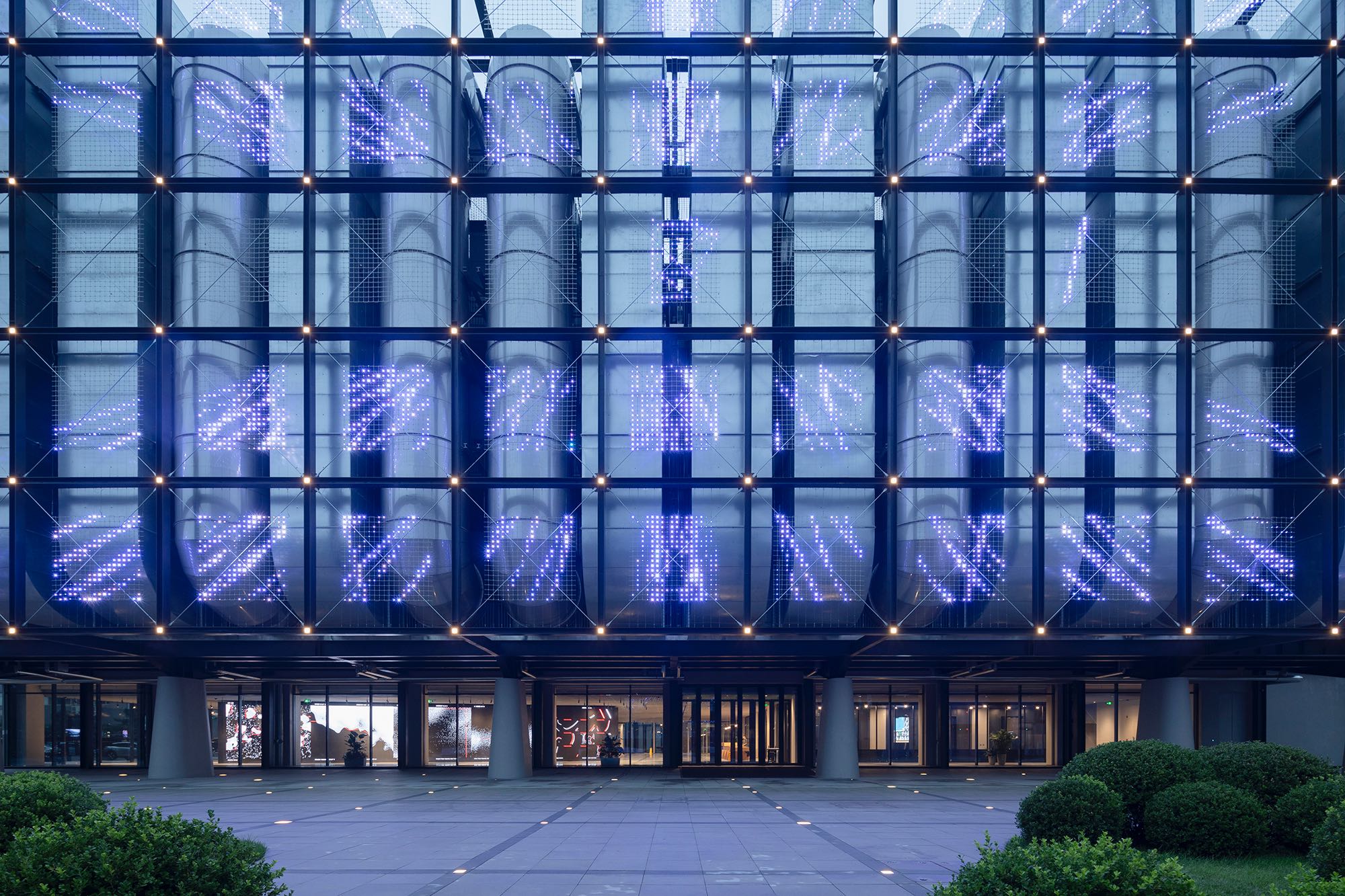
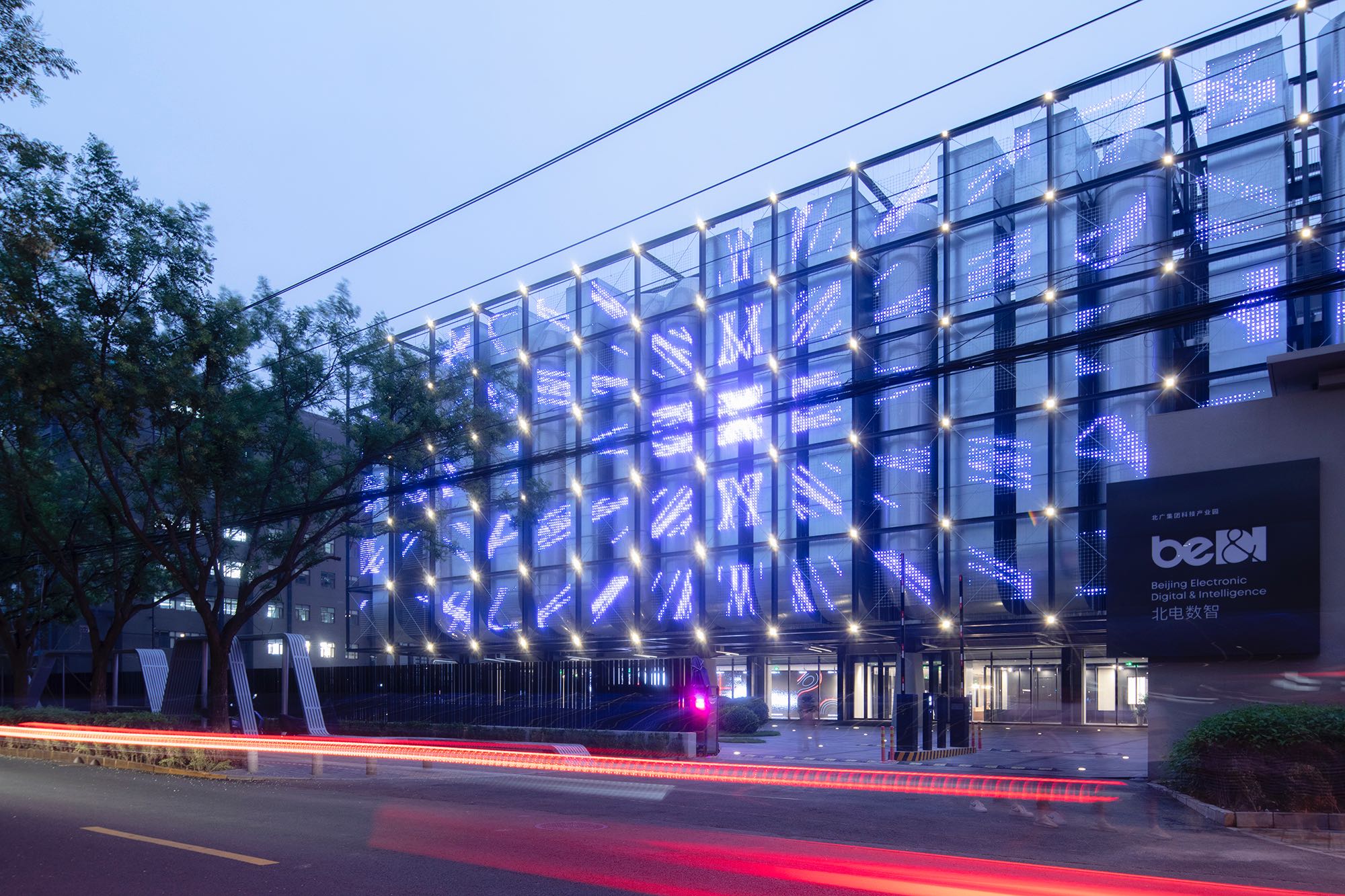
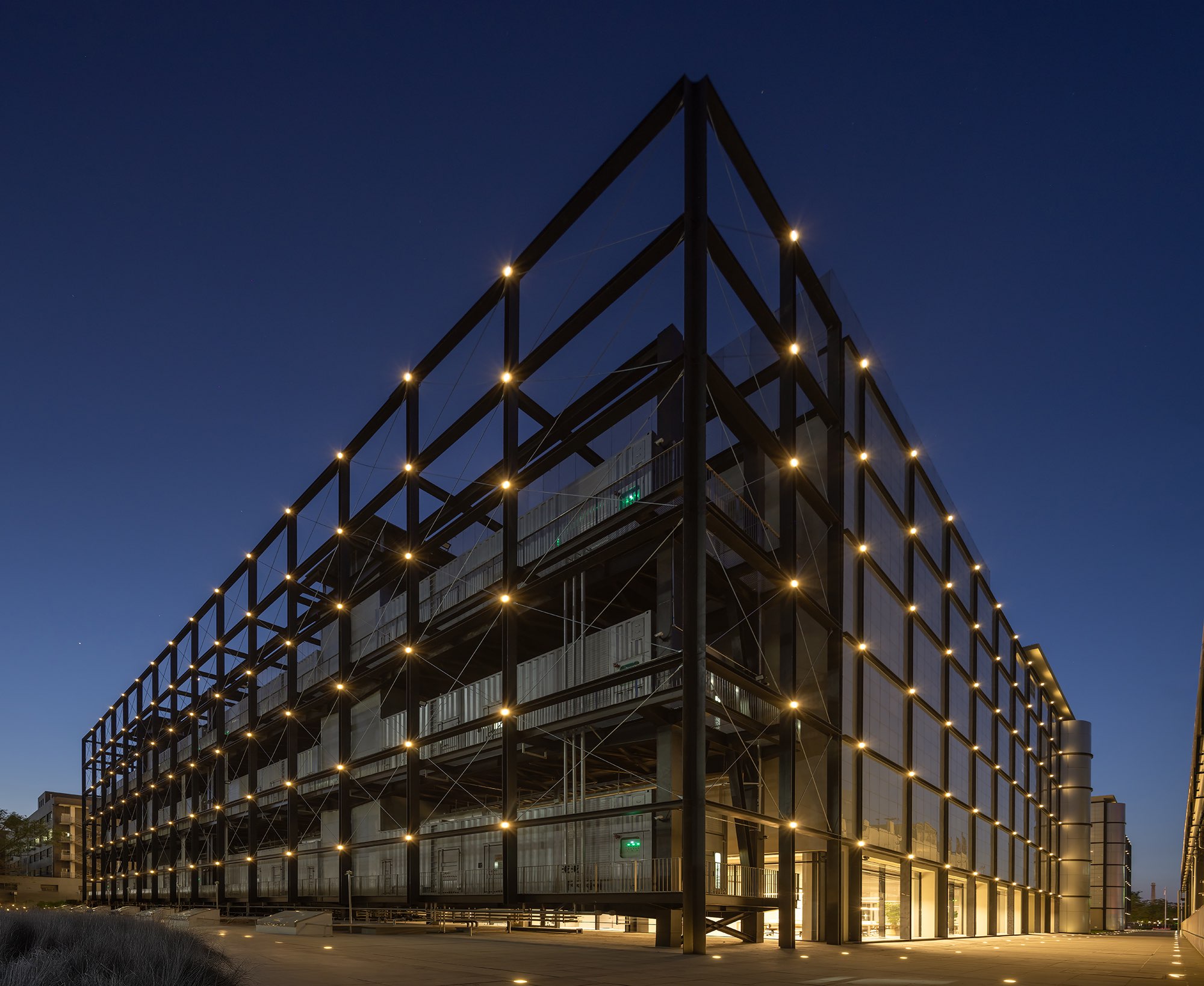
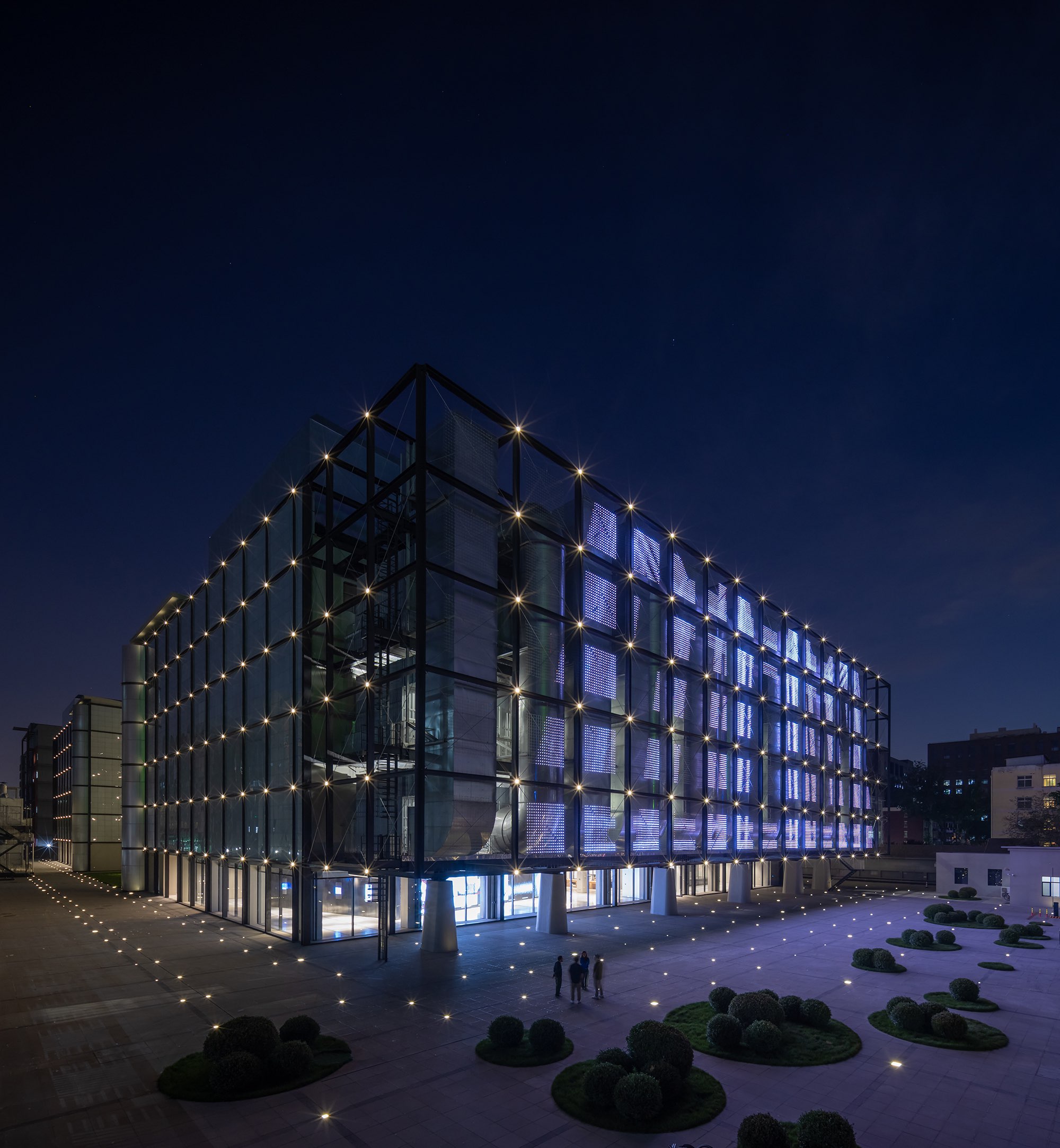
建築は日中はグリッドシステムの物理的形態として現れ、夜間は物理的躯体が視界から消え、仮想情報が建築の新たな躯体を形成する。建築は都市の中で、絶えず成長し存在し続ける形態として表現されている。
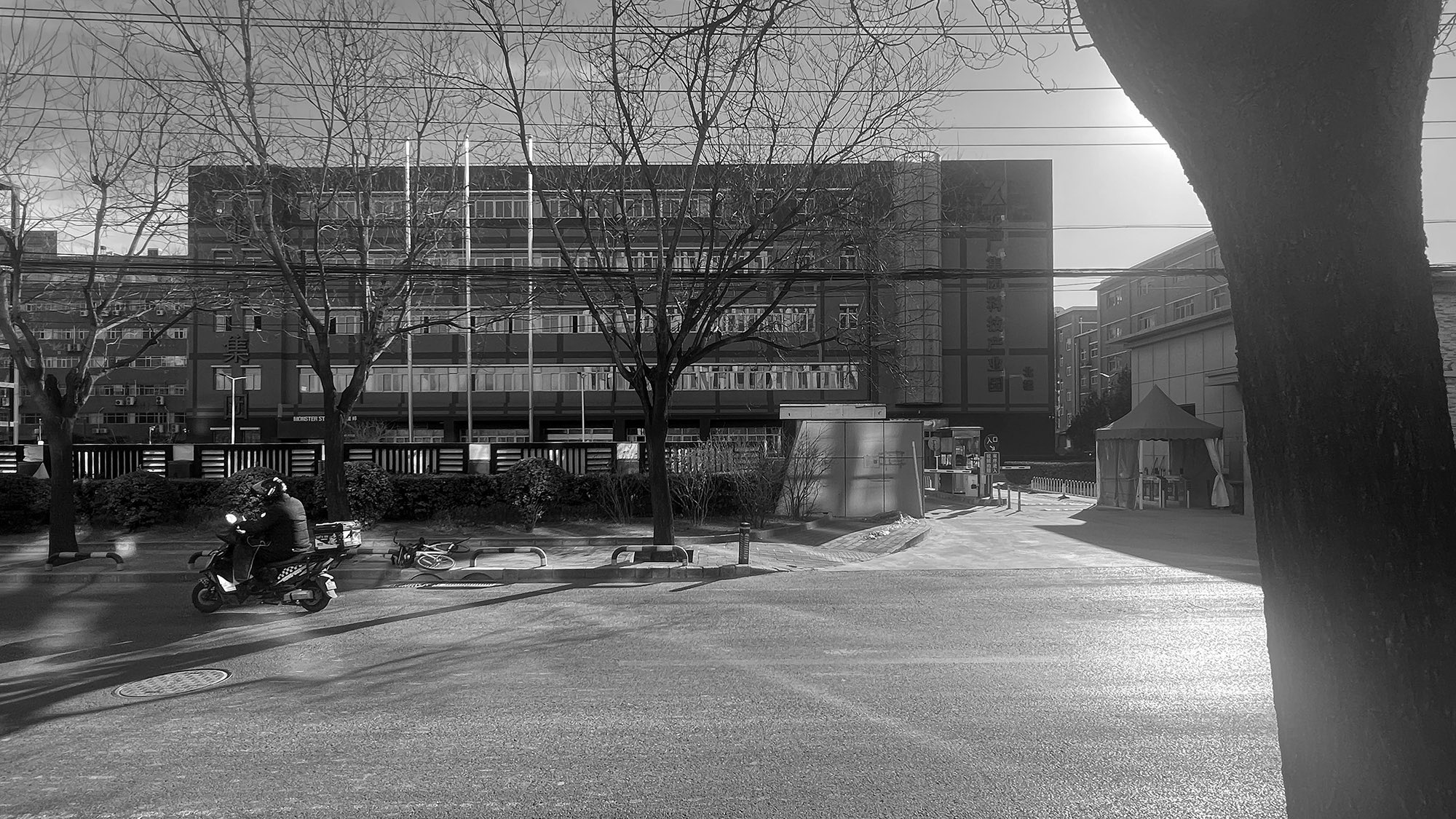
Before Renovation ©︎ llLab.
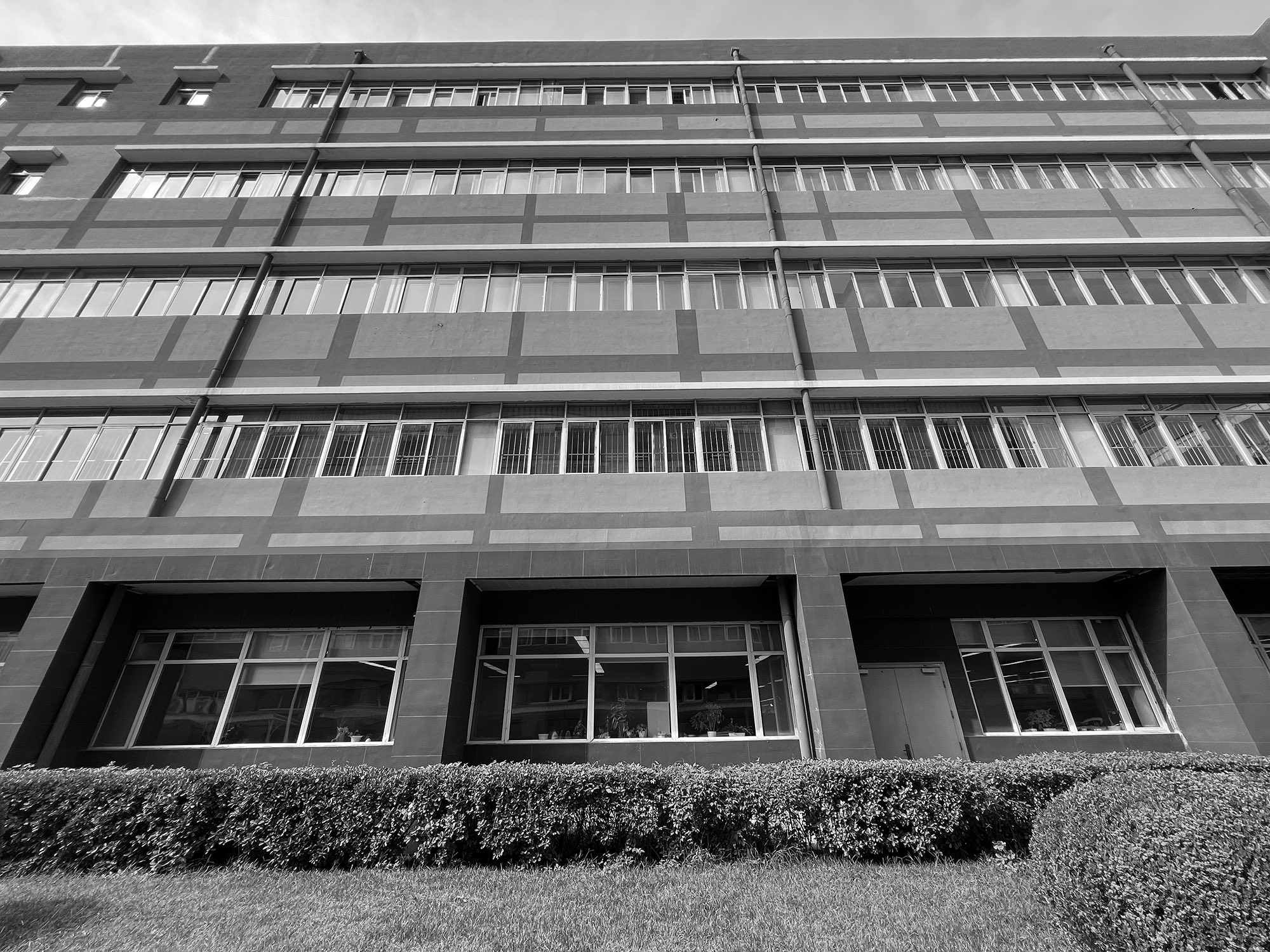
Before Renovation ©︎ llLab.
建物内の空間では、建築の原動力はコンピューティングパワー(計算能力)であり、コンテンツ開発の原動力は「コンピューティングパワー・シアター」である。
この空間は共存する人間活動を導入し、「ブラックボックス」と「ガラスボックス」を人間の空間の担い手として用い、オフィス、展示ホール、多目的室など多様な機能を受け入れる。
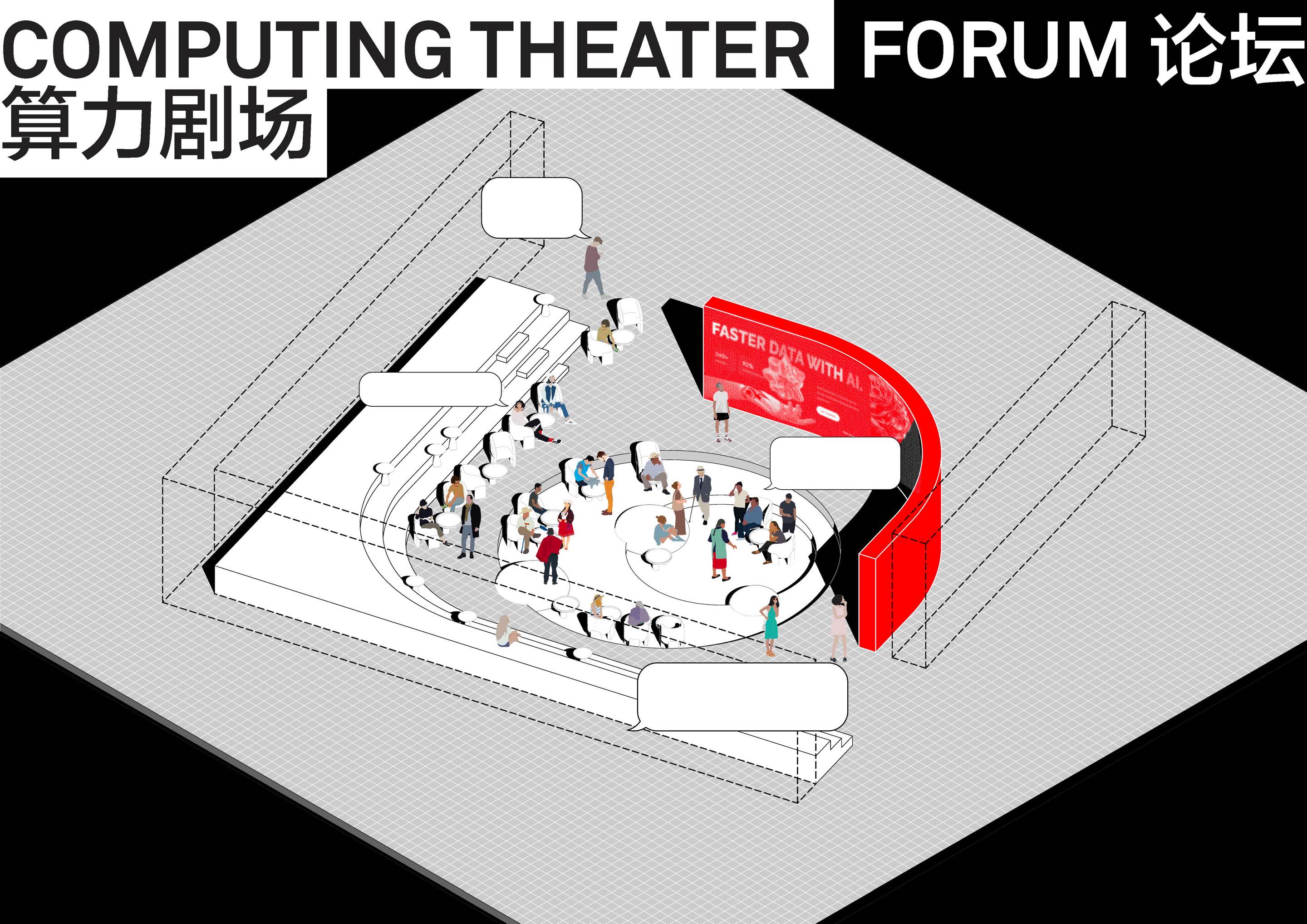
Computing Theater Forum ©︎ llLab.
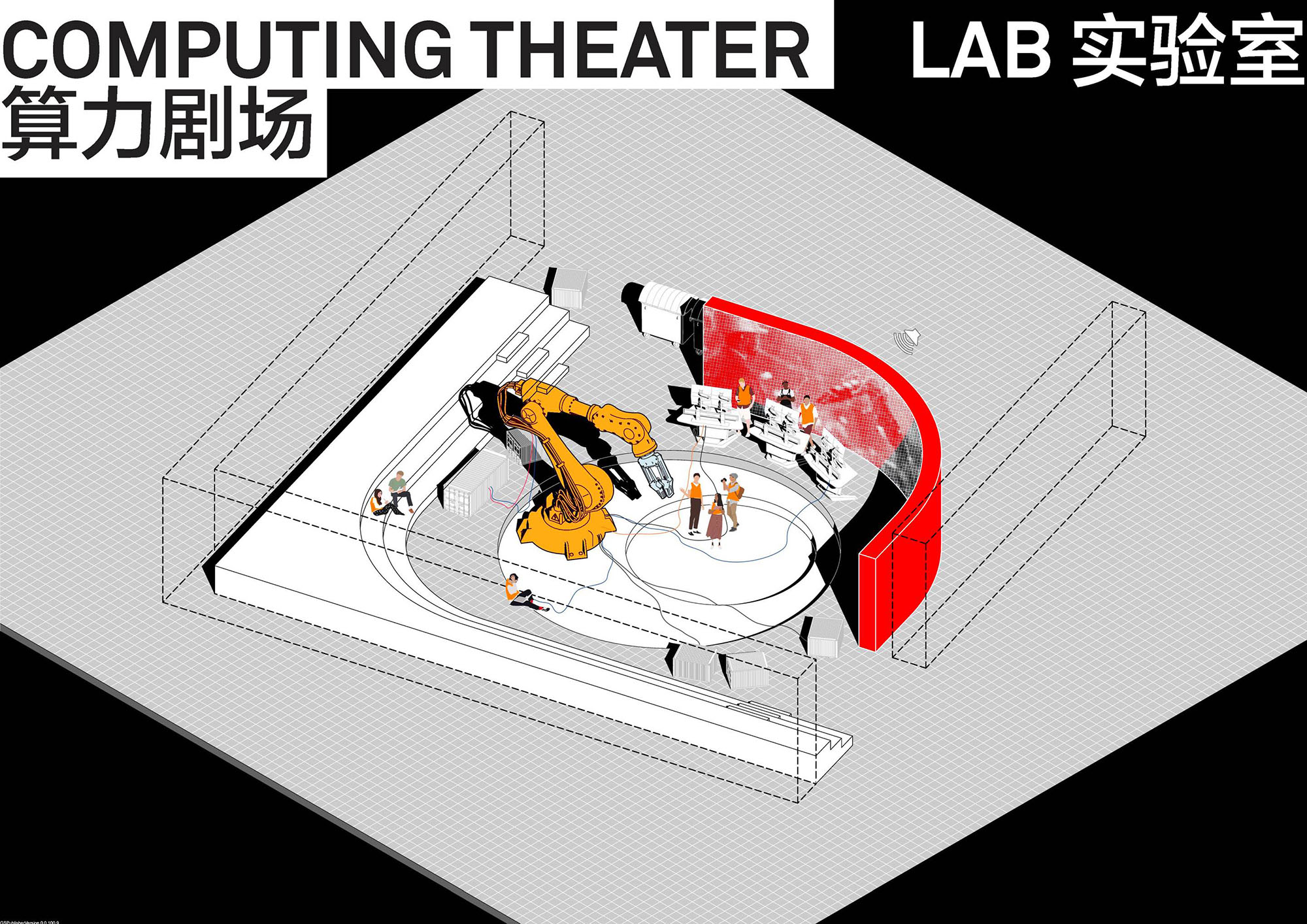
Computing Theater LAB ©︎ llLab.

Computing Theater Talk ©︎ llLab.
公共広場とファサード表現
昼:機能と生命の可視化
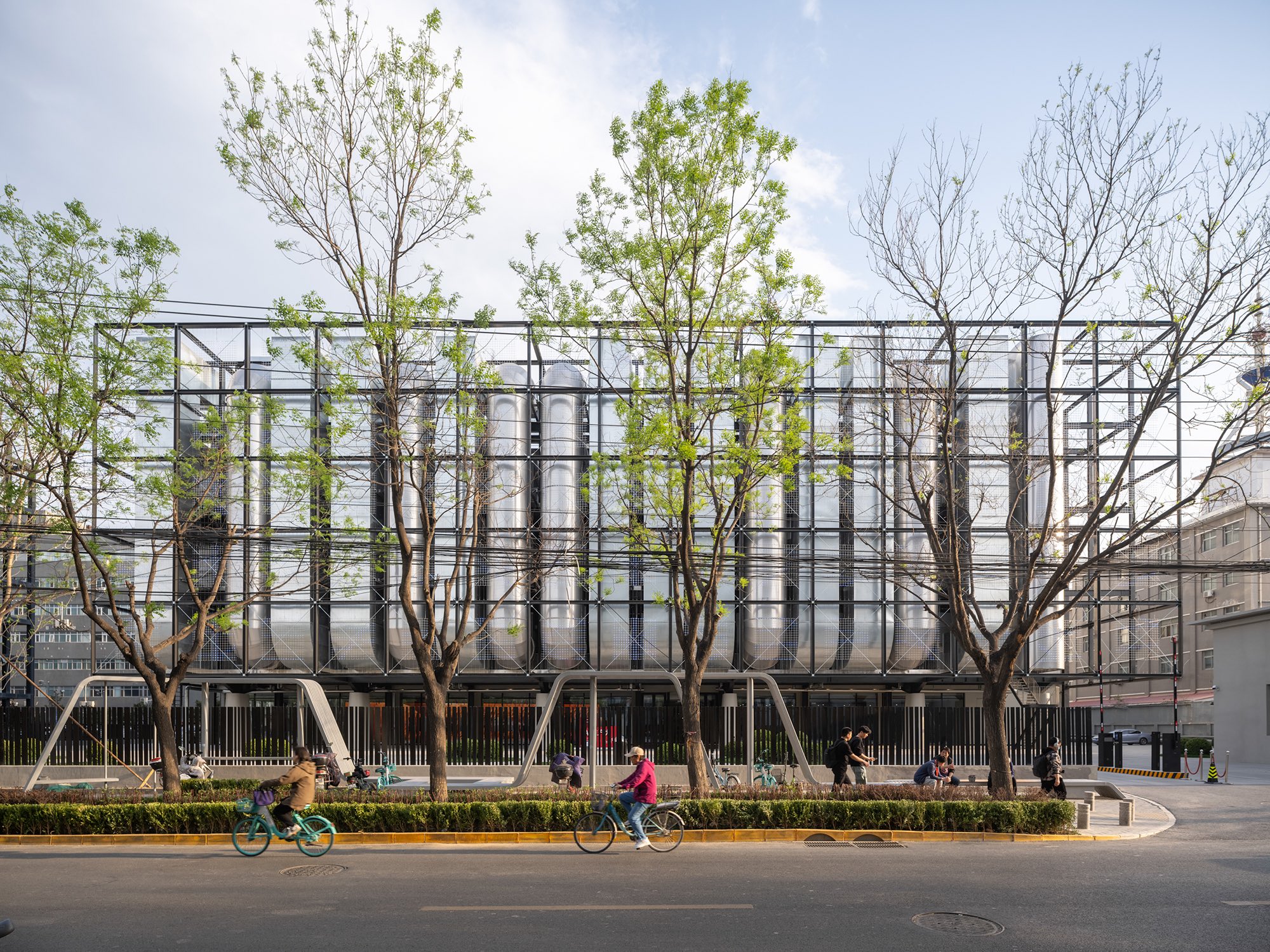
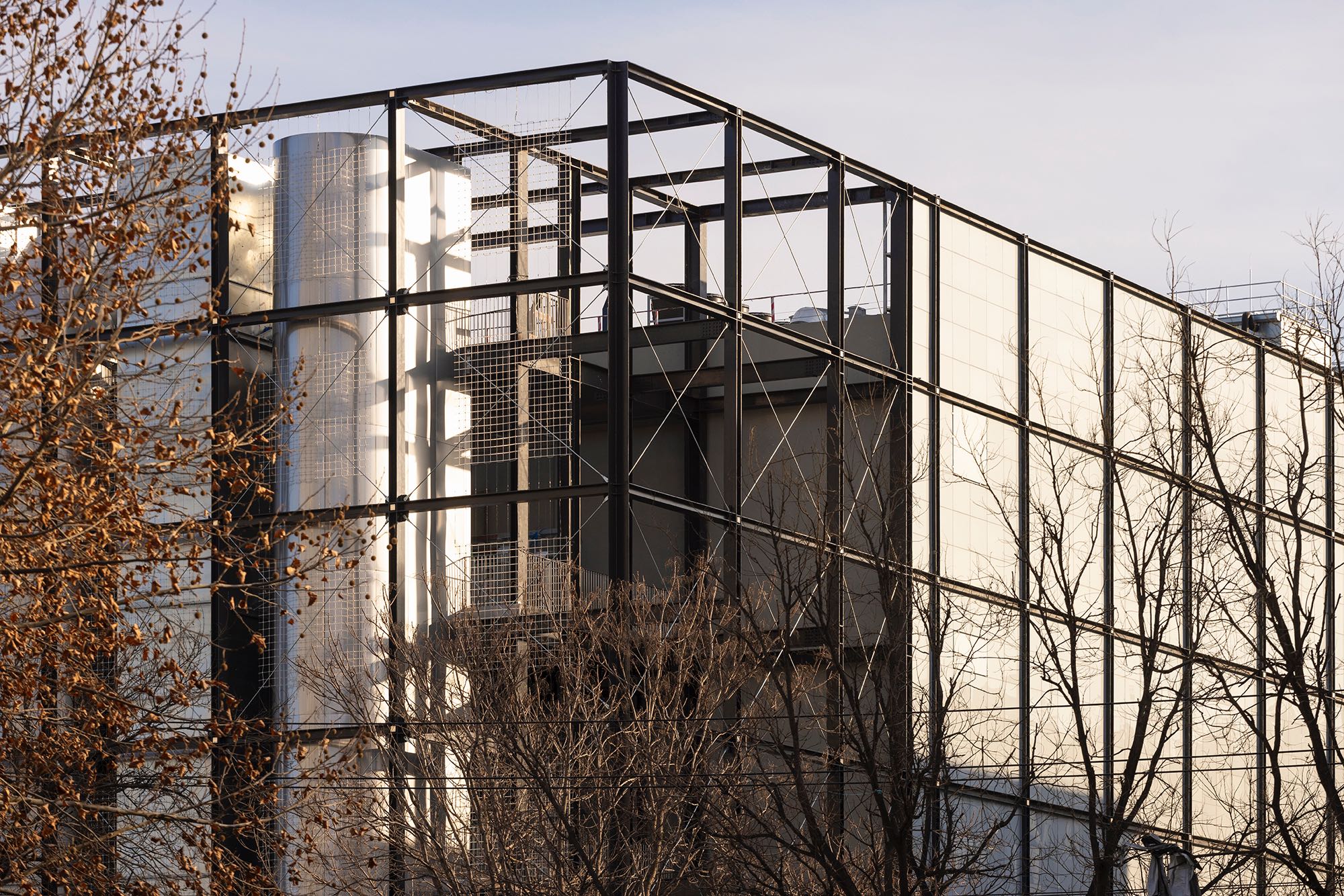
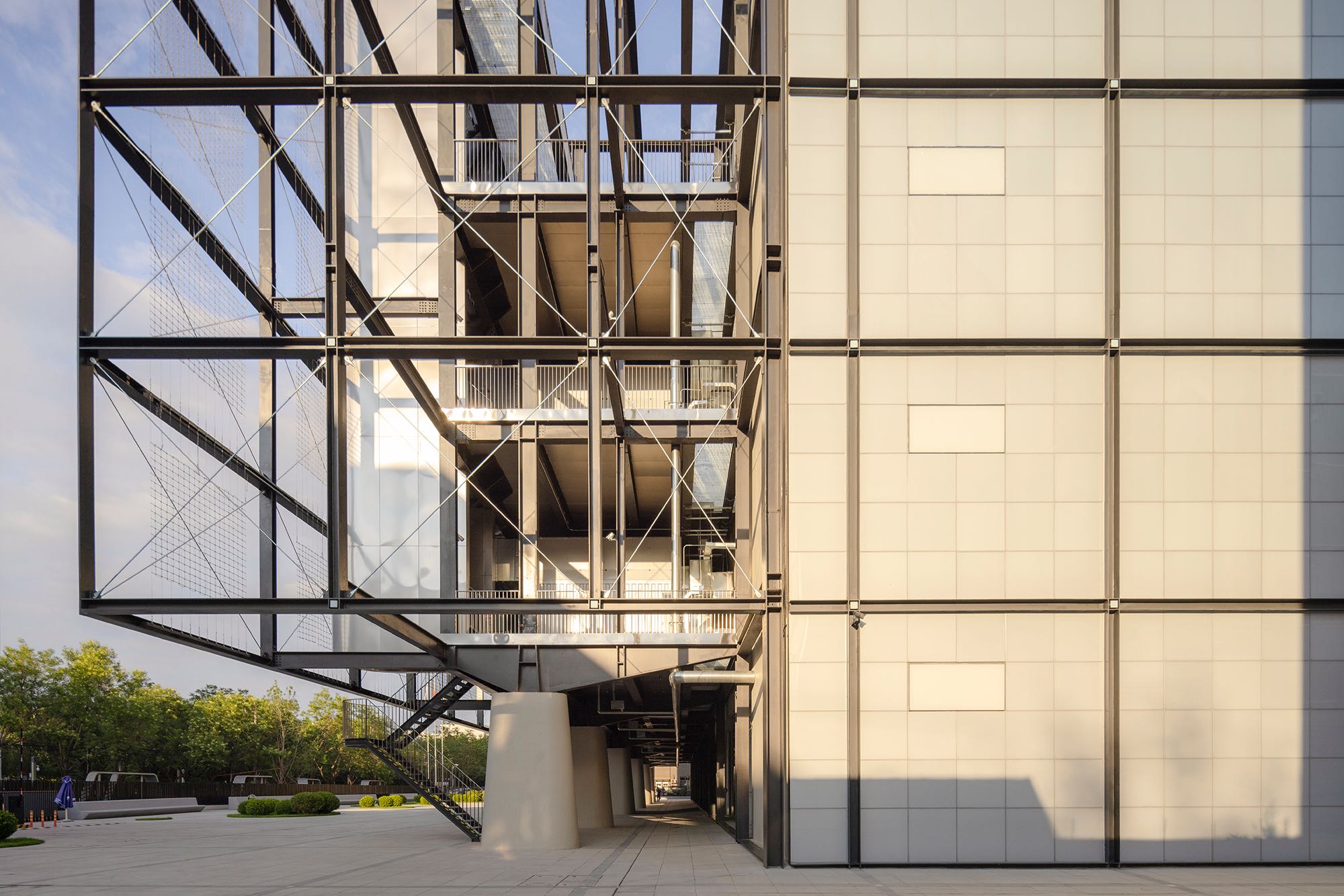
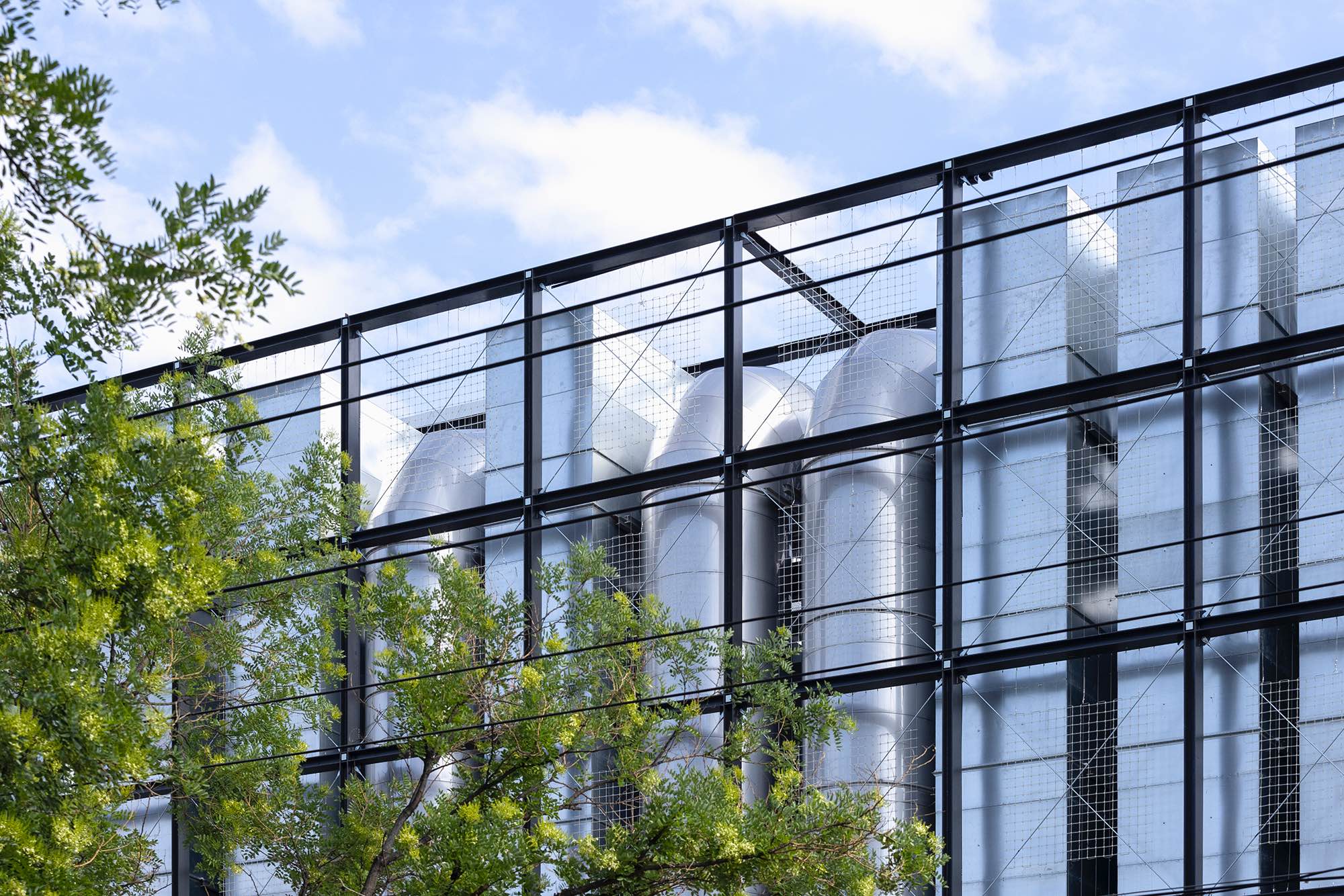
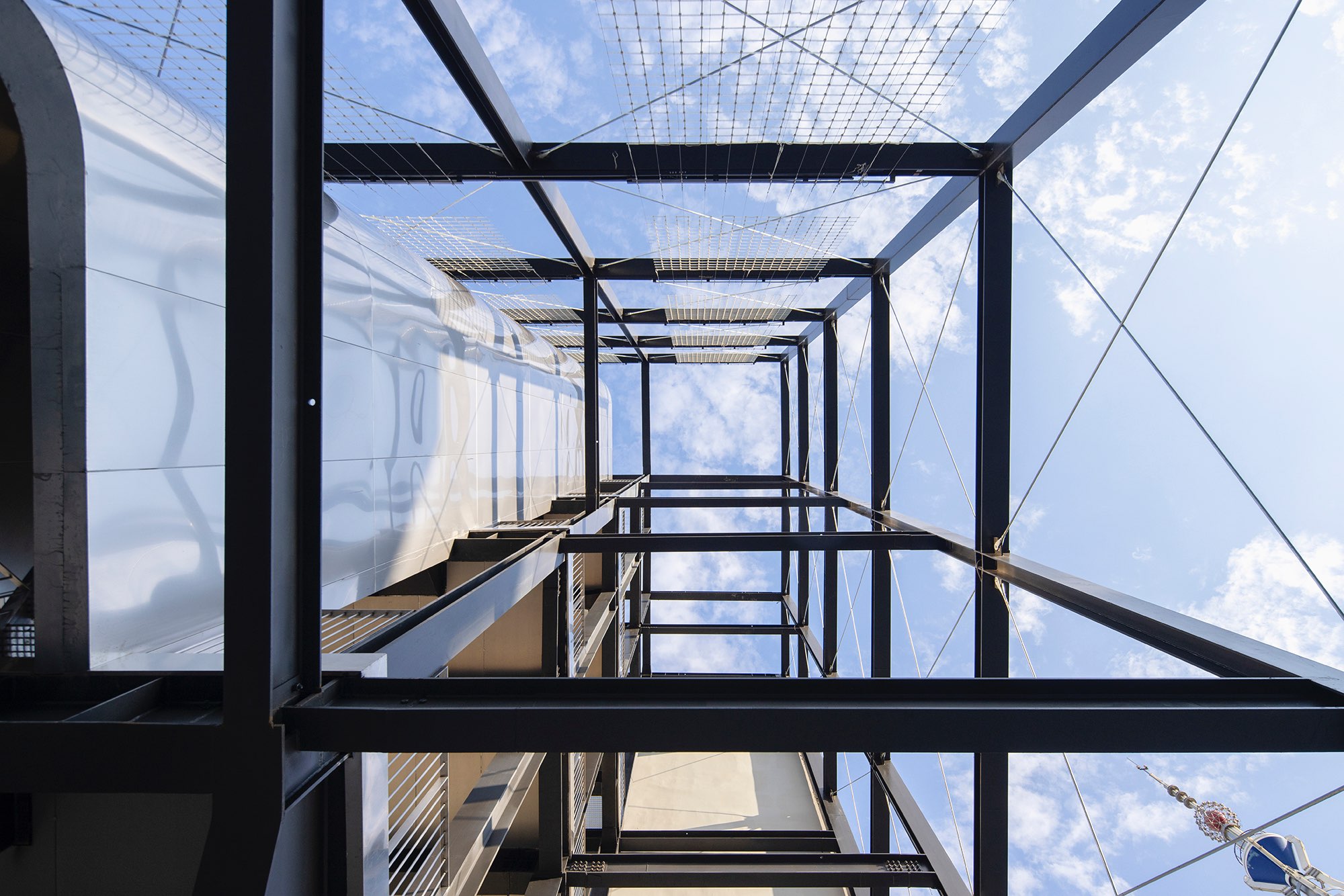
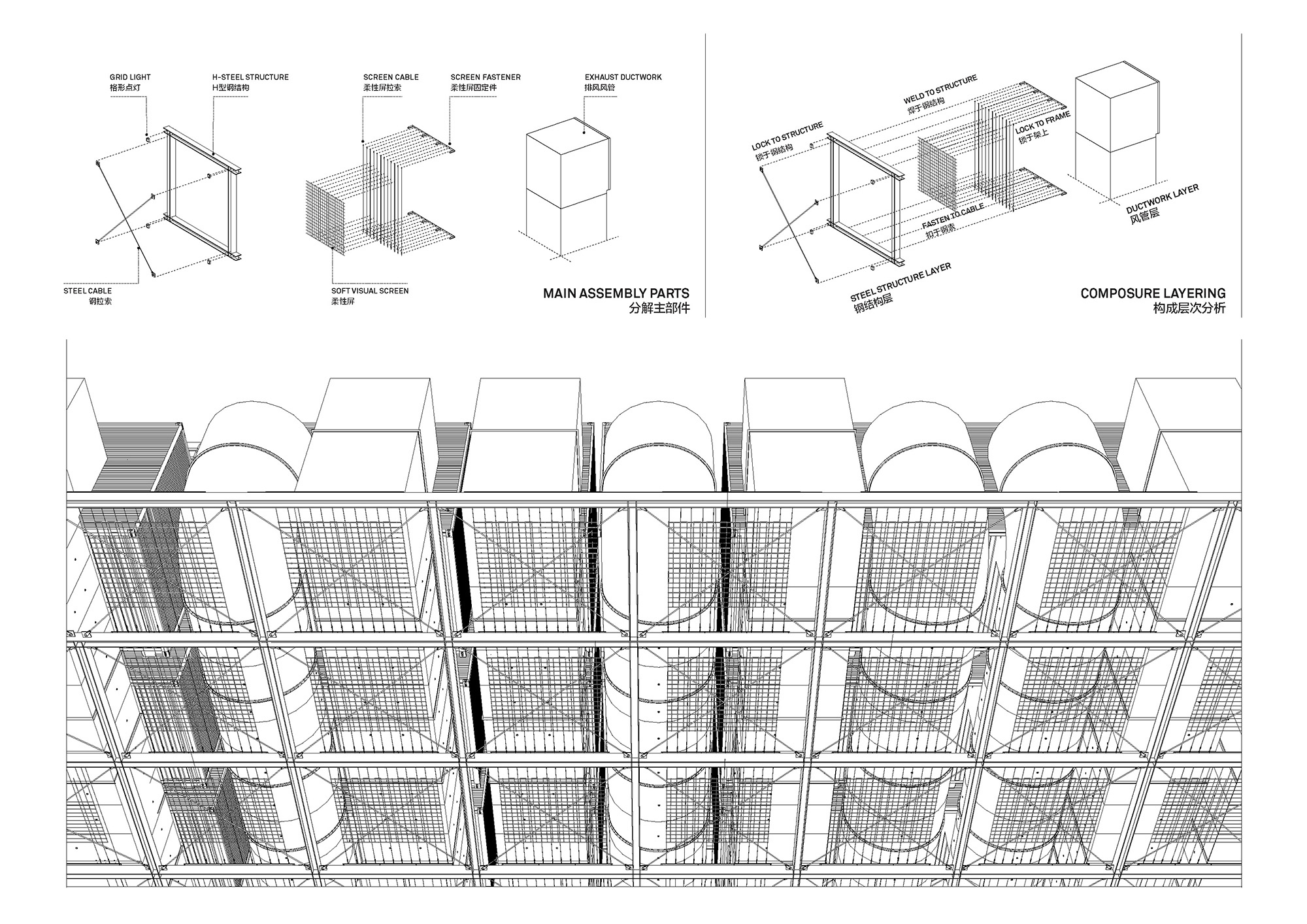
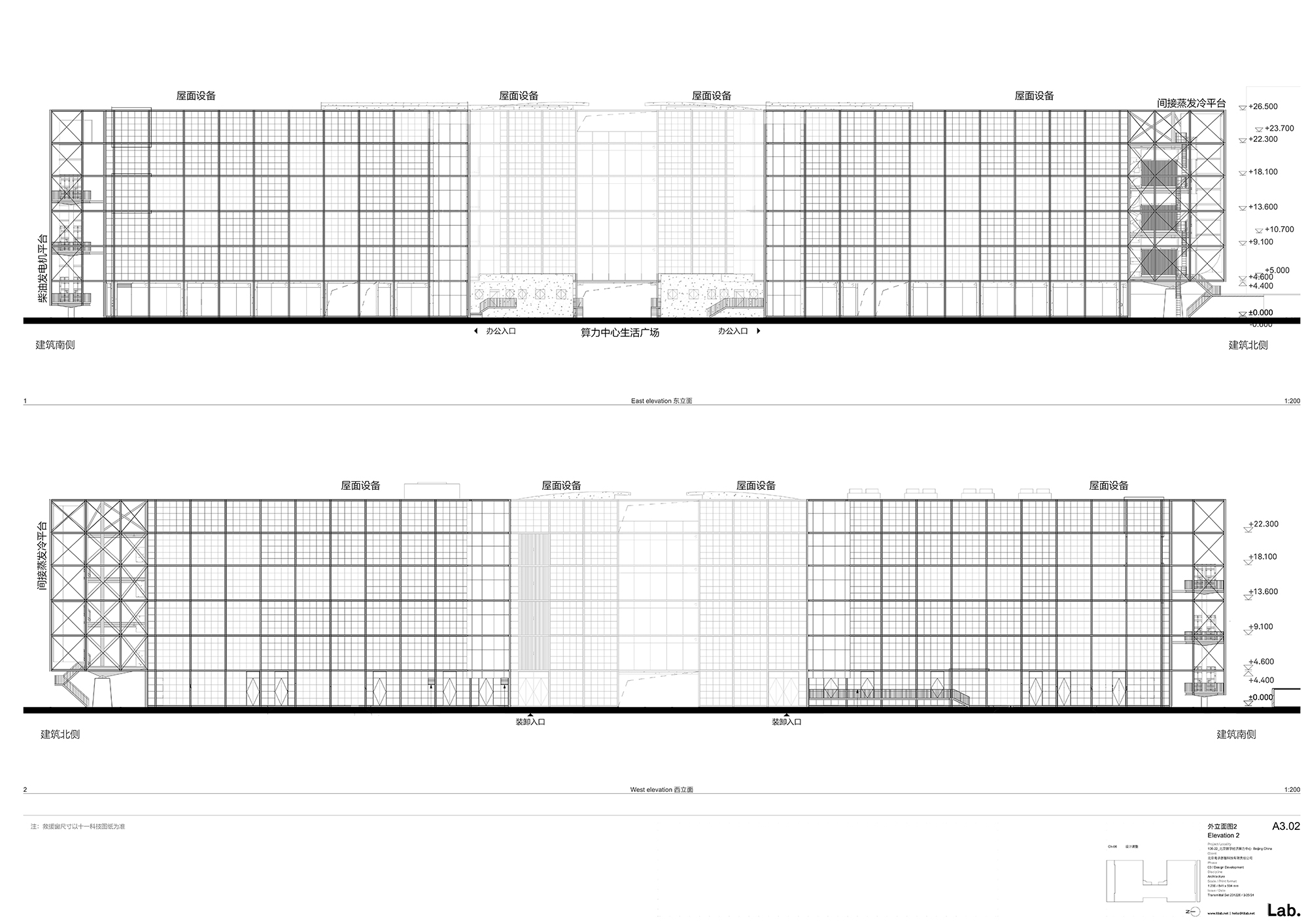
建築のファサードは昼間、自然光下において機能ハードウェアを外露し、生物体の稼働、呼吸、心拍を象徴する知性体の生態を強調する。各階に設置された間接蒸発冷却装置は循環空気を抽出し、風管を通じて屋上へ送ることで、建築内外を縦断するダクトの言語を形成する。
夜:物理が消え、情報が建築を形成
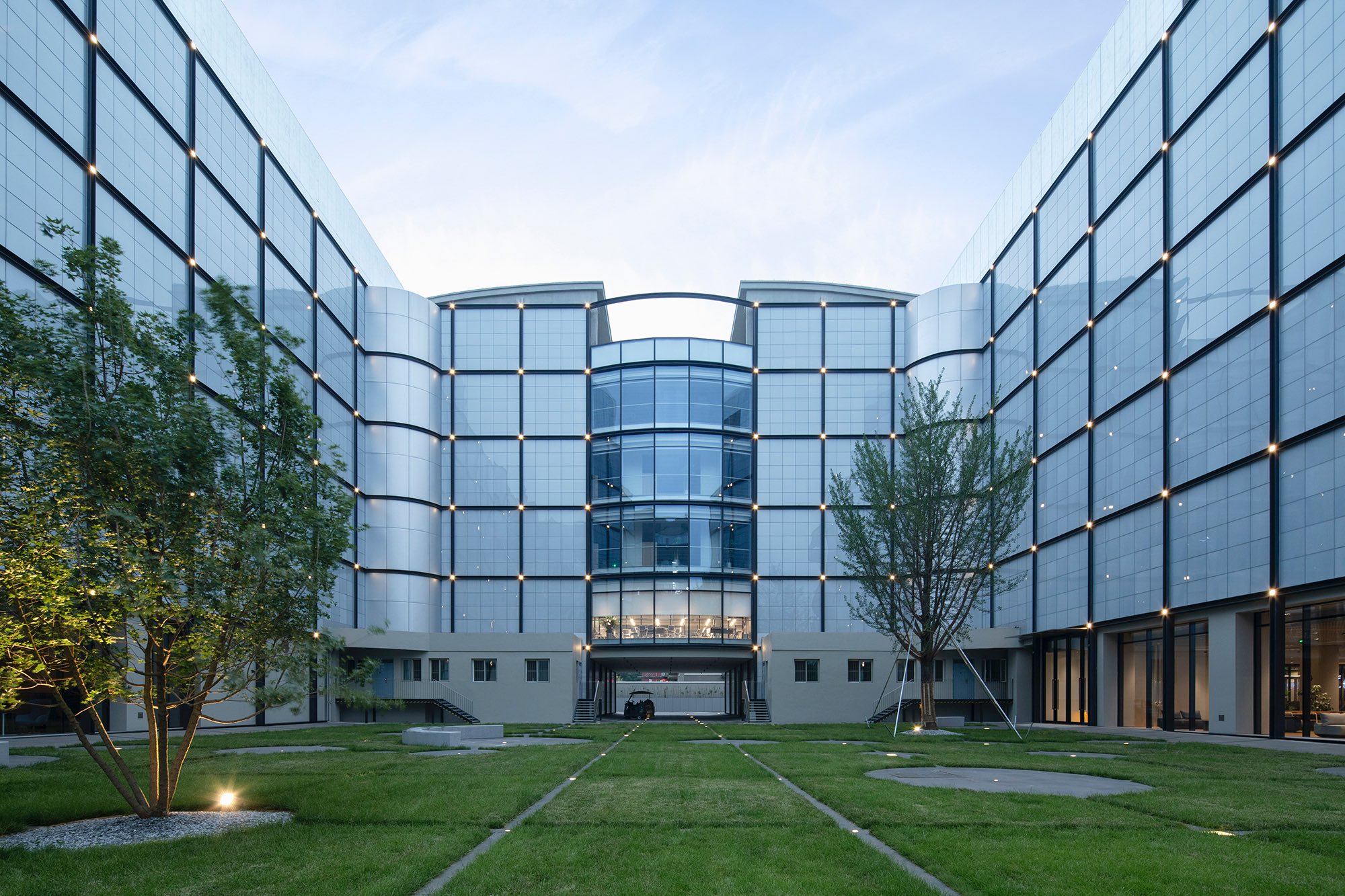
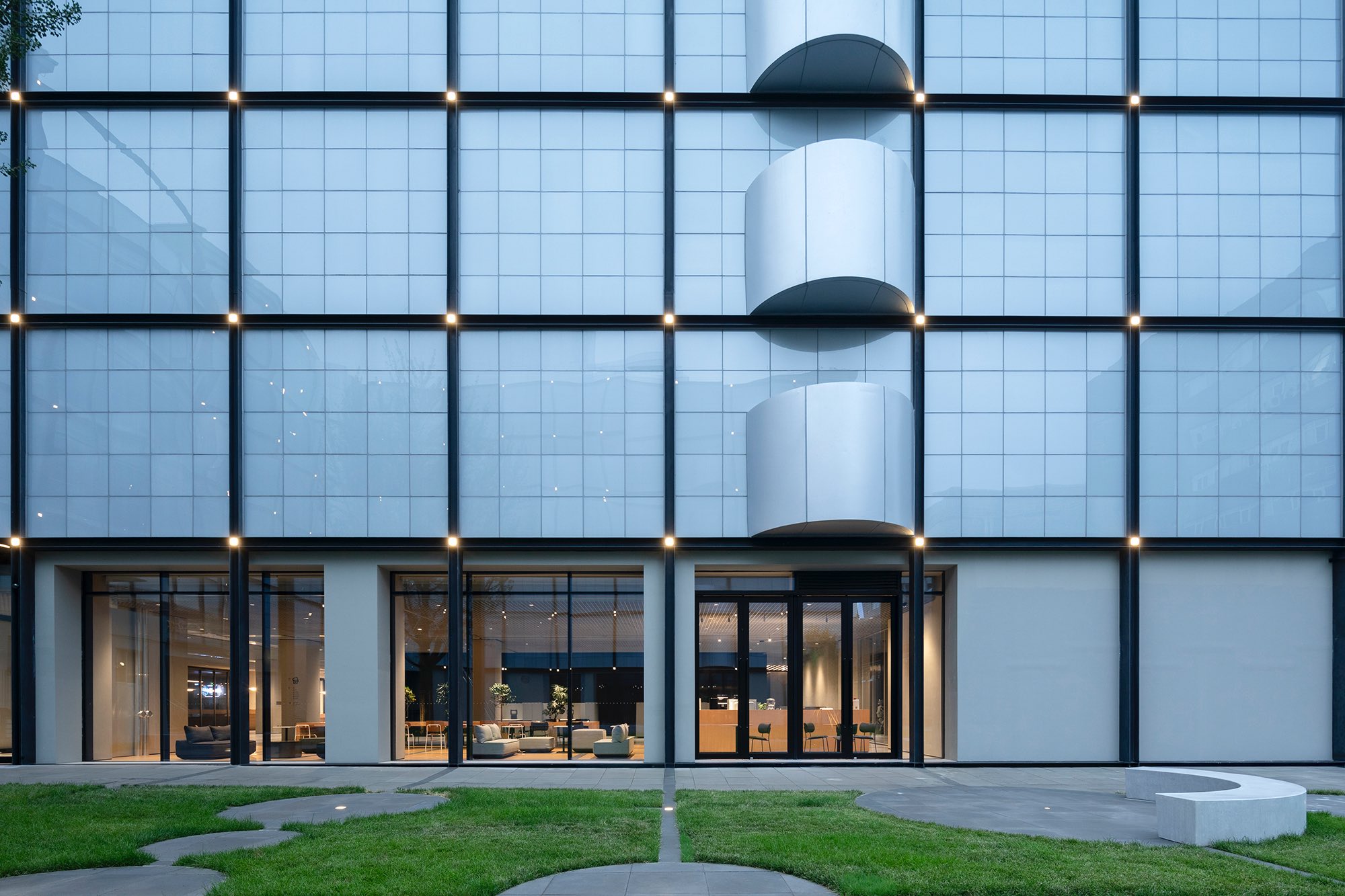
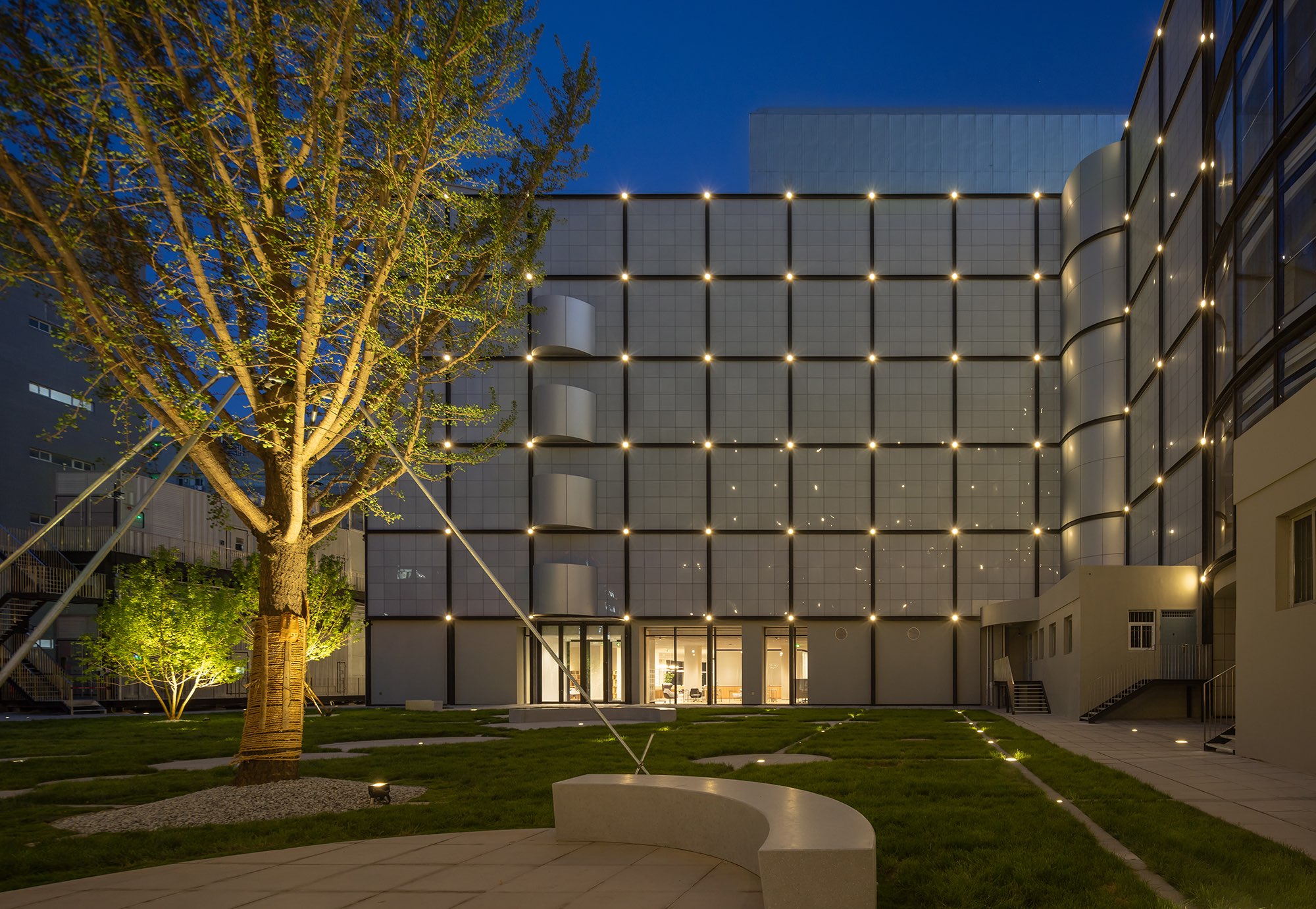
夜間、建築の物理的躯体は視覚的に消失し、ファサードグリッドフレームの交点に灯る光と地面の照明が仮想空間を形成する。内部のフレキシブルスクリーンに映し出されるリアルタイム情報は、建築インテリジェント体の言語として外部へと可視化される。
私たちはその枠組みを設計したに過ぎず、その言語は情報蓄積と環境変化に応じて進化し続ける。利用者が変わり、環境が変わるとき、この知能体も変化し、学習し、表現するのである。
© Arch-Exist Photography
© Arch-Exist Photography
主要な建築空間と機能構成
中庭から室内までの透明化と公共性
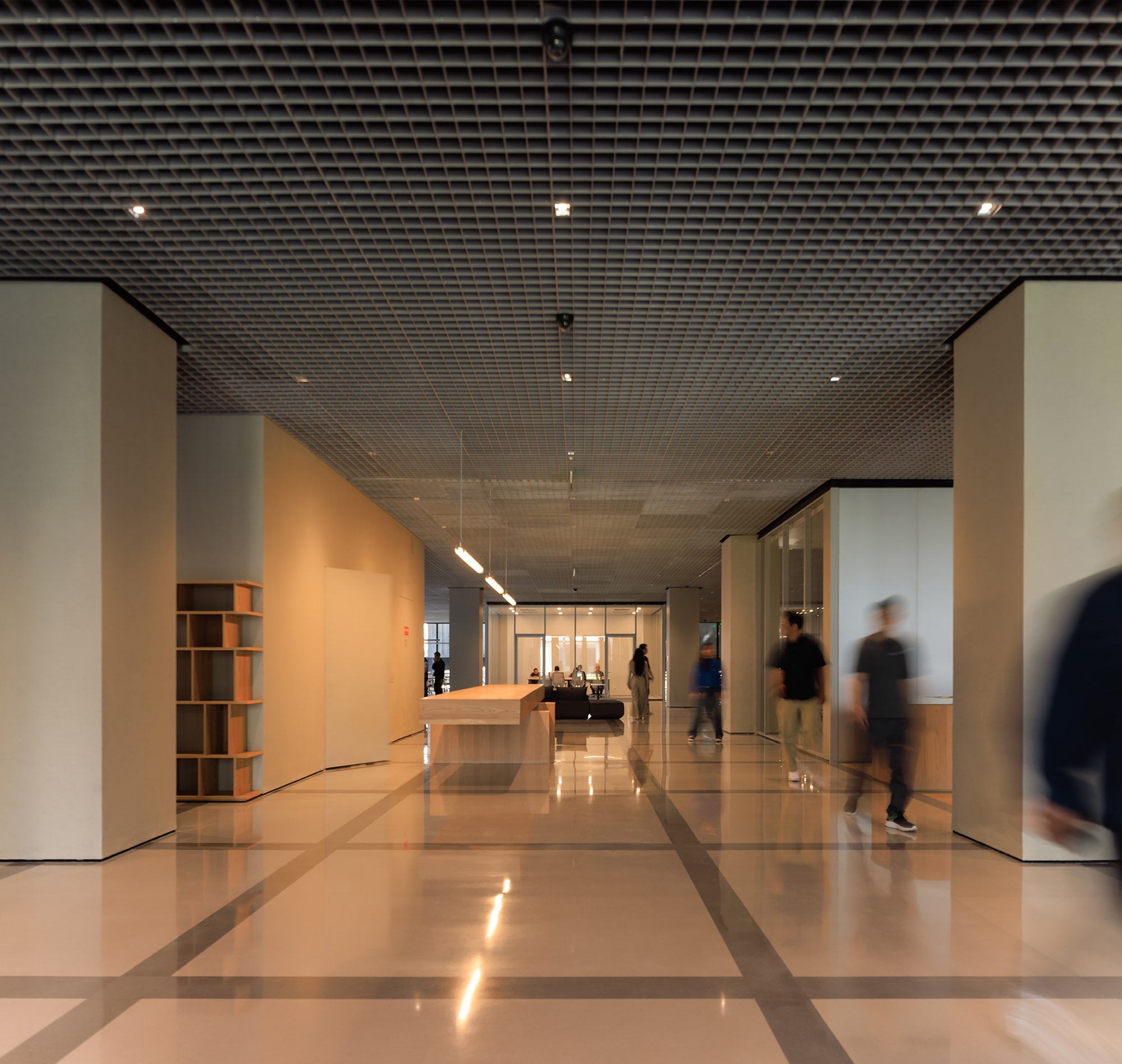
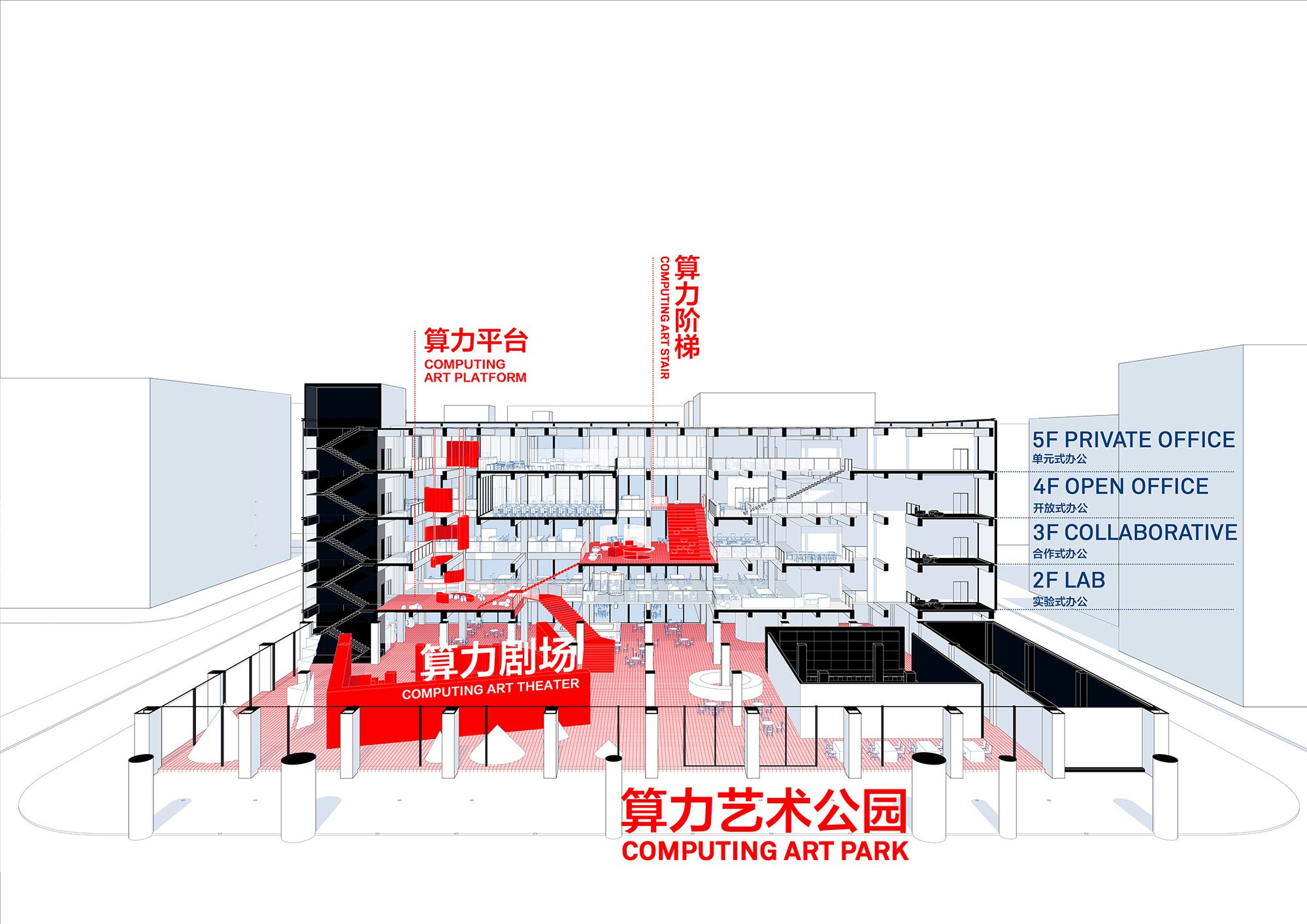
建築は中庭から室内空間まで完全に透明化され、人間の活動を受け入れ、公共の視線と社会的つながりを建物の内部へと導入する。
1階の北側および南側の一部空間は、複合的な仕事と生活を融合したオープンスペースとして、創造性と関連業界の生態的交流を刺激し、業界の最先端研究開発プロセスを推進する。これはコンピューティングパワー時代の都市オフィスセンターであり、業界の科学普及、共有、共創を統合した総合プラットフォームとなる。

© Fernando Guerra FG+SG
© Fernando Guerra FG+SG

© Fernando Guerra FG+SG
産業と都市をつなぐ知能共有の場
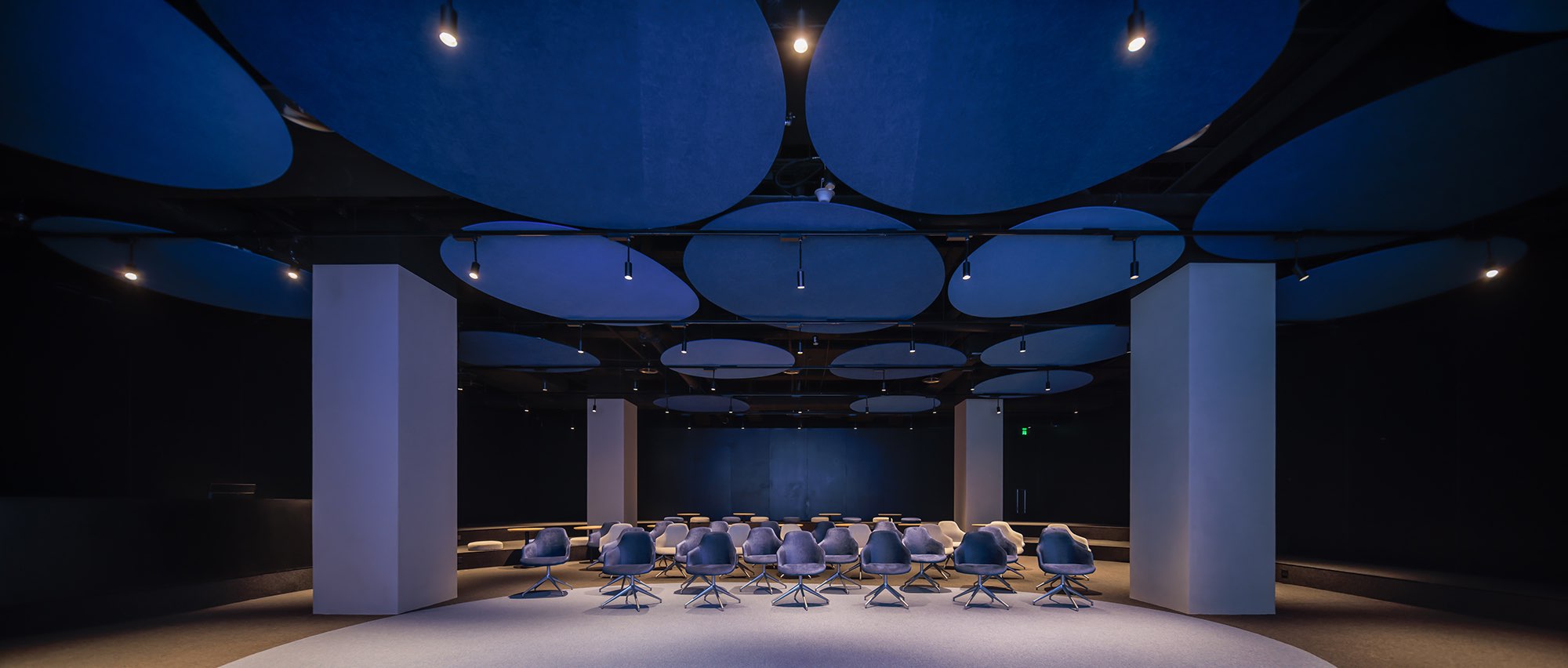
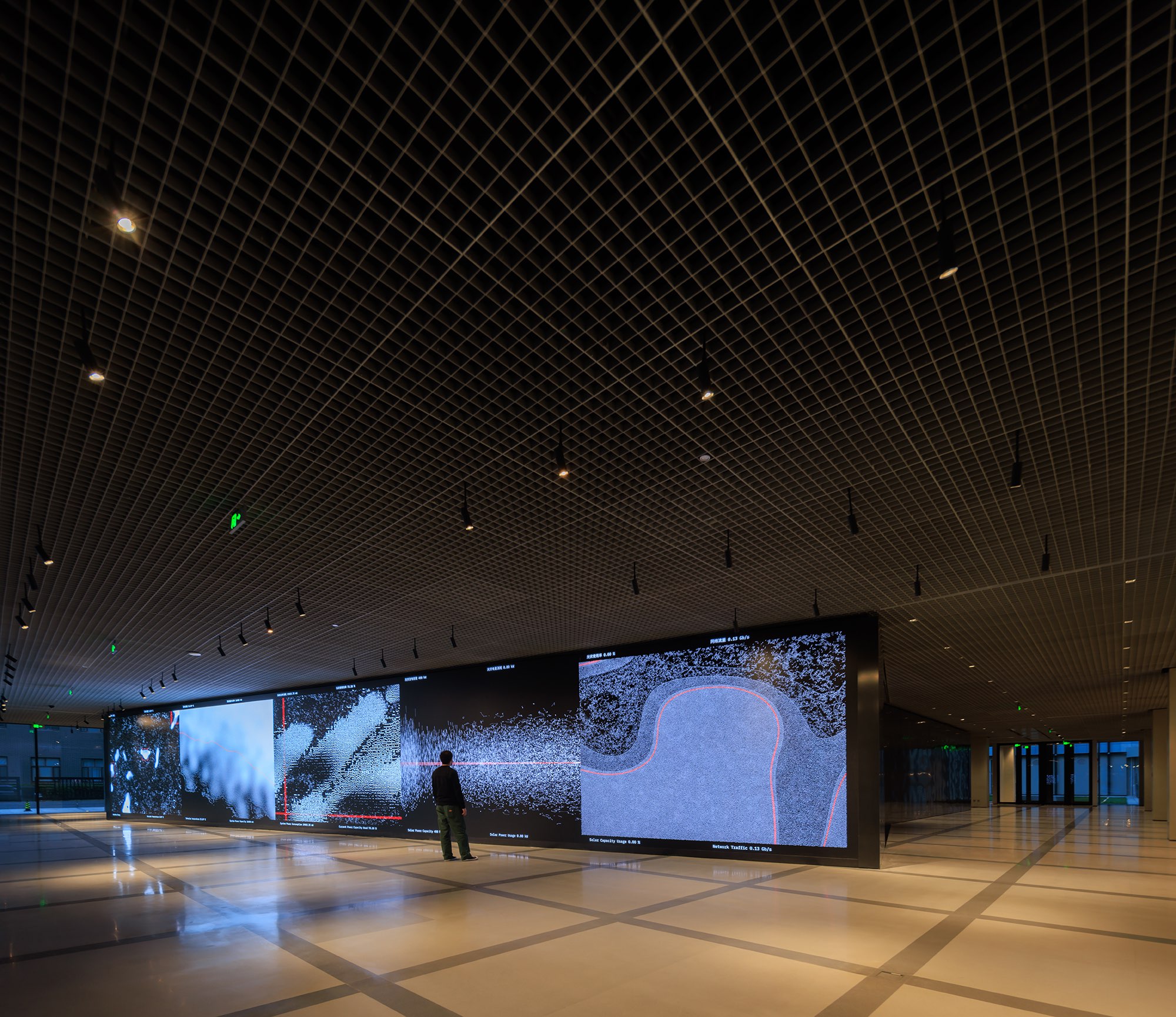
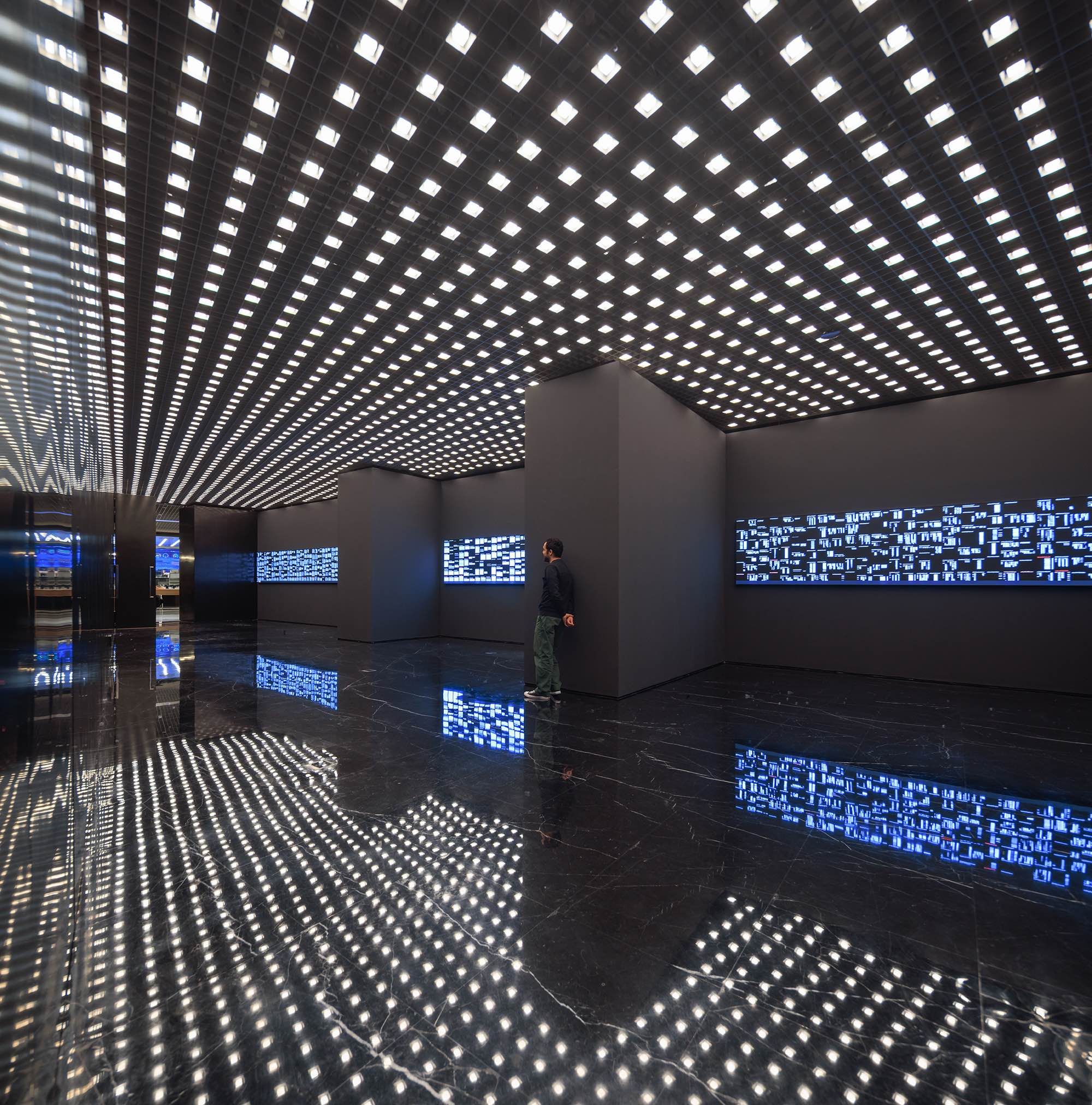
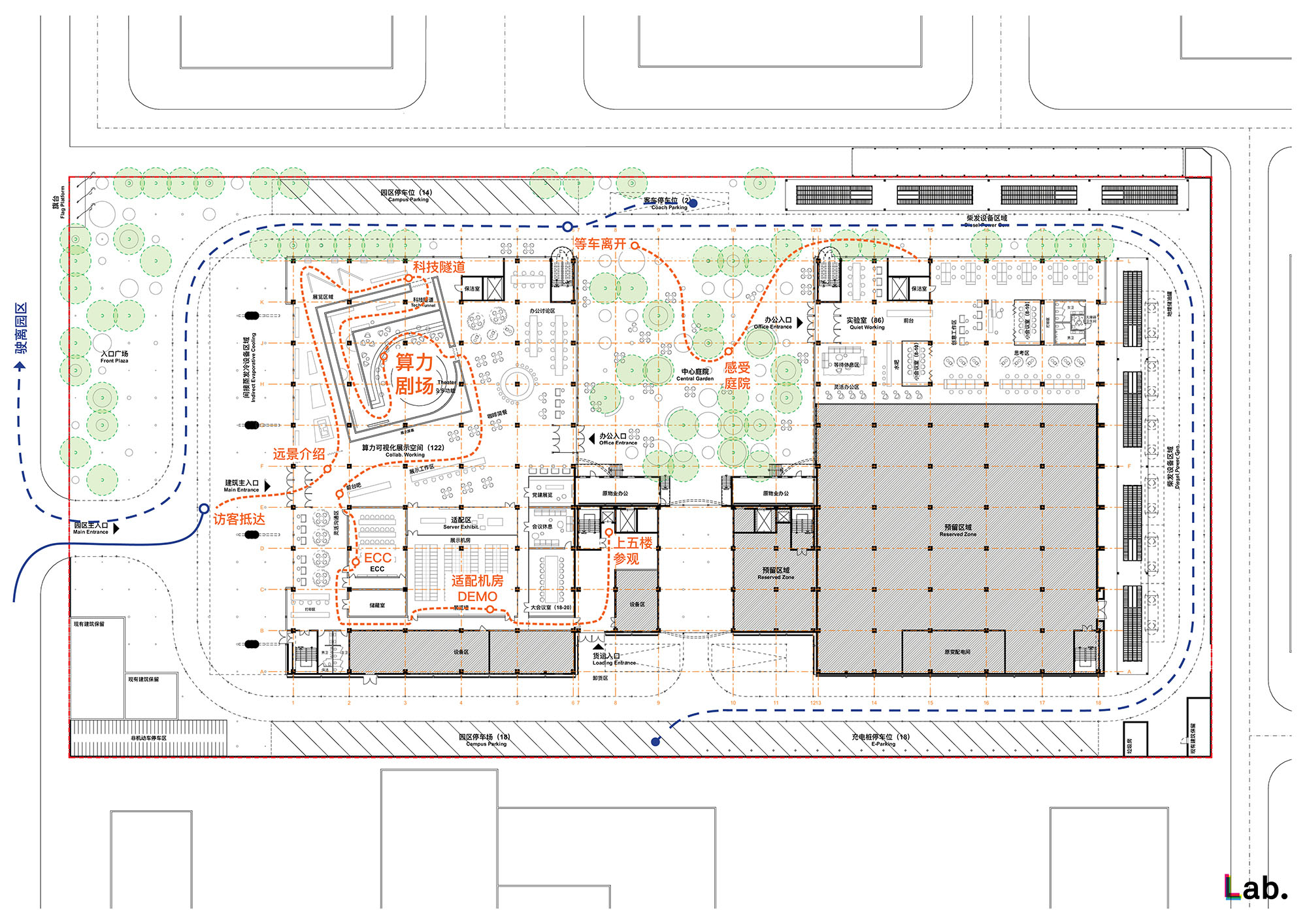
北側1階にはコンピューティングパワー・シアター、オフィス、カフェ、軽食スペース、休憩エリア、会議センター、多目的ホールが集約されている。一般公開されているコンピューティングパワー展示ホールでは、農耕時代からコンピューティングパワー時代に至る人類発展を示し、未来のテクノロジー景観を提示する。
コンピューティングパワー・シアターは多目的ホールとして、将来の酒仙橋フォーラムのメイン会場となる。テクノロジー業界の最先端技術と人材がここで交流し、中国のAIコンピューティングパワーにおける国産化の進化を促す。
併せて設置されたデータセンターのECC(エネルギー効率化センター)と国産チップの適応展示スペースでは、業界最先端のデータセンターの稼働原理や設備レベルを直感的に体感できる。隣接する会議エリアは展示見学後の交流の場として機能し、カフェテリアとフレキシブルオフィススペースは生活広場に面しているため、自然環境の中で議論や交流が行うことができ、共有・共創の業界風土を醸成する。
© Fernando Guerra FG+SG
© Fernando Guerra FG+SG
インキュベーションと新しいワークスペース像
南側1階には多様なオフィスシーンが配置され、産業インキュベーション拠点として機能する。南北両側は生活広場と連結され、緑の活気が室内に流れ込み、ここで働く人々は庭園のような開放的な環境を享受する。
人工知能エコシステム及び運用保守要員も、建物2~5階の縦型オフィススペースに入居している。しかし、この新たな産業に真に適したオフィス形態とは何か。建築空間内では生成空間と家具実験室を融合させ、人工知能に最適なワークスペースを模索する試みも行われている。
© Fernando Guerra FG+SG

© Fernando Guerra FG+SG
「自己進化する知能体」としての建築
知能時代の象徴は、絶え間ない進化と変革にあり、〈SPARK 761〉は単なる物理空間やハードウェアの集合体ではなく、自己進化と成長を遂げる「知能体」である。
知能時代におけるコンピューティングパワーの急激な増加と多様化するニーズに対応するため、コンピューティングパワーやアルゴリズム・データのフルスタック連携を通じて、インテリジェントなコンピューティングパワーの供給を実現すると同時に、需要の変化に応じてスケジューリングを行い、負荷の変化に応じて戦略を調整する。
動的ファサードは都市と対話し、建築のコンピューティングパワーをリアルタイムに可視化し、人工知能の自律的覚醒と反復進化という未知の可能性を示す。

© Fernando Guerra FG+SG
人類とテクノロジーをつなぐ「コンピューティングパワー・パーク」
人工知能はすでにSFの領域を超え、誰もが触れ活用できる技術となっている。〈SPARK 761〉は単なる「コンピューティングパワー・センター」ではなく、技術と人類を接続する「コンピューティングパワー・テクノロジーパーク」である。
計算能力を供給すると同時に、公共意識の向上と産業エコシステムの接続を目指し、テクノロジーと人間をつなぐ架け橋となる。
AIは人間なくして成立せず、人間とAIの協働こそが創造と探求の源泉である。善悪に関する表層的な議論に留まらず、この絶え間ない進化を、物理的存在とデジタル仮想という多層的な生活様式へと統合し、最終的にそれらを1つに融合することを願っている。
© Arch-Exist Photography
© Arch-Exist Photography
© Arch-Exist Photography
© Arch-Exist Photography

© Arch-Exist Photography

© Fernando Guerra FG+SG

© Fernando Guerra FG+SG

© Fernando Guerra FG+SG
© Fernando Guerra FG+SG
© Fernando Guerra FG+SG
© Fernando Guerra FG+SG

© Arch-Exist Photography
ART PARK JOURNEY ©︎ llLab.

Working Typologies ©︎ llLab.
ACADE COMPOSITION DIAGRAM ©︎ llLab.
Modes of Circulation ©︎ llLab.
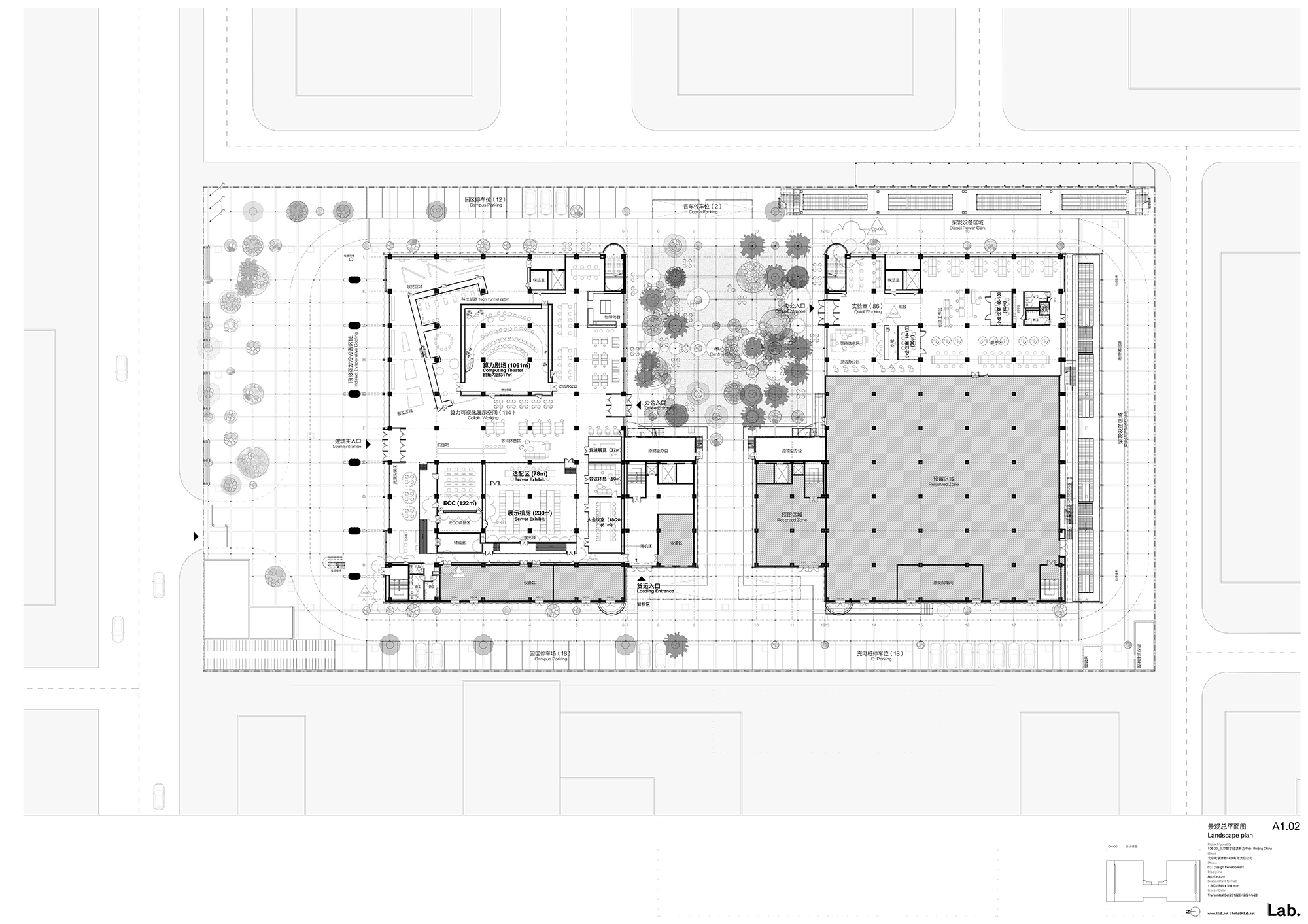
©︎ llLab.
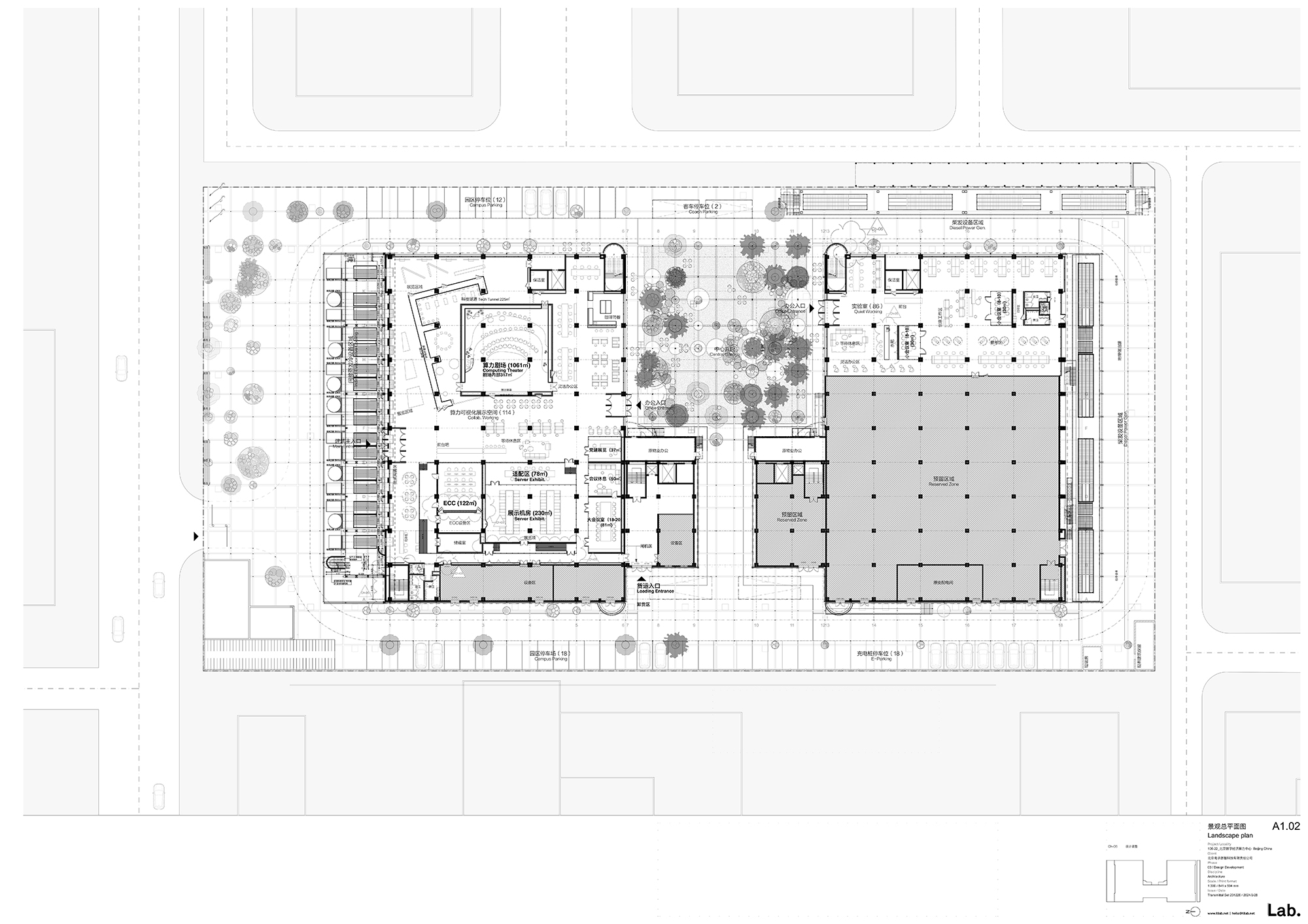
©︎ llLab.
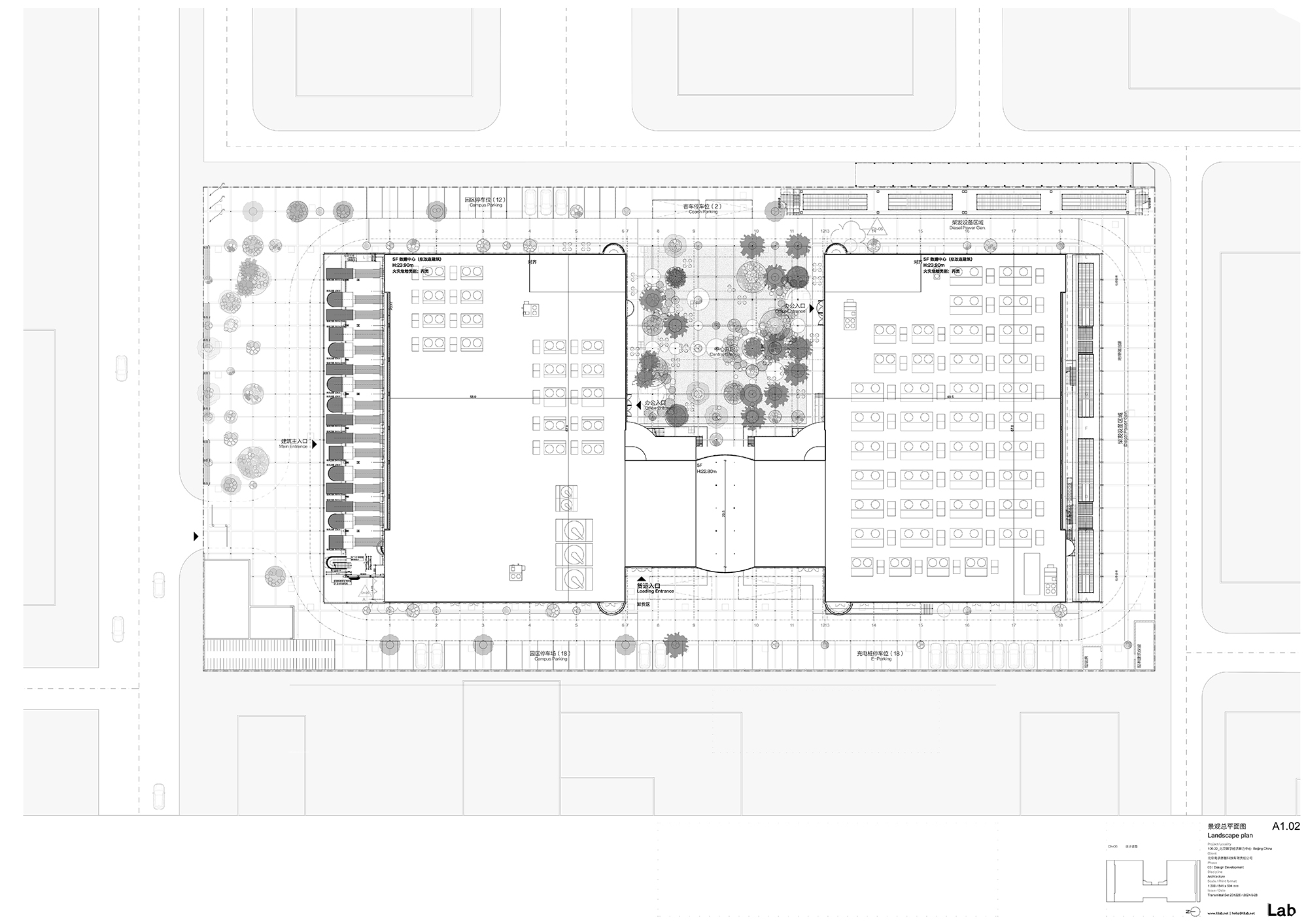
©︎ llLab.
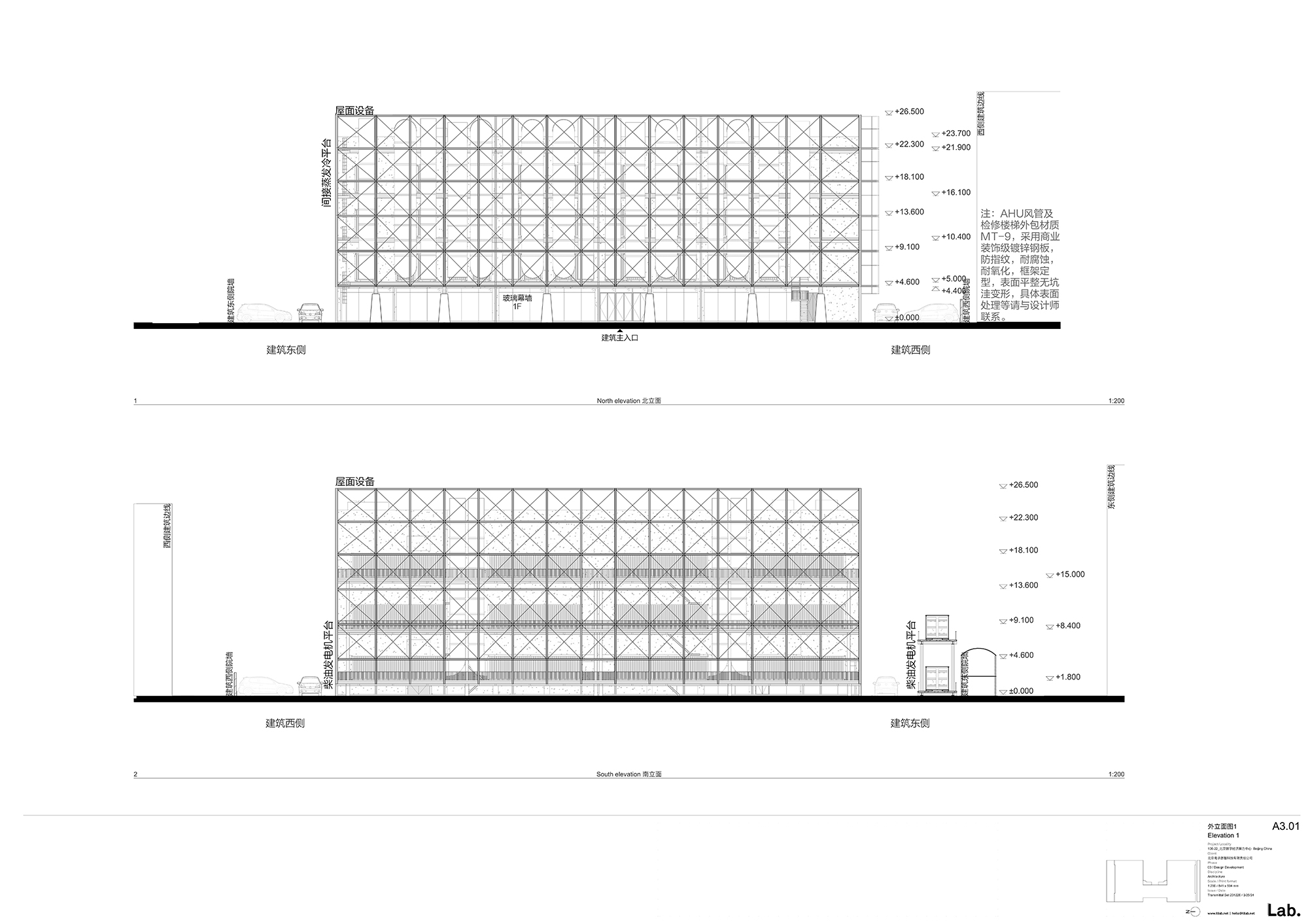
©︎ llLab.
©︎ llLab.
以下、llLab.のリリース(英文)です。
SPARK 761, Beijing Digital Economy AIDC by llLab.
The human civilization began with the agricultural era, underwent the mechanical innovations of the Industrial Revolution, and then leaped into the digital environment of the information age. Today, we have entered an era of coexistence between humans and artificial intelligence. Throughout this long historical process, humanity has continuously created the foundational infrastructure of the world, and through the outcomes of infrastructure from different eras, we have discovered new possibilities for the future.
As time evolves, since humanity entered the digital information age, infrastructure has gradually coexisted with us in an invisible manner. However, humans have gradually begun to feel a disconnect from this subtle coexistence, as if seeking new ways to reintegrate the changes brought by this “black box” into our way of life. From a one-way input and passive acceptance relationship, to altering variables to attempt achieving reasonable results, and further developing into a physical human-machine integration of input and invisible output, perhaps the next step—or what we are currently trying to understand—is how to adapt to this “black box” environment that has already become part of our lives.
Our goal is not to resist, because we respect humanity and hope that the unknown products of evolution can allow humans to continue coexisting with their environment. Therefore, in the process of exploring and creating this new artificial intelligence infrastructure, we aim to reveal the unknown role of the “black box,” transforming what was once inaccessible into something we can understand and communicate with. We even attempt to co-evolve and integrate with it.
From complete isolation, to one-way expression and passive reception, to the emergence of wearable interactive modes that integrate with our bodies, we have begun to imagine: could they one day become our environment? Will they exist invisibly in our lives, allowing us to communicate and converse with them at any time?
Spark·761 – Beijing Digital Economy AIDC
Located in the core area of Jiuxianqiao, Chaoyang District, Beijing, it is the only artificial intelligence computing power park within the central urban area of Beijing.The architectural concept overturns the traditional, enclosed data and information center systems, enabling society, people, and activities to coexist with the building, its contents, and the invisible world of intelligent information. Beyond the intelligent computing rooms, energy-related support, and functional hardware requirements, the building manifests as a physical grid system under sunlight. At night, its physical form visually fades away, replaced by a new architectural body formed by virtual information, which continuously evolves and grows, existing within the city.
Additionally, within the building space, the driving force of the architecture is computing power, while the driving force behind content development is the Computing Power Theater.
The space introduces coexisting human activities, using the “black box” and the “glass box” as carriers for human spaces, accommodating diverse functions such as offices, exhibition halls, and multi-purpose rooms.The “black box” is positioned by rotating within the conventional grid. The changing environments inside and outside the site serve as integrated reflections of the evolving era and its constantly developing thematic content focused on contemplation, leading humans into the “Computing Power Theater”—a place of inspiration for discussing topics related to humans, artificial intelligence, and societal evolution.
The “glass box” exposes all previously closed-off and inaccessible content to the human touch, fully revealing it within the architectural space. It aims to encourage proactive interaction, allowing humans to spontaneously connect what was once untouchable to levels that are now visible and accessible.As ecological partners within the space, humans coexist with invisible information, influencing and communicating with it. This allows the building’s virtual composition and physical entity to coexist and evolve symbiotically to varying extents, transforming the park into a computing power science park that integrates technology and humanities. Humans and the carriers become mutually parasitic, evolving together in symbiosis.
Architectural Form:
This is actually a logic that integrates the traditionally separate construction of equipment platforms with the building itself, considering them as one entity. It’s a way of thinking that has faced comprehensive criticism within the inertia of social thought. However, we believe this is the true starting point for making AI human-centric. The action of “opening up” requires a complete rethinking and overturning of the overall logic.The prerequisite for the overall logic to hold is that it must first achieve functionality. Once the basic requirements of the equipment are clarified—as guided by fundamental clues—the frequency and scale of the language the equipment provides have led us to adopt this integrative approach.
At the same time, this building is also an artificial intelligence organism. Therefore, the intuitive biological dynamic sensations related to the biological life fundamentals of breathing and blood vessels have led to a form where one can perceive the internal dynamics of the tubular structure under the condition of airflow transmission within it. This is a basic requirement for maintaining vital signs.
Although we had also hoped to give it a chance to truly speak and produce sound, environmental constraints prevented this from being realized, so we could only use image language as a substitute.
This should be an intuitive architectural manifestation of biological ecological vital signs, and it is definitely in its preliminary, immature form right now. It will only be after it has grown to a certain stage that looking back, one can understand the meaning behind the embryonic form of today’s language.Main Facade System of the Public Plaza:
The building’s facade, under natural light during the day, presents exposed functional hardware, highlighting the functional operation of biological mechanisms—the breathing and heartbeat—representing the ecological embodiment of the intelligent entity. Indirect evaporative cooling equipment connecting each floor to the internal computer room spaces extracts the recirculated air and channels it upward through ductwork to the roof height, thus forming a vertically running-through language of ductwork.However, at night, the building’s biological form disappears visually, expressed instead through the intersections of the spatial system and hidden modes of thought. The illuminated intersections of the facade’s grid framework and the lights at the intersections of the ground grid form a virtual space that overlaps with the real physical space of the day. The real-time language of the building’s intelligent entity is then visually transmitted to the outside world through an unknown form of imagery via an internal flexible screen.
We have established a framework, but its language will also evolve in different ways due to its accumulation of information and changes in the environment; this evolution is unknown.
Users change, the environment changes, and this intelligent entity learns, adapts, and expresses accordingly.Main Architectural Spaces:
The building achieves complete transparency from courtyards to interior spaces, fully embracing human activity and introducing public sightlines and social connections into its interior.Parts of the building’s ground floor on the north and south sides are designed as versatile, open spaces for both work and life, aiming to stimulate creativity and ecological exchange within related industries, and to advance the development process for cutting-edge industry research. This positions it as the urban office center of the computing power era—a comprehensive platform integrating industry science popularization, sharing, and co-creation.
On the north side of the ground floor, a variety of functions are integrated, including the Computing Power Theater, offices, a coffee shop, casual dining, relaxation spaces, a conference center, and multi-purpose halls. Depending on different usage needs, one can freely choose a workplace and working environment. Among these, the Computing Power Exhibition Hall is open to the public and will showcase the historical progress of human development, starting from the agricultural era up to the arrival of the computing power era, driven by the advancement of infrastructure and the upgrading of energy sources. It ultimately looks towards the future—a technological landscape where computing power serves as the productive force.
The Computing Power Theater, serving as a multi-purpose hall, will act as the main base for the future Jiaoxianqiao Forum, where cutting-edge technologies and professionals from the technology industry will exchange ideas and dialogue, thereby accelerating the progress of domestic AI computing power in China.
Simultaneously, the Data Center’s ECC (Enterprise Command Center) and a dedicated space for showcasing domestically produced chips are located here, allowing visitors to more directly experience the operational principles and equipment standards of state-of-the-art data rooms. Adjacent meeting areas provide spaces for exchange after visiting the exhibition hall. The coffee and casual dining area, along with flexible office settings facing the lifestyle plaza, allow people to discuss and chat in a natural environment, enhancing the shared and collaborative industry atmosphere.
The ground floor on the south side also encompasses various types of office settings, serving as a base for industrial incubation. The north and south sides are connected by the lifestyle plaza, allowing green vitality to flow into the interior, enabling people working here to enjoy an open, garden-like environment.
AI ecosystem and operations personnel will also occupy the vertical office spaces on floors 2 through 5 of the building. However, determining what type of office model is truly suitable for this new industry, the building space also attempts to integrate generative space concepts with a furniture laboratory, exploring workspaces genuinely suited for the AI community.The hallmark of the intelligent era is constant evolution and advancement.
The Beijing Digital Economy Computing Power Center is not merely a static collection of physical spaces or hardware equipment; it is more an active “intelligent entity” capable of autonomously completing “metabolism” and achieving self-evolution and growth.Facing the intelligent era’s rapidly growing and diverse demands for computing power, the Beijing Digital Economy Computing Power Center, through full-stack synergy of computing power, algorithms, and data, can not only achieve the supply of intelligent computing power but also schedule according to demand changes and intelligently adjust strategies based on load variations.
The dynamic facade communicates with the city, visualizing the building’s real-time computing power, attempting for the first time to interpret the unknown aspects of AI’s self-awakening and iterative evolution.
More than just a Computing Power Center, it is a “Tech Park” Connecting Humanity
AI has long moved beyond science fiction imagination and is now an accessible and usable universal technology for people. In the future, everyone will be able to master AI skills and leverage AI to create value. The Beijing Digital Economy Computing Power Center is not just a “computing power center”; it is also a computing power tech park integrating modern technology and humanities. While supplying computing power, it also aims to enhance public awareness and connect the industrial ecosystem, serving as a link between technology and humanity.The open-ended intelligent computing evolution model, embodied in both the architecture and its content, hopes to allow everyone to directly perceive it and even communicate, interact, and coexist with it.
AI cannot exist without humans. The synergy between AI and humans should be the reason for our creation and exploration. We do not wish to remain stuck in superficial discussions about good and evil; rather, we hope to integrate this ceaseless evolution with our physical existence and the multi-layered modes of life—physical and digital virtual—and ultimately merge them into one.Porject information
Project Location:
18 Jiuxianqiao Middle Road, Beiguang Tech-Industrial Campus, Chaoyang District, Beijing
Site Area: 17,223.07m2
Construction area: 35,765.81m2Project Status: Completed
Project Timeline: August 2022 – April 2025Client: Beijing Electronic Digital & Intelligence (beD&I)
Client Executives: Lei Jing, Dong Kan, Jianghong Zhang
Client Branding and Marketing Team: Zhen Yang, Xiaoying Lv, Tianqi Bao
Client Construction Management Team:
Meng Xue, Zhengxin Yang, Chunran Liu, Jie Wen, Zheng Li
Zheng Cao, Wei Yang, Jia Song, Xiaoqiang Zhang, Huibo Hao, Hao WangArchitectural Design: llLab.
Project Partner: Hanxiao Liu, Luis Ricardo
Project Lead Architect: Lingling Liu
Project Team:
Lingkong Yin, Ziyu Wei, Chao Zuo, Luyao Hou, Lexian Hu, Fei Chen, Yujun Yan, Yihui Zhao, Han Xue, Tiance Liu
Project Site Architect: Ziyu Wei, Tiance Liu (Site Assistant)
Project Interns: Yicheng Wang, Siqi GuoStructural Design
LuAn Lu Partners StructureLighting Consultant
Puri Lighting Design
Team members: Fang Hu, Yahui Li, Zanbao Ma, Xian ZhaoFurniture Planning
KOKUYO & LAMEX
Team members: China teamLocal Design Institute
The IT Electronics Eleventh Design&Research Institute Scientific and Technological Engineering Corporation Limited (EDRI)Construction and Supervision
China Construction First Building (group) Corporation Limited
Beijing International Construction Group Co.
Beijing Dongfang Huatai Construction Supervision Co.Integrated Artworks Artists
Amy Karle, Richard Vijgen, Norimichi HirakawaPhotography
Fernando Guerra | FG+SG
Arch-Exist Photography
Tian Fangfang
llLab. 公式サイト
https://www.lllab.net
【購読無料】空間デザインの今がわかるメールマガジン TECTURE NEWS LETTER
RECOMMENDED ARTICLE
![NOSIGNERが店舗をデザイン、観葉植物専門店[REN]がリニューアル](https://magazine-asset.tecture.jp/wpcms/wp-content/uploads/2021/09/10120047/20210812ren_sub1-900x450.jpg)


![[大阪・関西万博]海外パビリオン紹介_クウェート](https://magazine-asset.tecture.jp/wpcms/wp-content/uploads/2025/05/02212808/rIMG_6860-900x675.jpg)