パラメトリックに再生する東アジアの伝統木造 - 「斗拱」を現代的再解釈した、樹木のような構造が支える〈3本の木の家〉
©︎ Rohspace
©︎ Rohspace
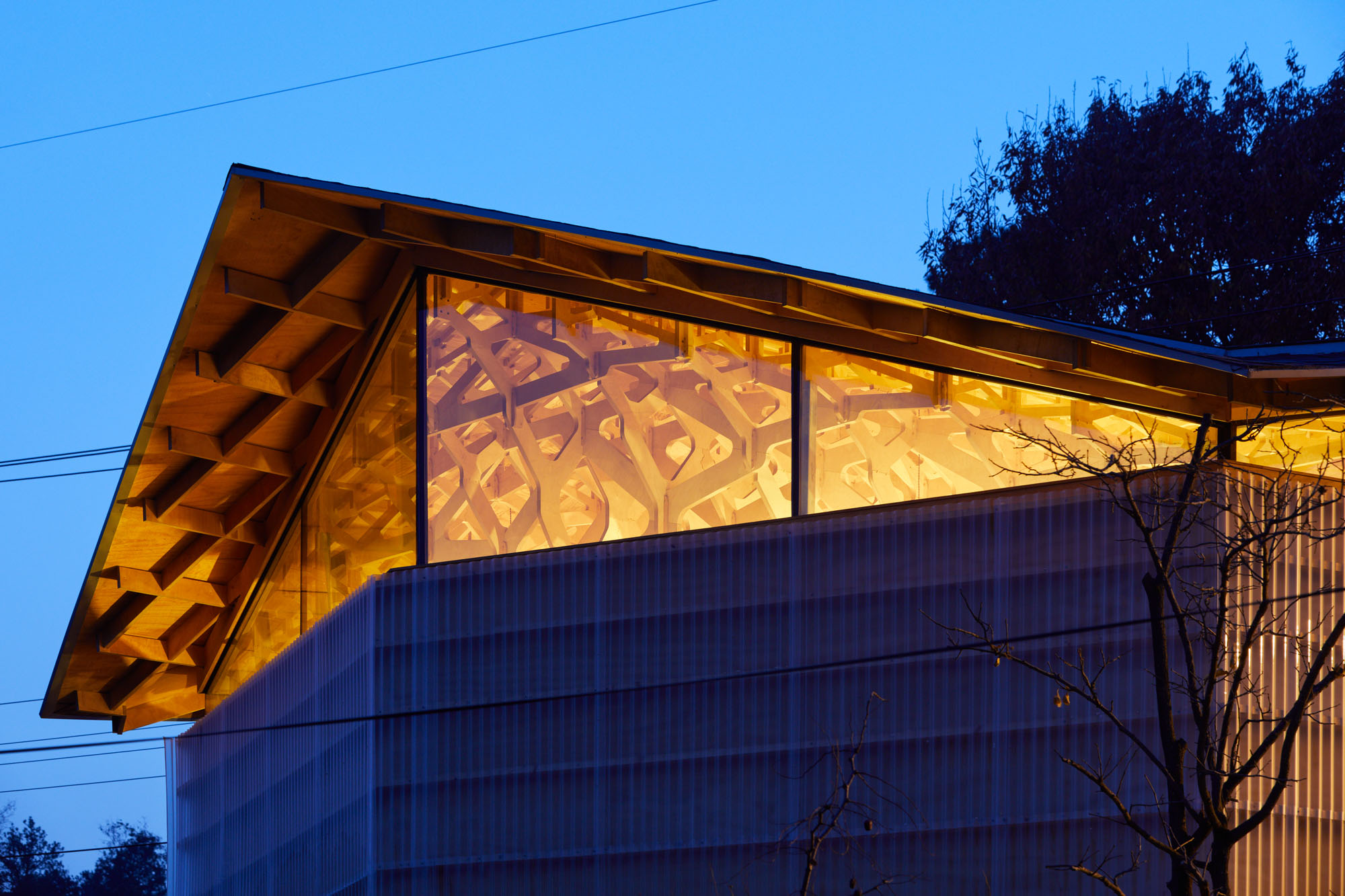
韓国の慶尚北道に位置する〈3本の木の家(The House of Three Trees)〉は、時代の流れで失われた東アジアの木造建築の伝統を、現代の素材「エンジニアリングウッド」と現代技術「パラメトリックツール」を用いて再生することを目指して設計された住宅です。
韓国の設計事務所 JK-AR(Jae Kim Architects & Researchers)が設計しました。
注目ポイント
- コンピュテーショナル・デザインによる、金属ジョイントを用いない「組物」
- 東アジア建築特有の「斗拱(ときょう)」を昇華するパラメトリック・ワークフロー
- Grasshopperのプラグイン「Karamba」による施工効率と物流条件の最適化
(以下、JK-ARから提供されたプレスキットのテキストの抄訳)
©︎ Rohspace
©︎ Rohspace
忘れられたモニュメント:伝統と革新が交差する「ツリー・シリーズ」
木構組システムの現代的再構築
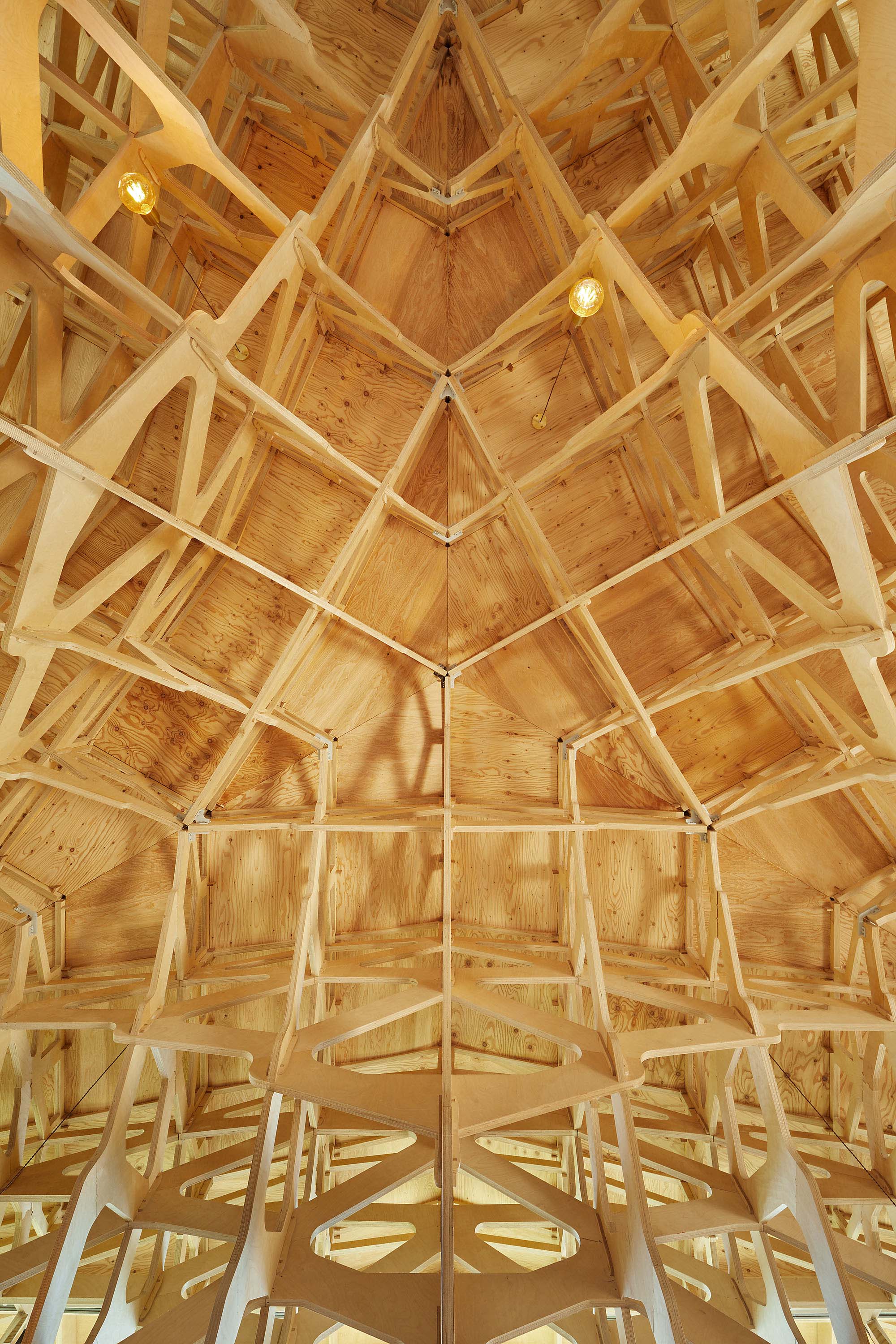
JK-ARによる「ツリー・シリーズ」は、東アジア建築における伝統的な木製ブラケットシステム(組物)を再現する一連のデザインプロジェクトである。その目的は、伝統的な木構組を詳細に分析し、その構造と製造プロセスを現代の建築産業に適応可能な形で再構築することにある。
しかし、本プロジェクトが目指すのは、単なる施工の効率化や様式の模倣に留まる「伝統の近代化」ではない。そうした安易なプロセスを拒絶し、伝統的システムを根本から刷新することで、実験的かつ革新的な再生を目指している。
©︎ Rohspace
©︎ Rohspace
3つの設計指針「自由・性能・接合」
上記の文脈において「ツリー・シリーズ」は3つの大きな目的を掲げている。
第1の目的は、「造形的自由」の獲得である。東アジアの木組み工法は各国で多様な発展を遂げてきたが、一方で伝統建築特有の形式主義がその多様性を制限してきた側面もある。本プロジェクトでは、Grasshopperなどのパラメトリックツールを活用することで、従来のシステムが抱えていた形態的制約を克服している。
第2の目的は、「構造性能」の追求である。もともとこのシステムは構造的な要請から考案されたものであり、その本来の意図を保持することは極めて重要である。加えて、パラメトリックに生成された多様な形態のなかから、適切な解を選択する基準として構造解析を用いる。Grasshopperのプラグイン「Karamba」による解析は、モックアップ試験や構造計算の時間的効率化を大きく向上させている。
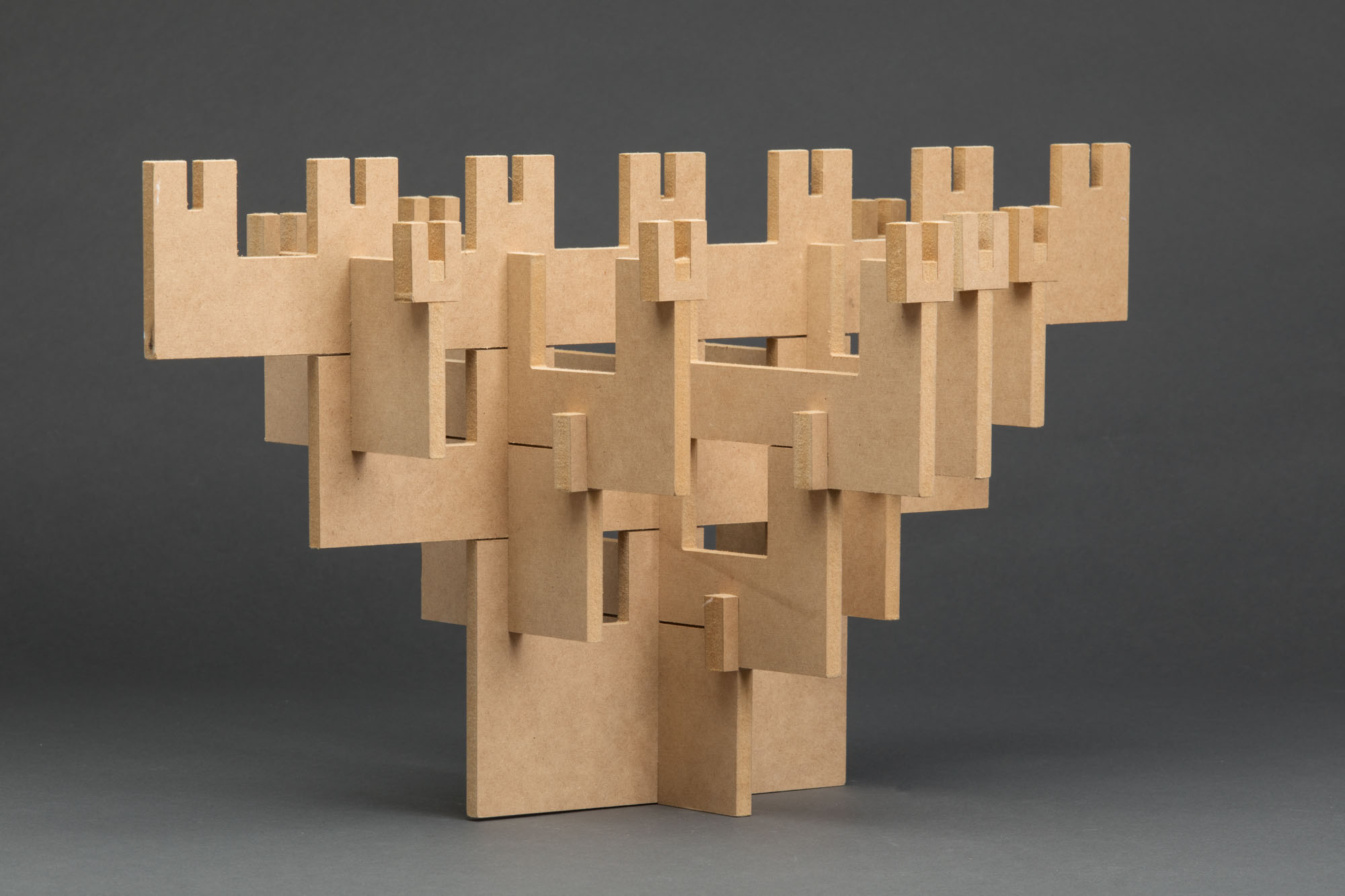
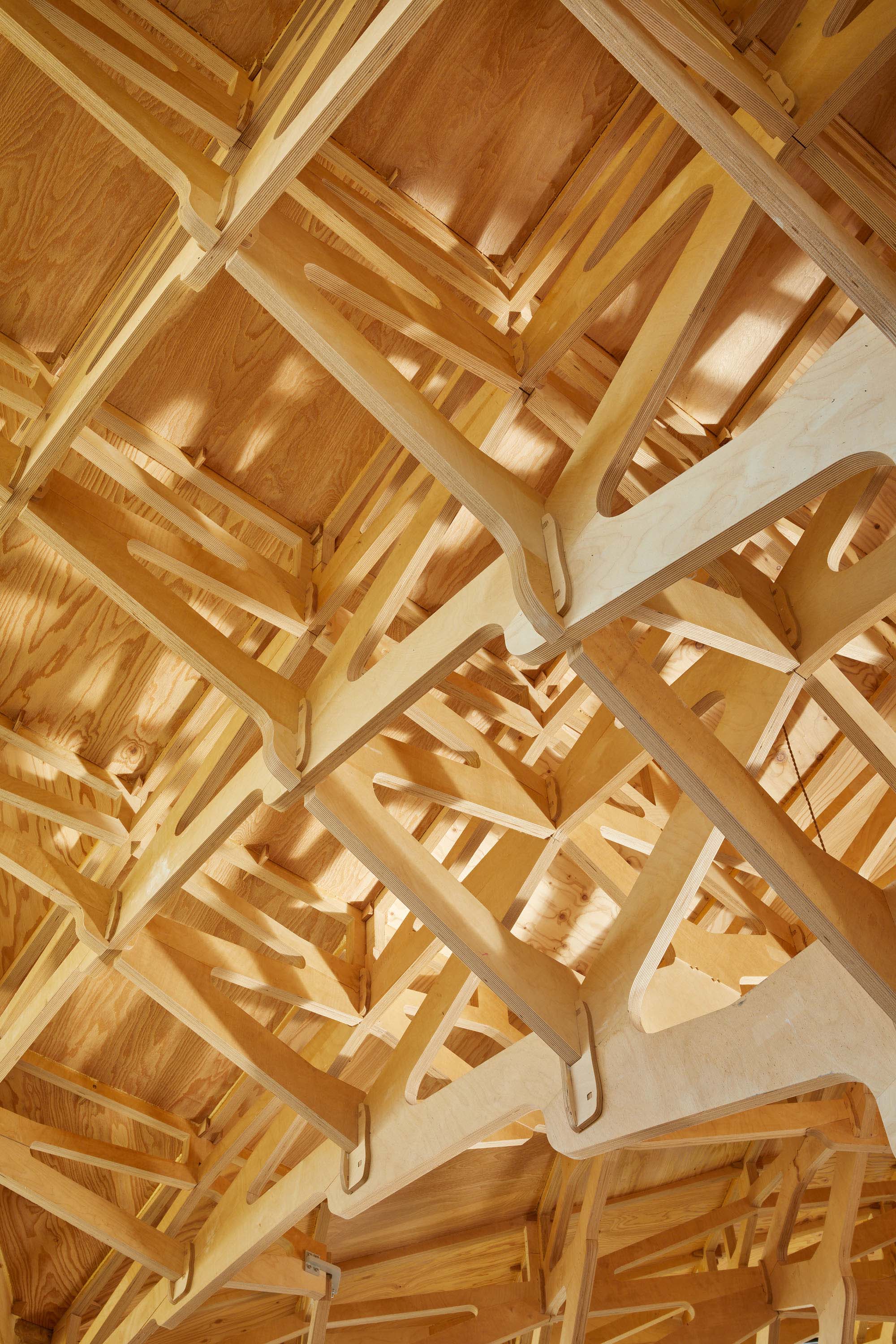
最後の目的は、「新たな接合部」の開発である。木造構造において、接合部は引張力と圧縮力の双方を受ける最も重要な要素となっている。本プロジェクトでは、金属製ジョイントやボルトといった付加的な部材を一切排除し、摩擦力のみによって十分な構造性能を確保することを目指している。
©︎ Rohspace
Section Perspective
100年前に途絶えた東アジア木造建築を呼び覚ます〈3本の木の家〉
現代技術による「建築的幻想」としての住宅
〈3本の木の家〉は、ある建築的幻想を具現化した作品である。この幻想は、過去100年の歴史において「もし特定の事件が起きなかったら」という代替現実を探求している。
もし朝鮮王朝後期(17〜19世紀)に木材資源が枯渇していなかったら。そして、枯渇に直面しながらも現在のように安価な木材輸入が早期に実現していたら。さらに、21世紀の建築を鉄筋コンクリートが支配していなかったら。これらの仮定が成立していれば、東アジアの木造建築は独自の進化を止めず、1500年以上にわたる文化を継承しながら、全く新しい建築体験を提示していたはずである。
本プロジェクトは、100年前に途絶えた東アジア木造建築の再生であり、象徴的な支え構造(韓国の「孔楞(Gong-po)」、中国の「斗拱(Dougong)」)の現代的な再解釈である。単なる伝統の模倣や過度な抽象化を批判し、構造と装飾が一体となった「構造的側面」にこそ、東アジア建築の真価を見出している。デジタルファブリケーション等の現代技術は、伝統を新たな方向へと進化させる鍵となるのである。
Joint study 01
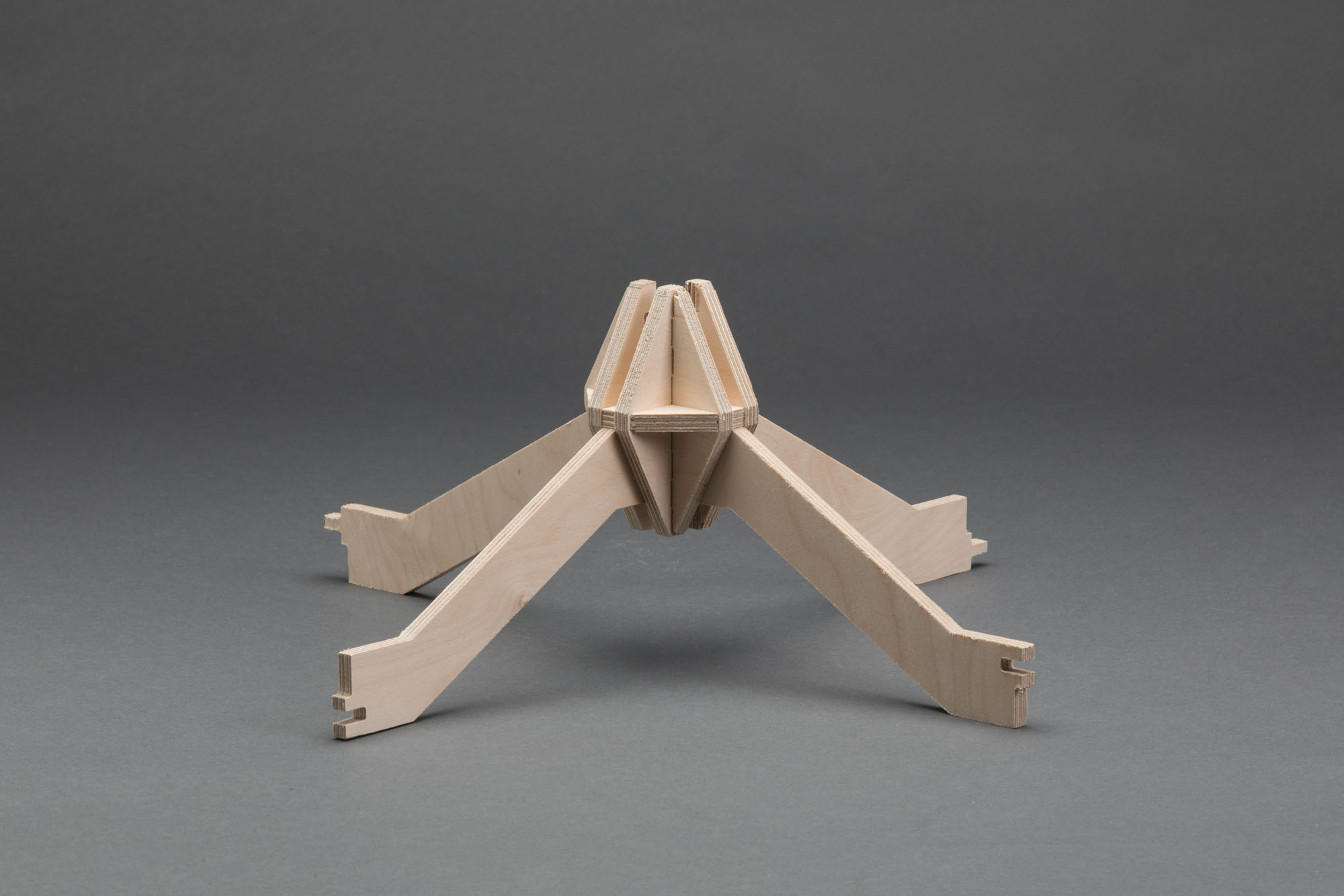
Joint study 02
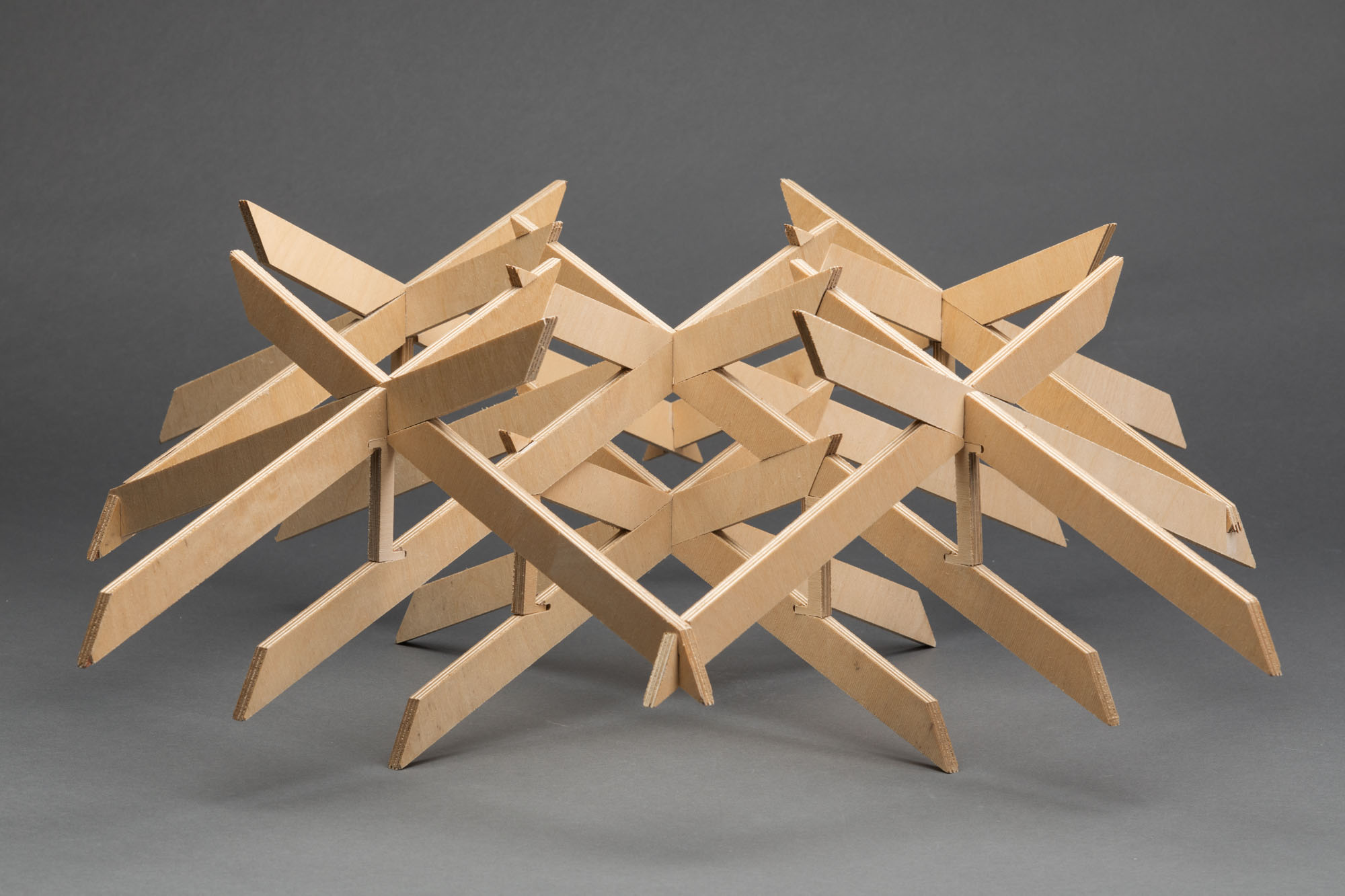
Joint study 03
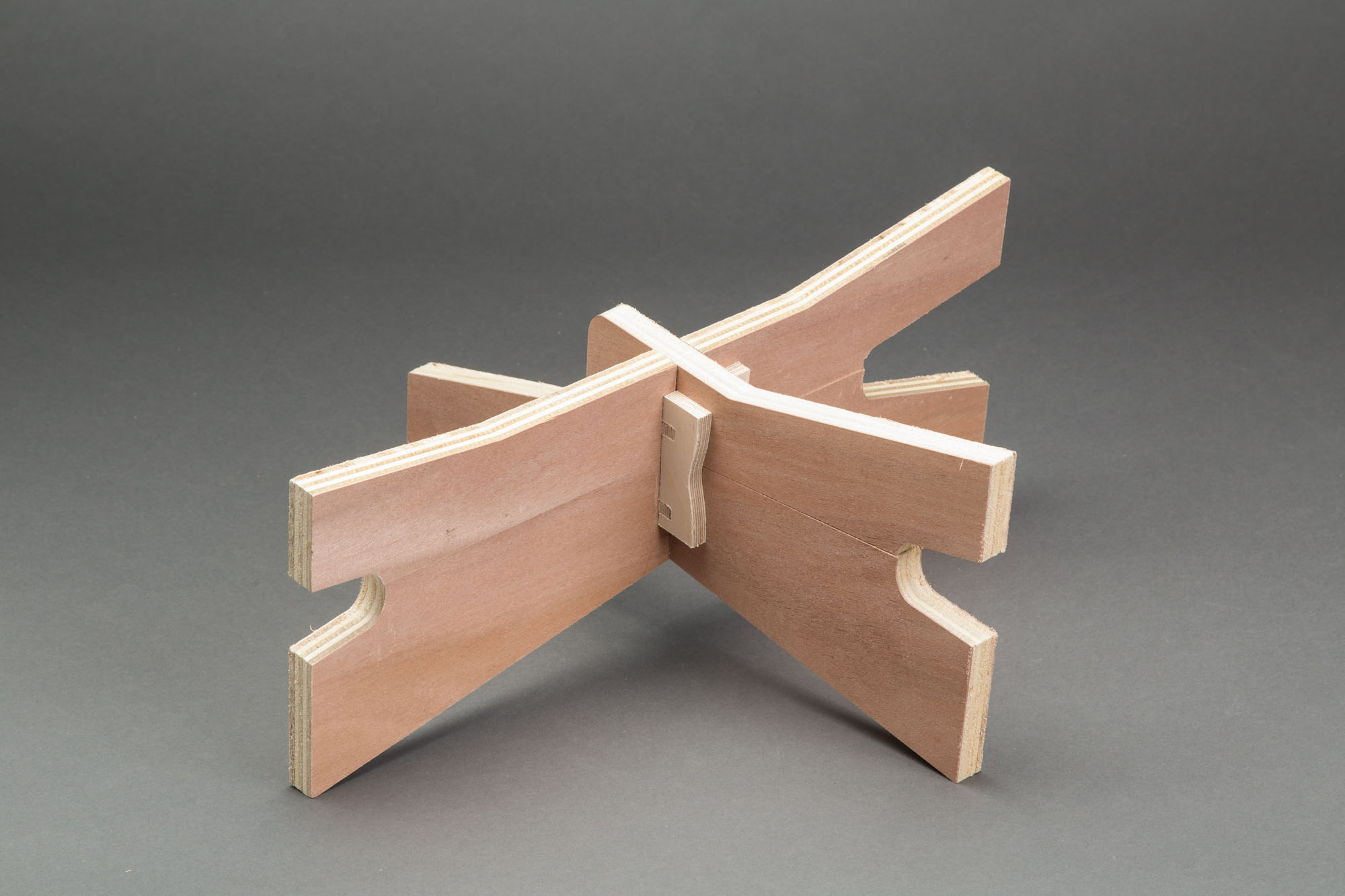
Joint study 04
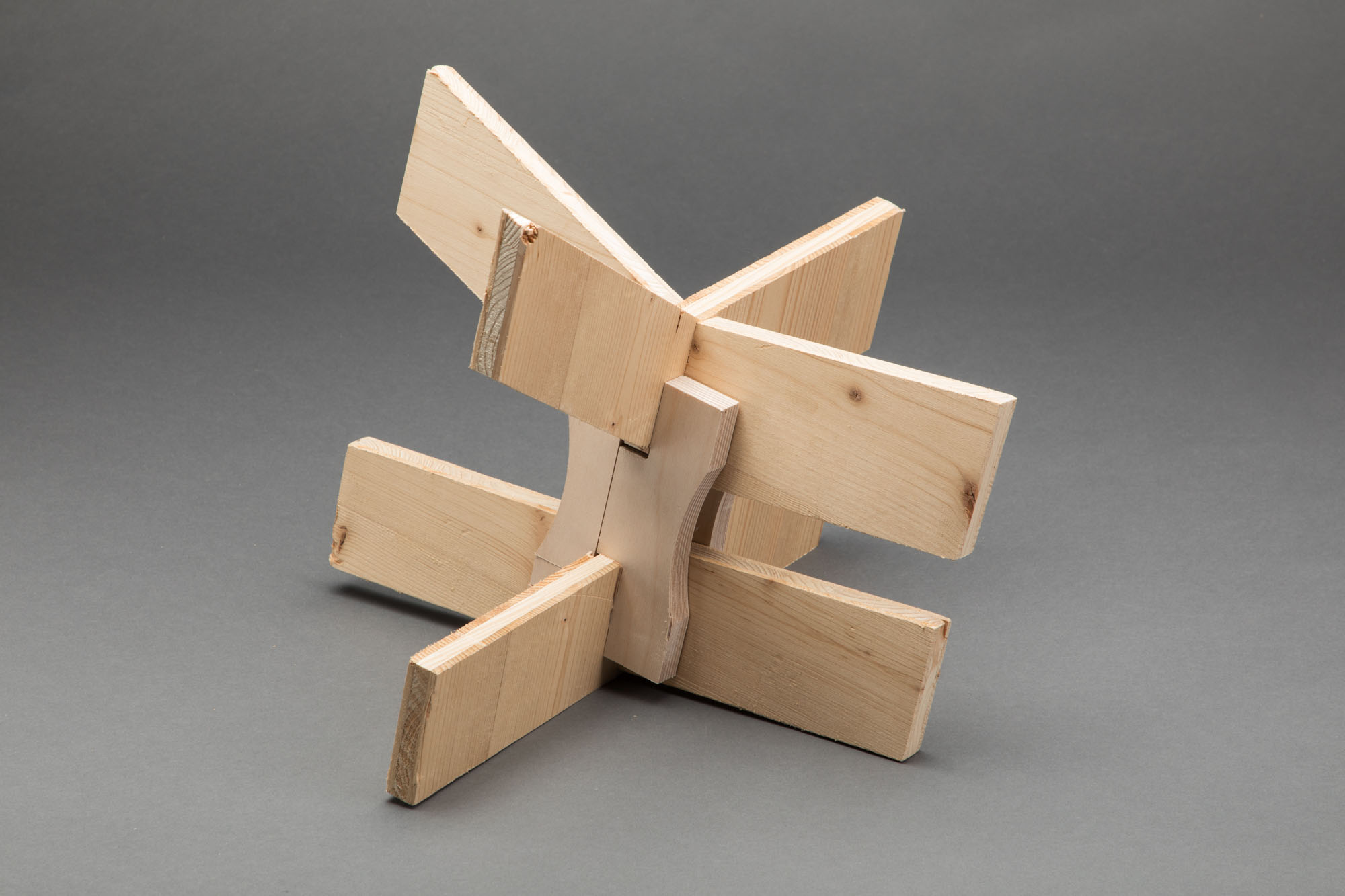
Joint study 05
「3本の木」が創り出す森の体験
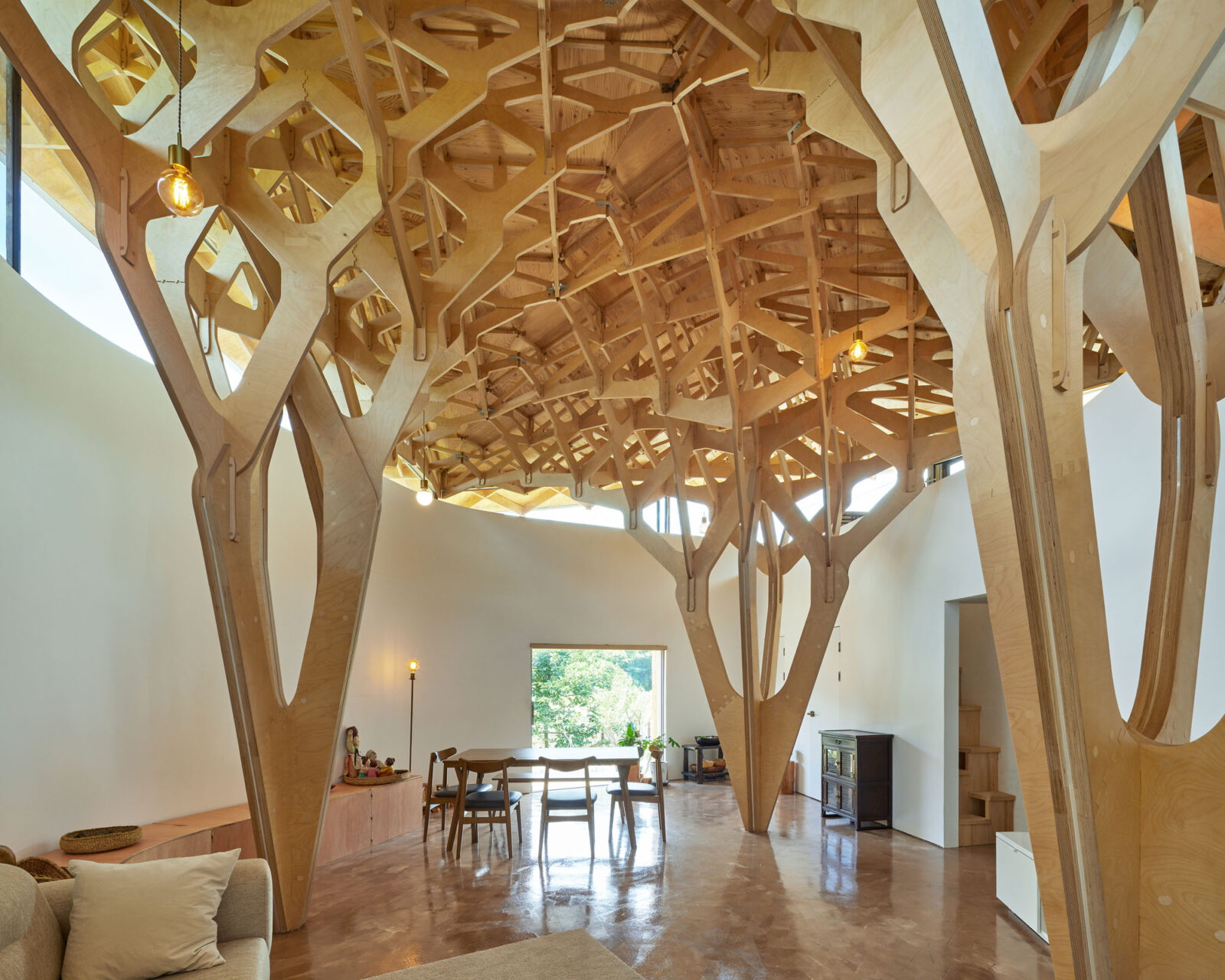
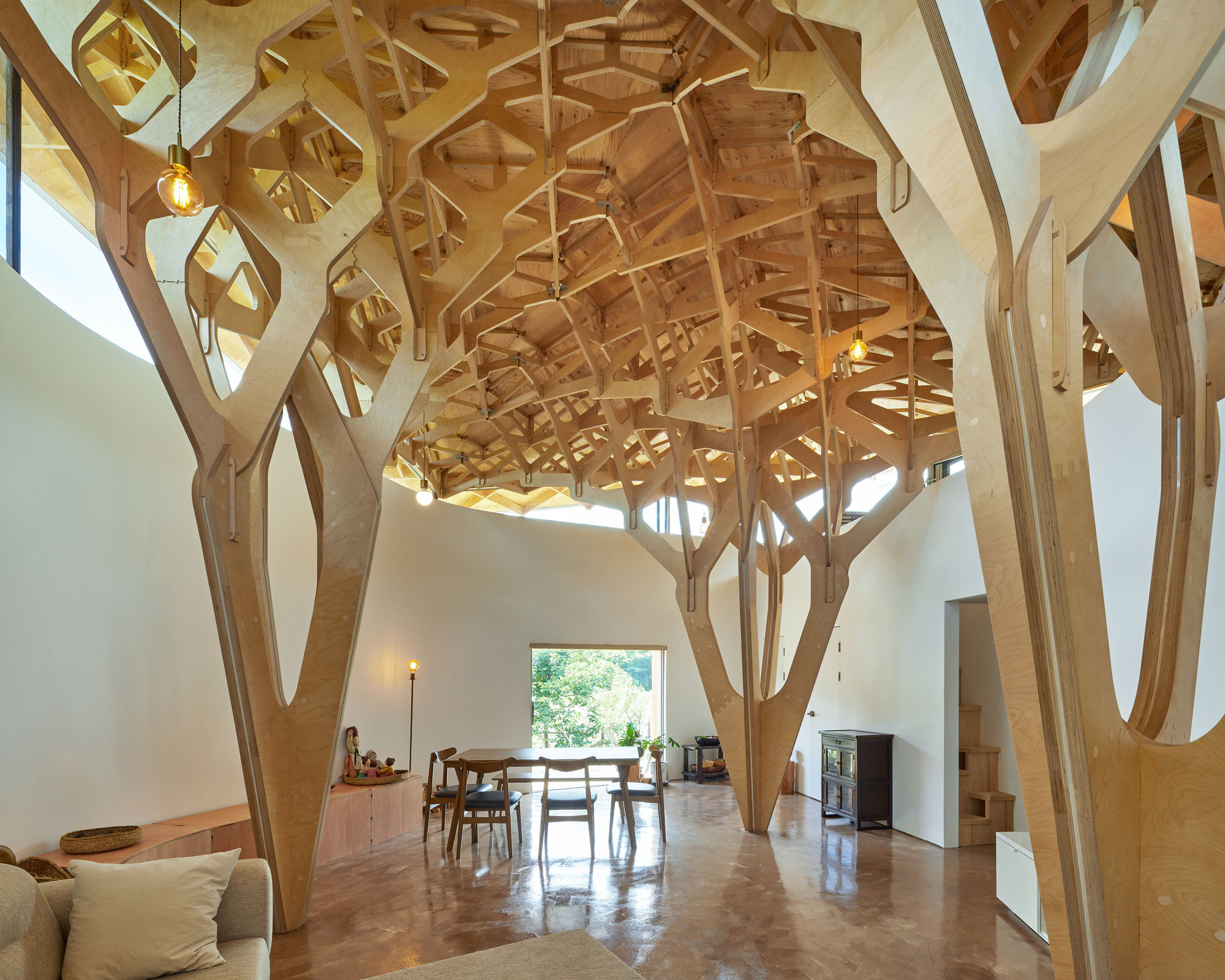
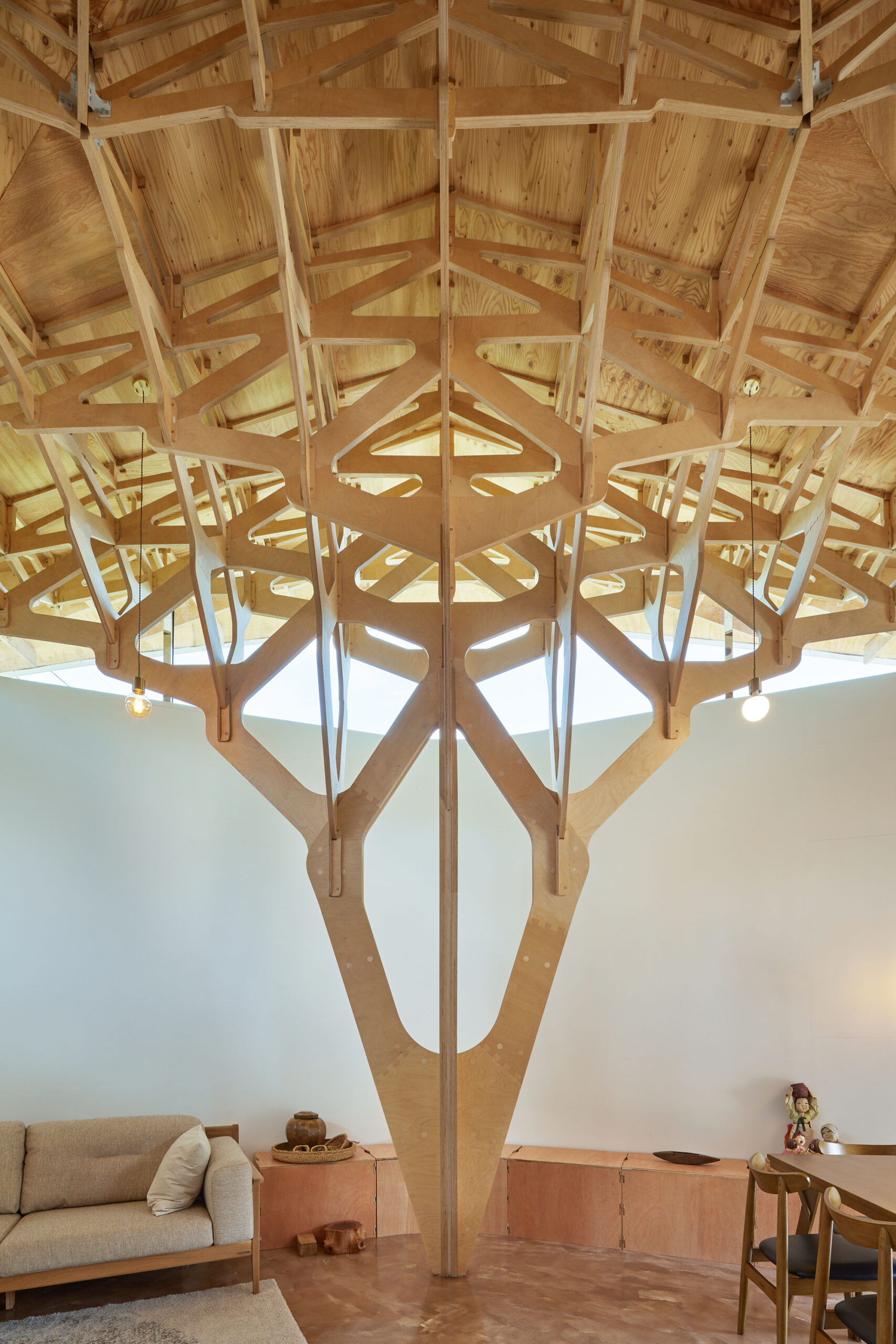
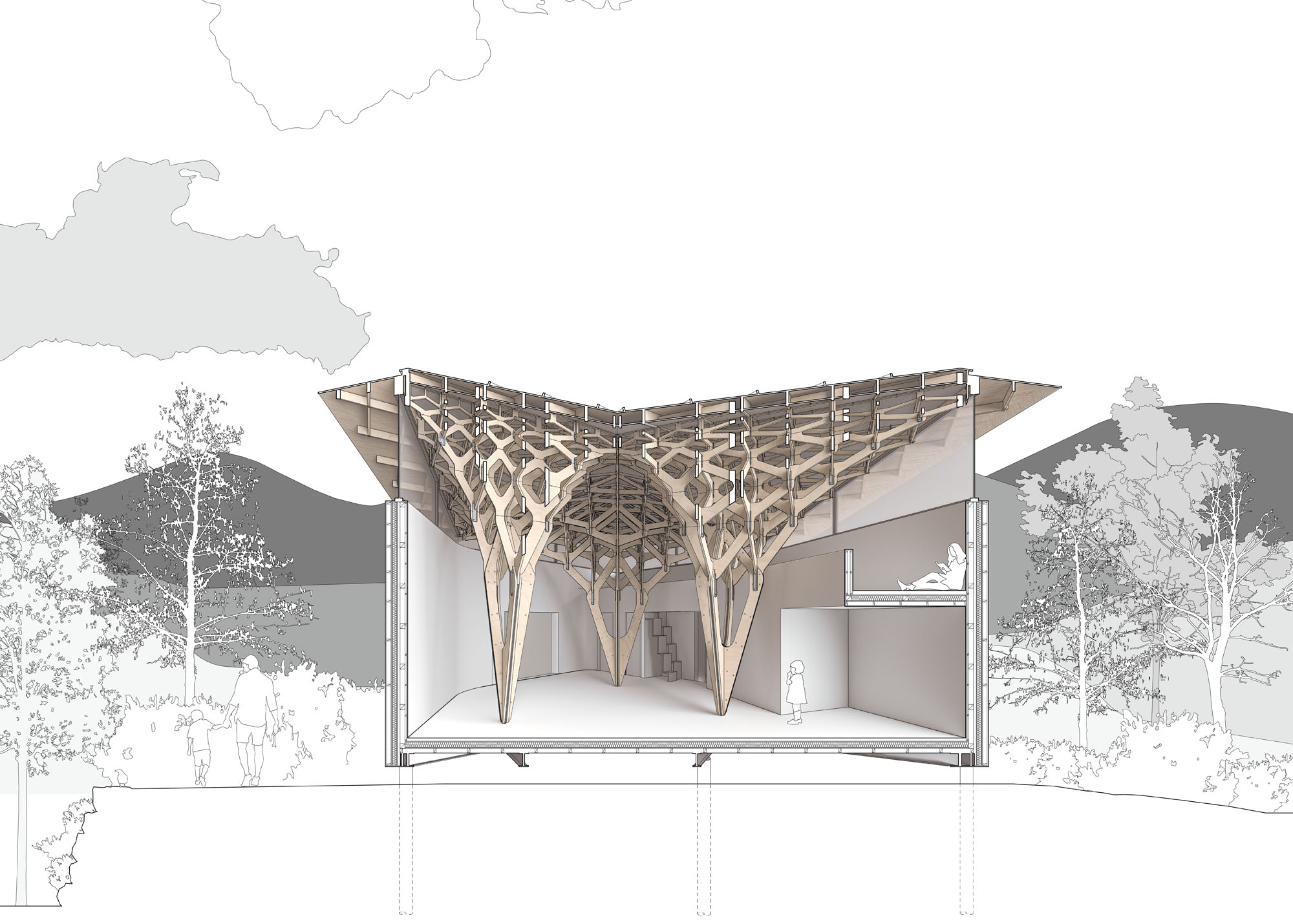
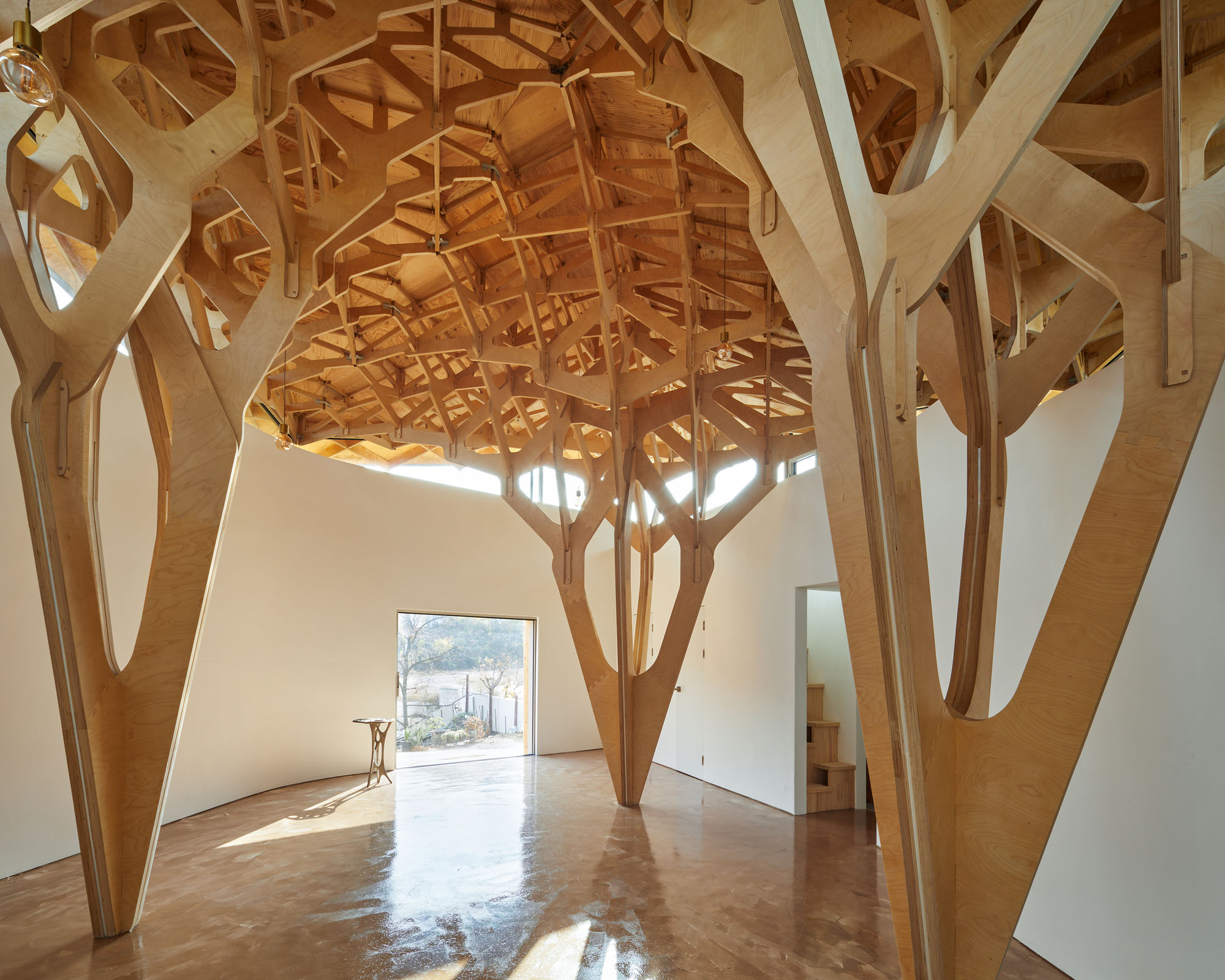
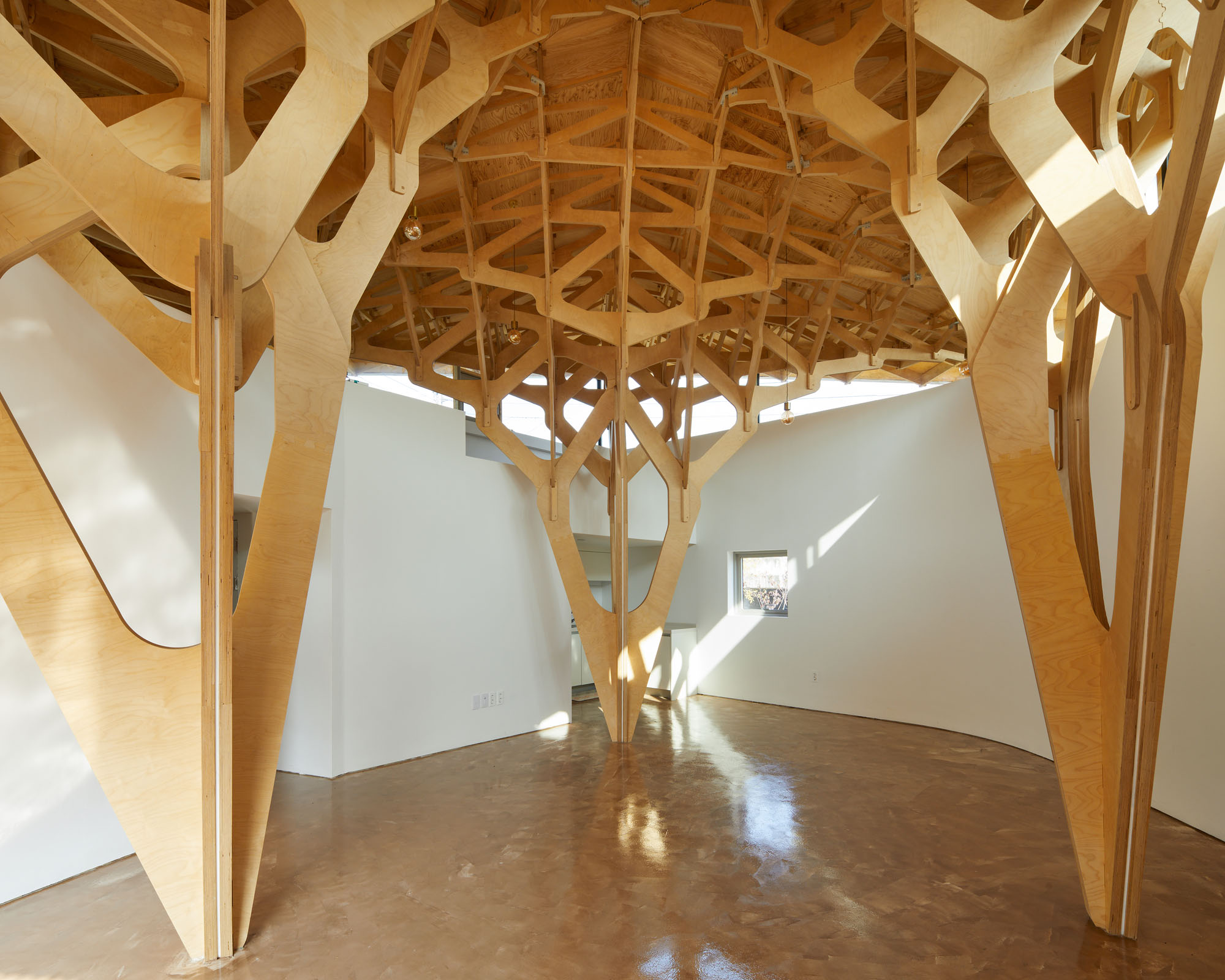
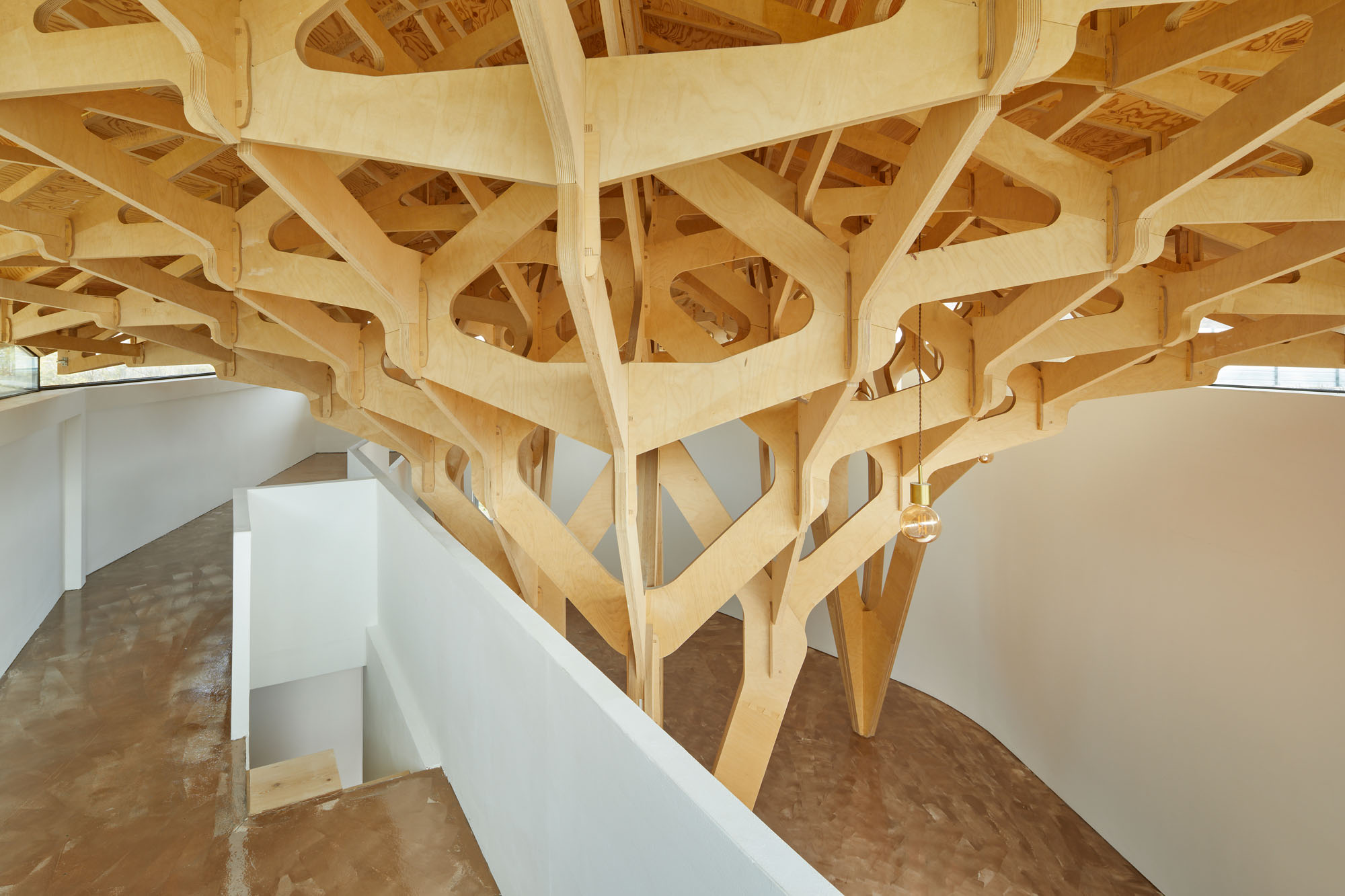
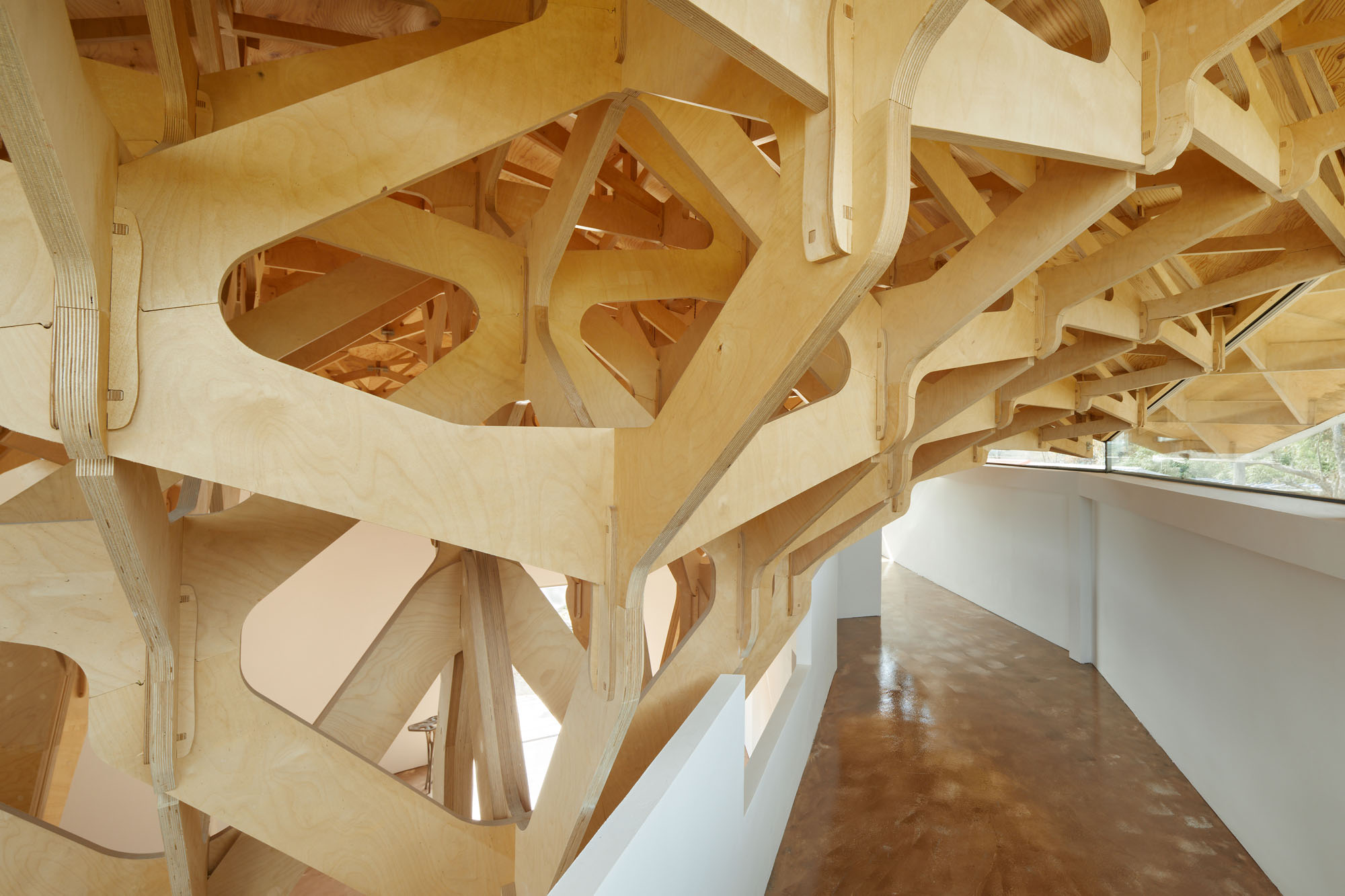
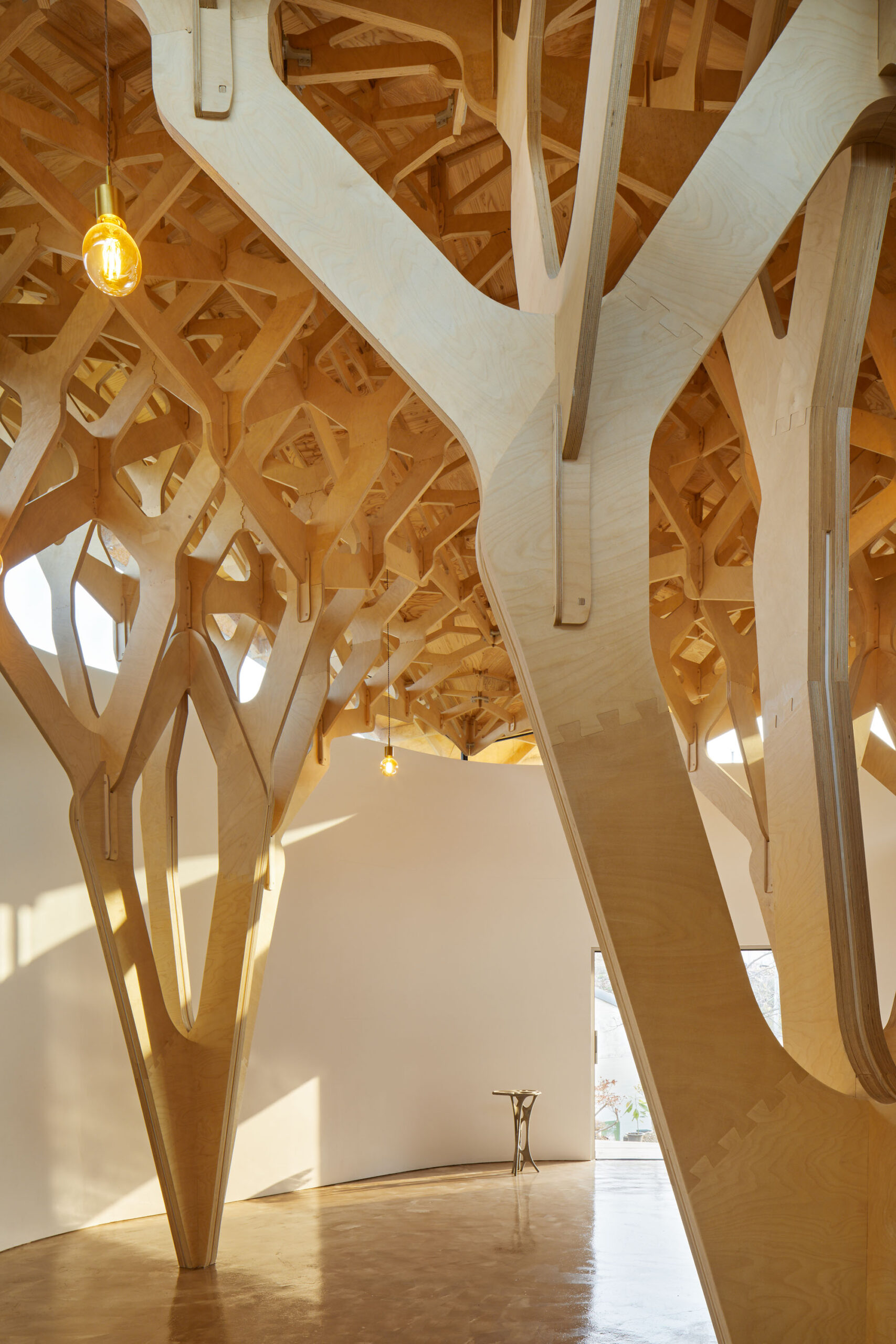
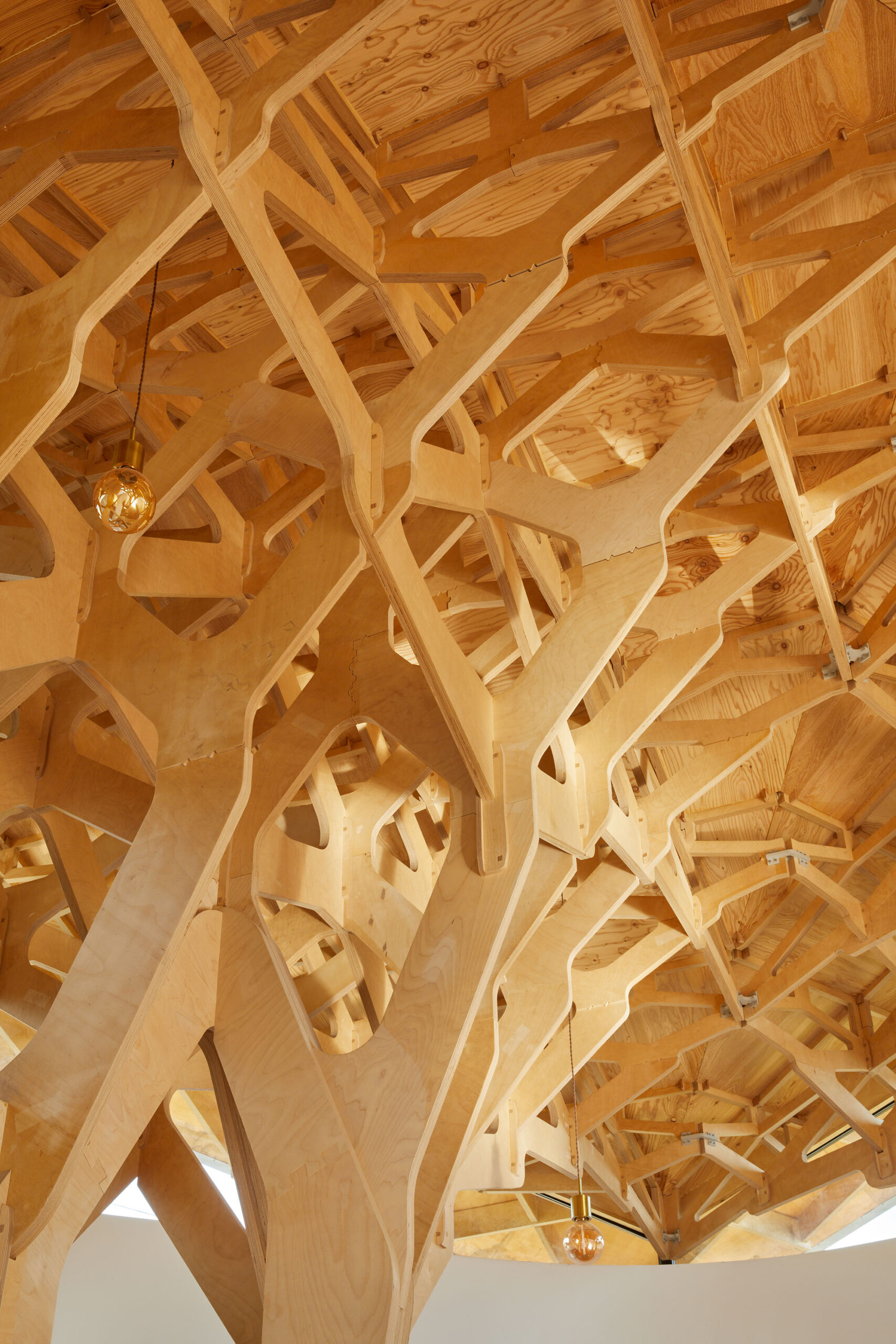
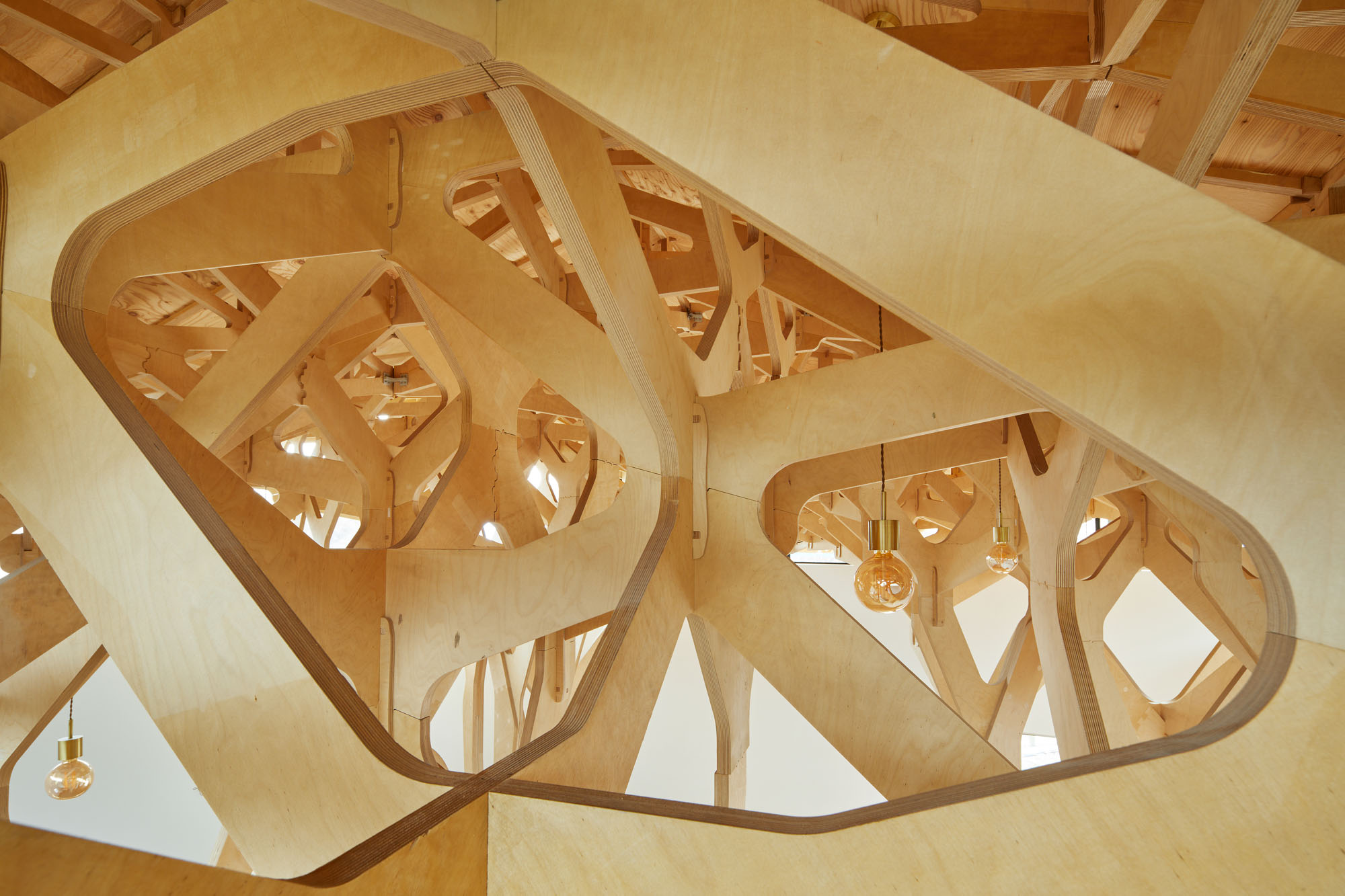
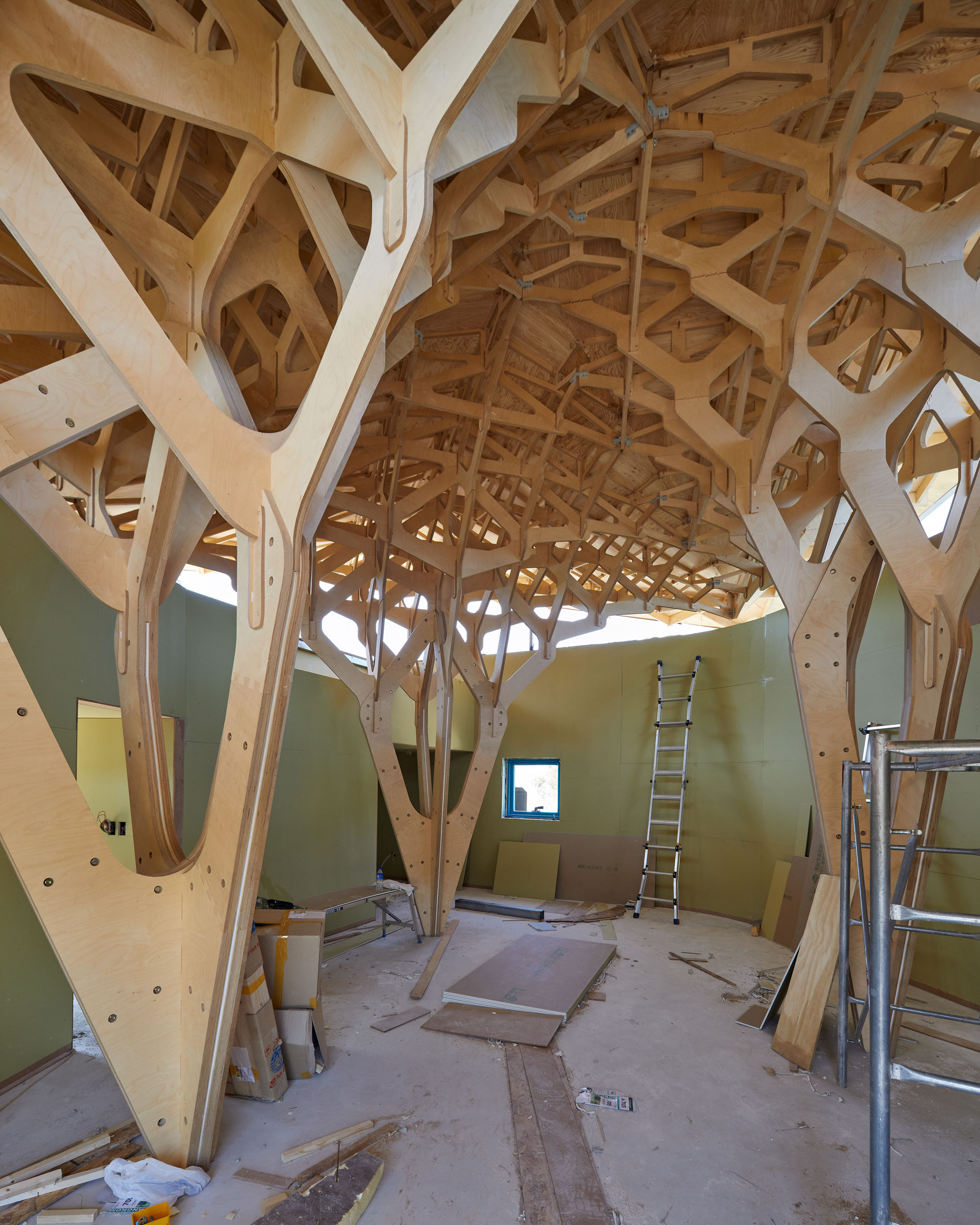
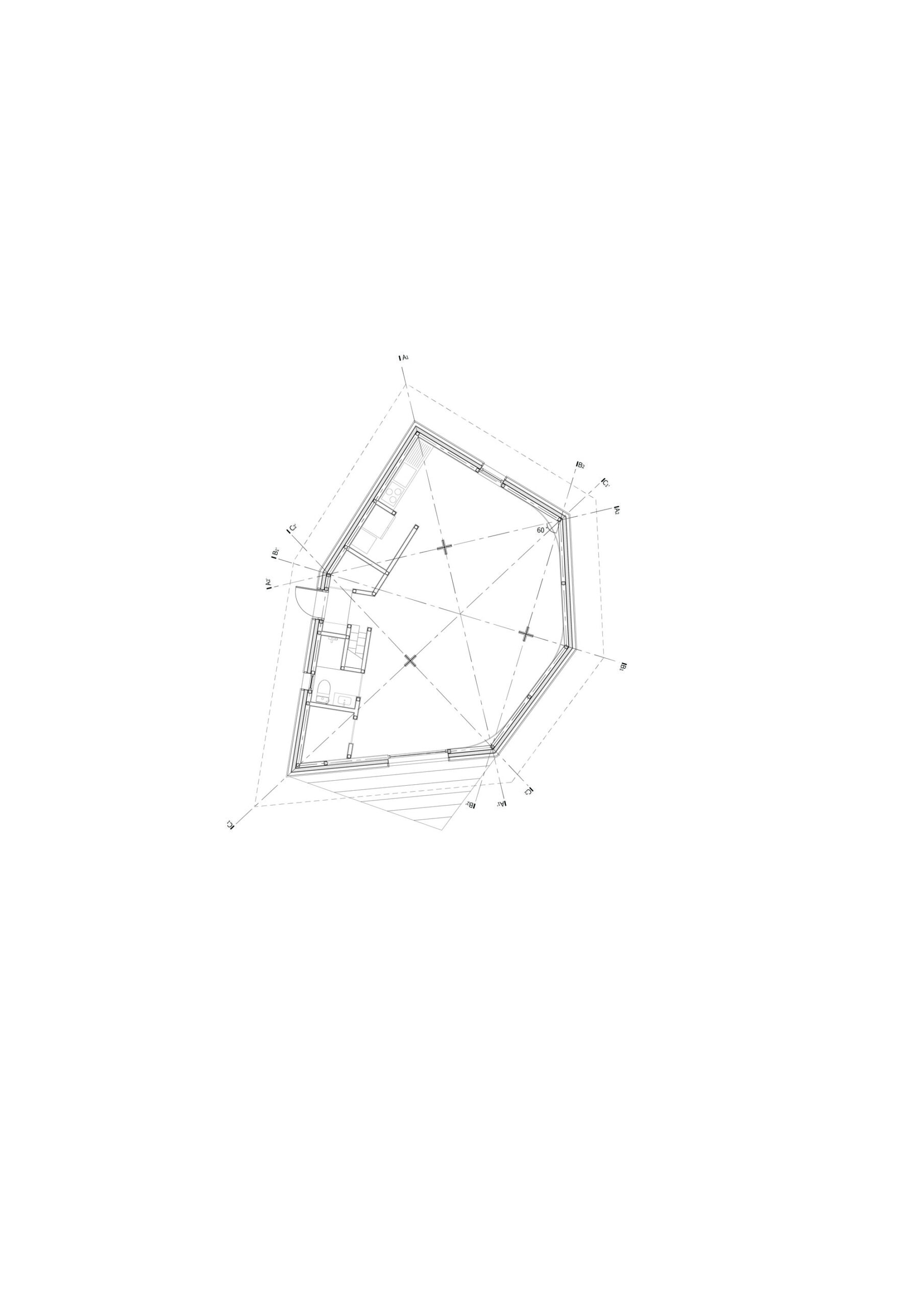
建物内部に配された「3本の木」は、不規則な六角形の平面形状に対応する内部空間を形成している。これらは屋根を支える最小限の構造体であると同時に、空間のアンカーポイントとしての役割を果たす。
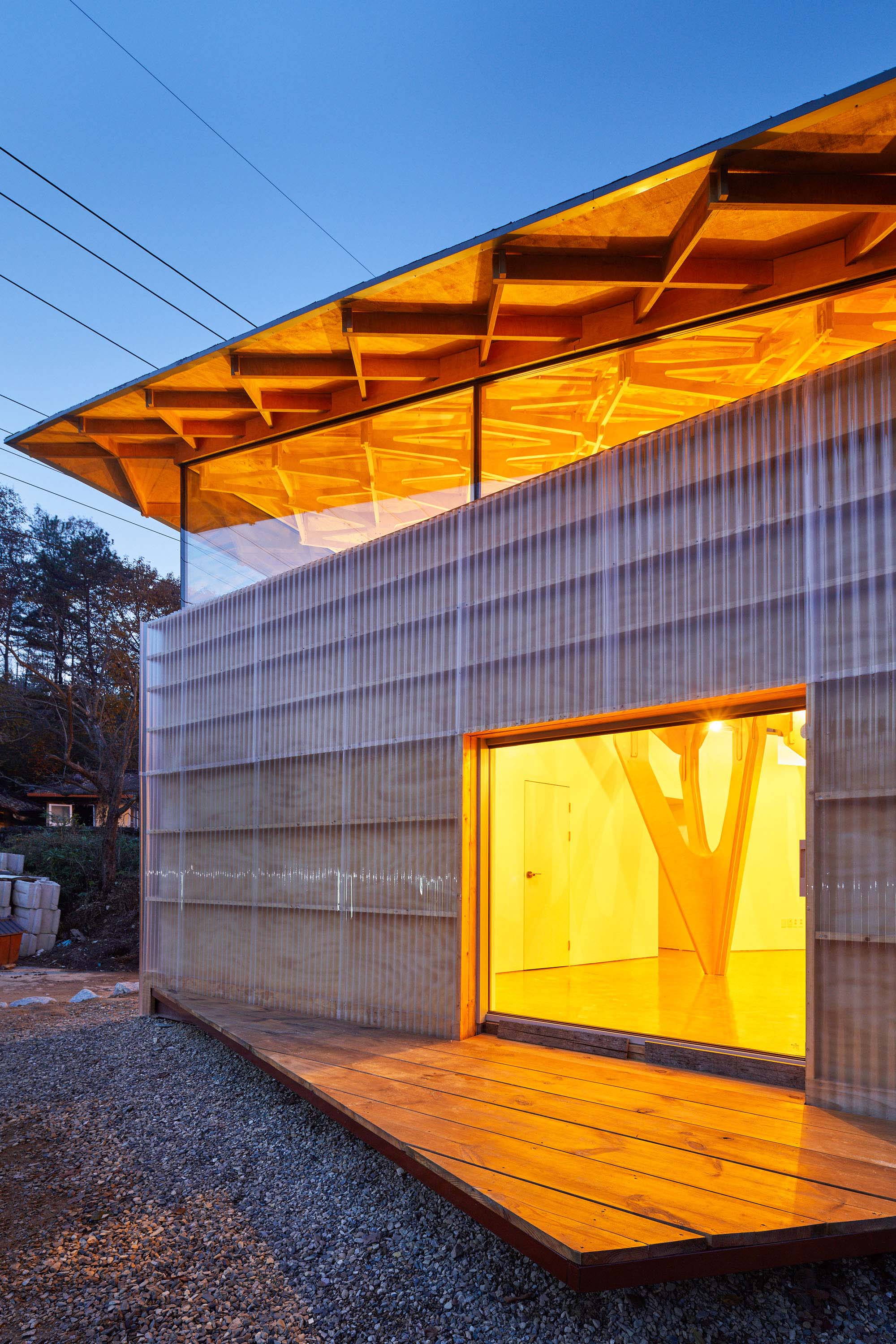
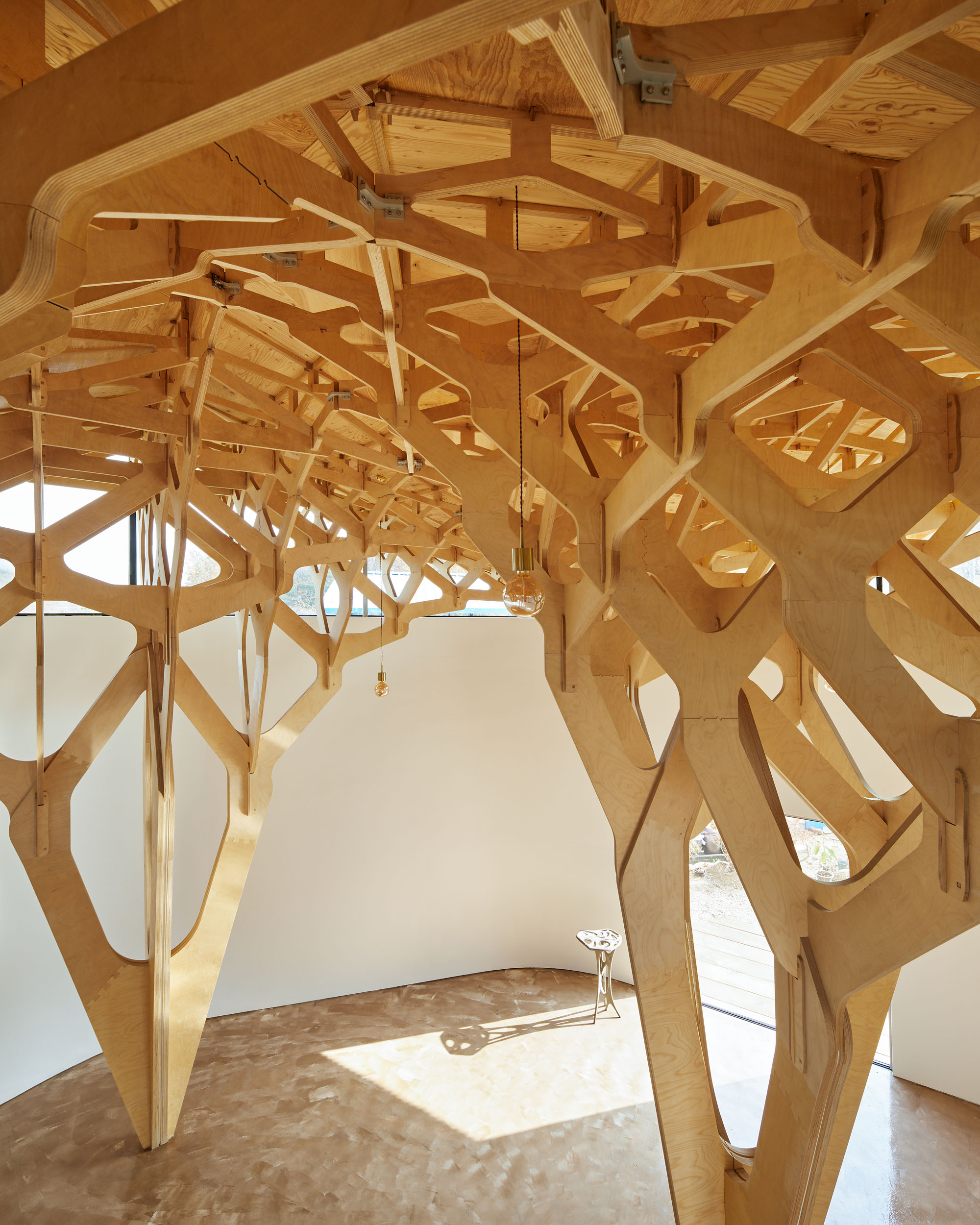
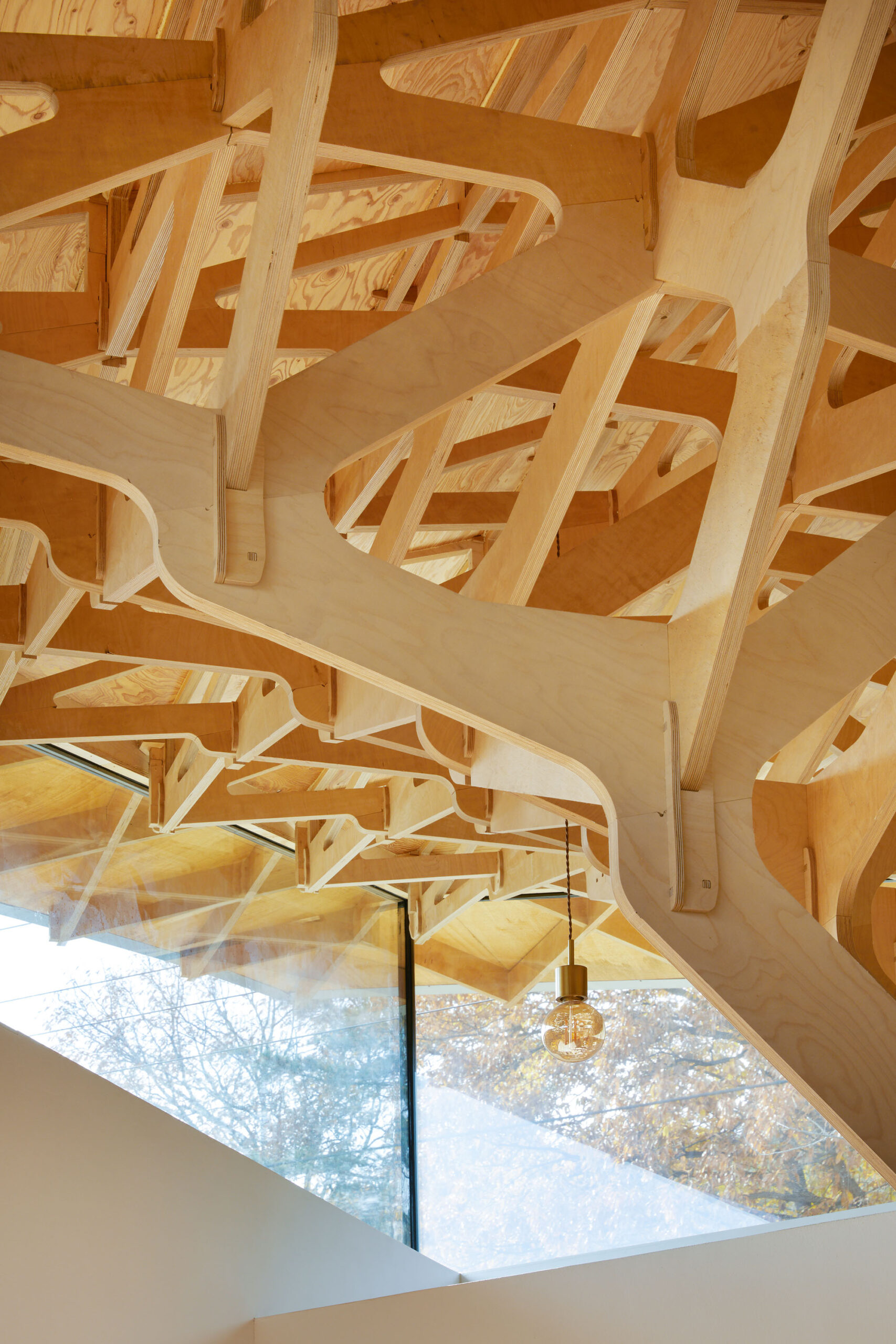
外壁は、韓国の厳しい冬を乗り切るための断熱性を確保しつつ、内部の視覚体験をコントロールするよう設計された。内部に留まる人々は、力強い木構造が支配する閉鎖的な空間を享受する一方で、意図的に配置された開口部からは厳選された外部の景色を望むことができる。屋根と壁の隙間から差し込む光の移ろいは、まるで森の中に降り注ぐ陽光を彷彿とさせ、住人に時間の経過を強く意識させる。
また、この木構造は釘などの金属部材を一切使わない木工接合のみで構成されている。これは伝統への敬意であると同時に、部材として使用されたエンジニアードウッド(加工木材)がもつ純粋な強度を証明する試みでもある。
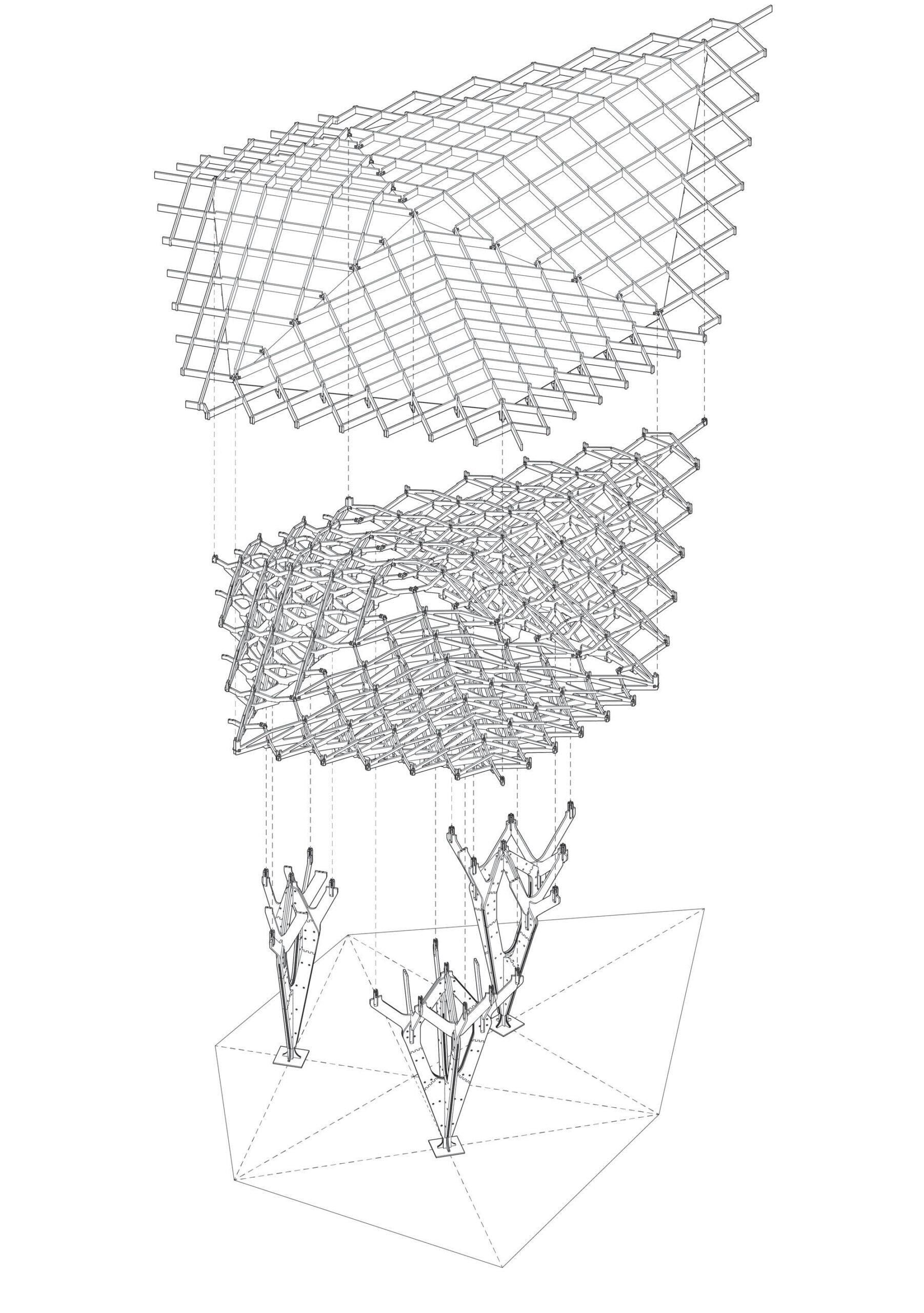
Three Trees Exploded
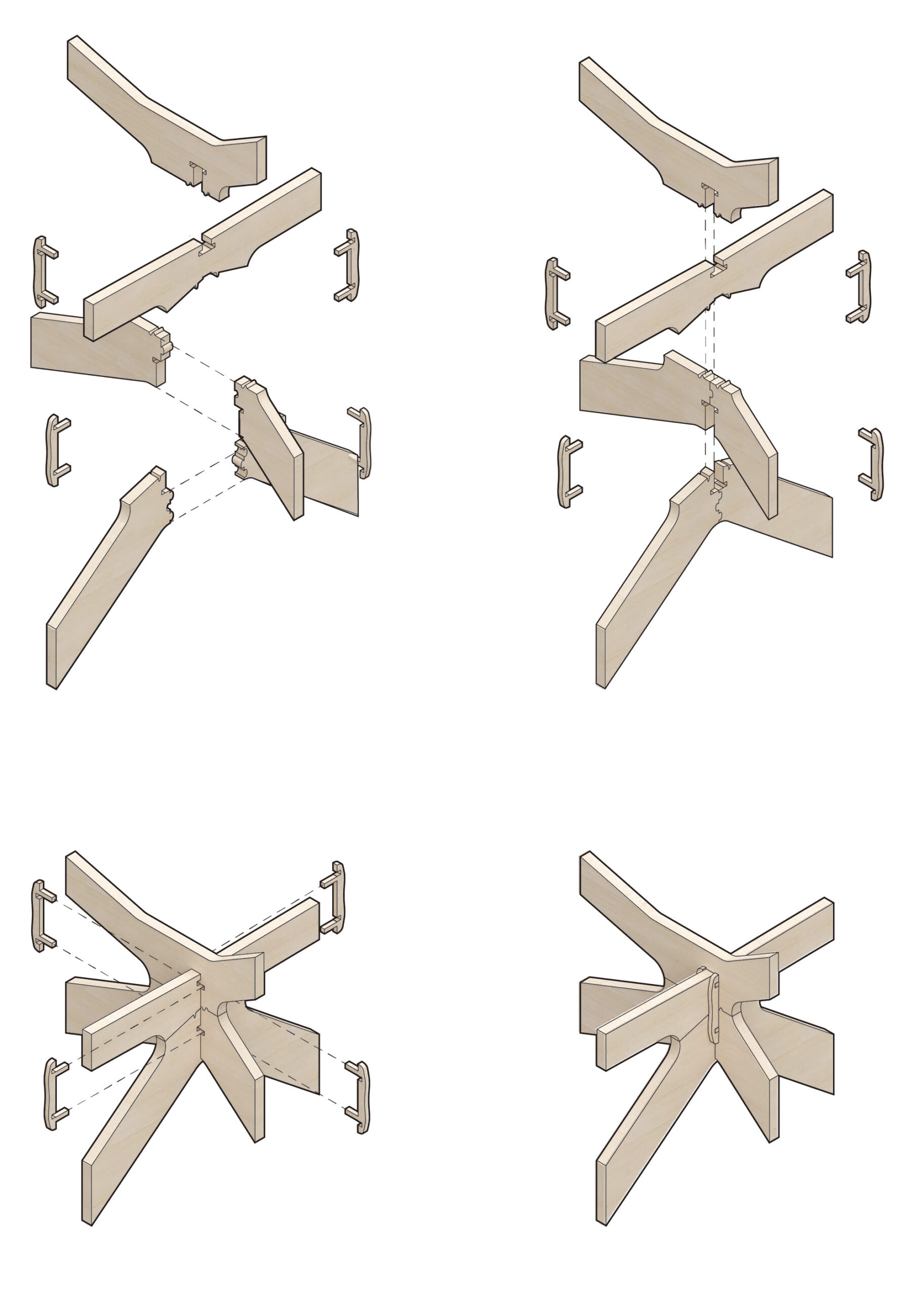
Three Trees Joints
アルゴリズムによる秩序と素材の選択
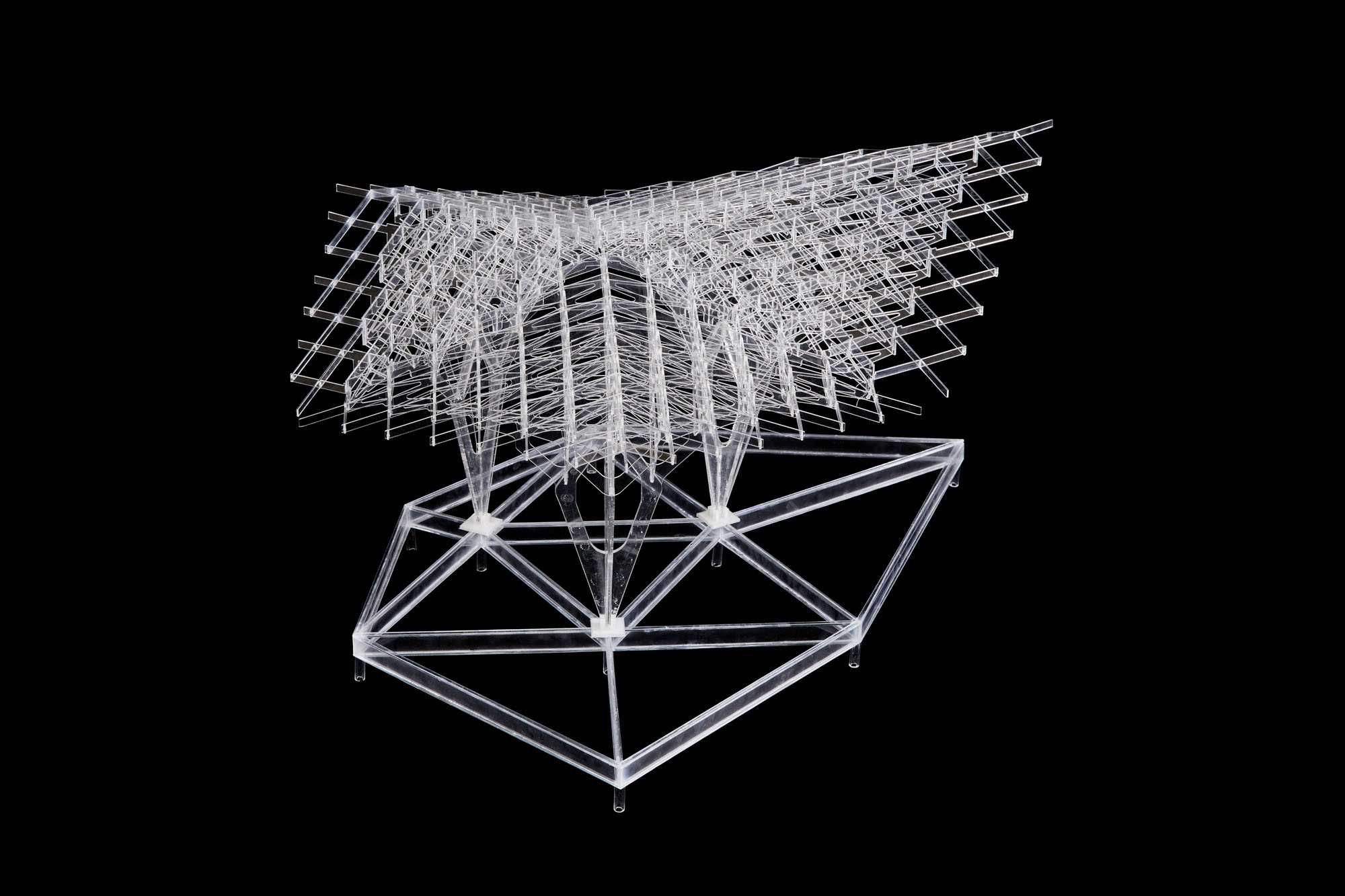
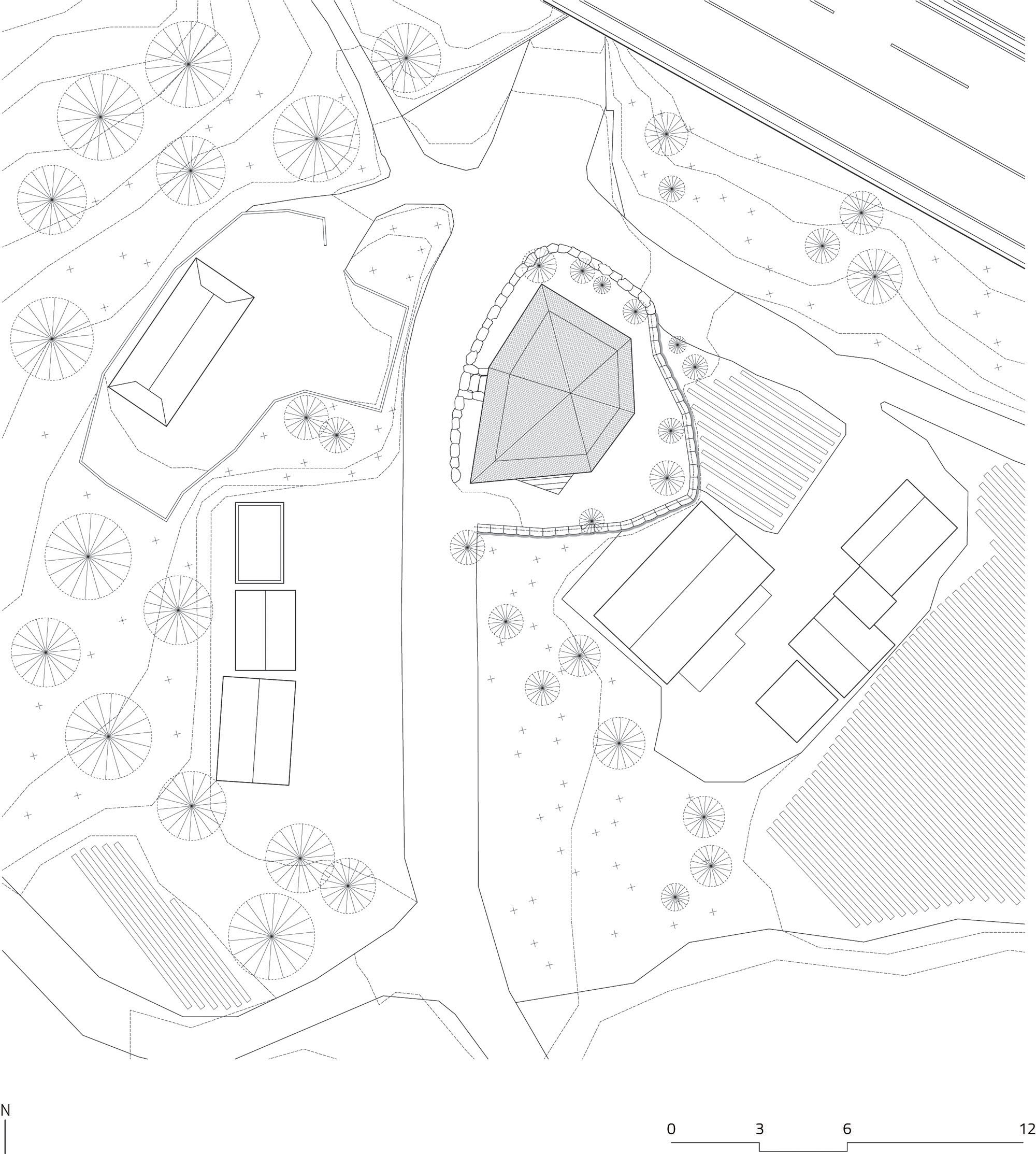
建物の平面は敷地の不規則な境界線に沿っているが、アルゴリズムによって生成された幾何学的な秩序に基づいている。この秩序が「3本の木」を配置する指針となり、その複雑な形状の設計と解析を導き出した。結果として、施工効率と物流を最適化した4,006個もの精密な木製部材が導出されたのである。
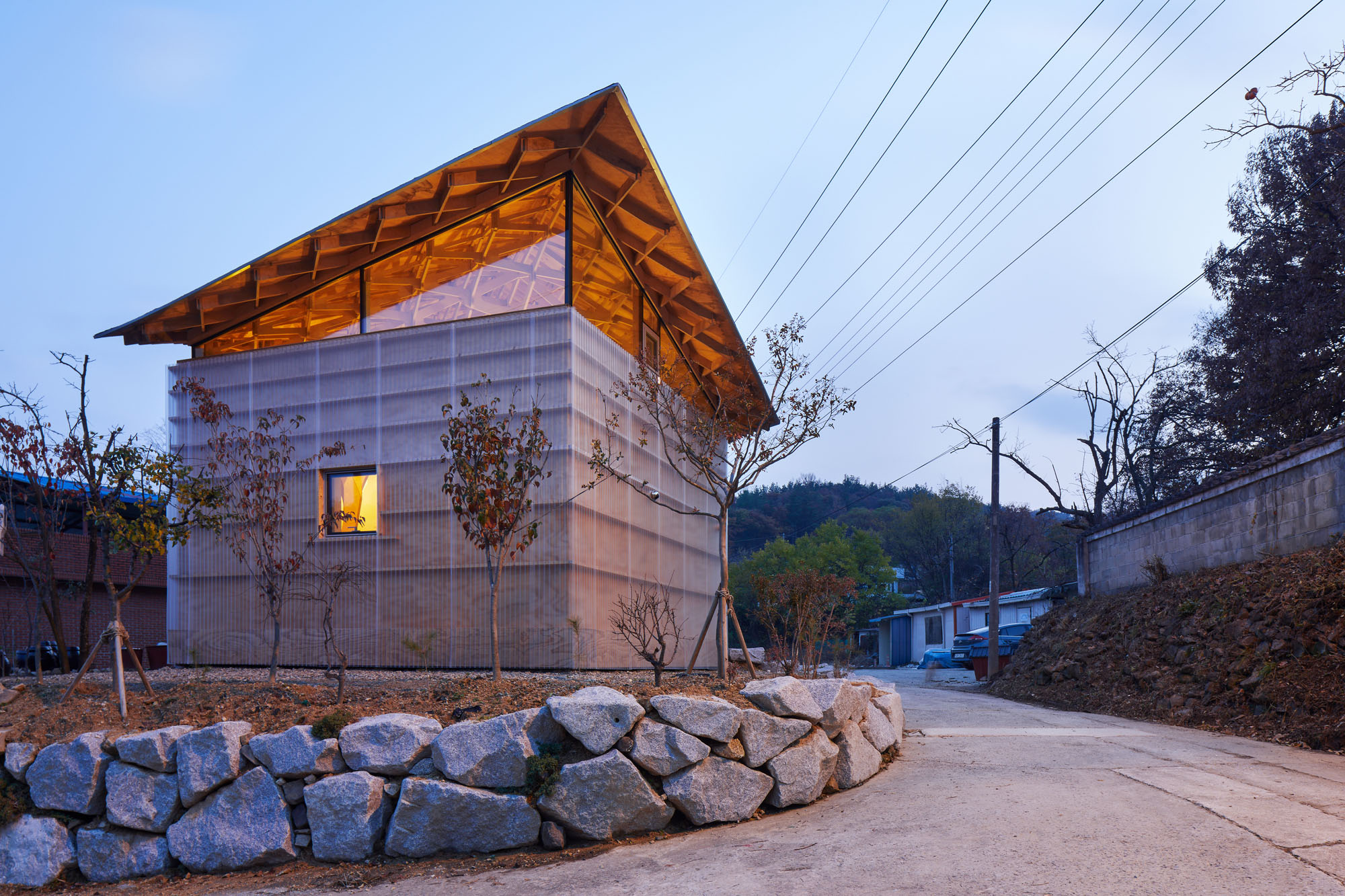
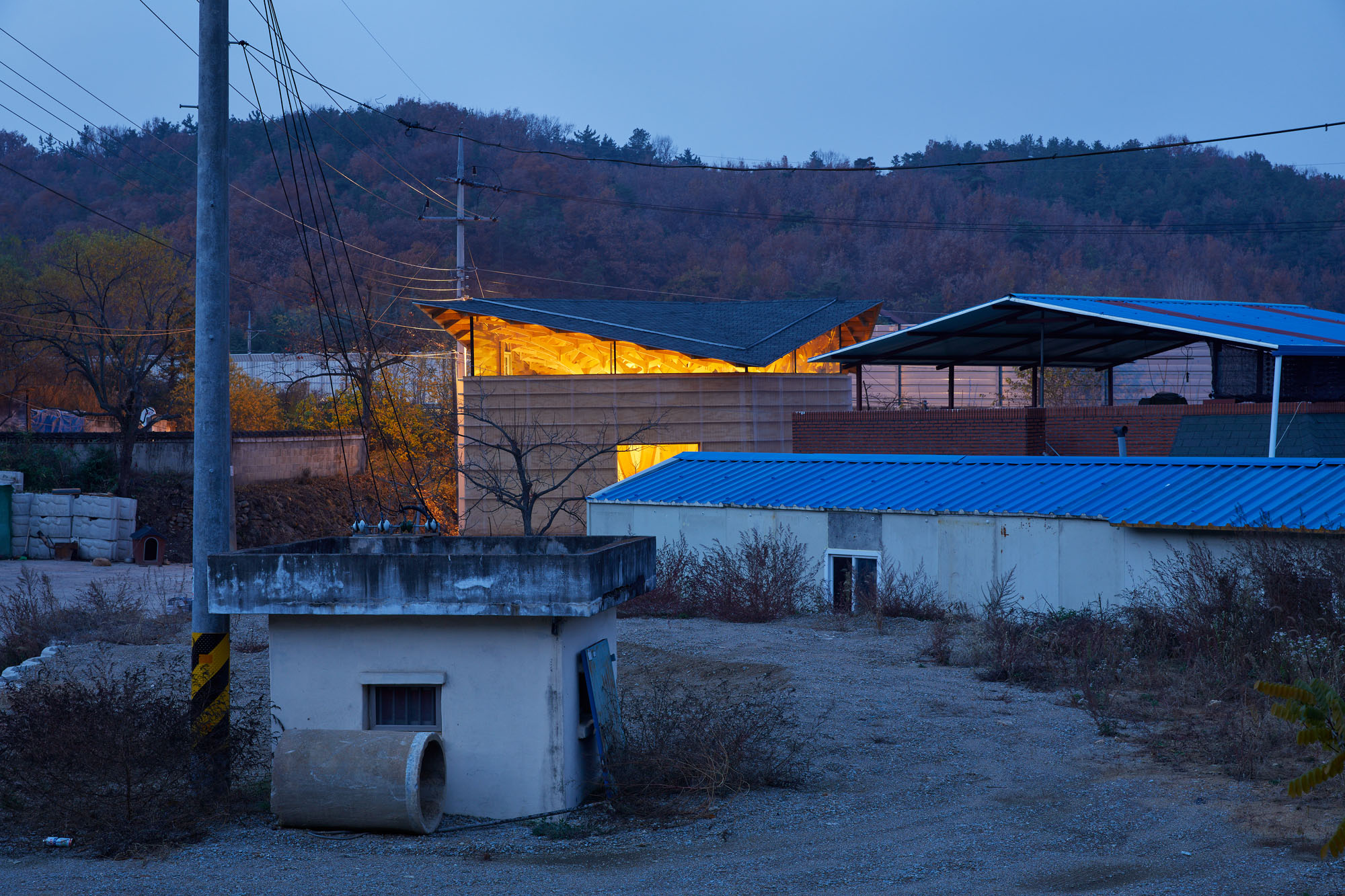
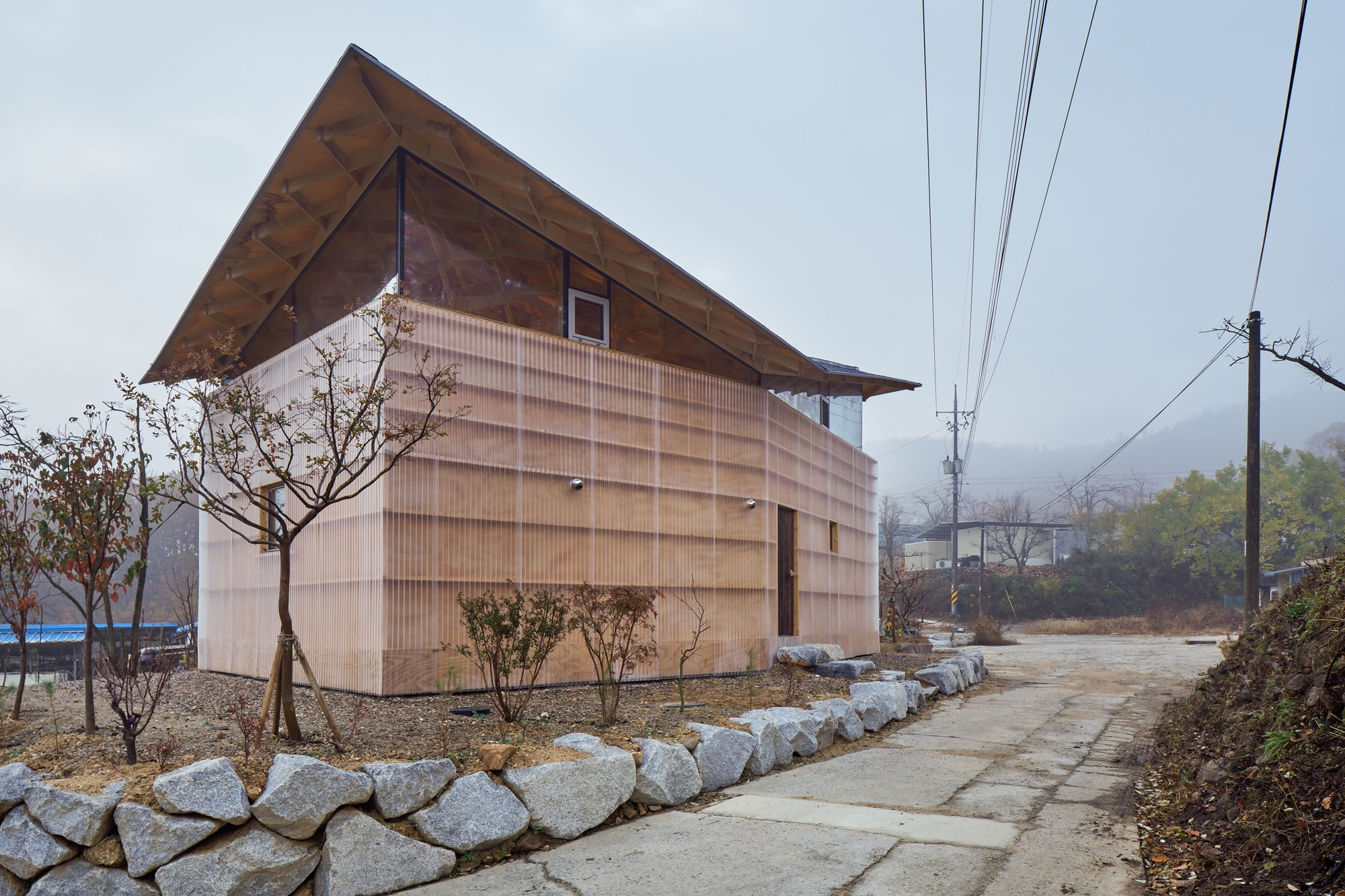
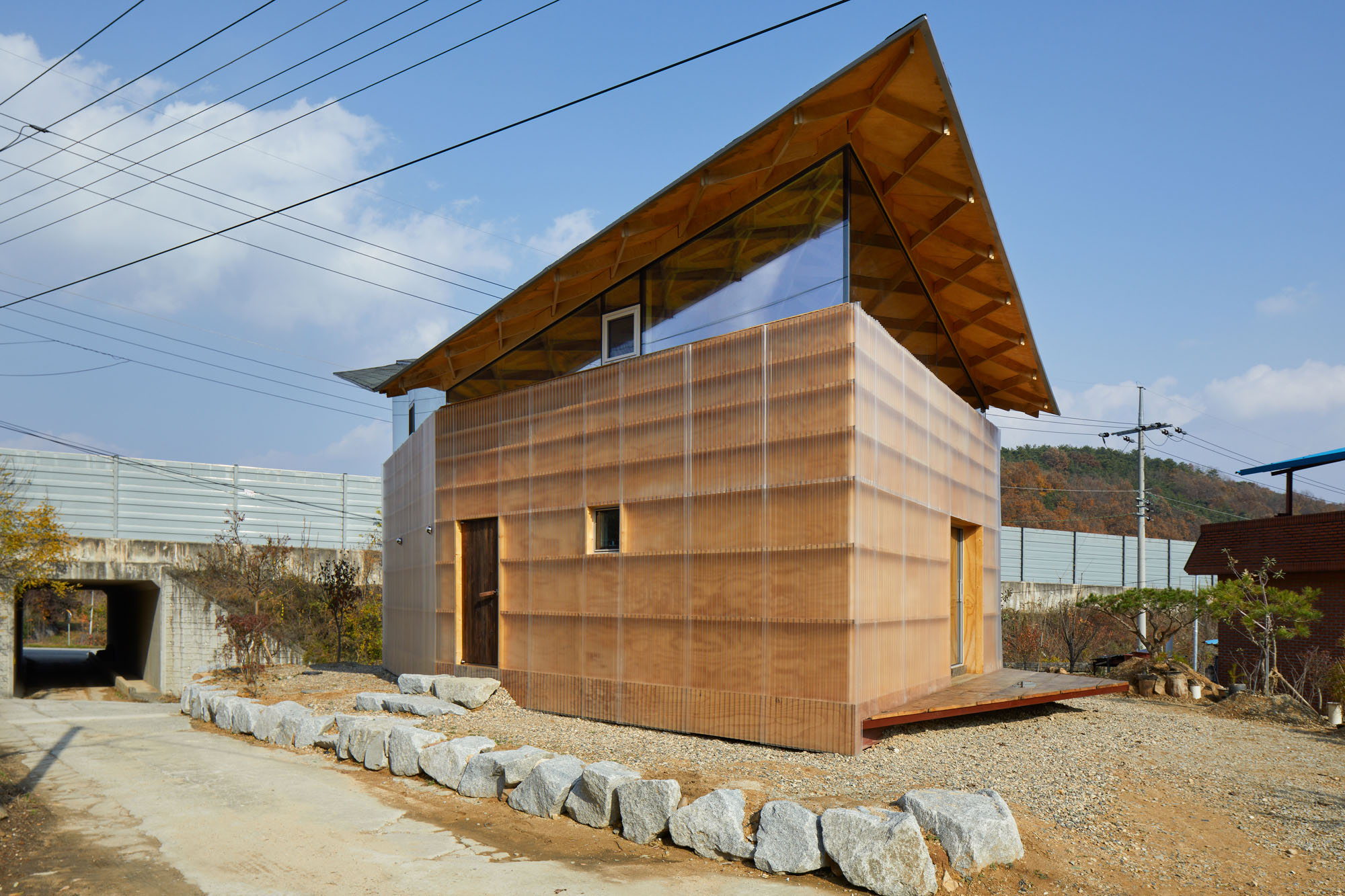
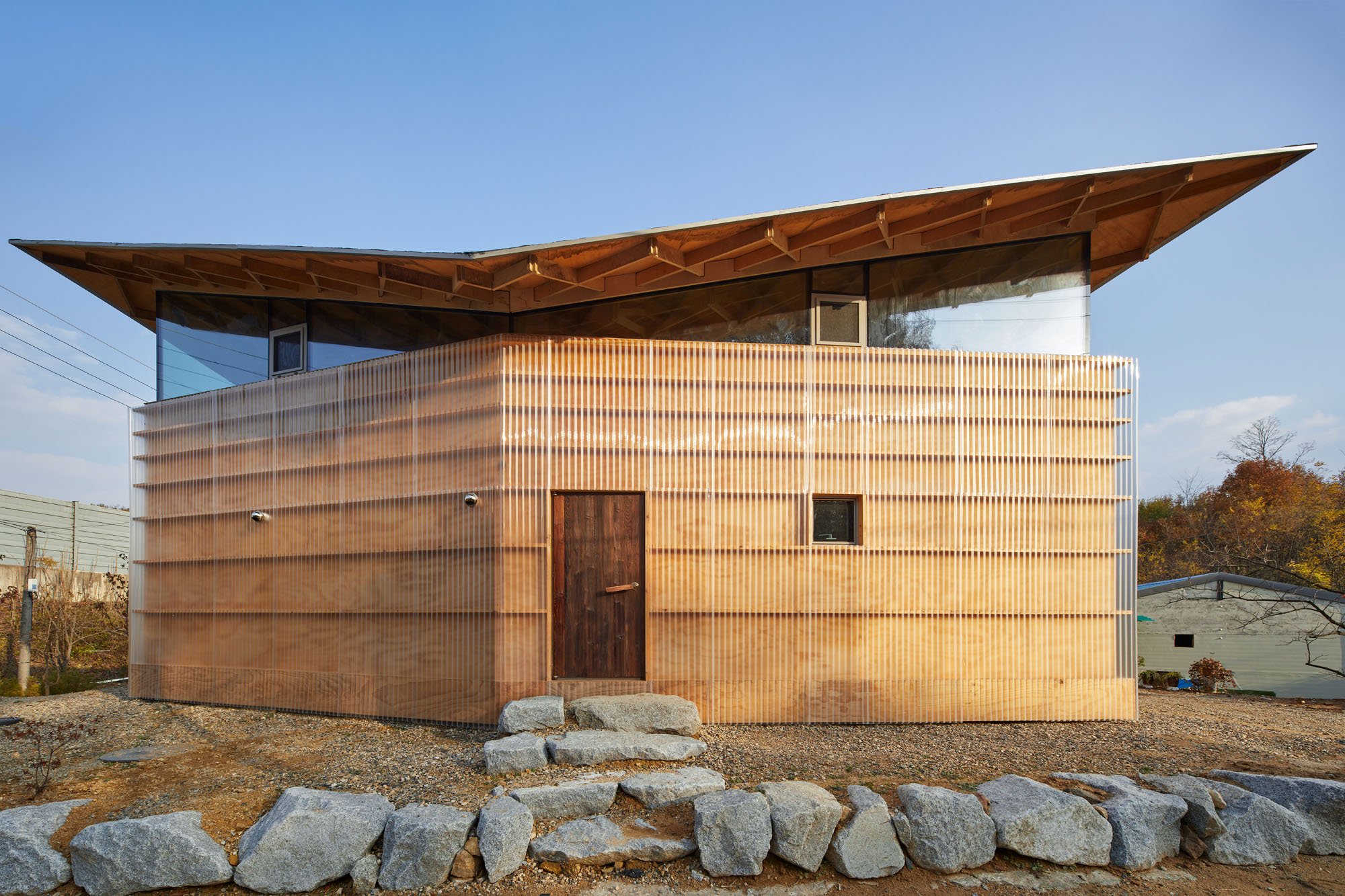
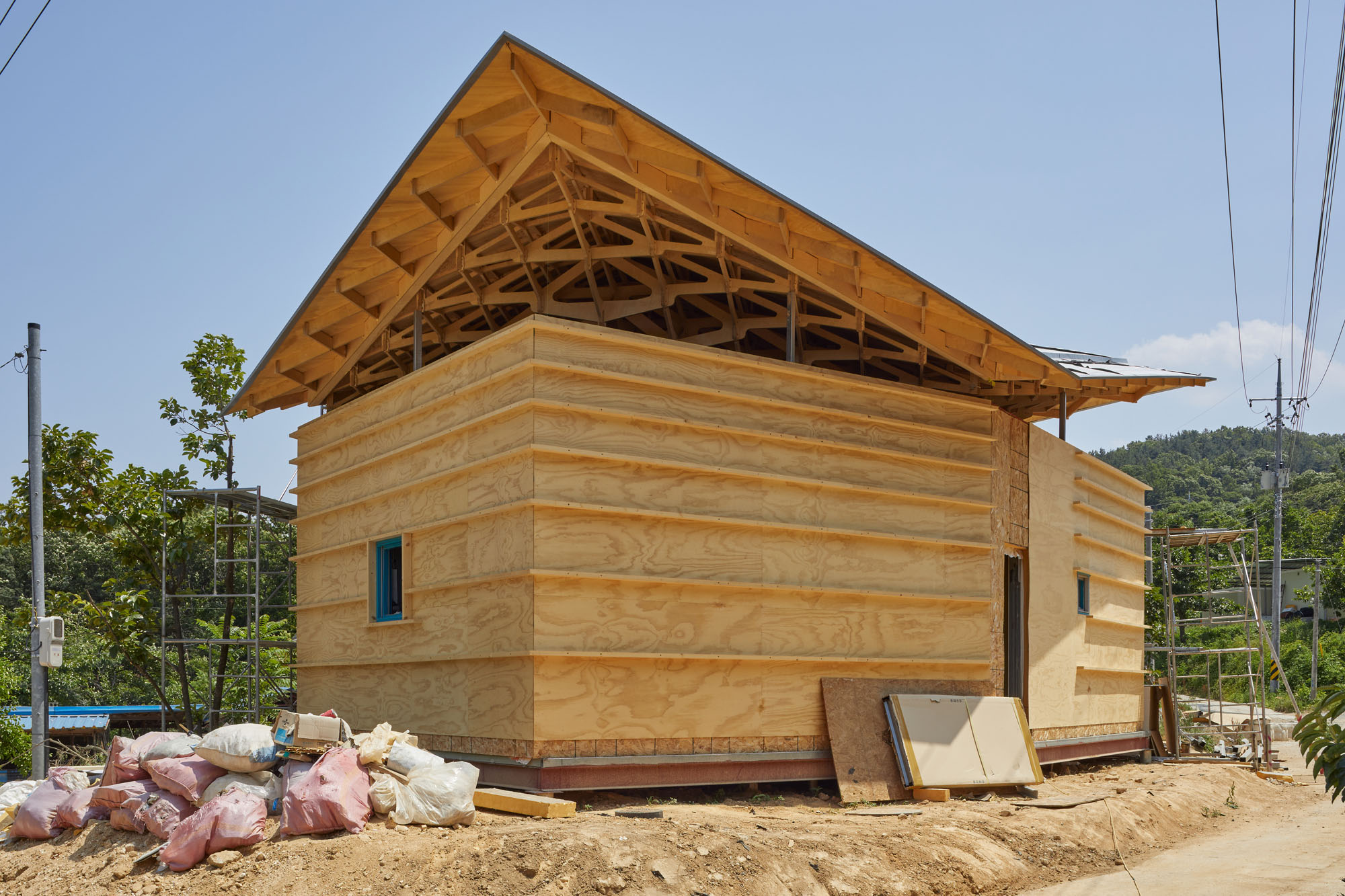
屋根の設計や素材の選定には、周辺の典型的な農村住宅の影響が反映されている。1970〜80年代に政府基準で建てられた平屋根の農村住宅は、排水不良による雨漏りが深刻な課題となっていた。その解決策として住民が自主的に設置した「サンドイッチパネルの勾配屋根」という即興的な建築手法から着想を得て、軽やかに浮遊する屋根のデザインが生まれた。素材には現地で安価に流通するアスファルトシングルを採用し、その軽やかさを強調している。
外装材には合板やポリカーボネート波板といった、近隣の倉庫や温室で広く使われている素材を選定した。半透明のパネルから内部の合板がほのかに透ける意匠は、建物に幽玄な軽やかさを与え、周囲の景観と対比をなしつつも地域の文脈を想起させる。機能面においても、このパネル層が空気層を形成することで断熱性能を高め、内部の合板を風雨から守る合理的な役割を担っている。
©︎ Rohspace
©︎ Rohspace
©︎ Rohspace
©︎ Rohspace
©︎ Rohspace
©︎ Rohspace
©︎ Rohspace
©︎ Rohspace
©︎ Rohspace
©︎ Rohspace
©︎ Rohspace
©︎ Rohspace
©︎ Rohspace
Structure model 01
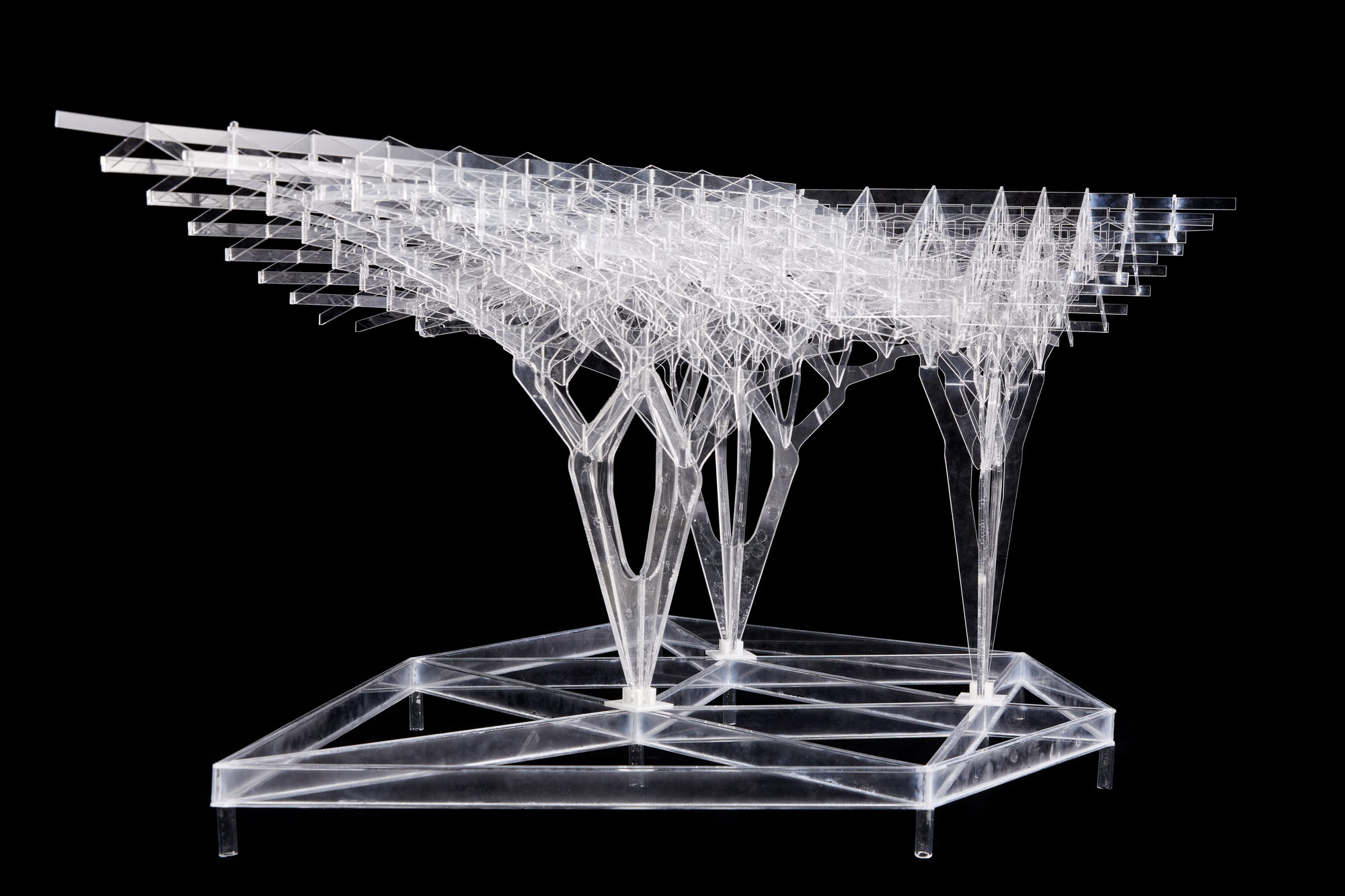
Structure model 02
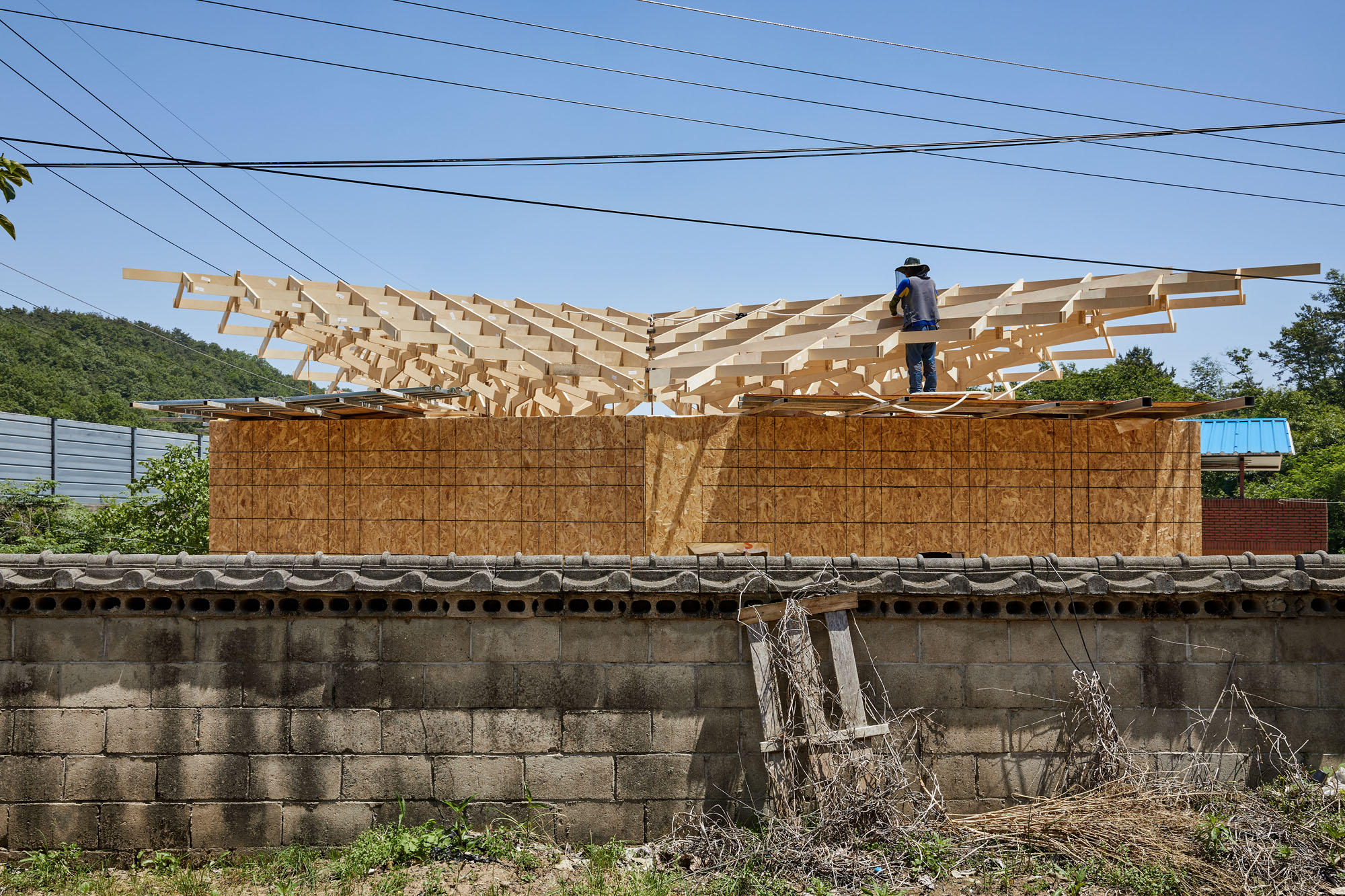
©︎ Rohspace
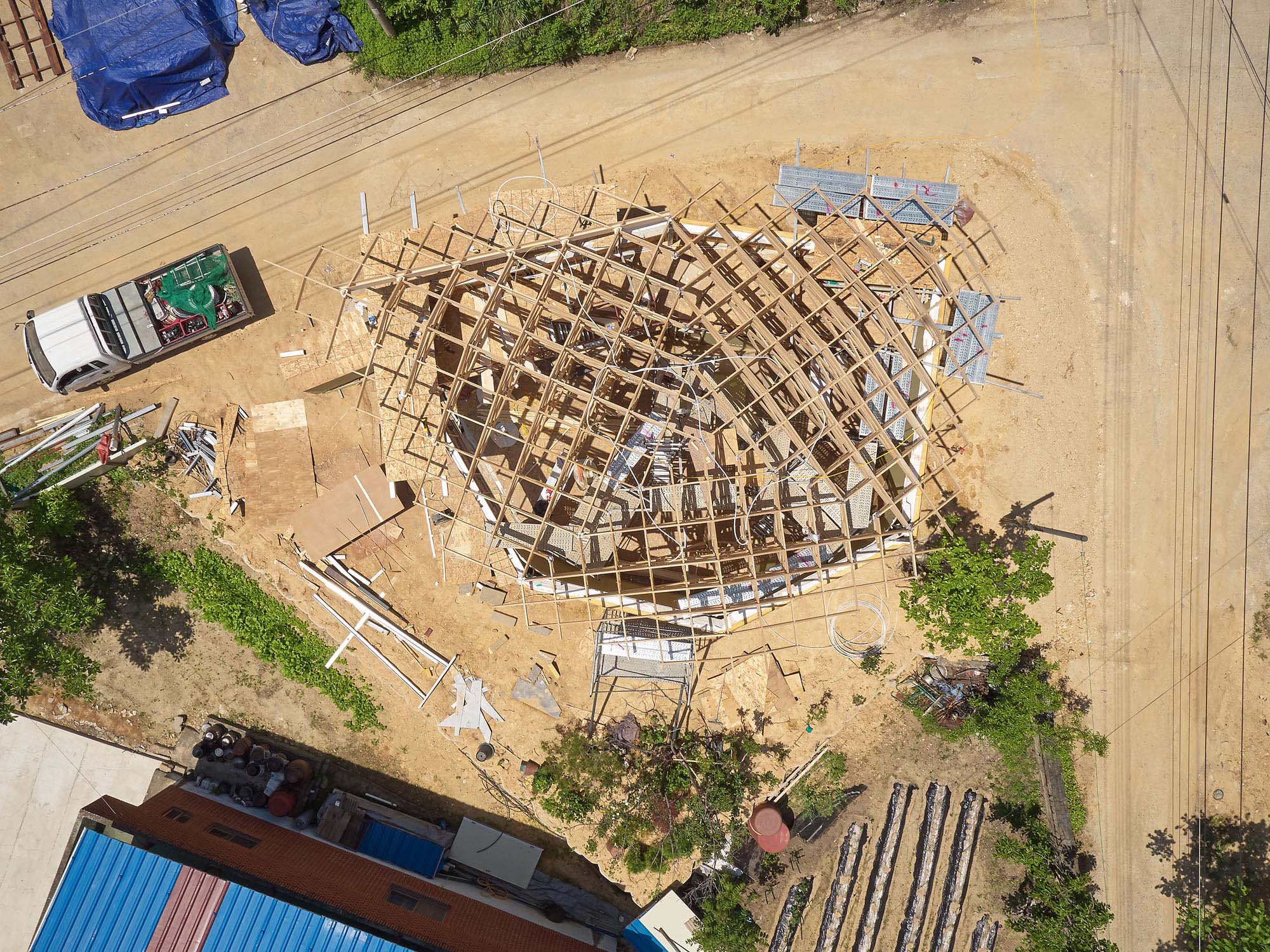
©︎ Rohspace
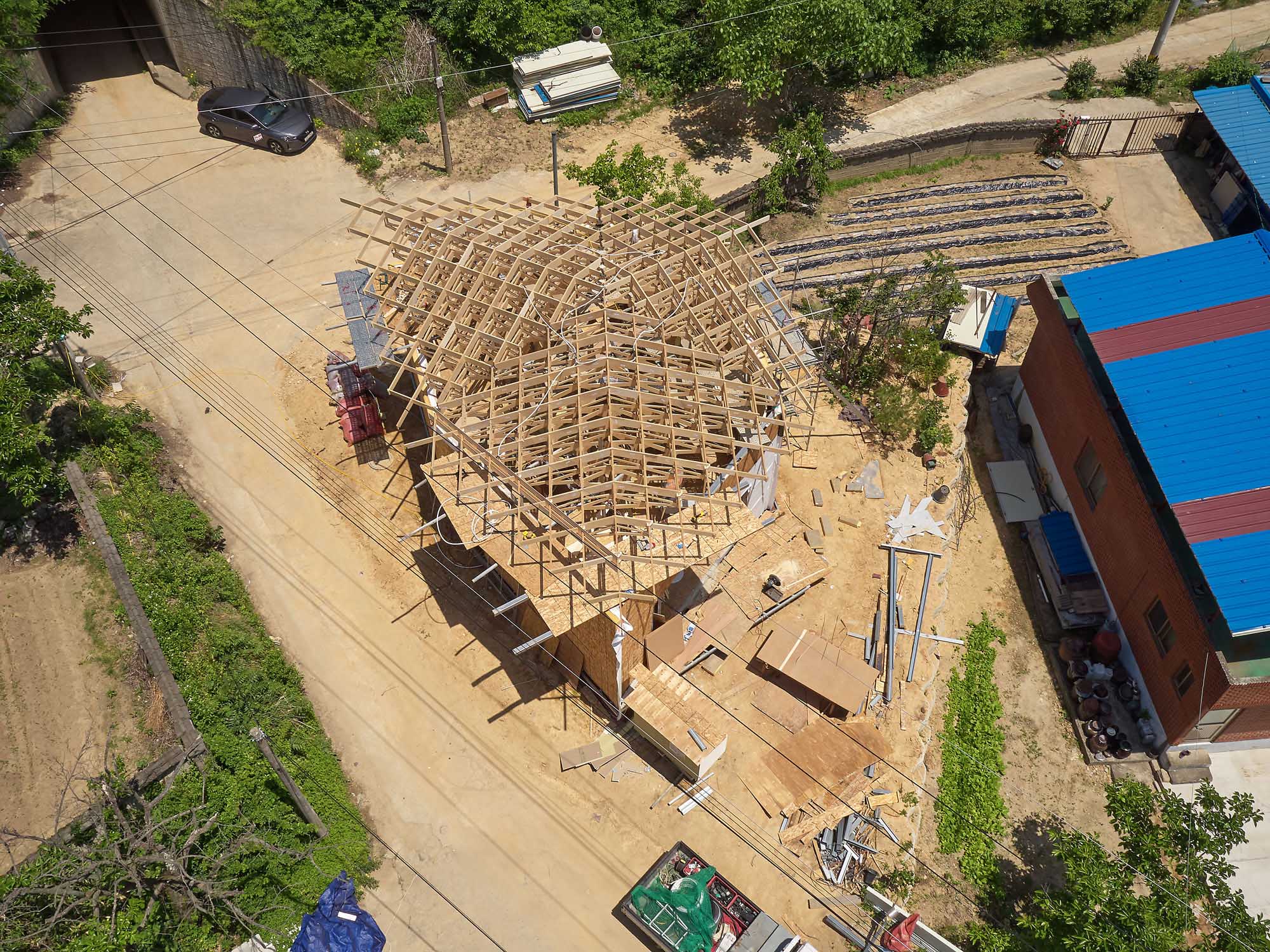
©︎ Rohspace
©︎ Rohspace
©︎ Rohspace
Masterplan
Plan
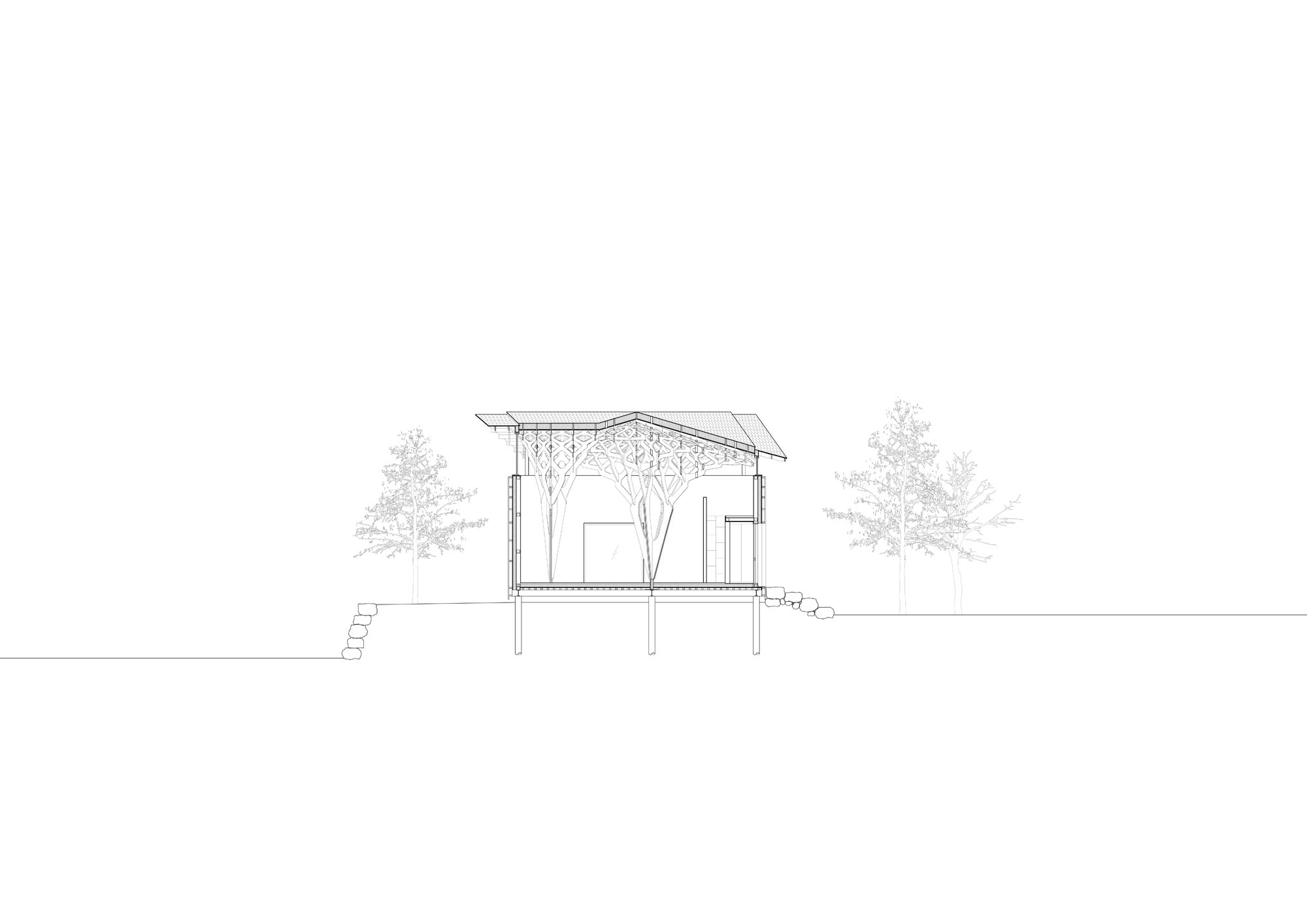
Section
以下、JK-ARのリリース(英文)です。
Forgotten Monuments
Tree Series
The “Tree Series” is series of design projects that recreate the wooden bracket system of East Asian architecture. The purpose of the “Tree Series” is to analyze the traditional bracket system and recreate it in order for the structure and fabrication process to be compatible with the contemporary industry of architecture. However, the “Tree Series” rejects a process called “modernization” of traditional architecture, which merely aims at efficiency of construction and imitation of a traditional style. Rather, the “Tree Series” aims for a totally new, experimental and radical rebirth of the traditional system.
In this context, ” Tree Series ” has three aims. The first aim is formative freedom. The traditional method of joinery has developed into various forms in many ways in each country of East Asia. Nevertheless, the formalism of traditional architecture hindered its freedom to be more diverse. However, the use of parametric tools, such as Grasshopper, overcomes the morphological limitations previously imposed on the system. The second aim is the consideration of structural performance. Originally the system was invented for a structural reason, and it is important to retain that original intent. In addition, structural performance will be a criterion for determining which of the diverse forms achieved in the first goal is appropriate. The structural analysis achieved by the Grasshopper plug-in, Karamba, can result in time efficiency for mockup tests and calculation. The last aim is the development of new joints. In wooden structures, a joint is the most important component that receives both tensile and compressive forces. The project aims to create sufficient structural performance through only friction, without using additive elements such as metal joints and bolts.
The House of Three Trees
The House: Architectural Fantasy
The House of 3 Trees is the realization of an architectural fantasy; the fantasy explores an alternate reality in which several historical events of the past century have not occurred. What if timber resources were not depleted in the late Joseon Dynasty of Korea in 17th to 19th Centuries? Despite the exhaustion of timber, what if globalization had begun earlier and had introduced the import of wooden materials from Russia, Canada, Northern Europe and Japan as affordably as it is now? Finally, what if the reinforced concrete structure had not dominated the architecture of the 21st century? Then, the timber buildings of East Asia may have continued to evolve. These premises can give us an opportunity to retain a culture of timber architecture that we had kept for at least 1500 years, and may further lead us to experience a new architecture.This house is the rebirth of East Asian timber architecture that disappeared 100 years ago. More specifically, the project is the reinterpretation of the iconic wooden bracket systems ubiquitous in the East Asia timber architecture. Called “Gong-po” in Korea and “Dougong” in China, the system was the most symbolic part of East Asian timber buildings from both structural and aesthetic perspectives. The house criticizes today’s application of traditional buildings that is superficial, merely imitating traditional expressions in architecture, or too abstract. Rather, the house redefines the virtue of East Asian timber buildings in its tectonic aspect which is a combination of structure and ornamentation. Moreover, the house serves as an example of how contemporary technology such as design computation and digital fabrication can reinterpret traditional architecture. Technology can give East Asian timber construction the potential to evolve in a new direction.
Three Trees and Becoming a Forest
The 3 trees within the house create an interior space, responding to the hexagonally shaped building footprint. Three trees as anchor points are also a minimum requirement to support the roof. Apart from the structure, the wall enclosing the house was required to insulate during the cold winter in Korea, as well to tailor the visual experience while inside the space. As a result, people inside experience only enclosed space dominated by the tree structure, yet they still have a curated view to the outside through apertures. The change of time can be felt through sunlight’s movement as it filters into the gap between the roof and wall. It resembles the sunlight falling into a forest. In this way, the trees become a forest.The tree structure of the house is solely composed of wooden joinery. The construction method without using additive fastener such as nails is not only intended to follow traditional methodology, but to show the sheer strength of engineered timber as a structural element.
Building Form and Material Choice
The footprint of the house follows the erratic shape of the site. Despite its irregular hexagonal form, the house can follow an order generated by algorithmic tools. The order by the tools sets the guideline for placing 3 Trees. Algorithmic tools again guided the design and analysis of the complex form of 3 trees. The 4006 pieces of wooden elements generated to form the 3 trees resulted from the optimized numbers for construction efficiency and logistics.In addition to designing a building form, the typical rural houses around the site inspired the roof design and material choice. Rural houses built in 70 and 80’s, which were designed by construction standards given by a government, have a flat roof that results in poor drainage and rainwater accumulation, which pose serious threats to the homes’ water-resistance these days. The voluntary solution to rainwater leakage is to cover an existing flat roof with a pitched roof made of sandwich panels. This spontaneously made roof inspires the design of a thin and floating roof with the notion of lightness. Also, the use of asphalt shingles, known locally as cheap materials, helped to emphasize the lightness of the roof.
Moreover, other commonly used materials in the rural area of Korea were selected for the exterior finish of the house. These include plywood and plastic panels for the exterior walls. Especially, polycarbonate corrugated panels, for the exterior wall finishing material, are often seen as the cladding of warehouses and greenhouses. This translucent panel subtly reveals the plywood finishing inside and, similarly to the roof, gives an ethereal lightness to the building which simultaneously contrasts from adjacent houses and recollects other structures common in the region. Functionally the panels generate an additional air layer and increase insulation performance, as well protect inner plywood from rainwater.
JK-AR 公式サイト
https://www.jk-ar.com
![[Report]RUI Architectsが可動モジュールを設計して松竹のアートスペースをリニューアル、柿落とし展「継承のトランジション」の会場デザインも担当](https://magazine-asset.tecture.jp/wpcms/wp-content/uploads/2026/07/24141011/20260713shutl_press11-01309-c-900x629.jpeg)
![[Interview]BIM図面審査がスタート! さまざまな設計者のニーズに応えるVectorworksによる「限界のないデザイン」の世界](https://magazine-asset.tecture.jp/wpcms/wp-content/uploads/2026/07/13084316/rinterview_vectorworks_056-e1784200974912-900x555.jpg)