イベントと共に開閉する、貝のようなパビリオン - プログラムと連動して無段階に変容する〈シェル・ブック・パビリオン〉
©︎ Zhu Yumeng
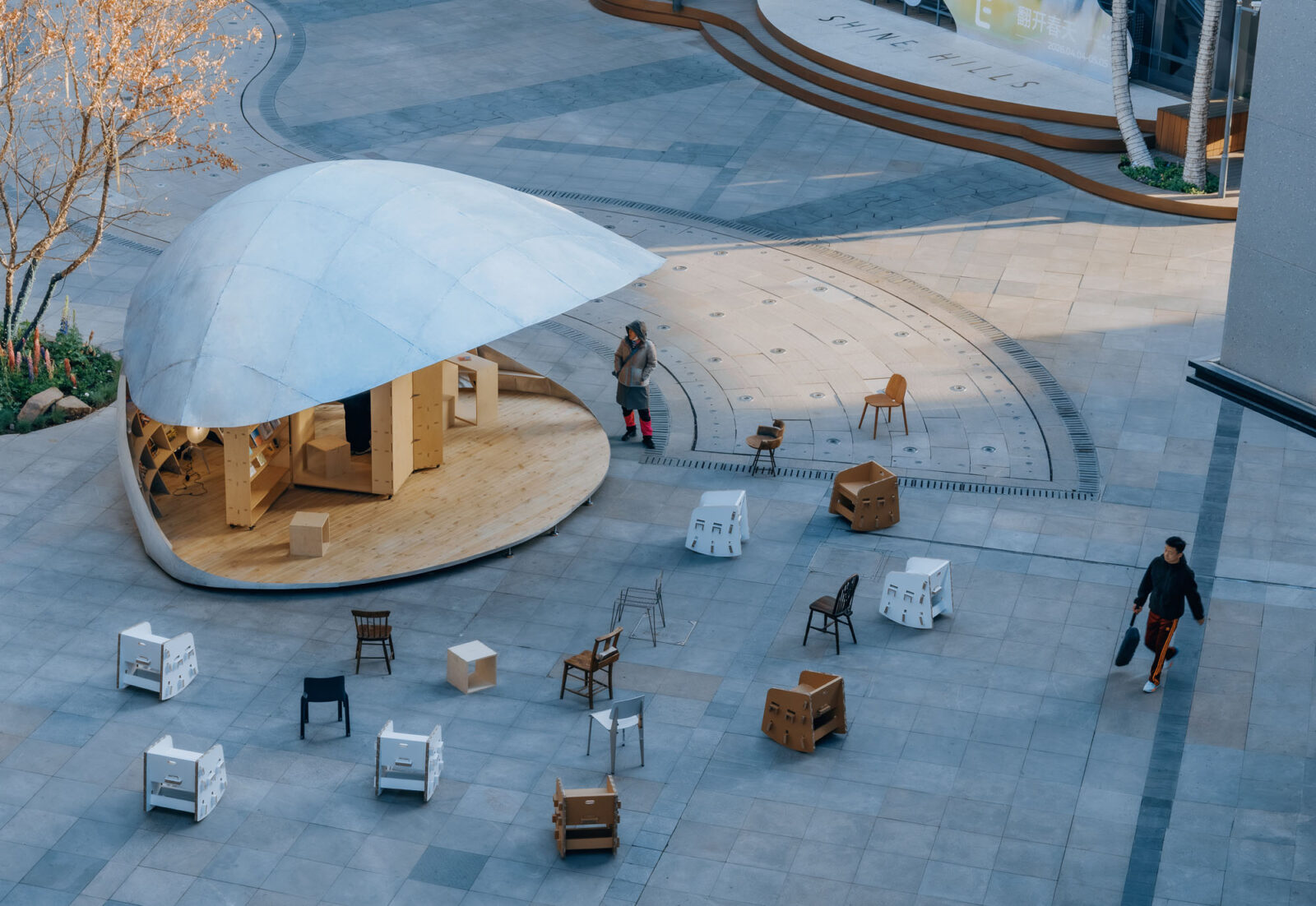
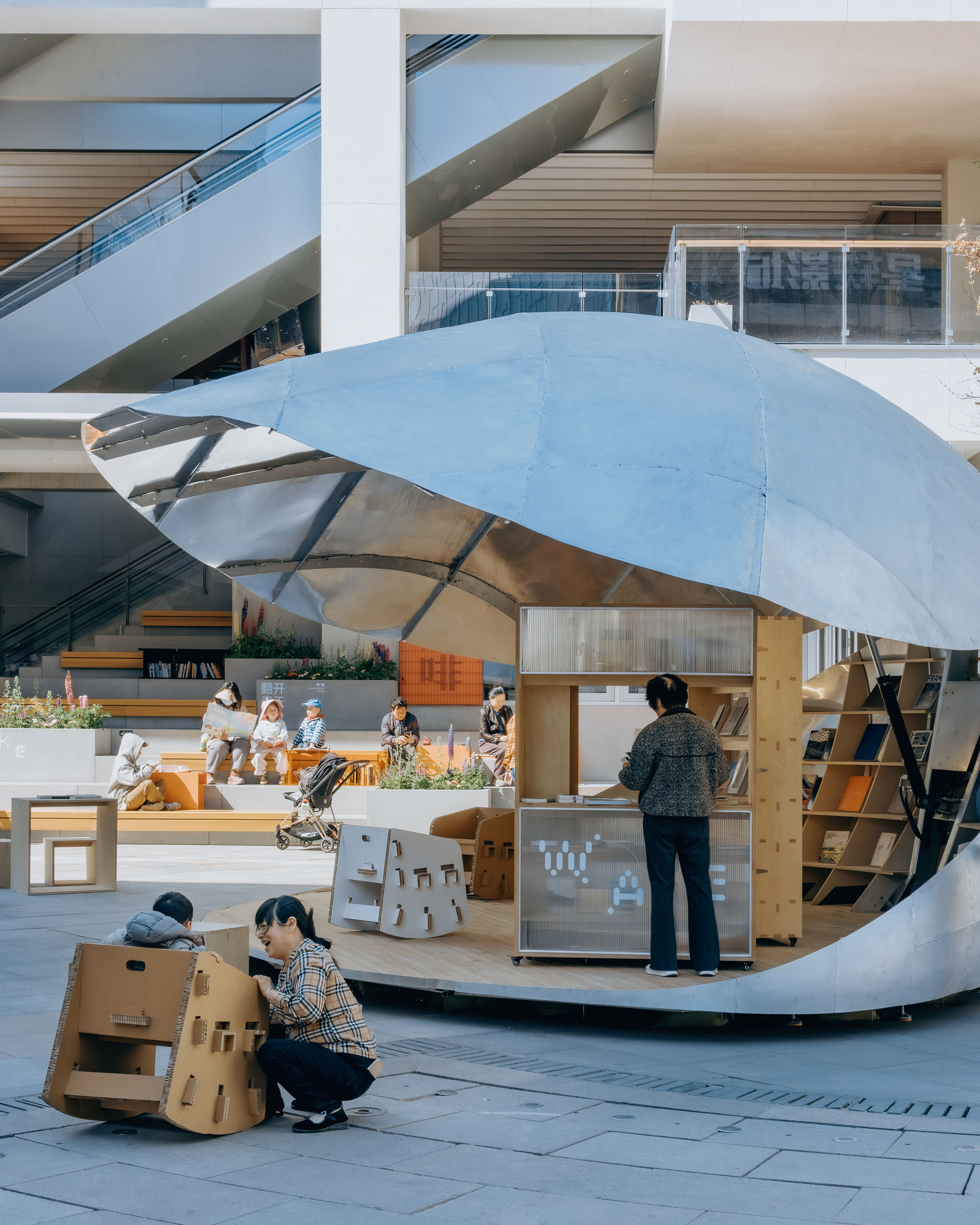
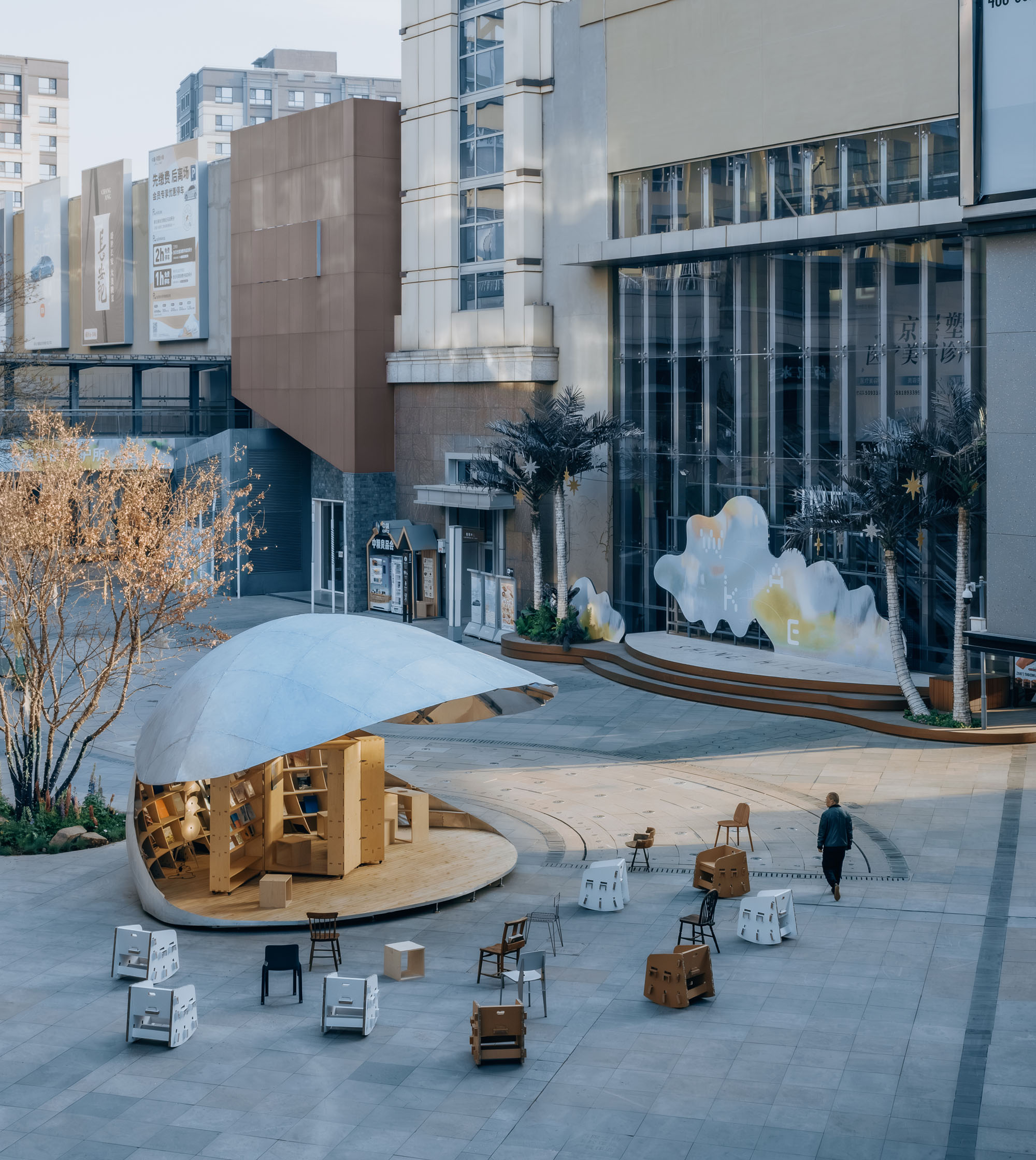
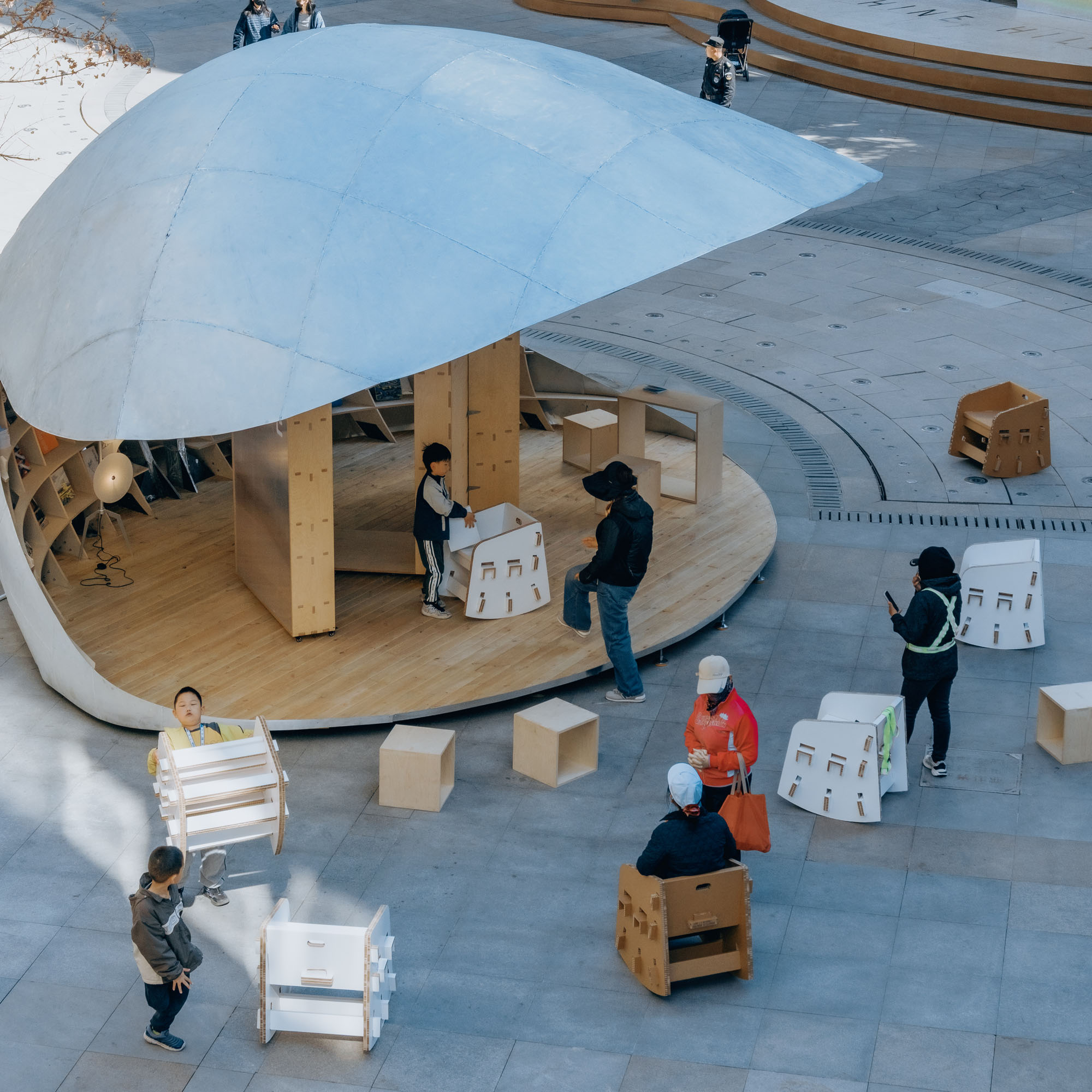
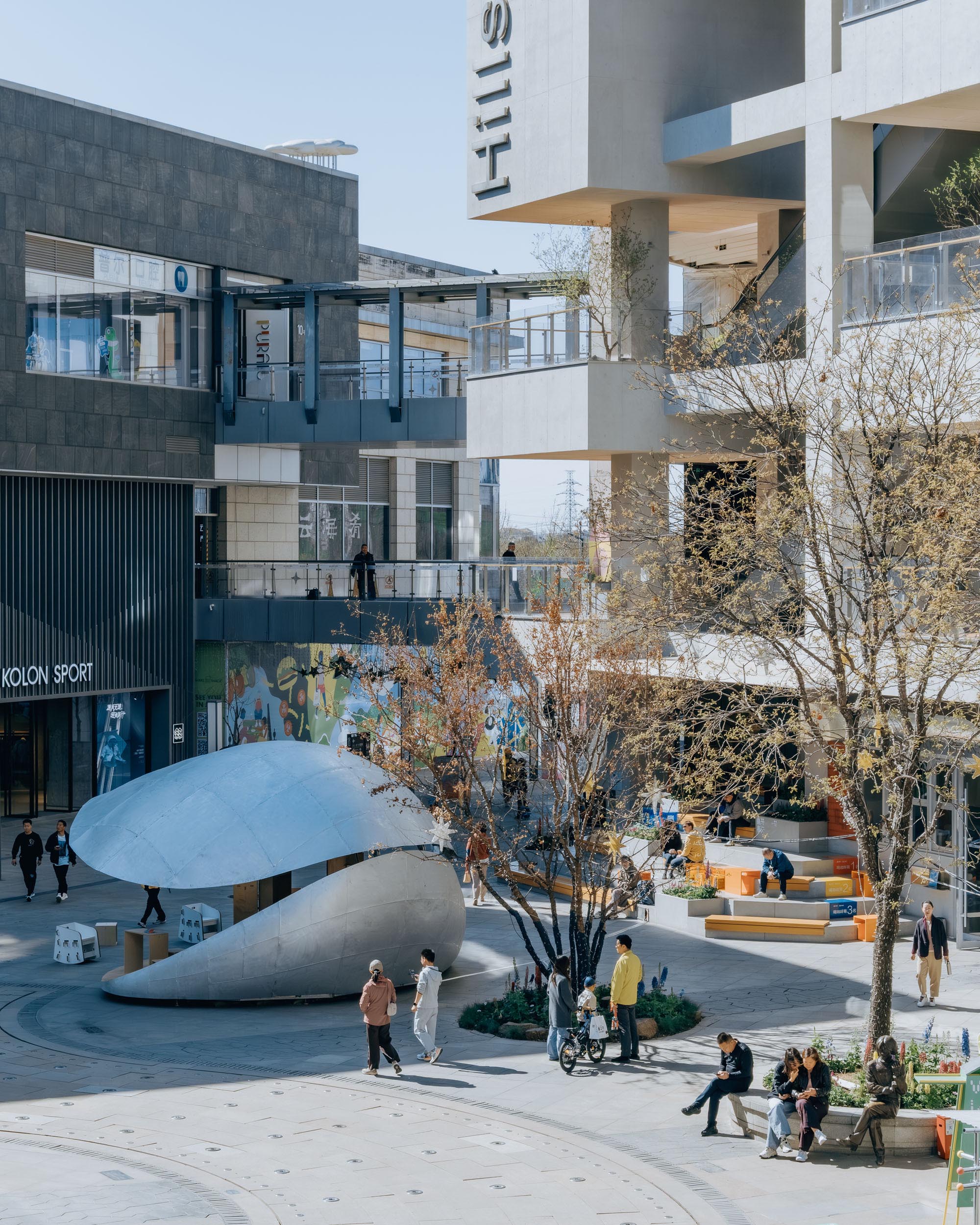
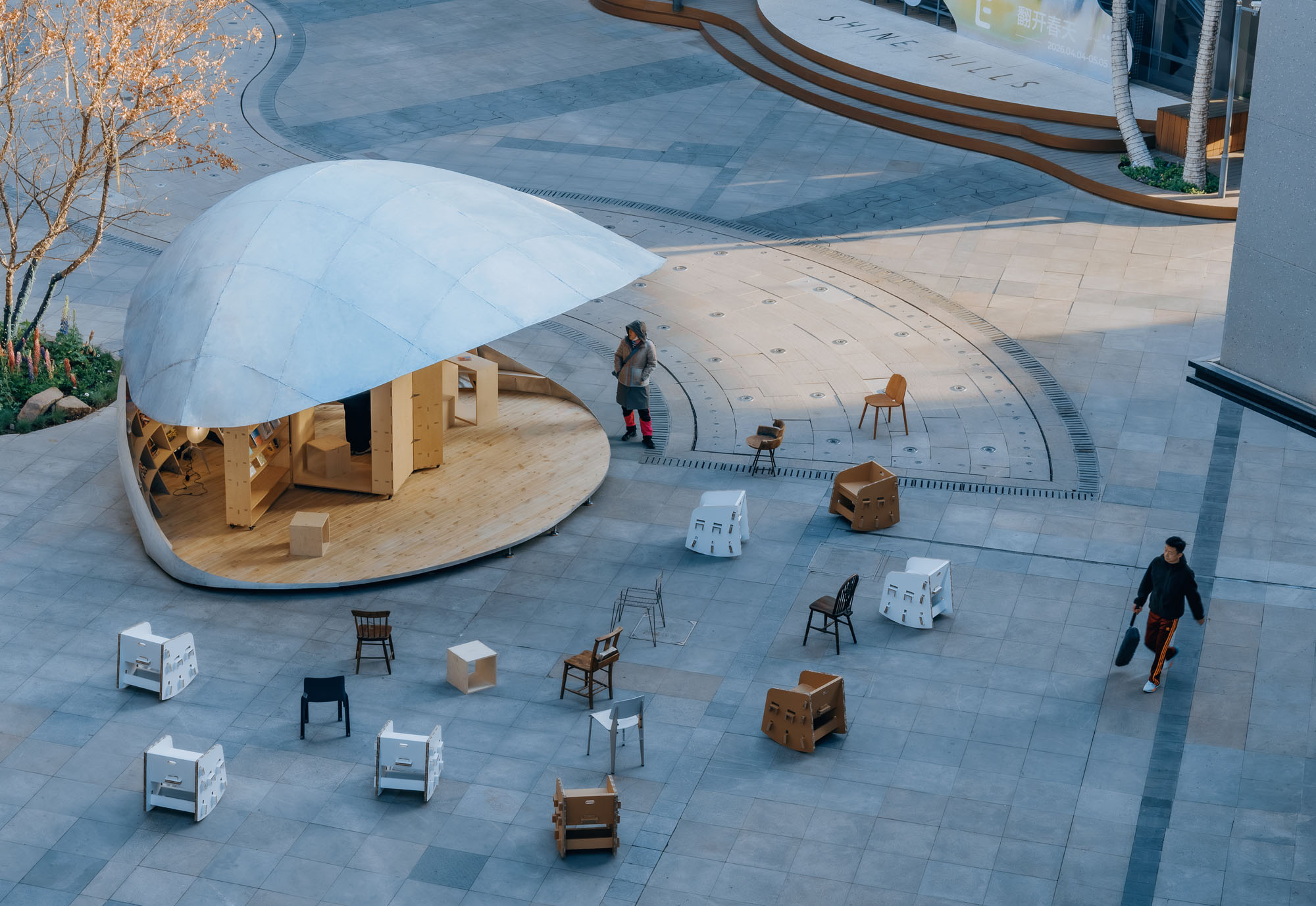
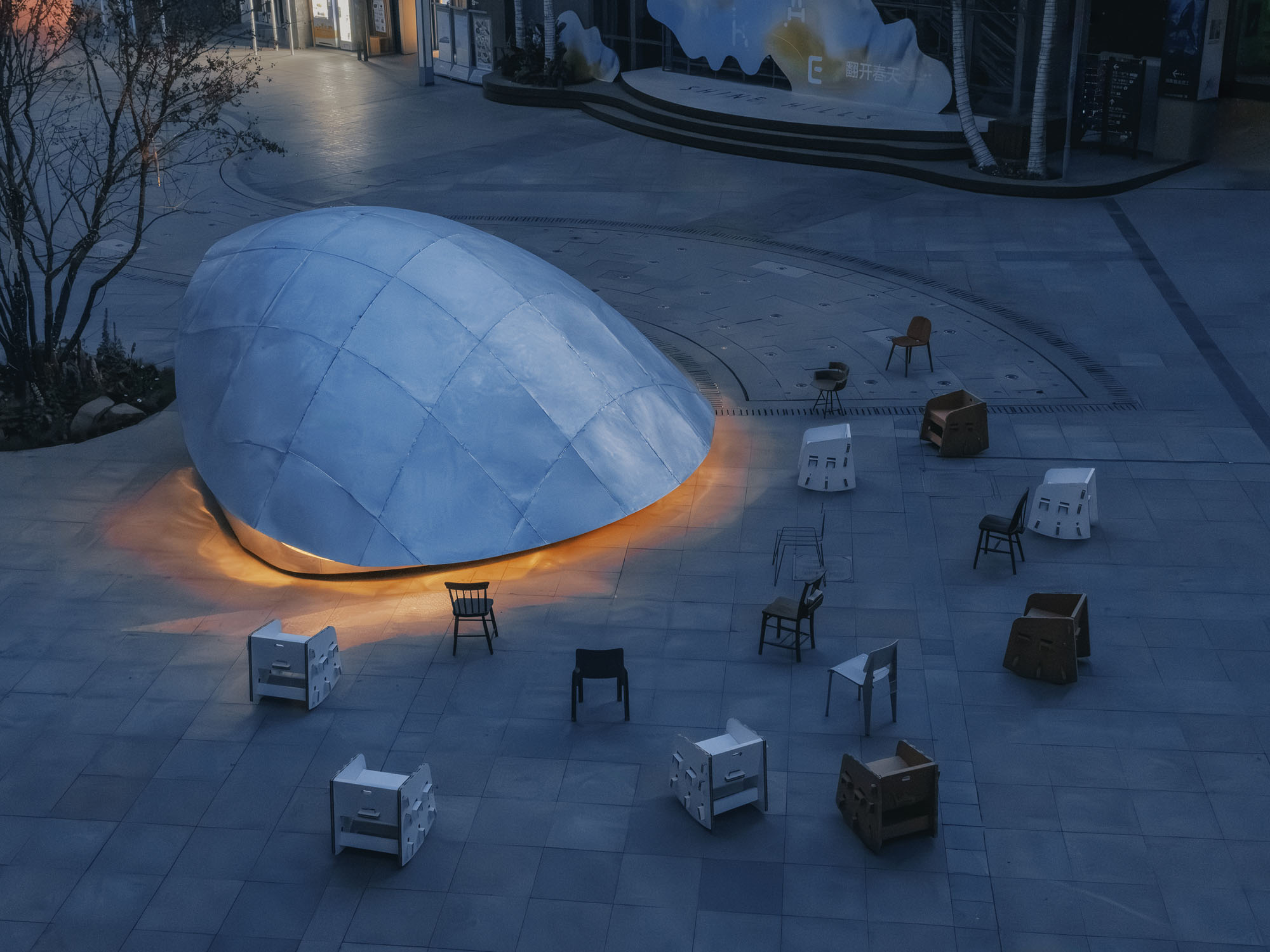
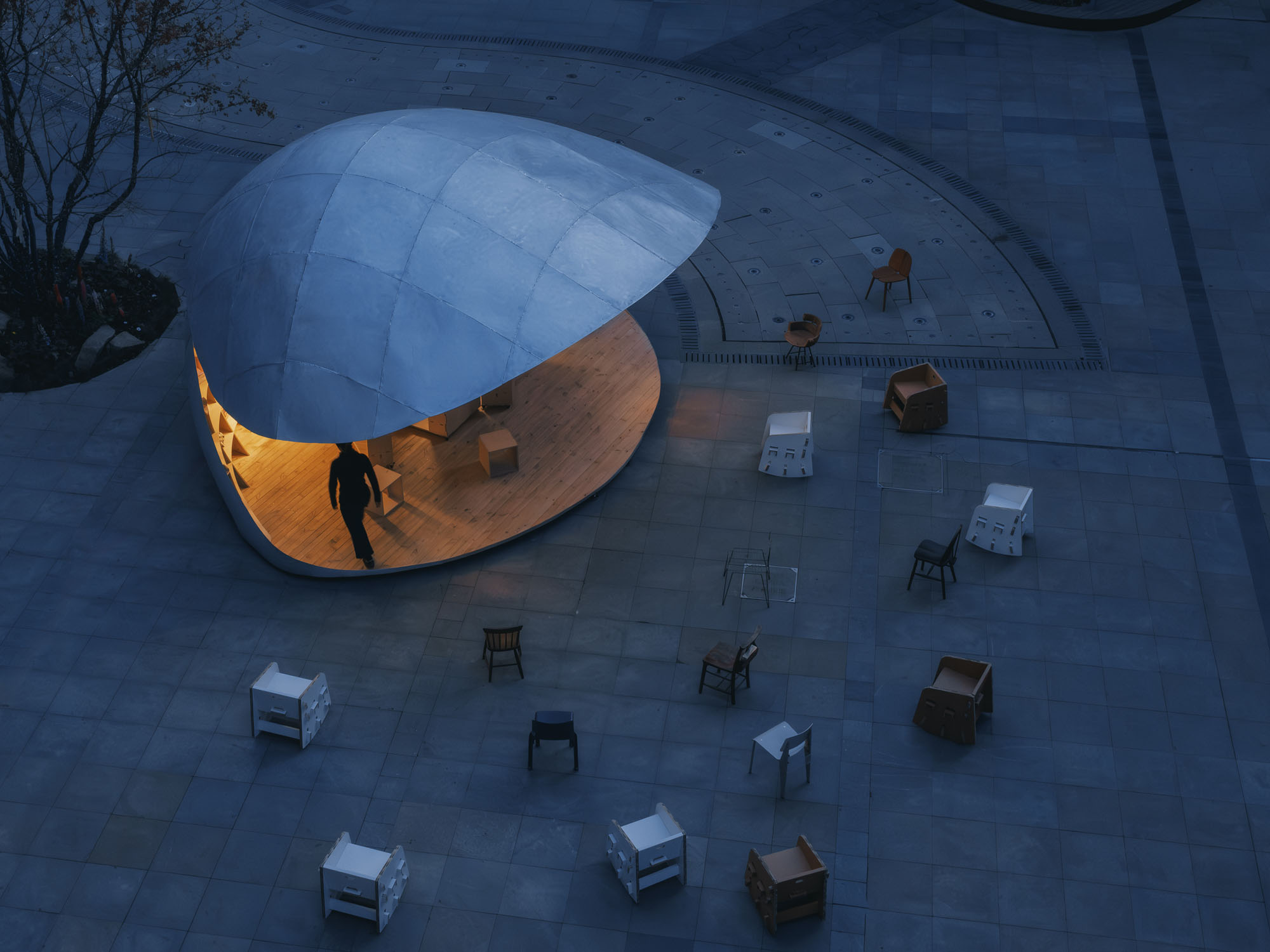
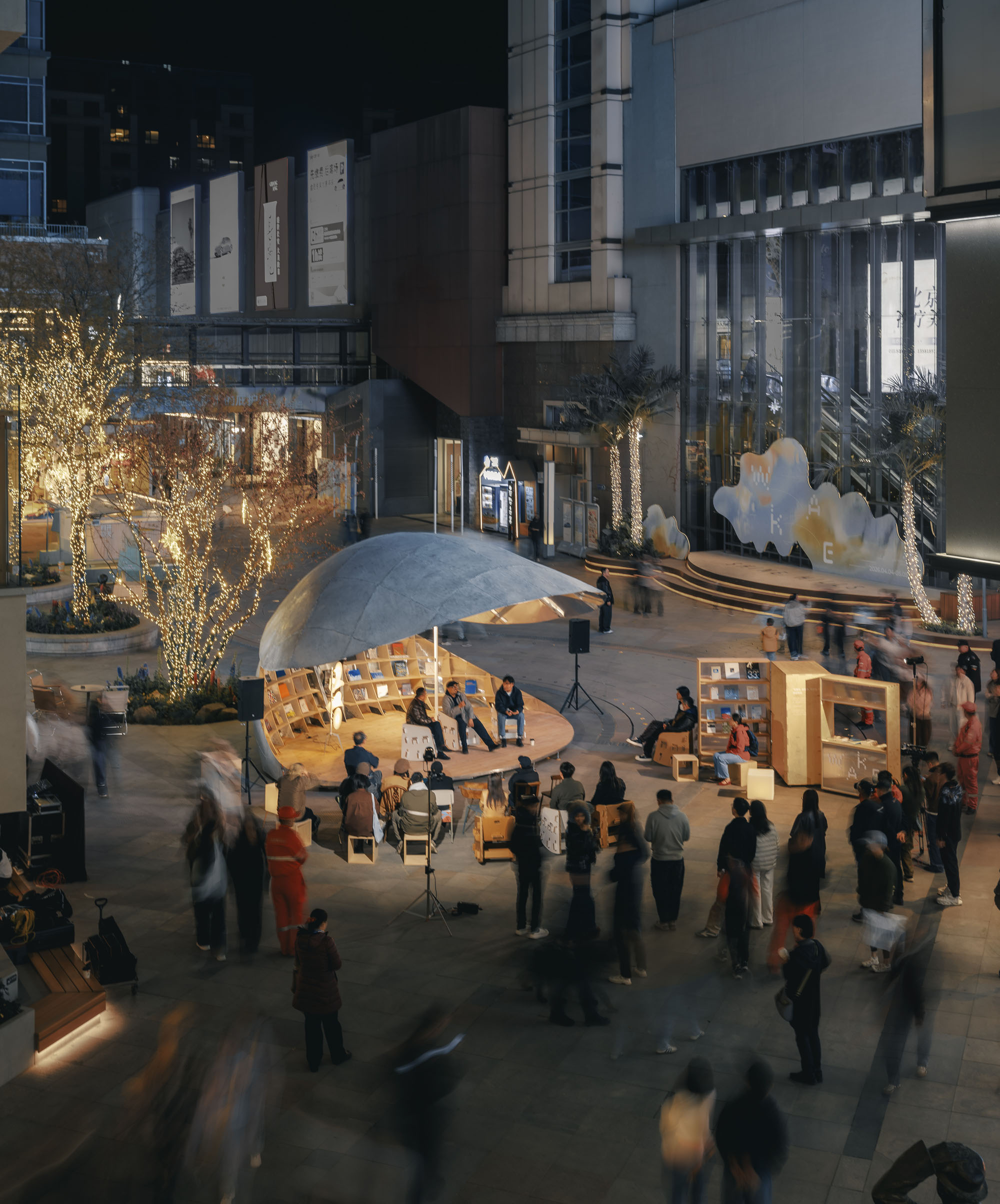
北京に誕生した〈シェル・ブック・パビリオン(Shell Book Pavilion)〉は、公共広場の中心という立地に応答した、「開閉するシェル型構造」の地域コミュニティ向けのブックパビリオンです。
中国の設計事務所LUOスタジオ(LUO studio)が設計しました。
注目ポイント
- 敷地に応答する3つのアイデア:遊び心、中心性、開放性
- 全開から全閉まで、アクティビティと連動し無段階に姿を変える公共空間
- イベントの進捗に合わせて変化する、プログラムの一部となる「展開する空間」
- 航空宇宙グレードのアルミフレームやCNC加工など、建築スケールを成立させる高度な加工技術と素材
(以下、LUOスタジオから提供されたプレスキットのテキストの抄訳)
起源:馴染み深い場所への応答
シャイン・ヒルズは、私にとって決して見知らぬ場所ではない。近所にあるため、かつては子供と一緒に頻繁に訪れていた場所である。最初に抱いた印象は、広場に点在する数多くのアートインスタレーションの存在だけでなく、子供や地域社会に開かれた、人々が遊び、くつろげる場所であるという点であった。
ここで小さなコミュニティ向けのブックパビリオンを設計するよう依頼を受けた時、それはまるで日常生活に溶け込んだ馴染み深い場所へ戻ってくるような感覚であった。この場所が真に求めている公共空間とはどのようなものか、改めて考える機会となったのである。
その意図は、単に広場に小さな構造物を設置することではない。コミュニティ志向の商業環境における日常生活と、読書、くつろぎ、そして出会いとを結びつけることであった。
©︎ Zhu Yumeng
©︎ Zhu Yumeng
3つの核心的なアイデア:遊び心、中心性、開放性
こうした願いと敷地への綿密な分析に基づき、3つの核心的なアイデアが徐々に浮かび上がってきた。
第1のアイデア:遊び心
広場の中心に位置するため、単に通り過ぎたり避けられたりするのではなく、人々が近づいて立ち止まりたくなるような、人を惹きつける魅力が不可欠であった。
第2のアイデア:360度全方位の存在感
四方から歩行者が集まる広場の中心に位置するため、明確な裏面をもつ従来の建物として構想することはできなかった。どの側面も等しく活気があり、魅力的でなければならない。つまり、あらゆる方向から視認でき、アクセス可能でなければならないのである。したがって、従来の箱型建築は選択肢にはなり得なかった。
第3のアイデア:開放性の維持
これほど公共性の高い場所において、閉ざされた内向的な構造は場違いである。その代わりに、通行人、風通し、活動、そして広場の人の流れといった周囲との強いつながりを維持すべきであった。
©︎ Zhu Yumeng
©︎ Zhu Yumeng
©︎ Zhu Yumeng
絶えず変容する空間
垂直に開くシステムへの転換
初期のアイデアから、ブックパビリオンは徐々に形を成していった。それは固定的で静的な存在としてではなく、変化し、進化し続けることを意図した空間としてである。当初は、以前のプロジェクトである子供向けの可動式てんとう虫型マイクロライブラリーの後半部分を拡大することを検討したが、側面が開く仕組みでは雨水の問題が避けられなかった。そこで、垂直に開くシステムへと方向転換し、最終的に〈シェル・ブック・パビリオン〉が生まれたのである。
連続する可能性のスペクトル
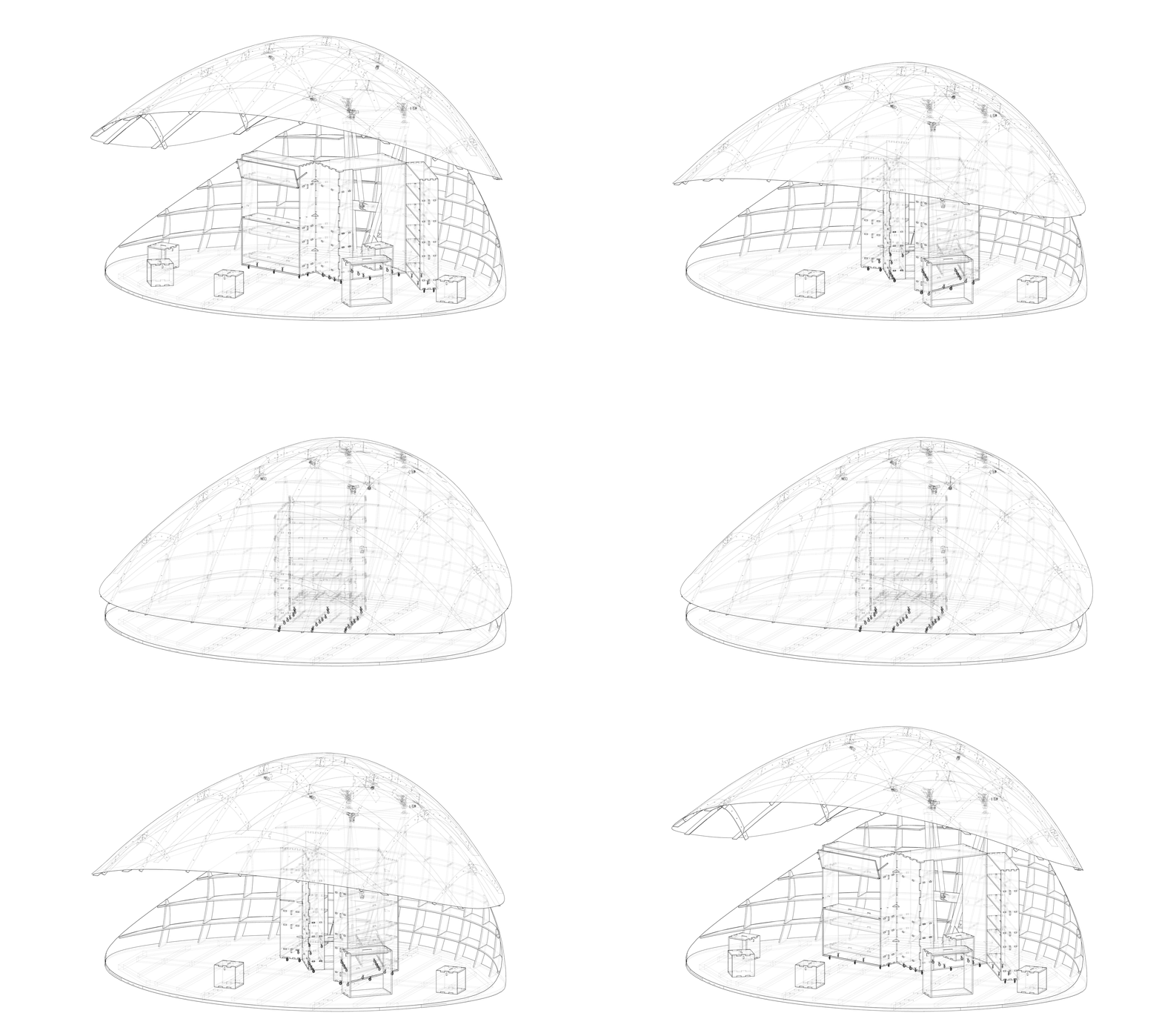
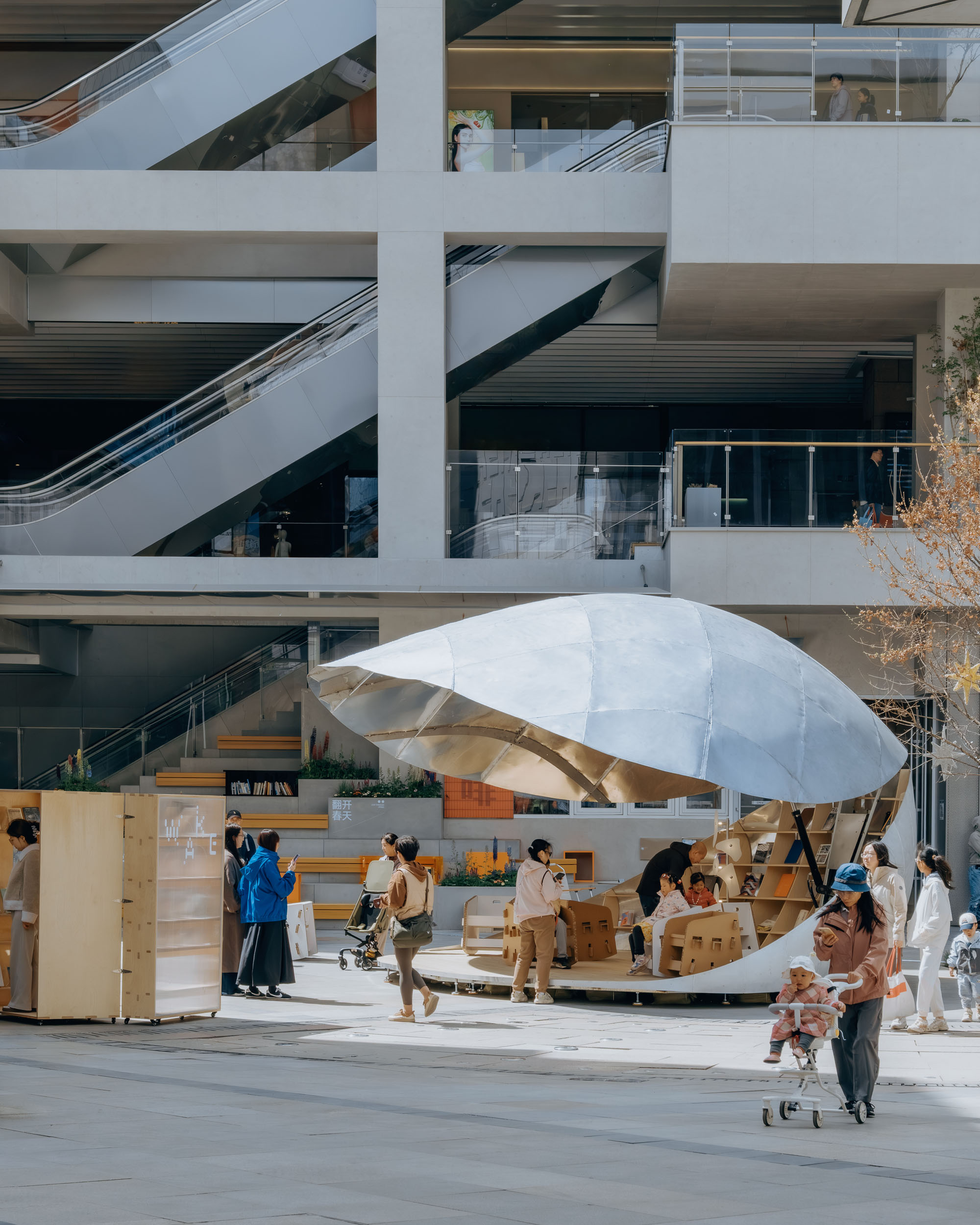
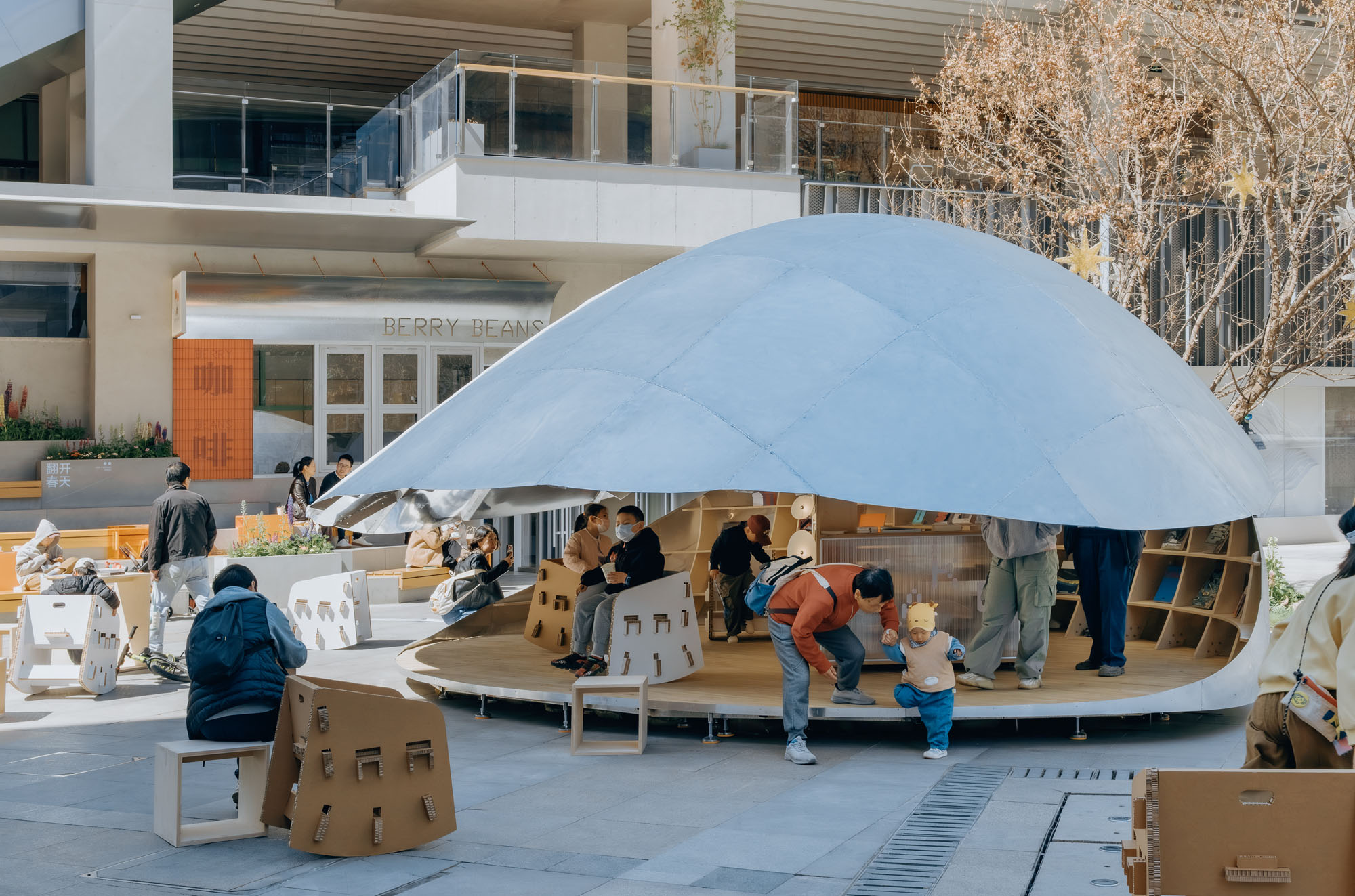
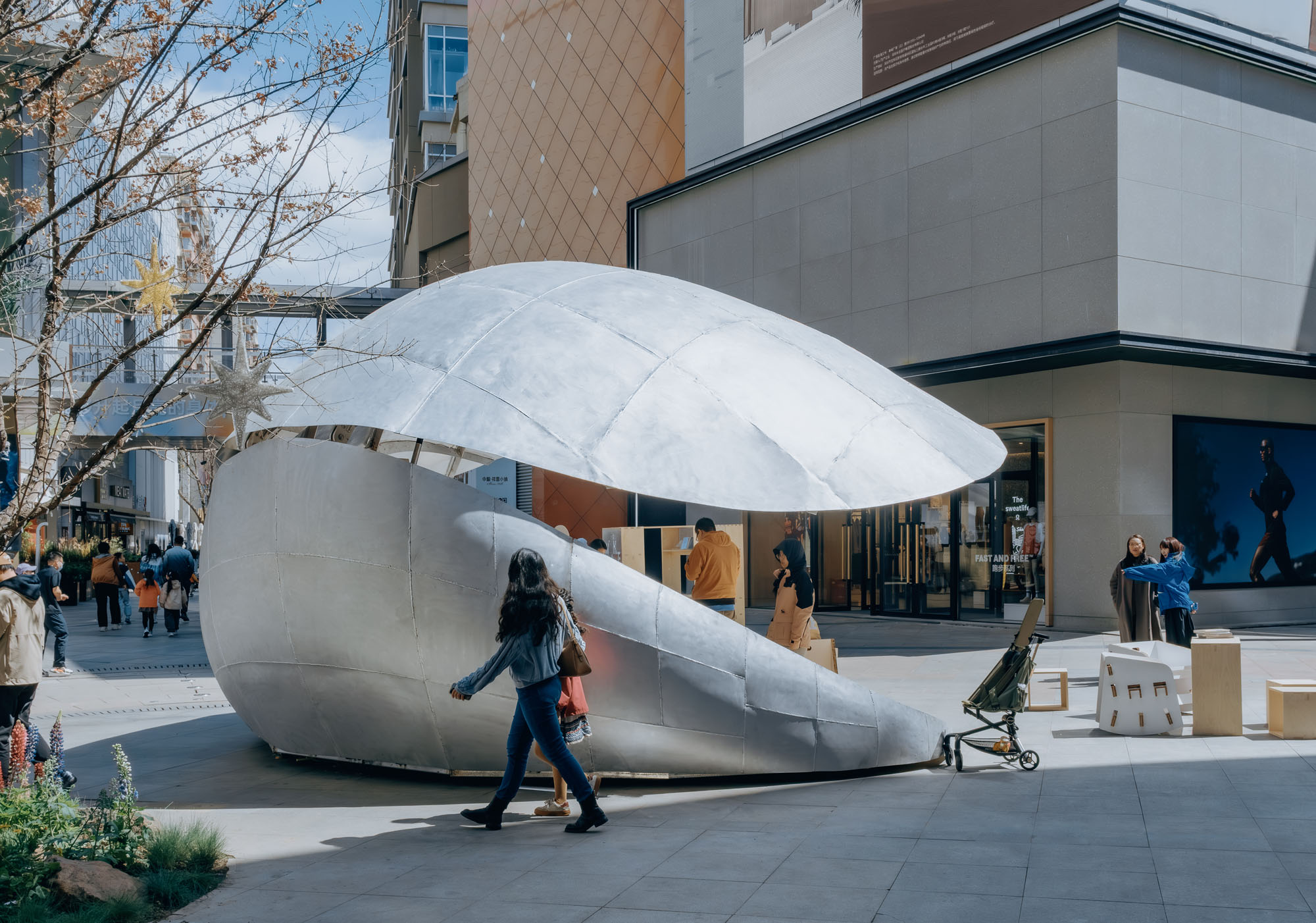
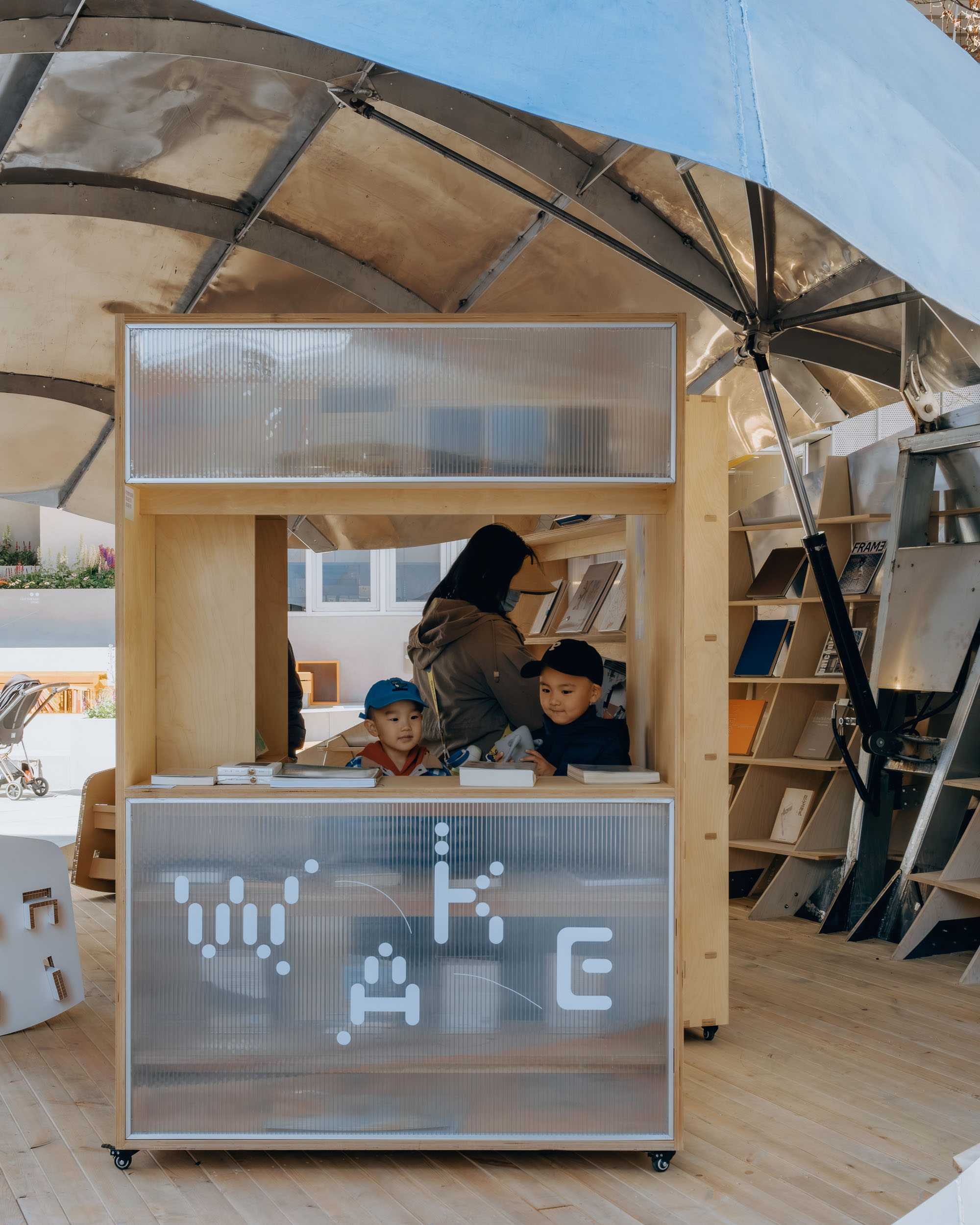
この構造物は、単に開いたり閉じたりするだけではない。この2つの状態の間には、連続した可能性のスペクトルが存在している。全開、半開、部分的に閉じた状態、ほぼ閉じた状態、そして完全閉鎖。それぞれの状態が、異なる形態、空間の雰囲気、そして人との関わり方を生み出す。
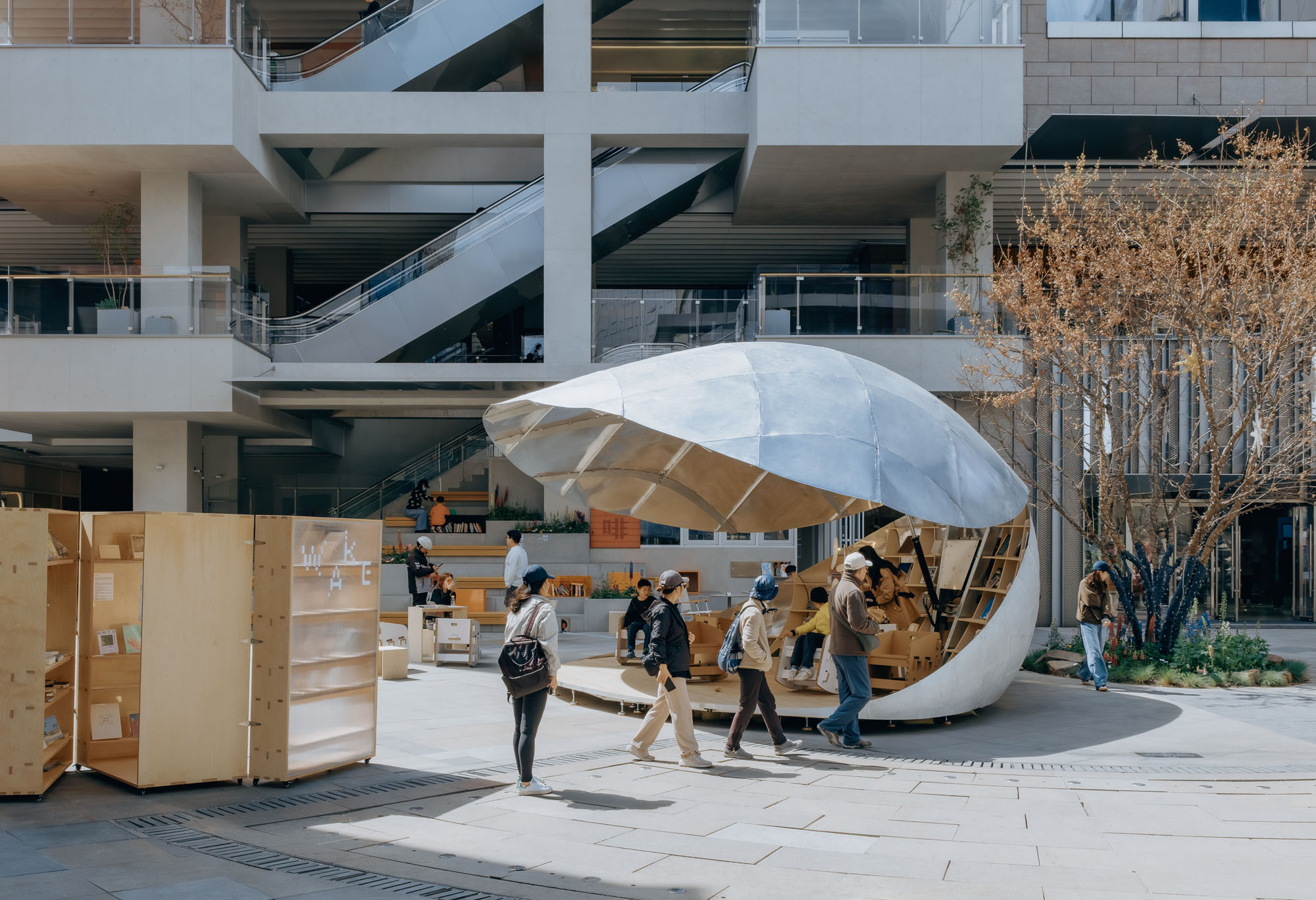
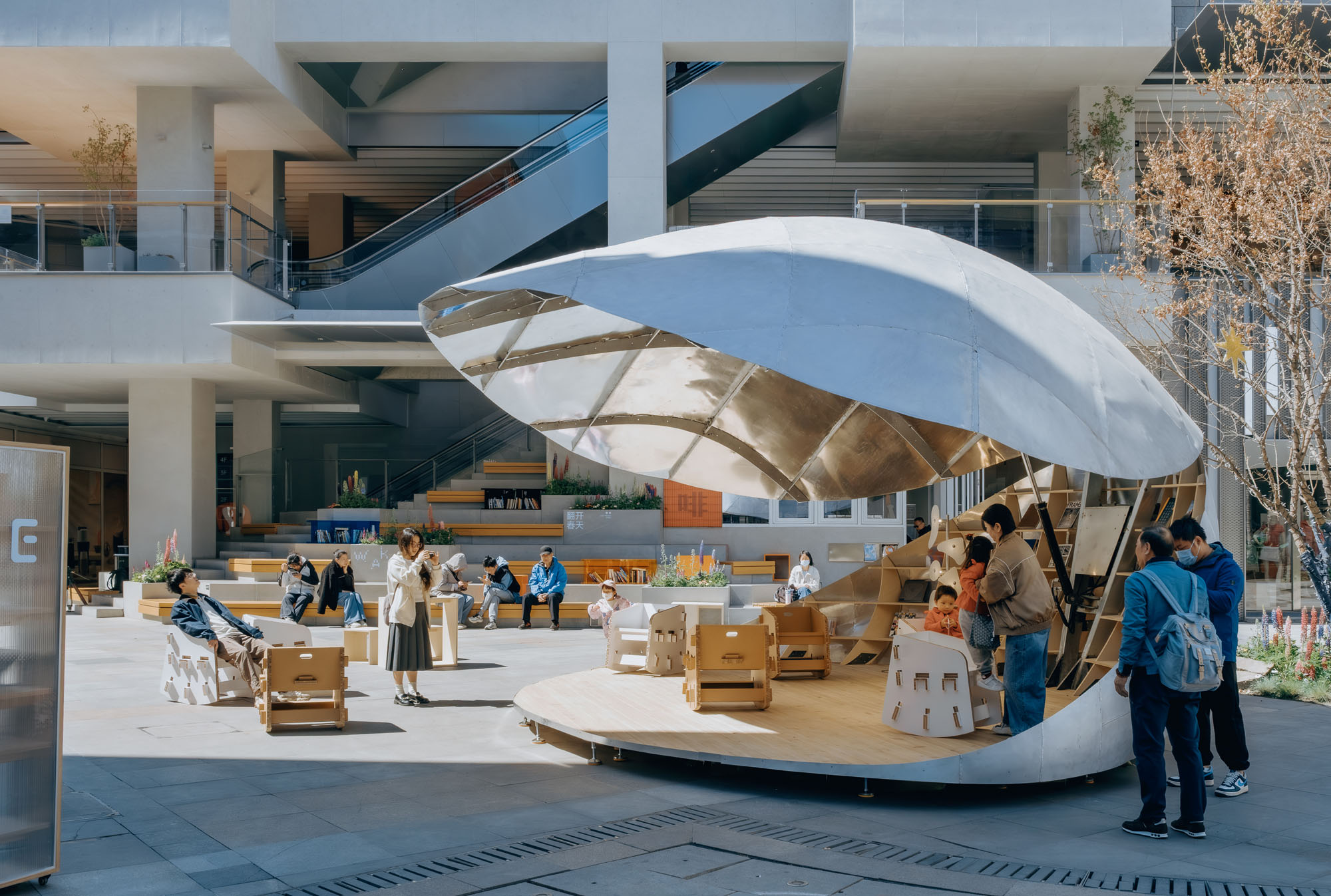
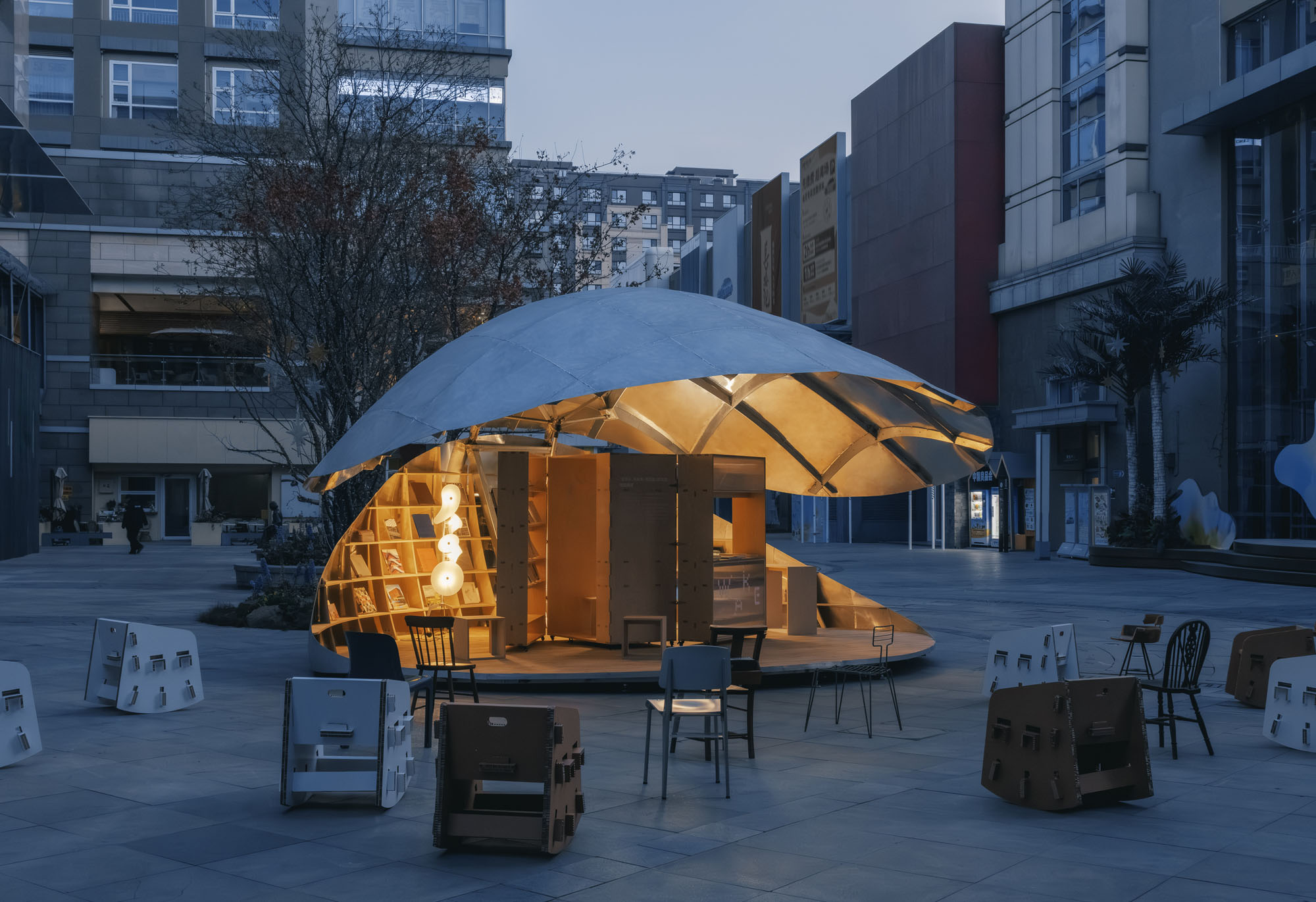
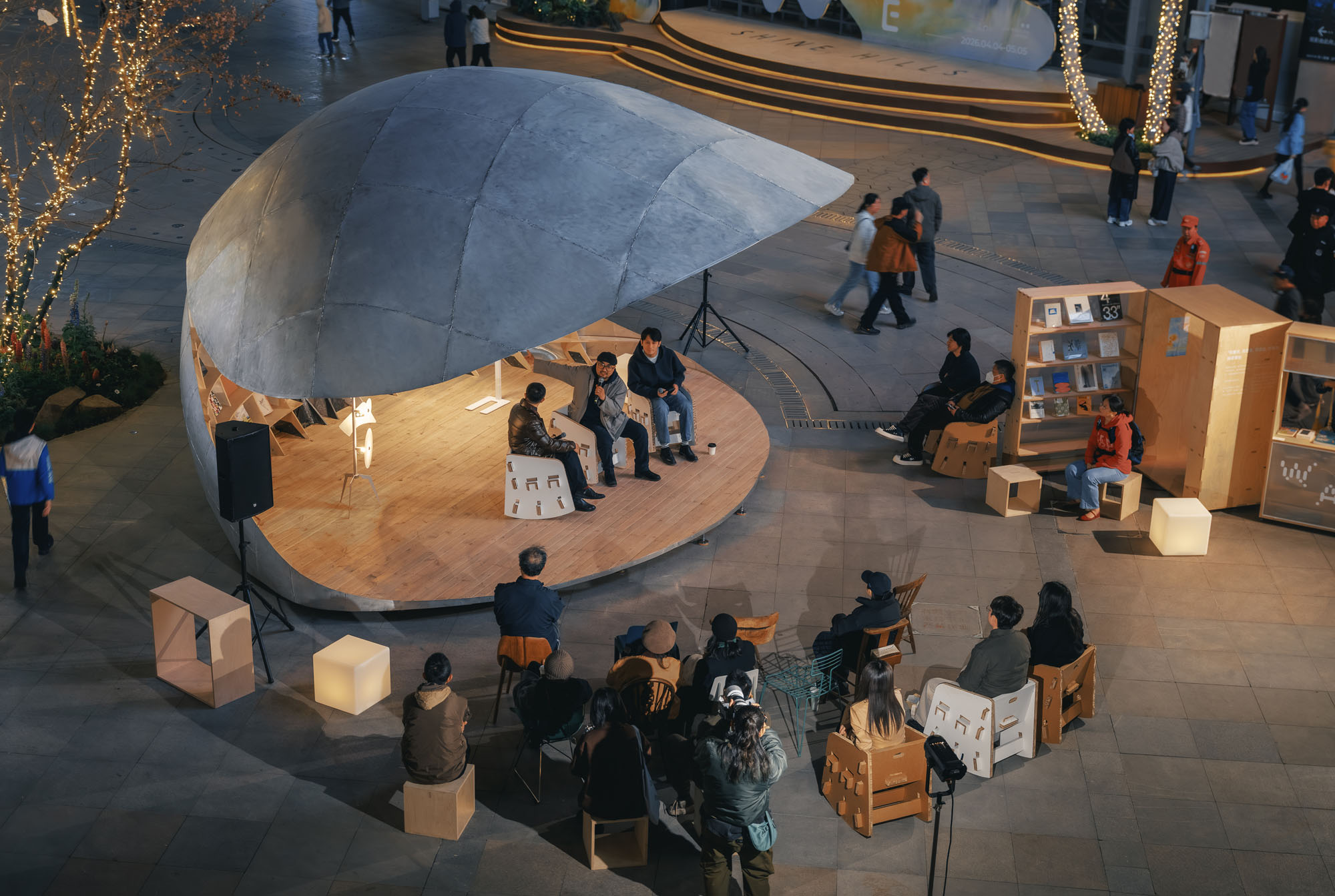
全開の状態では、外へと広がる公共の舞台のような感覚を覚える。
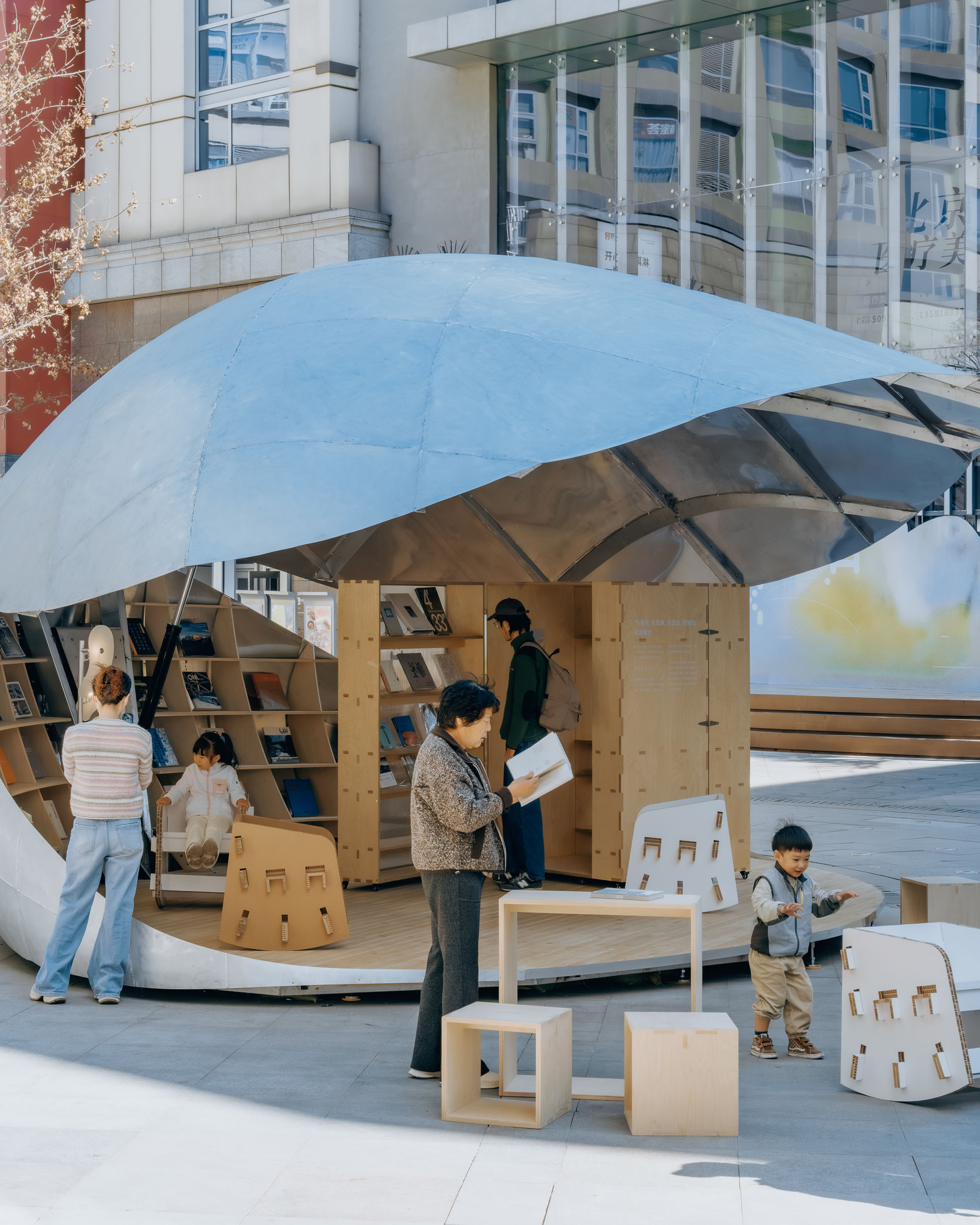
半開の状態では、外部とのつながりを保ちつつ、確かな安らぎの空間を提供する。
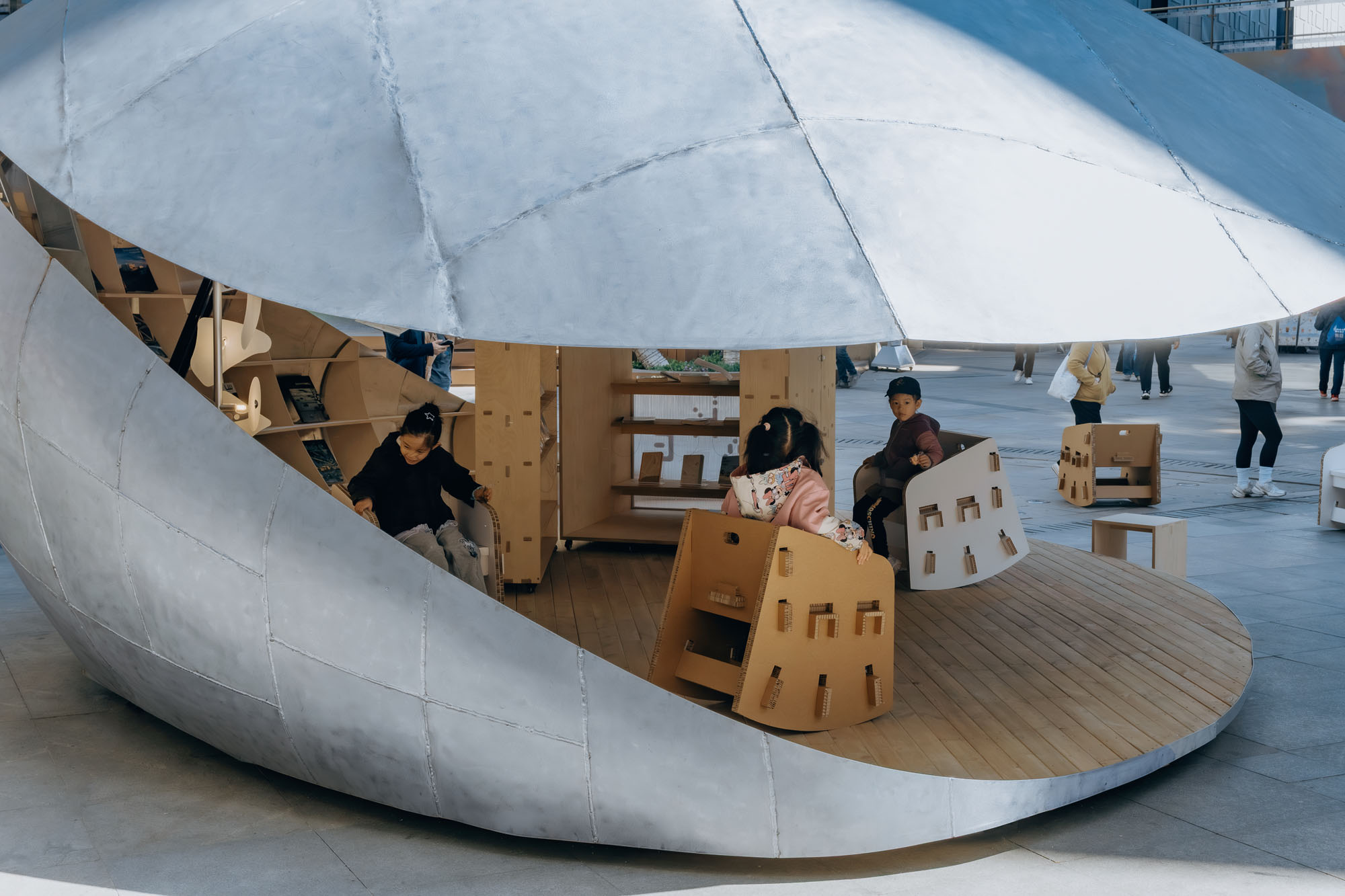
部分的またはほぼ閉じた状態では、静寂と内省的な雰囲気を帯び、まるで優しく内側に引き込まれた貝殻のようになる。
©︎ Zhu Yumeng
©︎ Zhu Yumeng
イベントの一部となる「展開する空間」
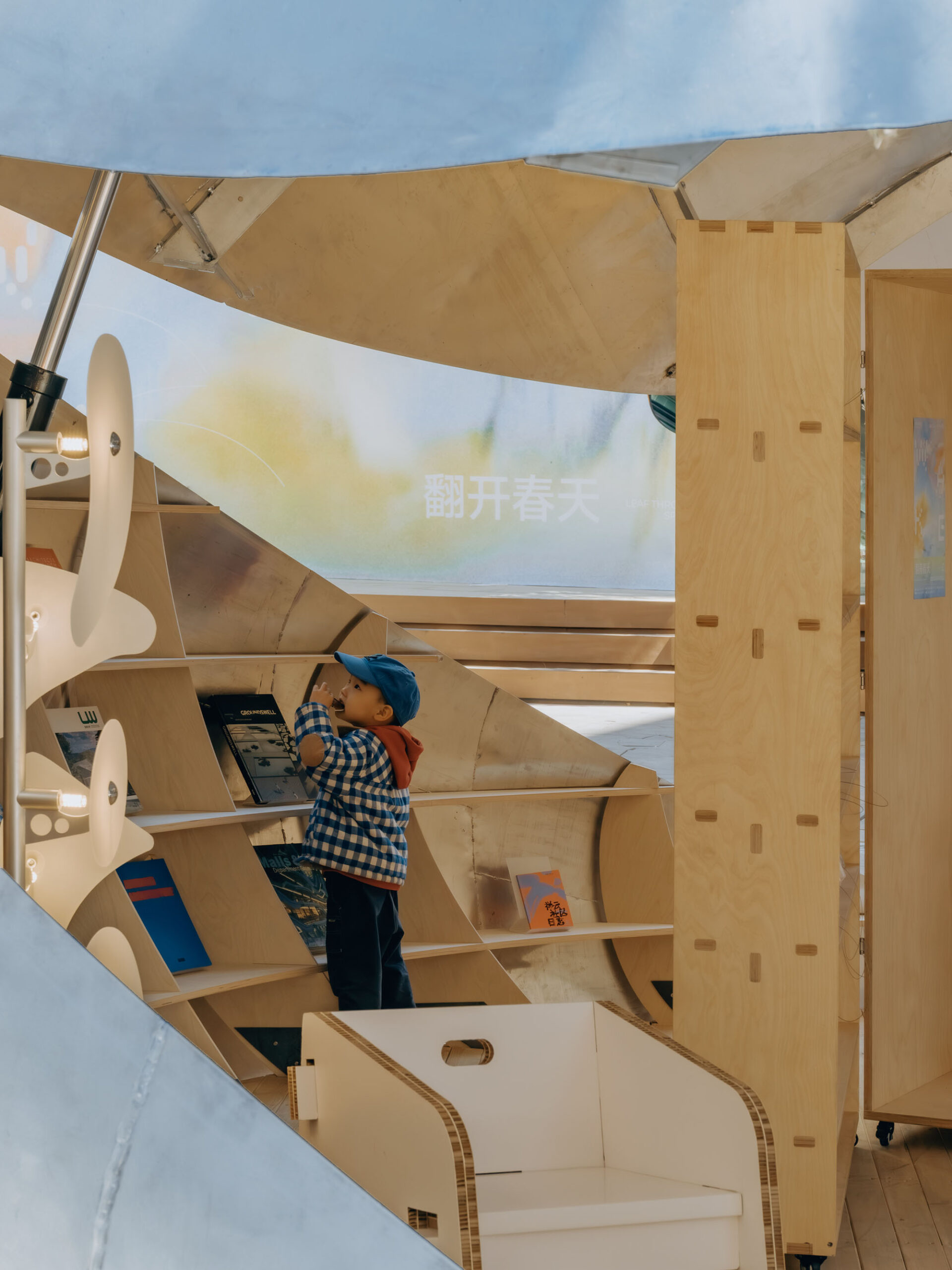
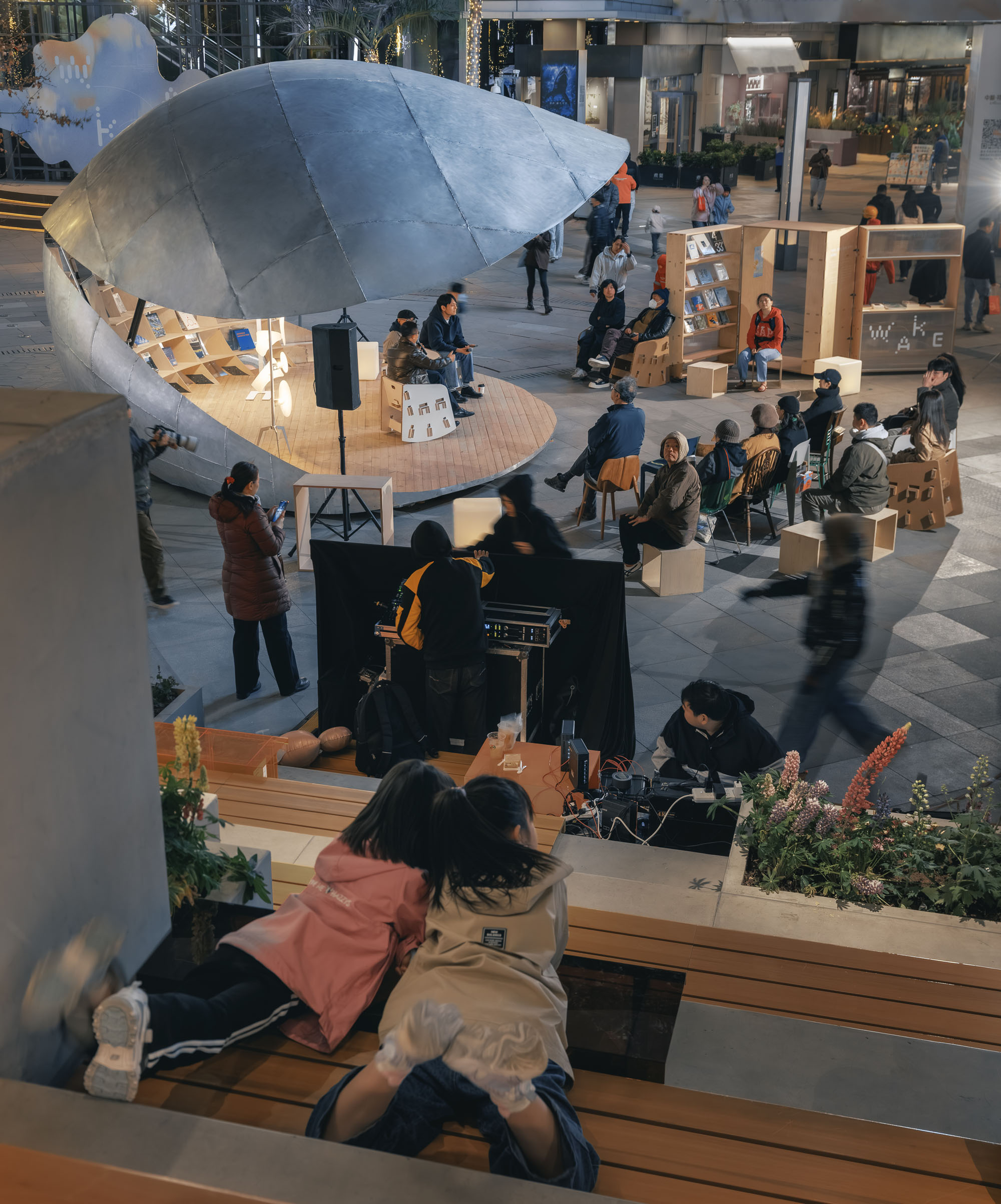
この段階的な変容は、実際の利用においても重要な役割を果たす。例えば朗読会では、最初は話者が閉じた殻の中にいるが、それが開くにつれて徐々に聴衆の前に姿を現す。このようにして、空間はイベントの一部となる。静的な背景としてではなく、イベントと共に展開する能動的な存在として、体験全体に微かな儀式的な感覚を添えるのである。
©︎ Zhu Yumeng
©︎ Zhu Yumeng
©︎ Zhu Yumeng
スケール、構造、そして職人技:入り込み、佇むための空間
建築的なスケールと快適性
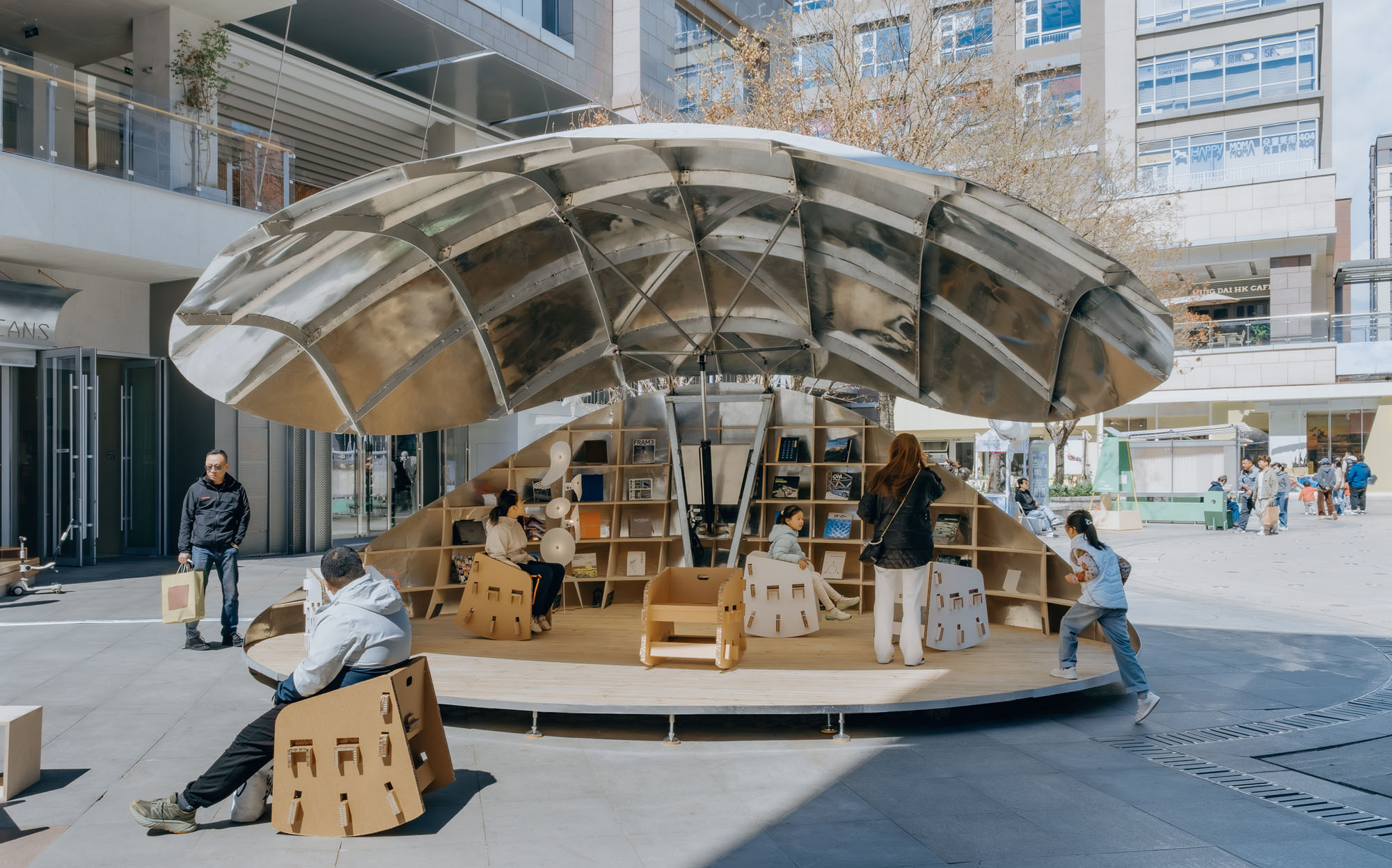
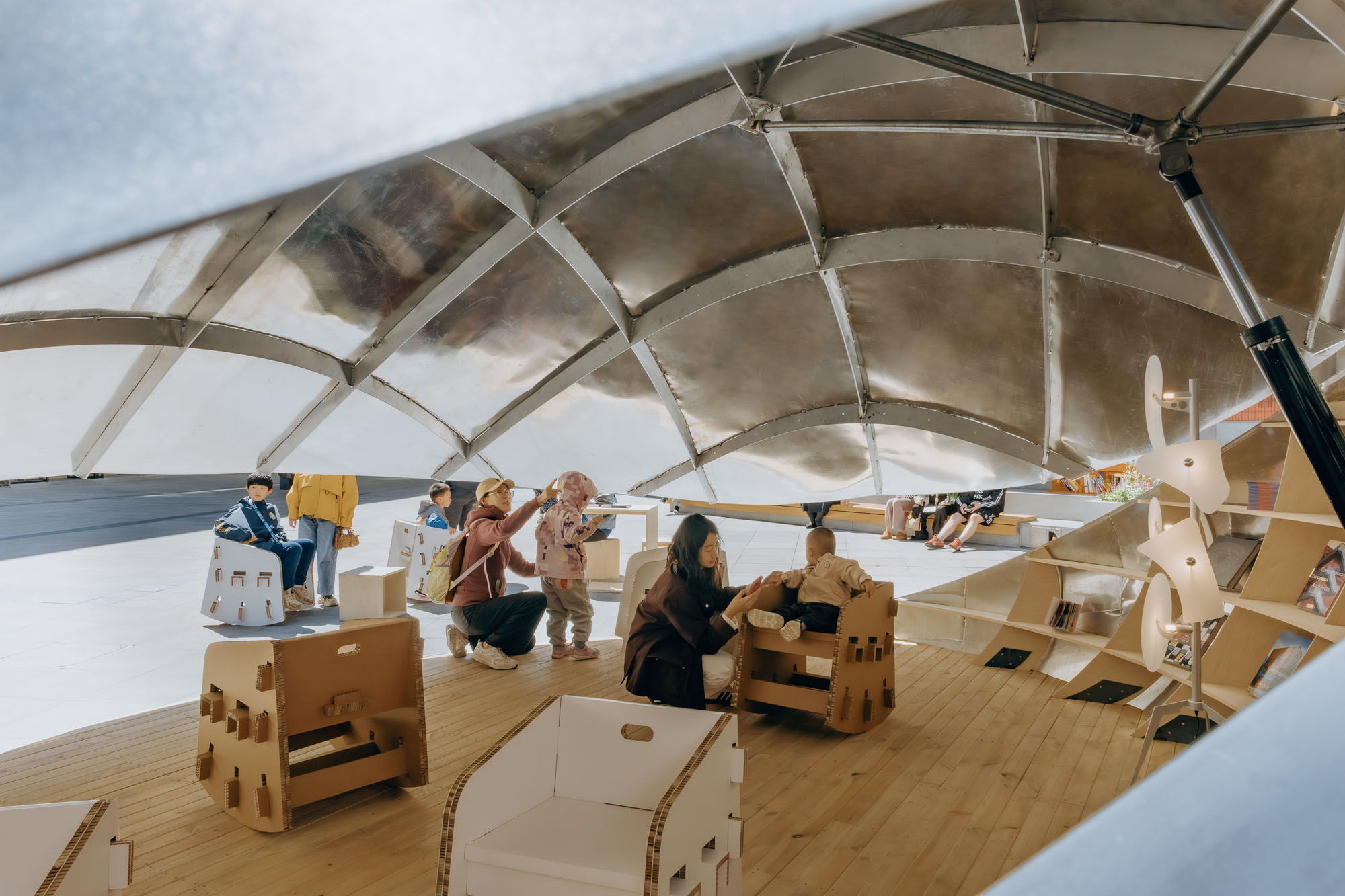
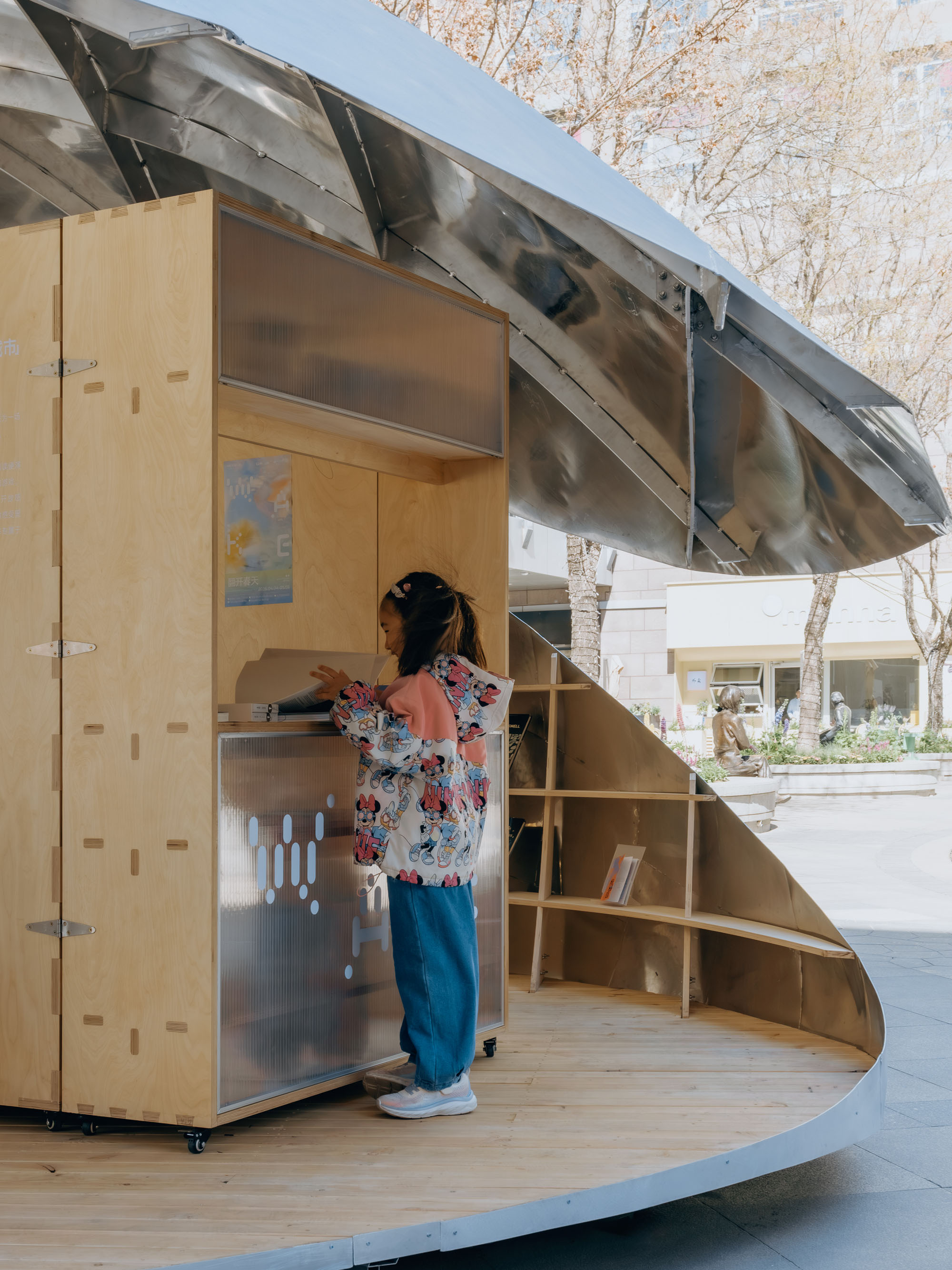
その軽やかで貝殻のような外観にもかかわらず、このプロジェクトは小さなインスタレーションではなく、建築的なスケールで構想されている。完全に開かれた状態では、屋根の面積は40m²を超え、約8m×6mの広さをもち、人々がくつろぎ、雨風をしのぐための公共空間を形成する。内部の高さは2.5mから4.2mに及び、読書や集まり、さまざまな活動を行うのに十分な快適さを確保している。
©︎ Zhu Yumeng
©︎ Zhu Yumeng
©︎ Zhu Yumeng
多様な技術と素材の統合
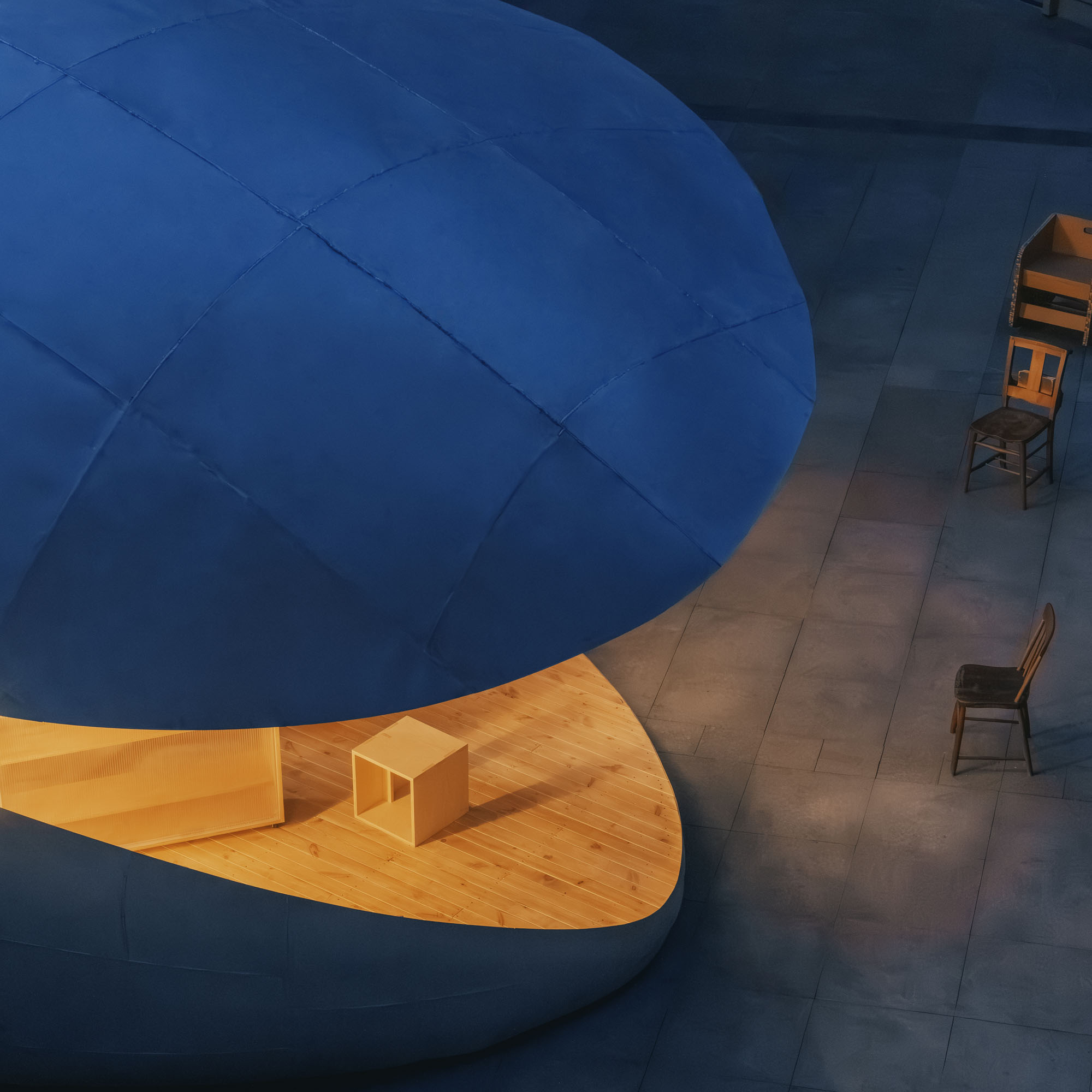
このため、本プロジェクトは開閉による視覚的な面白さを超え、スケール、安定性、安全性の観点から建築として機能している。空間デザインにとどまらず、ベアリング支持式の開閉機構をはじめとする機械システムや、鍛造、CNC加工、旋盤加工、溶接といった多様な金属加工プロセスが統合された。
繰り返される開閉サイクル下での長期的な耐久性を確保するため、構造フレームには航空宇宙グレードのアルミニウムが採用されている。内部には木材要素が導入され、設計上の精度、構造的な信頼性、そして温もりある手触りのバランスを慎重に図る必要があったのである。
©︎ Zhu Yumeng
©︎ Zhu Yumeng
©︎ Zhu Yumeng
課題と意義:複雑な条件下での公共空間の絆づくり
困難な施工条件と現場での調整
設計から製作、設置に至るまでの全工程をわずか20日間で完了させなければならず、これはほぼ不可能な課題であった。異なる工場から材料が現場に届くと、課題はより現実的なものとなった。広場の地面は不均一であり、高低差が18cm近くあったことは、精密な開閉、正確な位置合わせ、そして全体的な安定性が求められる可動構造物にとって大きな障壁となった。基礎の水平調整、設置精度、構造物の位置決め、そして荷重性能のすべてにおいて、現場での繰り返しの調整が必要とされたのである。
さらに、プロジェクトが商業公共広場内に位置していたため、施工は夜間に限定されていた。吊り上げ、溶接、組立、試験、現場での調整はすべて限られた夜間に行わなければならず、施工プロセスは極めて過酷なものとなった。
進化し続ける小さな公共空間
この構造物の軽やかさ——静かに展開し、穏やかな存在感を放つその姿——は、綿密な調整、技術的な精度、そして現場での問題解決の賜物である。これは単なる小さな本のパビリオンでも、単なるインスタレーションでもなく、その状態の変化、そして時間、天候、利用のパターンと共に進化する小さな公共空間なのである。
人々はそれに近づき、その周りに集まり、中に入ったり、あるいは単にそれがゆっくりと開いたり閉じたりする様子を眺めたりすることができる。ここで重要なのは固定された形態ではなく、コミュニティ広場の中心において、いかにして公共的なつながりを育み続けるかということである。
©︎ Zhu Yumeng
©︎ Zhu Yumeng
©︎ Zhu Yumeng
©︎ Zhu Yumeng
©︎ Zhu Yumeng
©︎ Zhu Yumeng
©︎ Zhu Yumeng
©︎ Zhu Yumeng
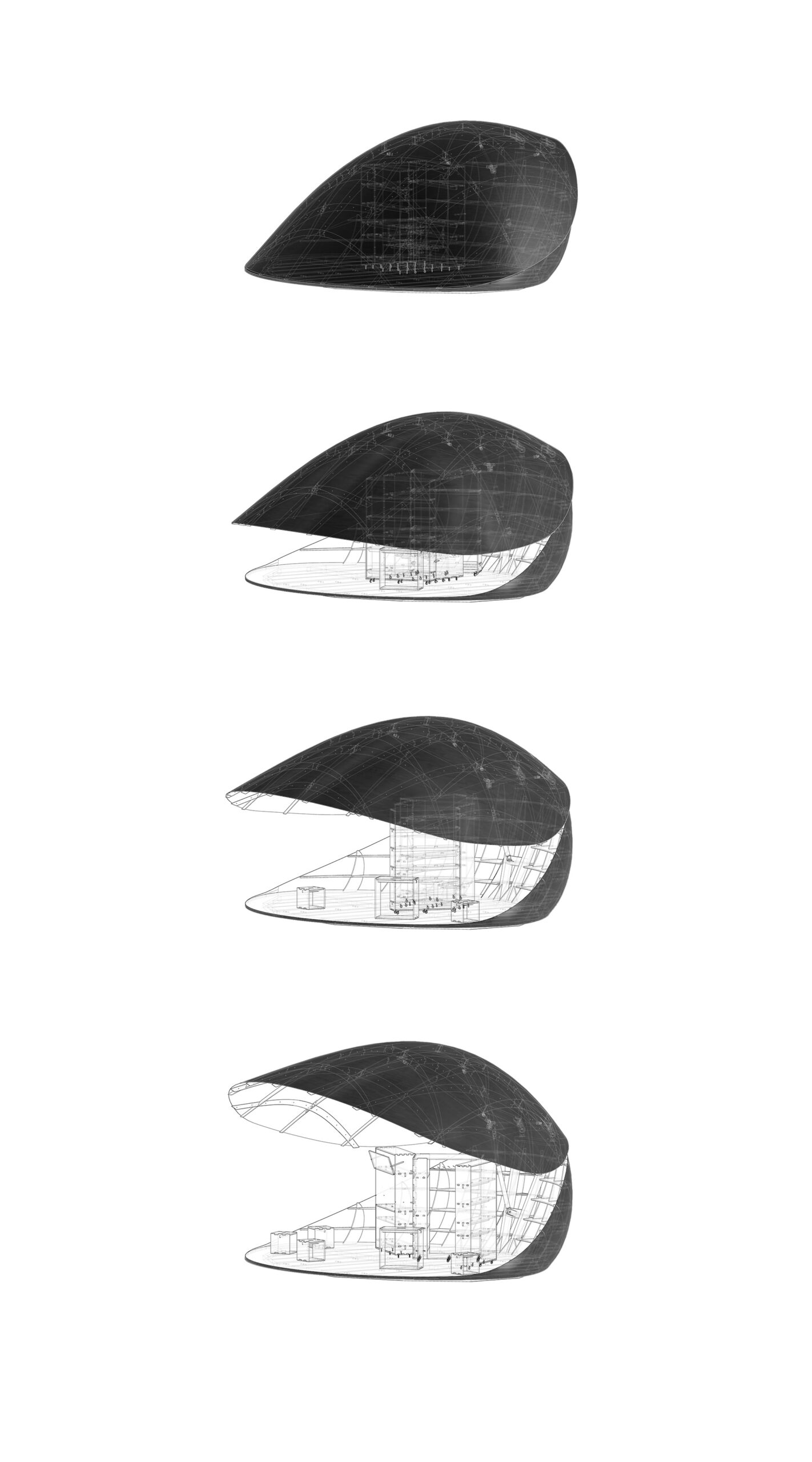
Closing opening states
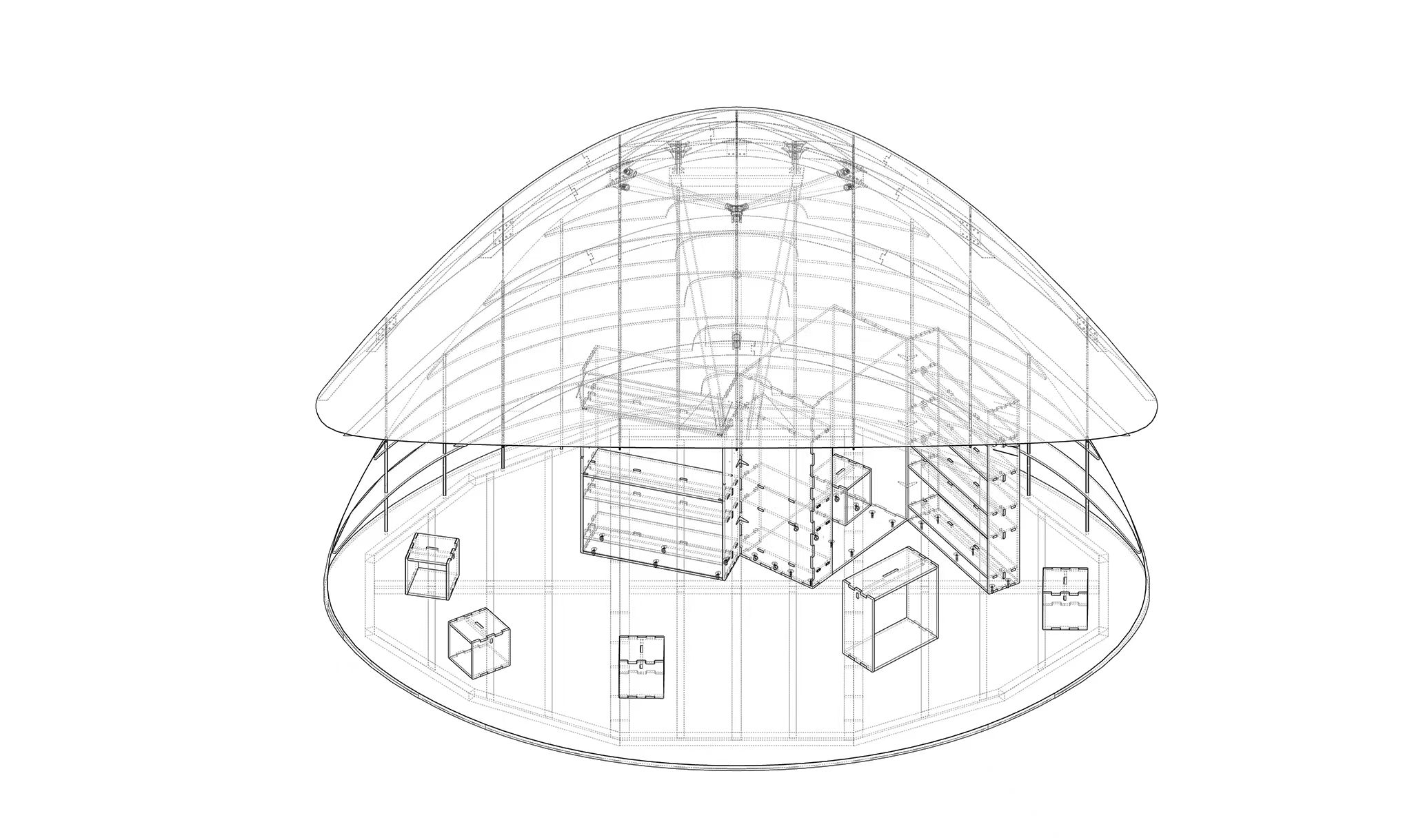
Front axonometric diagram
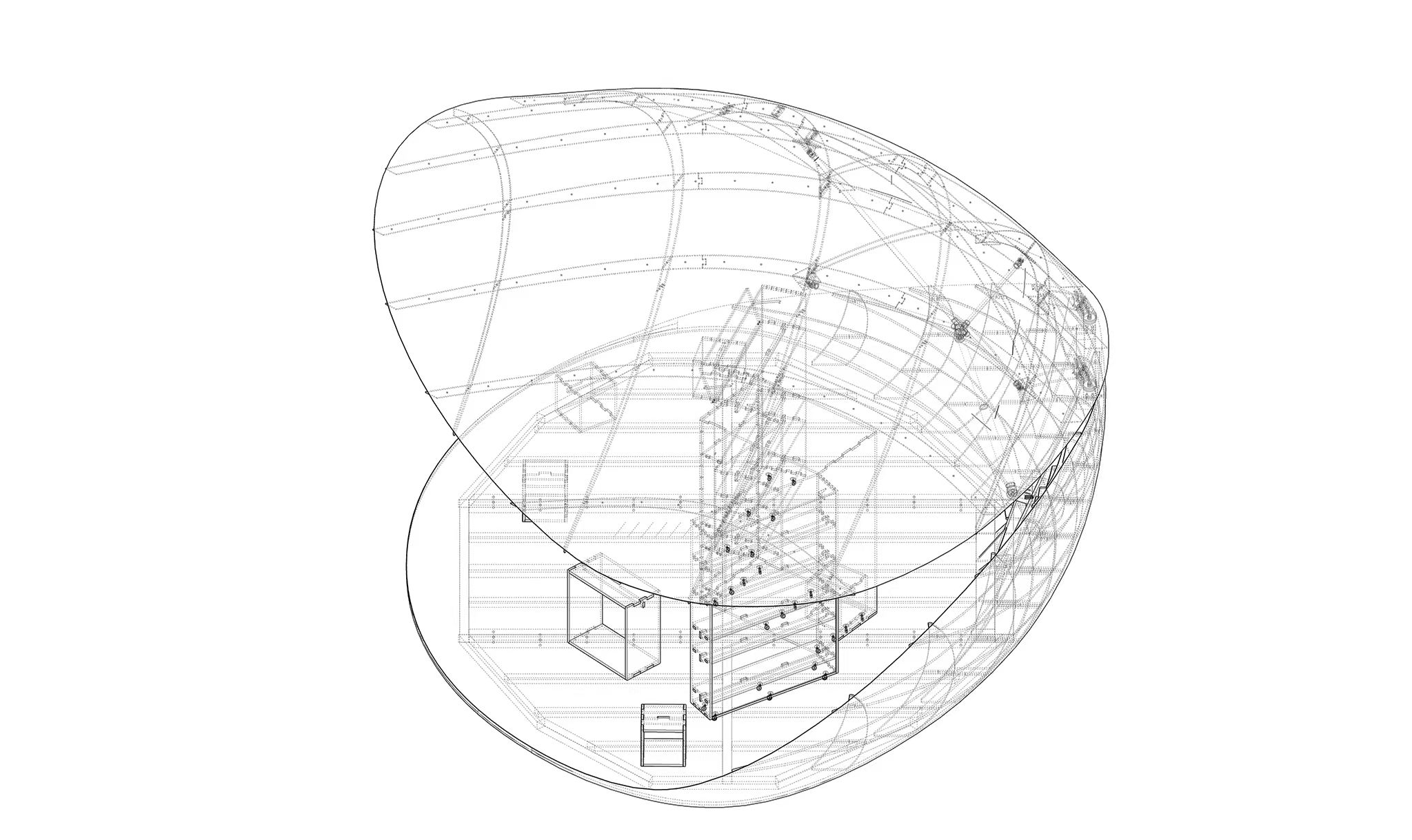
Side axonometric diagram
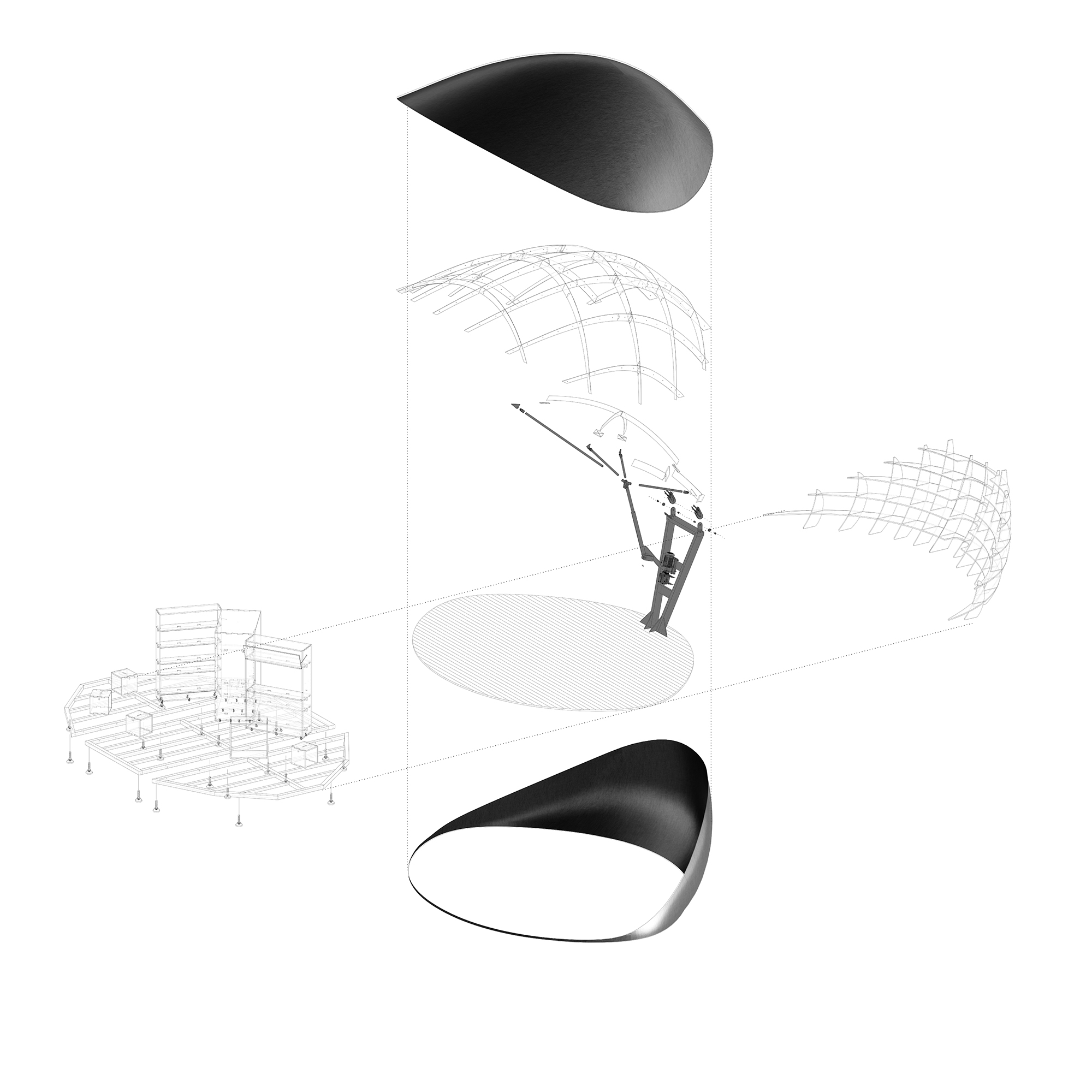
Exploded axonometric diagram
以下、LUOスタジオのリリース(英文)です。
Shell Book Pavilion by LUO studio
Origin: A Response to a Familiar Place
Shine Hills is not an unfamiliar place to me. Since it is close by, I used to visit it often with my child. My earliest impression was not only the many art installations scattered across the plaza, but also its openness to children and community life—a place where people could play and linger. When I was invited to design a small community book pavilion here, it felt like returning to a familiar place woven into everyday life—an opportunity to reconsider what kind of public space this site truly calls for.
The intention was not simply to insert a small structure into the plaza, but to connect daily life in a community-oriented commercial setting with reading, lingering, and encounters.
Three Core Ideas: Playfulness, Centrality, and Openness
Based on these aspirations and in-depth analysis of the site, three core ideas gradually emerged.
First, it needed to be playful.
Situated at the center of the plaza, it had to be engaging enough to draw people in—inviting them to approach and linger, rather than simply walk past or avoid it.Second, it needed a 360-degree presence.
Positioned at the center of a plaza with pedestrian flows from all directions, it couldn’t be conceived as a conventional building with a defined back side. Every side needed to be equally active and engaging—visible and accessible from all directions. A conventional box was therefore never an option.Third, it had to remain open.
In such a highly public setting, a closed, introverted structure would be out of place. Instead, it should maintain strong connections with its surroundings—passersby, airflow, activities, and the circulation of the plaza.A Space in Constant Transformation
From the initial ideas, the book pavilion gradually took shape—not as a fixed, static presence, but as a space meant to shift and evolve. We initially considered enlarging the latter half of our earlier project, a movable ladybug-shaped micro-library for kids, but its side-opening mechanism would inevitably cause rainwater issues. This led us to shift toward a vertical opening system, which eventually gave rise to the “Shell Book Pavilion.”
The structure does not simply open and close. Between these two states lies a continuous spectrum of possibilities. It can be fully open, half open, partially closed, nearly closed, and fully shut. Each state creates a different form, spatial atmosphere, and relationship with people.
Fully open, it feels like a public stage unfolding outward.
Half open, it stays connected to the outside while offering a strong sense of shelter.
Partially or nearly closed, it becomes quieter and more introverted, like a shell gently drawn inward.This gradual transformation also plays an important role in actual use. During reading sessions, for instance, the speaker is initially within the closed shell, then gradually revealed to the audience as it opens. In this way, the space becomes part of the event—not as a static backdrop, but as an active presence that unfolds with it, lending the entire experience a subtle sense of ceremony.
Scale, Structure, and Craft: A Space to Enter and Linger
Despite its light, shell-like appearance, the project is conceived at an architectural scale rather than as a small installation. When fully opened, the roof spans over 40 square meters, measuring approximately 8 meters by 6 meters—defining a public space for lingering and sheltering. The interior height ranges from 2.5 meters to 4.2 meters, ensuring comfort for reading, gathering, and activities.
For this reason, the project transcends the visual interest of opening and closing, operating as architecture in terms of scale, stability, and safety. Beyond spatial design, it integrated mechanical systems, including a bearing-supported opening mechanism, and multiple metalworking processes such as forging, CNC machining, lathe work, and welding. To ensure long-term durability under repeated opening cycles, the structural frame was built from aerospace-grade aluminum. Timber elements were introduced into the interior, requiring a careful balance between engineered precision, structural reliability, and tactile warmth.
Challenges and Significance: Fostering Public Relationships Under Complex Conditions
The entire process—from design to fabrication to installation—had to be completed in just 20 days, a near-impossible task. When materials from different factories arrived on site, the challenges became more tangible. The plaza’s ground was uneven, with an elevation variation of nearly 18 centimeters, posing a significant challenge for an operable structure that required precise opening, accurate alignment, and overall stability. Foundation leveling, installation accuracy, structural positioning, and load performance all required repeated on-site calibration.
At the same time, construction was restricted to nighttime due to the project’s location within a commercial public plaza. Lifting, welding, assembly, testing, and on-site coordination all had to be carried out during limited nighttime hours, making the construction process highly demanding.
The structure’s sense of lightness—its quiet unfolding and gentle presence—is the result of intensive coordination, technical precision, and on-site problem-solving. It is not merely a small book pavilion, nor simply an installation, but a small public space that evolves with its different states—and with time, weather, and patterns of use. People can approach it, gather around it, step inside, or simply watch it slowly unfold and close. What matters here is not a fixed form, but how it continues to foster public relationships at the heart of the community plaza.
Project Information
Project Name: Shell Book Pavilion
Design & Construction: LUO studio
Design Team: Luo Yujie, Hong Lun, Cao Yutao
Client: Shine Hills
Location: Fountain Plaza, North Zone, Shine Hills, Shunyi District, Beijing
Roof Area (Fully Open): 43 m²
Photography: Zhu Yumeng
Completion: April 2026
LUOスタジオ 公式サイト
http://www.luostudio.cn