細い路地の先、四方を建物に囲まれた都市の隙間に建つ築年数不詳の木造アパートを、家族のための住まいへとリノベーションした本計画。近隣で飲食店を営む家主が、娘夫婦のためにこのアパートを住宅へと改修し譲り渡すことを決めたことから、本計画は始まった。
現地調査に訪れた際、飲食店の脇の路地で子供たちが遊び、近くで家族がその様子を見守る姿があった。そうした光景は、近年の都市ではあまり見られなくなった、地域の中で自然な交流が生まれる環境であり、我々はその風景に強く惹かれた。
新たな住まい手からは、「家族や友人が集まる明るい家にしたい」「離れていても家族の気配を感じられる家にしたい」という声があった。また四方を建物に囲まれているため1階よりも2階の方が採光効率が良いことは明らかだったが、LDKは1階に配置したいという要望が寄せられた。
そこで我々は、新たな家族の動線となる斜向かいに建つ家主の飲食店とこの新しい家を繋ぐ道を路地の拡張と捉え、住宅内にも路地の豊かさを引き込み、路地と地域と一体的に感じられる住宅を提案した。具体的には、前面道路から本物件へと続くアプローチから建物を真っすぐ貫く広い土間と、トップライトを設けた光庭を配置し、住宅内部にまるで外部のような明るい空間をつくり出した。
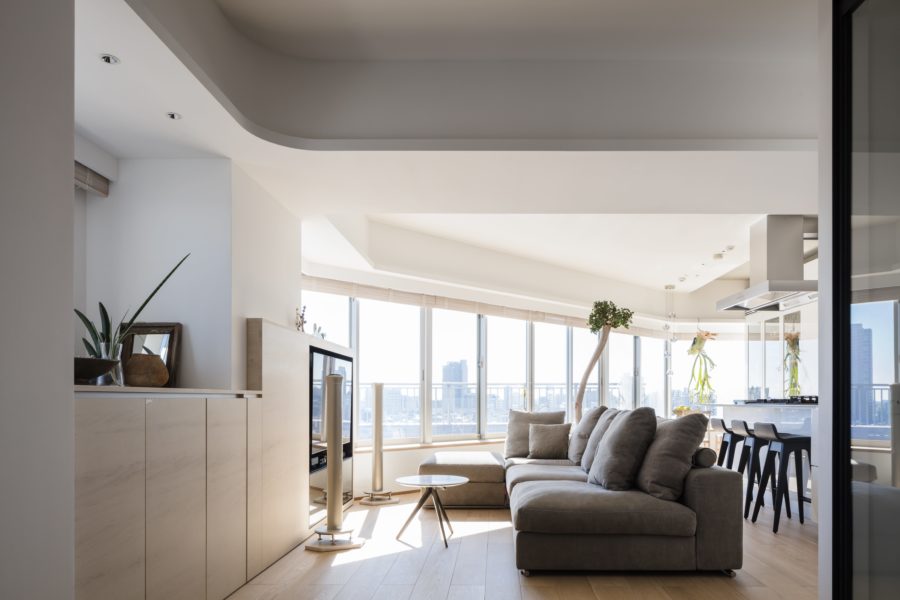
光庭は住まいの中心となるように、水回り以外の居室はすべて光庭へ面するように配置することで、採光計画上不利な1階へも最低限な光をもたらすよう計画した。1階のLDKは冷暖房効率を考え設置した引き違い戸はLDK空間での透過性を考えガラスに、2Fの各居室の小窓はツインカーボとすることでプライバシーを確保しつつ、光の透過によって家族の気配を感じられるようしている。採光や通風を必要としない浴室・トイレなどの水回り設備は北側に集約し、空間構成の合理性を確保した。
既存建物の再生にあたっては、構造体の確認と補強を実施。腐食した柱を新しい構造体へと入れ替え、傾きの補正を行い、現代の住宅性能へと引き上げた。
また、以前のアパートの記憶を継承する意図から、一部の柱や軸組みを意図的に残し、光庭と立体的に交差するブリッジ部にはその構造を現しながら、新しい生活空間の中に位置付けている。ブリッジ周りの手摺りには、梁下までガラスを設け、子供の安全性と視覚的な広がりを両立させ、既存の構造材を引き立たせる設えとした。
両親から譲り受けたアパートの記憶を活かしながら、地域の繋がりを住まいに取り込むことを考えた本計画。本住宅の完成と同時期に、家主の蕎麦屋も次世代への継承を見据えた改修工事が進められている。家主の飲食店とこのアパートの名前には共に「楓」の文字が使われていた。「楓」の花言葉は「美しい変化」「大切な思い出」「調和」などを指す。そこで我々は「楓」と建物の構成を掛け合わせを「楓灯の家」と名付た。路地を介して2つの生活が繋がり、日々の営みを通じて、家族や地域との新たな関係が育まれていくことを願っている。(伊藤茉莉子、安齋幸太郎)
A residential renovation where an enclosed alleyway brings light indoors
This project involved renovating an old wooden apartment building, its age unknown, nestled in an urban gap surrounded by buildings at the end of a narrow alley, into a home for a family. It began when the owner, who runs a restaurant nearby, decided to convert this apartment into a residence and pass it on to his daughter and her husband.
During our site survey, we saw children playing in the alley beside the restaurant, watched over by their families nearby. This scene represented an environment fostering natural community interaction—a sight increasingly rare in modern cities—and we were deeply drawn to it.
The new residents expressed desires for “a bright home where family and friends gather” and “a home where you can feel the presence of family even when apart.” Although the second floor would have better natural light due to the surrounding buildings, they specifically requested that the living-dining-kitchen (LDK) be placed on the first floor.
Therefore, we proposed a home that integrates the alleyway and the neighborhood as one. We viewed the path connecting the new home to the restaurant owned by the landowner, located diagonally across the street and serving as the new family’s main route, as an extension of the alleyway. This approach brought the richness of the alleyway into the house itself. Specifically, we created a bright space within the home that feels almost like the outside by placing a wide earthen floor that runs straight through the building from the approach leading from the front road to the property, and a light-filled courtyard with a skylight.
Positioning all living spaces except wet areas to face the light-filled courtyard, intended as the home’s center, ensures even the first floor—disadvantaged in daylighting—receives essential light. The sliding doors in the first-floor LDK were chosen for their energy efficiency in heating and cooling. To maintain transparency within the LDK space, they were made of glass. The small windows in the second-floor bedrooms use twin-pane glass to ensure privacy while allowing light to pass through, enabling family members to sense each other’s presence. Bathroom and toilet facilities, which require no natural light or ventilation, were consolidated on the north side to ensure rational spatial organization.
During the renovation of the existing structure, the framework was inspected and reinforced. Corroded columns were replaced with new structural members, correcting any tilt and upgrading the building to meet modern residential performance standards.
To preserve the memory of the former apartment, some columns and framing were intentionally left exposed. The bridge section, intersecting the light court in a three-dimensional way, highlights this structure while integrating it into the new living space. The handrails around the bridge feature glass extending down to the beam level. This design balances child safety with visual openness while highlighting the existing structural elements.
This project aimed to incorporate memories of the apartment inherited from the parents while integrating community connections into the dwelling. Concurrent with the residence’s completion, the owner’s soba restaurant underwent renovation work to pass it on to the next generation. Both the owner’s restaurant and this apartment building originally bore the character “Kaede” (Maple). The flower language of the maple tree signifies “beautiful change,” “cherished memories,” and “harmony.” Thus, we named the building “House of Maple Light,” combining “Kaede” with the structure’s composition. Through the alleyway connecting these two lives, new relationships with family and the community will blossom through daily activities. (Mariko Ito, Kotaro Anzai)
【楓灯の家】
所在地:東京都
用途:戸建住宅
クライアント:個人
竣工:2025年
設計:KITI DESIGN OFFICE
担当:伊藤茉莉子、安齋幸太郎
構造設計:桑子 亮、木村友美(桑子建築設計事務所)
施工:澤田大悟、石川光希(KITI)
撮影:貝出翔太朗(https://kaideshotaro.info)
工事種別:リノベーション
構造:木造
規模:地上2階
敷地面積:135.84m²
建築面積:75.63m²
延床面積:118.57m²
設計期間:2024.01-2024.08
施工期間:2024.08-2025.02
【Futo no Ie】
Location: Tokyo, Japan
Principal use: Residence
Client: Individual
Completion: 2025
Architects: KITI DESIGN OFFICE
Design team: Mariko Ito, Kotaro Anzai
Structure engineer: Ryo Kuwako, Tomomi Kuwako / KUWAKO ARCHITECTS AND ENGINEERS
Construction: Daigo Sawada, Mitsuki Ishikawa / KITI
Photographs: Shotaro Kaide (https://kaideshotaro.info)
Construction type: Renovation
Main structure: Wood
Building scale: 2 stories
Site area: 135.84m²
Building area: 75.63m²
Total floor area: 118.57m²
Design term: 2024.01-2024.08
Construction term: 2024.08-2025.02