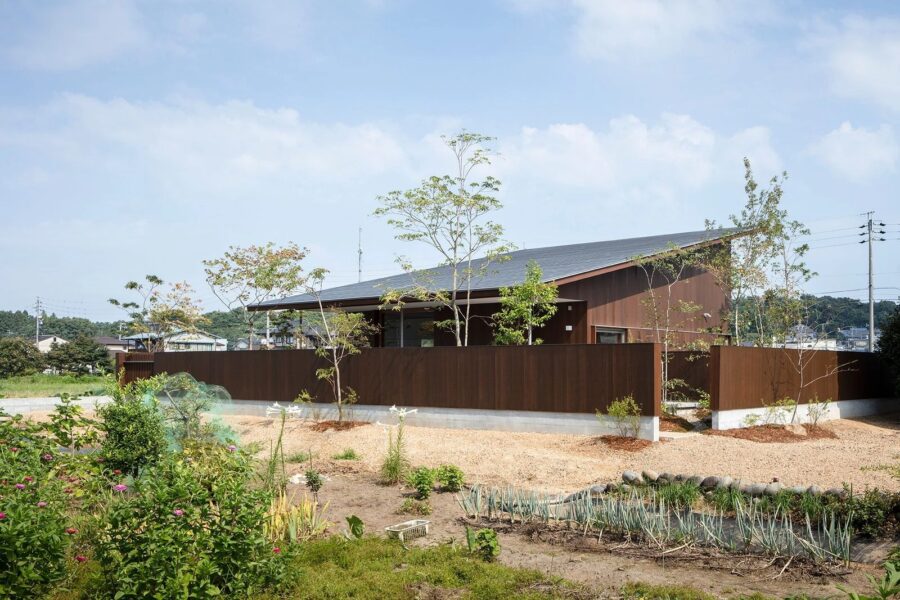
敷地は岡山県岡山市南区の郊外にある。江戸時代からの干拓によって内海を陸地に変え、農業が発達してきた地域と山の裾野との境界に位置している。近年は農家の減少、少子高齢化、人口減少、郊外の宅地開発が進んだことで、周辺は宅地と農地とが混在しており、また空き家や耕作放棄地の問題が顕在化しつつある。
このプロジェクトはそのような土地の変遷の中、かつて農業用倉庫として使用された木造建築を事務所兼住居として改修し、また、使用されていない前面の耕作放棄地を原っぱのような空き地としての外部空間と読み替えて活用することで、地方都市の郊外での暮らし方、建築と外部空間との関係、そして街並みへのアプローチを現代に適合するよう、新たに捉え直すものである。
ここでは、既存建築がもっていた「2層のひと繋がりの空間」の中に折り返しのひと筆動線を計画し、その後、必要な用途を空間内の動線上適切な場所に配置した。その結果、「天井高の低い平面的な広がりのあるエントランスとダイニング・キッチン」、「吹き抜けにより開放性のあるリビング」、階段を介して「折れ屋根の勾配天井により高さが暫時的に変化するベッドスペースとワークスペース」といった多様な居場所が生まれた。
空間構成はおおらかに、居室を個々の用途で厳格に完結させず、補強した構造材や水回り、収納スペースを動線の中に配置しながら各居場所が空間を跨ぐよう繋げ、それらに合わせて家具や植栽を配置した。開口を設けた場所では外部の風景と連続してもいる。建物東西面のハイサイドライトは、内部の動線と合わせて空へと視線を抜くことで空間に広がりをもたらし、また自然光を届ける役割を担う。家具や手すりなどの、より人間の身体感覚に近づくスケールにおいては既製、造作を問わず、高さ・断面寸法・素材を揃えたり近似させ、反復することで空間全体を構築する要素を緩やかに束ねた。
屋根は既存建築から架け替えを行い、形状および勾配は周辺の山並みの稜線の勾配と内部動線の流れに沿うように定めた。また、空き地は周辺の住宅との距離感において物理的な緩衝空間の役割を果たすと同時に、近隣の公園を補完する役割となり地域の子供たちの遊び場としても使用されている。
現在の日本の人口減少社会において、地方の郊外では都市およびそれに伴う生活インフラの縮小、地域拠点の集約、既存建物ストック活用による日常生活や治安の維持・向上が急務の課題であり、そのアクチュアルな解決が求められている。岡山県でも岡山市中心部では市街地のコンパクトシティ化が推進されているが、同時に中心市街地を支える郊外の地域拠点の住環境の整備が重要であると考えている。
そして、それぞれの地域に住まう人々にとっては開発よりも寧ろ、既存建築および外部空間の読み替えや更新を積極的に行うことで、新たな暮らし方を探していくことの方が大切なのではないだろうか。
今回は、この土地から生まれた木造の農業用倉庫という建築類型が我々の改修計画を導いた。周辺環境から生まれたおおらかなひと繋がりの空間と屋外空間が、時間を経て用途を変えつつも、再びその環境に混ざって多義的な居場所を生み出している。
(上西 徹)
A residence reimagined from an agricultural warehouse into a contemporary living space
The site is located in Minami Ward, Okayama City, Okayama Prefecture. It sits at the boundary between an area where agriculture developed after the Edo period’s land reclamation of inland seas, and the foothills of the mountains. In recent years, due to the decline in the number of farming households, a low birthrate, an aging population, and the advancement of suburban residential development, the surrounding area has become a mix of residential and agricultural land. Problems such as vacant houses and abandoned farmland are becoming increasingly apparent.
This project, amidst such land transitions, renovates a former wooden agricultural warehouse into an office and residence. It also reinterprets and utilizes the unused, abandoned farmland at the front as an external space resembling a meadow. This aims to redefine, in a contemporary context, ways of living in suburban areas of regional cities, the relationship between architecture and external space, and approaches to the streetscape.
Here, a single, folded circulation path was planned within the existing building’s “two-story, continuous space.” Necessary functions were then placed at appropriate points along this circulation route within the space. This resulted in diverse living spaces: a “low-ceilinged, expansive entrance and dining-kitchen area,” an “open living room with a double-height ceiling,” and, accessed via stairs, a “bed and work space where the height temporarily changes due to the pitched roof’s slope.”
The spatial composition is generous, avoiding strict compartmentalization of rooms by function. Reinforced structural elements, wet areas, and storage spaces are integrated into the circulation paths, connecting each space across the layout. Furniture and plants are then arranged to complement these connections. Openings created continuity with the external landscape. High-side windows on the east and west facades provide views to the sky, aligned with internal circulation paths, creating spatial expansiveness while delivering natural light. At the scale closer to human perception—furniture and handrails—both prefabricated and custom elements were unified or approximated in height, cross-sectional dimensions, and materials. This repetition gently binds the elements, constructing the entire space.
The roof was replaced from the existing structure, with its shape and slope determined to align with the gradient of the surrounding mountain ridges and the flow of internal circulation. The vacant lot serves as a physical buffer zone, maintaining a distance from surrounding residences, while also complementing the nearby park, which functions as a playground for local children.
In Japan’s current population-declining society, urgent challenges in suburban areas include the shrinkage of cities and their associated living infrastructure, the consolidation of local hubs, and the maintenance and improvement of daily life and public safety through the utilization of existing building stock. Practical solutions to these issues are demanded. While Okayama City promotes compact city development in its central urban area, it is equally important to improve the living environment in suburban local hubs that support the central city.
For the people living in each of these areas, rather than new development, isn’t it more important to actively reinterpret and renew existing buildings and outdoor spaces to explore new ways of living?
This time, the architectural typology of wooden agricultural warehouses born from this land guided our renovation plan. The expansive, interconnected spaces and outdoor areas born from the surrounding environment, while changing uses over time, have blended back into that environment, creating multifaceted places.
(Tohru Uenishi)
【つながりの構え】
所在地:岡山県岡山市
用途:戸建住宅
クライアント:個人
竣工:2025年
設計:上西徹建築設計事務所
担当:上西 徹
施工:株式会社イチエ建匠
撮影:小川重雄
工事種別:リノベーション
構造:木造、S造
規模:地上2階
敷地面積:349.00m²
建築面積:58.39m²
延床面積:97.32m²
設計期間:2023.05-2025.01
施工期間:2025.03-2025.10
【sequential structure】
Location: Okayama-shi, Okayama, Japan
Principal use: Residence
Client: Individual
Completion: 2025
Architects: Uenishi Tohru Architects
Design team: Uenishi Tohru
Construction: ICHIEKENSHO
Photographs: Shigeo Ogawa
Construction type: Renovation
Main structure: Wood, S
Building scale: 2 stories
Site area: 349.00m²
Building area: 58.39m²
Total floor area: 97.32m²
Design term: 2023.05-2025.01
Construction term: 2025.03-2025.10