埼玉県春日部市、妙善寺の本堂を建て直す計画である。現代では檀家の数が減っていく中で、いまだ関係をもっていなかった地域の住民に対して新しく門戸を開いていくため、寺院建築がもつ閉鎖的な印象を払拭し、機能的にも空間的にも連携を取っていけるあり方を提案した。
寺院建築は和小屋によって屋根の自由度を上げ、照り屋根をつくってきた歴史があり、耐震性を保つ少ない開口部が光を限定することで、本尊への象徴性をもたらしてきた。一方で、日常生活において宗教に対する意識が薄くなる中、その暗く、閉ざされた印象が敷居の高さを生んでいる。僕らが提案したのは、現代的な素材や構法によって今までの宗教建築の形として連続しながらも、新しいイメージや使い方を喚起する空間である。
敷地には、南側の参道からと北側の旧街道からの2つのアプローチがあるため、裏表両面に対して玄関をもち、通り抜けられる風通しのよいお寺とした。10m角の平面をもつ本堂がさまざまな活動を受け止められるように、内部に柱を落とさない構造計画とした。四隅を隅切りとした斜めの耐力壁によって耐震要素をもたせながら、10m角のロの字の梁と、小屋組を受ける8.19m角のロの字の梁が入れ子になって小屋組みを支える構成である。
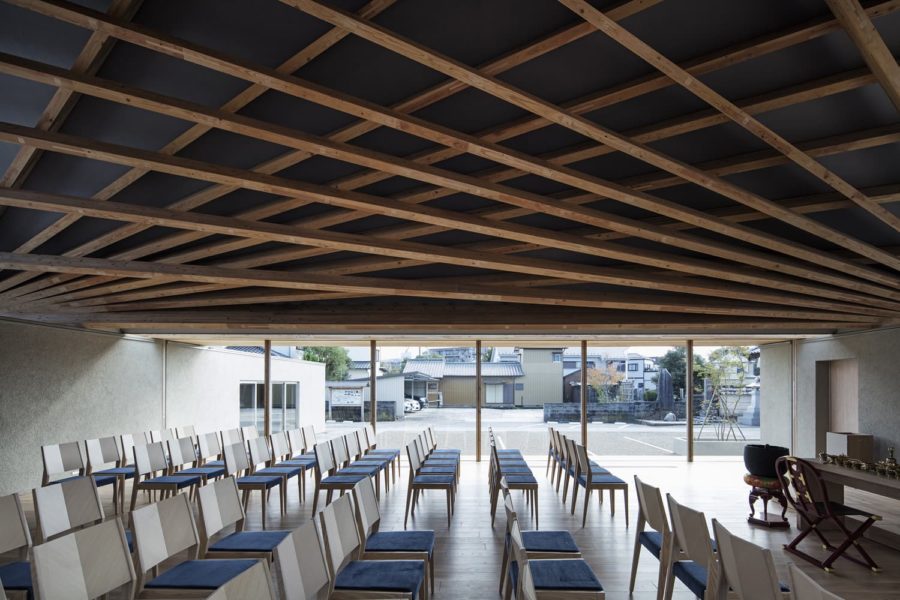
柱梁+束+垂木による寺院建築の伝統的な和小屋形式を踏襲し、束柱梁として桧のCLT60×420mmを341mm間隔で配置し、湾曲集成材による曲げ垂木によって屋根を構成している。一般的な和小屋では梁が吹き抜け空間を横断し、さらに水平剛性を確保するために火打ち梁で補強される。通常、吹き抜け空間となる部分の水平剛性が極端に弱くなるが、今回は小屋梁レベル付近に下屋屋根が4方向に接続していることで水平剛性がとれ、火打ち梁などの必要がない計画となる。
また、一般的なお寺の屋根架構では、照り屋根をつくるための加工、下地、2次部材などが屋根裏に多数配置されていることから、架構の複雑さによる施工の難易度が上がり、かつそれらを隠すための天井が張られている。表と裏をつくってしまう屋根形状に対して、今回の計画では細かく配置したCLTと曲げ垂木のシンプルな架構によって、屋根の表と裏が一致する架構が現れ、気積の大きな、明るく開放感のあるお堂空間が実現できた。
門型のCLTフレームは曲線状に配置されることで本尊への集中線的効果をもちながら、従来の和小屋の寺院建築にはない妻面の大きなハイサイドライトによって明るく軽やかな本堂を生み出している。湾曲集成材を垂木に用いることで、本来の寺院建築では屋根の端部を照る形だったものが、現代の構法によってもっとのびやかに迎え入れる形を生んでいる。寺院建築が檀家のための祈りの空間だけでなく、地域住民にとっても活動の場となる新しいあり方である。
本堂の斜め壁は、仏画の絵解をしたり、プロジェクターで投影して映画を見たり、活動の起点となる。無柱で段差のない本堂は平面的に余白が十分にあるため、コンサートを行ったり、地域活動の舞台として本堂を使用することができる。北側の御斎室によって冠婚葬祭への対応がしやすくなるとともに、付随する給湯室で飲食店の営業許可を取れる仕様とし、シェアキッチンとして運用でき、地域住民の方が新しいチャレンジを行うことも可能である。竣工してからすでに、宗教的な行事だけでなく、シェアキッチンでのチャレンジショップや地域のイベントが行われている。官がもちうる公共性と別の共同性がこの大きな屋根の下で育まれ、人が集うことの豊かさを次の時代へつないでいってほしい。
(柿木佑介、廣岡周平)
A temple building where the open hall space, supported by a wooden framework, serves as a venue for community activities
This project involves the reconstruction of the main hall at Myoshin-ji Temple in Kasukabe City, Saitama Prefecture. Amid declining numbers of parishioners in modern times, the proposal aims to open the temple’s doors to residents who have not yet formed a connection to it. To achieve this, we sought to dispel the impression of temple architecture as closed off and to propose a design that fosters functional and spatial integration.
Temple architecture has a history of using traditional Japanese roof structures to increase roof flexibility, creating sloped roofs. By limiting light through the few openings necessary to maintain seismic stability, these structures have imbued the principal image with symbolism. On the other hand, as awareness of religion in daily life diminishes, this dark and closed-off impression creates a sense of exclusivity. Our proposal is a space that, while maintaining continuity with the traditional forms of religious architecture through modern materials and construction methods, evokes a new image and new ways of using the space.
Since the site has two entrances—one from the approach path on the south side and one from the old highway on the north side—the temple was designed with entrances on both the front and back sides, creating a well-ventilated space that allows people to pass through freely. To ensure the 10-meter-square main hall can accommodate a variety of activities, we designed a structural plan that eliminates interior columns. The structure incorporates seismic resistance through diagonal load-bearing walls with chamfered corners. At the same time, the roof framework is supported by a nested system of 10-meter-square L-shaped beams and 8.19-meter-square L-shaped beams, which in turn support the roof trusses.
Following the traditional Japanese roof structure of temple architecture, which consists of columns, beams, posts, and rafters, 60×420 mm CLT cypress beams are arranged at 341 mm intervals as strut-post beams, and the roof is constructed using curved rafters made of laminated timber. In typical Japanese-style roof structures, beams span the open-plan space and are reinforced with cross-beams to ensure horizontal rigidity. Normally, the horizontal rigidity of the open-plan area becomes extremely weak; however, in this design, the lower roof connects in four directions near the level of the roof beams, providing sufficient horizontal rigidity and eliminating the need for cross-beams.
Furthermore, in the roof structures of typical temples, the processing, sheathing, and secondary members required to create a sloped roof are densely arranged in the attic space. This increases construction difficulty due to the structure’s complexity, and ceilings are installed to conceal these elements. In contrast to roof shapes that create distinct “front” and “back” sides, this design employs a simple framework of finely spaced CLT panels and curved rafters, resulting in a structure where the front and back of the roof are unified. This has enabled the creation of a bright, open hall space with a large volume.
The gate-shaped CLT frame, arranged in a curved pattern, creates a converging visual effect toward the principal image, while the large, high-side windows on the gable—unseen in traditional Japanese temple architecture—produce a bright, airy main hall. By using curved engineered wood for the rafters, the roof, which in traditional temple architecture would have cast shadows at its edges, now creates a more expansive and welcoming form through modern construction methods. This represents a new approach to temple architecture, where the space serves not only as a place of prayer for parishioners but also as a venue for community activities.
The slanted walls of the main hall serve as a focal point for activities, such as explaining Buddhist paintings or projecting movies. The column-free, level floor plan provides ample open space, enabling the hall to host concerts or serve as a stage for community events. The dining hall on the north side is used for ceremonial events. At the same time, the adjacent kitchen meets the requirements for a food service license, allowing it to operate as a shared kitchen and enabling residents to take on new challenges. Since its completion, the space has already hosted not only religious ceremonies but also pop-up shops in the shared kitchen and local community events. We hope that a sense of community distinct from the public nature of government institutions will flourish under this large roof, carrying the richness of human connection into the next generation.
(Yusuke Kakinoki, Shuhei Hirooka)
【妙善寺本堂】
所在地:埼玉県春日部市
用途:神社・寺院
クライアント:個人
竣工:2023年
設計:PERSIMMON HILLS architects
担当:柿木佑介、廣岡周平、池谷浩樹
構造設計:オーノJAPAN
施工:榊住建
撮影:田中克昌
工事種別:新築
構造:木造
規模:平屋
敷地面積:558.38m²
建築面積:198.72m²(既存部との合計:346.71m²)
延床面積:182.60m²(既存部との合計:382.49m²)
設計期間:2021.04-2022.09
施工期間:2022.10-2023.05
【Myozenji Main Temple】
Location: Kasukabe-shi, Saitama, Japan
Principal use: Shrine, Temple
Client: individual
Completion: 2023
Architects: PERSIMMON HILLS architects
Design team: Yusuke Kakinoki, Shuhei Hirooka, Koki Iketani
Structure engineer: Ohno JAPAN
Construction: Sakaki Juken
Photographs: Katsumasa Tanaka
Construction type: New building
Main structure: Wood
Building scale: 1 story
Site area: 558.38m²
Building area: 198.72m² (Total with existing section: 346.71m²)
Total floor area: 182.60m² (Total with existing section: 382.49m²)
Design term: 2021.04-2022.09
Construction term: 2022.10-2023.05