地方の課題とはなんだろうか。高齢化、つくり手・後継者不足、働く場所・働き方の多様性が低い、魅力的な場所が少ない、ローカルコミュニティ、古民家再生は活発だが築年数が中程度の空き家が多い、空き家の使い方が分からない。
東京から移住(Uターン)し、都心と地方との壁を感じ、地方の壁を超えるために模索し続けてきた。その模索した解の1つとして、築42年のハウスメーカーが建てた鉄骨ボックスラーメン構造の空き家を購入およびリノベーションし、自社の建築設計事務所と住宅、多目的に利用できる空間を外に開くことで複合施設のような住宅のような建物を考えた。
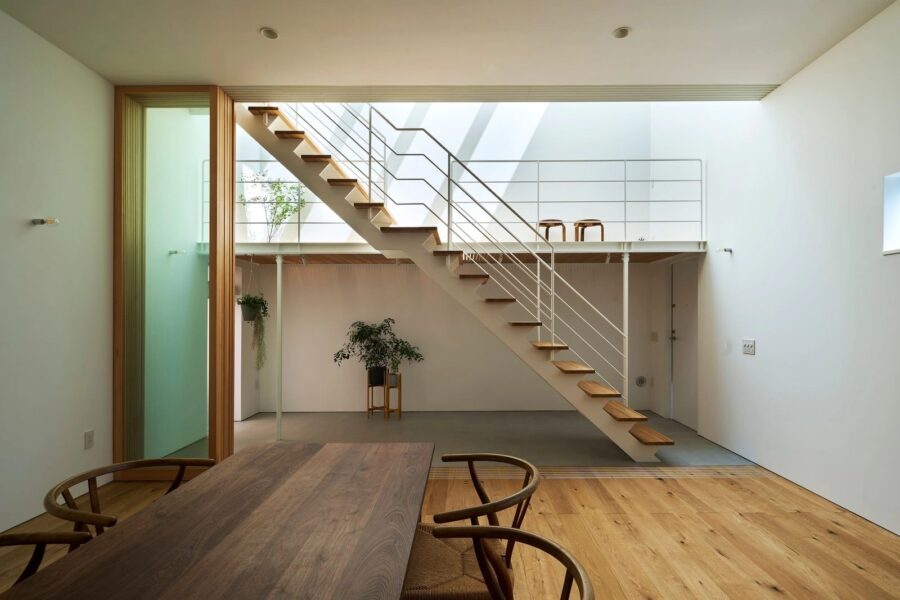
もとは5人家族が住んでいた住宅で、天井高さが一般的な2.4mの個室が並ぶ、ごくありふれた間取りであった。事務所兼用住宅としては使いにくい間取りのため、ボックスラーメン構造という特性を活かし、内部をすべて解体し、各場所の使い方は決めきらずに、建物全体をフレキシブルに使えるような空間構成とした。
妻は東京の建築設計事務所に勤めおり、リモートで働くインテリアデザイナーのため、自社オフィス部分を共有している。私たちの暮しを考慮すると、日中は夫婦ともにオフィスで過ごすため使わないスペースが生まれる。そこで、打ち合わせスペースは、時折ギャラリーやワークショップ、ポップアップストアなどに。2階のLDKは、子連れのママ会、教室利用、ピラティススタジオなど、様々な用途に変わる複合施設のように家を開いている。
地方だからこそ建築家が”まち”と関わる必要があるのではないだろうか。今まで知らなかったことが〈千波のいえ〉を通して”様々なことができる”ということに変わり、まちが楽しくなれば良いと考えている。家を外に開くことで新たなコミュニティが生まれ、空間への興味を促し、新たな空き家活用のモデルケースとなるような実験的な住宅を目指した。(仲田裕貴)
A complex residence combining work, living, and openness
What are the challenges facing rural areas? Aging populations, shortages of skilled workers and successors, limited diversity in workplaces and work styles, a lack of attractive destinations, and local communities struggling with the active restoration of old houses, yet many moderately aged vacant homes remain. There is also uncertainty about how to utilize these vacant properties.
After relocating from Tokyo (a U-turn), I felt the barrier between the city center and the regions, and have continuously sought ways to overcome this regional divide. As one solution to this exploration, I purchased and renovated a 42-year-old vacant house built by a major homebuilder using a steel box-frame structure. By opening up the space to the outside, combining our architectural design office with residential and multi-purpose areas, I envisioned a building that functions like a complex facility yet feels like a home.
Originally a home for a family of five, it had a widespread layout with individual rooms featuring the standard 2.4m ceiling height. This layout was impractical for a combined office and residence. Leveraging the characteristics of the box-type frame structure, we completely gutted the interior. We deliberately avoided assigning fixed uses to specific areas, creating a flexible spatial configuration that allows the entire building to be used adaptively.
My wife works remotely as an interior designer for an architectural design firm in Tokyo, sharing the office space within our home. Considering our lifestyle, we both spend our days working in the office, leaving unused space. Thus, the meeting space occasionally transforms into a gallery, workshop, or pop-up store. The second-floor living-dining-kitchen area opens up the house, serving as a multifunctional facility that hosts gatherings with moms and children, classroom sessions, Pilates studios, and various other uses.
Isn’t it precisely because we’re in a rural area that architects need to engage with the “town”? Through the “Senba no Ie,” what was previously unknown has transformed into “a place where many things are possible.” We hope this makes the town more enjoyable. By opening the house outward, we aimed to create a new community, spark interest in the space, and develop an experimental residence that could serve as a model for utilizing vacant houses. (Hirotaka Nakata)
【千波のいえ】
所在地:茨城県水戸市
用途:戸建住宅、オフィス
クライアント:個人
竣工:2023年
設計:hiro nakata atelier
担当:仲田裕貴
施工:金澤建築
撮影:ryukanari
工事種別:リノベーション
構造:S造
規模:地上2階
敷地面積:302.99m²
建築面積:81.00m²
延床面積:126.42m²
設計期間:2022.05-2023.02
施工期間:2023.02-2023.08
【Senba no Ie】
Location: Mito-shi, Ibaraki, Japan
Principal use: Residence, Office
Client: Individual
Completion: 2023
Architects: hiro nakata atelier
Design team: Hirotaka Nakata
Construction: Kanazawa Kenchiku
Photographs: ryukanari
Construction type: Renovation
Main structure: S
Building scale: 2 stories
Site area: 302.99m²
Building area: 81.00m²
Total floor area: 126.42m²
Design term: 2022.05-2023.02
Construction term: 2023.02-2023.08
![[Report]RUI Architectsが可動モジュールを設計して松竹のアートスペースをリニューアル、柿落とし展「継承のトランジション」の会場デザインも担当](https://magazine-asset.tecture.jp/wpcms/wp-content/uploads/2026/07/24141011/20260713shutl_press11-01309-c-900x629.jpeg)
![[Interview]BIM図面審査がスタート! さまざまな設計者のニーズに応えるVectorworksによる「限界のないデザイン」の世界](https://magazine-asset.tecture.jp/wpcms/wp-content/uploads/2026/07/13084316/rinterview_vectorworks_056-e1784200974912-900x555.jpg)