

中国の湿地に溶け込むウォール・ミュージアム - 屋根と床の境界をなくし、「壁」のみで空間を定義する〈陳湖湿地アートセンター〉
©︎ Yumeng Zhu
中国・武漢に建つ〈陳湖湿地アートセンター(Chenhu Wetland Art Center)〉は、自然豊かな湿地公園内に佇む美術館です。
「壁」を空間形成の唯一の原動力とする「ウォール・ミュージアム」をコンセプトに、北京を拠点に活動する建築事務所 TAO(Trace Architecture Office)が設計しました。
注目ポイント
- 「壁」のみで空間を定義する実験的な空間構築
- 壁がランダムに分散する、湿地の生態系を模した「多孔質な」平面計画
- 「水の記憶」を可視化する水面と連続する造形
- 環境の変化を映し出す特注のGRCファサード
(以下、TAOから提供されたプレスキットのテキストの抄訳)
©︎ Yumeng Zhu
©︎ Yumeng Zhu
水の都・武漢の歴史と地理的背景
中国の地理的中心に位置する武漢は、明・清の時代には「九省(中国全域の古称)への玄関口」と呼ばれていた。古代の雲夢(うんぼう)湿地から始まり、大禹(だいう)による漢水の長江への導水、さらに成化6年(1470年)の河道変更を経て、この都市は現在の「河城」としての姿を徐々に形成してきた。
「百湖の都」とも称される武漢は、川や湖、水路が複雑に織りなす都市であり、総面積の4分の1を水域が占めている。「水」と「都市」の関係は、切っても切れないほど緊密である。
©︎ Yumeng Zhu
©︎ Yumeng Zhu
手つかずの自然が残る、湖畔の三角地帯
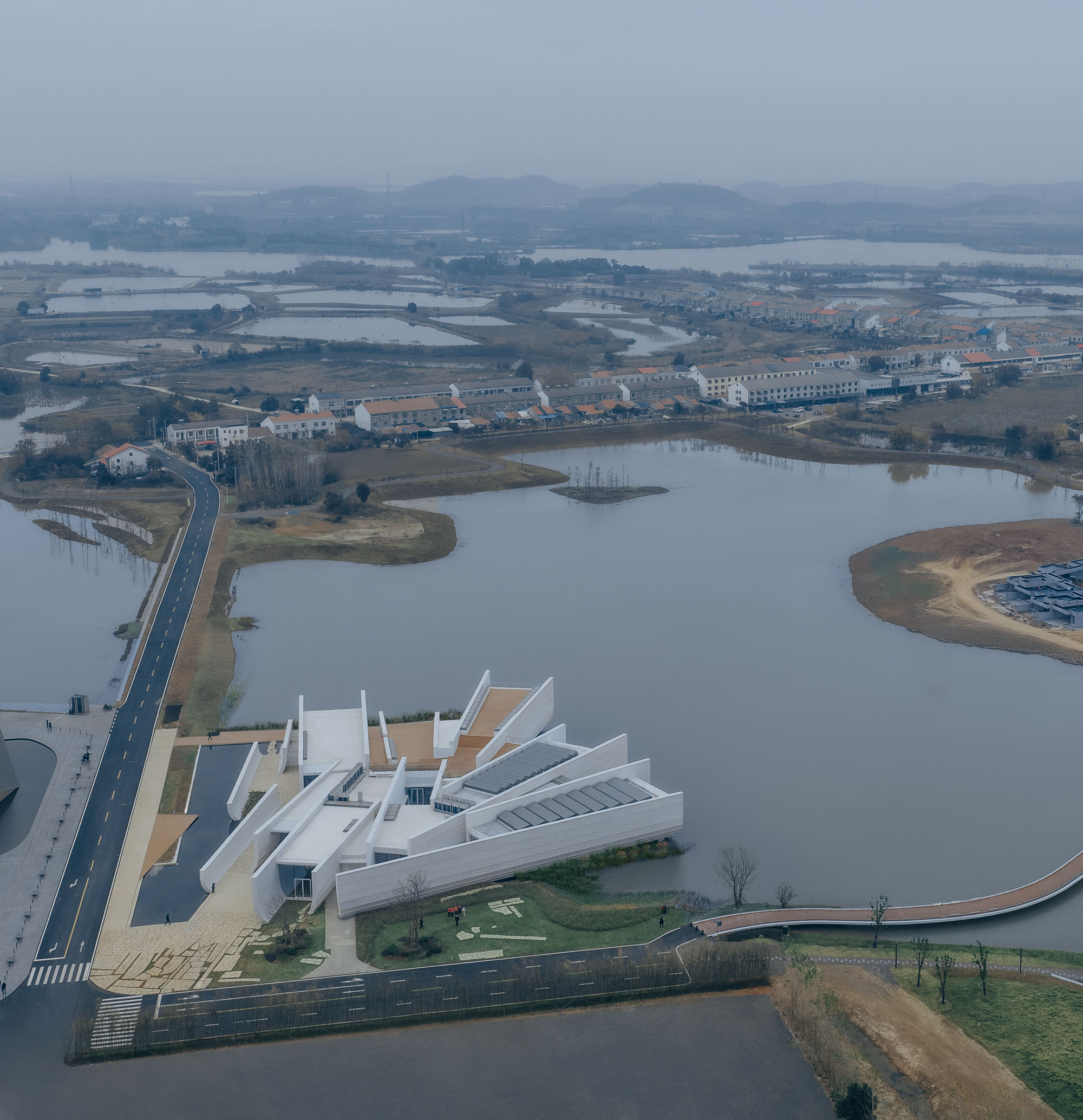
本プロジェクトの敷地は桐湖省級湿地公園に囲まれ、武漢の都心部から車で約1時間ほどの距離に位置している。桐湖地域は広大な土地に対して人口密度が低く、清澄な空気と肥沃な土壌に恵まれている。農地、水域、森林、河岸がそれぞれ景観の約4分の1ずつを占め、自立した環境を形成している。
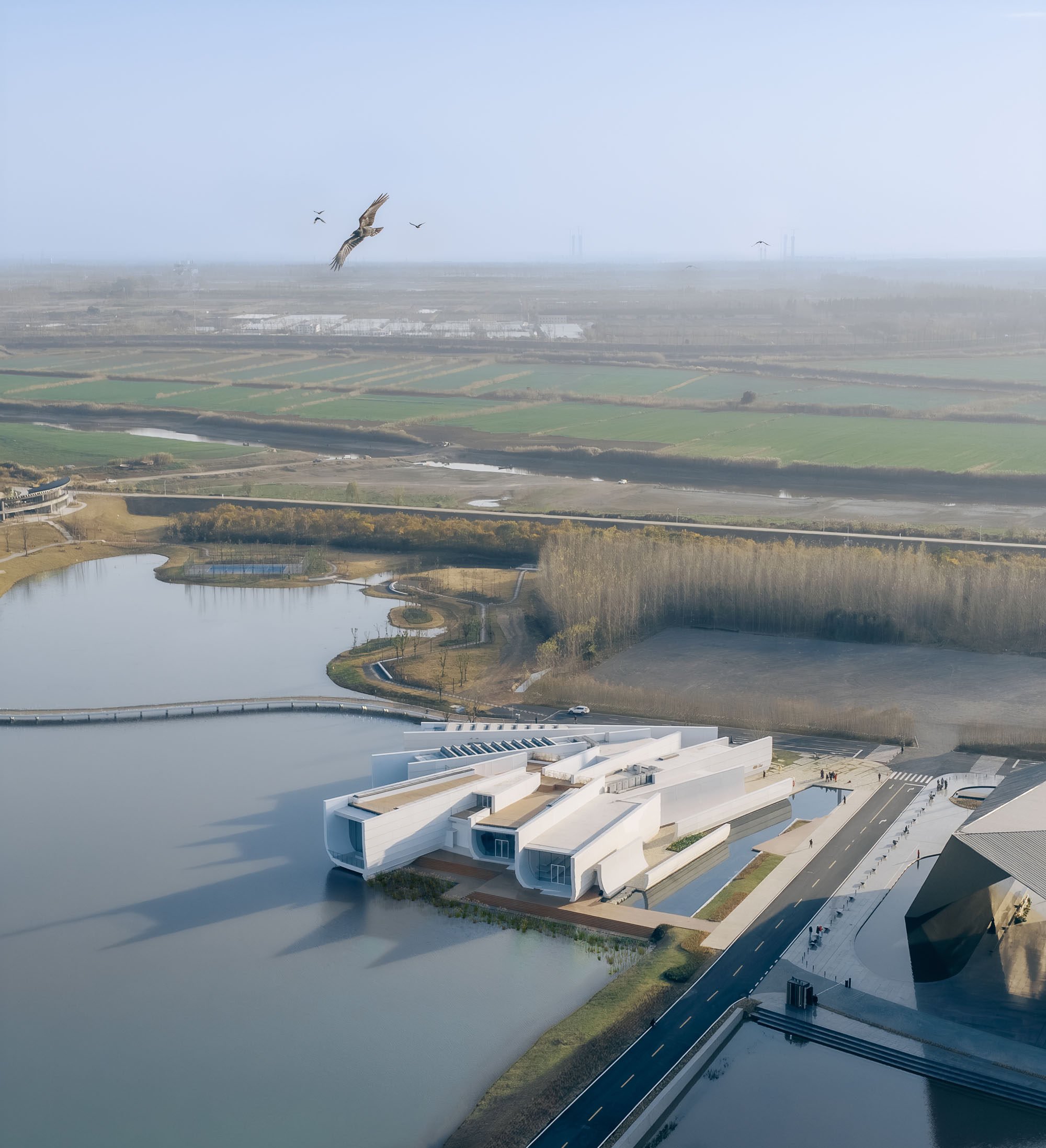
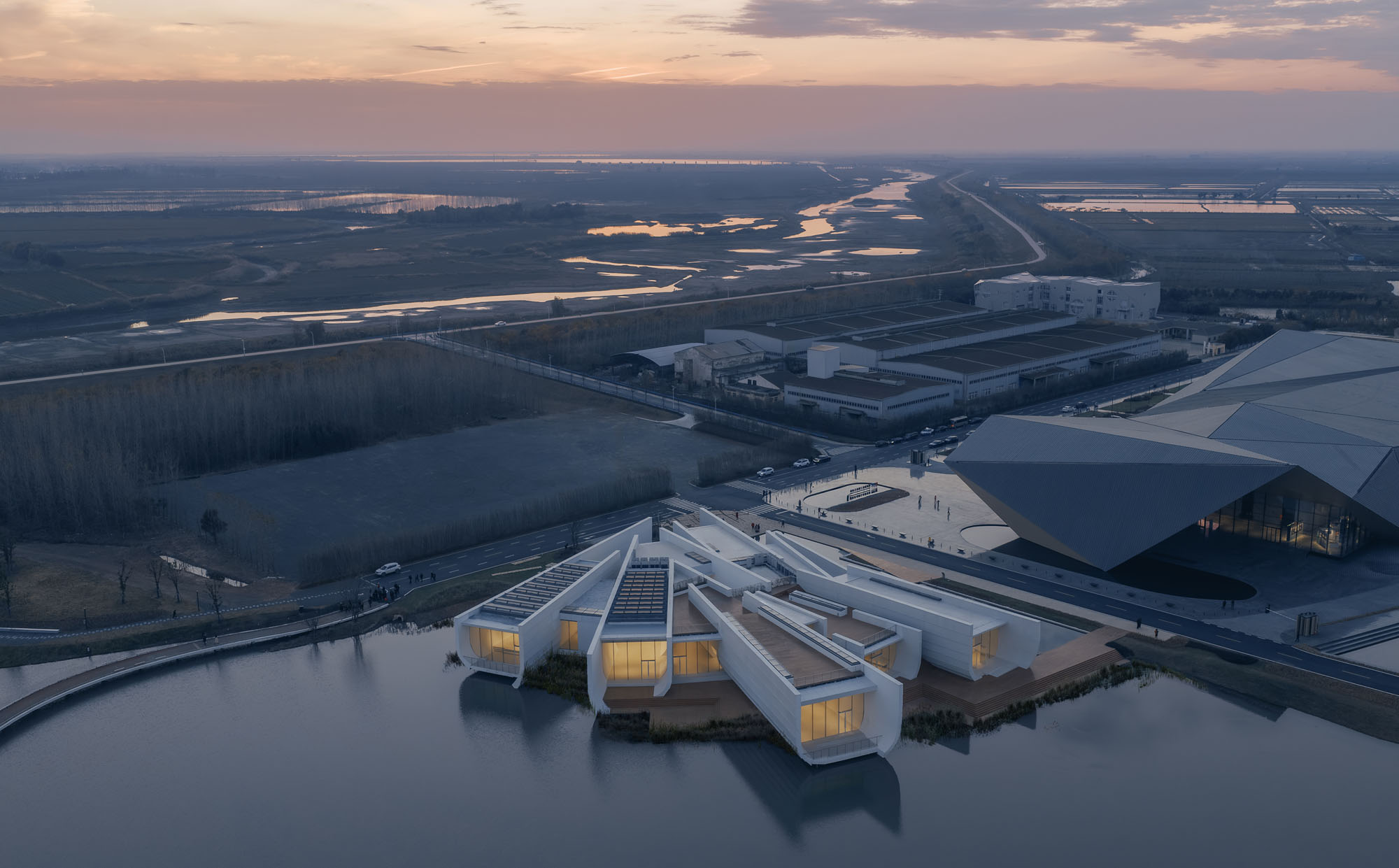
都市の喧騒から遠く離れ、広大な田園地帯にひっそりと佇むこの敷地は、湖と森に包まれている。建物は、自然の湖岸と人工の道路の分岐点が交わる、三角形の細長い土地に配置されている。ここは、風と水が長い年月をかけて、なだらかな地形と蛇行する水辺を形づくってきた場所である。
©︎ Yumeng Zhu
©︎ Yumeng Zhu
空間形成の原動力としての「壁」への探求
2017年、私たちは「壁」という生成的な要素がもつ建築的な潜在能力を探求する過程で、「ウォール・ミュージアム」という概念を構想した。
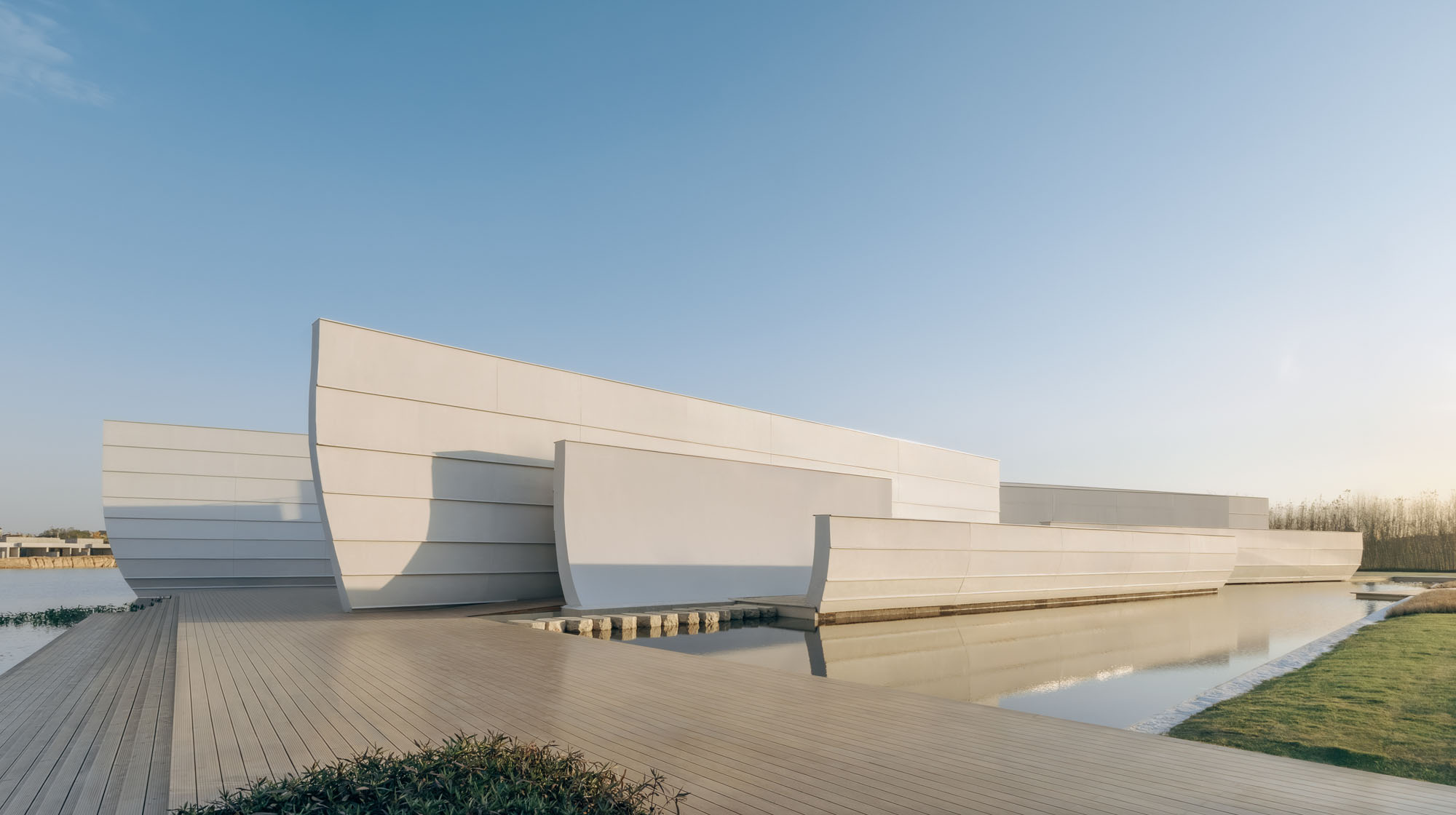
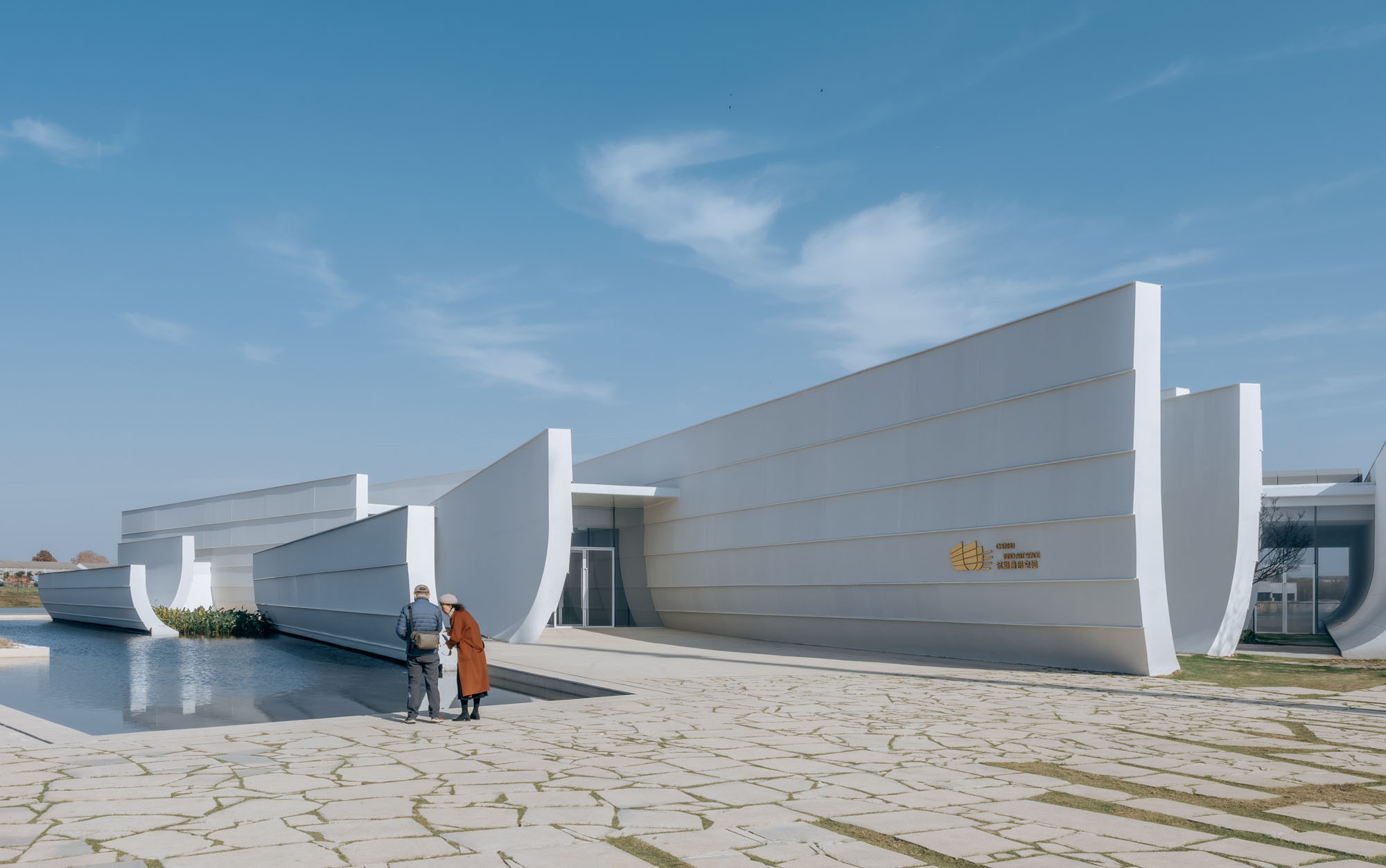
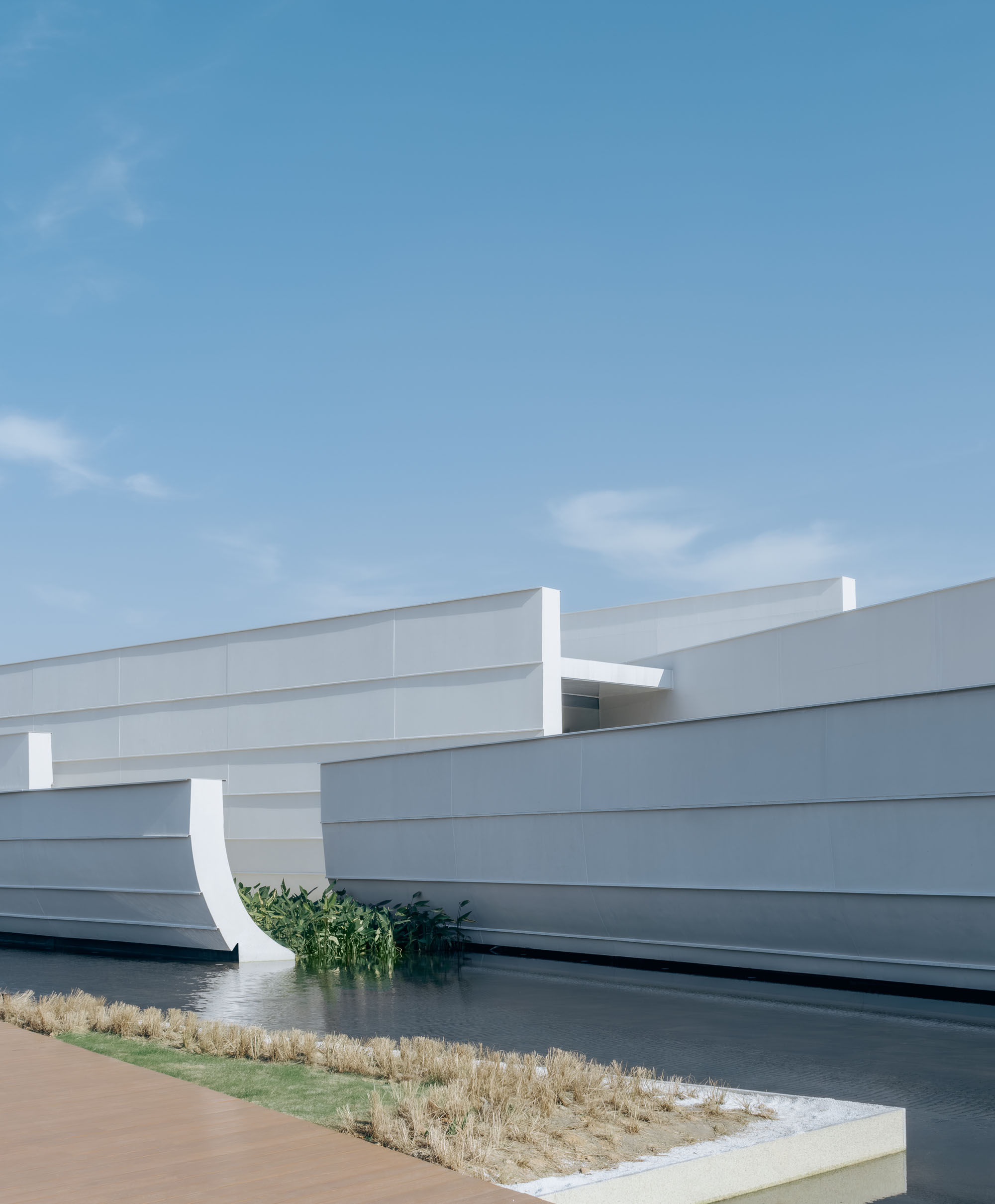
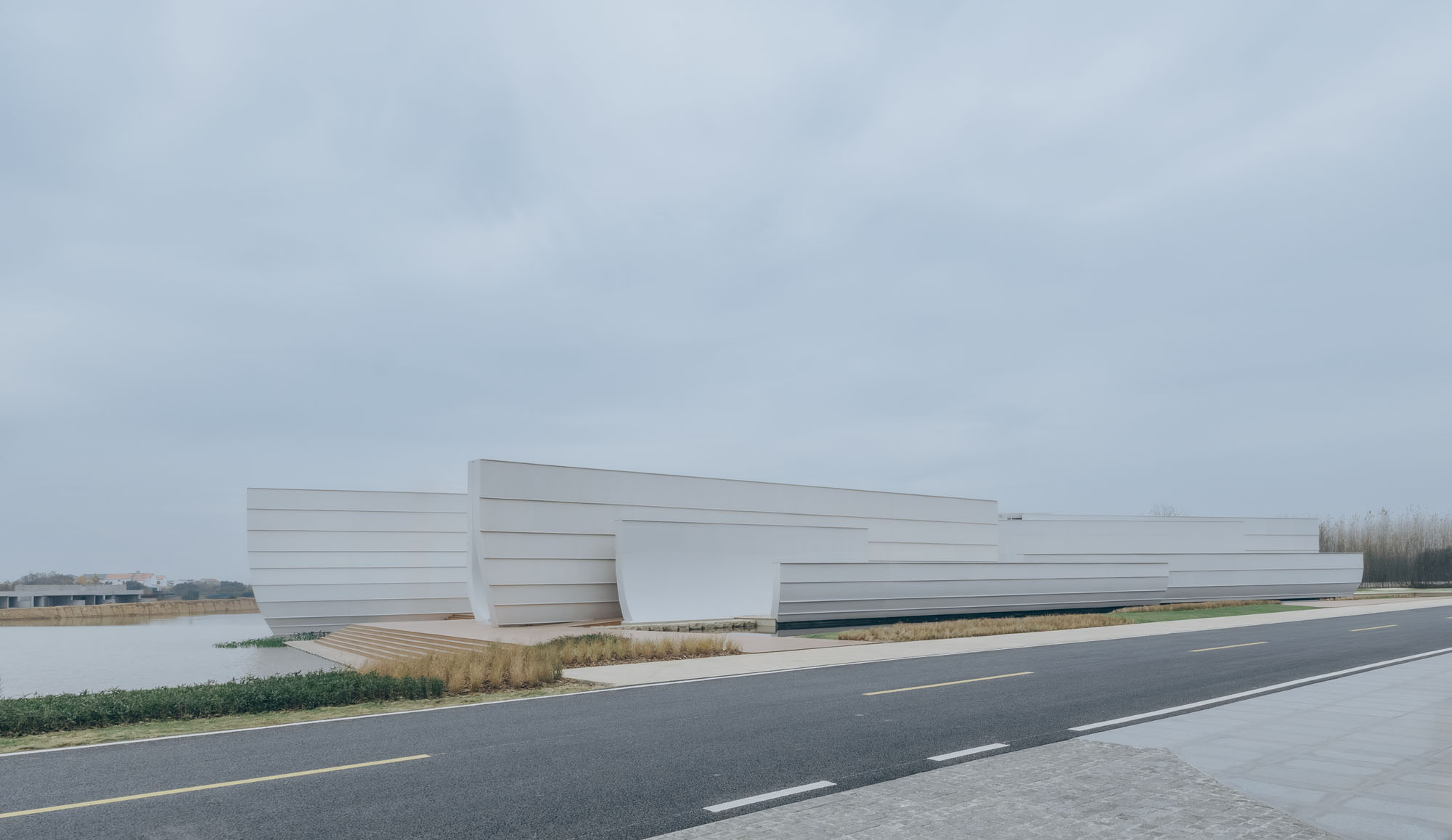
このプロジェクトにおいて、空間形成の唯一の原動力となるのは壁である。壁が上に向かって厚みを増していくにつれ、屋根は徐々にその存在を消し、光が差し込む壁面の隙間へと変化していく。その建物は、広大な景観のなかに点在する廃墟のように見え、根源的な重みや地殻のような堅固さを喚起する。
今回のプロジェクトが位置する「干潟」という独特な立地は、壁がいかにして空間的な関係を再構築し、敷地との確固たる結びつきを表現し得るのかを、私たちに改めて問いかけている。本プロジェクトは、こうした自然条件から生み出されたものである。
©︎ Yumeng Zhu
©︎ Yumeng Zhu
「水の記憶」を宿す、水面と連続する造形
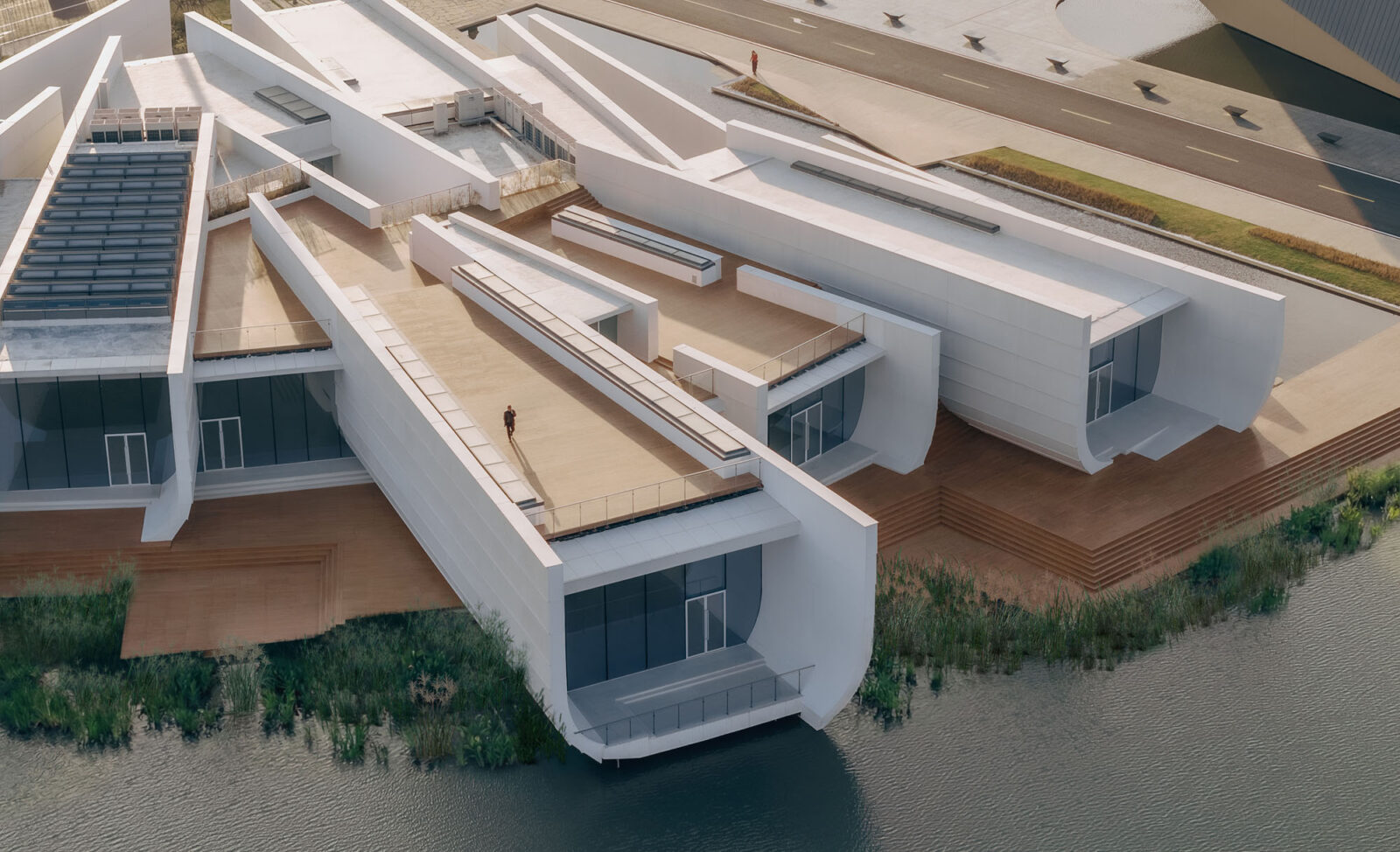
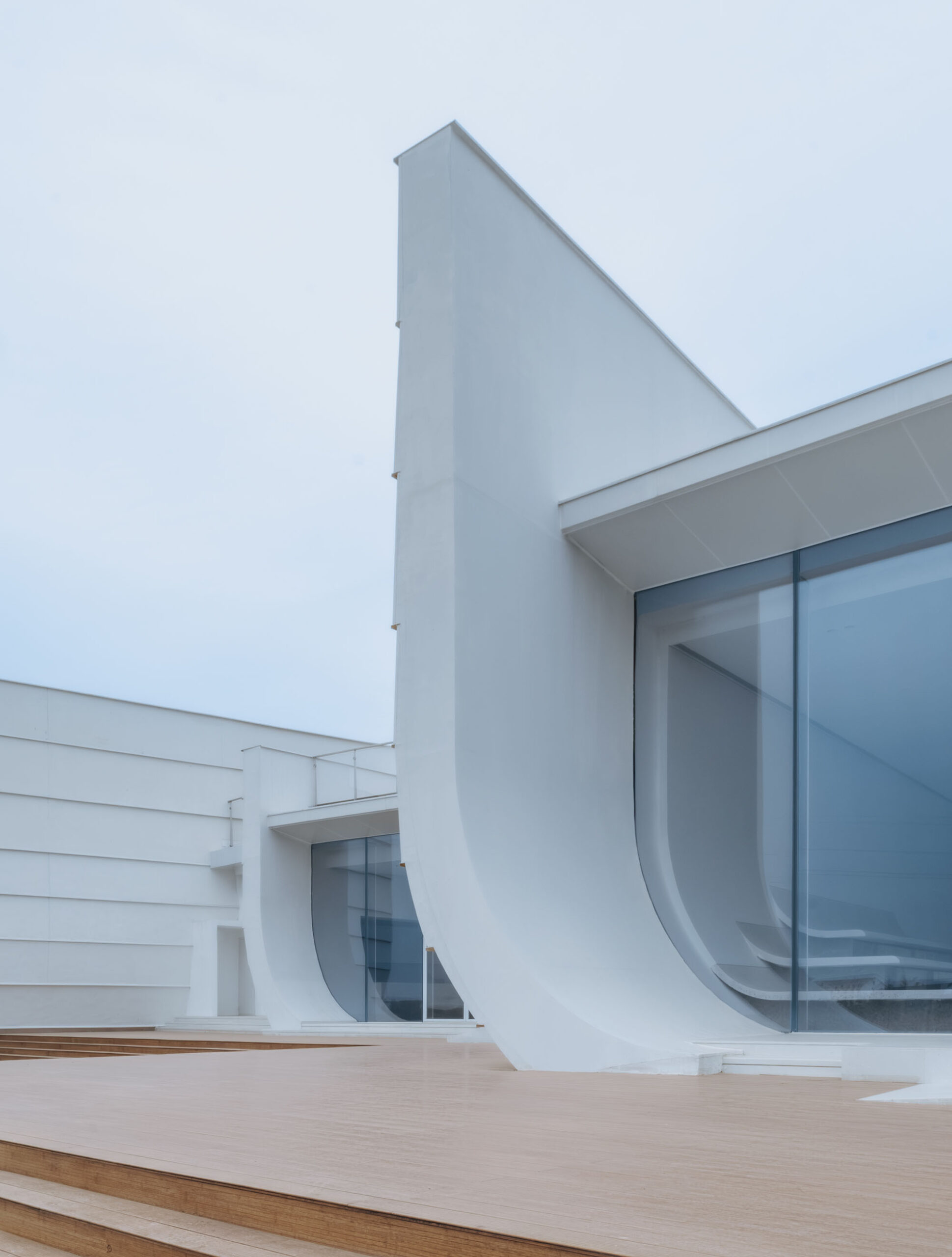
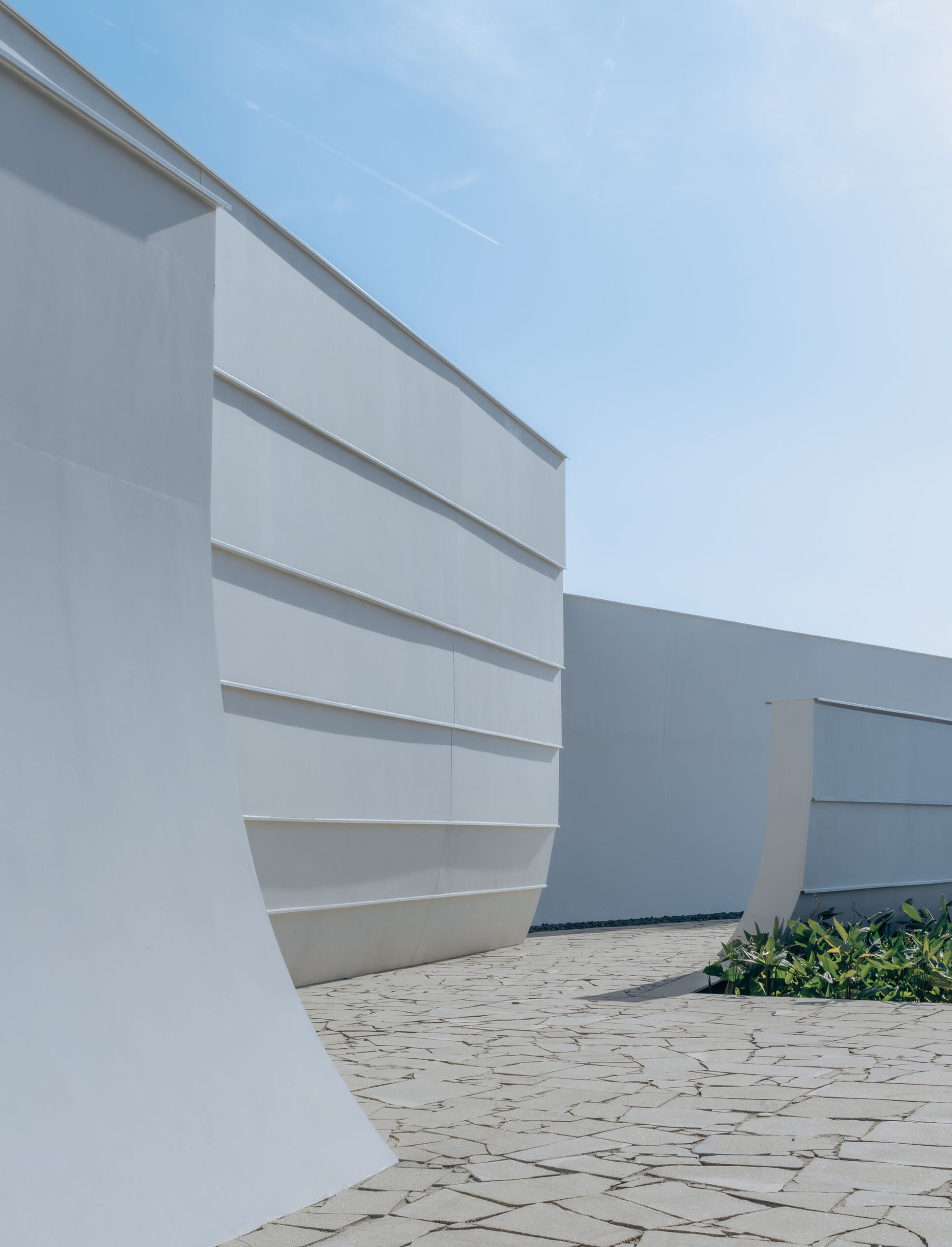
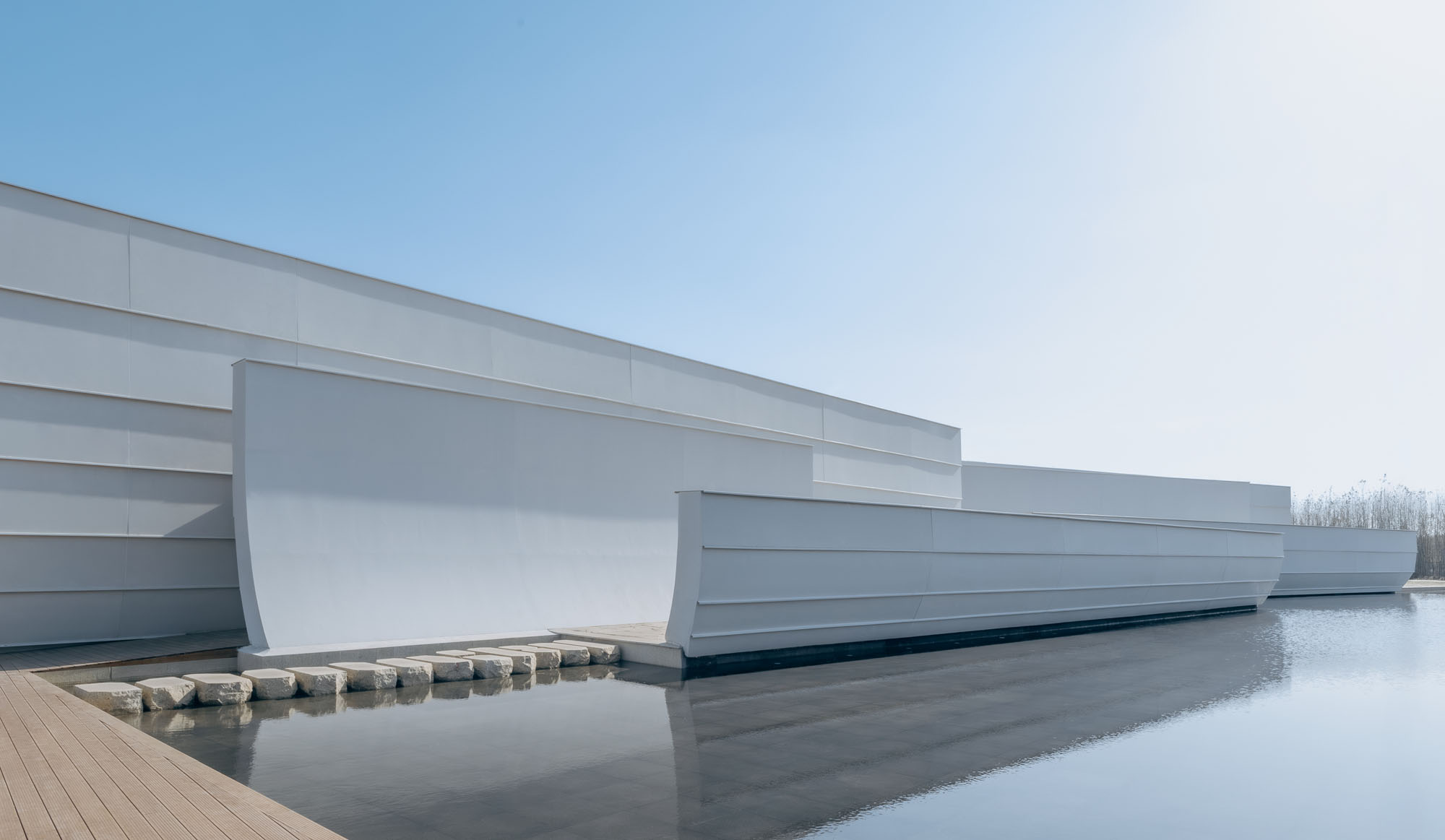
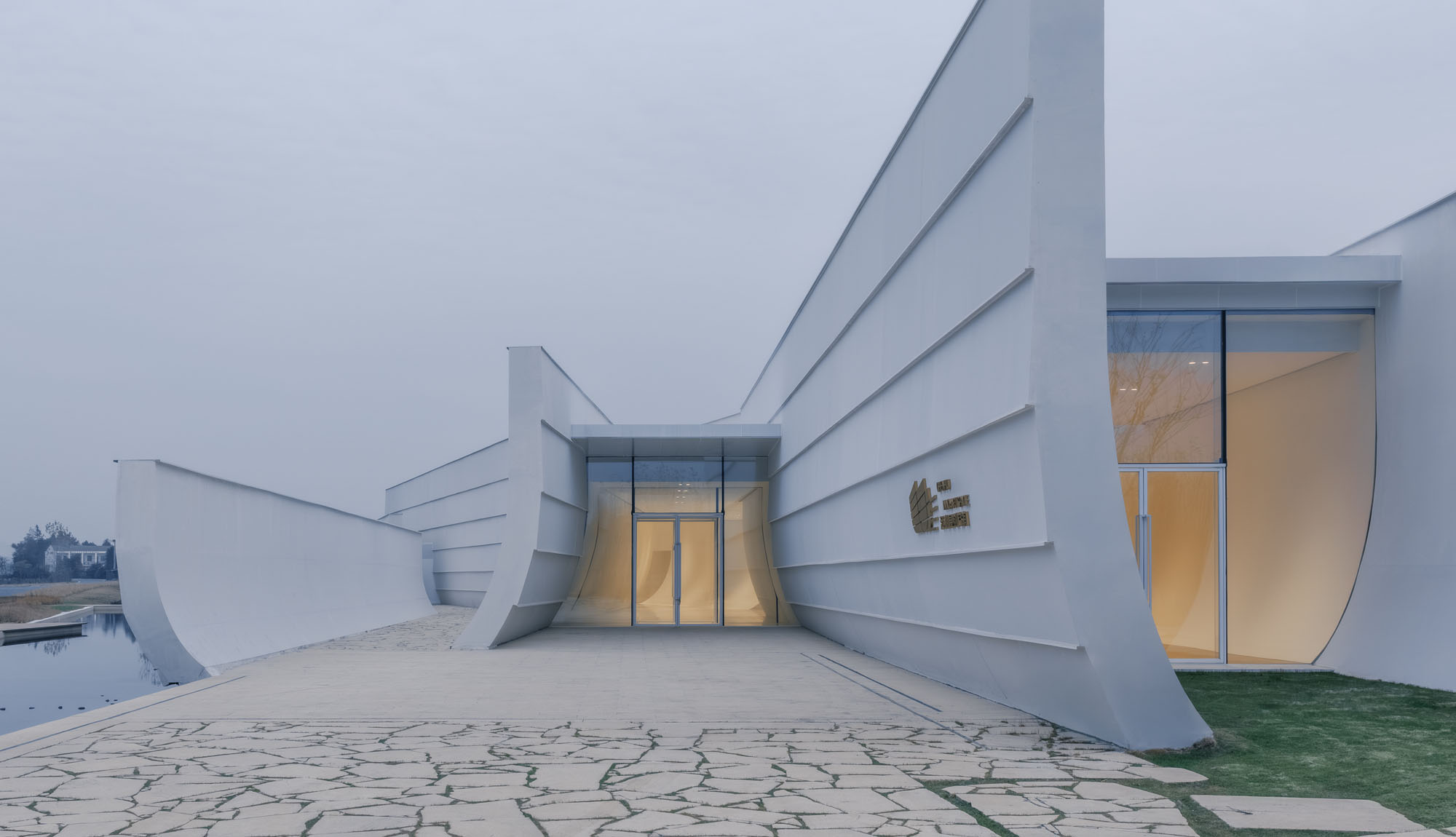
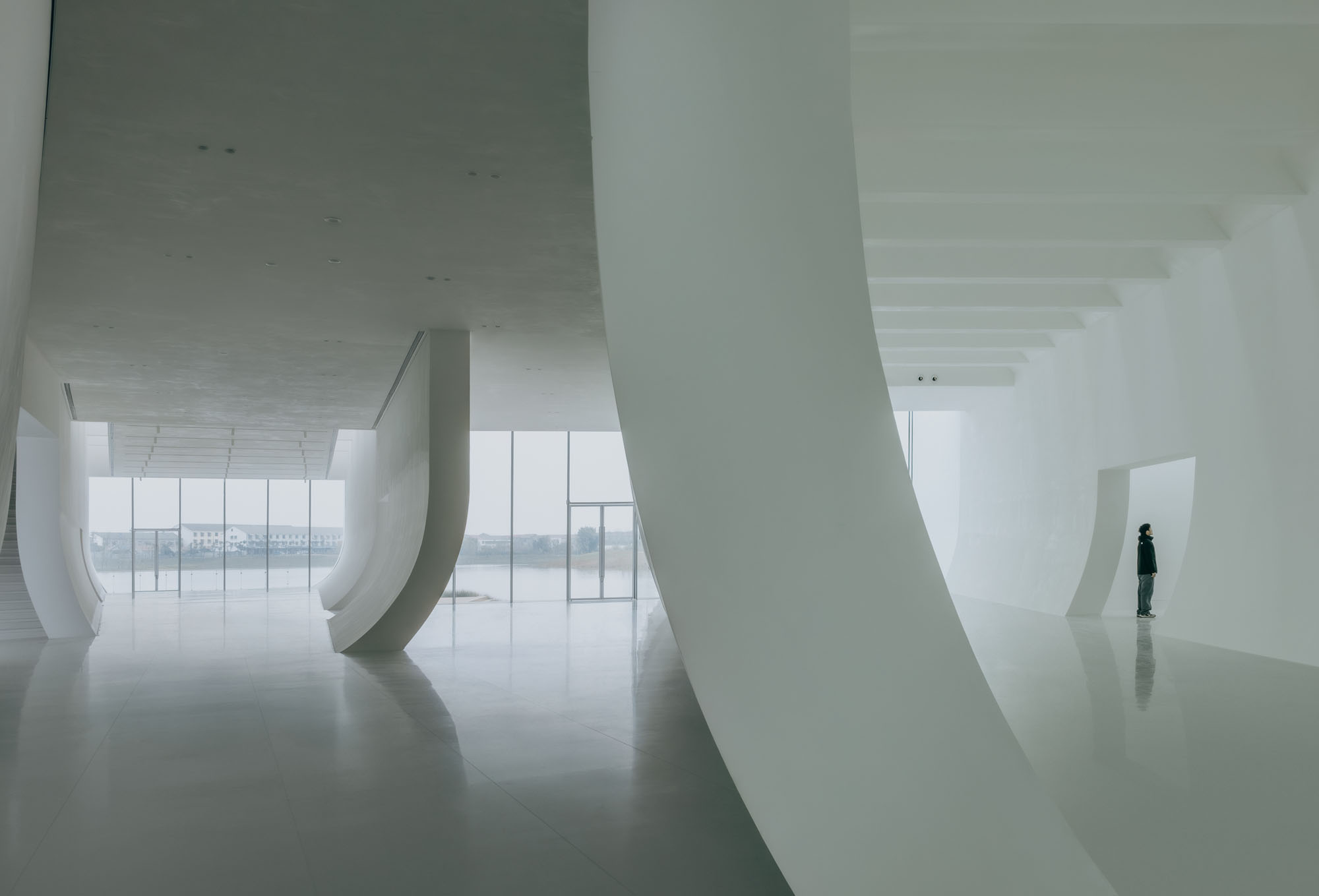
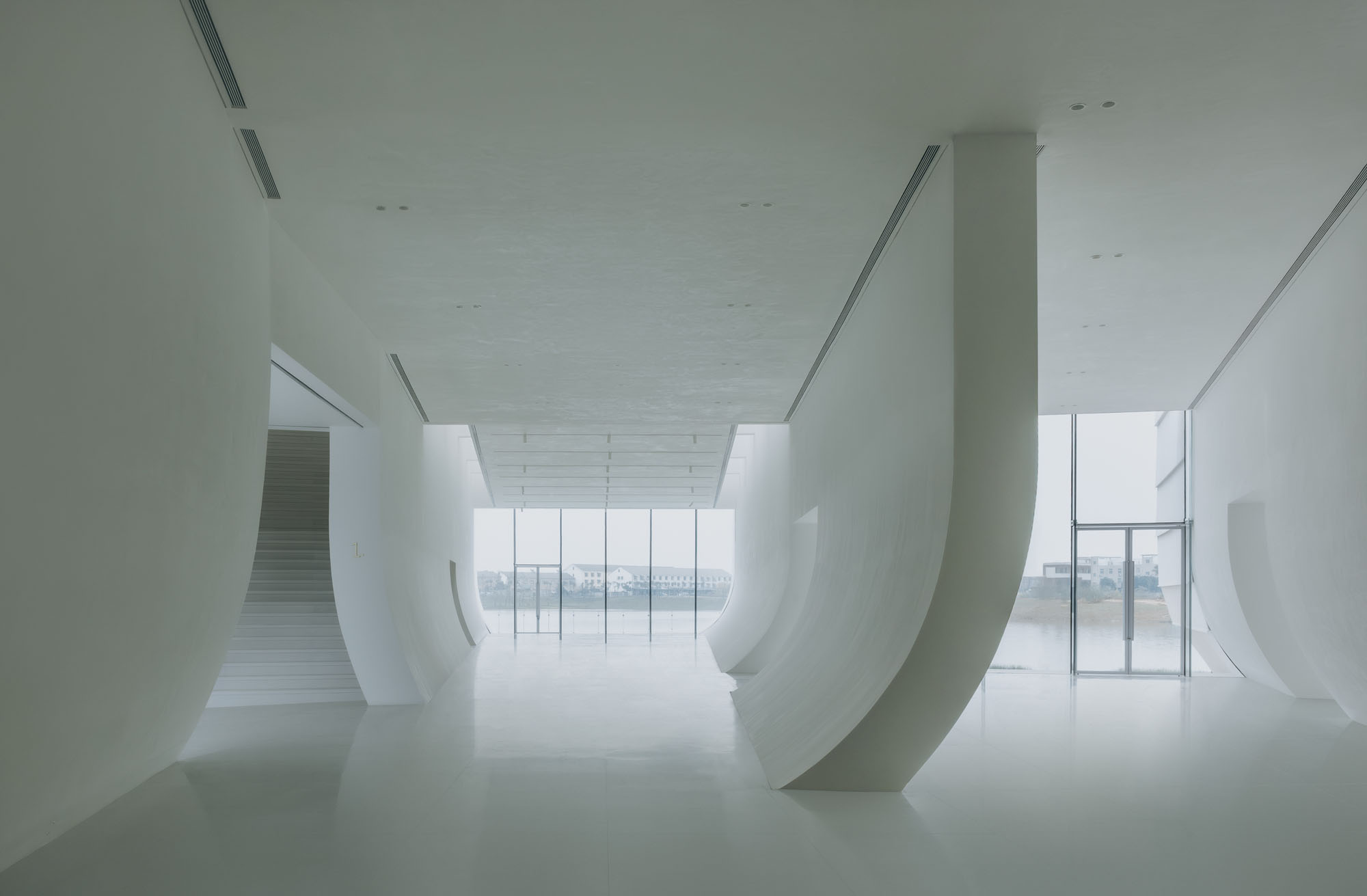
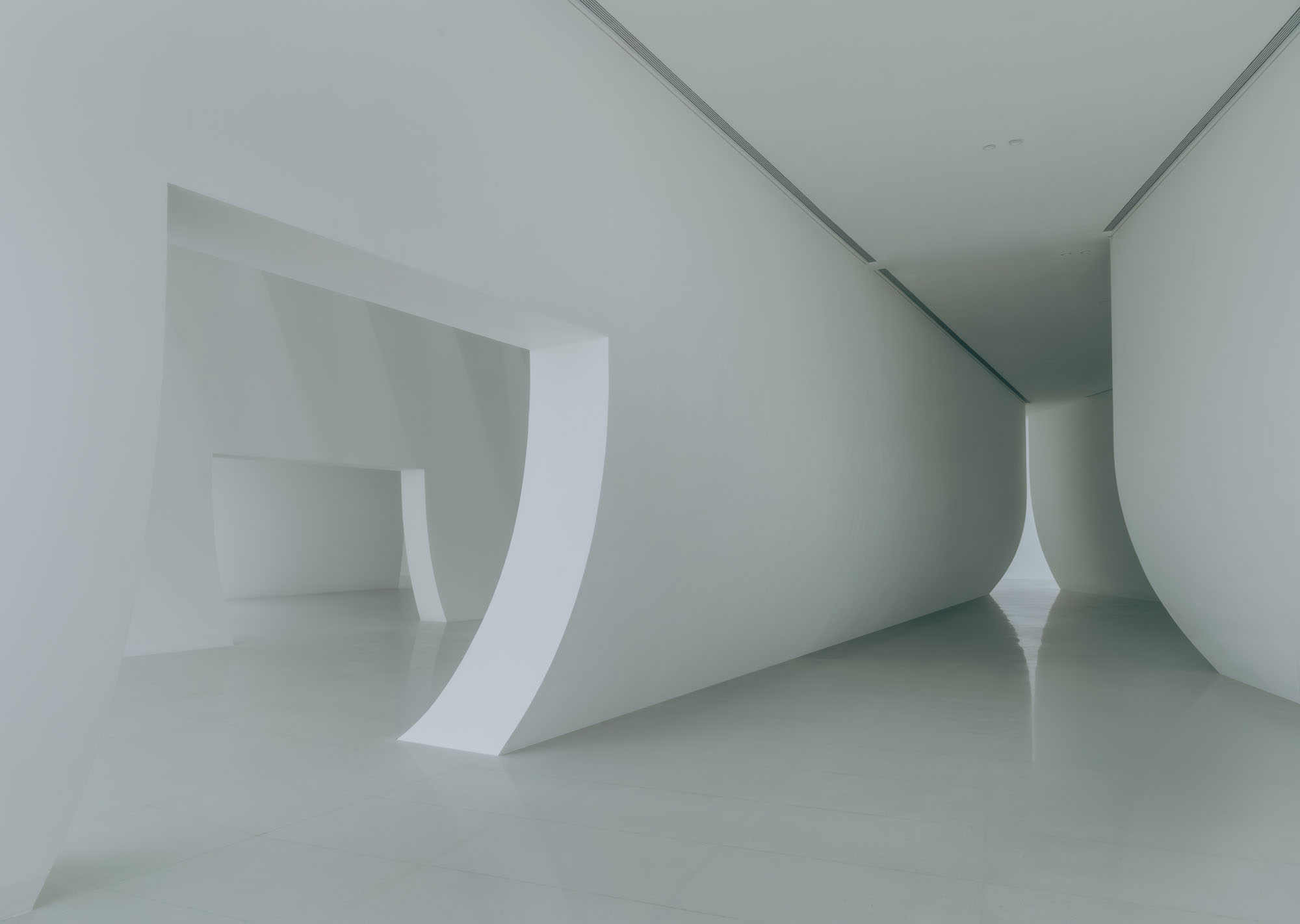
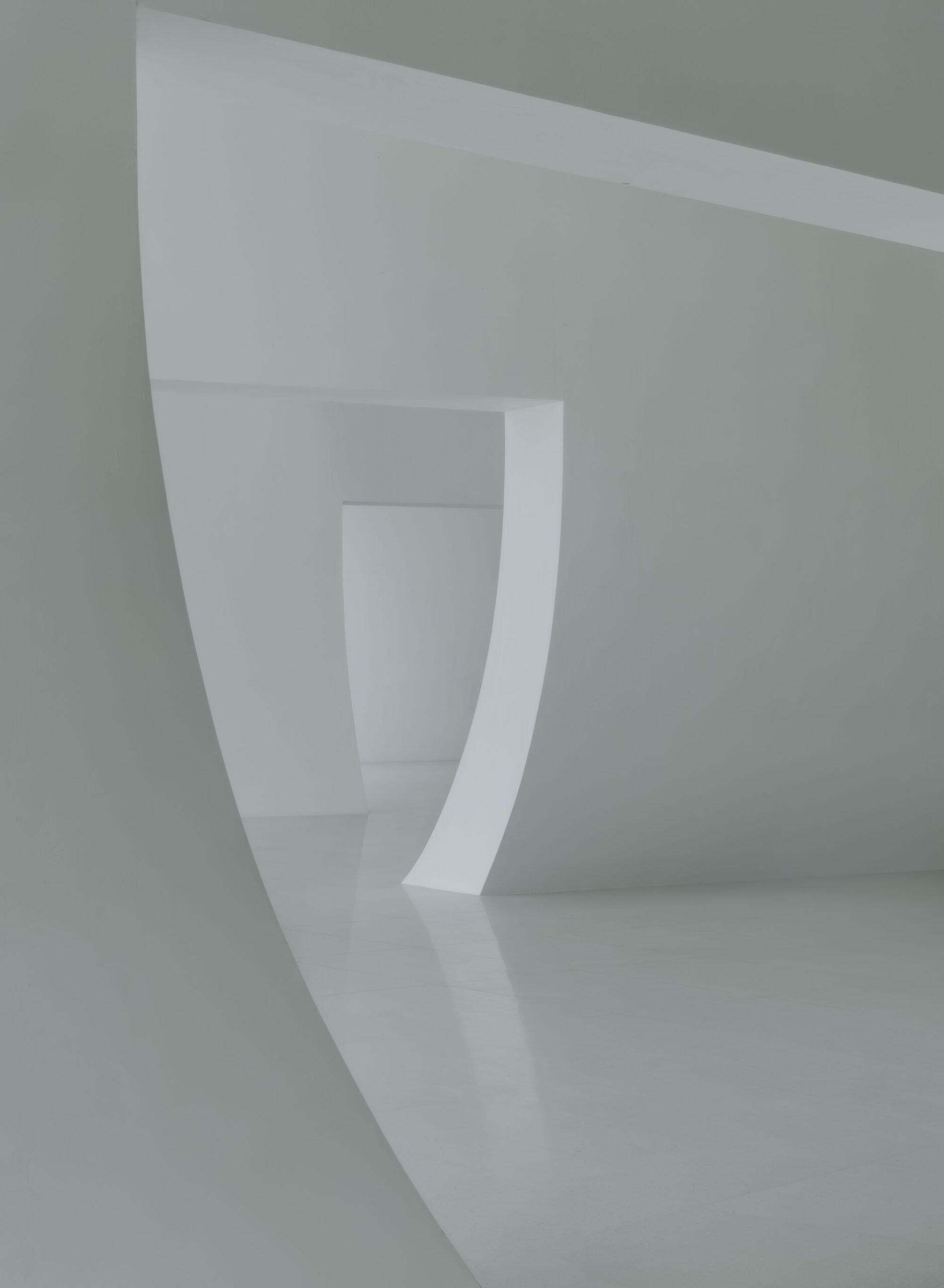
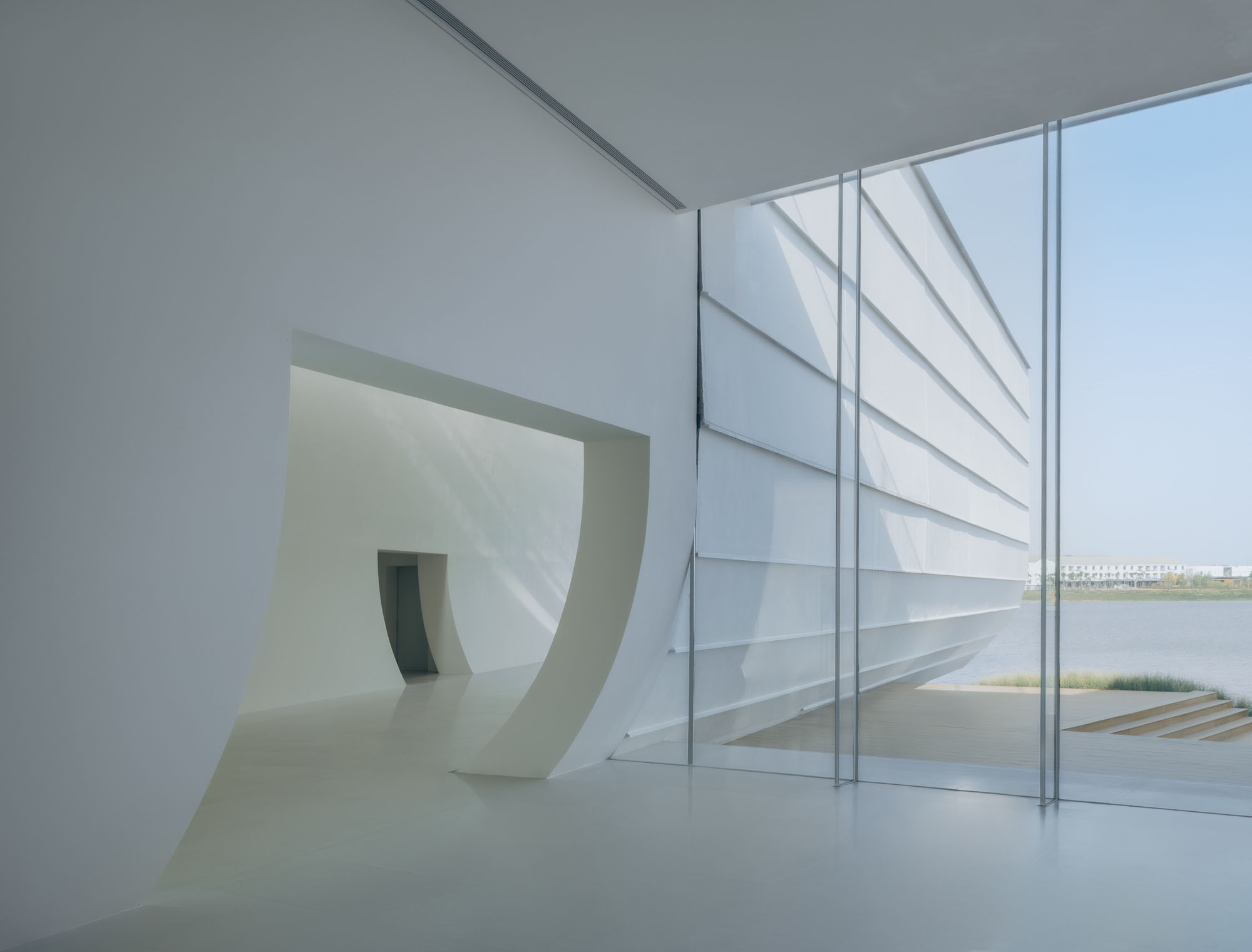
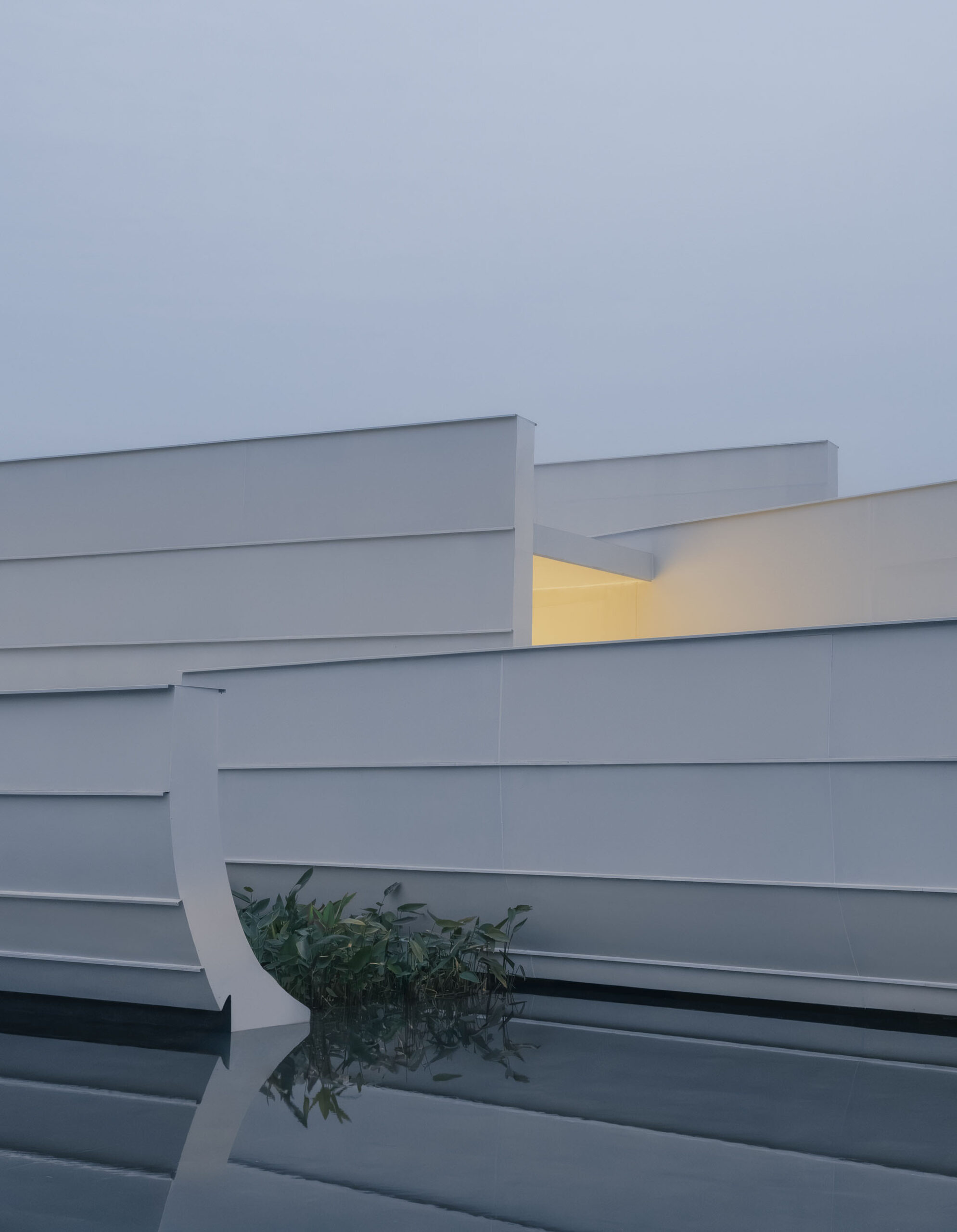
湾曲した下部の壁は、単なる抽象的な造形ではなく、水の浮力に対する応答である。それらは水際に沿ってわずかに起伏し、まるで水流によって押し上げられ、浸され、形づくられているかのようである。建築と水とを隔てる明確な境界線は存在しない。
湾曲した壁の基部は水面を優しく撫で、地平線上に独特の反射を生み出しながら、建物が湿地の景観の一部となることを可能にしている。この「湾曲」という操作は、造形言語であると同時に時間的な表現でもあり、水が大地を擦り、浸透していく際の動きを記録している。こうして建築は、「水の記憶」を宿す器となるのである。
©︎ Yumeng Zhu
©︎ Yumeng Zhu
既存の枠組みを超える「ウォール・ミュージアム」
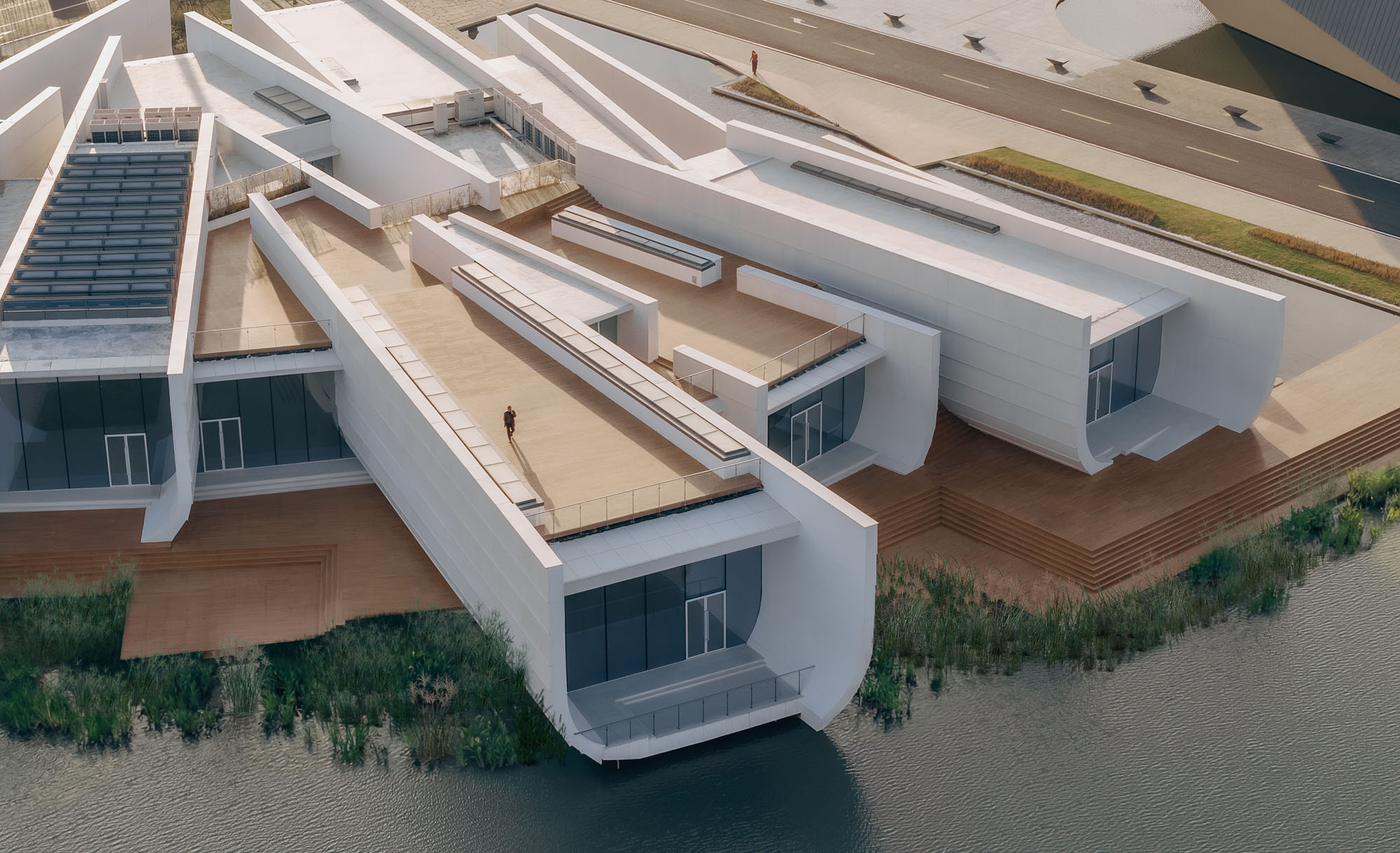
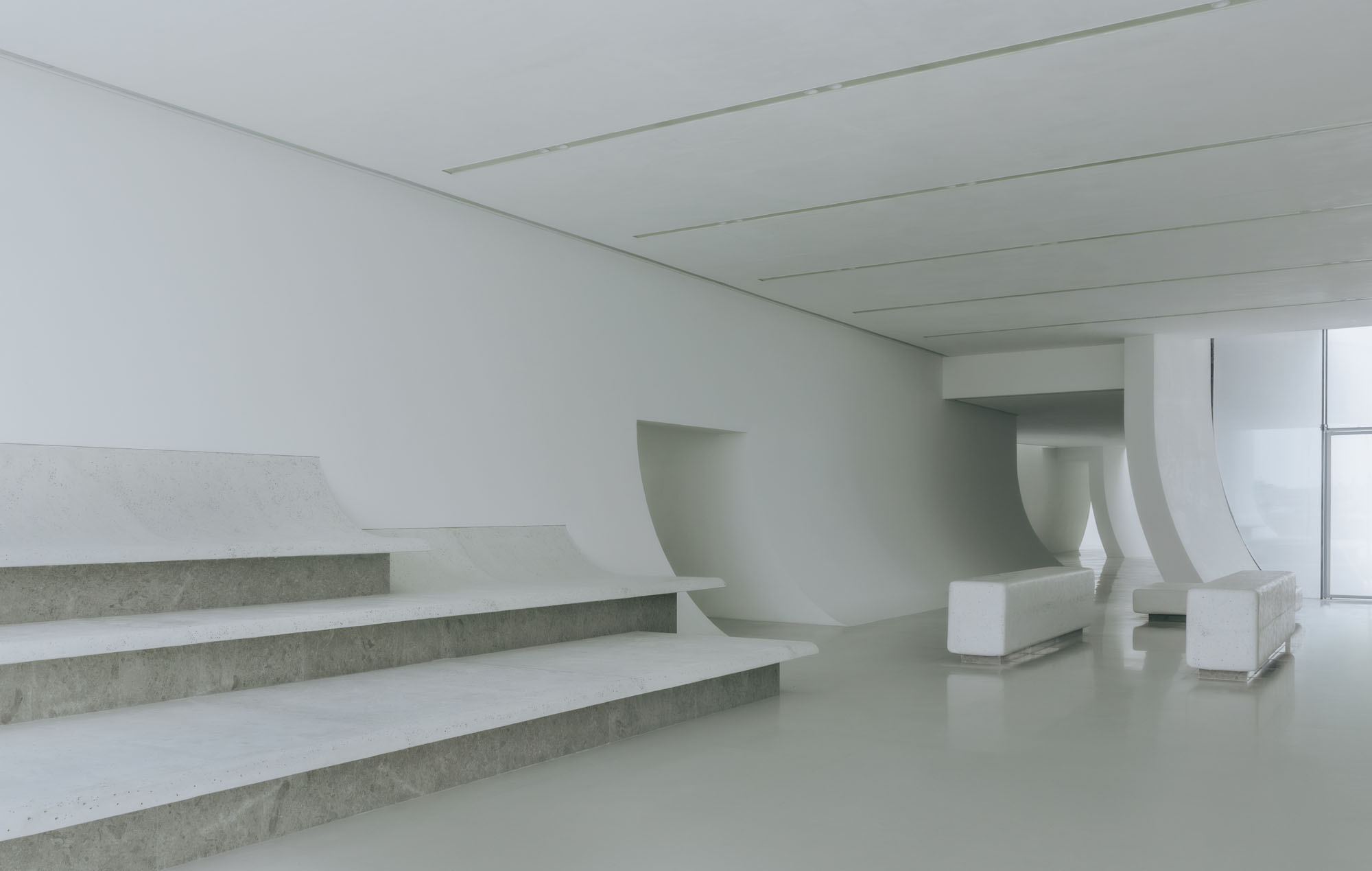
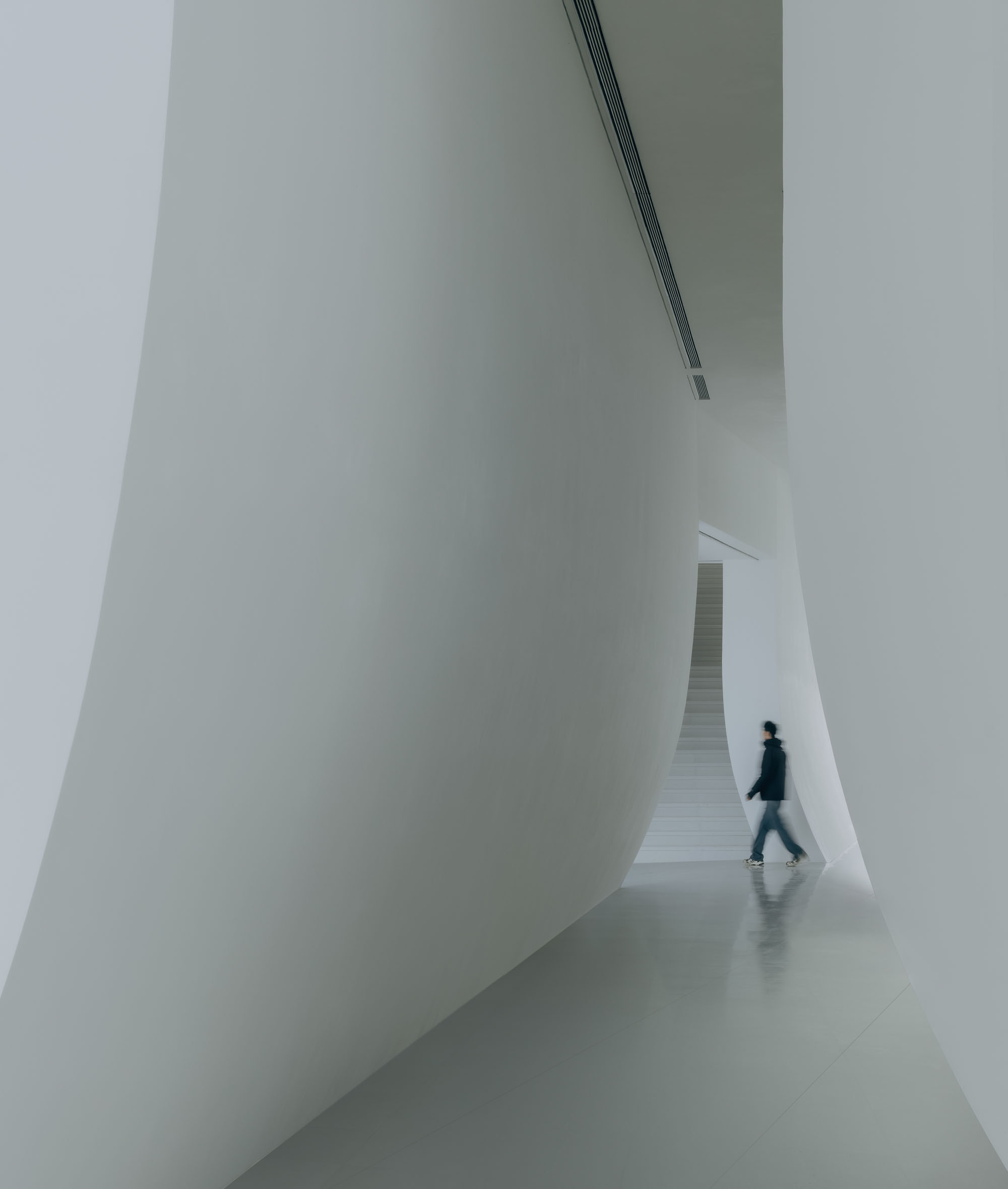
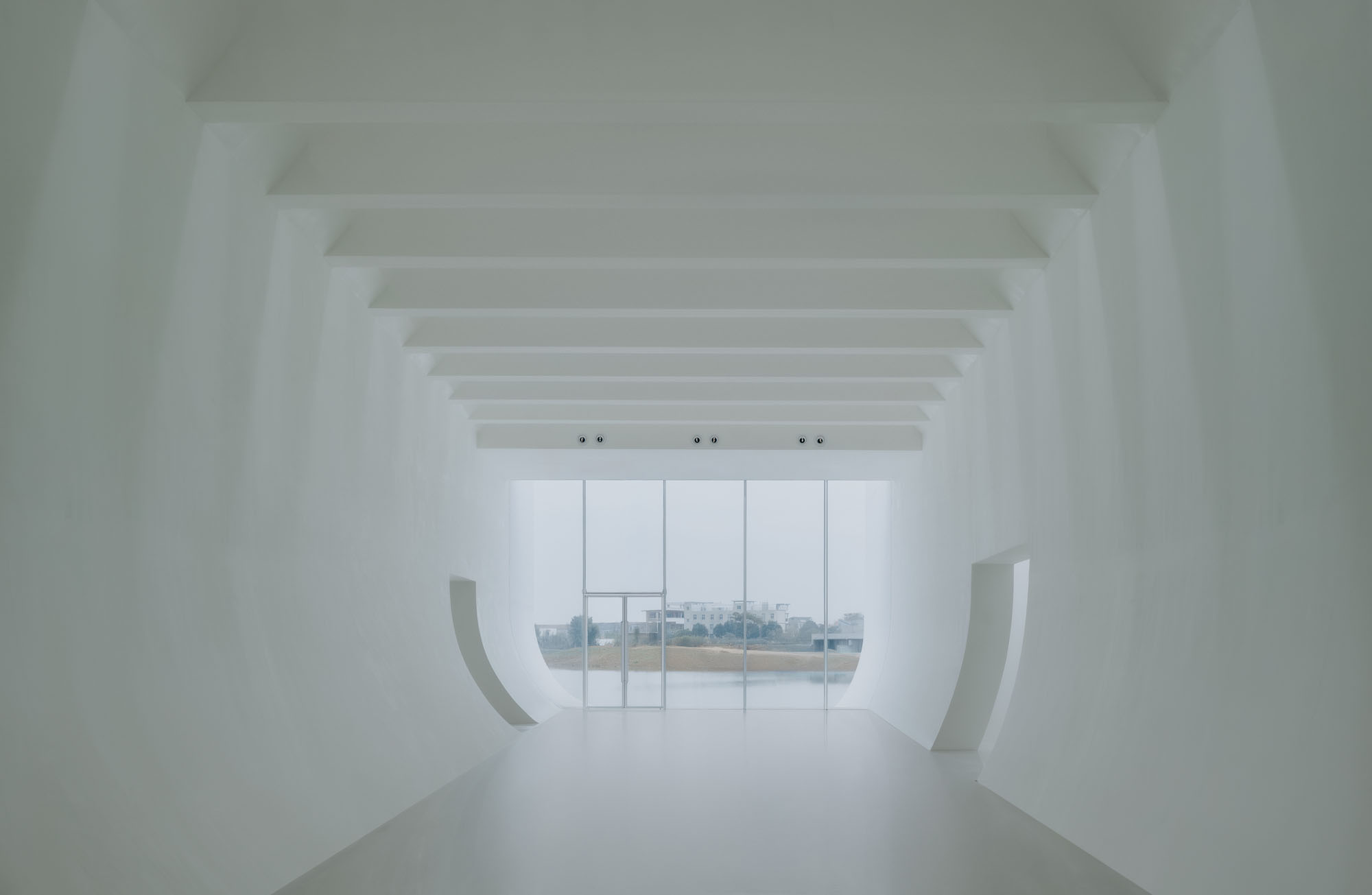
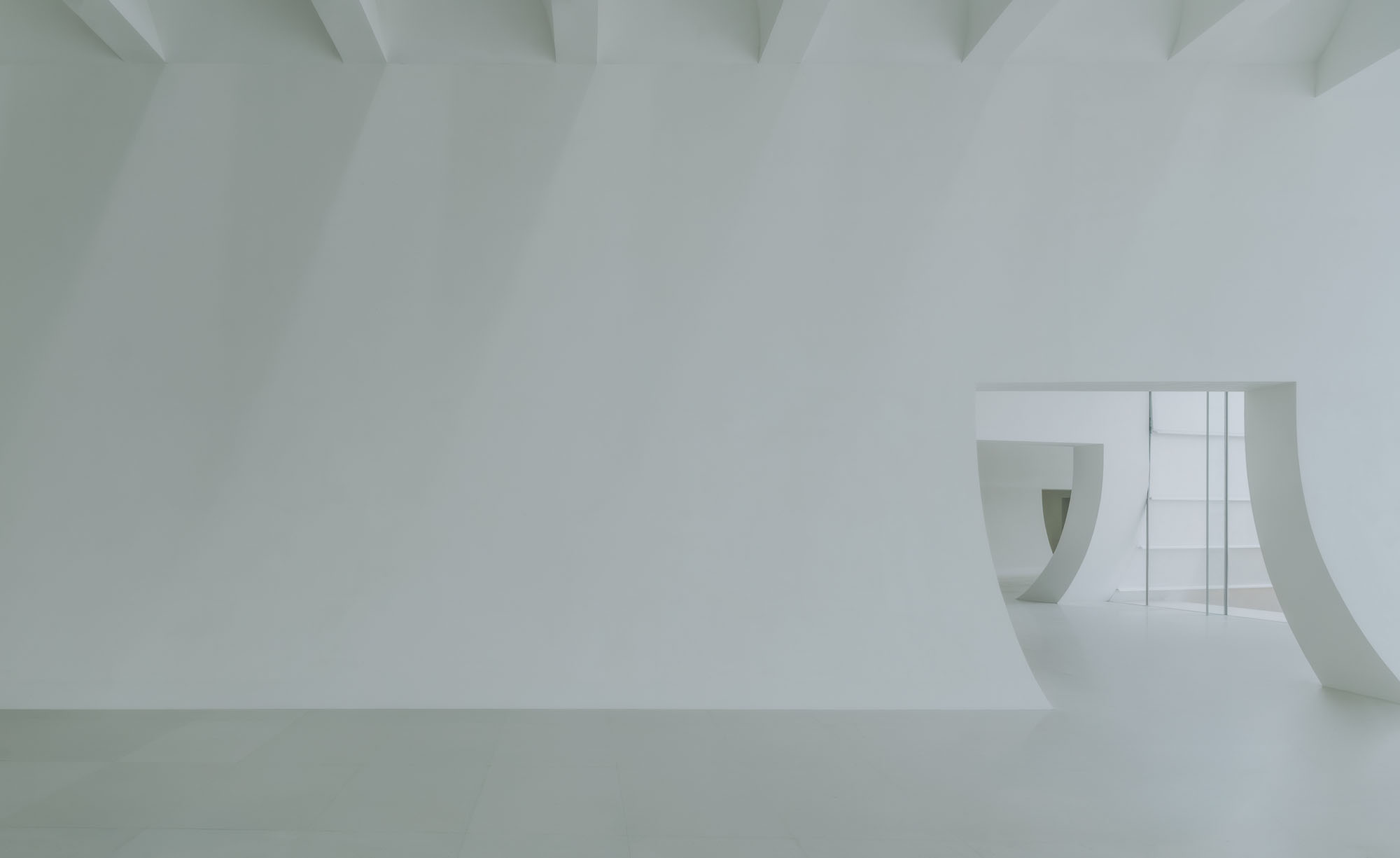
従来の美術館の建築類型においては、屋根が光を取り入れ、壁が展示の背景となり、床が動線を導くのが一般的である。しかしここでは、壁と地面の境界が溶解している。
屋根は壁に貫かれ、天窓が自然光を下へと導く。さらに屋根面は不確定な高さに浮かんでいるように見え、人々の空間知覚を宙吊りにする。これは、まさに壁のみによって定義された美術館である。
©︎ Yumeng Zhu
©︎ Yumeng Zhu
湿地の生態系に呼応する「多孔質な」平面構成
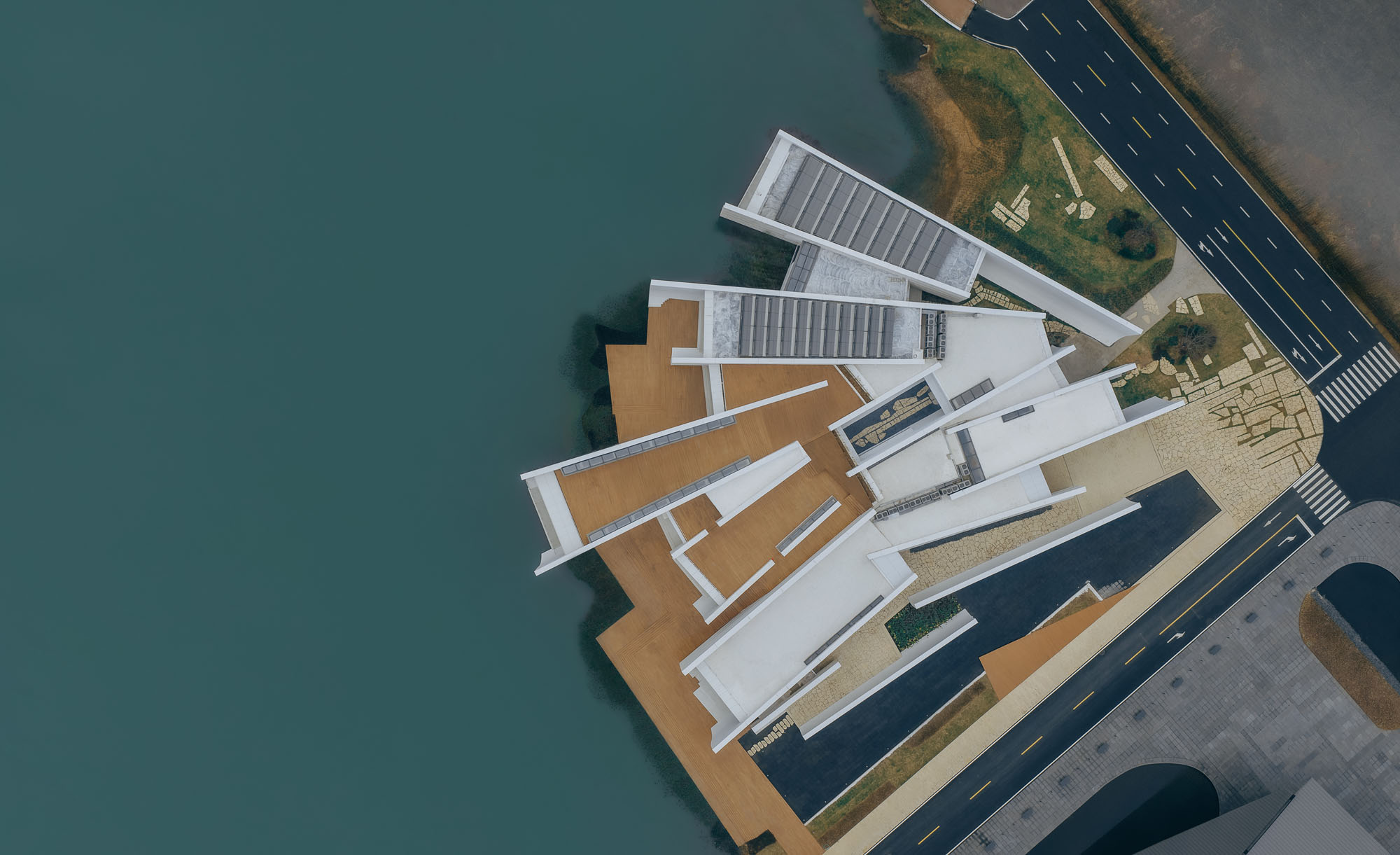
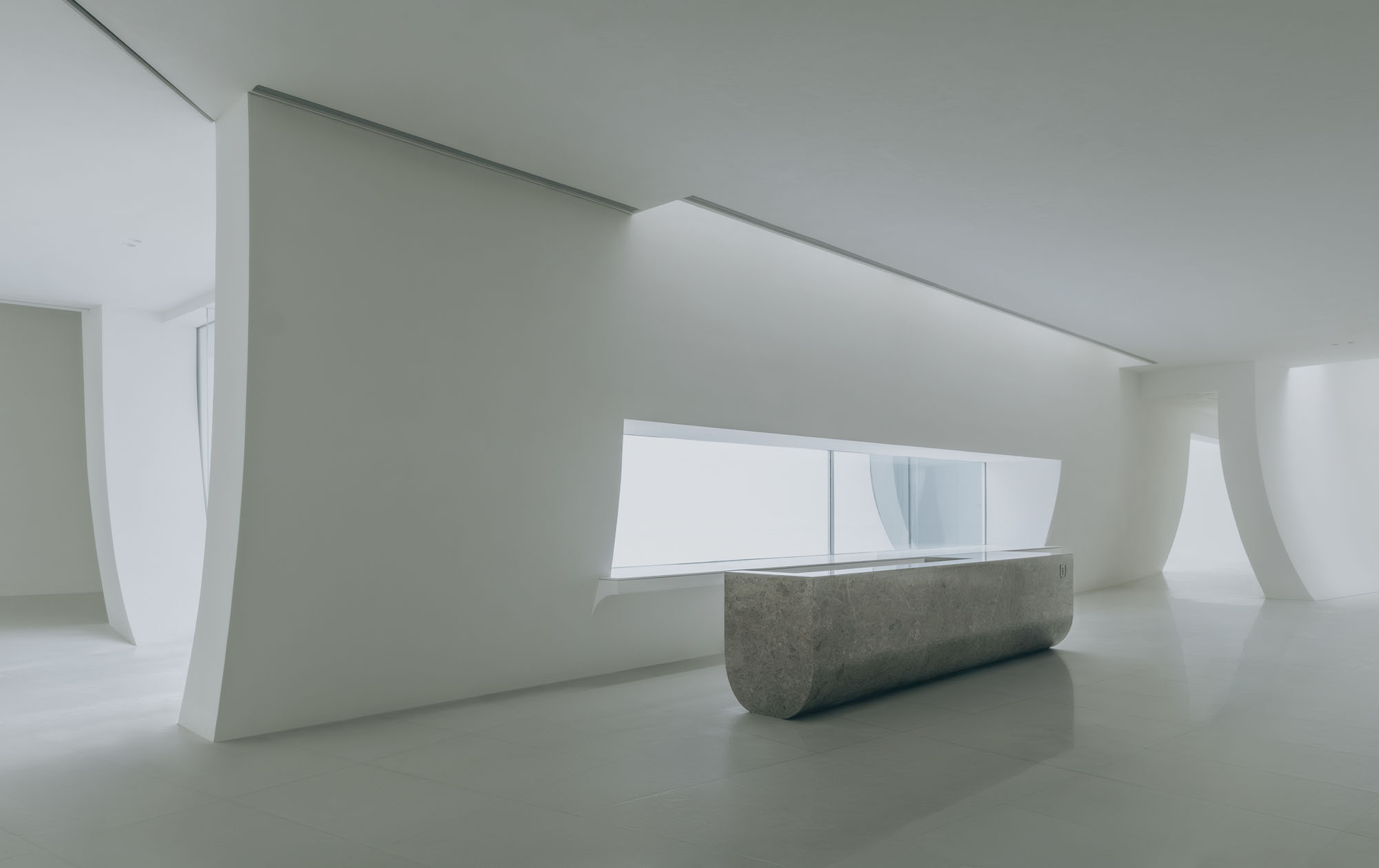
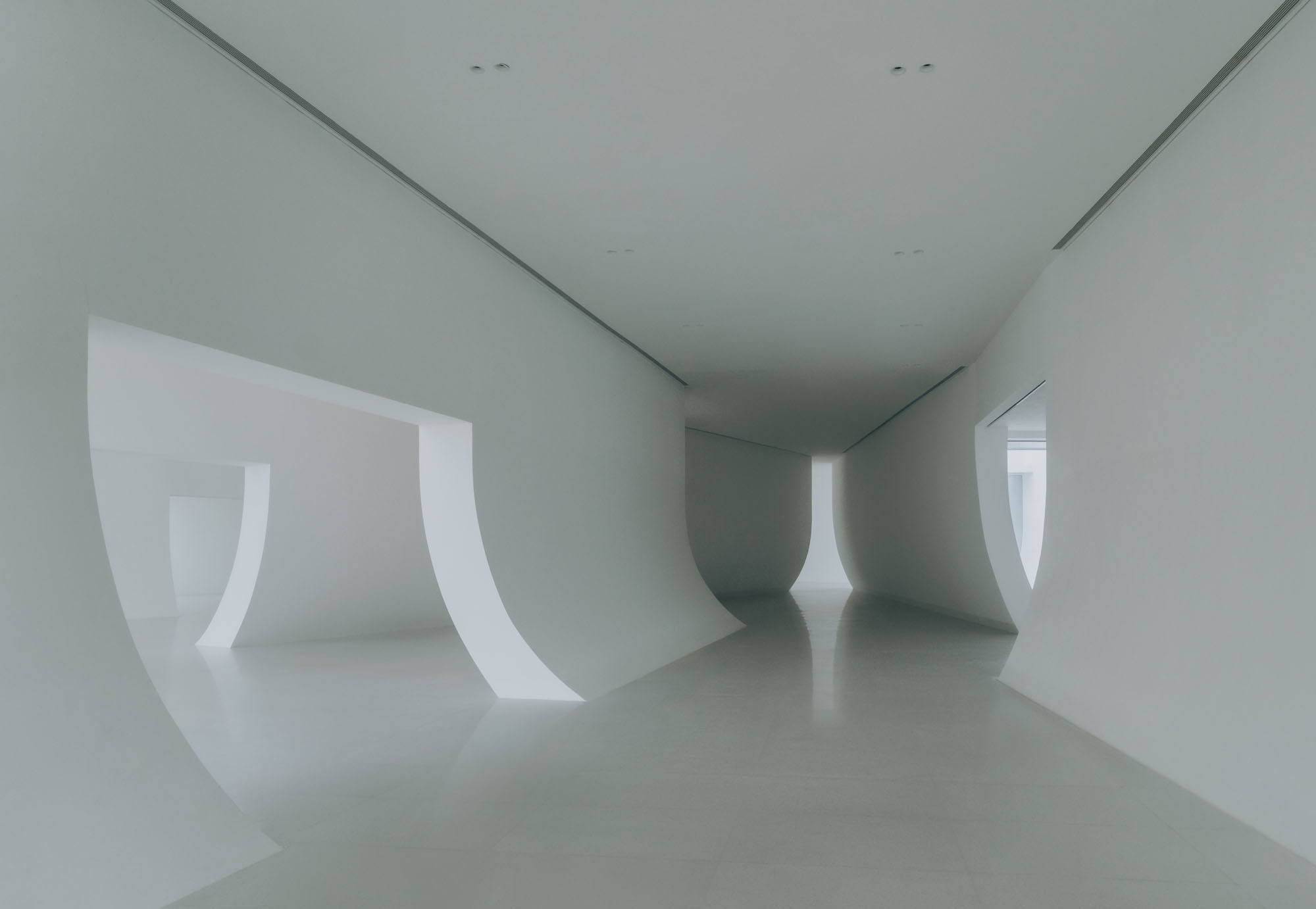
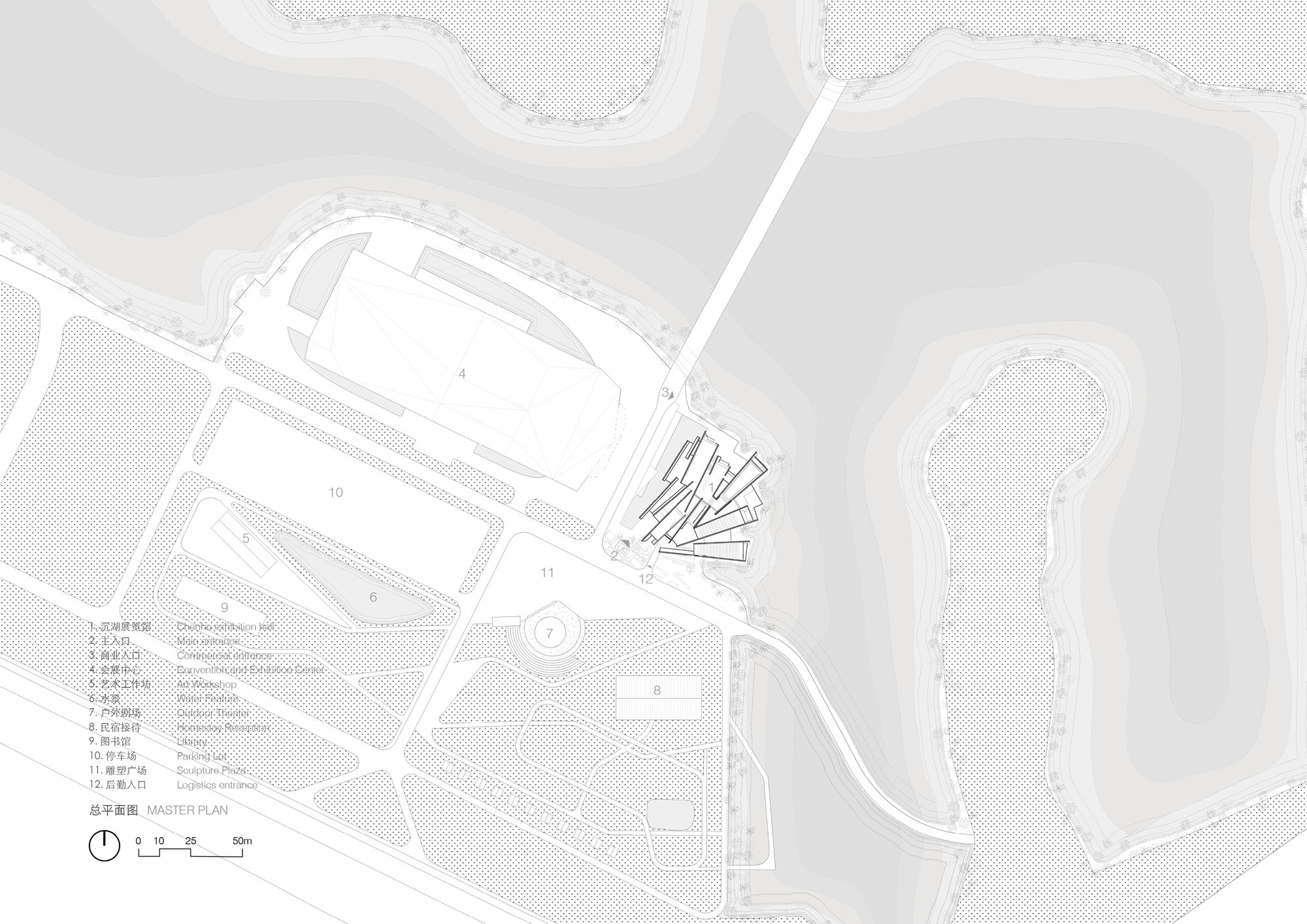
その平面は、連続した囲いではなく、自由に配置された壁によって構成されている。それらの壁は半ば自発的に現れたかのように見えつつも、都市形態のもつ密度と、開放的な水辺の緩やかさとの間を調停している。
上空から見下ろすと、その構成は岸辺に沿って浮かぶ有機的な生命体のようである。分散していながらも統一感をもち、人工的でありながら自然に形成されたかのようにも見える。この不確定な平面は、固定された中心や境界をもたず、多孔質で開放的であり、かつ共生的であるという湿地の生態学的な論理を反映している。
©︎ Yumeng Zhu
©︎ Yumeng Zhu
自然と展示が交錯する、流動的な空間体験
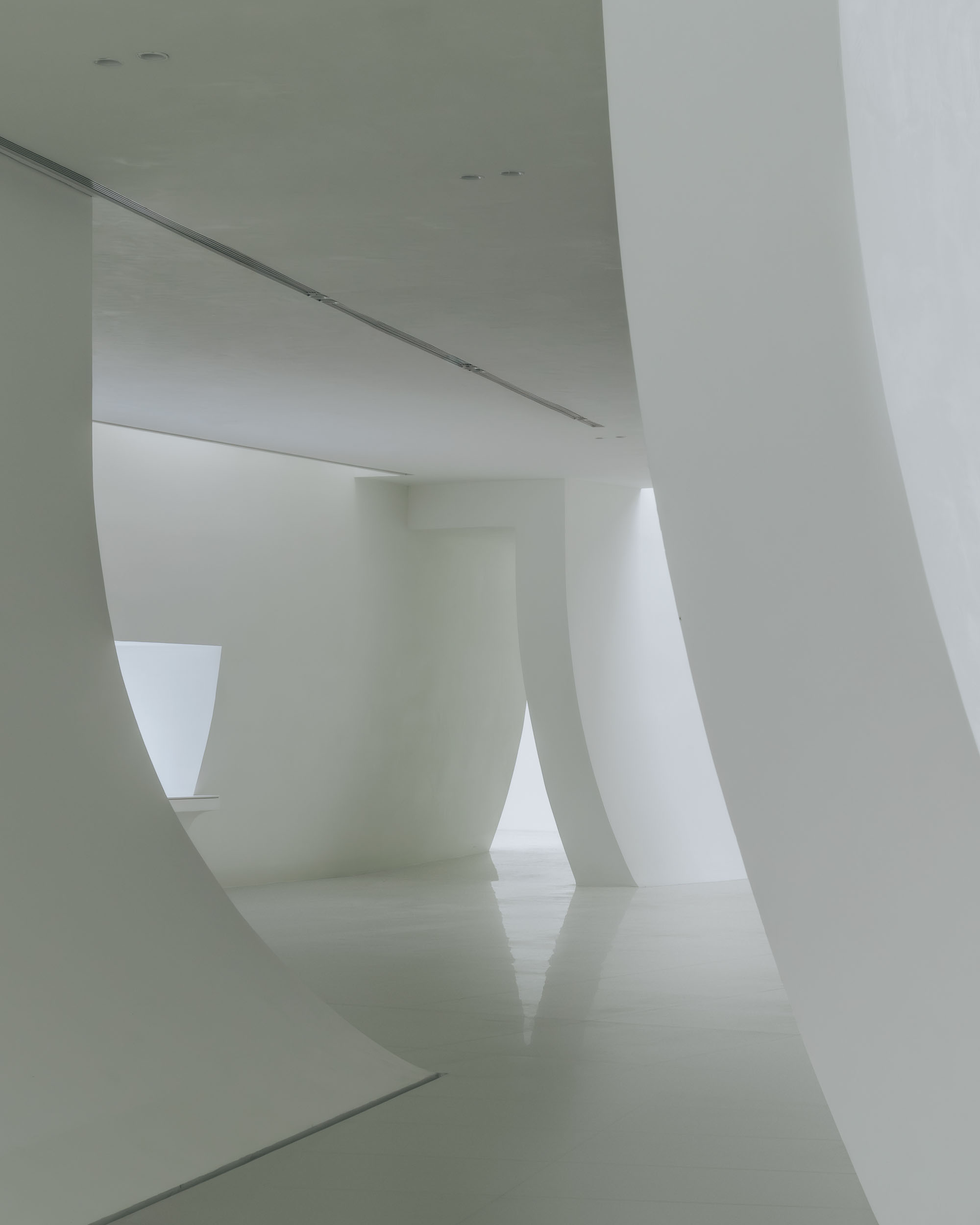
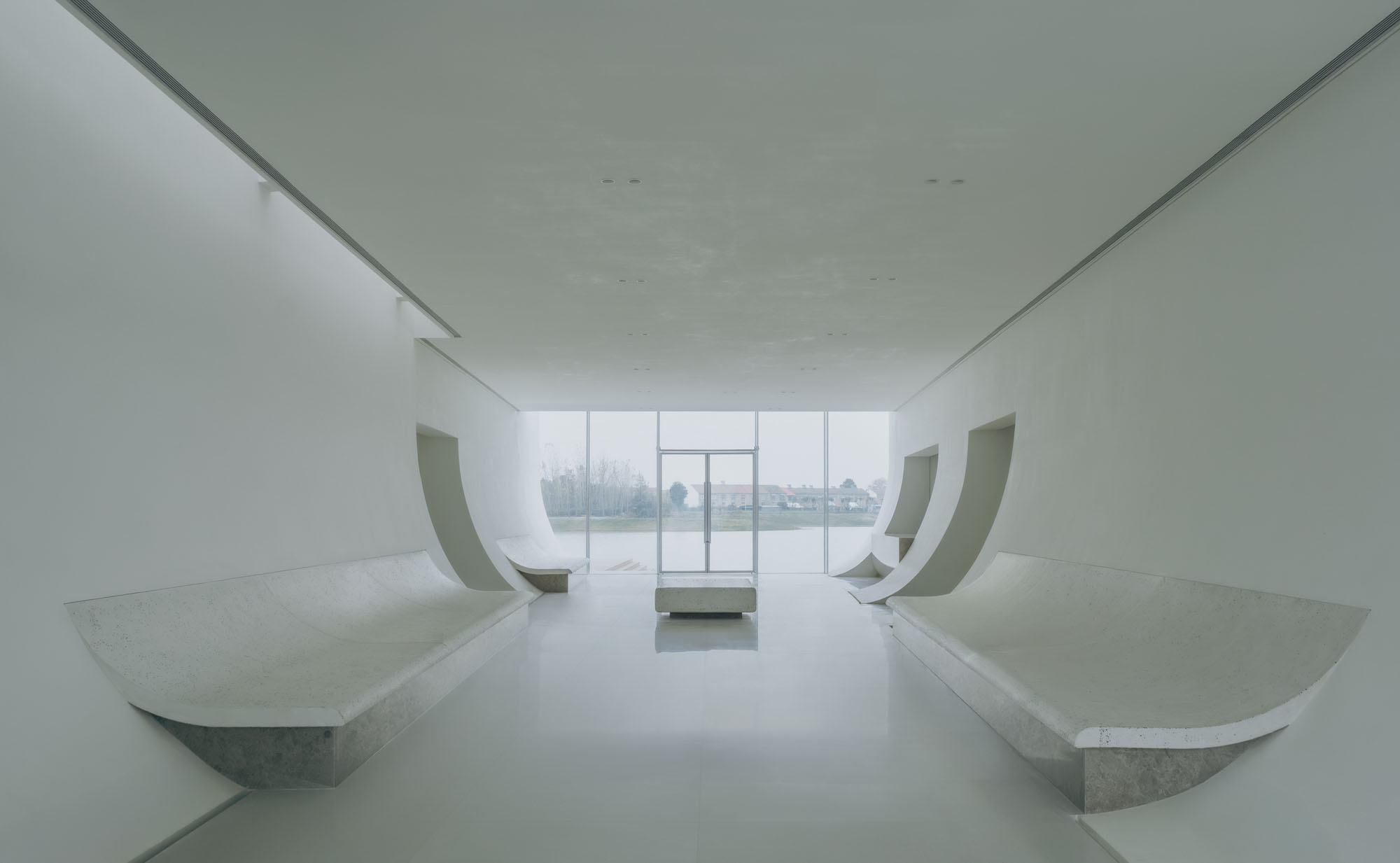
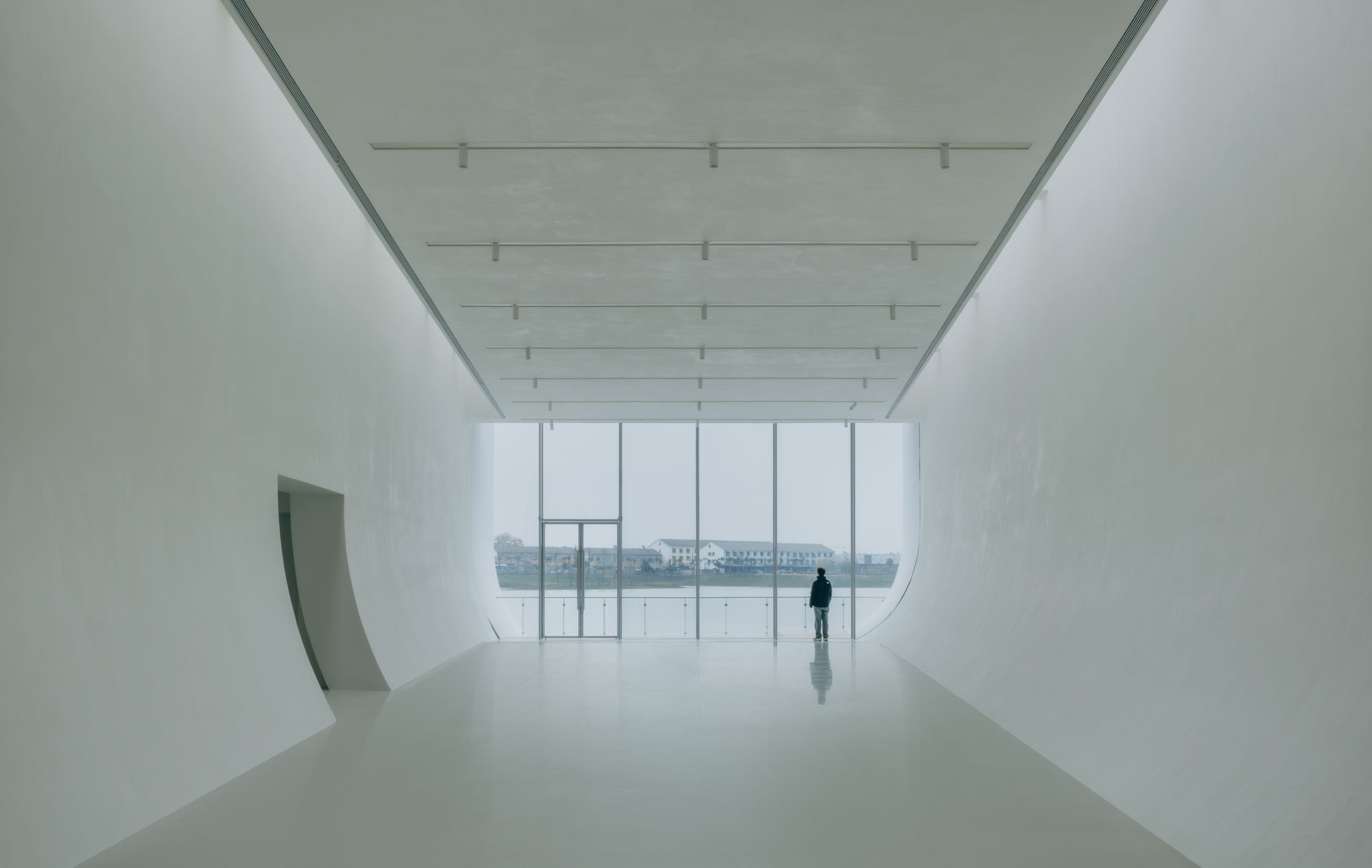
分散して配置された壁は、直線的ではない展示空間の連なりを生み出している。来館者は、曲がり、分かれ、そして再びつながる経路を歩みながら、絶えず開けた水辺の景色へと引き寄せられる。このレイアウトによって、「内と外」や「展示と自然」の間に新たな境界が生まれる。
ここでは、単に展示物を鑑賞するだけでなく、壁や光、そして水と身体的に関わりながら、展示そのものに参加することになる。湾曲する壁は、人々の行動や知覚を導くインターフェースとして機能し、「鑑賞」という行為を流動的な身体的体験へと展開させるのである。
©︎ Yumeng Zhu
©︎ Yumeng Zhu
©︎ Yumeng Zhu
光と気候を映し出す、呼吸するファサード
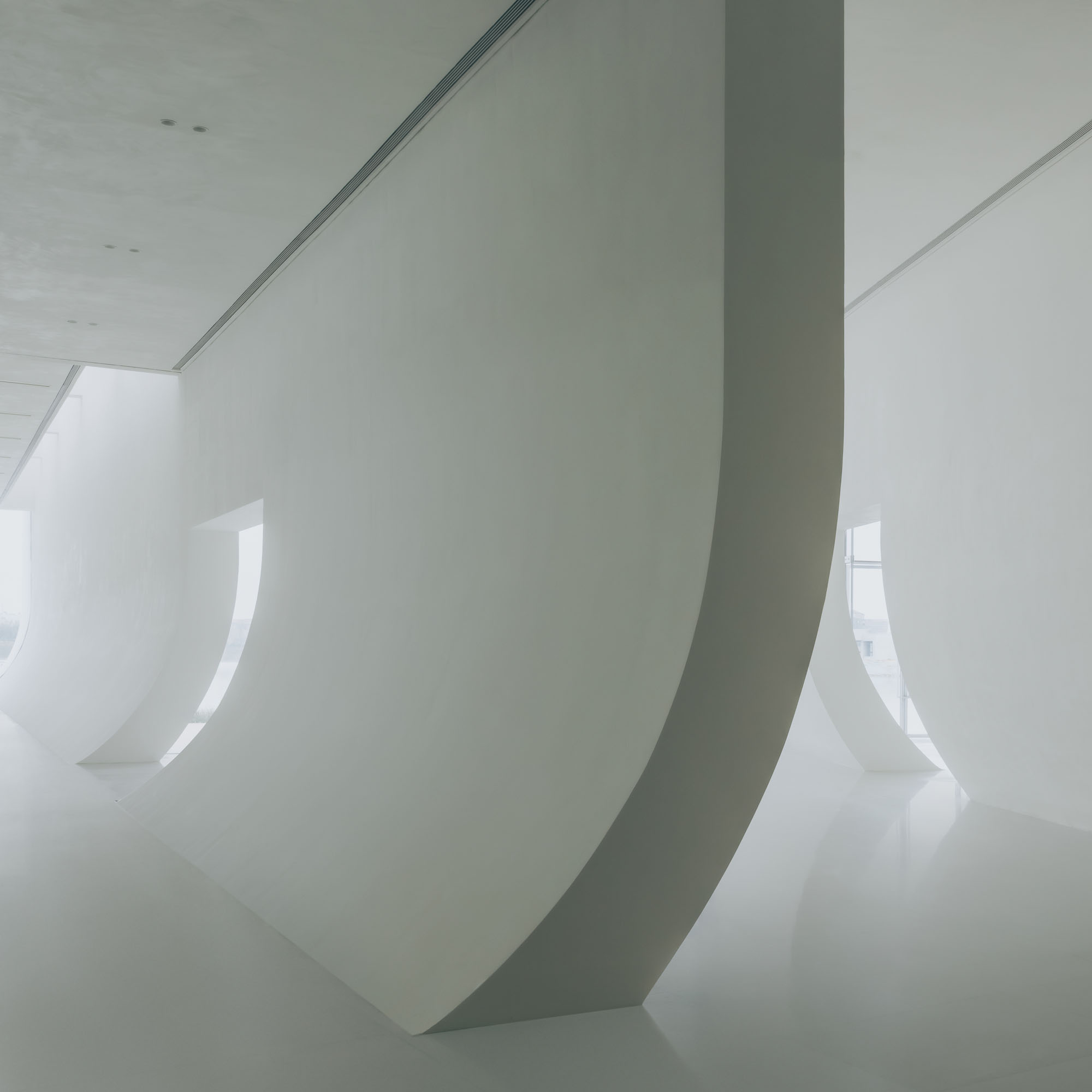
建物の外装には、貝殻や巻き貝の骨粉を配合したGRC(ガラス繊維補強セメント)パネルが採用されている。その粒状の質感は、日光の当たり具合や湿気によって、微かなきらめきや潤いを帯びた光沢を生み出す。この素材の選択は、決して装飾的な目的からではない。マクロな視点では敷地内のきらめく水面と共鳴し、ミクロな視点では自然素材ならではの触覚的な温もりを伝えている。
移ろいゆく日差しと壁の多様な曲率によって、表面は明るい部分から影の落ちる部分へ、あるいは乾いた状態から湿った状態へと変化し、そこに時間の経過を刻み込んでいく。このファサードは、湿地の気候や光、そして素材が共存するためのインターフェースである。
©︎ Yumeng Zhu
©︎ Yumeng Zhu
環境へと緩やかに溶けゆく「プロセス」としての建築
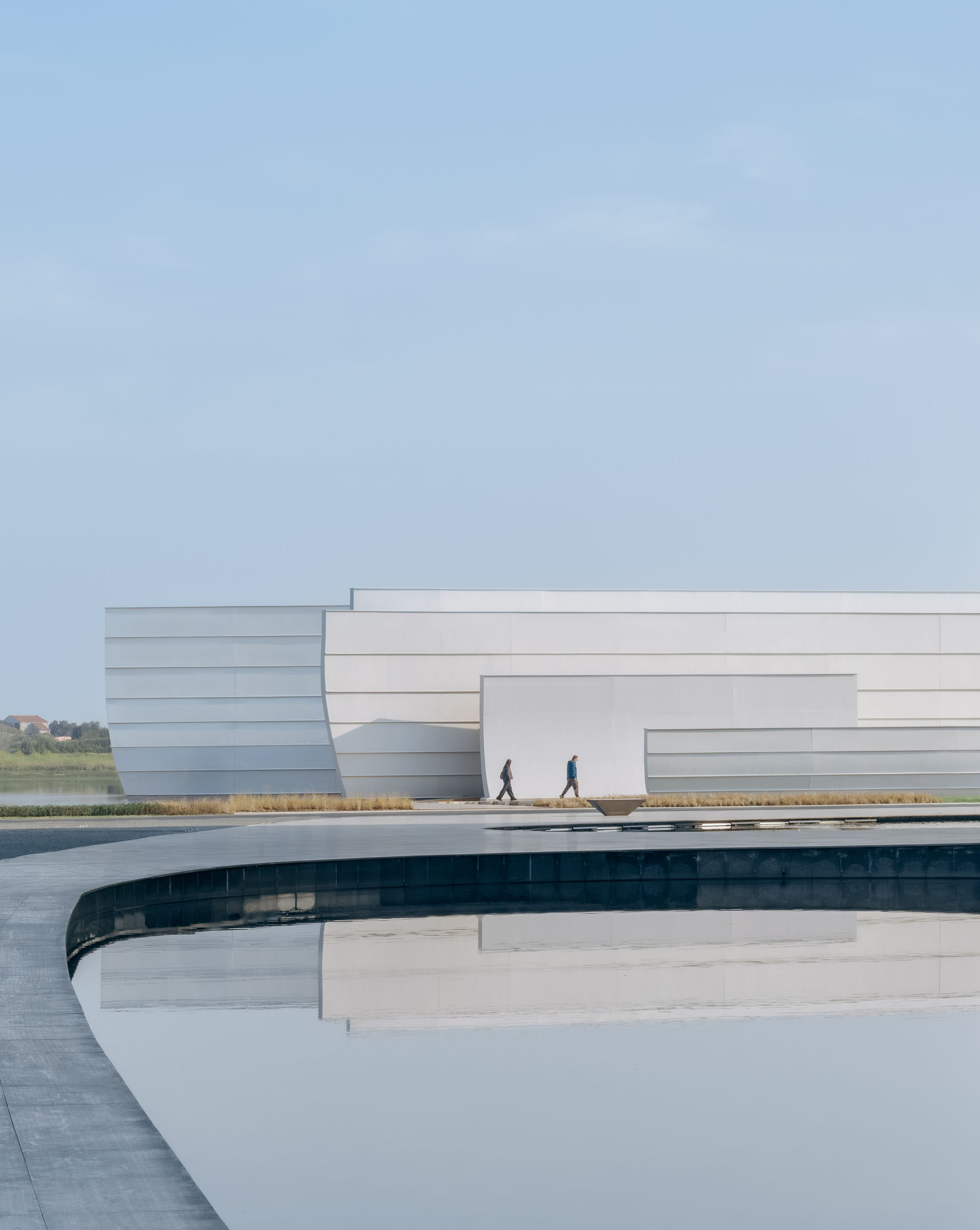
〈陳湖湿地アートセンター〉は、視覚的な優位性を主張する建築ではない。むしろ、周囲の環境の中へ優しく溶け込んでいる。折り重なる下部の壁は水面に向かってうなだれるように佇み、分散した平面は陸と湖の間で呼吸している。そして、豊かな質感をもつファサードは、建物の皮膚そのものを湿地の一部と同化させている。
ここでは、建築は孤立した物体ではなく、光、風、水、そして時間の力によって周囲と徐々に融合していく「プロセス」となっているのである。
©︎ Yumeng Zhu
©︎ Yumeng Zhu
©︎ Yumeng Zhu
©︎ Yumeng Zhu
©︎ Yumeng Zhu
©︎ Yumeng Zhu
©︎ Yumeng Zhu
©︎ Yumeng Zhu
©︎ Yumeng Zhu
©︎ Yumeng Zhu
Master plan ©︎ TAO
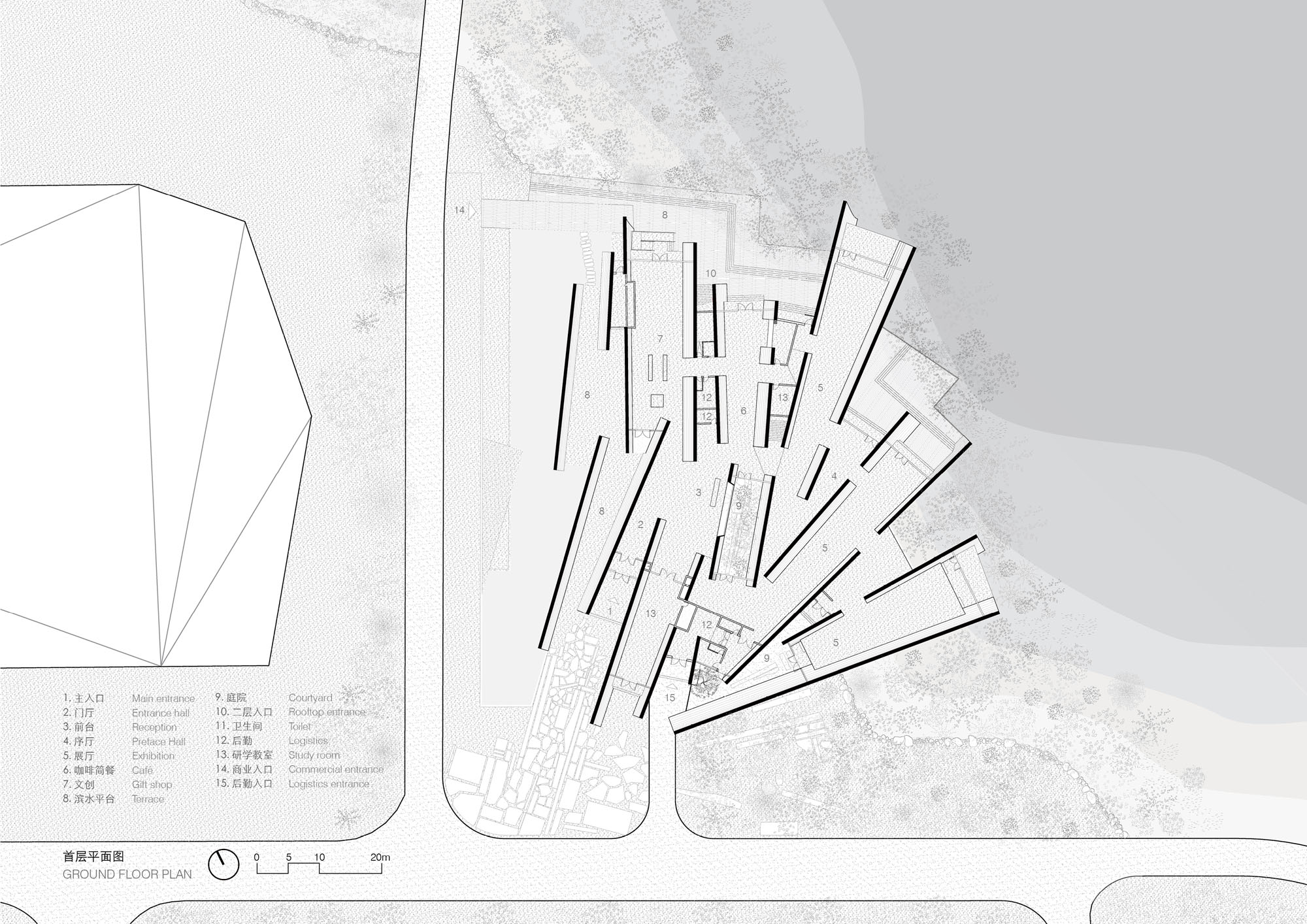
Ground floor plan ©︎ TAO
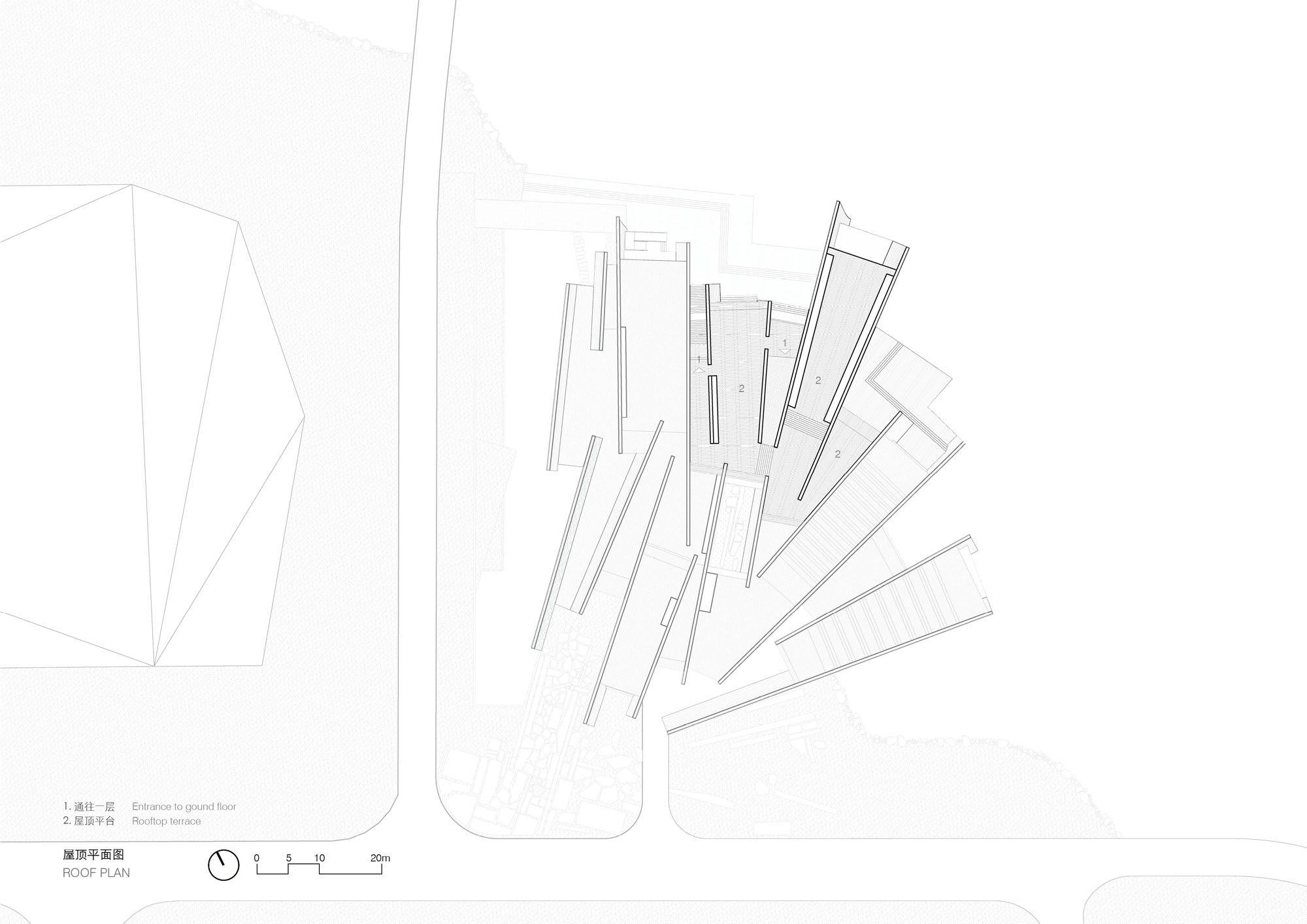
Roof plan ©︎ TAO
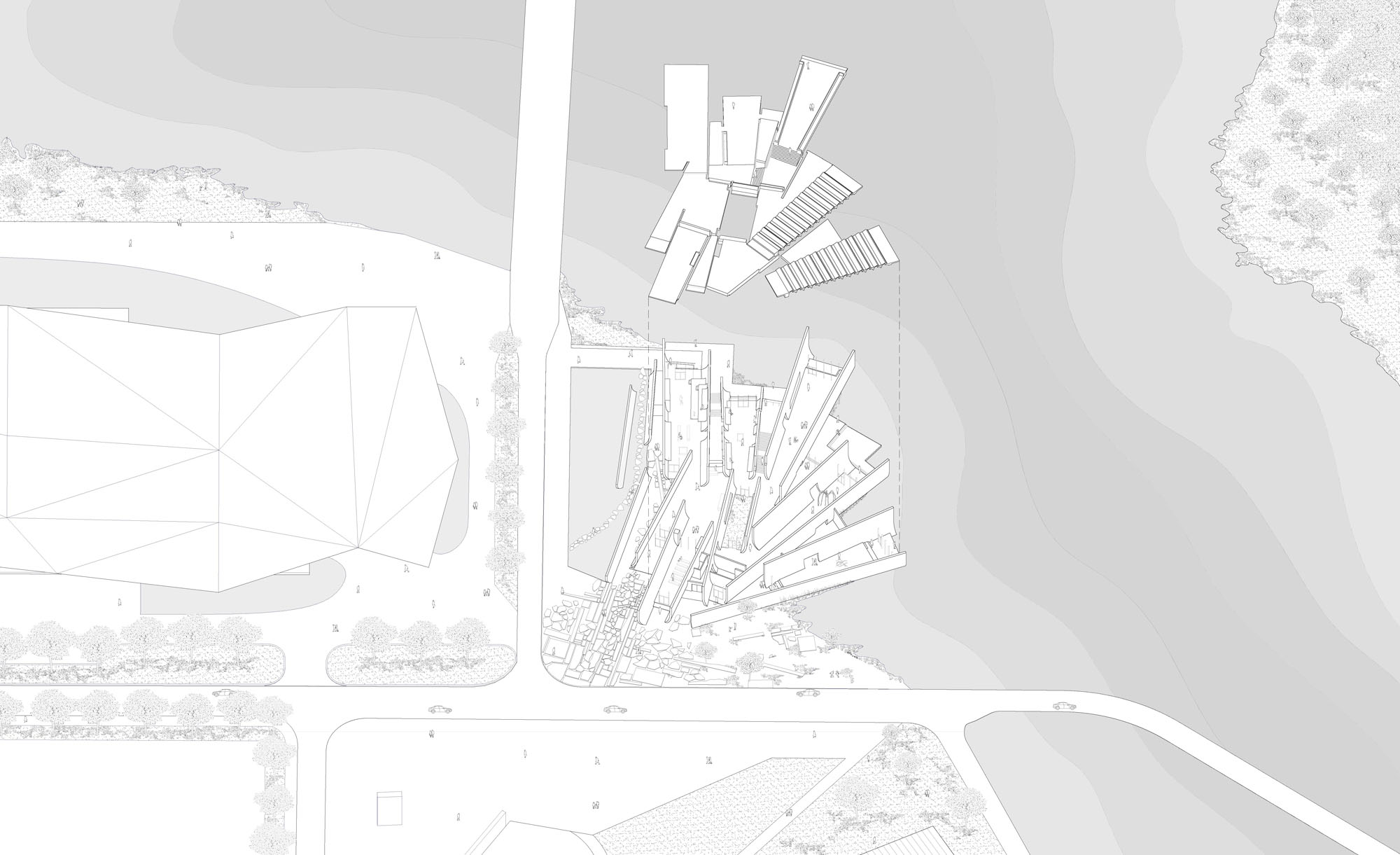
Axonometric drawing without roof ©︎ TAO
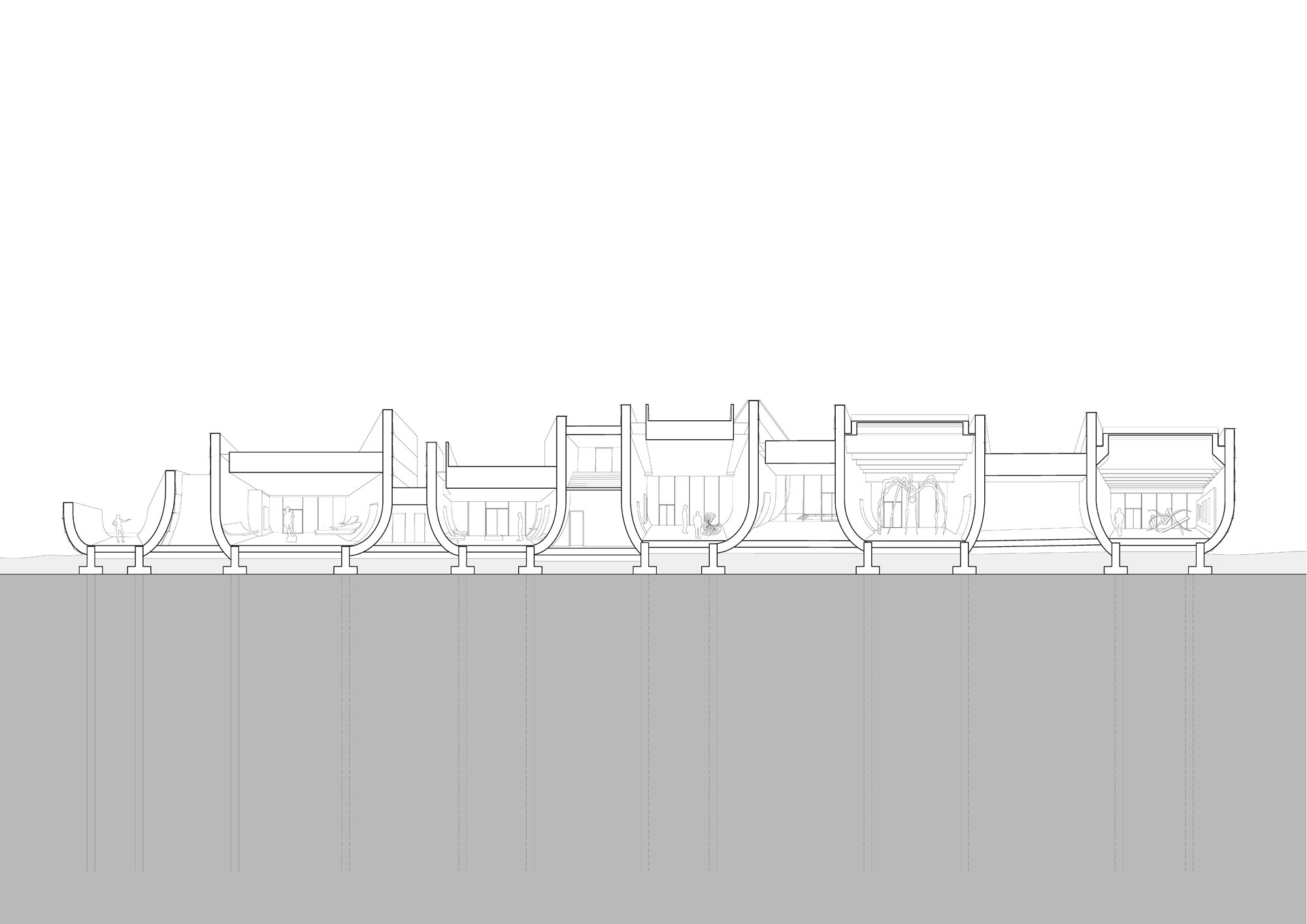
Scatter section perspective ©︎ TAO
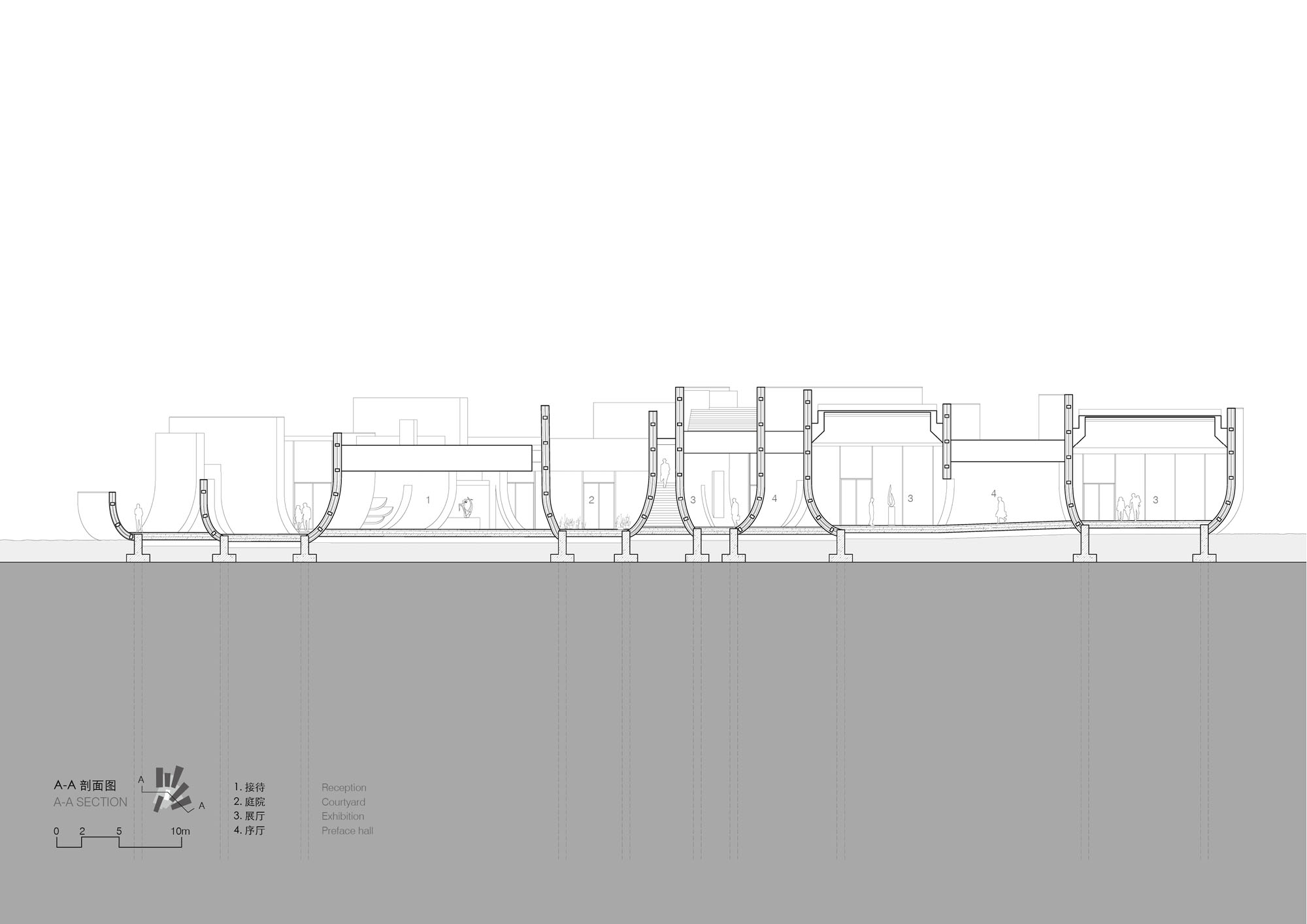
Section A-A ©︎ TAO
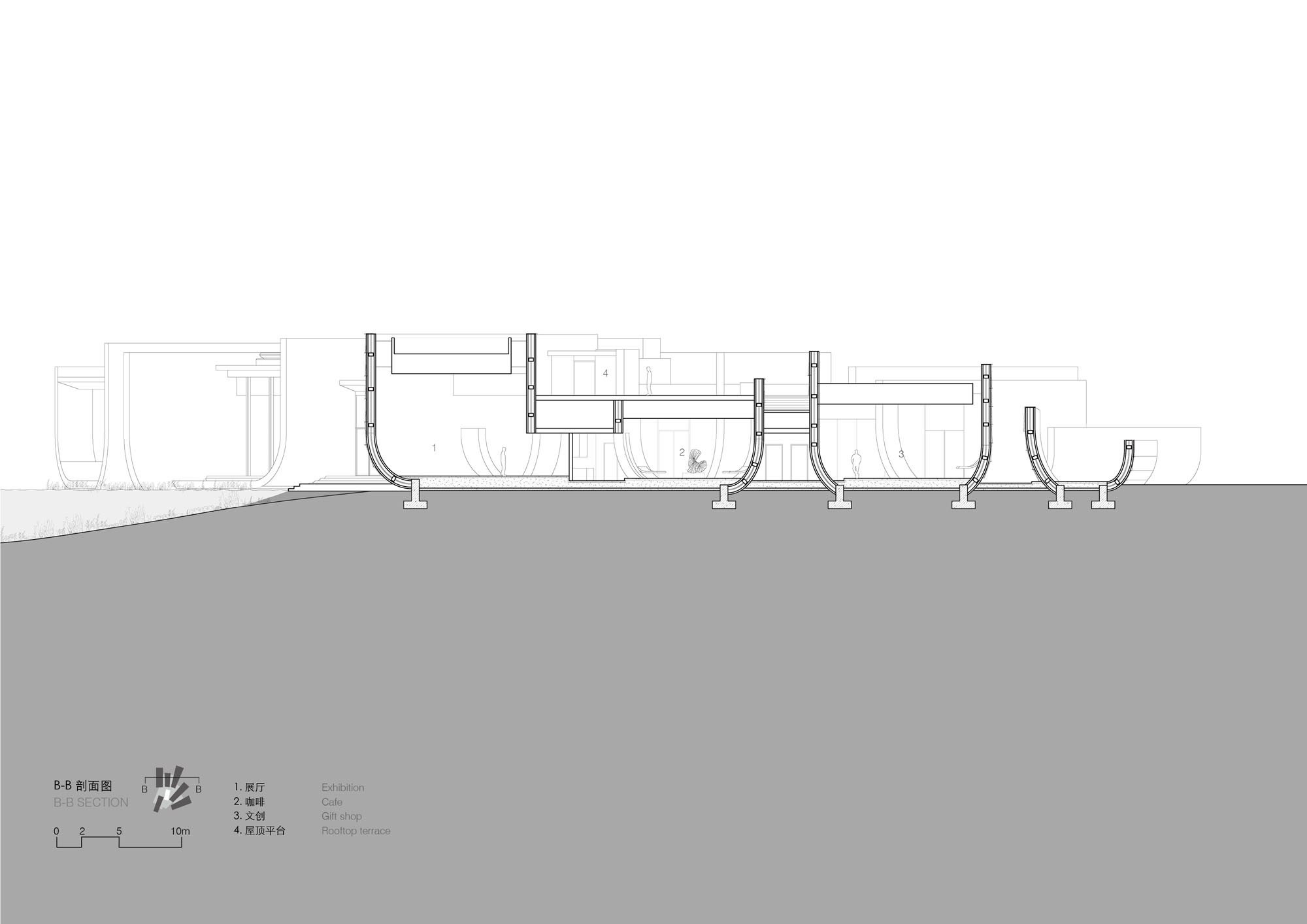
Section B-B ©︎ TAO
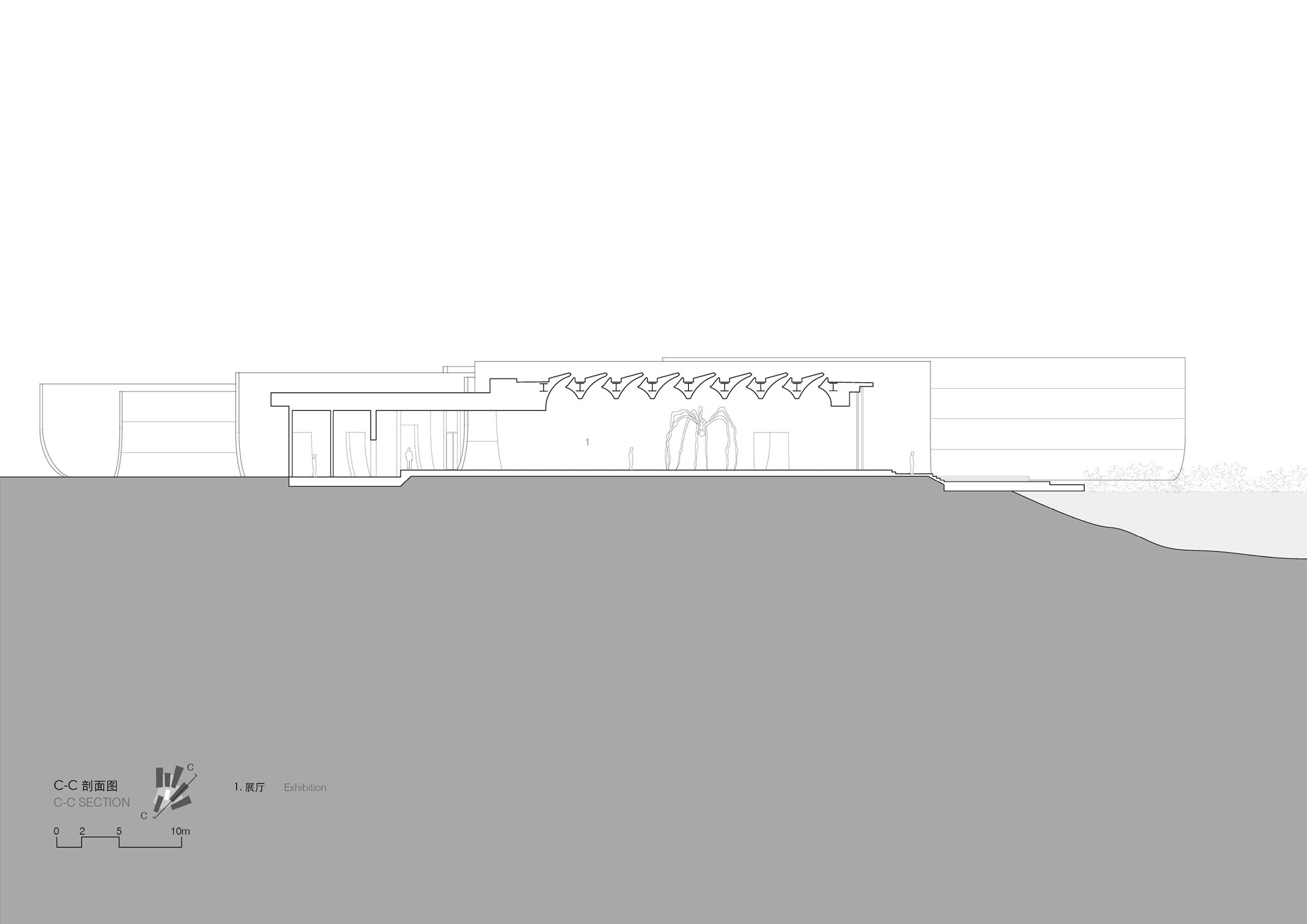
Section C-C ©︎ TAO
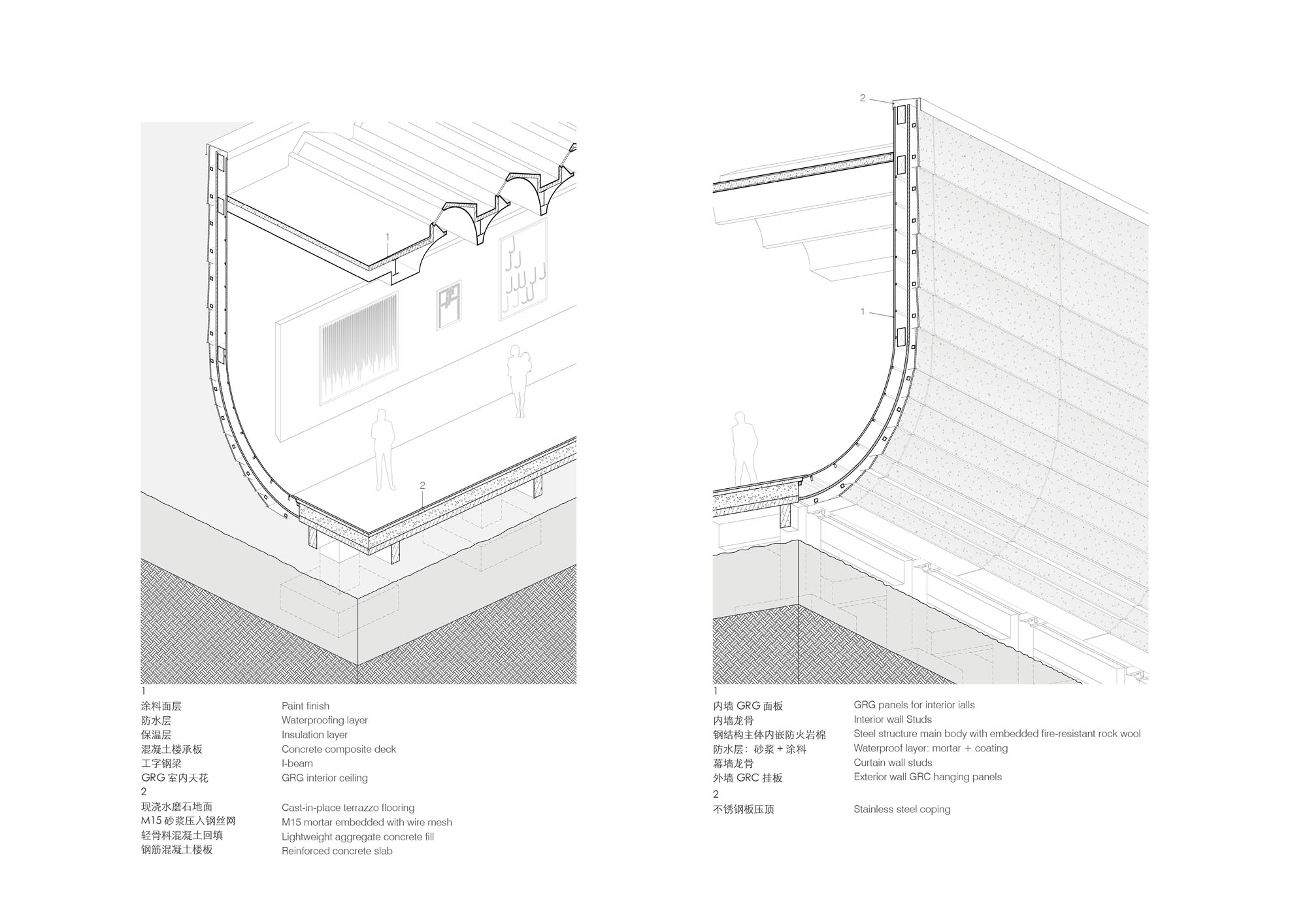
Detail axonometric ©︎ TAO
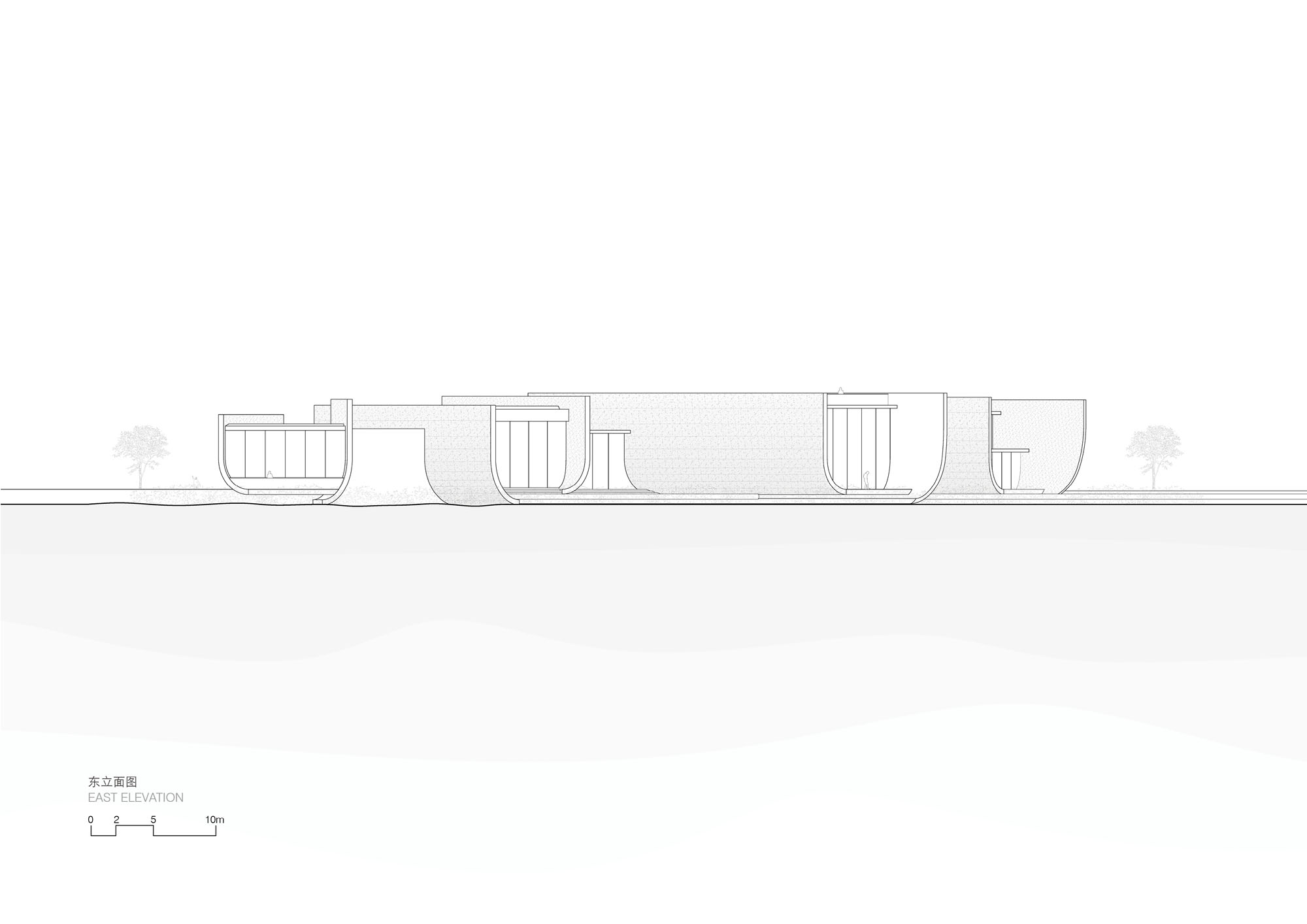
East elevation ©︎ TAO
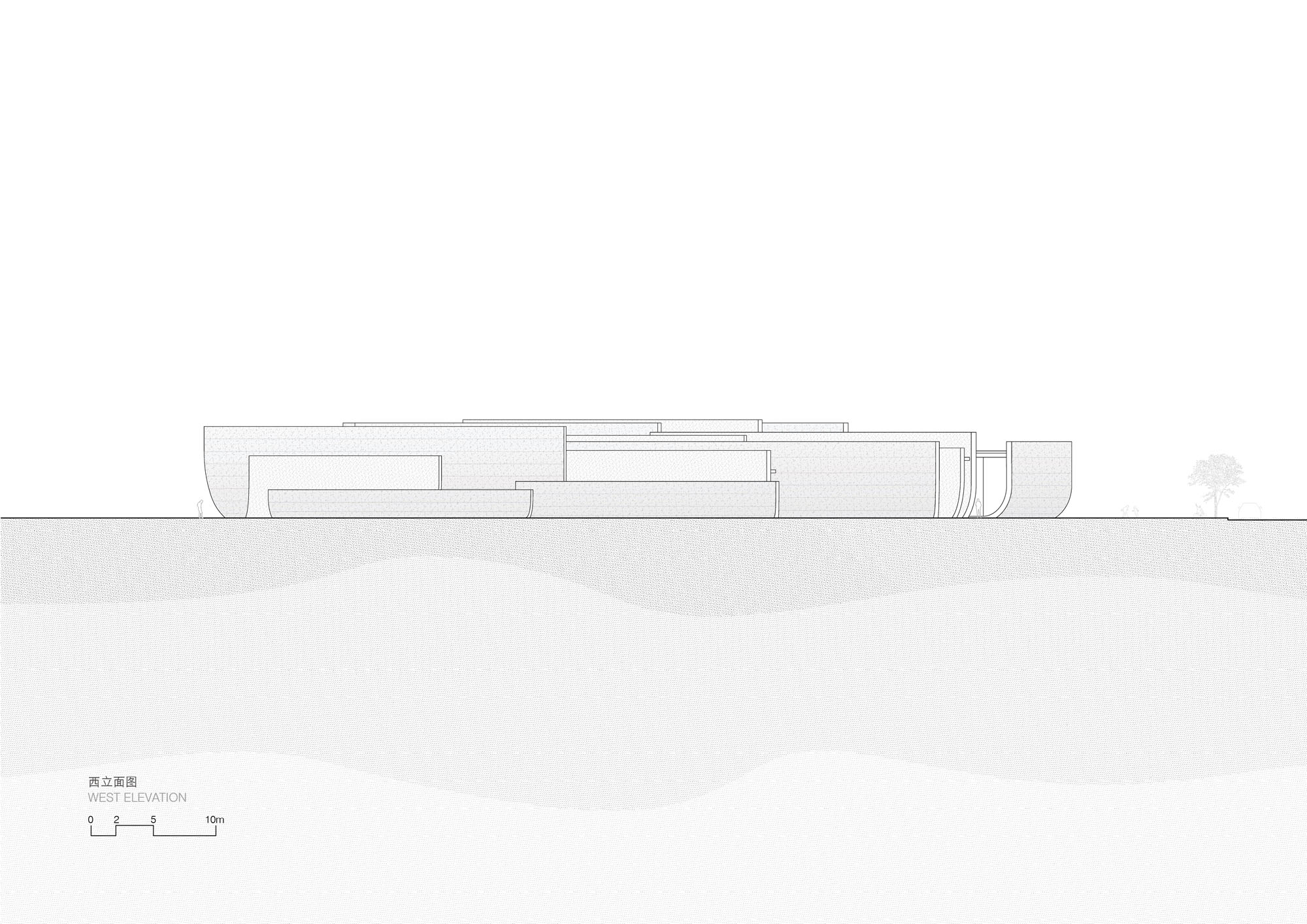
West elevation ©︎ TAO
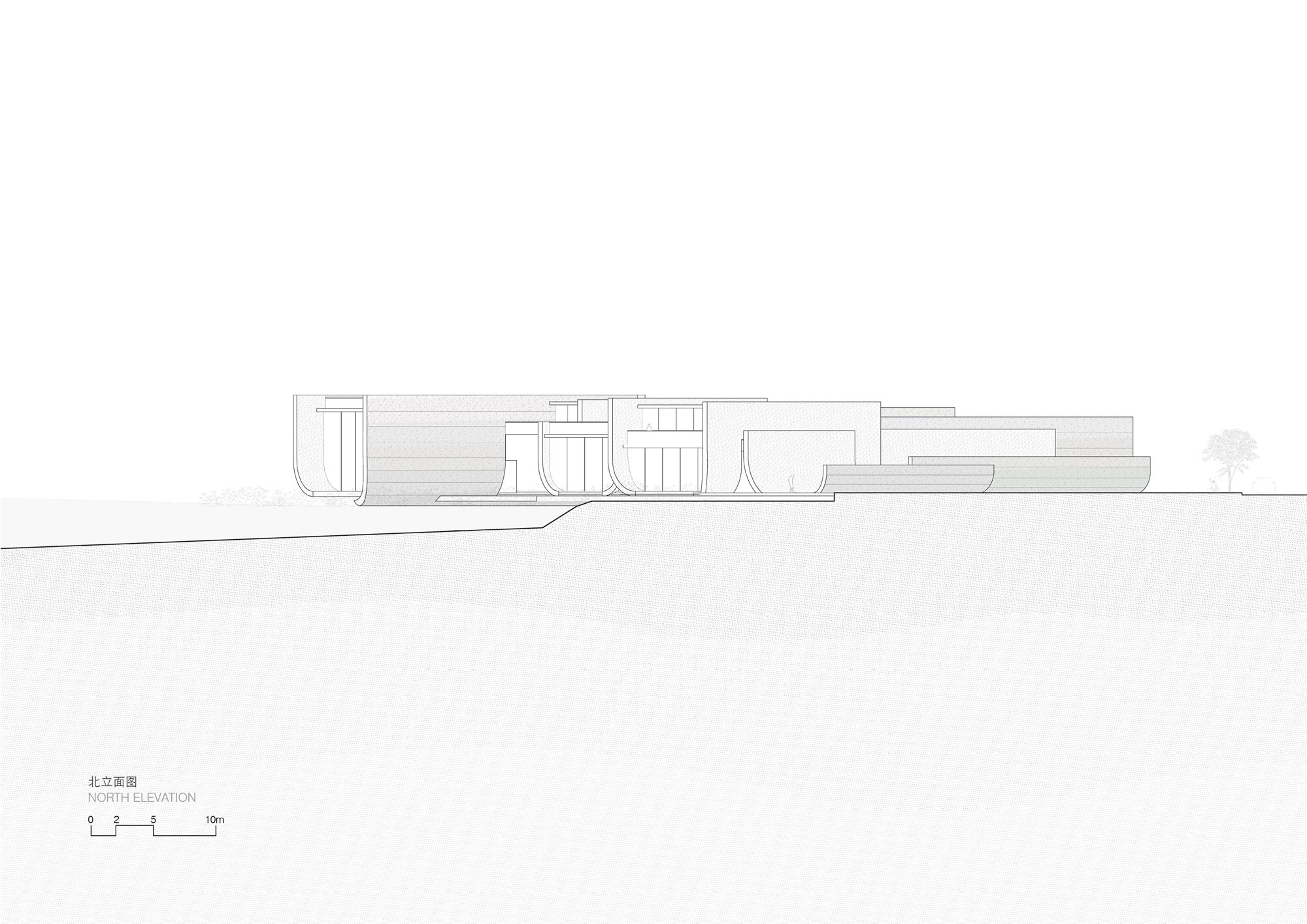
North elevation ©︎ TAO
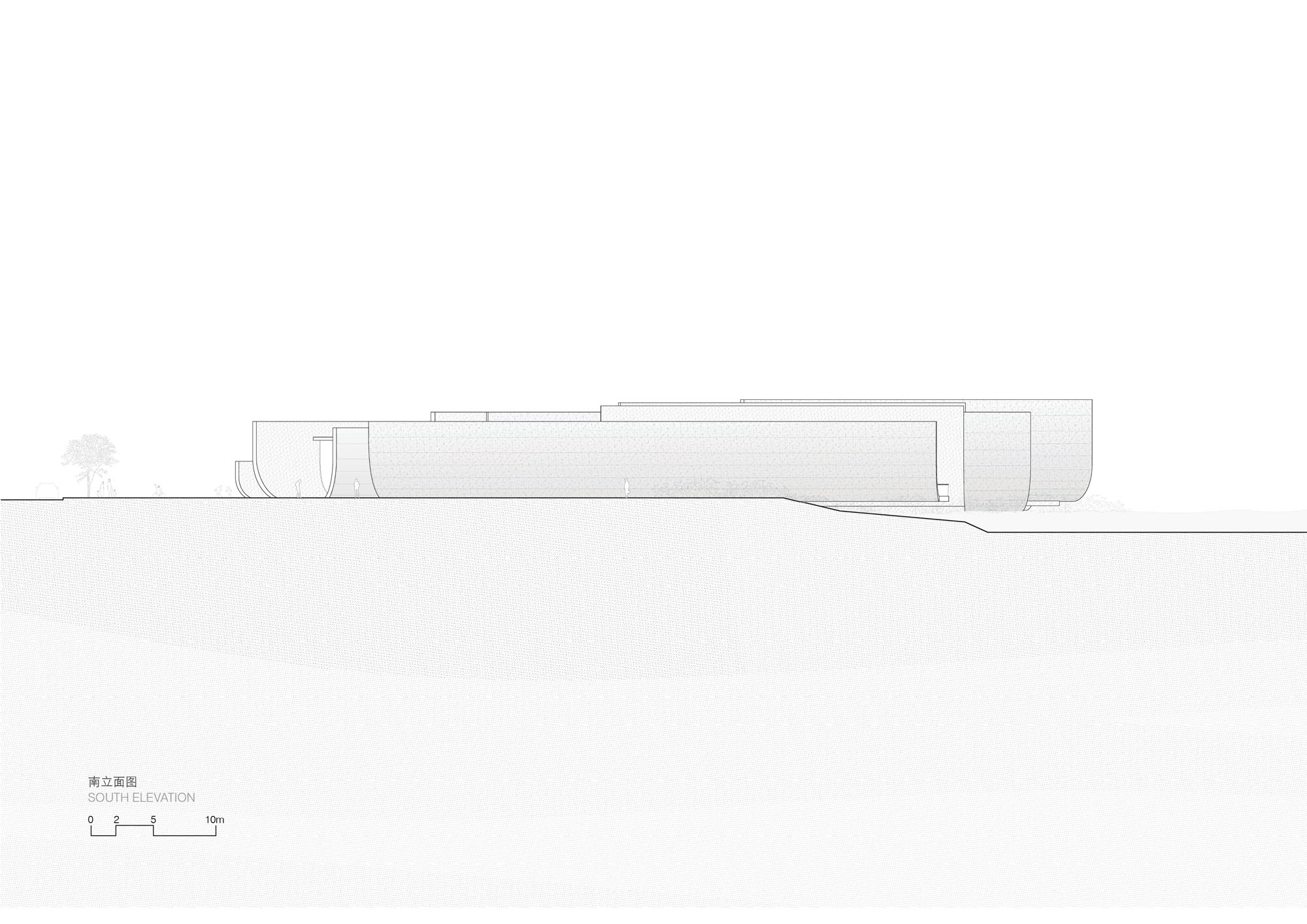
South elevation ©︎ TAO
以下、TAOのリリース(英文)です。
Chenhu Wetland Art Center / Trace Architecture Office (TAO)
Situated at the geographical center of China, Wuhan earned the title of the “Gateway to Nine Provinces” as early as the Ming and Qing dynasties. From the ancient Yunmeng wetlands, to Yu the Great diverting the Han River into the Yangtze, and later the river’s course shift in the sixth year of Emperor Chenghua’s reign, the city gradually took shape as today’s “River City.” Renowned as the “City of a Hundred Lakes,” Wuhan is interwoven with rivers, lakes, and waterways, with water areas occupying one quarter of its territory. Evidently, the relationship between “water” and “city” is inseparable.
The site is enveloped by the Tonghu Provincial Wetland Park and lies approximately one hour’s drive from Wuhan’s urban core. Within the Tonghu region, the land is expansive and sparsely populated, with clean air and fertile soil. Farmland, water bodies, woodlands, and riverbanks each constitute roughly one quarter of the landscape, forming a self-contained environment. Removed from urban noise and concealed within rural expanses, the site is surrounded by lakes and forests. The project stands on a triangular slip of land at the junction of a natural shoreline and an artificial road fork. Here, wind and water have long shaped the gentle terrain and meandering waterline.
In 2017, we developed the Wall Museum from an inquiry into the architectural potential of the “wall” as a generative element. In this project, the wall becomes the sole driver of spatial formation. As the walls thicken upward, the roof gradually dissolves, turning into fissures between wall surfaces through which light enters. The building appears like a ruin dispersed across an expansive landscape, evoking a sense of primal weight and tectonic solidity. The unique locality of the intertidal flat where the present project is situated once again prompts us to reconsider how walls can reformulate spatial relationships and articulate a grounded connection to the site.
This project emerges from these natural conditions. The bending lower walls are not mere abstract form-making, but a response to the buoyant force of water. They rise and fall subtly along the water’s edge, as if pushed, saturated, and molded by the flow. No sharp boundary separates architecture from water; the folded wall bases lightly touch the water surface, producing a distinctive reflection at the horizon line and allowing the building to become part of the wetland landscape. This “folding” is both a formal language and a temporal expression—it records the gestures of water as it brushes against and permeates the land. The architecture thus becomes a vessel of “water’s memory.”
In conventional museum typologies, the roof admits light, walls serve as exhibition backdrops, and floors guide circulation. Here, the boundary between wall and ground dissolves. The roof is pierced by walls, skylights draw daylight downward, and the roof plane hovers at an indeterminate height, suspending one’s perception. This is a museum defined by walls alone.
Its plan is not a continuous enclosure but a spatial field composed of freely distributed walls. They appear almost spontaneous, yet mediate between the density of urban form and the looseness of open water. From above, the configuration resembles organic bodies floating along the shore—dispersed yet unified, simultaneously artificial and naturally formed. This indeterminate plan echoes the ecological logic of wetlands: lacking fixed centers or boundaries, it is porous, open, and symbiotic.
The dispersed walls produce a gallery sequence that is not linear. Visitors navigate a path that bends, divides, and reconnects, continually drawn toward glimpses of the open water. The layout engenders a threshold between “inside and outside,” “exhibition and nature.” Here, one does not merely view the exhibition but participates in it, engaging bodily with walls, light, and water. The folded walls become interfaces that guide behavior and perception, allowing “viewing” to unfold as a fluid corporeal experience.
The exterior employs GRC panels incorporating shell and conch aggregates. Their granular texture produces subtle glimmers and a moist sheen under sunlight and humidity. This material choice is not decorative; at a macro scale it resonates with the site’s shimmering waters, while at a micro scale it conveys the tactile warmth of natural matter. Under shifting daylight and due to the wall’s varied curvature, the surface transitions from bright to shaded, from dry to damp, registering the passage of time. The façade becomes an interface where wetland climate, light, and material coexist.
The Chenhu Wetland Art Center does not seek visual dominance. Instead, it settles gently into its environment. The folded lower walls bow toward the water; the dispersed plan breathes between land and lake; and the textured façade makes the building’s skin part of the wetland itself. The architecture ceases to be an isolated object and becomes a process—one that gradually merges with its surroundings under the forces of light, wind, water, and time.
Credits & Data
Project title: Chenhu Wetland Art Center
Client: Wuhan Urban Construction Investment and Development Group Co., Ltd.
Location: Caidian District, Wuhan City, Hubei Province, China
Program: Exhibition Space
Principal architect: HUA Li / TAO (Trace Architecture Office)
Design team: HUA Li, NA Xinyi, ZHOU Chang, ZHONG Sheng, Jonatan García-Cervantes, LU Guoxi, YAO Tian, QIAN Jin, ZHANG Peng
Structural engineer: ZHU Yu, LIZhong
MEP engineer: ZENG Cuilin
Construction drawing: Wuhan Civil Architectural Design & Research Institute Co., Ltd. (Ding Song, Lin Fan, Wu Jiaqi, Zhu Yu, Wu Lizhang, Xu Kailian, Zeng Cuilin, Gao Cong, Huang Mengqing)
Construction team: Wuhan Yucheng Qianli Construction Co., Ltd.
Floor area: 2,774 sq. m
Structural system: Steel
Design: 2024 – 2025
Construction: 2025
Photograph: Yumeng Zhu
TAO 公式サイト
https://www.t-a-o.cn


![[Interview]iF Design代表のウヴェ氏に聞く、建築と都市の2026年メガトレンド](https://magazine-asset.tecture.jp/wpcms/wp-content/uploads/2026/07/23221054/iF_AwardCeremony_2026_AwardCeremony-82-900x600.jpg)
![[Report]激変する時代の中で、建築とデザインはどう拡張するか。「iF DESIGN AWARD 2026」授賞式&最新トレンド](https://magazine-asset.tecture.jp/wpcms/wp-content/uploads/2026/07/24010304/iFDesignTrendConference26-45-900x600.jpg)
![[Report]RUI Architectsが可動モジュールを設計して松竹のアートスペースをリニューアル、柿落とし展「継承のトランジション」の会場デザインも担当](https://magazine-asset.tecture.jp/wpcms/wp-content/uploads/2026/07/24141011/20260713shutl_press11-01309-c-900x629.jpeg)