
集成材で編むパラメトリックな大屋根 - デジタル技術と職人技を融合し「森の樹冠」を再現する〈レイクサイド・レストラン〉
©︎ Guan Xiaoqing
©︎ Guan Xiaoqing
中国河北省定州市にSUPアトリエ(SUP Atelier)が設計した〈レイクサイド・レストラン(Lakeside Restaurant)〉は、定州市園芸博覧会のシルクロード・フレンドシップ・パーク内の水辺に建つレストランです。
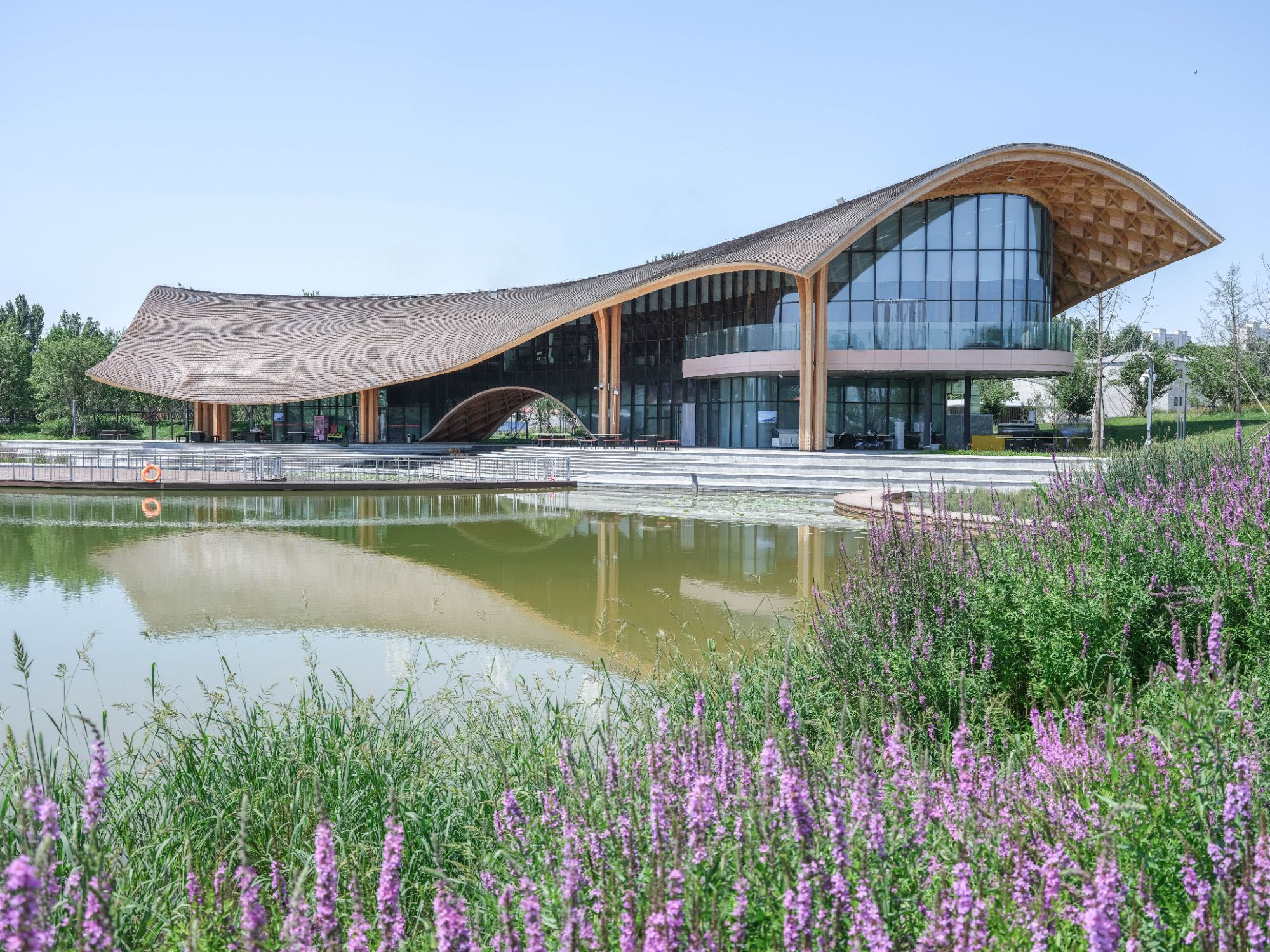
パラメトリックデザインによって「森の樹冠」を再現した、集成材で構成されたうねる木造大屋根構造が特徴的な建築です。
注目ポイント
- パラメトリックデザインによる木造構造の最適化
- ランドスケープの動線と建築のシームレスな融合
- 屋根のうねりが生み出す断面的な空間変化
- デジタル技術と木工職人技のハイブリッド
(以下、SUPアトリエから提供されたプレスキットのテキストの抄訳)
©︎ Chen Xinxing
©︎ Chen Xinxing
景観と調和する「森の樹冠」
本プロジェクトは、定州市園芸博覧会内のシルクロード・フレンドシップ・パークにおける主要な景観エリアに位置している。公園全体の景観デザインは「祥雲」をテーマとしており、円形の景観大通りが公園全体をつなぎ、求心的なレイアウトによって多様な景色を創出している。
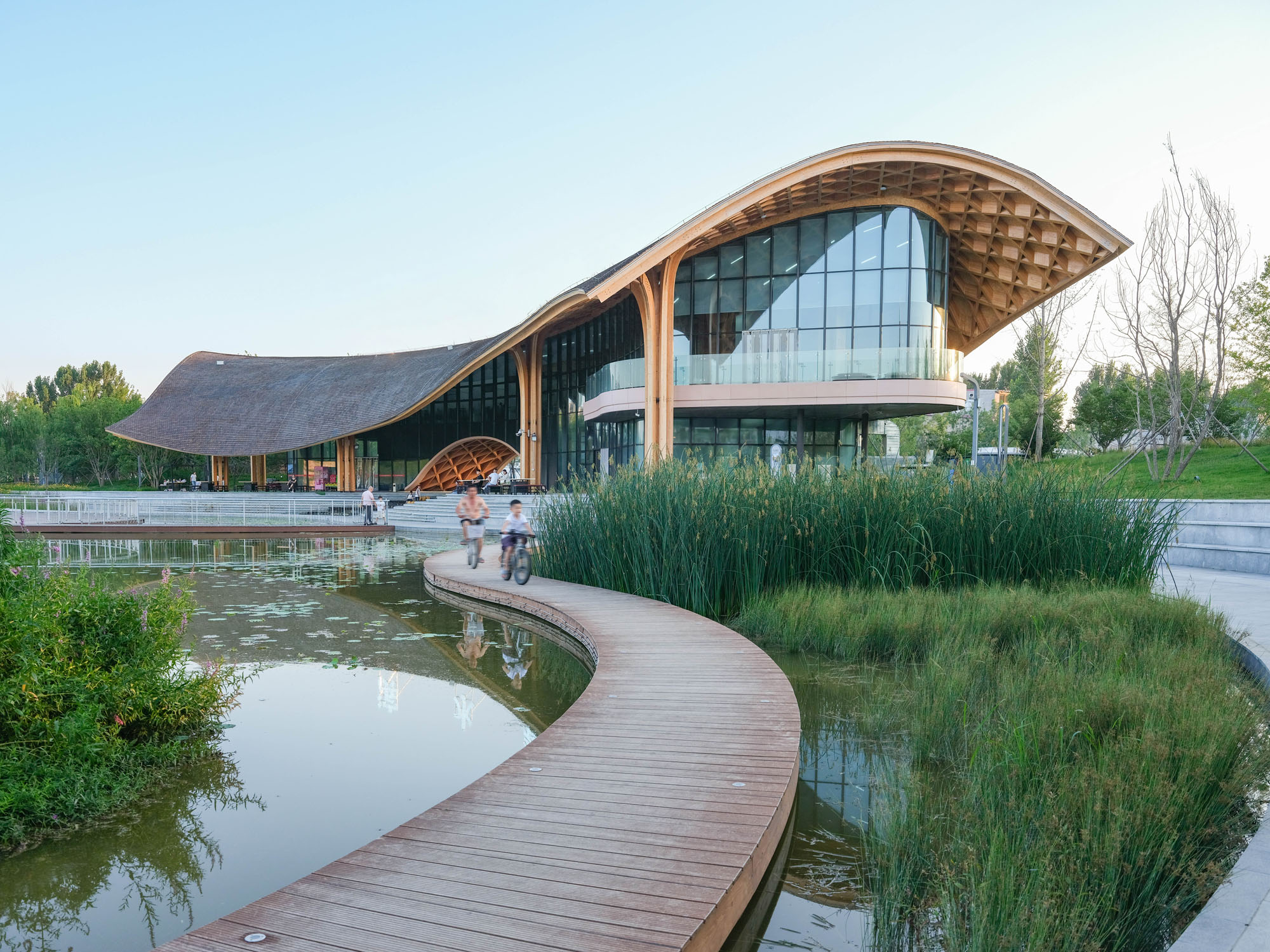
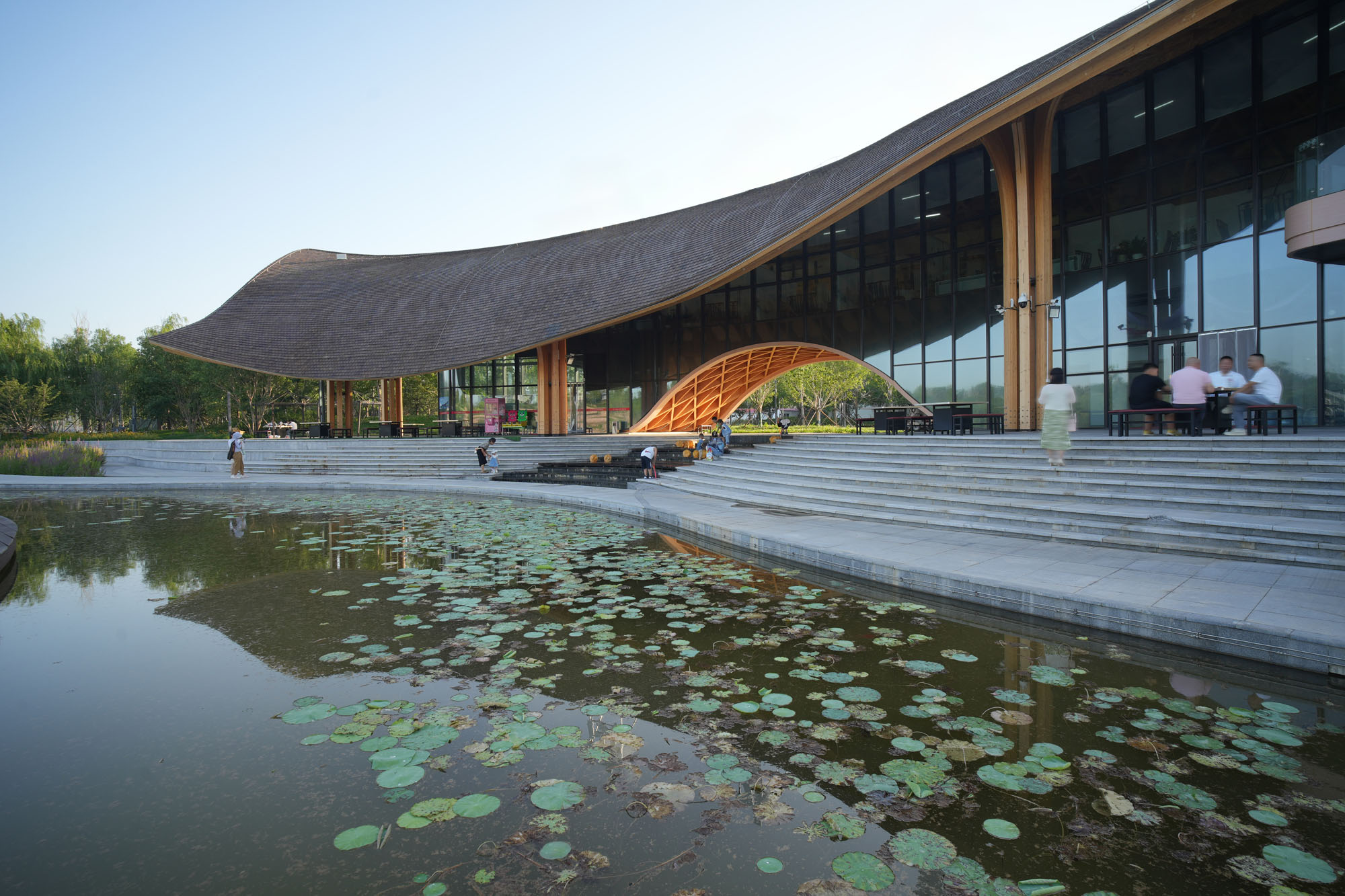
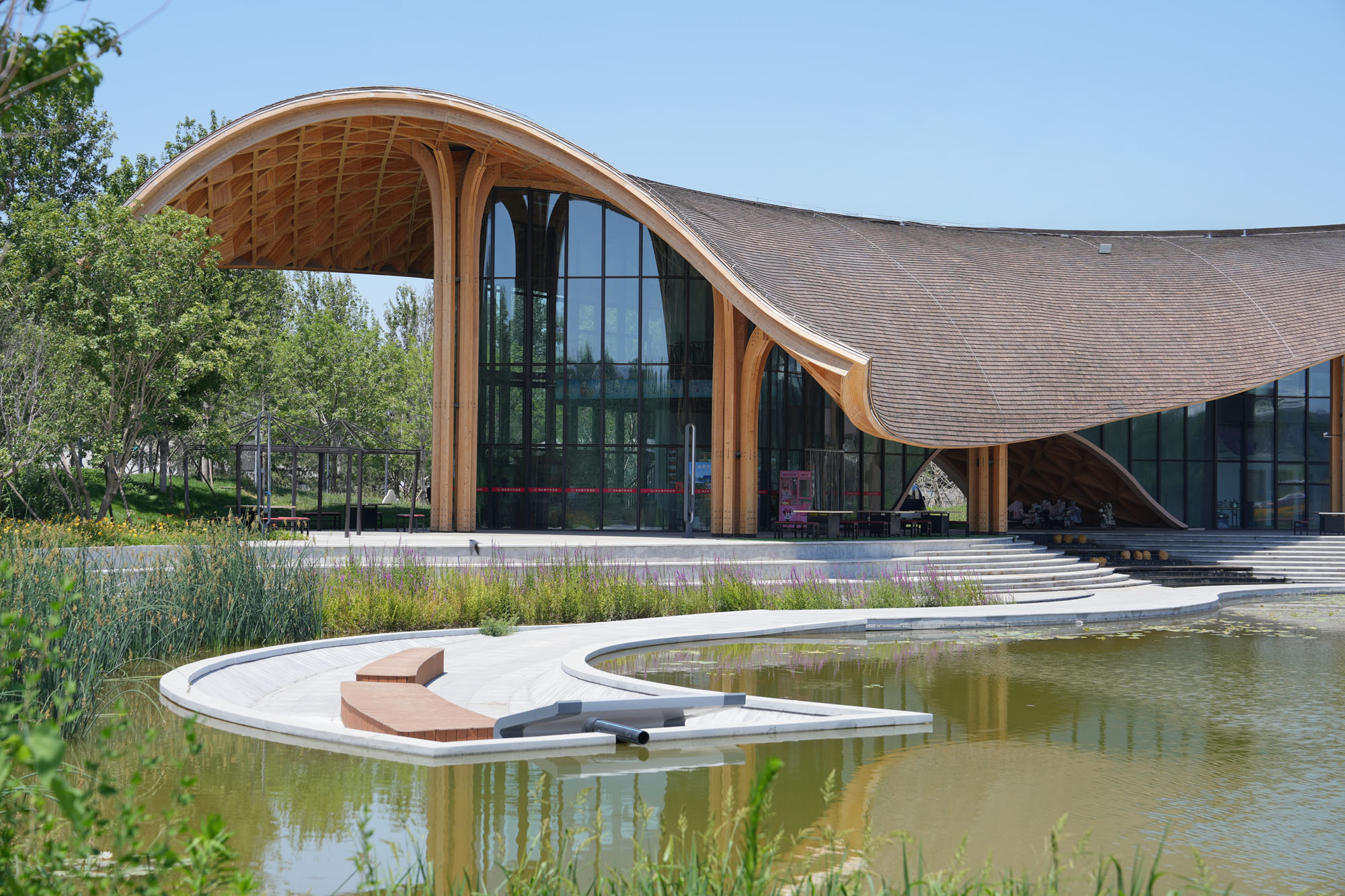
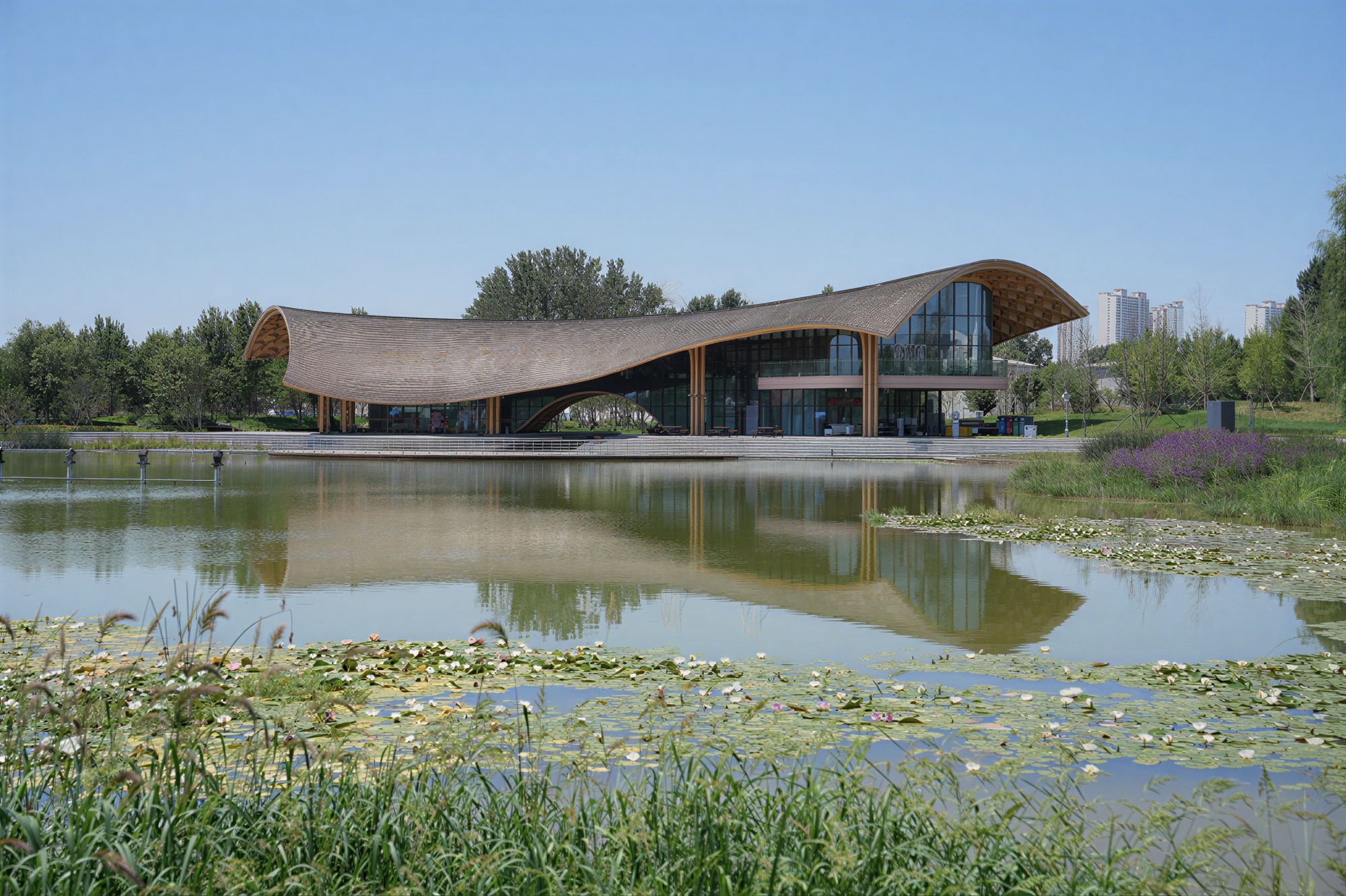
その中でも、〈レイクサイド・レストラン〉は中央の湖が描く曲線的な湖岸に沿って穏やかに広がる。編み込まれた木造構造が、うねるような森の樹冠を思わせる自由で伸びやかな曲線を描き、周囲の自然環境とシームレスに溶け込むことで、まるで優雅に舞っているかのような佇まいを見せている。
©︎ Chen Xinxing
©︎ Chen Xinxing
敷地の課題を解決する動線と建築の一体化
設計の初期段階から、設計チームは公園のコンパクトなレイアウトと貴重な湖畔空間という課題の解決に注力し、建物が水辺の環境にシームレスに溶け込み、景観を損なわないよう努めた。
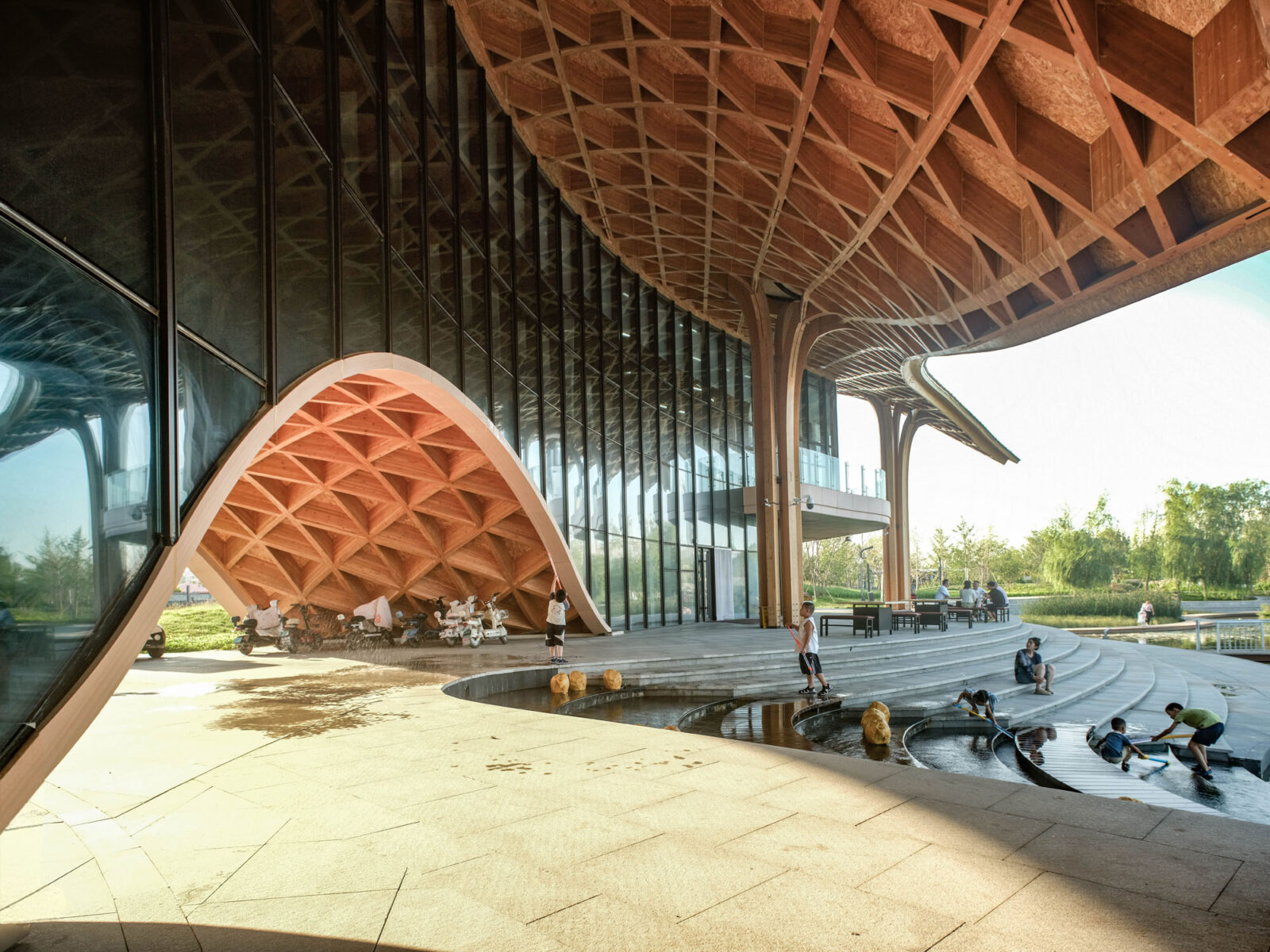
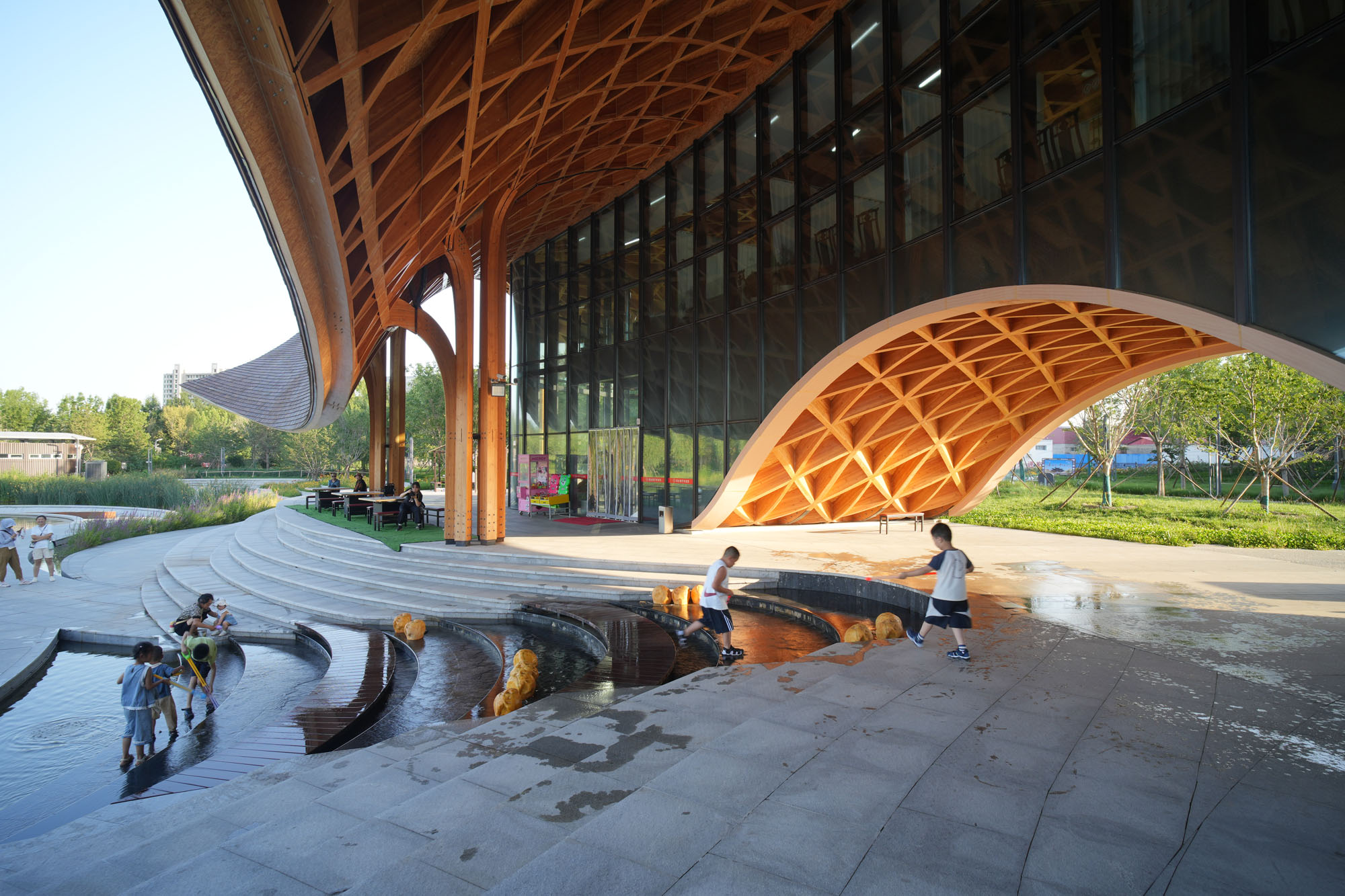
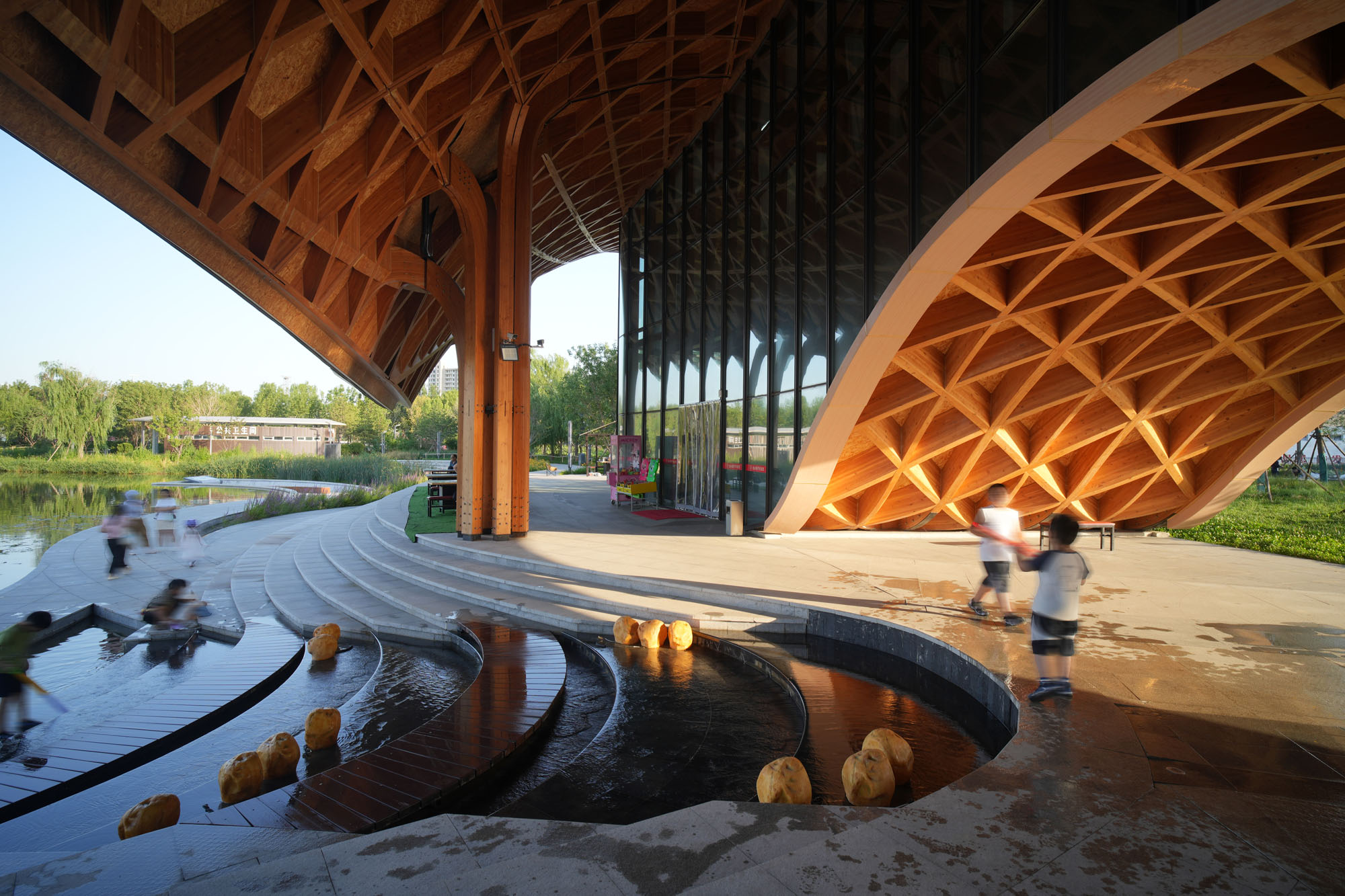
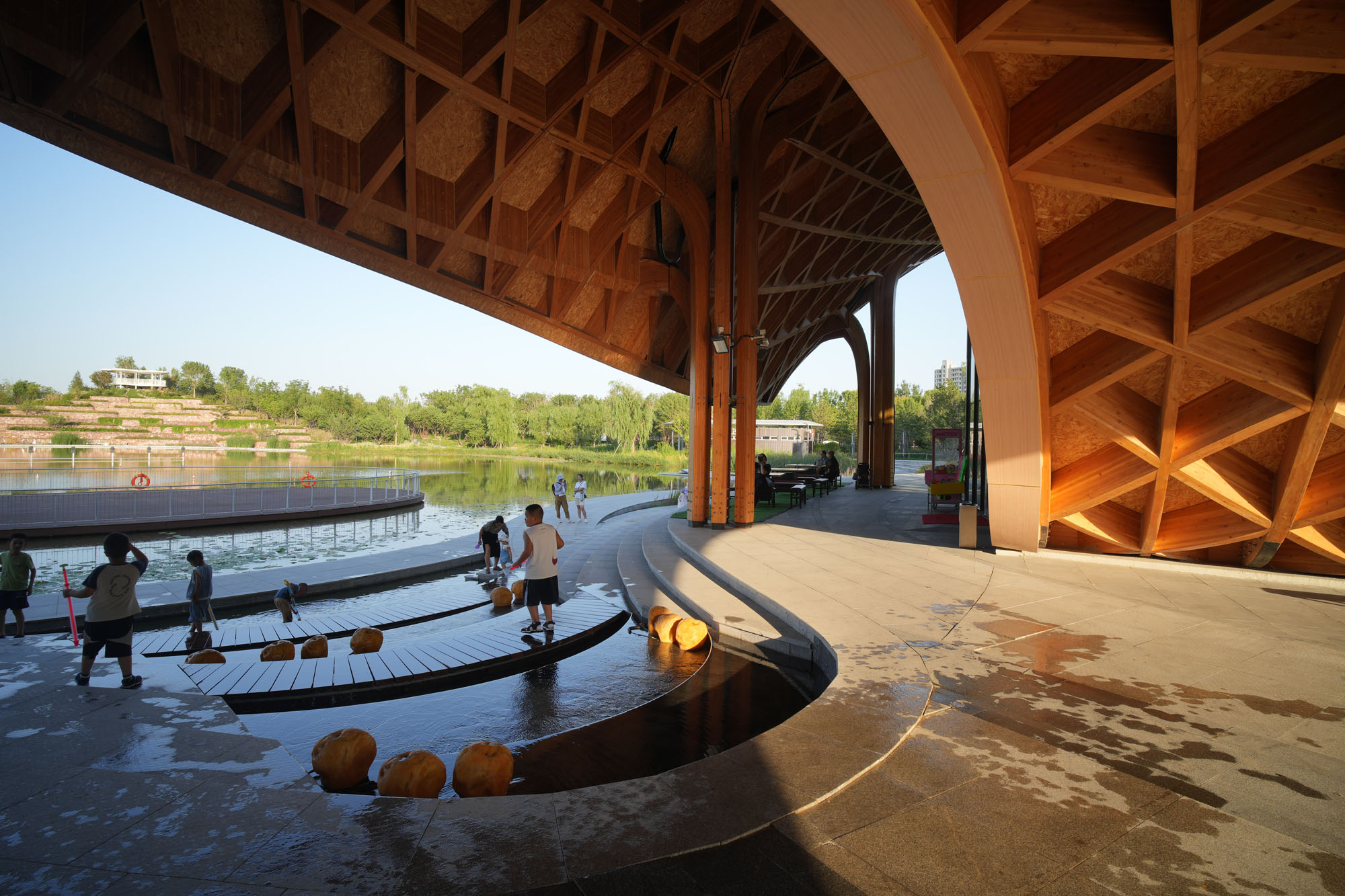
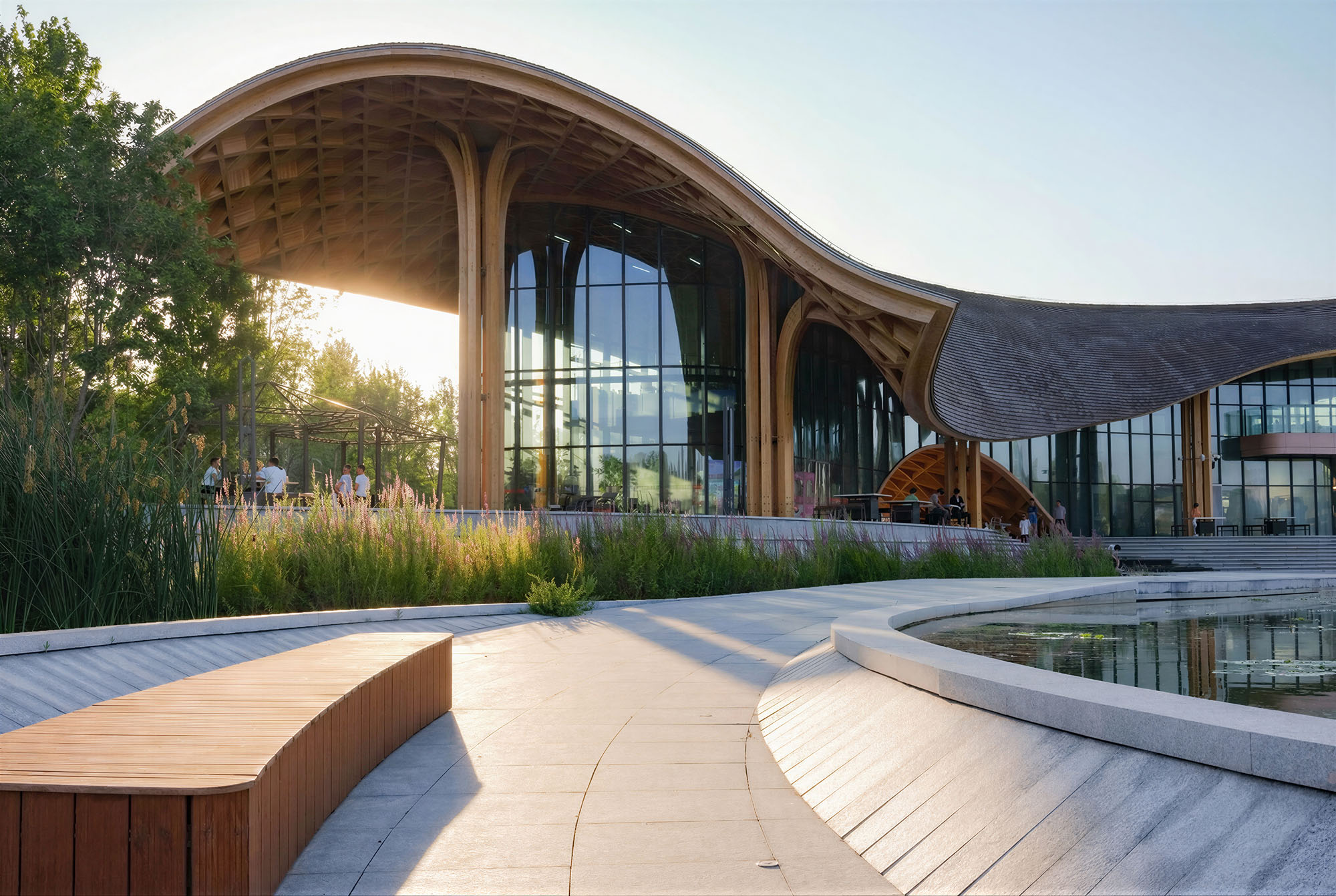
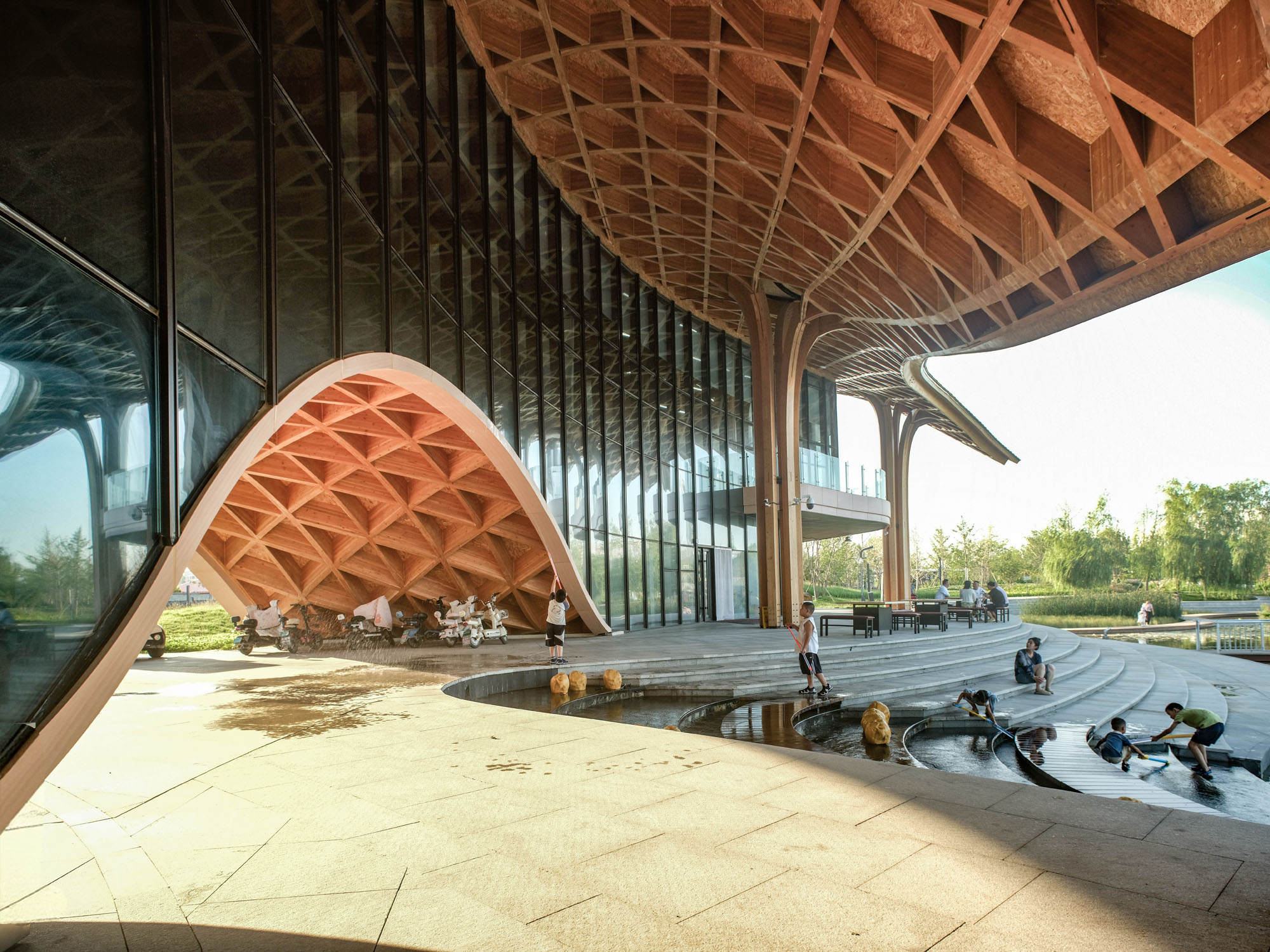
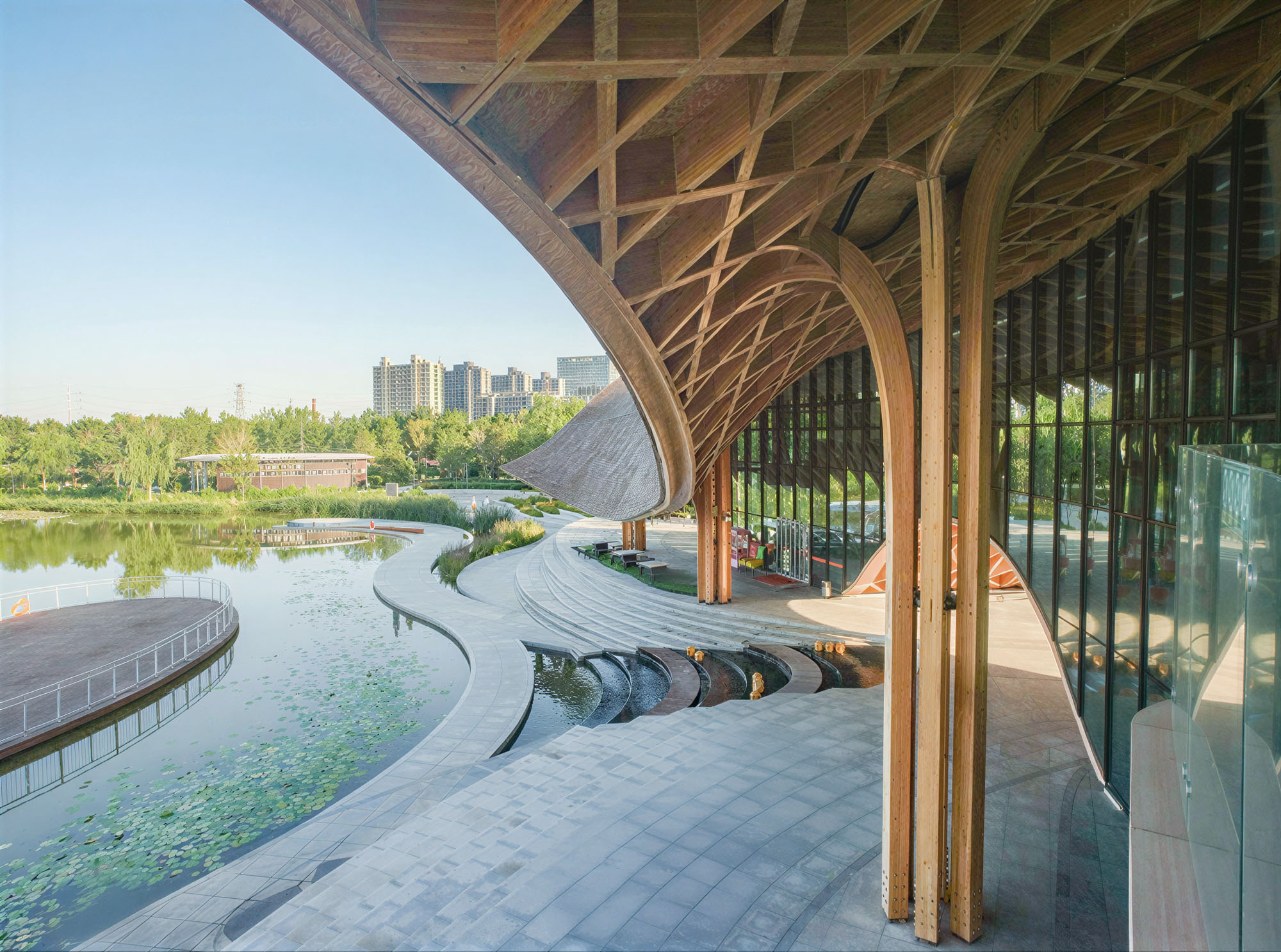
最終的に採用されたのは、建物を景観の動線と一体化させるアプローチである。来園者は庭園の小道を歩き、モダンな木製のアーチをくぐり、階段状のステップを降りて水辺のプラットフォームへと至る。
ずらして配置された木製のトレリスは、水辺に面したプラットフォームや2階のテラスと呼応している。これは、過度に長い建物形状の単調さを打破するだけでなく、半閉鎖的かつ半開放的なデザインを通じて、自然と建築の調和のとれた融合を実現するものである。
©︎ Chen Xinxing
©︎ Chen Xinxing
©︎ Chen Xinxing
周辺環境に応答する機能的なレイアウト
〈レイクサイド・レストラン〉は、南から北へと緩やかに傾斜し、南北方向に水辺に沿って伸びる全体形状を特徴としており、木造構造が主要な構造システムとして機能している。
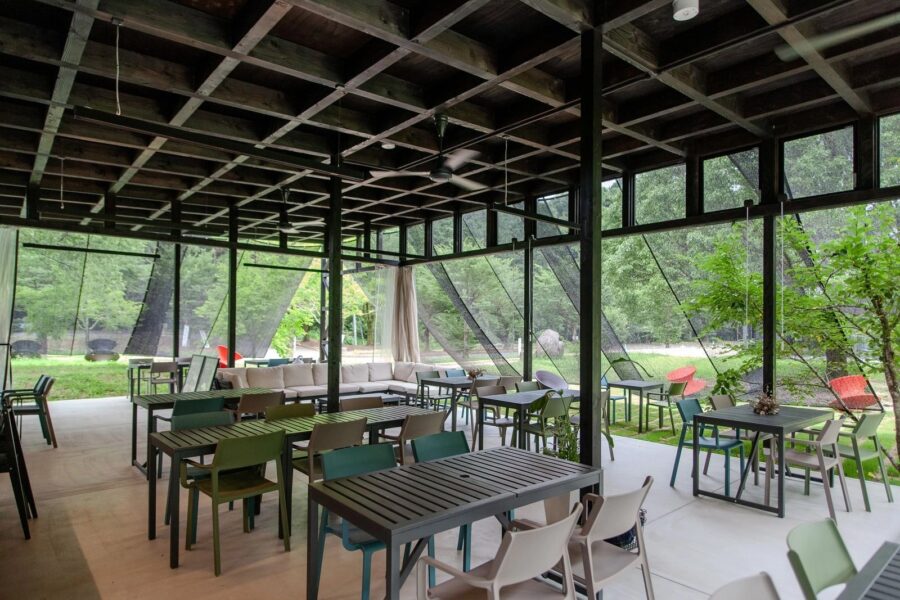
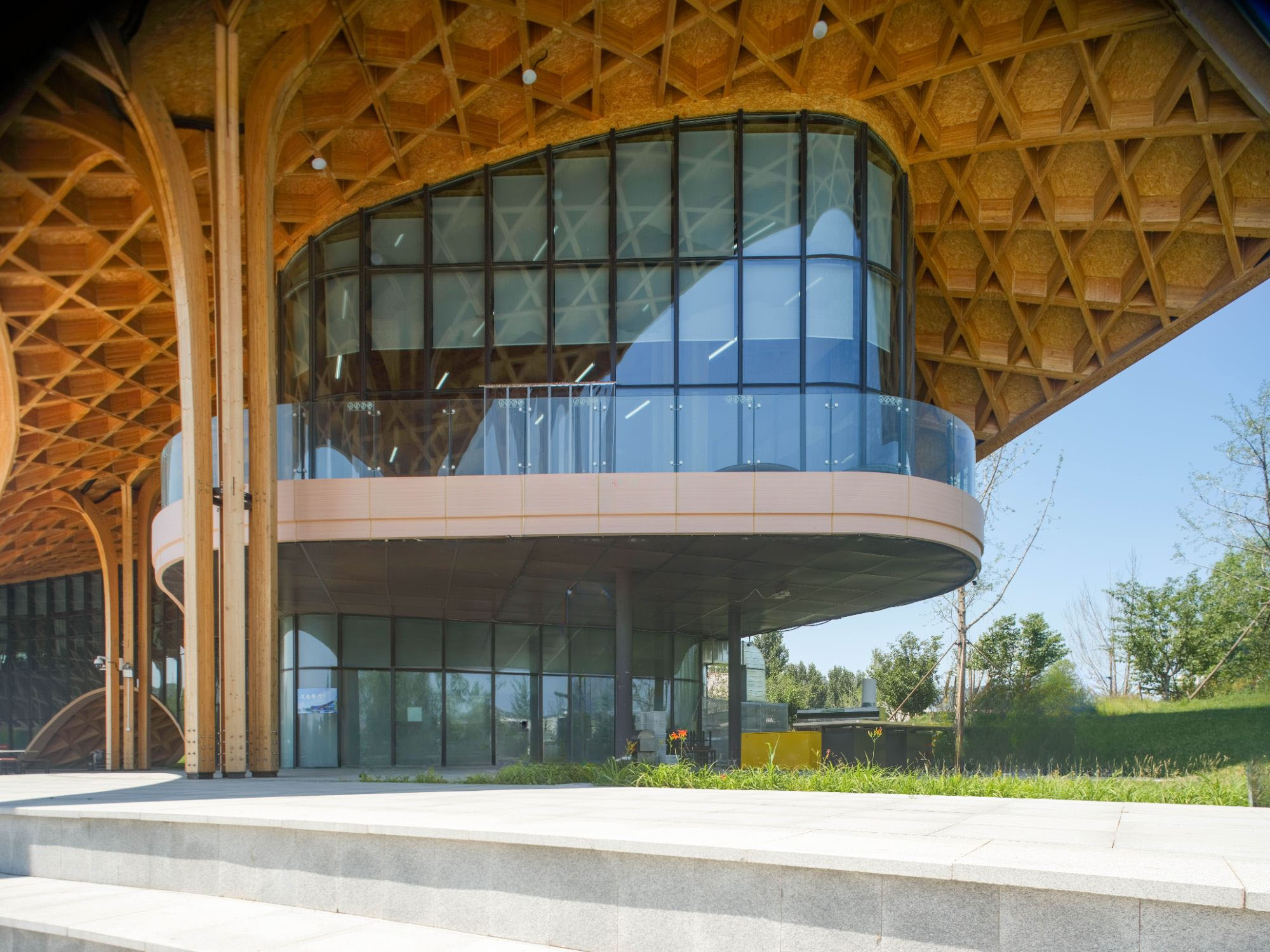
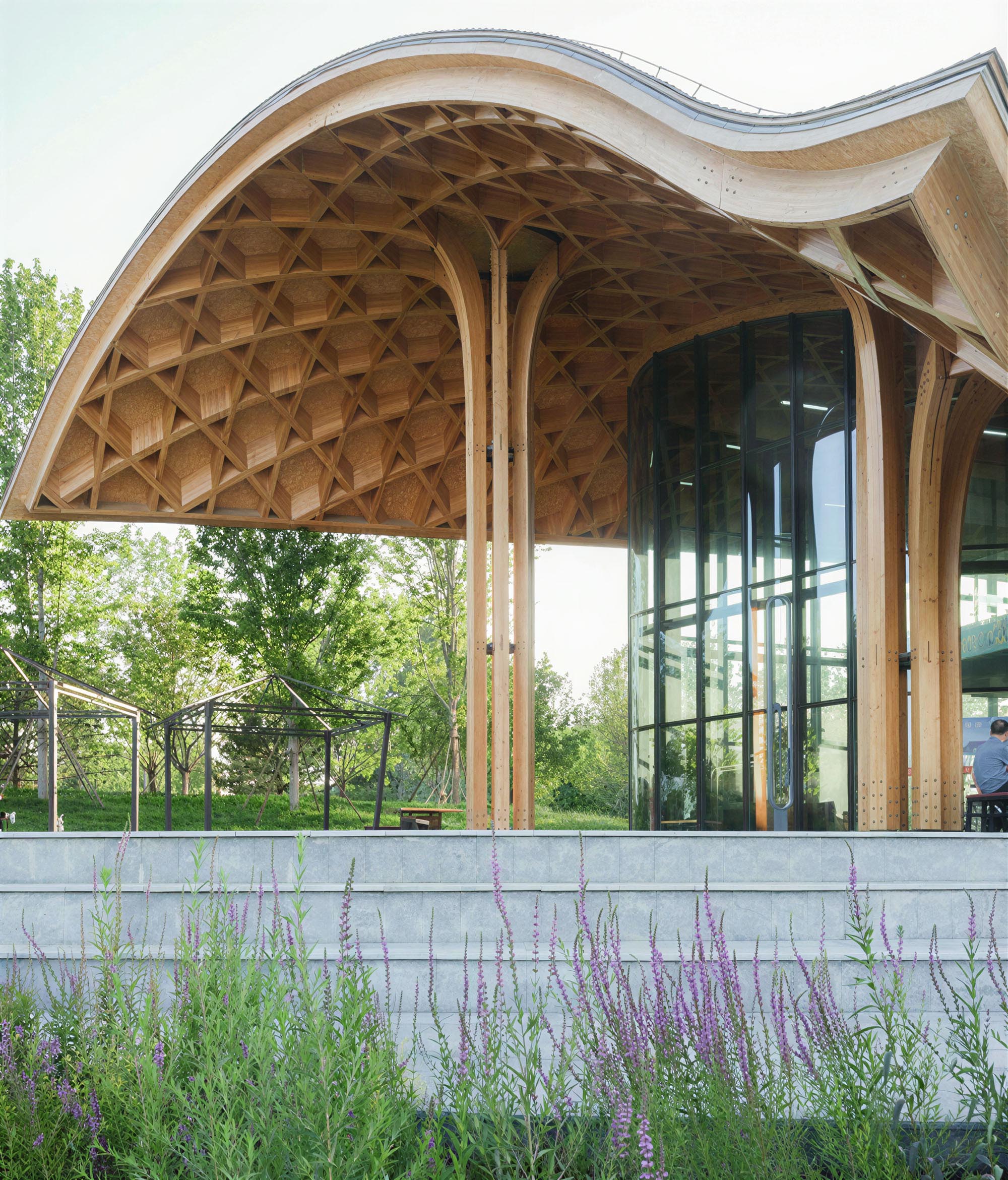
花開くような木製の柱と屋根のキャノピーは一体として設計され、森の樹冠のイメージを緻密な精度で再現している。機能的なレイアウトは明確に定義されており、南側の1階には半吹き抜けのエントランス・レセプションおよび展示エリアを配置し、上層階にダイニングエリアを設けている。また、1階はアーチ型の通路をまっすぐ通り抜けられる構造となっている。
©︎ Chen Xinxing
©︎ Guan Xiaoqing
一方、北側は2階建てのダイニングスペースで構成されている。メインの庭園小道に面する西側のファサードは、比較的閉鎖的なデザインである。これにより、キッチンやその他の補助機能を隠しつつ、来訪者を中央のアーチへと導き、そこから直接水辺へと至る動線を形成している。
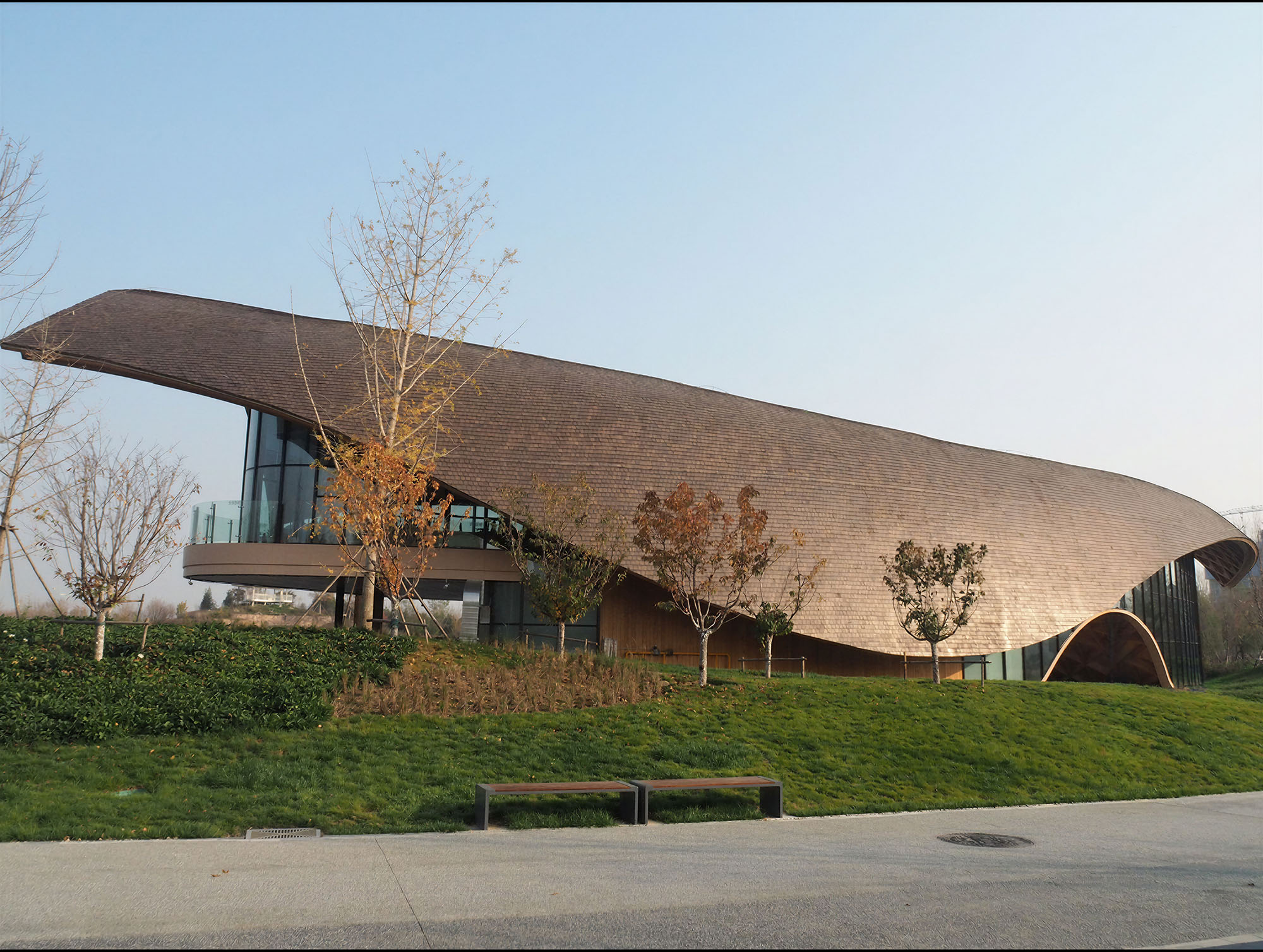
南、北、東のファサードは湖を見渡す設計であり、張り出した屋根が来訪者の動線に合わせてうねることで、変化に富んだ多層的な軒下空間を生み出している。視線を導き、湖を見渡し、立ち止まってくつろぐという、段階的な空間体験を提供する。
©︎ BOEY YING YAN
©︎ Guan Xiaoqing
屋根のうねりが生み出す3つの空間体験
屋根のダイナミックなうねりは、3つの特徴的な空間体験を創出している。
- 南端:低く張り出した軒が視覚的なアンカーとなり、その傾斜は湖岸の勾配に沿って水面へと視線を誘う、親密で人間的なスケールの雰囲気を醸し出す。
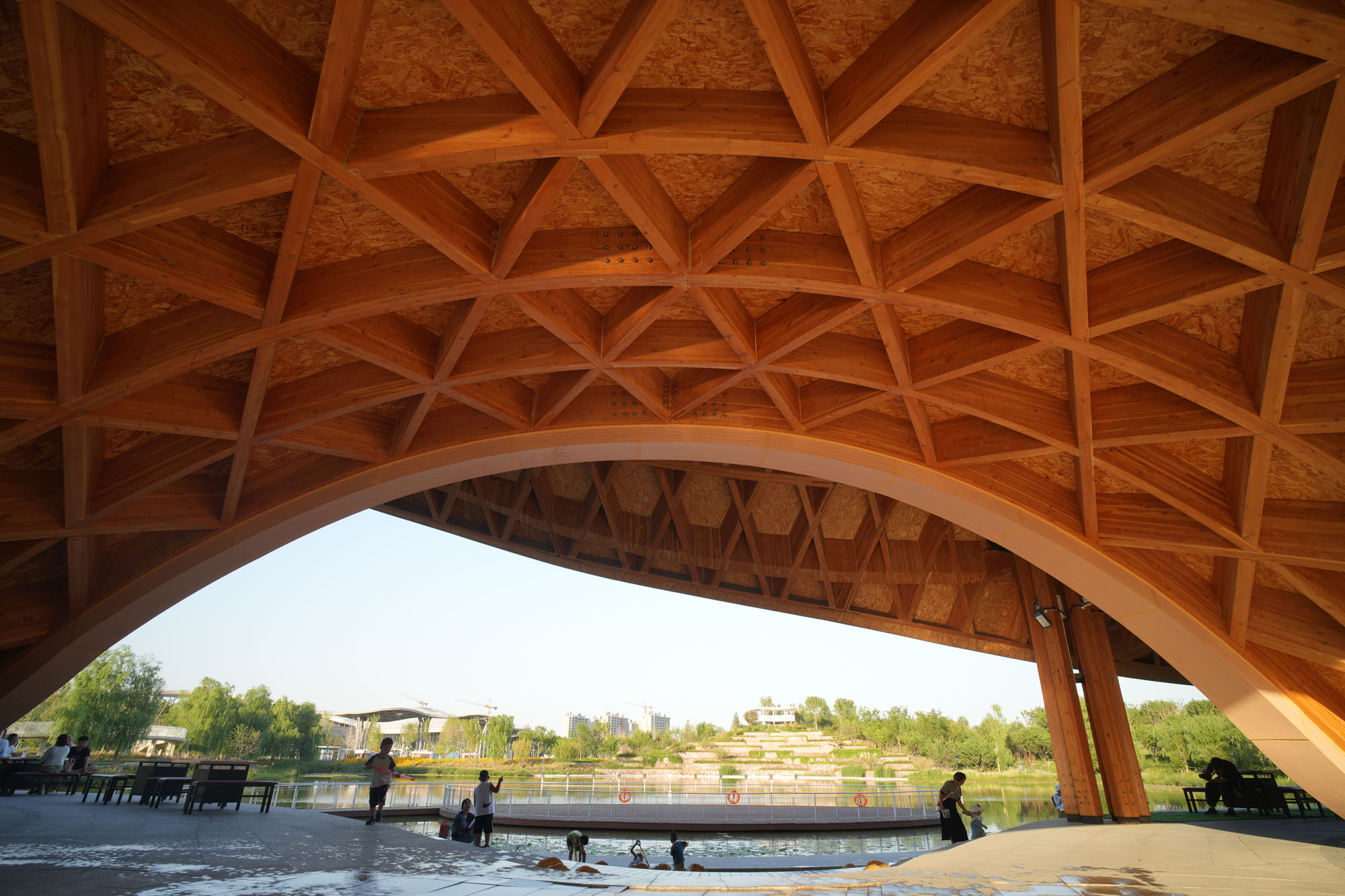
- 中央アーチ部分:屋根が森の樹冠が裂けたかのように急激に立ち上がり、交通の要所であり視覚的な回廊として機能する。ここを通る来訪者は、囲まれた庭園の小道と開けた湖の眺望の間を移動する際、「森の隙間から差し込む湖面の木漏れ日」のような詩的な変化を体験する。
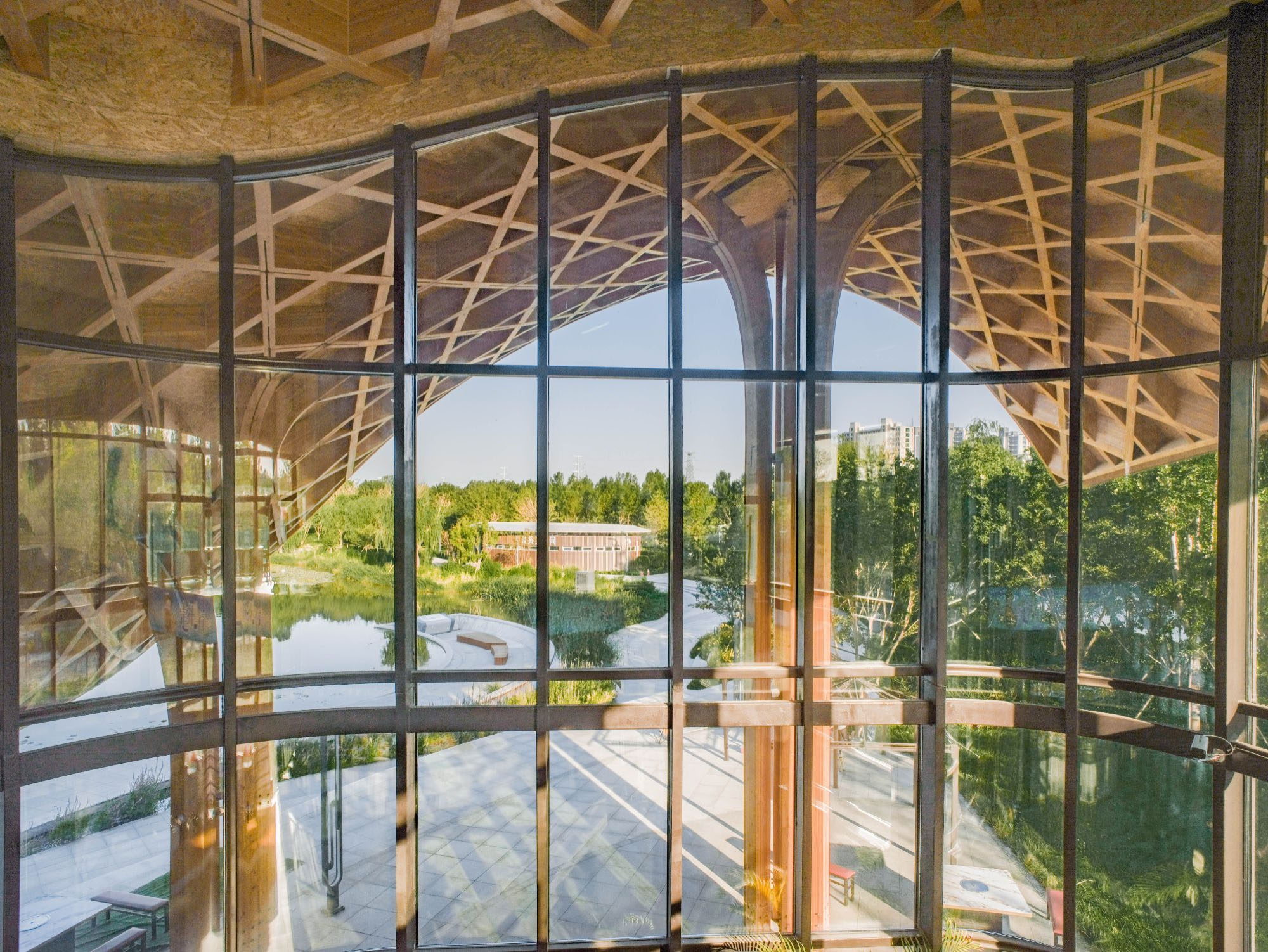
- 北端:屋根が最高点に達し、広大な片持ちテラスが湖の上へと伸びている。ここでは、木製の柱が樹木の幹が天へと伸びる様子を模し、絡み合う木製の梁が樹冠の疎密な配置を再現することで、湖の眺望を最大限に引き立て、鑑賞体験の閉じたループを完成させている。
©︎ Guan Xiaoqing
©︎ Guan Xiaoqing
パラメトリックデザインを用いた木造構造
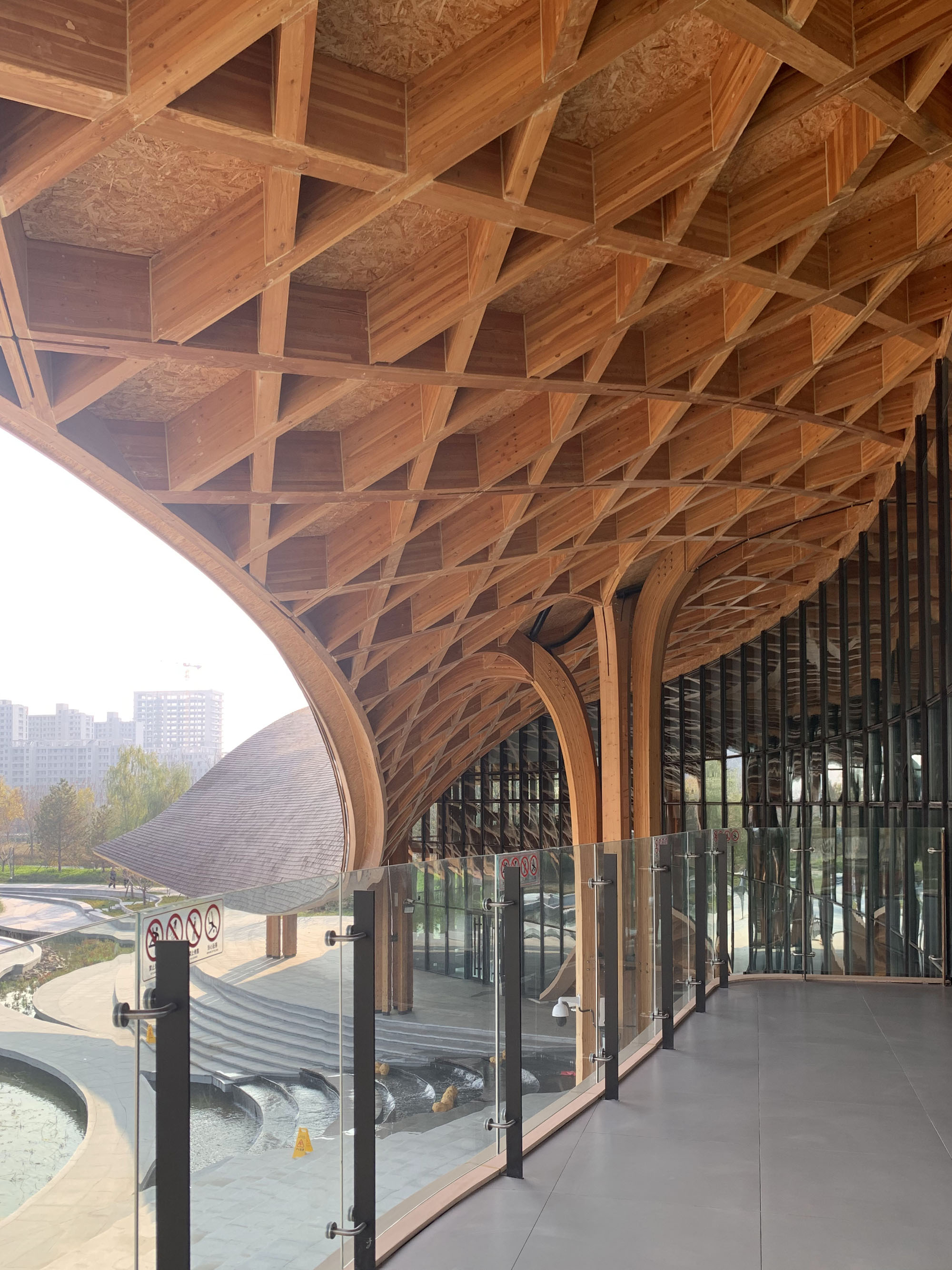
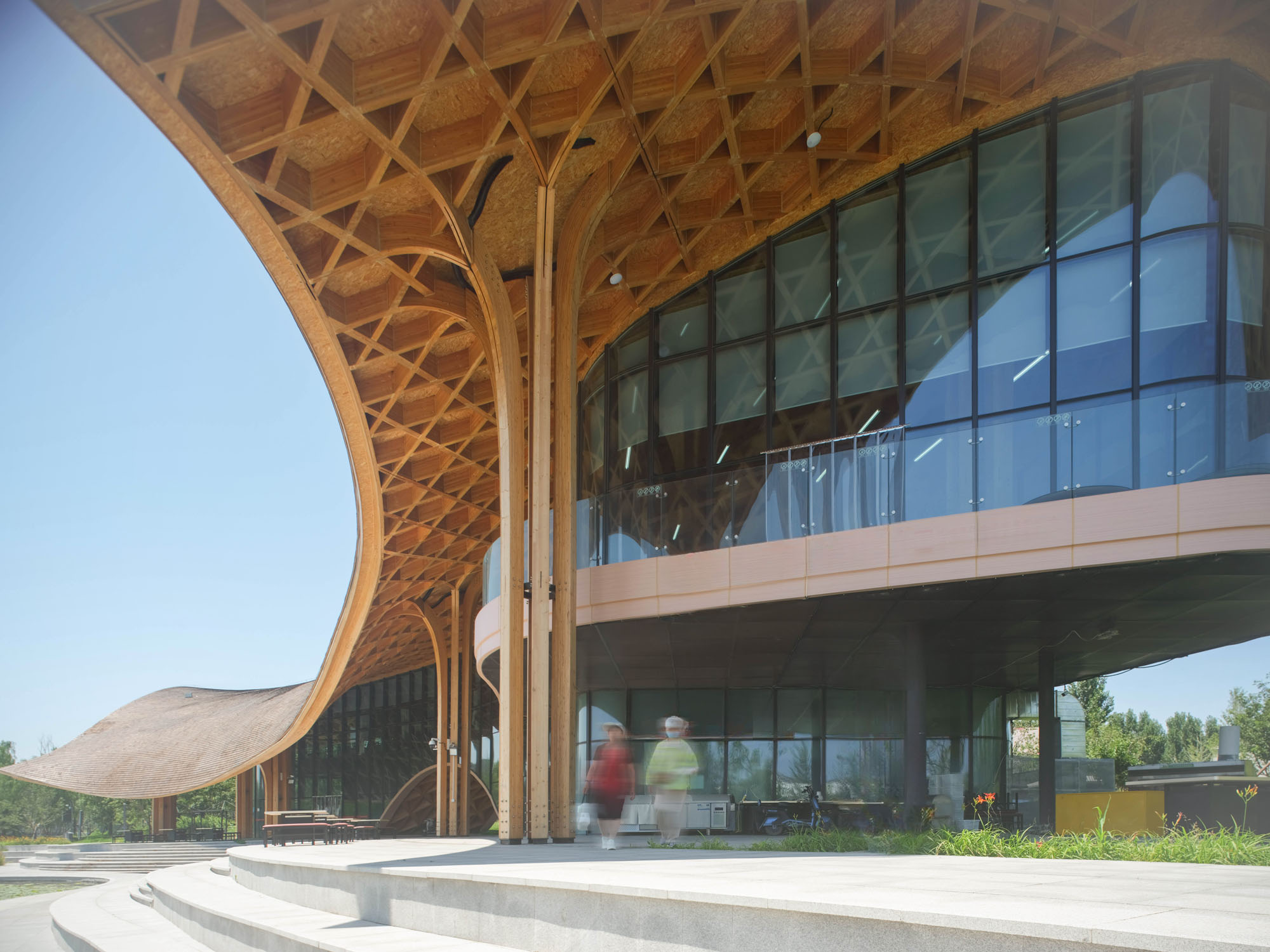
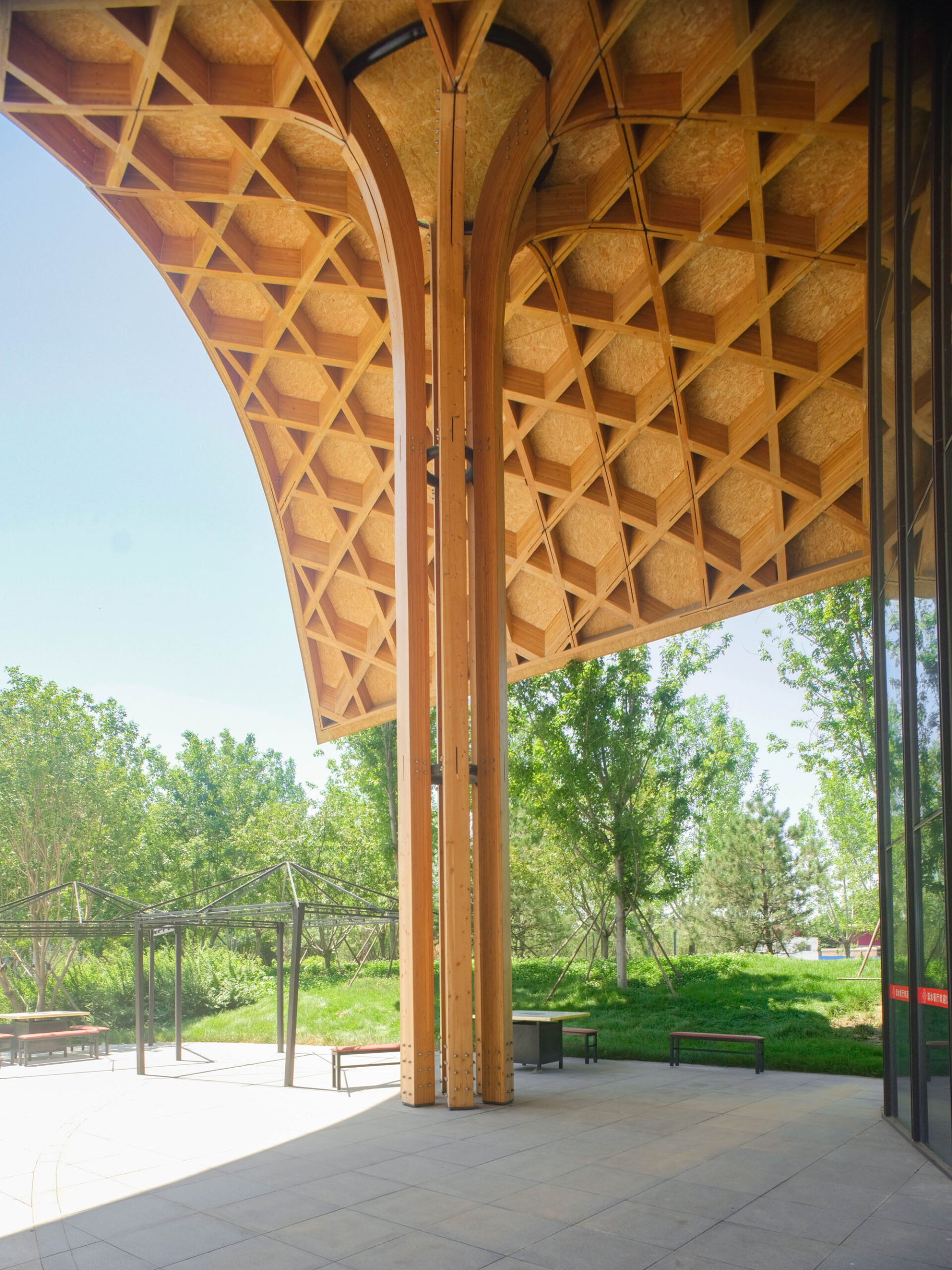
施工面において、本プロジェクトは現代的な集成材を主要な材料として採用している。花開くような木柱はフルティンバー切断技術で製作され、二股に分かれた柱頭部は屋根のキャノピーと自然に接続している。
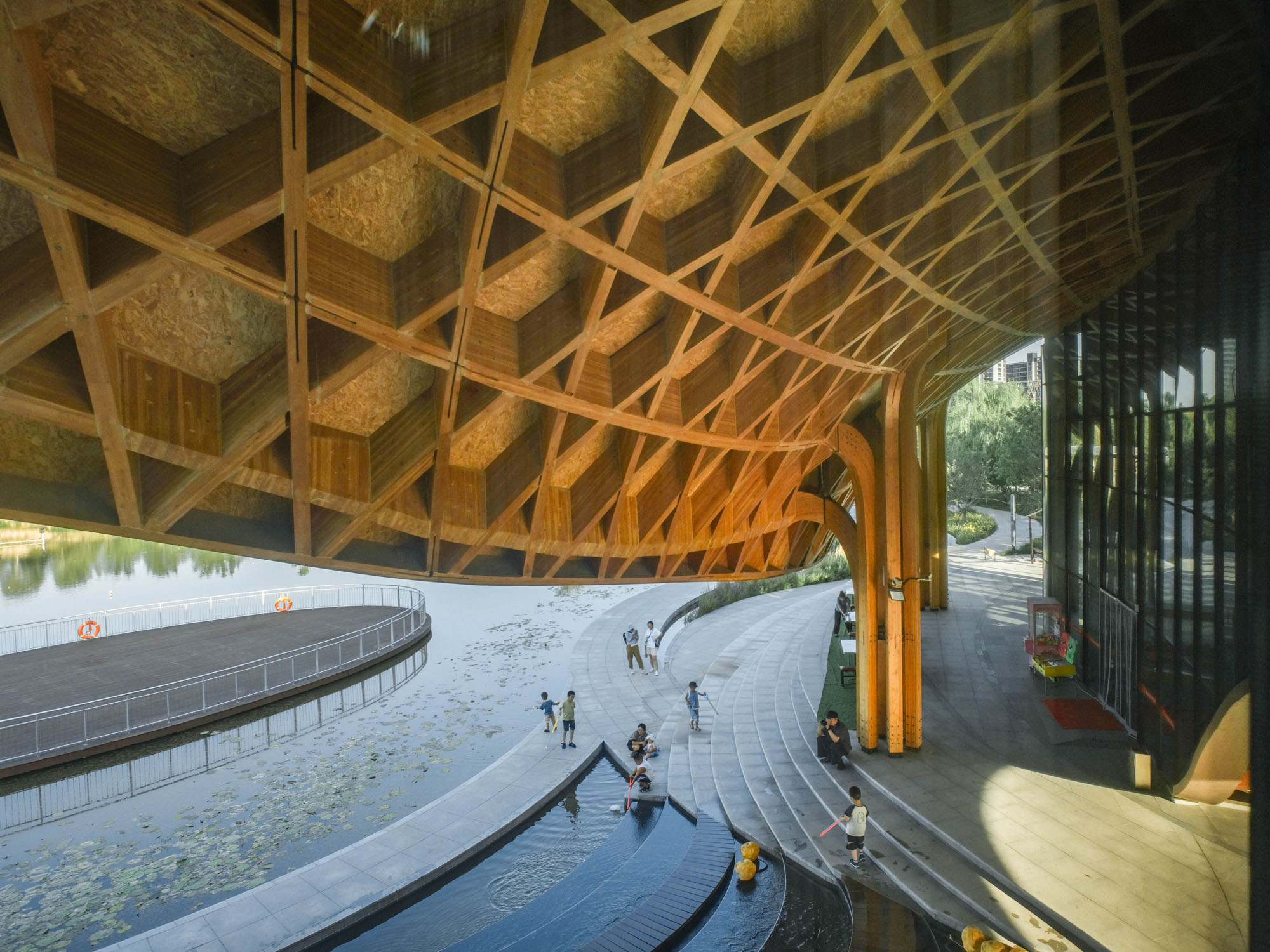
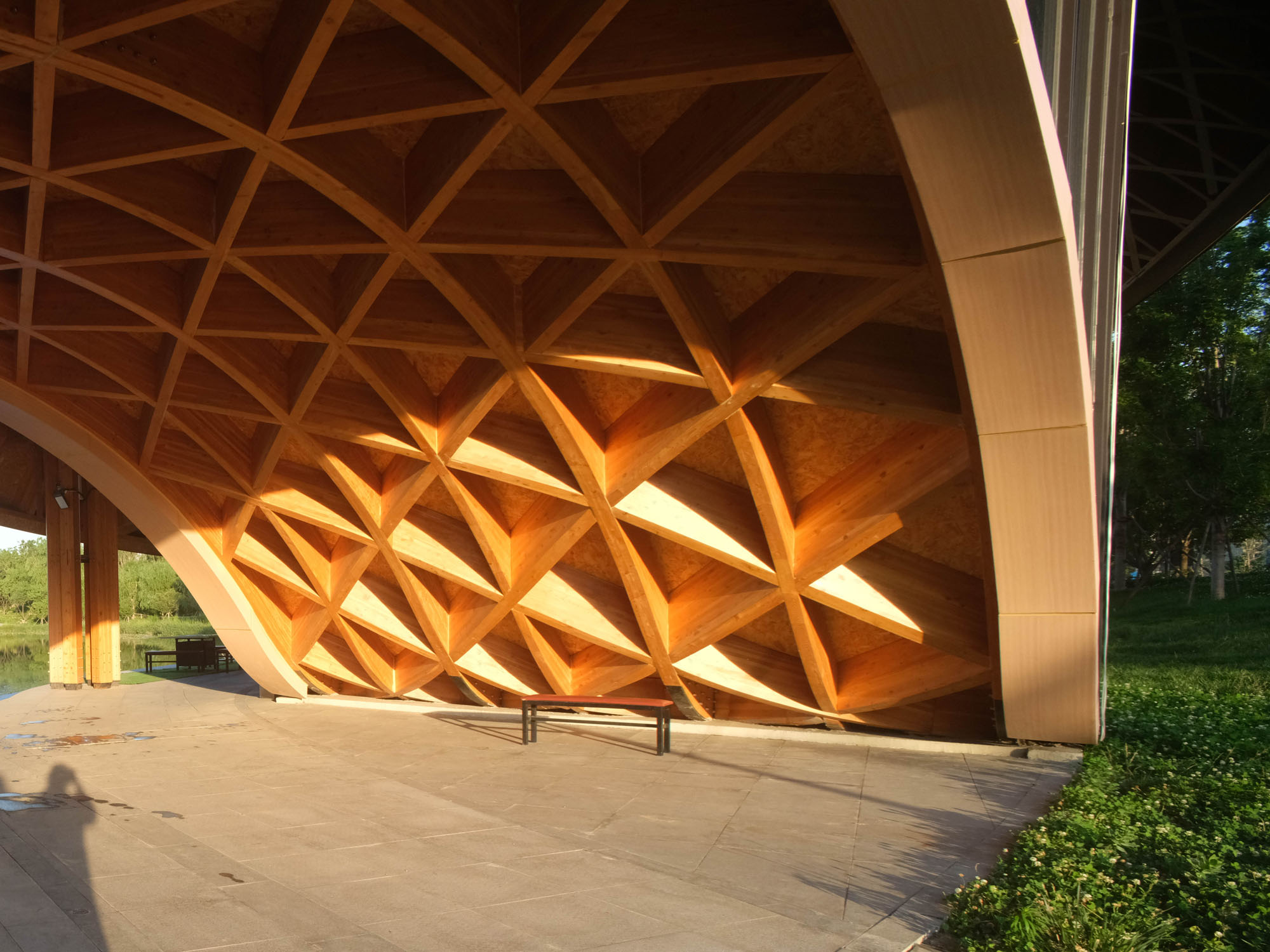
屋根の木製梁の曲げ半径はパラメトリックデザインによって制御され、モデルを何度も反復した結果、8つの花開く木柱のクラスターが主要な耐力部材として決定された。屋根構造は二方向交差システムから三方向交差システムへとアップグレードされ、六角形と三角形のユニットからなるグリッドを形成している。
この設計は、力学的な要件を満たすだけでなく、細長い構造部材によって鬱蒼とした森の樹冠のイメージを強調し、経済効率と構造安全性のバランスの取れた統合を実現している。
©︎ Guan Xiaoqing
©︎ Guan Xiaoqing
デジタル技術と職人技の融合
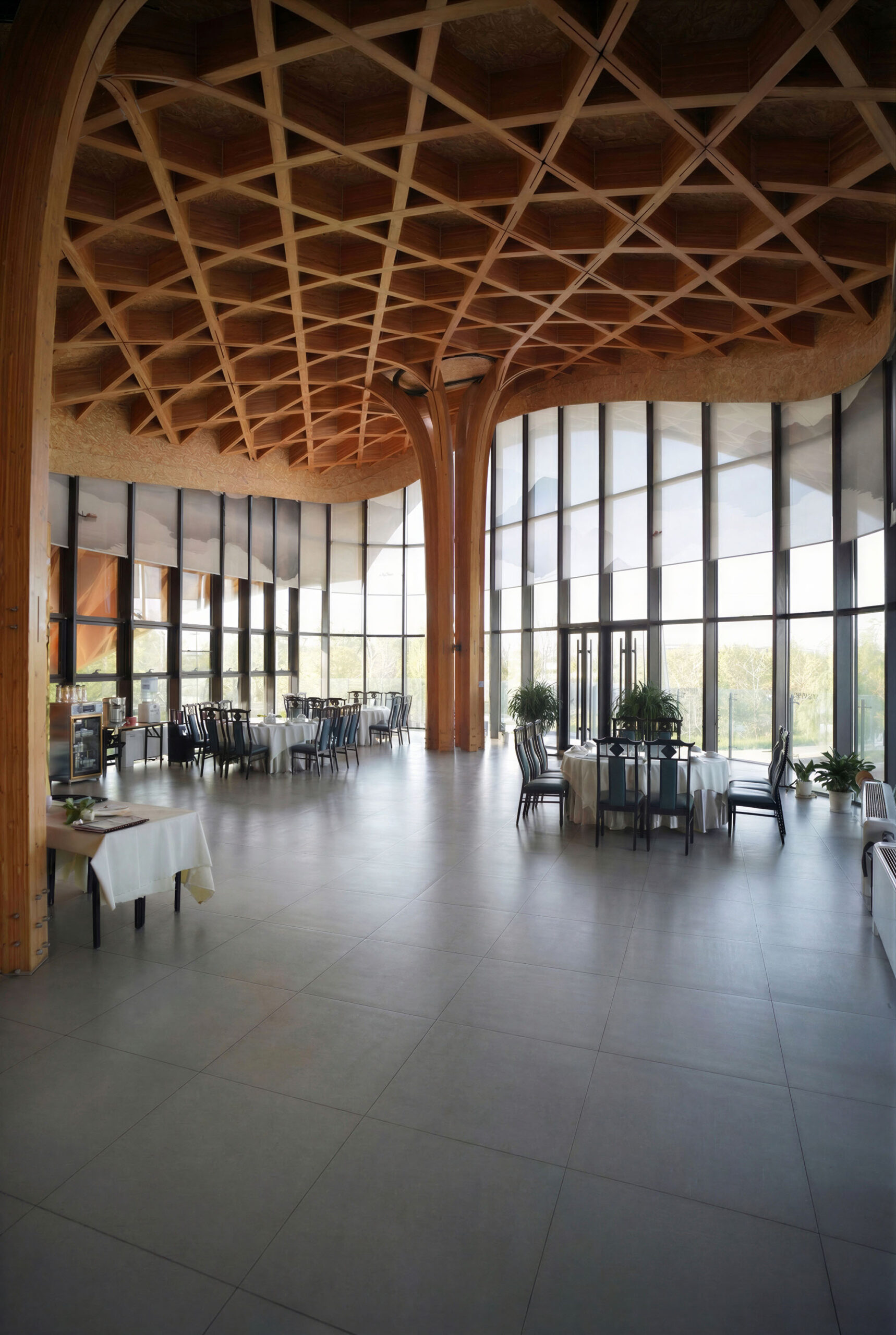
施工段階では、デジタル技術と工業的なプレファブリケーション化により精密な形状制御を達成した。同時に、デジタルツールを用いて木製部材の寸法を最適化し、人間的なスケールで木材の触覚的な職人技を引き出している。
昼間は、軒先の木造構造がガラスファサードに影を落とし、没入感のある層状の森林樹冠の雰囲気を醸し出す。夜になると、内部の照明が点灯してカーテンウォールの境界を曖昧にし、曲線を描く木造構造全体が鮮やかな流動性を放ち、その姿を余すところなく披露する。
©︎ Chen Xinxing
自然と共存するランドマーク
湖畔の風景に着想を得た〈レイクサイド・レストラン〉は、デジタル木造構造の設計と施工を活用し、工業的な精密制御と伝統的な木工の職人技を完璧に融合させている。
その結果、自然と調和して共存する自由で生き生きとしたウォーターフロント空間を形成し、卓越した景観価値と没入感のある体験を兼ね備えた、定州シルクロード・フレンドシップ・パークの象徴的なランドマークとして誕生したのである。
©︎ Guan Xiaoqing
©︎ Guan Xiaoqing
©︎ Guan Xiaoqing
©︎ Chen Xinxing
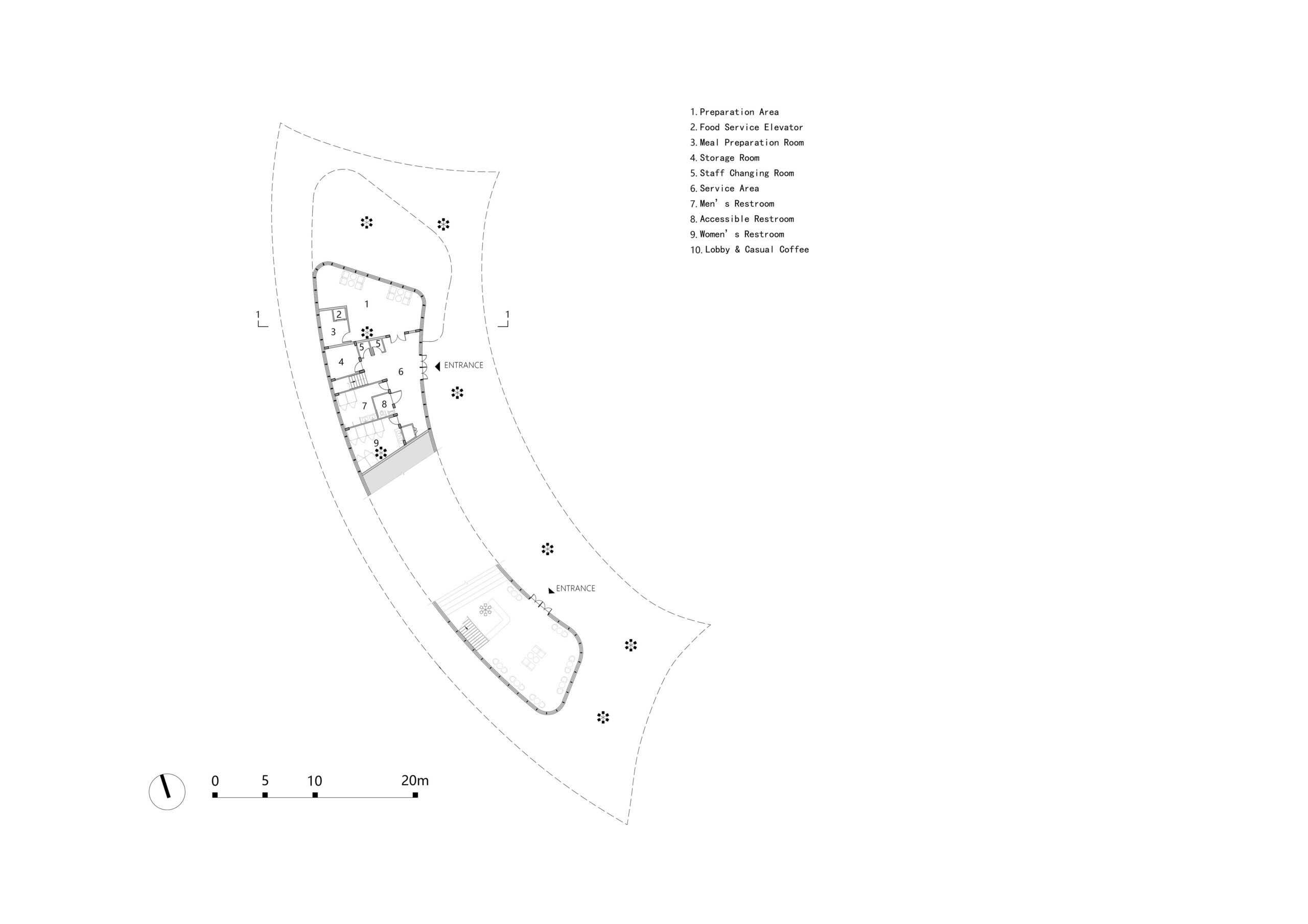
First Floor Plan
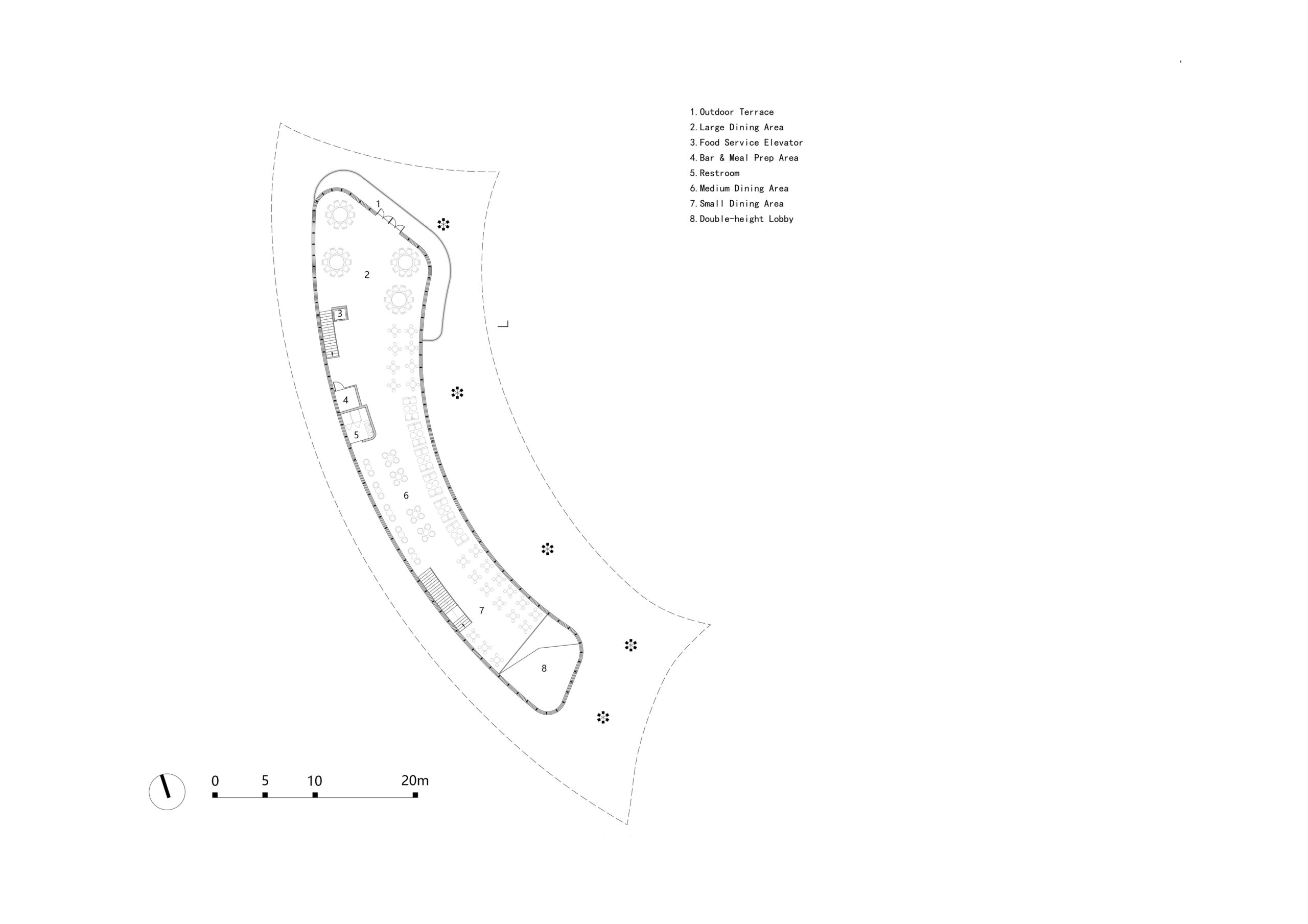
Second Floor Plan
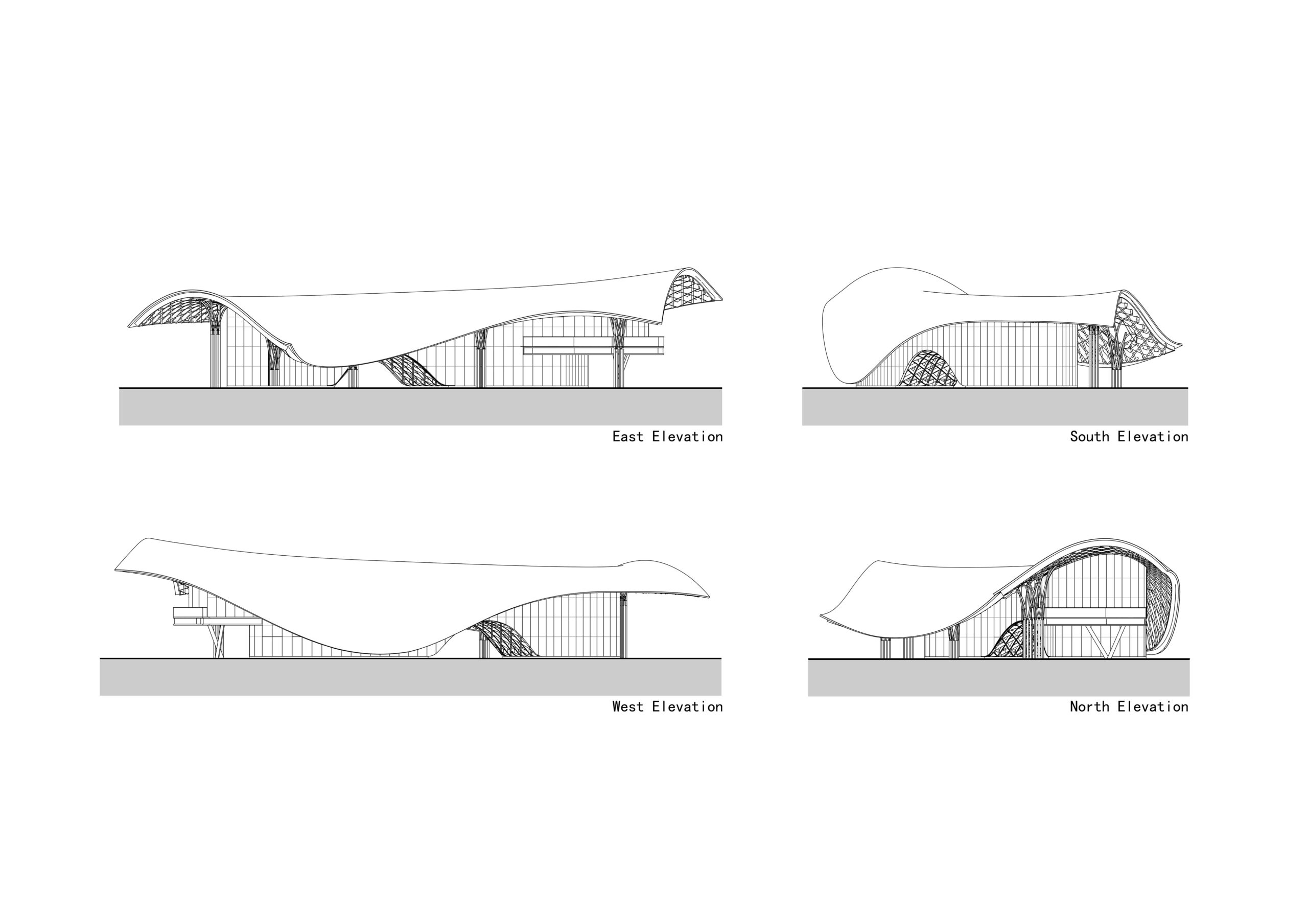
Elevation
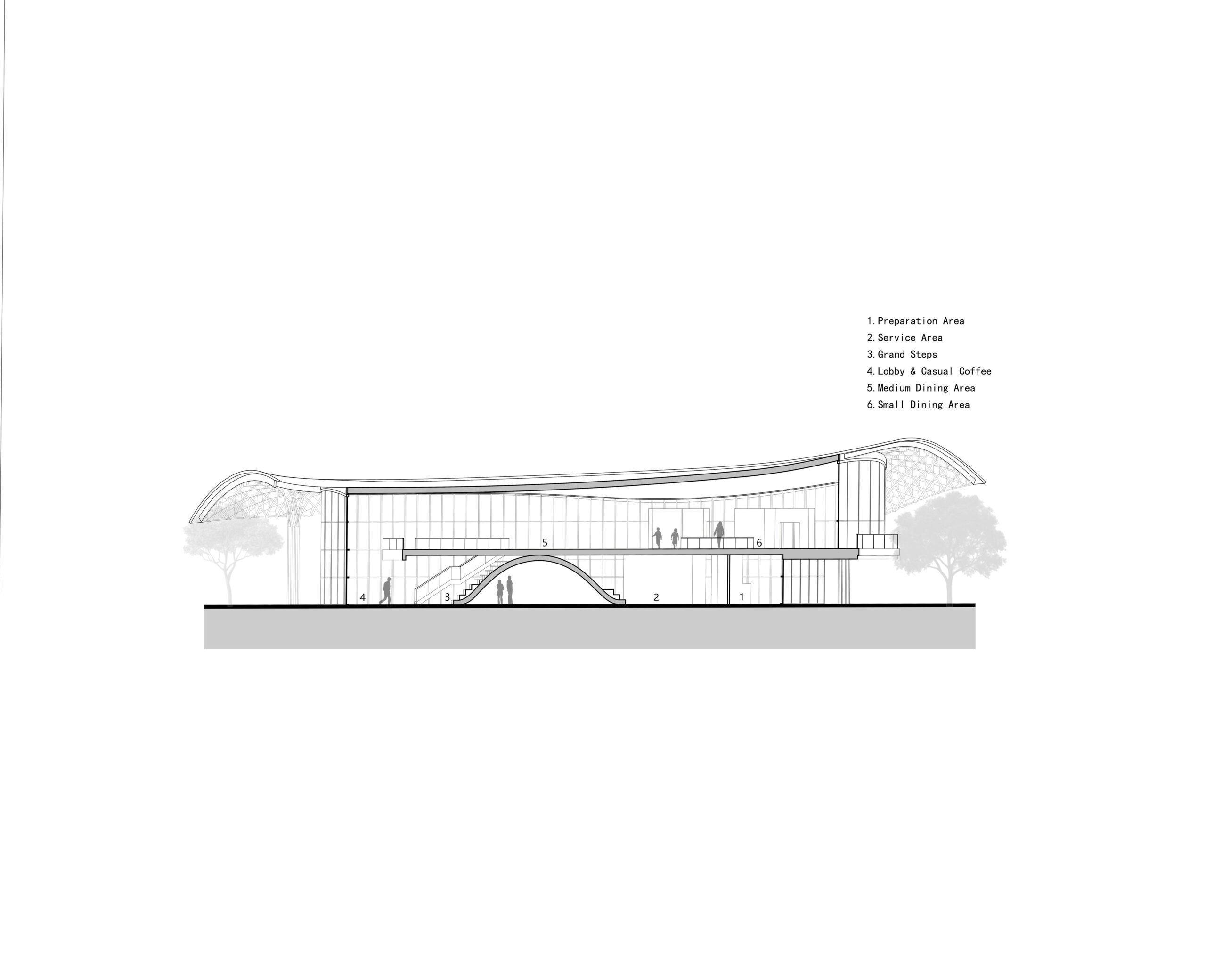
Section
以下、SUPアトリエのリリース(英文)です。
Forest Canopy and Archways – Lakeside Restaurant at Silk Road Friendship Park in Dingzhou
The project is located in the core landscape area of the Silk Road Friendship Garden at the Dingzhou Garden Expo. The overall landscape design of the garden centers on the theme of auspicious clouds, with a circular landscape boulevard connecting the entire garden and a centripetal layout creating a diverse array of scenes. Among them, the restaurant unfolds gently along the curved shoreline of the central lake, its woven wooden structure forming a free and stretching curved form that resembles the undulating forest canopy. Blending seamlessly with the surrounding natural environment, it appears as if dancing gracefully.
From the very outset of the design process, the team focused on solving the challenges of the park’s compact layout and the preciousness of the lake space, striving to have the building blend seamlessly into the waterfront environment and avoid disrupting the water scenery. Ultimately, an approach that integrates the building with the landscape circulation routes was adopted. Visitors walk along the garden paths through modern wooden archways and reach the waterfront platform via cascading steps. The staggered wooden trellises echo the water-accessible platforms and the second-floor terraces, which not only breaks the monotony of the overly long building form but also achieves a harmonious integration of nature and architecture through a semi-enclosed, semi-open design.
The restaurant features an overall form that slopes gently upward from south to north and stretches along the shoreline in a north-south direction, with a wooden structure serving as its main structural system. The blossoming wooden columns and the roof canopy are designed as an integrated whole, echoing the imagery of a forest canopy with meticulous precision.Its functional layout is clearly defined: on the south side, the ground floor houses a semi-double-height entrance reception and exhibition area with a dining area on the upper level, and the ground floor runs straight through the archways; the north side consists of a two-story dining space. The west facade faces the main garden path and is designed to be relatively enclosed, concealing the kitchen and other auxiliary functions while guiding visitors to converge toward the central archways, through which they can reach the water’s edge directly. The south, north and east facades overlook the lake, with the roof cantilevering out to create a multi-layered under-eaves space that undulates and evolves with visitors’ circulation routes, forging a progressive spatial experience of guiding the view, overlooking the lake, and pausing to linger.
The dynamic undulations of the roof form create three distinctive spatial experiences: At the southern end, the low-hanging overhanging eave acts as a visual anchor, its slope following the incline of the shoreline to craft an intimate, human-scaled atmosphere that draws the eye toward the water surface; at the central archways, the roof rises abruptly like a parted forest canopy, serving as a transportation hub and a visual corridor—visitors passing through it experience a poetic shift from the “dappled lake light through forest gaps” as they move between the enclosed garden path and the open lake view; the roof ascends to its highest point at the northern end, where an expansive cantilevered terrace stretches out over the lake. Here, wooden columns mimic the upward growth of tree trunks, and interlaced wooden beams replicate the sparse and dense arrangement of treetops, maximizing the framing of lake views and completing the closed loop of the viewing experience.
On the construction level, the project adopts modern glued laminated timber as the primary material. The blossoming wooden columns are crafted with full-timber cutting technology, with the forked column capitals connecting naturally to the roof canopy. The bending radii of the roof wooden beams are controlled through parametric design, and after multiple model iterations, eight clusters of blossoming wooden columns were determined as the main load-bearing components. The roof structure was upgraded from a two-way crossed system to a three-way crossed one, forming a grid of hexagonal and triangular units. This design not only meets mechanical requirements but also reinforces the imagery of a dense forest canopy with slender structural members, achieving a balanced integration of economic efficiency and structural safety.
During construction, the project achieved precise form control through digital and industrial prefabrication, while optimizing the dimensions of wooden components via digital tools to bring out the tactile craftsmanship of wood at a human scale. By day, the wooden structure of the eaves casts shadows onto the glass facades, evoking an immersive layered forest canopy ambiance; by night, the interior lights are turned on, blurring the boundaries of the curtain walls and allowing the entire curved wooden structure to exude vivid fluidity in full display.
Inspired by the lakeside scenery, this restaurant leverages digital wooden structure design and construction to perfectly integrate industrial precision control with traditional woodworking craftsmanship. It ultimately shapes a free and vivid waterfront space that coexists in harmony with nature, emerging as an iconic landmark in Dingzhou Silk Road Friendship Garden that boasts both outstanding viewing value and an immersive experiential feel.
Project Name: Lakeside Restaurant at Silk Road Friendship Park in Dingzhou
Location: Dingzhou City, Hebei Province
Floor Area: 2,400 m²
Completion Date: 2025
Overall Site Design: DDON
Architectural Team: SUP Atelier of THAD&GUANGZHOU BOSHA ARCHITECTURAL DESIGN INSTITUTE CO., LTD
Principal Architects: Song Yehao, Chen Xiaojuan
Architectural Design Team: Xie Dan, Boey Yingyan, Gao Weizhi, Guan Xiaoqing, Chen Kaile, Shi Lei, Shi Chunxue, Wang Yichao
Structural Consultancy: LuAn Lu Partners Structure Consulting
Lighting Design: One Lighting Studio of THAD
SUPアトリエ 公式サイト
https://www.supatelier.com/

![[Report]方丈庵から生き方を問う、21_21 DESIGN SIGHT 企画展「方丈記に学ぶ –生きるを編み直す小さな建築–」会場レポート](https://magazine-asset.tecture.jp/wpcms/wp-content/uploads/2026/09/01181900/20260828hojoki-ex_01_mag-endo4350-900x676.jpeg)