

CULTURE

© Kuster Frey
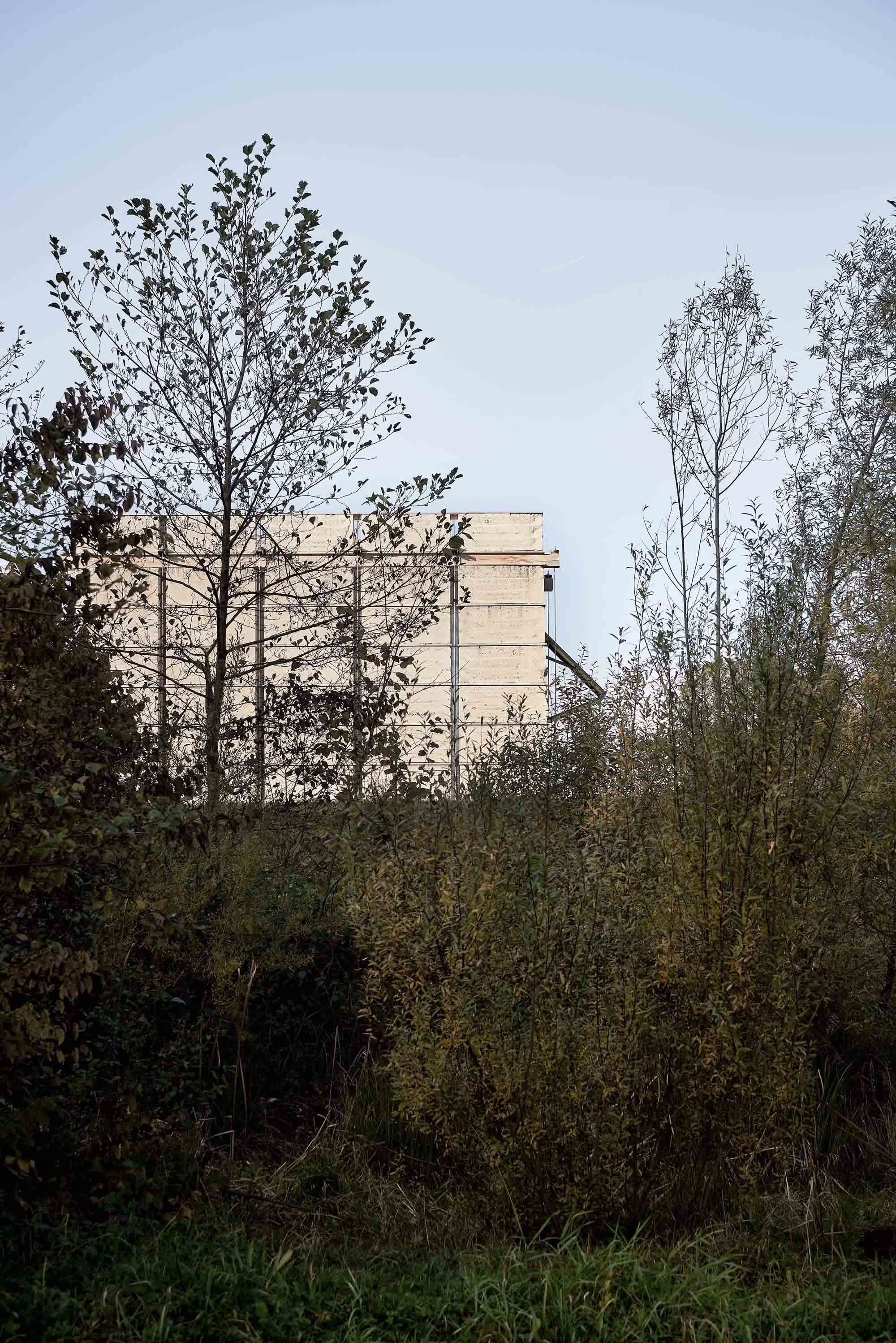
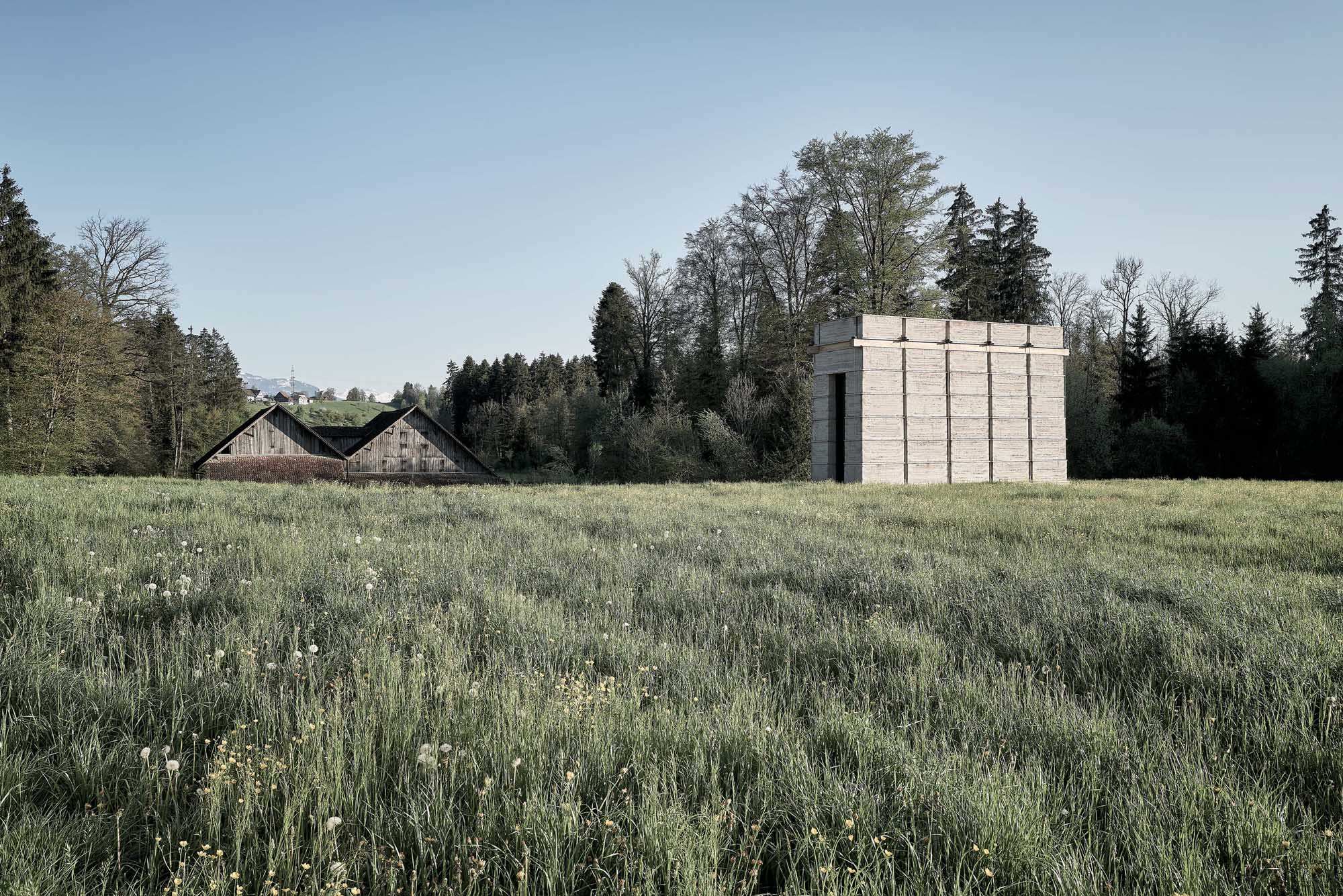
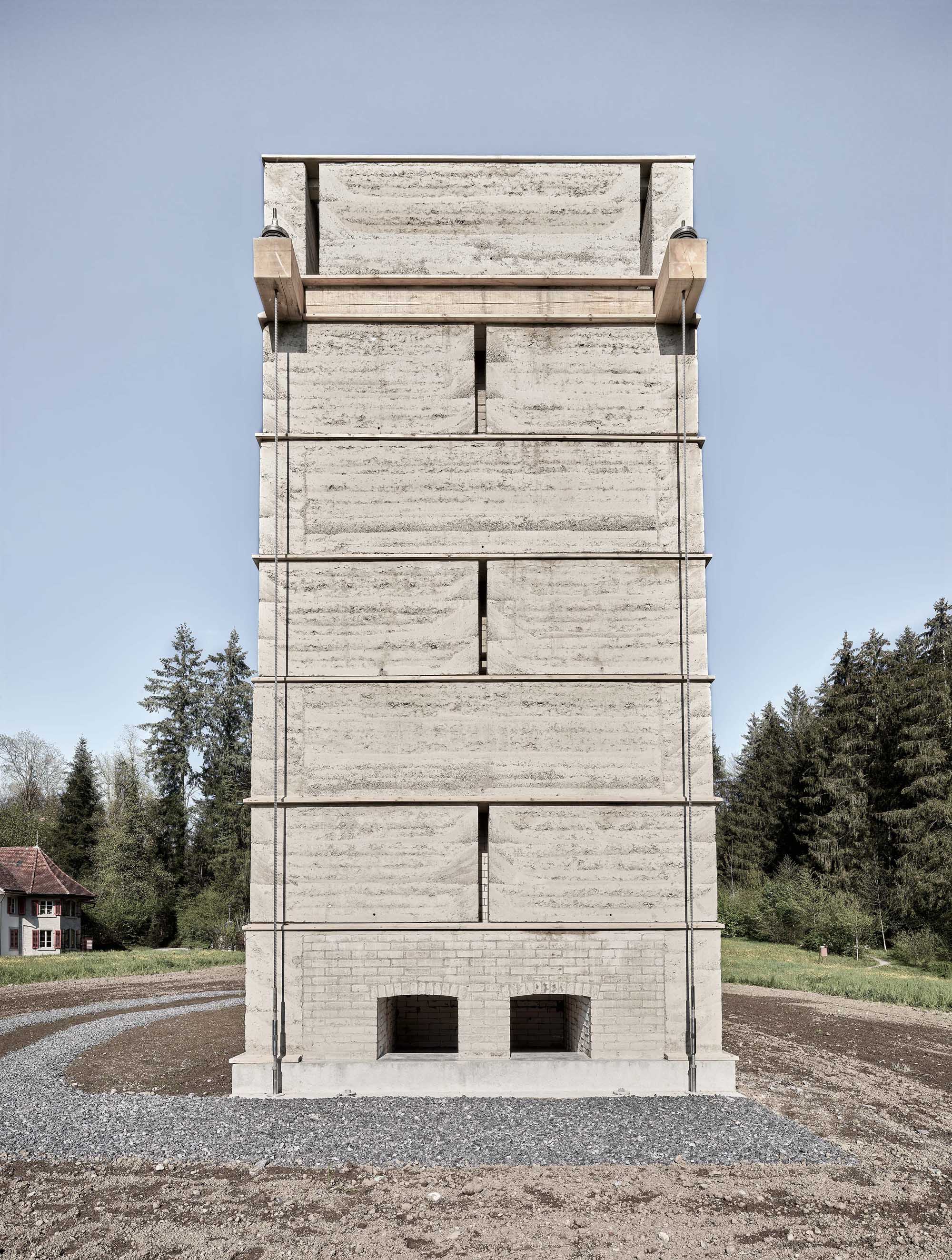
スイスのシャムに位置する〈窯の塔(Kiln tower)〉は、〈ブリックワークス博物館(Brickworks Museum)〉に建てられた世界初のプレストレスト土建築です。
チューリヒを拠点とするボルツハウザー・アーキテクテン(Boltshauser Architekten)が設計しました。
注目ポイント
- 圧縮に強い「版築(土)」と引張に強い「鋼材」を組み合わせたプレストレス構造
- 土建築の課題であった「耐震性」の確保と「多層化」の可能性を実証
- プレファブリケーションによる継ぎ目を意匠へ昇華し効率化
- 「10年後の解体」を前提とした、容易に分解・取り外しが可能な建築
(以下、ボルツハウザー・アーキテクテンから提供されたプレスキットのテキストの抄訳)
© Kuster Frey
© Kuster Frey
歴史的背景とプロジェクトの成り立ち
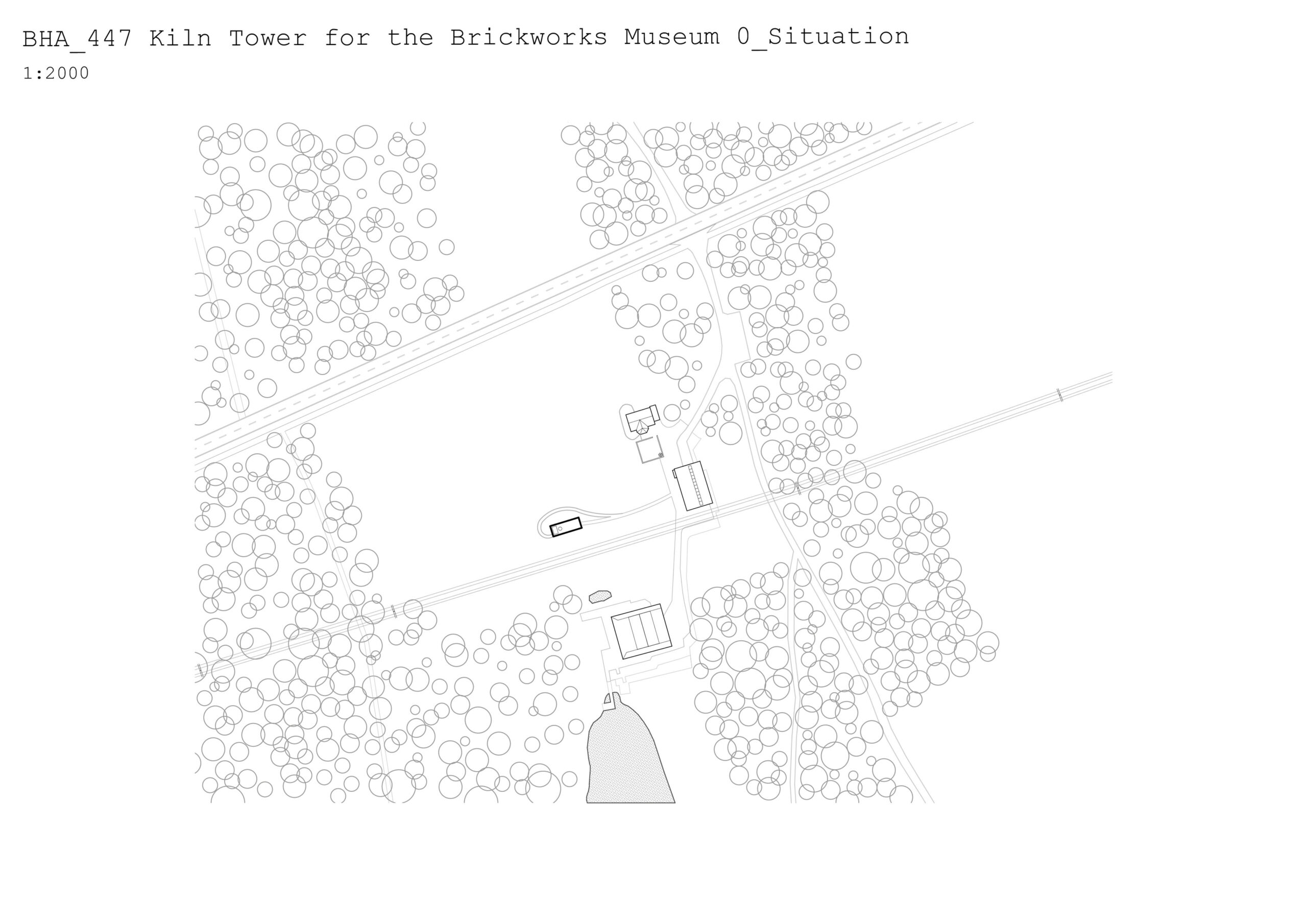
シャムに建つレンガ小屋は、現在ブリックワークス博物館によって運営されており、ドイツ語圏スイスにおいて手作業によるレンガ製造の遺構が唯一完全な形で現存する貴重な施設である。
保護対象となっているこの建造物群は、木造のレンガ乾燥小屋、現在は使用が禁止されている窯、歴史的な粘土採掘場のビオトープ、庭園付きの住宅、そして焼失した納屋の跡地に建てられた博物館で構成されている。
© Kuster Frey
2017年、ミュンヘン工科大学の客員教授のもとで学ぶ学生たちが、この敷地内に新しい「窯の塔」を設計する課題に取り組んだ。ロバート・ゲントナー(Robert Gentner)とレジーナ・ペッツィンガー(Regina Pötzinger)による学期課題案が現在のプロジェクトの基礎となっており、ザンクト・ガレンのシッターヴェルクにて実施されたモックアップを直接参照した、世界初の「プレストレスト土建築(prestressed earth building)」である。
この塔は、2019年にブルンネンにある旧セメント工場跡地で開催されたチューリッヒ工科大学のサマースクールの一環として製造された粘土要素を用いて組み立てられた。この実践では、スイスの建設会社LEHMAG AGの指導のもと、チューリッヒ工科大学、ミュンヘン工科大学、および国内外の大学から集まった約30人の学生たちが、このプロジェクトを通じて版築工法の実践的な経験を積んだ。
© Kuster Frey
現代的に進化した、生の粘土を用いた土建築
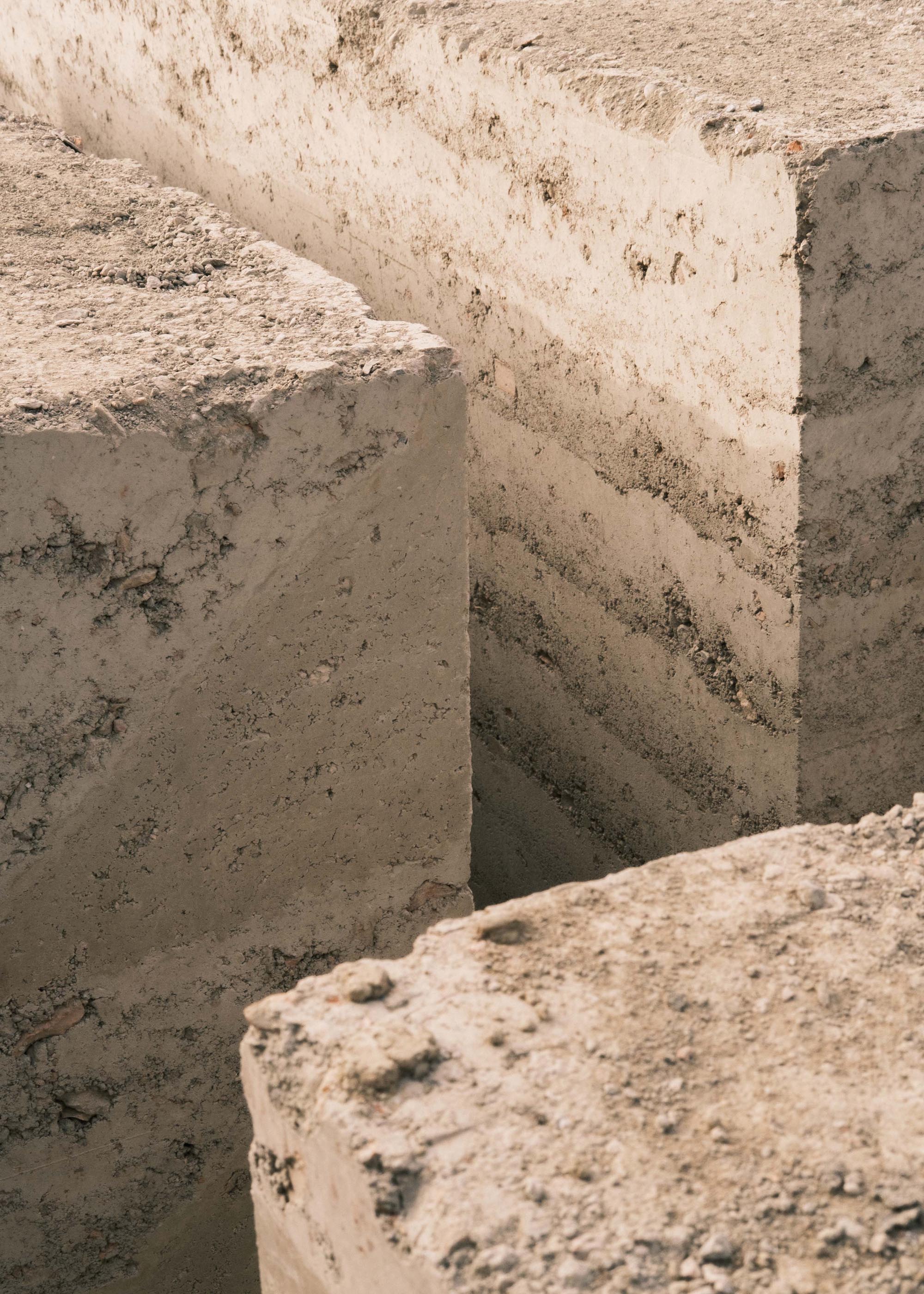
〈窯の塔〉の建築材料には焼成されていない生の粘土が使用されており、これは古来の版築工法を現代的に発展させたものである。新設されたこの塔は、高さ約8mの展望台から地域一帯を一望することを可能にしただけでなく、従業員が新しい窯を用いて再びレンガ焼成を行うことも可能にしている。さらに、博物館の新たな展示品を紹介するためのスペースも創出された。
© Kuster Frey
© Kuster Frey
空間構成と素材の対比
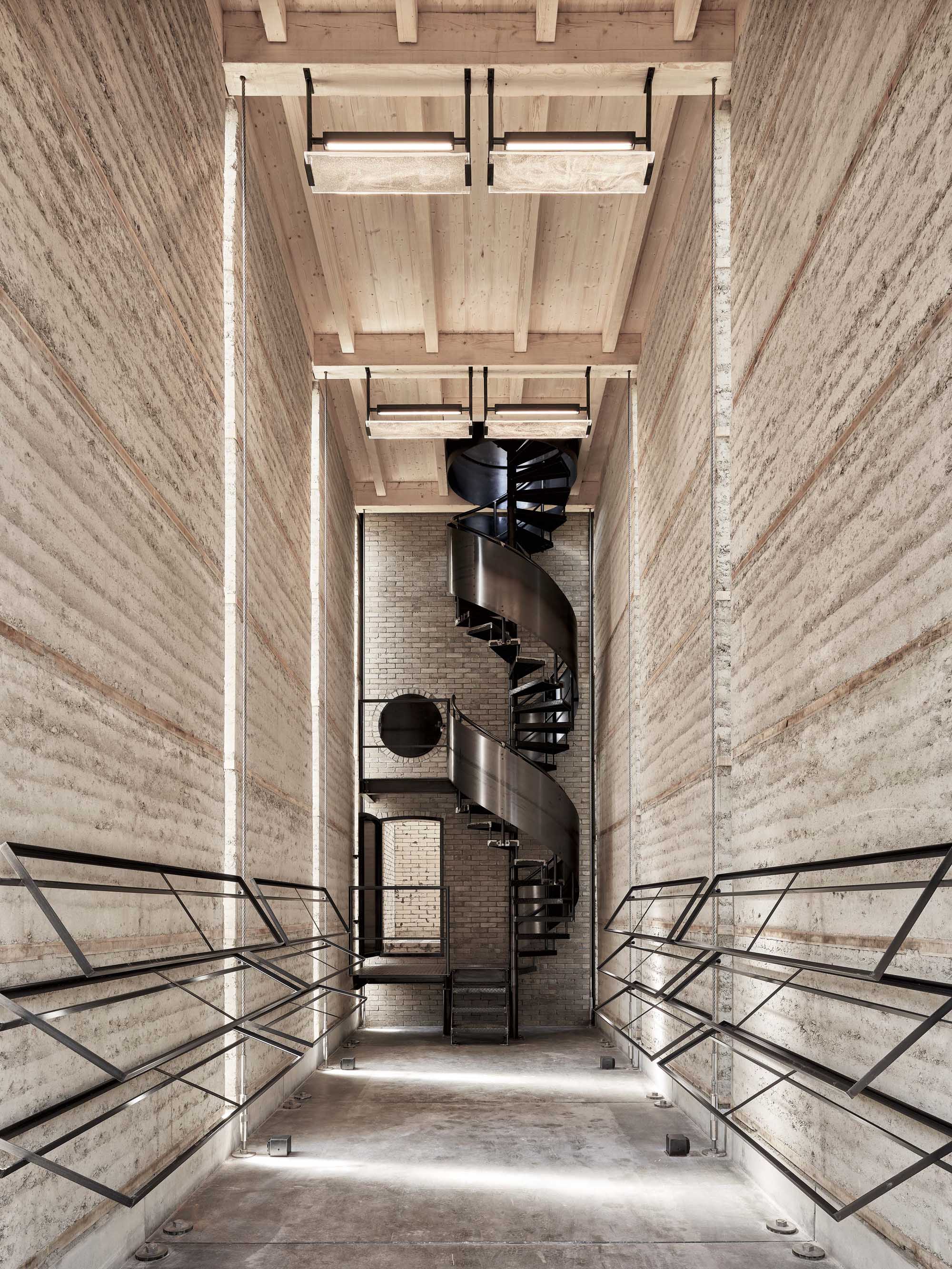
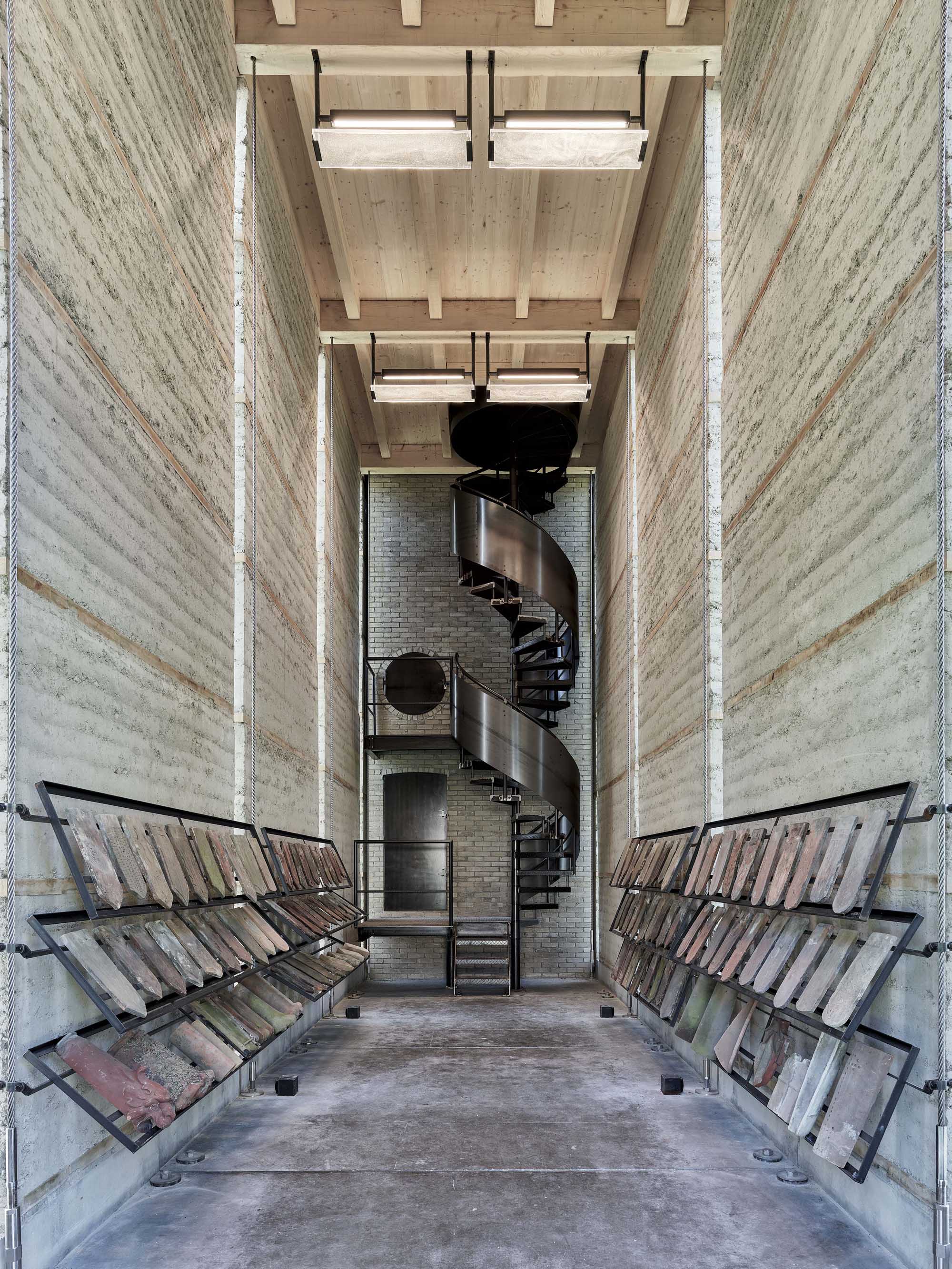
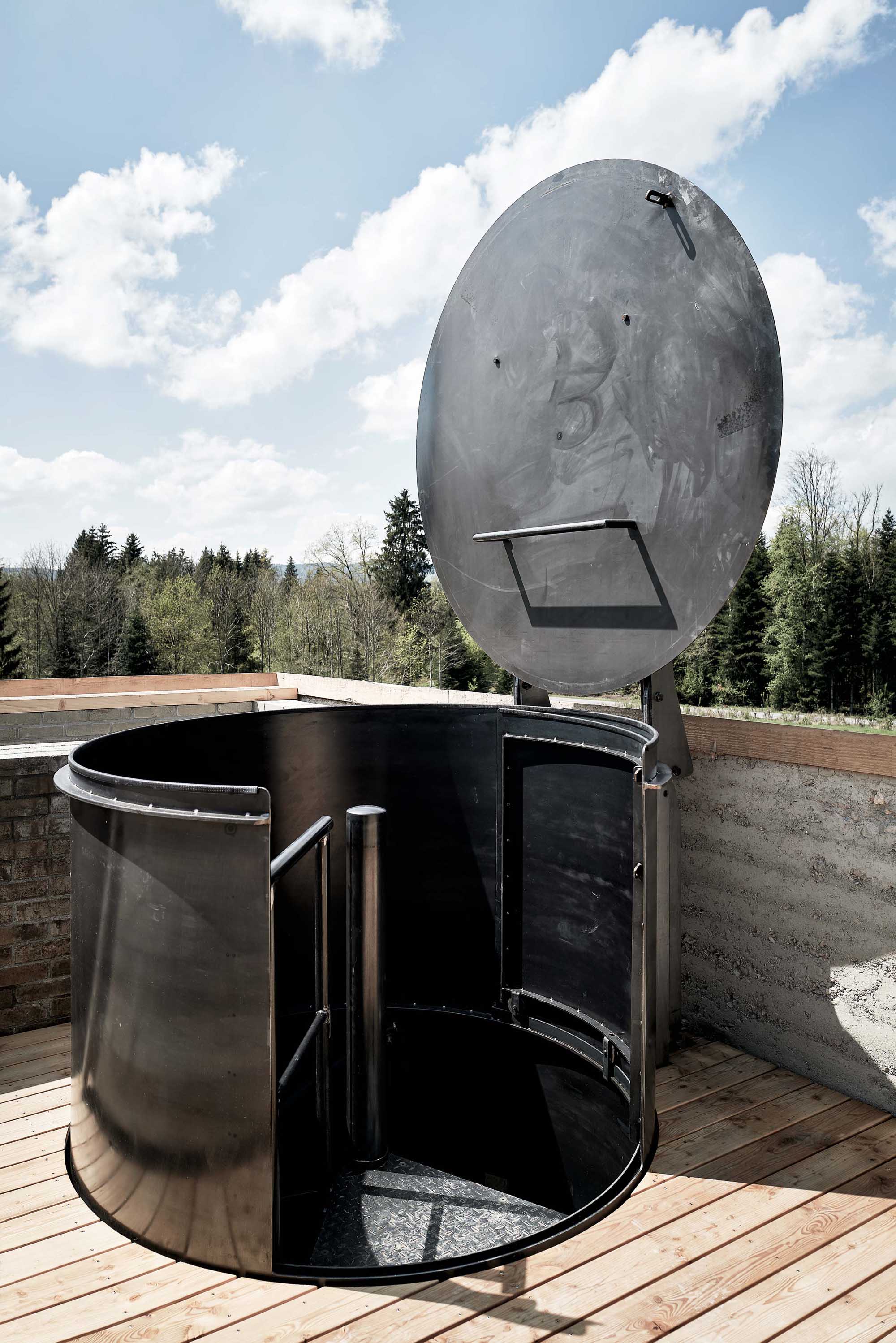
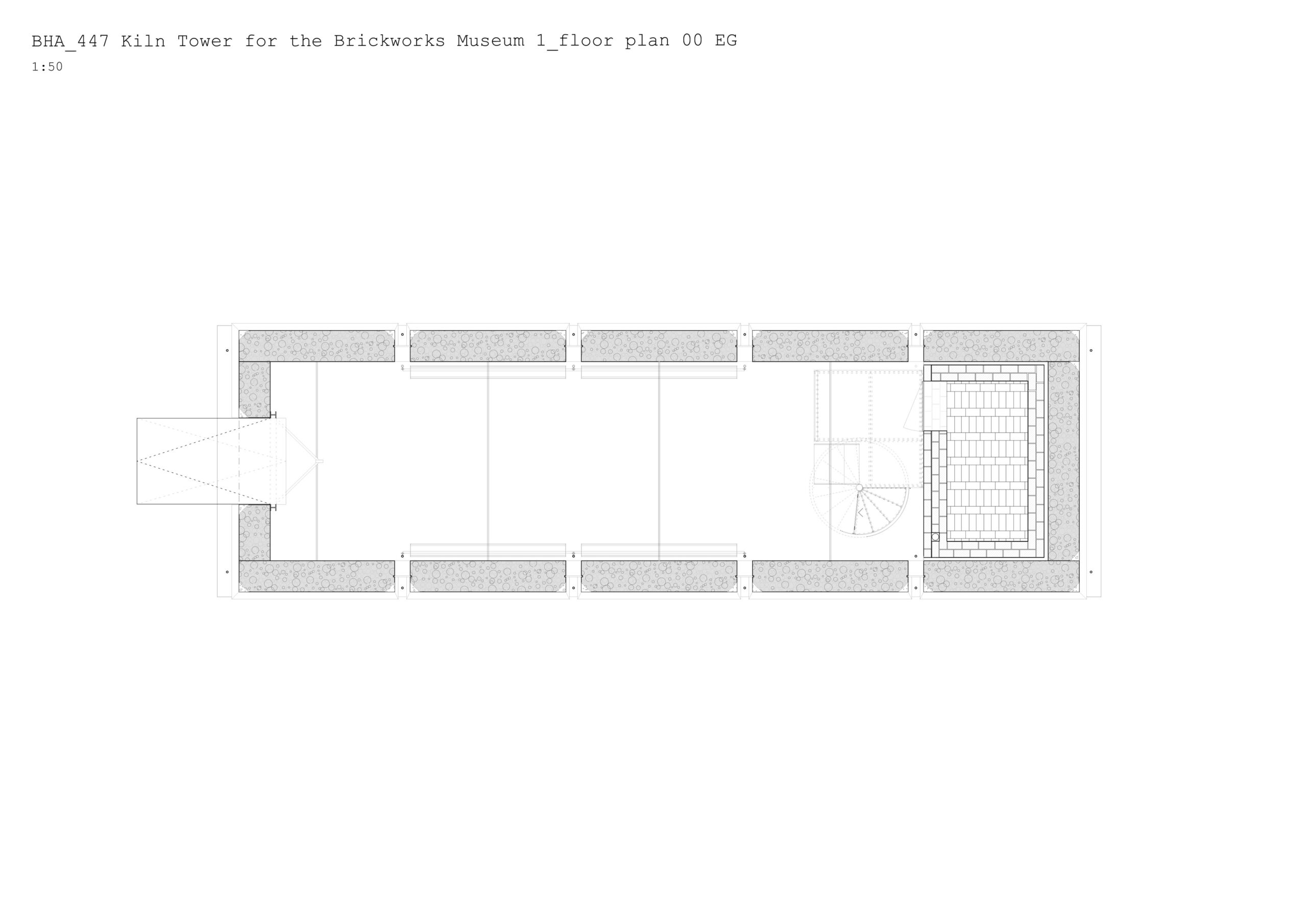
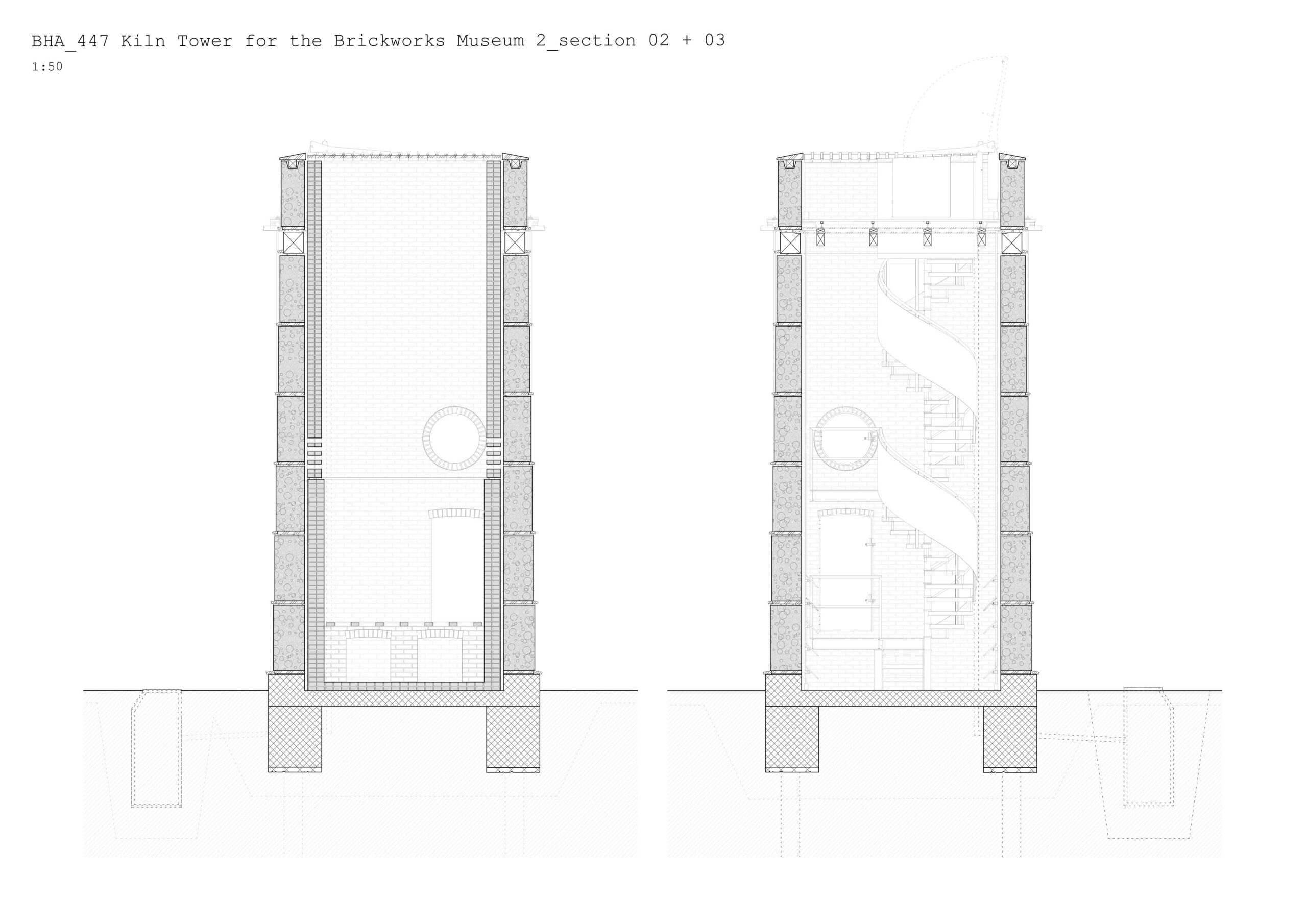
展示室とそれに隣接する窯は、頑丈な補強材が組み込まれた木製の天井で覆われている。空間の特性は、粘土の物質感と、窯の壁が放つ記念碑的な存在感によって決定づけられている。
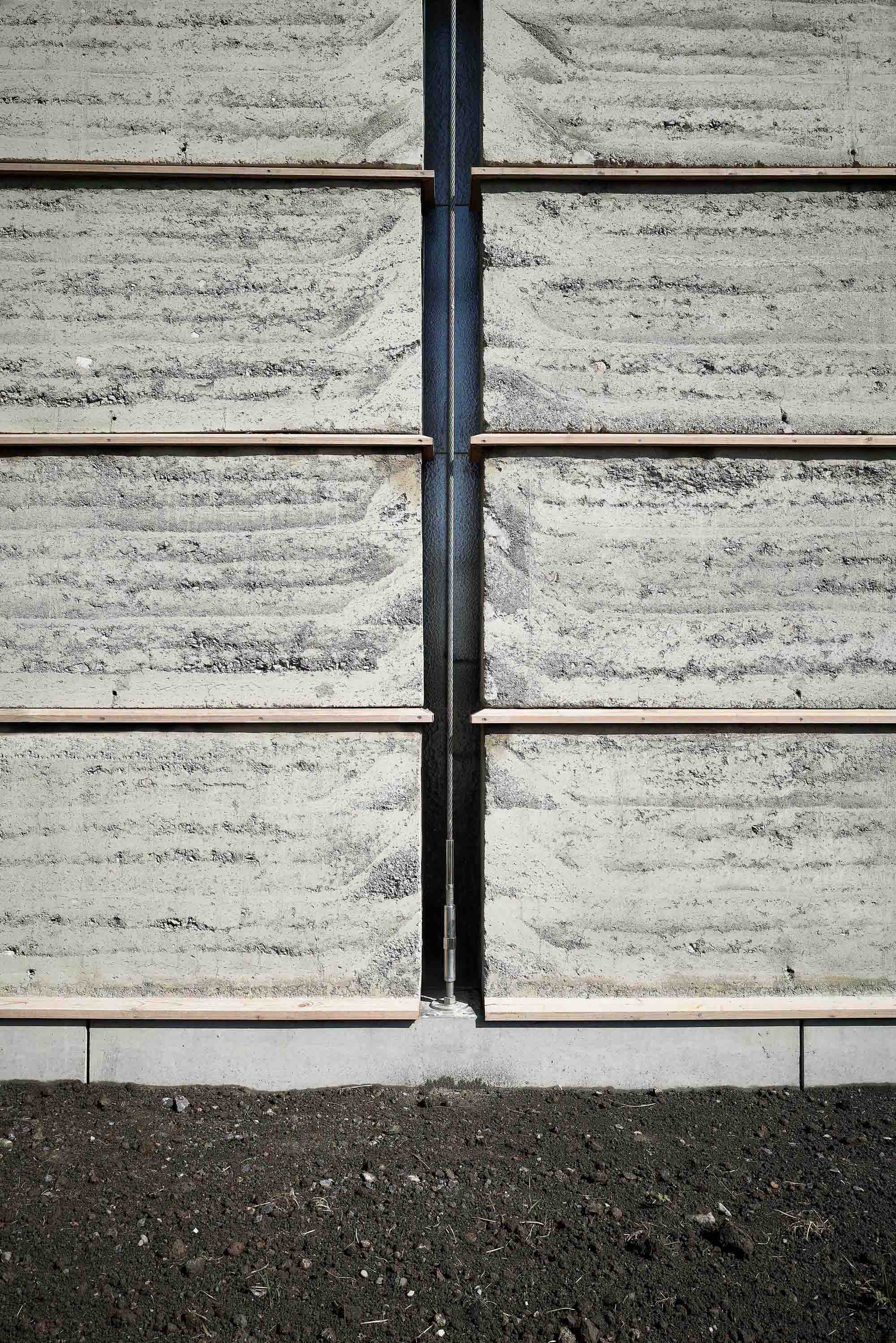
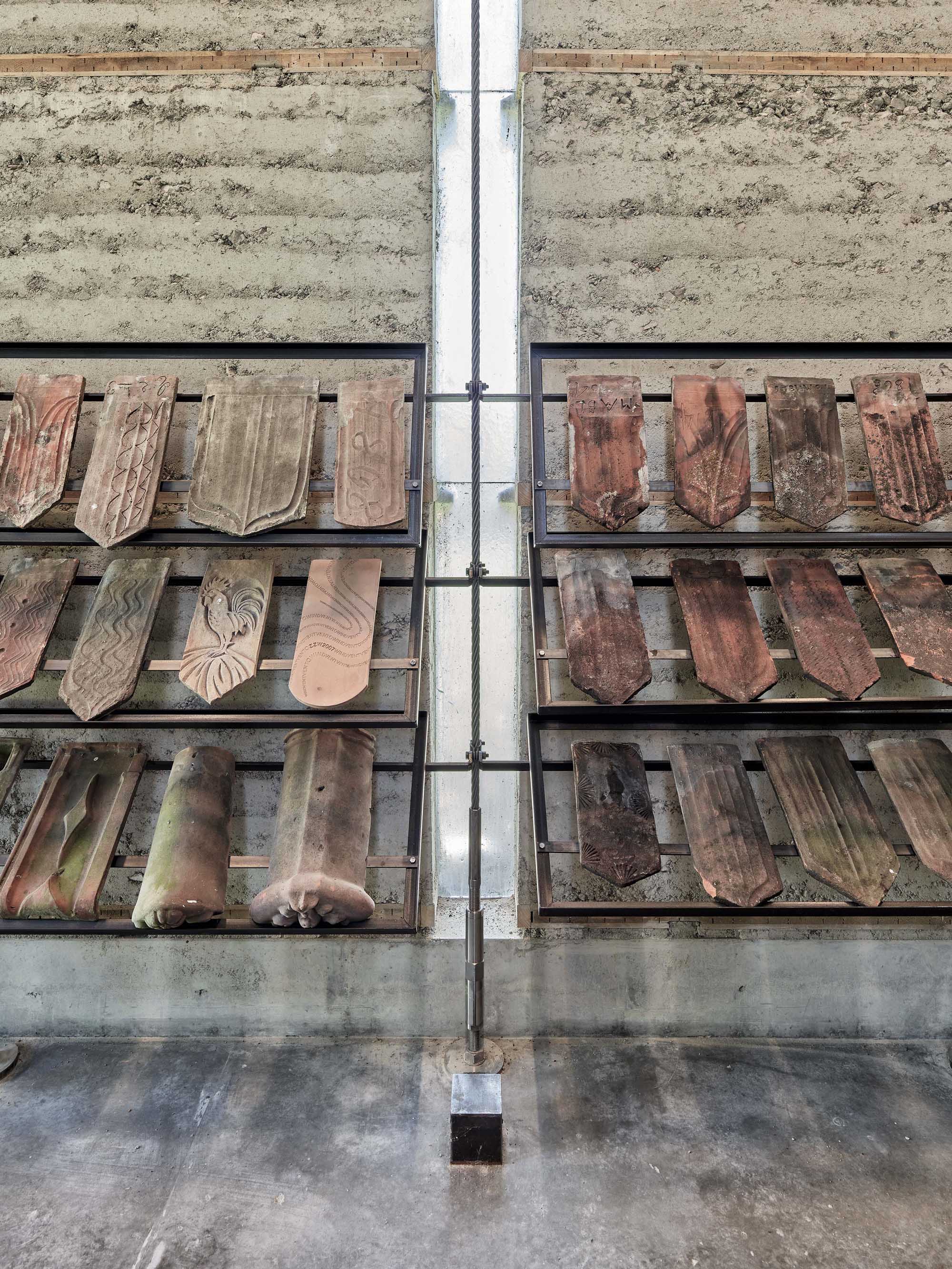
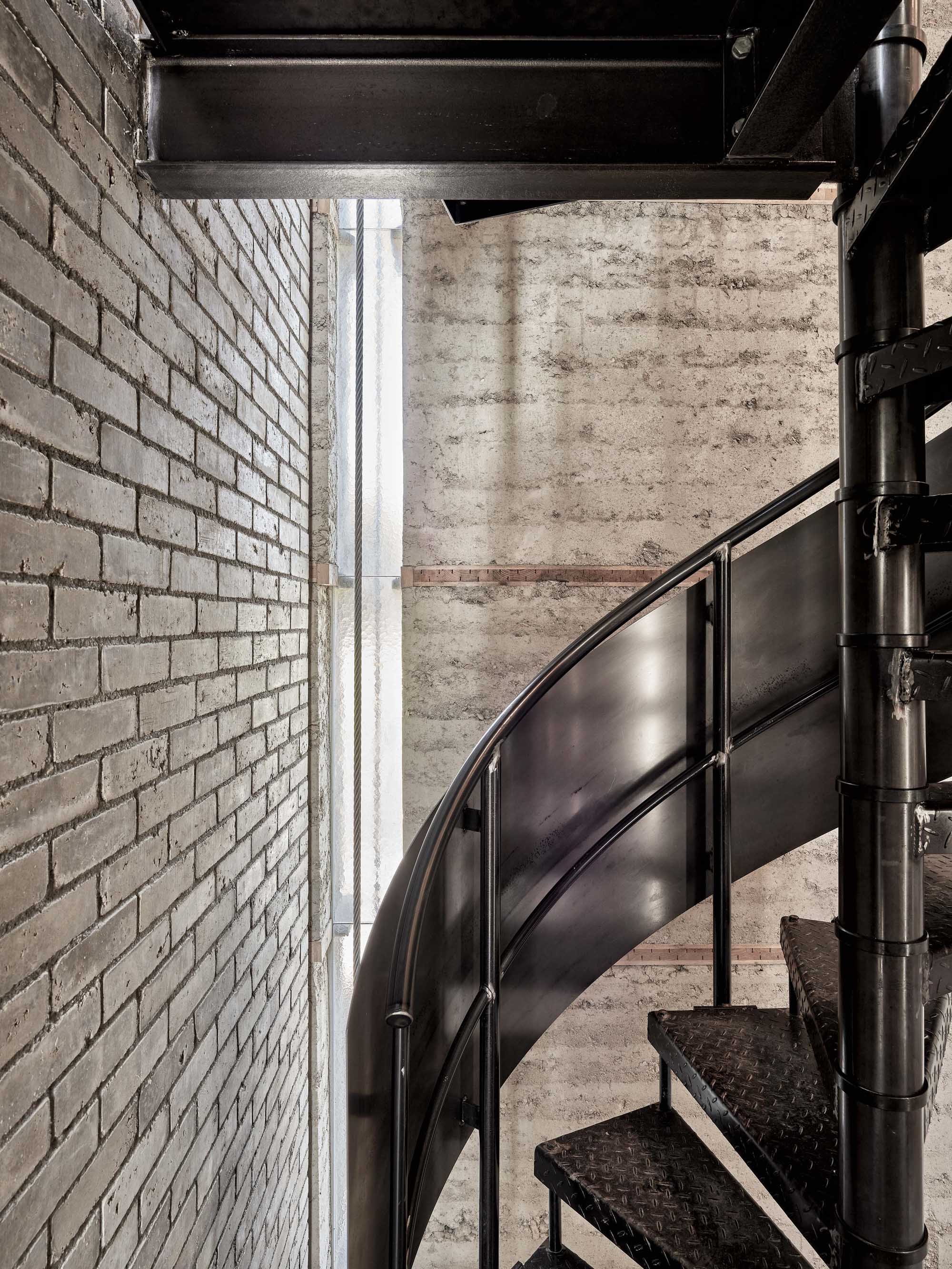
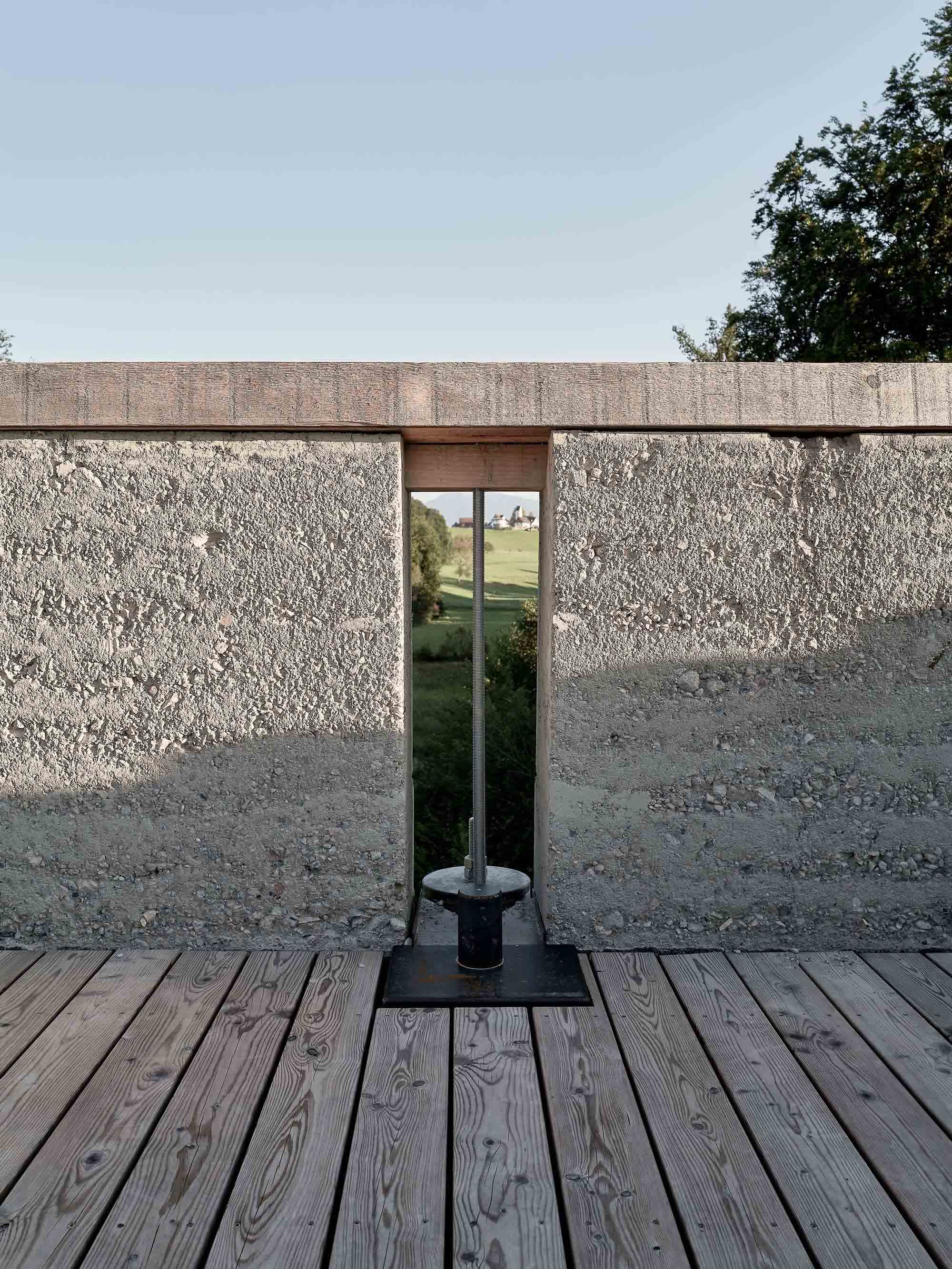
プレストレス材に走る目地の隙間から光が差し込むことで、粘土壁の重厚さが強調され、繊細な引張棒(テンションロッド)との鮮やかな対比を生み出している。この引張棒には、展示パネルや展示物を固定するためのシンプルな鉄骨フレームを取り付けることが可能である。また、屋上の展望台へは、らせん状の鋼鉄製階段によってアクセスする動線となっている。
© Kuster Frey

© Kuster Frey
プレファブリケーションによる「継ぎ目」を活かす実験的アプローチ
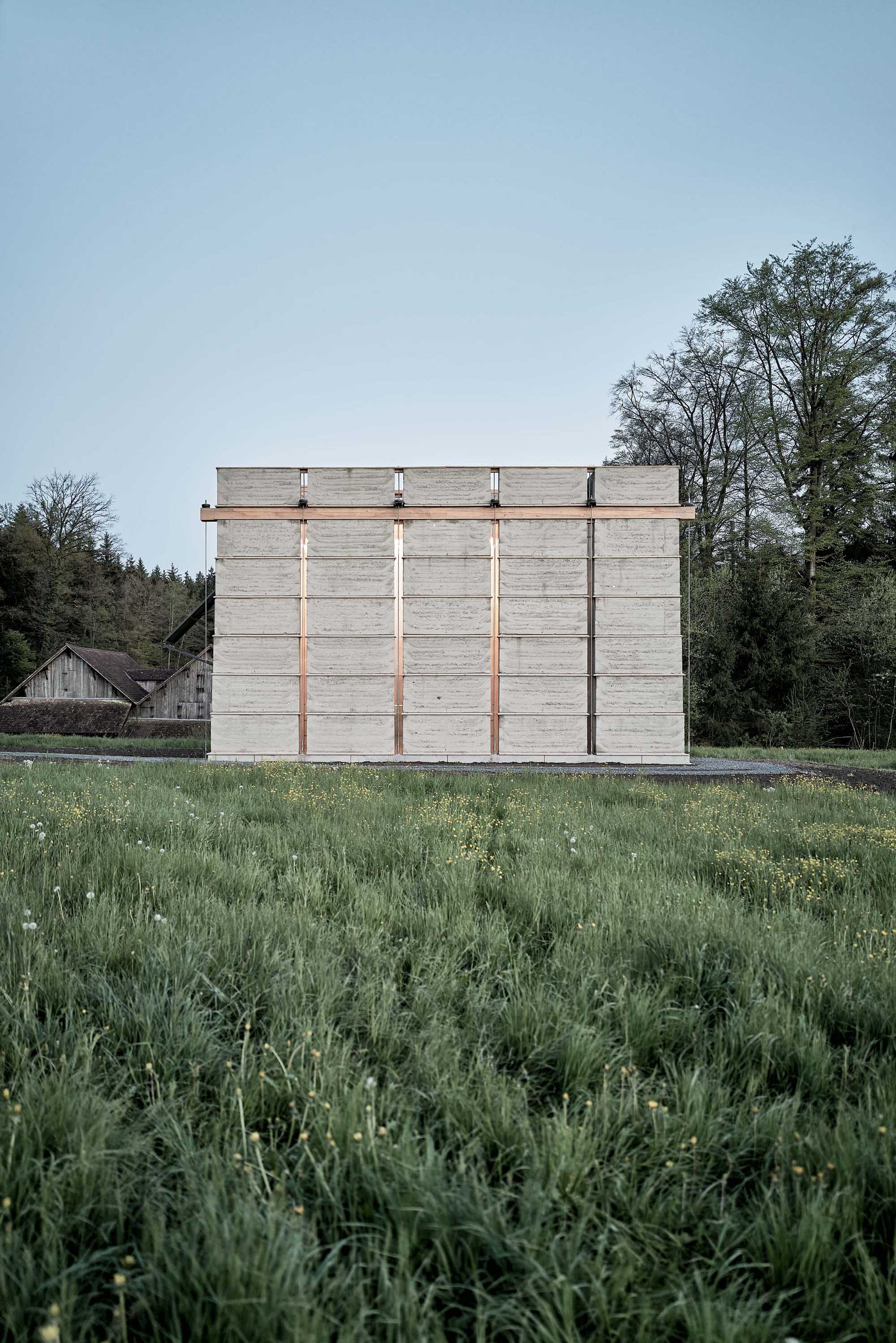
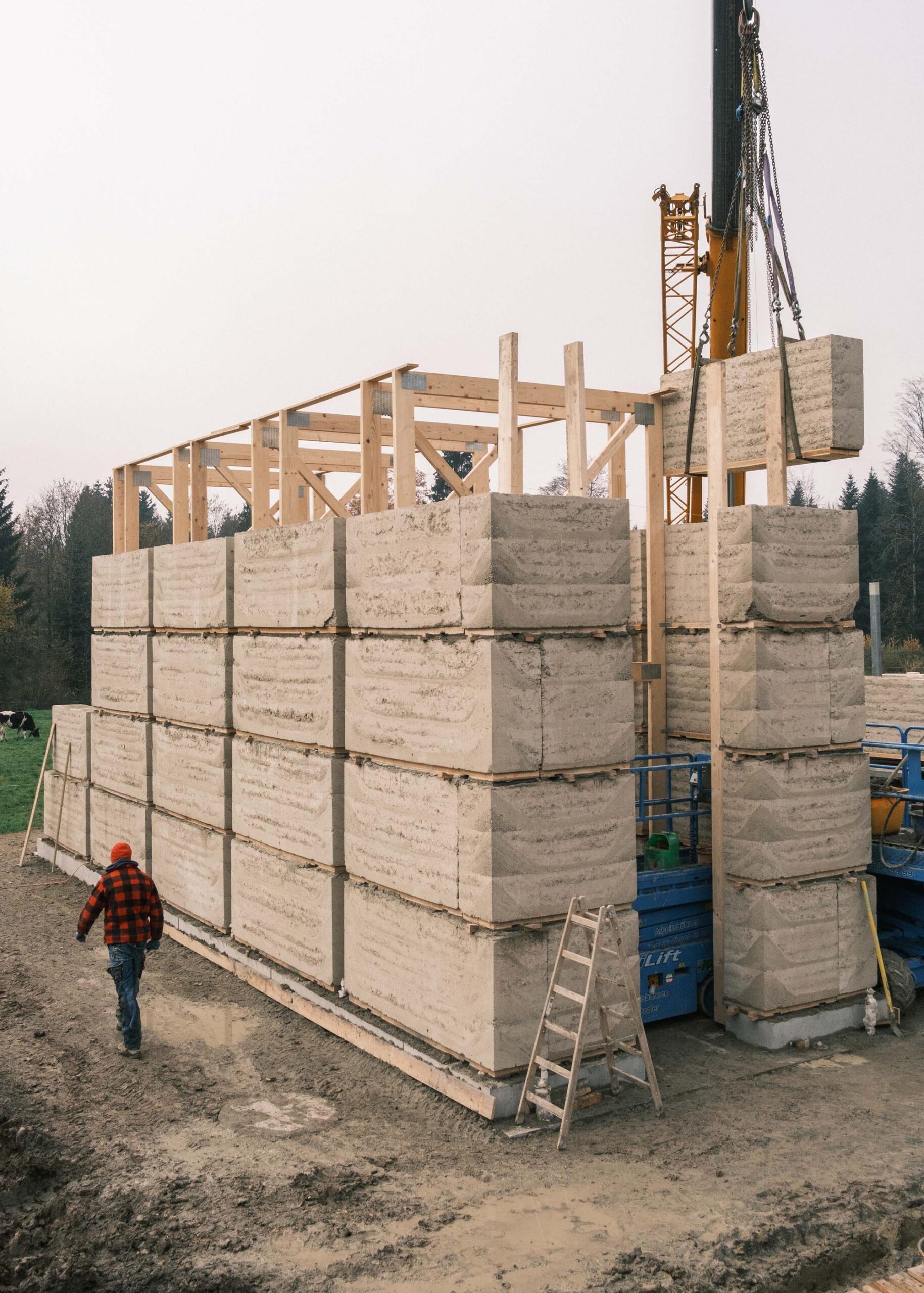
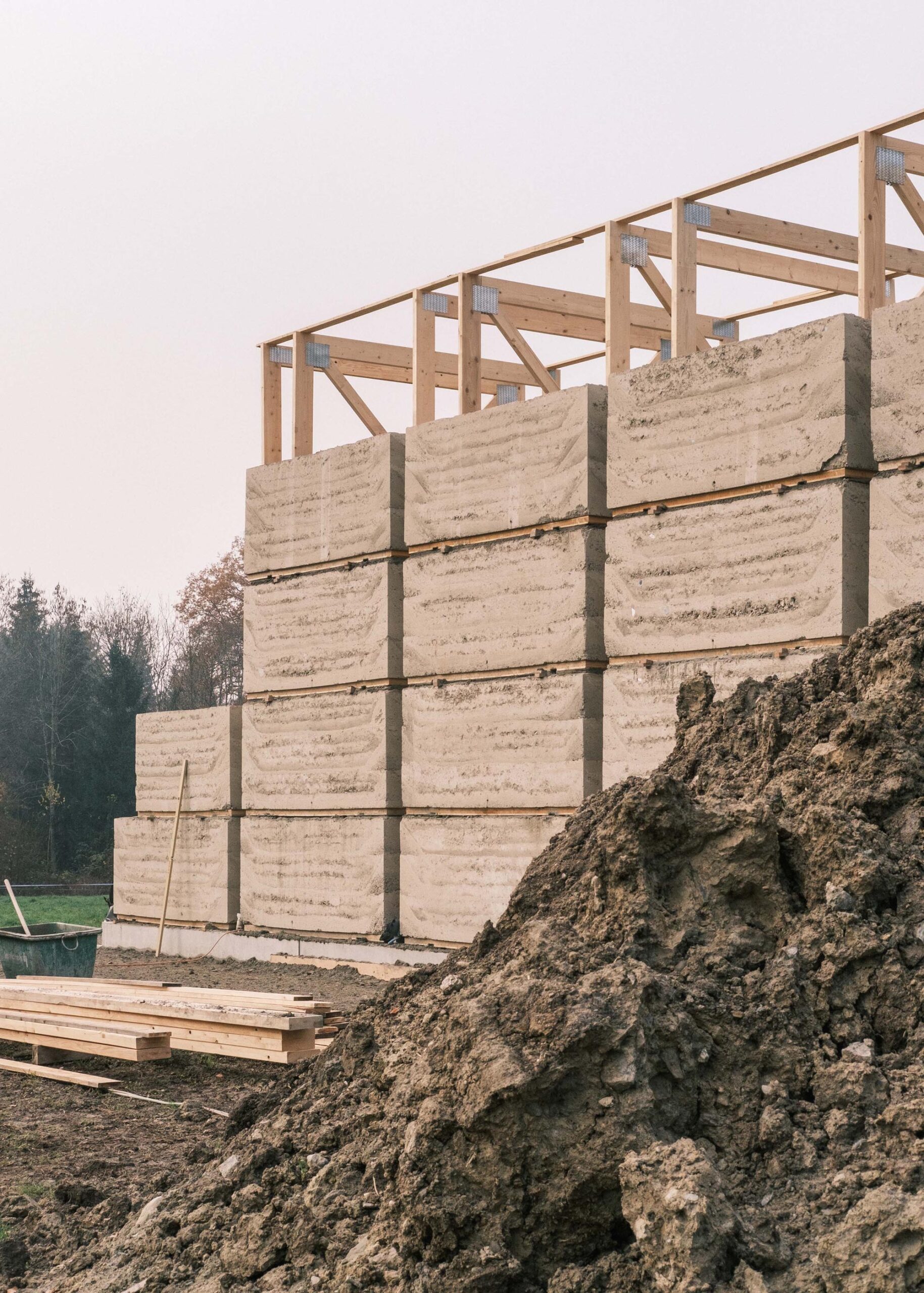
今日、スイスにおいて粘土要素(版築ブロック)を用いた建築は定着しつつある。しかし通常、輸送や組み立て条件に応じてサイズが決まるブロック間の継ぎ目は、施工後に手間のかかる手作業で埋められるため、要素化されたプレファブリケーションの痕跡は消されてしまうのが一般的である。
対してこのプロジェクトでは、「継ぎ目」をあえてテーマとした実験的な建築が試みられており、建設工程の効率化と構造上の革新による安定性の向上を目指している。
© Sandro Livio Straube
© Sandro Livio Straube
技術革新1:耐震性を高めるプレストレス構造
第1の革新は、前述の「プレストレス(緊張材等によってあらかじめ圧縮力を与える)」工法の導入である。地震荷重に対してシステムを強化するため、版築壁にはあらかじめ圧縮力がかけられている。基本的に圧縮力のみに耐えうる粘土と、高い引張強度をもつ鋼材は、互いに最適な補完関係にある。
プレストレスを導入したハイブリッド構造が、多層階の粘土建築を可能にするポテンシャルを秘めていることは、シッターヴェルクでのモックアップですでに実証済みであった。これにより、建築材料が継続的にクリープ(変形)するのではないかという懸念も払拭された。
むしろ歴史的建造物での知見に基づけば、この材料は圧力下で時間が経過するにつれて、安定性と硬度が増すことが示唆されている。
© Sandro Livio Straube
構造ディテール:外部テンションロッドと接合部
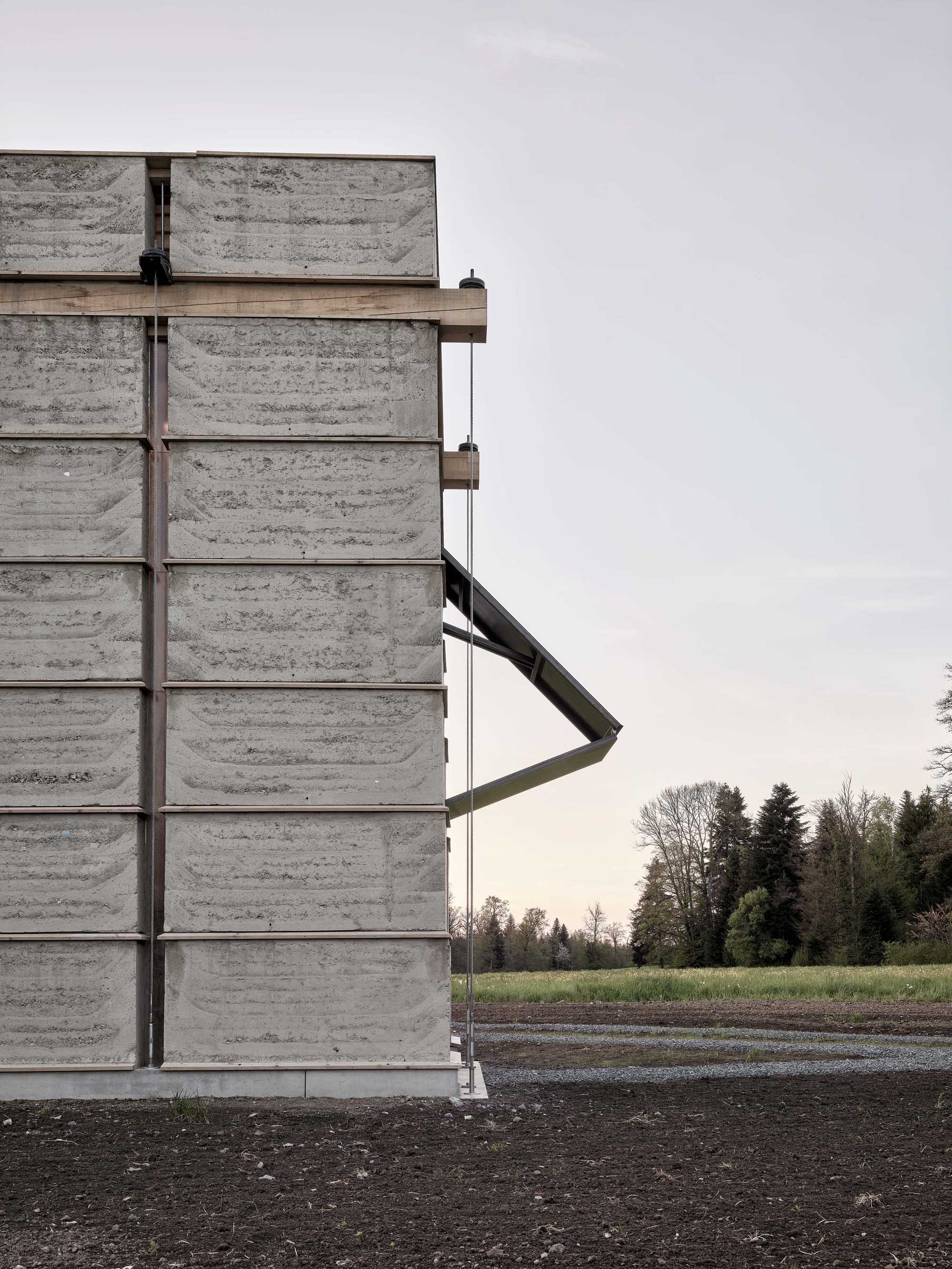
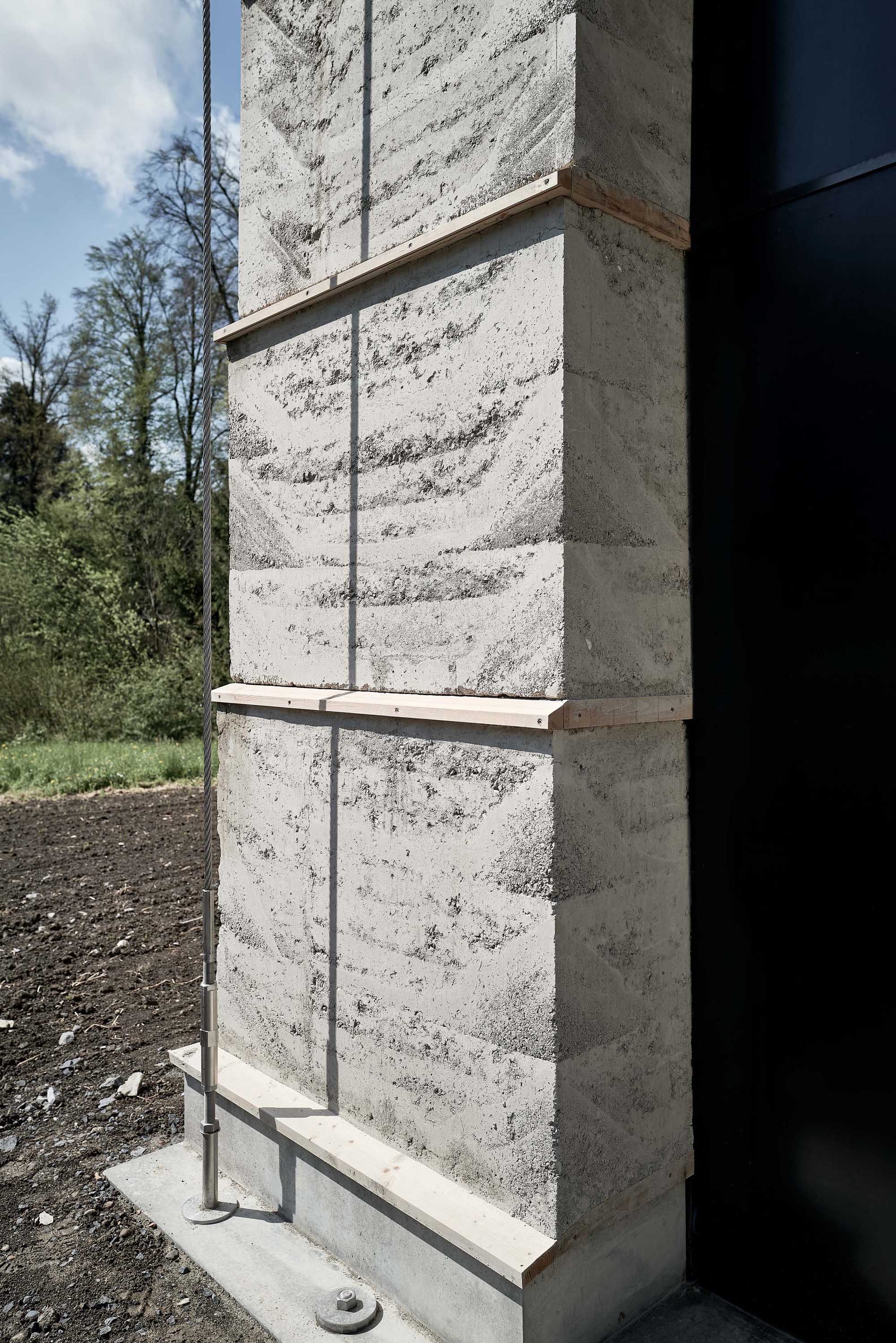
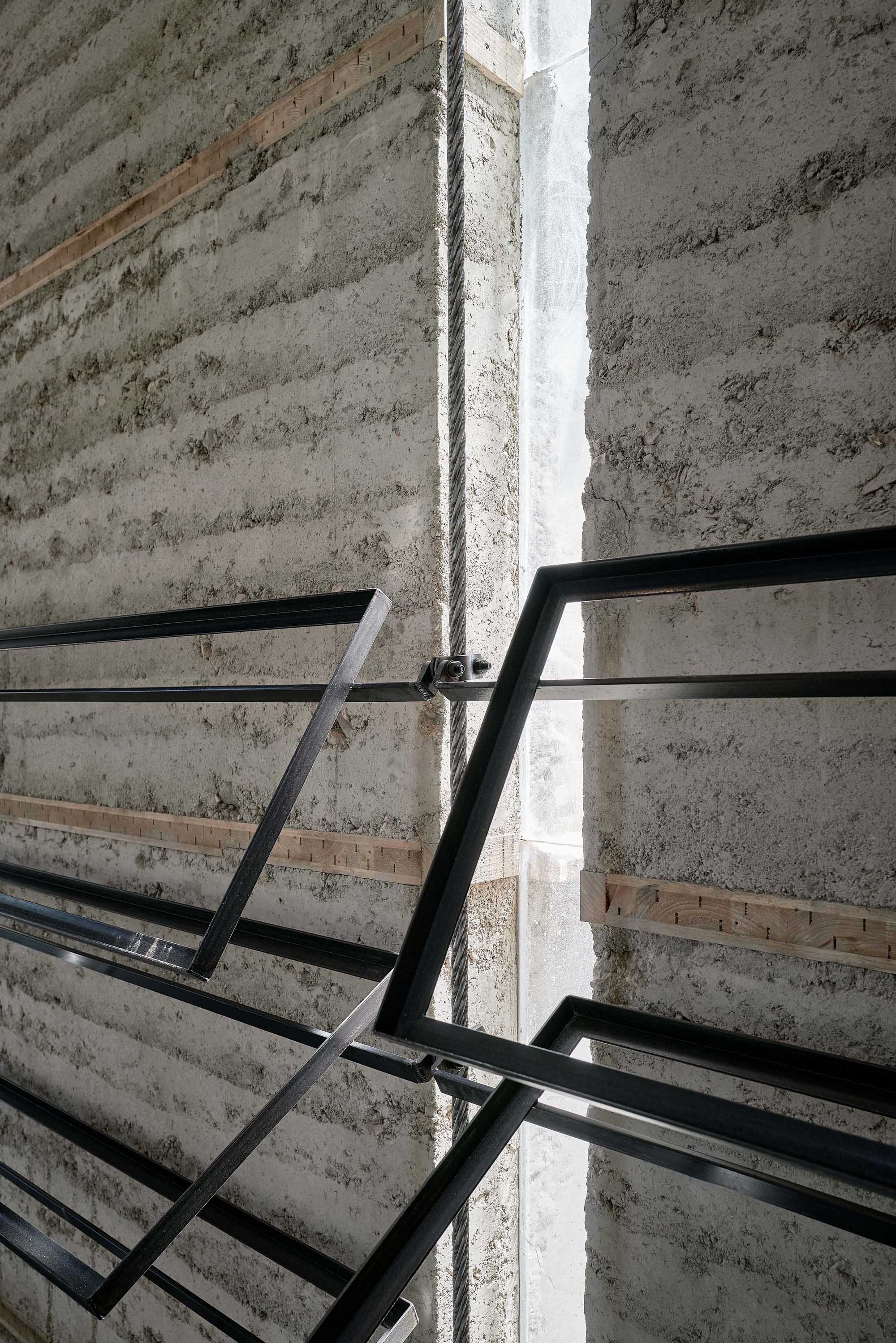
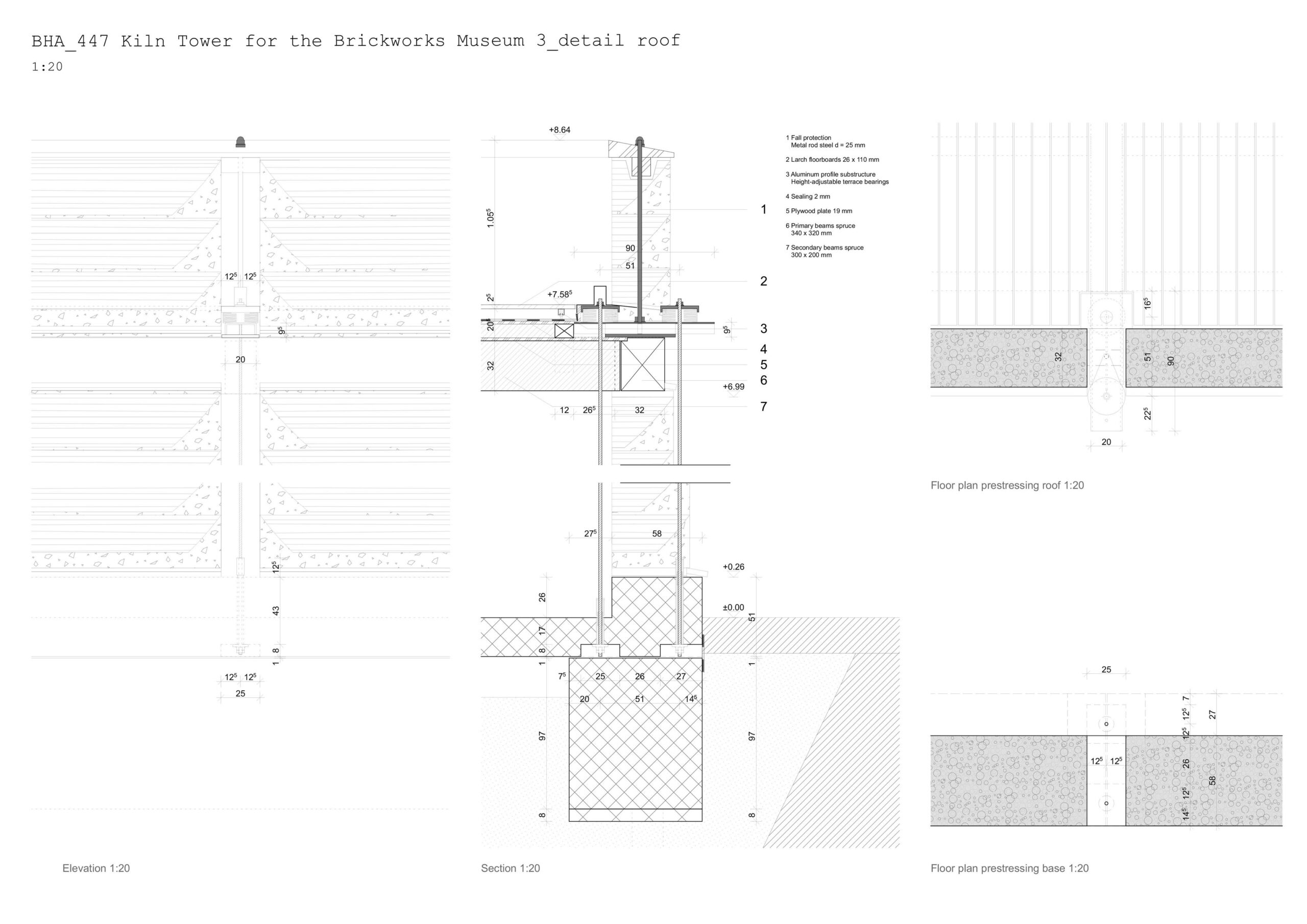
シッターヴェルクでのプロトタイプとは対照的に、この塔のテンションロッドは壁の両側に設置されている。これにより、プレストレスの視覚的効果が高まると同時に、定着部(テンションヘッド)へのアクセスも容易になった。
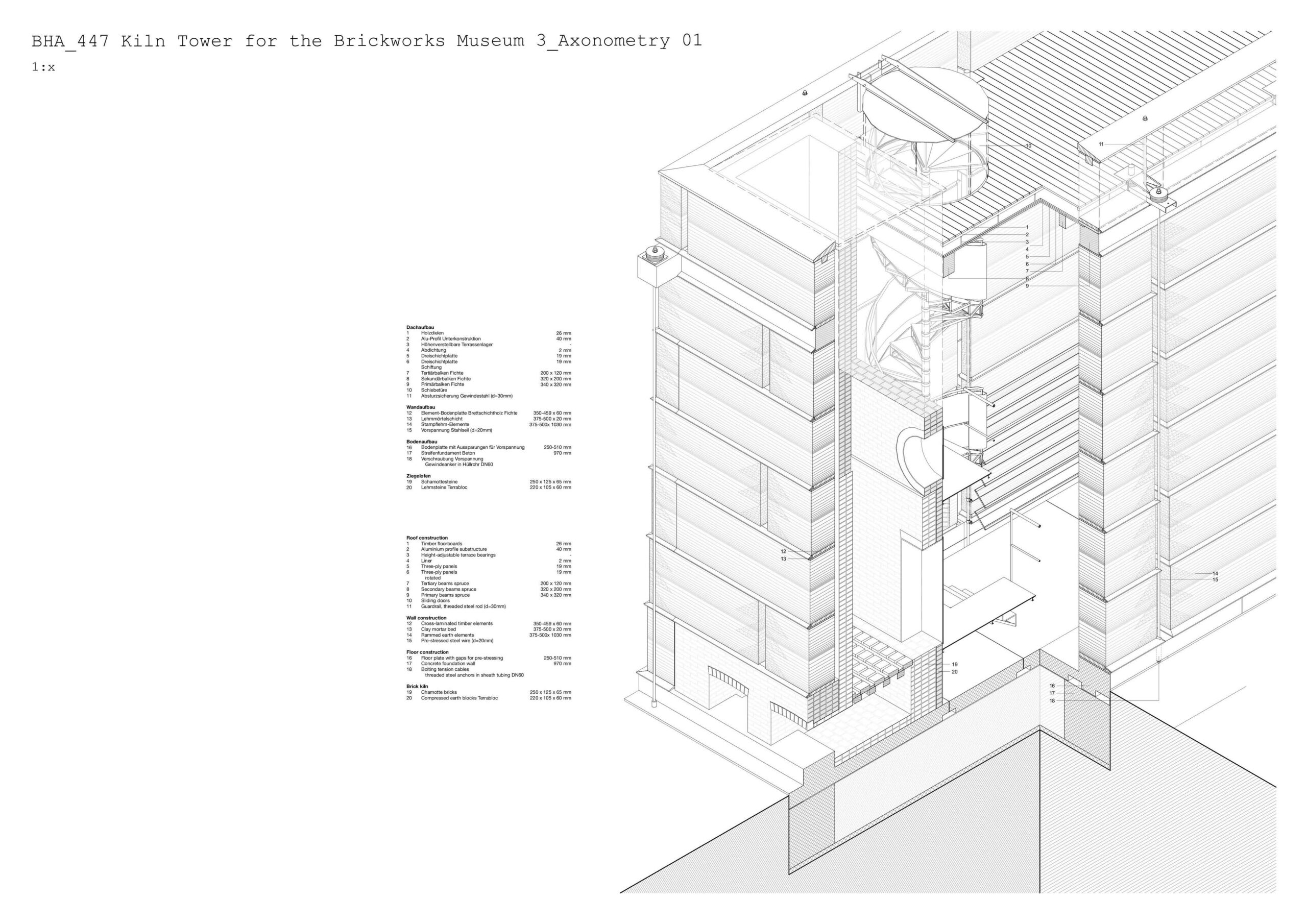
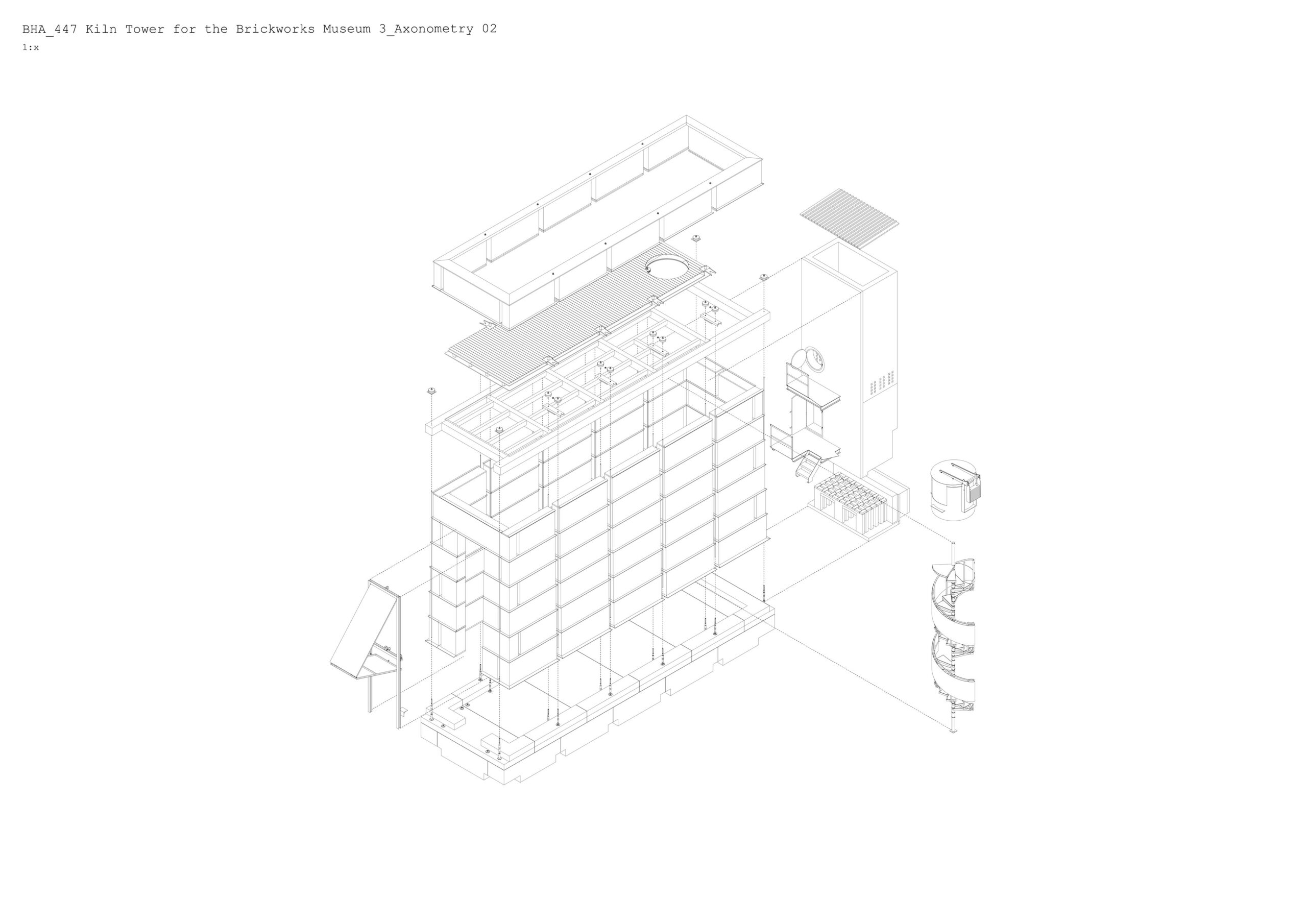
屋根の梁と結合して剛性のあるプレートを形成する木製のリングアンカーにより、壁要素に対して均等に引張力が伝達される仕組みである。下部においては、テンションロッドはプレキャストコンクリートの基礎に直接固定されており、この基礎は外部の雨水の跳ね返りから粘土壁を保護する役割も果たしている。

© Sandro Livio Straube
技術革新2:運搬と保護を兼ねた木製ベースプレート
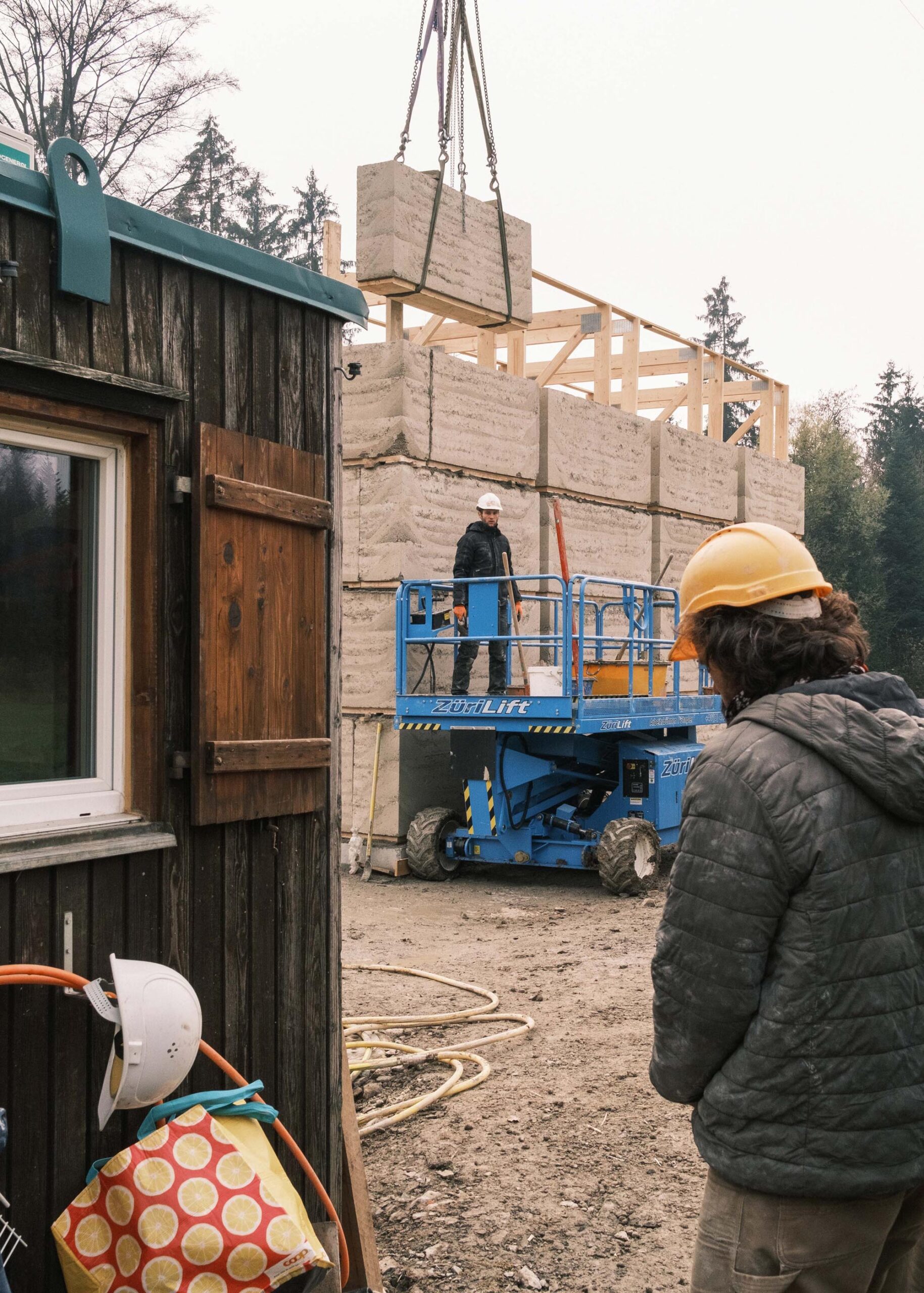
第2の革新は、壁構造に木製のベースプレートを統合した点にある。各粘土要素には、製造時に突き固めるための台座となったプレートがそのまま付属している。
型枠を外した直後の粘土は比較的柔らかい状態にあるため、このプレートがあることで運搬が容易になる。また、底面にある2本の溝は、運搬用ベルトのガイドとして機能する。現場にて粘土の流出を防ぎつつ接合の原理を明確に示す「水切り」がプレートに取り付けられる。さらに侵食を防ぐための追加策として、トラス石灰の水平層とコーナー補強が粘土に打ち込まれている。
© Sandro Livio Straube
サーキュラーエコノミーへの寄与と部材のリサイクル
「10年後にタワーを完全に解体する」という条件は、粘土のリサイクル可能性を探る好機となった。分離して設置されたプレストレスシステムは容易に取り外しができ、その後、部材を簡単に分解することが可能である。
製造に要した労力を考慮すれば、粘土ブロックをそのままの形で再利用することは理にかなっている。開放された目地、統合されたベースプレート、そして強化されたコーナーに表れるブロックの自律性は、こうした再利用を容易にするものである。また、粘土混合物の構成要素として建設廃材がリサイクルされていることからも、建築資材自体が循環経済(サーキュラーエコノミー)の一部として機能していると言える。
© Kuster Frey
© Kuster Frey
残土の活用による環境負荷の低減
このような実験的なプロジェクトを科学的にモニタリングすることは、研究が端緒についたばかりのこの建築材料に新たな可能性を開くことにつながる。スイスでは年間6000万トン以上の粘土や土が掘削されているが、そのほとんどは砂利採取場の埋め戻し材として未使用のまま廃棄されているのが現状である。
この未利用資源に新たな用途を見出すことができれば、コンクリートやレンガなど、製造に高コストとエネルギーを要する建築資材の代替として大きく貢献できるだろう。従来の建築工法と比較した場合、新築建物において最大40%の製造時エネルギーを削減することが可能となるのである。
© Kuster Frey
© Kuster Frey

© Kuster Frey
© Kuster Frey
© Kuster Frey
Situation
Floor plan
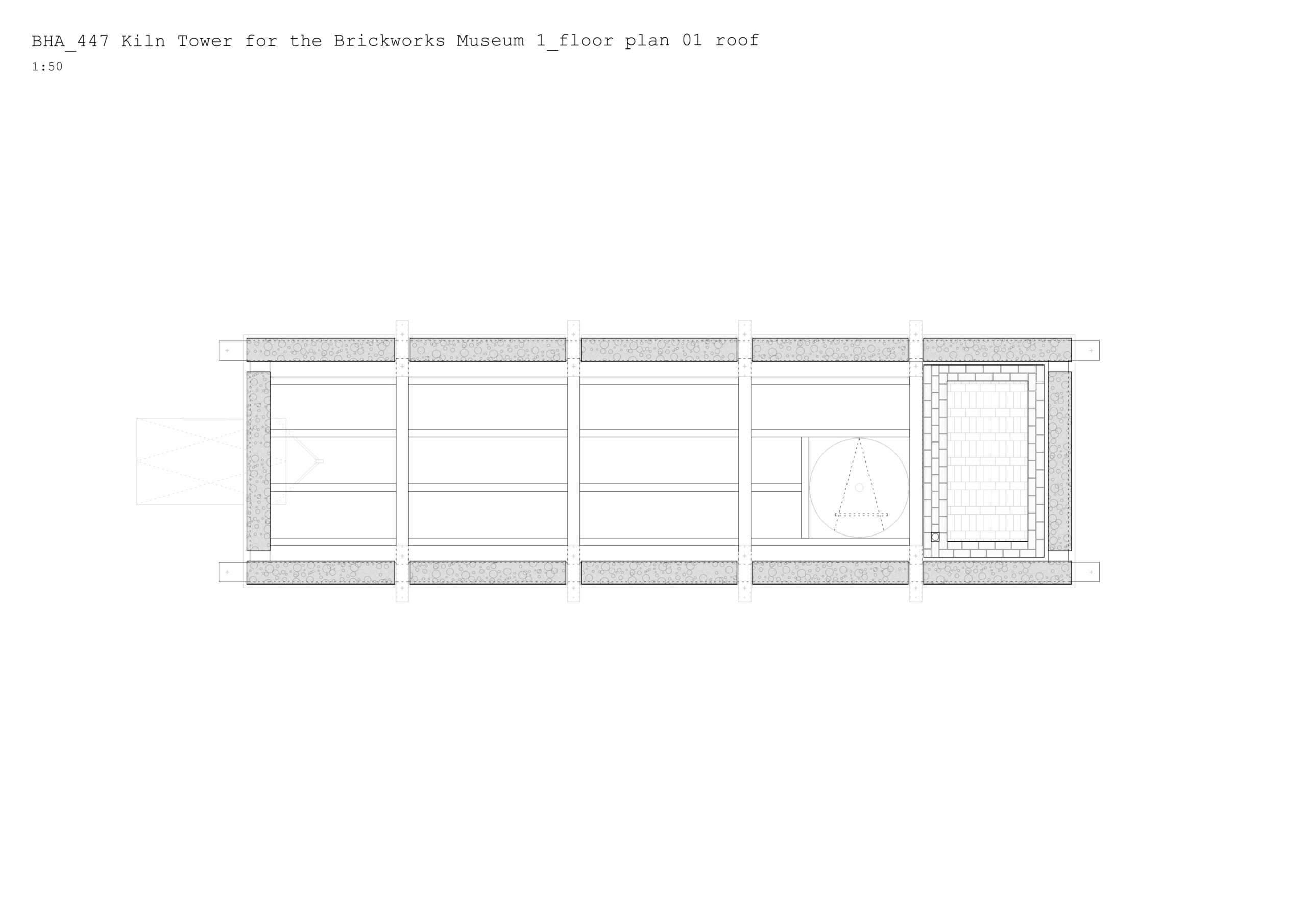
Floor plan

Floor plan
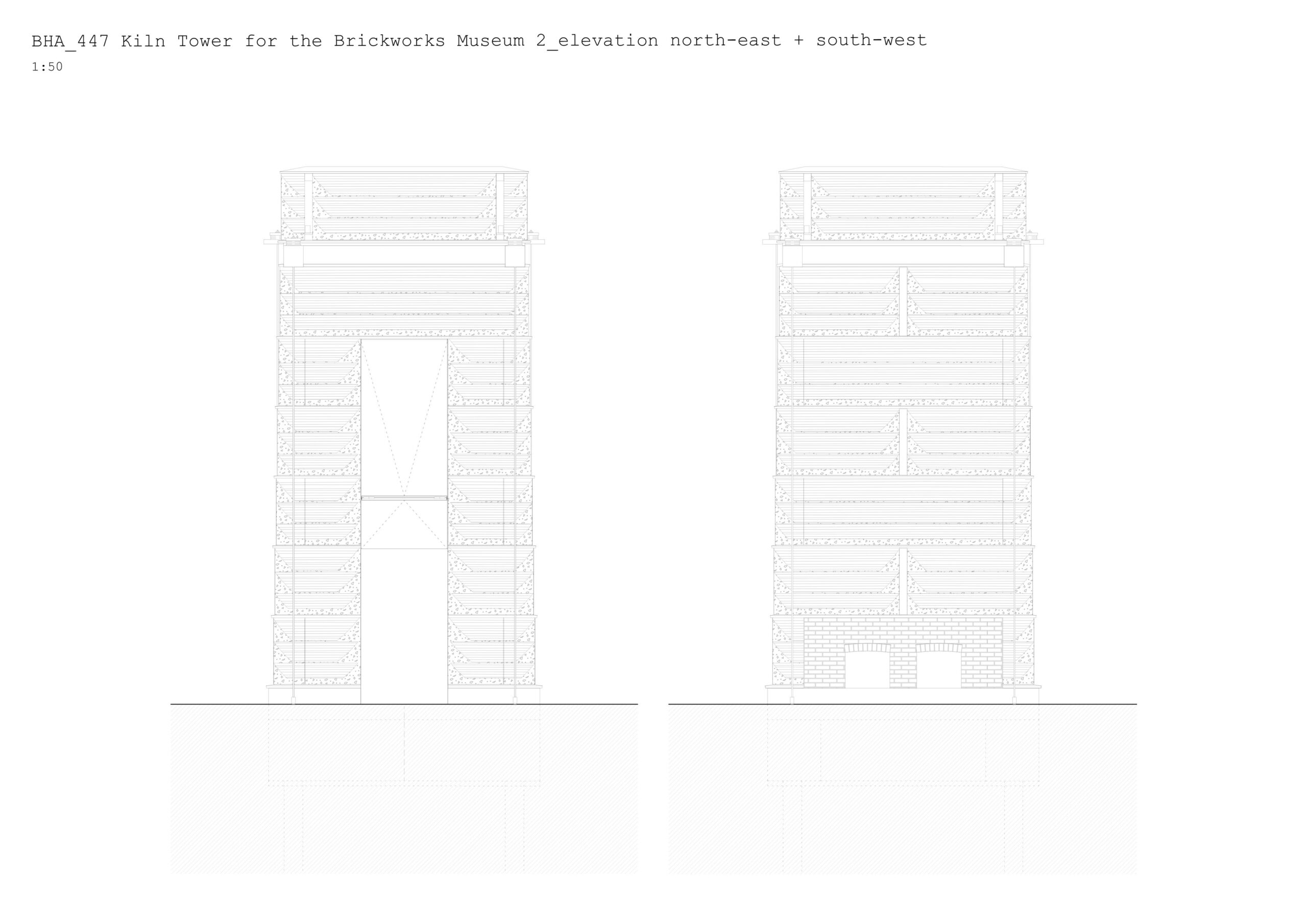
Elevation
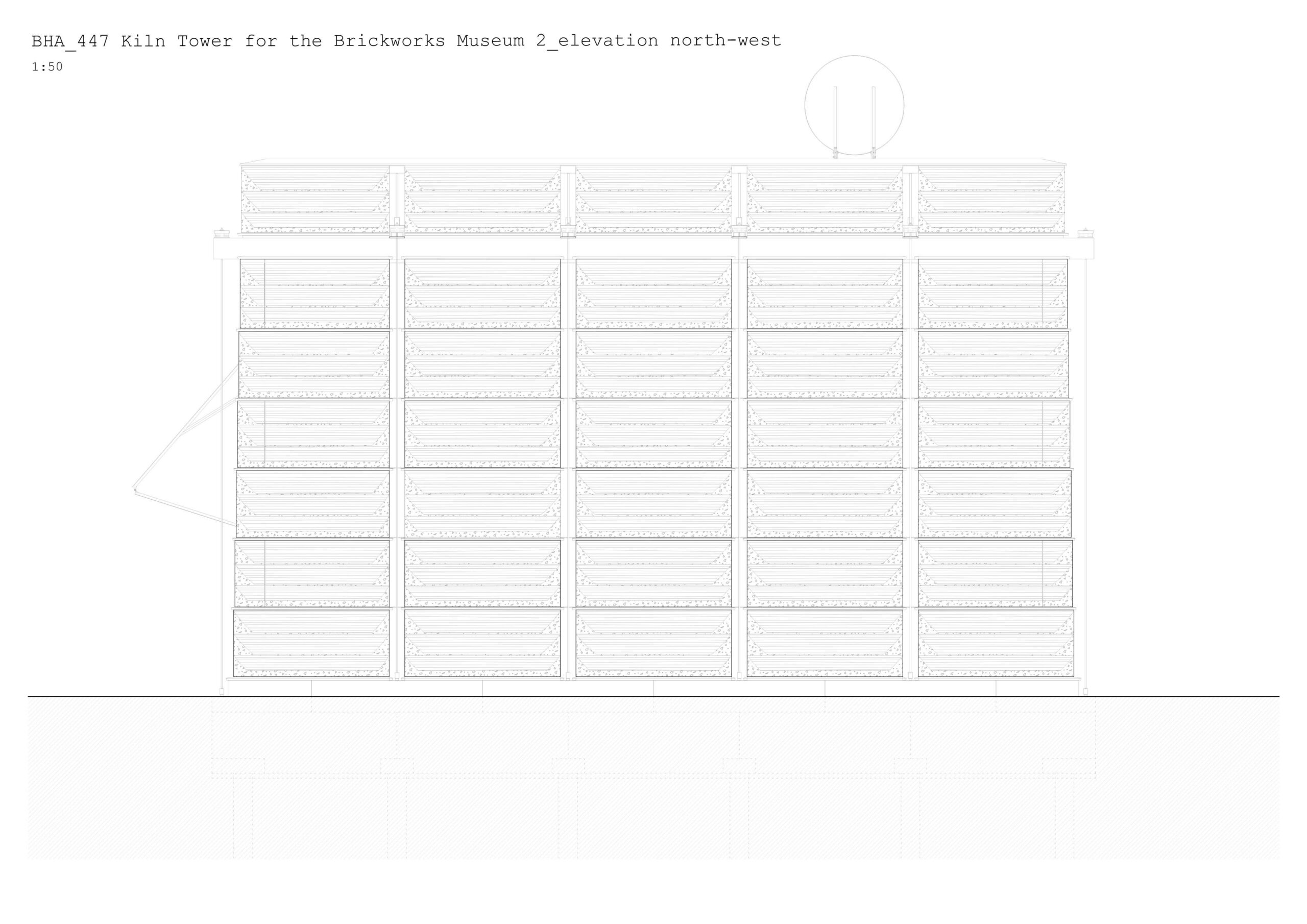
Elevation
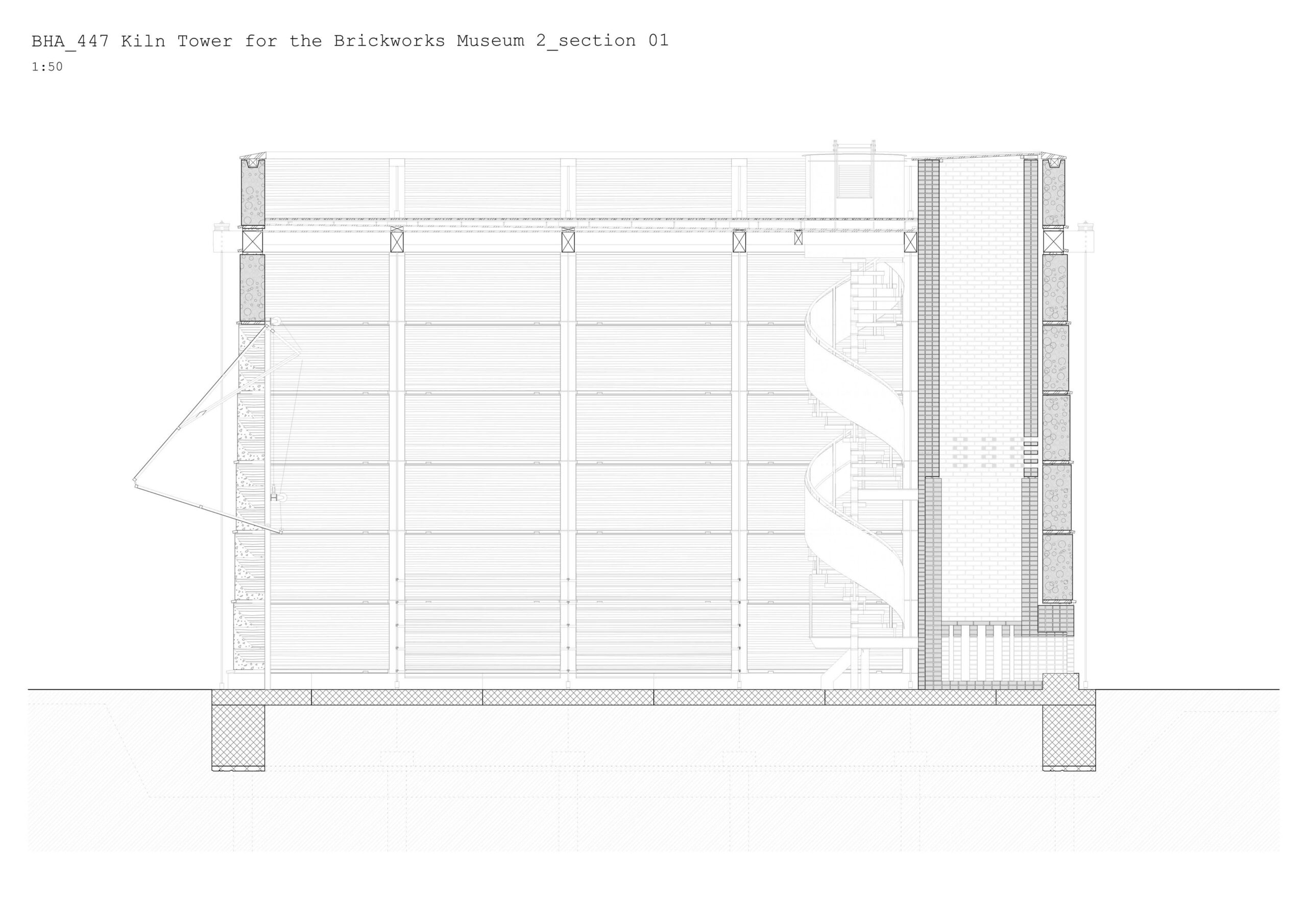
Section
Section
Axonometry
Axonometry
Detail
以下、ボルツハウザー・アーキテクテンのリリース(英文)です。
Kiln tower for the Brickworks Museum, Cham
2017 – 2021ADDRESS: Ziegelhütte, 6332 Cham
USE: Viewing tower, exhibiton space, kiln
COMMISSION TYPE: Direct commission
CLIENT: Verein Ofenturm, Ziegelei-Museum
PARTICIPATING PLANNERS
Architecture: Boltshauser Architekten AG, Zurich with students from TU Munich and ETH Zurich, based on the design by students Robert Gentner and Regina PötzingerGeneral planner, quantity surveyor, site supervision: Boltshauser Architekten AG, Zürich
structural engineer: SEFORB SARL, Uster
Lighting consultant: Reflexion AG, Zürich
Rammed earth construction: LEHMAG AG, Brunnen, together with students from various universities
Earth brick masonry: Terrabloc SA, Genf
Earth material: Ziegelei Schumacher AG, Gisiken
Timber and metal: Nüssli AG, Hüttwilen
Prestressing engineer: Jakob AG, Trubschachen
Foundation: Keller Unternehmungen AG, Pfungen
Civil engineer: KIBA Holding AG, Bäch
Master builder: Ineichen AG, BaarGROSS FLOOR AREA: 60 m²
BUILDING VOLUME: 480 m³
COSTS: 0.78 Mio. CHF
The “Ziegelhütte” in Cham, that is run today by the Brickworks Museum, is the only still intact suriving brickworks for hand-made products in the German-speaking part of Switzerland. The listed ensemble consists of a timber brick-drying shed, a kiln, that may no longer be operated, the biotope of the historical clay pit, a residential building with gardens, and a museum building replacing a burned-down barn. In 2017 students of the guest professorship at the TU Munich worked on the task of designing a new kiln tower on the site. The semester project by Robert Gentner and Regina Pötzinger formed the basis of this project. The prestressed earth-and-timber structure is based directly on the mock-up carried out at the Sitterwerk (cf. pp. 384 – 395) and is the world’s first prestressed earth building. The tower is made up of earth elements manufactured at the 2019 summer school of the ETH of the former cement plant in Brunnen. Supervised by LEHMAG AG, around thirty students from the ETH Zurich, the TU Munich, and other universities in Switzerland and abroad gained hands-on experience in rammed earth construction.
The building material of the kiln tower presents clay in its unfired form and demonstrates a contemporary development of the archaic method of building with rammed earth. The new tower allows visitors to survey the site from atop the roughly eight-meter-high viewing platform and enables the staff to fire bricks again in the new kiln. In addition, a space was created for for displaying other museum exhibits.
The exhibition room with the adjoining kiln has a solid, stiffening timber ceiling. Its character is defined by the presence of earth and the monumentality of the concluding kiln wall. Thanks to the light slits created by the open joints, in front of which the prestressing elements run, visitors can experience the whole solidity of the earth walls, that contrasts with the delicacy of the tension bars. Simple steel frames can be attached to these to hold exhibition panels or exhibits. A steel spiral staircase provides access to the viewing platform on the roof.
Today, building with rammed earth elements is an established practice in Switzerland. However, the joints between blocks, whose size depends on conditions of transportation and assembly, are usually time-consumingly hand-filled afterwards, thus eliminating the traces of building with prefabricated elements. In Cham, these traces are the theme of an experimental architecture which seeks to increase the efficiency of the building process and stability by means of structural innovations.
The first of these innovations is the aforementioned prestressing. To strengthen the system against earthquake loads, the rammed earth walls are prestressed. The earth, that can only withstand compressive loads, and the tensile steel are perfectly matched. That prestressed hybrid structures have the potential for use in multi-story rammed earth buildings was
already demonstrated by the mock-up at the Sitterwerk near St. Gallen. Here it was possible to dispel any reservations regarding continuous creep of the building material. Indeed, experience with historical buildings suggests that the stability and hardness of the material even increase under pressure and over time.
Unlike the prototype at the Sitterwerk, the tension bars of the kiln tower are installed on both sides in front of the wall. This increases the expressiveness of the prestressing and also facilitates access to the clamping chucks. A timber truss connected to the roof beams to form a rigid plate ensures that the tensile force is introduced evenly into the wall elements. At the bottom, the tension bars are anchored directly in the prefabricated concrete base protecting the earth against splashing water on the outside.
The second innovation is the integration of the timber base plates into the wall structure. Each element has its own plate on which it was rammed. As the earth is still relatively soft when the formwork is stripped, this facilitates transportation. Two grooves on the bottom serve as guides for the straps. A weather drip is installed on the plate on site to protect the earth from erosion and illustrate the joining principle. Horizontal layers and corners of trass lime are rammed into the earth as an additional erosion barrier.
The requirement of completely dismantling the tower after ten years was an opportunity to explore the potential of earth with regard to recycling. The prestressing system, installed separately, is easy to detach so that the elements can be simply removed. In view of the work involved, it would make sense to recycle whole blocks of earth. This is facilitated by the open joints and the integrated base plates and indeed by the modular autonomy of the blocks which is demonstrated for example by the reinforced corners. The building material itself is also part of the recycling system, with construction waste recycled as a component of the earth mixture.
The scientific monitoring of the experimental project helps to devise new possibilities for using this building material which we have so far only begun to investigate. More than sixty million tons of earth and clay are excavated in Switzerland every year, most of which goes unused as an infill material for gravel pits. Finding new ways to use this unexploited resource would be an important contribution to substituting energy-intensive building materials such as concrete and bricks. Compared with conventional building methods, this would enable embodied energy savings of up to forty percent in a new-build.
ボルツハウザー・アーキテクテン 公式サイト
https://boltshauser.info
【購読無料】空間デザインの今がわかるメールマガジン TECTURE NEWS LETTER
RECOMMENDED ARTICLE



