1960年代に多摩丘陵に開発された閑静な住宅地に建つ、夫婦と子供1人のための住宅である。北側斜面地を切り崩して造成された周辺環境には擁壁や塀が多く、人が平らな土地を求めて大地と格闘してきた痕跡が残る。周辺の住宅は、都心よりゆとりある土地と建蔽率 40%という条件から、南側に大きな庭を確保し、外壁面を揃える共通した建ち方をしていた。
敷地は急な坂道に面した角地で、かつての丘陵の断片ともいえる約2m の高低差が残されていた。この起伏を均して建てる従来の手法では、環境がもつ固有の魅力が暮らしから切り離されてしまうと感じ、地形の記憶を空間へ取り込むことを考えた。
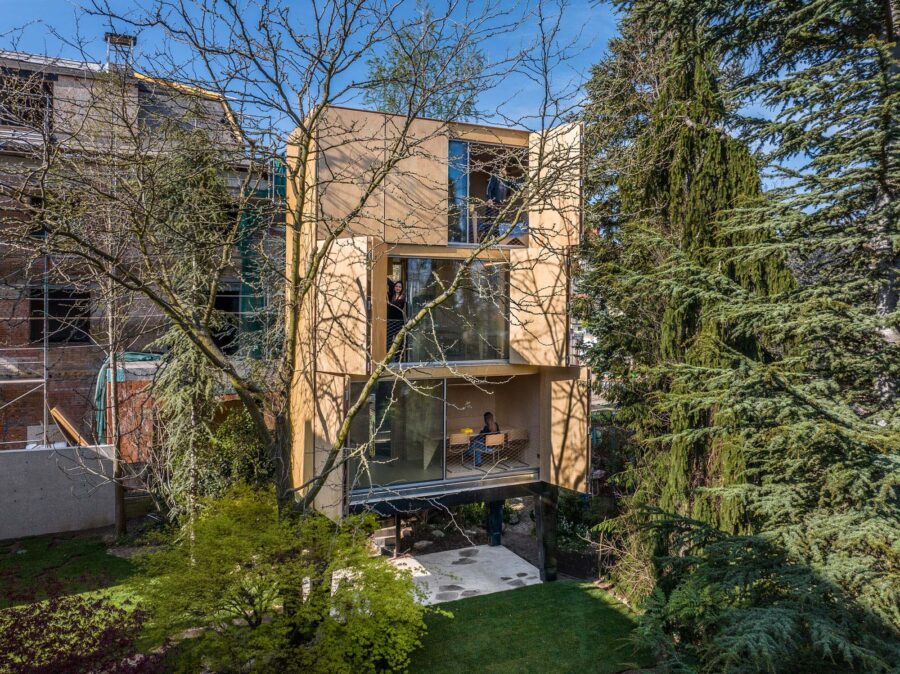
まず周辺の建ち方に倣い、同規模の矩形ヴォリュームを配置しつつ、街並みに連続する庭を設けた。擁壁の代わりに、土留を兼ねたコンクリート基礎を既存地盤に合わせて2段に設定し、その上に木架構を載せる構成とした。さらに床仕上げを分節し、道路から玄関ホール、スタディスペース、リビング・ダイニング、キッチン、テラスへと段状に連続するひとつながりの空間をつくった。床のレベル差は、視線や領域を緩やかに分けるだけでなく、腰を掛けたり背を預けたりと身体的な拠り所にもなる。リビングでは露出した基礎に座ると庭との距離が縮まり、スタディスペースは周囲の視線から守られた落ち着いた場所となる。家族はこれらの領域を行き来しながら、大地とのつながりを実感する。
外周部の立ち上がりは高さを揃えて風景へ馴染ませ、内部では床レベルに合わせた。架構より下が地形に従い、上部は一間半モジュールの木構造に切り替わることで、空間に2つの秩序を重ねている。この架構は、地形がもつ起伏に対して安定した構造体として自立する。平面の半分以上を占める吹き抜けを無理なく支え、南側両端に設けた幅390mmの柱によって、間口いっぱいに庭へ開く開口を実現した。さらに四方に設けた開口が多方向へ視線を導き、2階からも吹き抜け越しに庭を感じられる、立体的で開放的な空間となった。
造成によって均質化されてきた住宅地において、地形との関係を再編集する住まいのあり方を問い直した。地続きな床の変化が環境との結びつきを生み、大地が積み重ねてきた時間を日常の暮らしへと接続することを目指した。
(滝沢茂雄)
This house for a couple and their child stands in a quiet residential neighborhood developed on the Tama Hills during the 1960s. Formed by cutting into a north-facing slope, the surrounding landscape is marked by retaining walls and boundary fences̶traces of the long struggle to create level ground for habitation. Benefiting from generous plots compared with those in central Tokyo and a building coverage ratio of 40%, the neighboring houses share a common disposition: large south-facing gardens and façades aligned.
The site occupies a corner lot on a steep road, where a level difference of approximately two meters remains as a remnant of the former hillside. Rather than adopting the conventional approach of leveling the ground for construction, which would sever the site’s inherent qualities from everyday life, the project sought to incorporate the terrain’s memory into the spatial composition.
Following the surrounding pattern of development, a rectangular volume of comparable scale was placed on the site, creating a garden as a continuation of the streetscape. Instead of constructing a retaining wall, a two-tiered concrete foundation that also functions as earth retention was set in accordance with the existing ground level, upon which a timber frame was placed. The floor finishes were then articulated into a sequence of stepped levels, forming a continuous spatial progression from the street to the entrance hall, study, living and dining room, kitchen, and terrace. These changes in floor level gently define sightlines and territories while also providing places for the body̶to sit, lean, and rest. Sitting on the exposed concrete foundation in the living room brings one closer to the garden, while the study becomes a calm retreat sheltered from surrounding views. Moving through these interconnected domains, the family experiences a tangible relationship with the ground beneath them.
The perimeter foundation upstands rise to a uniform height, allowing the house to settle naturally into the surrounding landscape, while their interior faces follow the changing floor levels. Below the timber frame, the building responds to the contours of the terrain; above it, the structure shifts to a timber framework based on a 2.730-meter (1.5-ken ) module, superimposing two distinct spatial orders within the space. Independent of the irregular topography, this structural frame establishes a stable architectural order. It effortlessly supports the double-height space, which occupies more than half of the plan, while 390 mm- wide columns placed at both ends of the south façade allow the house to open fully onto the garden. Openings on all four sides further extend views in multiple directions, enabling the garden to be experienced even from the second floor across the void, creating a spatial environment that is both open and three-dimensional.
In a residential landscape that has been progressively homogenized through land development, the project reconsiders how housing might re-establish a relationship with topography. The continuous variation of the floor reconnects daily life with its environment, seeking to bring the accumulated time of the land into the experience of everyday living.
(Shigeo Takizawa)
【日野の住宅】
所在地:東京都日野市
用途:戸建住宅
クライアント:個人
竣工:2025年
設計:滝沢茂雄建築設計事務所
担当:滝沢茂雄
構造:yAt構造設計事務所
施工:吉田工務店
撮影:吉田 誠
工事種別:新築
構造:木造
規模:地上2階
敷地面積:179.80m²
建築面積:72.80m²
延床面積:102.61m²
設計期間:2023.04-2024.07
施工期間:2024.08-2025.03
【House in Hino】
Location: Hino-shi, Tokyo, Japan
Principal use: Residence
Client: Individual
Completion: 2025
Architects: Shigeo Takizawa Architects
Design team: Shigeo Takizawa
Structure engineer: yAt structural design office
Construction: Yoshida Komuten
Photographs: Makoto Yoshida
Construction type: New building
Main structure: Wood
Building scale: 2 stories
Site area: 179.80m²
Building area: 72.80m²
Total floor area: 102.61m²
Design term: 2023.04-2024.07
Construction term: 2024.08-2025.03