
プライマリー・アーキテクツが中国の村に手がけた、山並みにリンクする木造屋根の工房〈カーペンターズ・ホーム〉
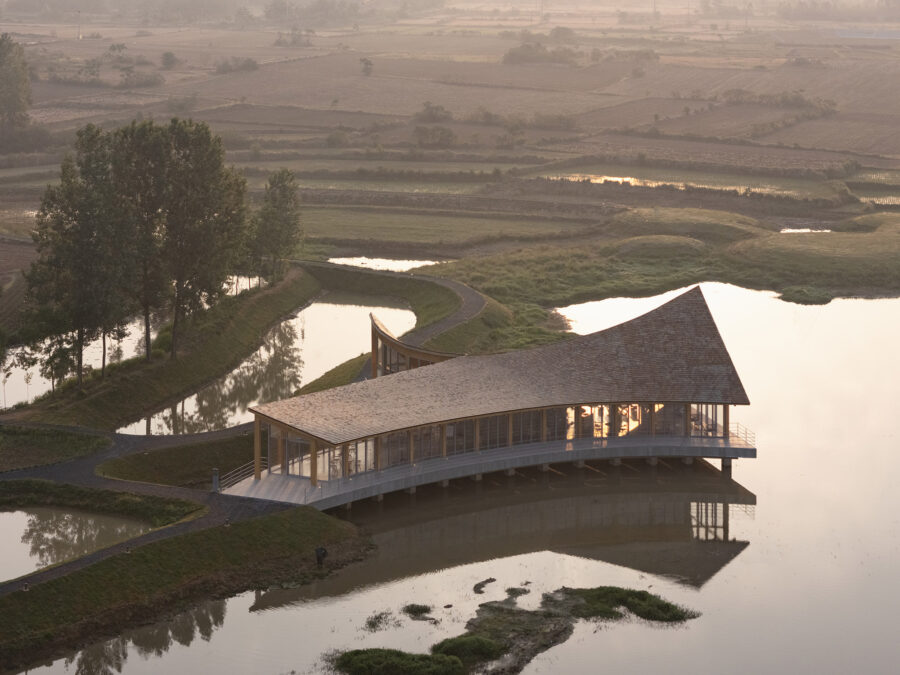
中国・河南省のハオタン村に建つ〈カーペンターズ・ホーム(Carpenter’s Home)〉は、伝統工芸の復興と農村の日常を結ぶ木造の複合型ワークショップです。
山稜の起伏に呼応する双曲面集成木構造の大屋根が特徴的な建築であり、建築の本質回帰(Primal)を理念に掲げる北京のプライマリー・アーキテクツ(Primary Architects)が設計しました。
注目ポイント
- パラメトリック制御で生み出す「双曲面集成木構造」
- 最大スパン26mを可能にするハイブリッド構造とプレファブ工法
- 谷間に落ちる光を思わせる湾曲した天窓
- 職人の作業場と展示・ワークショップ施設等を併せもつ木工複合施設
(以下、プライマリー・アーキテクツプライマリー・アーキテクツから提供されたプレスキットのテキストの抄訳)
©︎ DONG Image
©︎ DONG Image
木工技術と農村の暮らしを体現する木造建築
伝統工芸の復興から始まる農村振興
農村振興のモデル村として、ハオタン村(Haotang Village)は地元の伝統工芸の復活に取り組んでいる。同村は「八大伝統工芸復興プログラム」を立ち上げ、大工、鍛冶屋、竹細工職人などの地元の職人たちと提携している。古い住宅の微改修と新たな空間の建設を組み合わせることで、一連の特色ある工芸工房が生み出された。
この取り組みにより、散逸しつつあった農村の手工芸技術が日常生活に取り戻され、新たな息吹が吹き込まれている。工房は工芸品の展示や文化観光販売の場として機能するほか、学校向けの工芸研究・学習活動を定期的に開催している。地元の職人技の文脈を継承し、村の集合的記憶を保存しつつ、村民のための持続可能な収入増加の道も模索している。
©︎ DONG Image
©︎ DONG Image
©︎ DONG Image
©︎ DONG Image
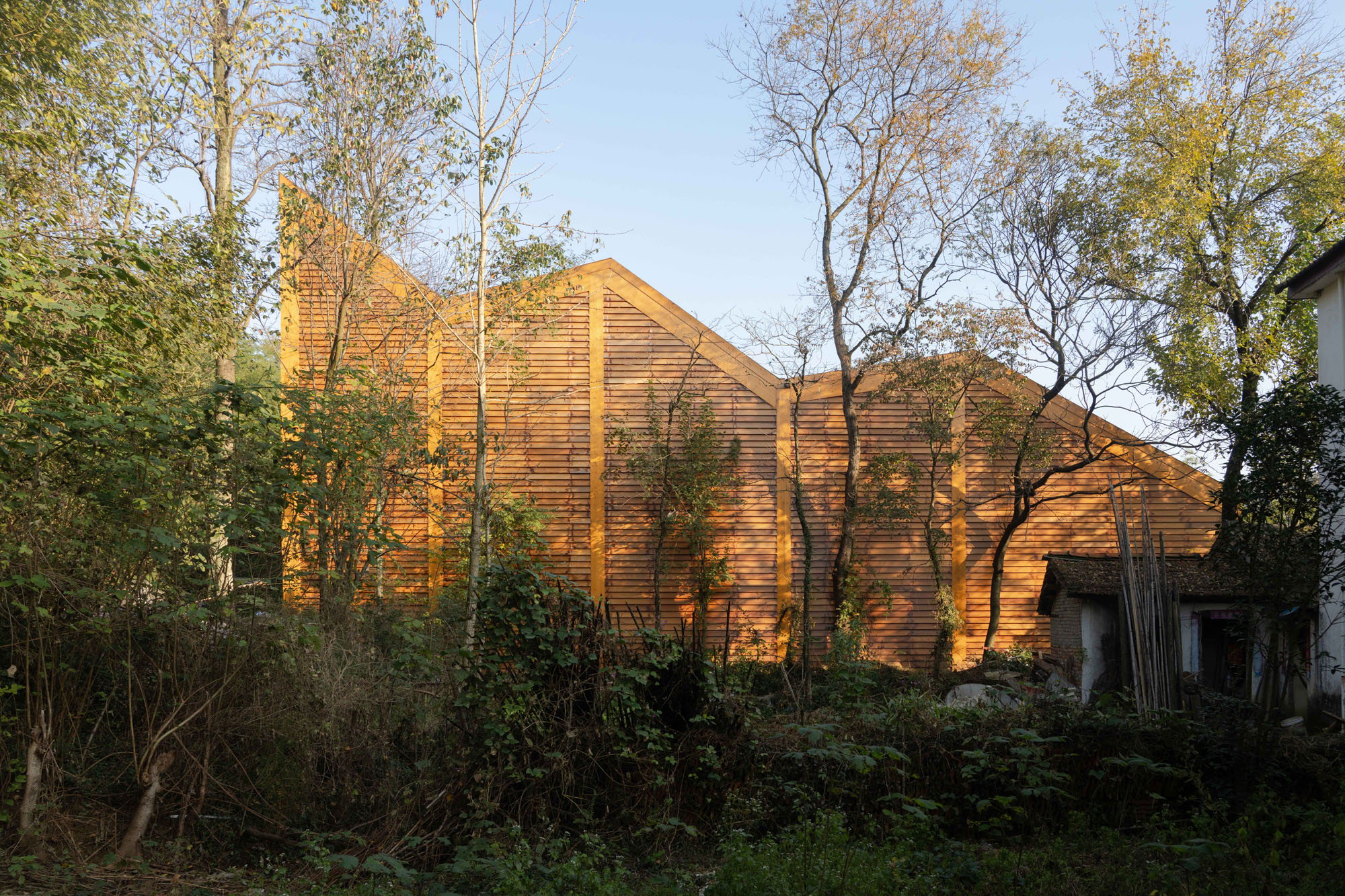
©︎ DONG Image
自然と調和する大工の家
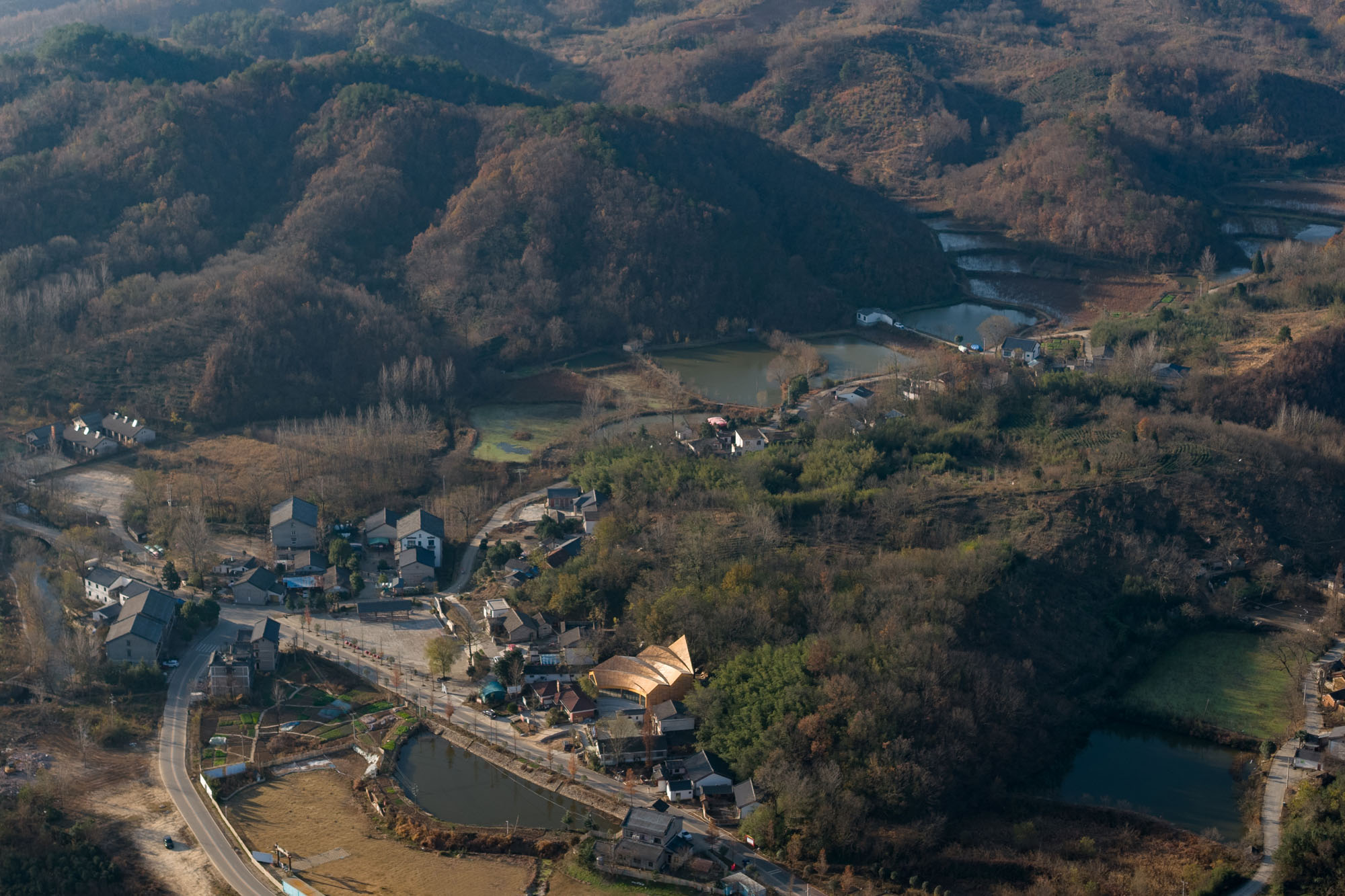
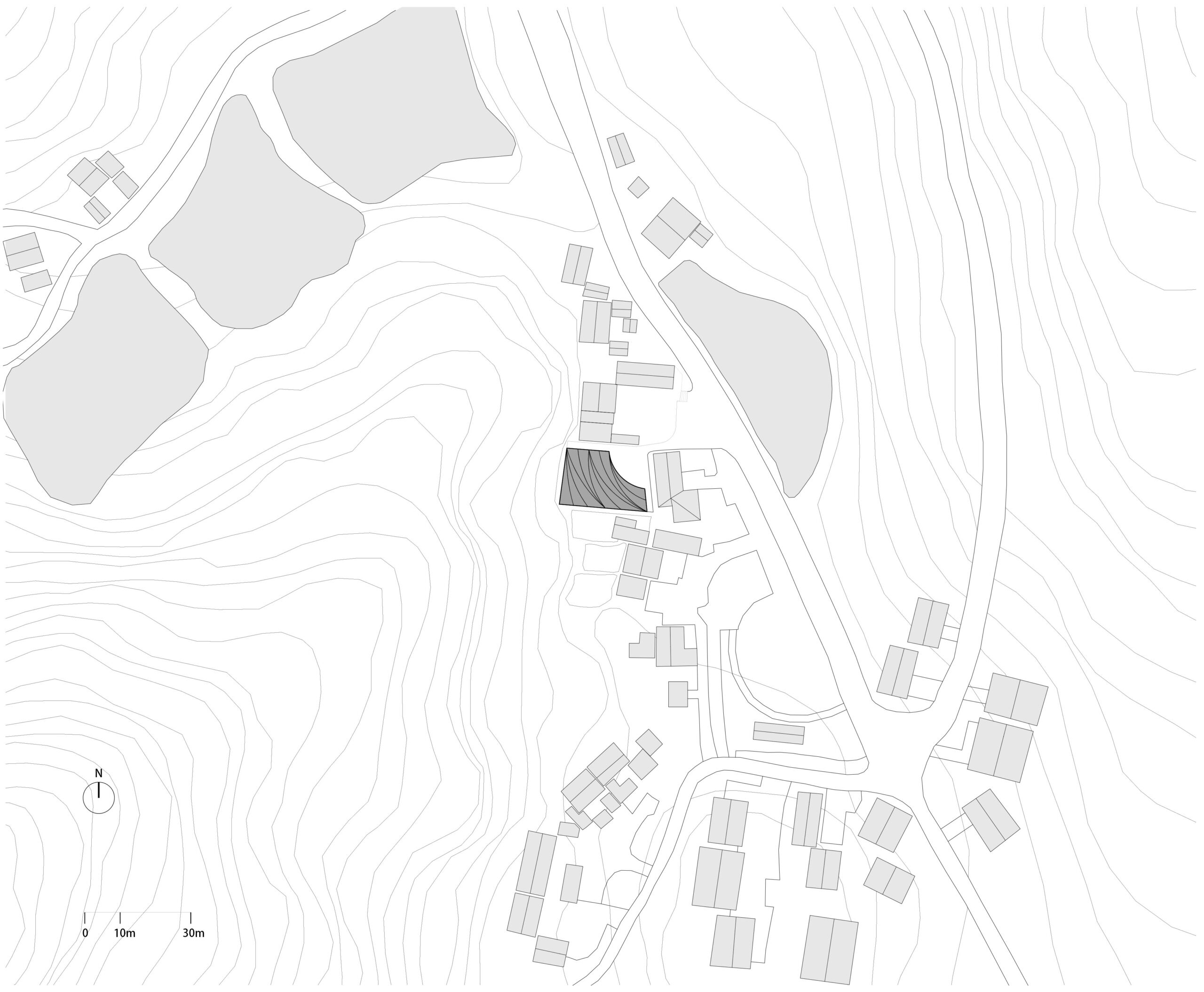
〈カーペンターズ・ホーム〉の敷地を視察する際、私たちは小道を通って村に入った。この敷地は、大別山脈の北側の麓から延びる山岳地形を特徴とし、河南省南部特有の起伏に富んだ景観を呈している。
村の入り口には、自然の山岳地形と調和して建てられた大工・張氏の住居が佇んでいた。彼が自ら建てた3階建ての家の南側には、元々の木工小屋がある。そこは長年、伝統的な道具や木材の保管場所として、また大工の張氏がかつてその技を振るっていた日常の作業場として機能してきた。
静謐な中庭から生まれた設計コンセプト
この木工小屋は長年の間に荒廃し、老朽化した建物となっていた。また、張氏も長年にわたり木工を行っていなかった。
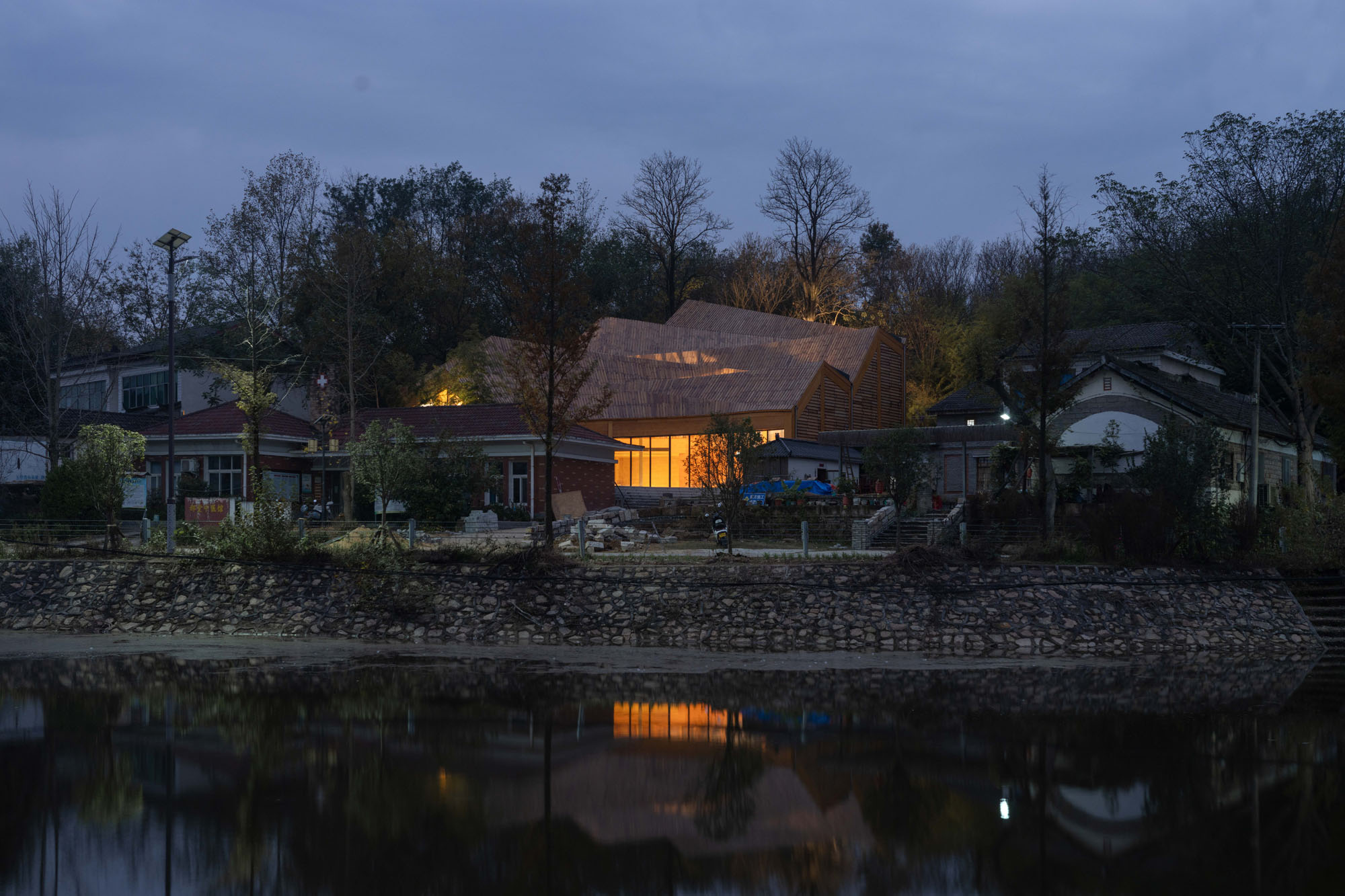
中庭に足を踏み入れると、河南南部の丘陵地帯特有の、包み込まれるような地形を肌で感じることができる。敷地は東に丘を抱き、南は村の住居に隣接し、西は村の保健センターの建物に守られている。それにより、内向的で静謐な空間が形成されている。
これが設計コンセプトの源泉となった。すなわち、新しい工房は山の文脈に従い、自然の質感を基調とし、敷地内の高低差を調和させ、山の奥地から村の表通りへと自然な移行を実現するものである。この建物は、村に優しく溶け込む軽やかな木造構造の器として構想されている。
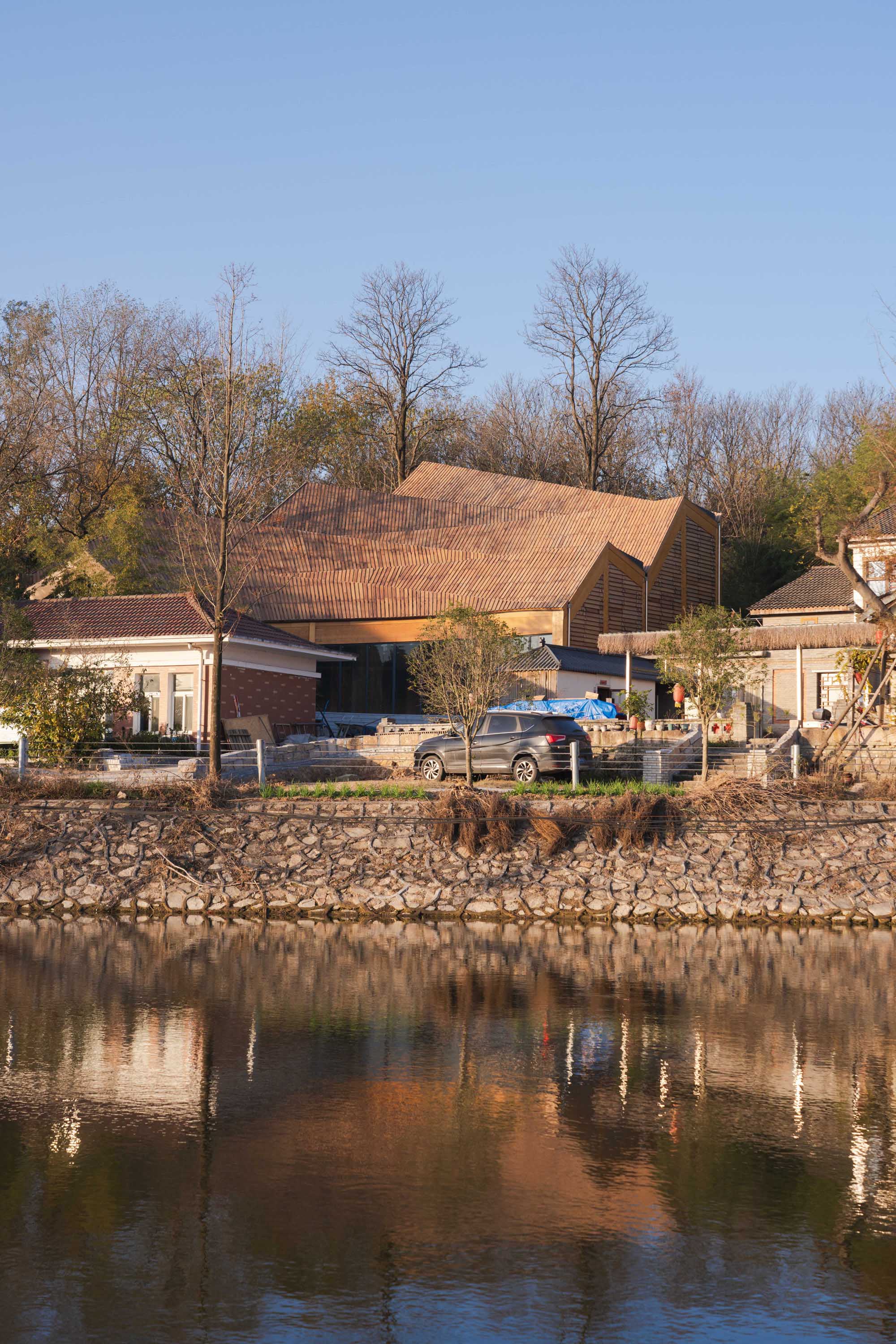
©︎ DONG Image
地域と来訪者をつなぐ二重の使命
「八つの工芸」イニシアチブの中心的な実践として、〈カーペンターズ・ホーム〉は二重の使命を担っている。それは、伝統的な木工生産と研究のための空間的基盤となるだけでなく、職人の日常生活に深く溶け込み、村、自然、そして訪れる観光客をつなぐ公共の結節点としての役割も果たす。
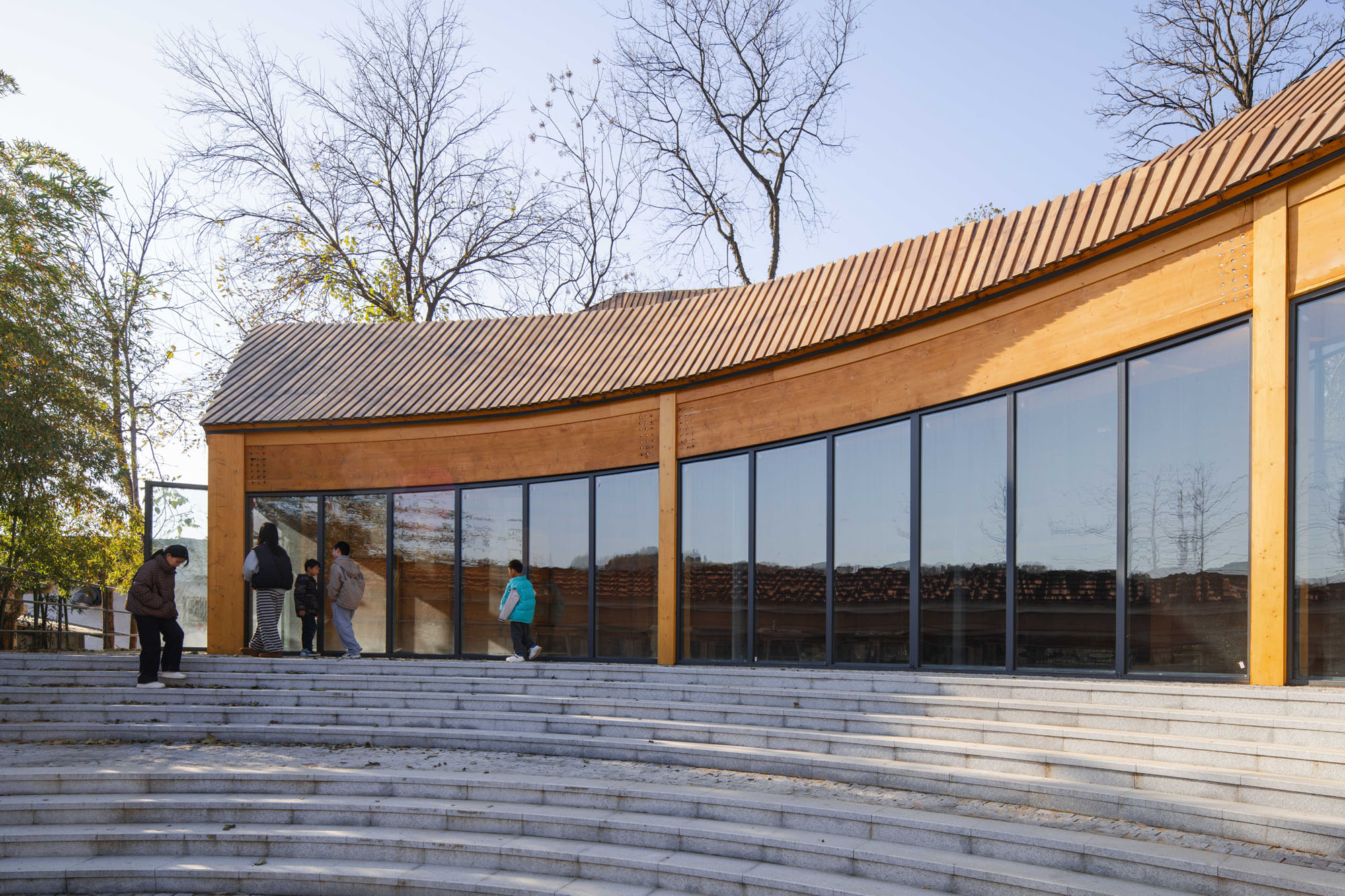
©︎ DONG Image
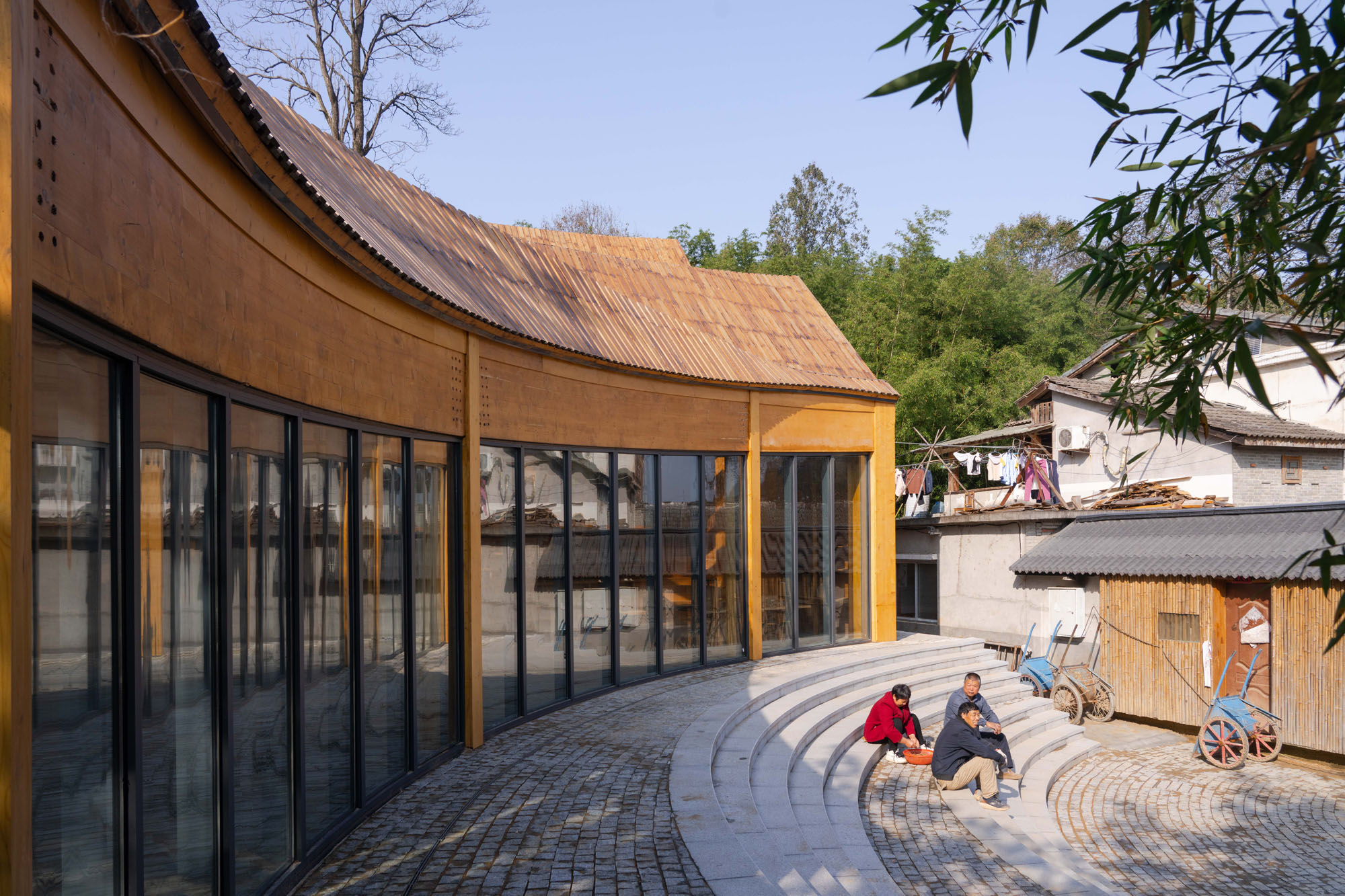
©︎ DONG Image
山稜の起伏に呼応する建築形態
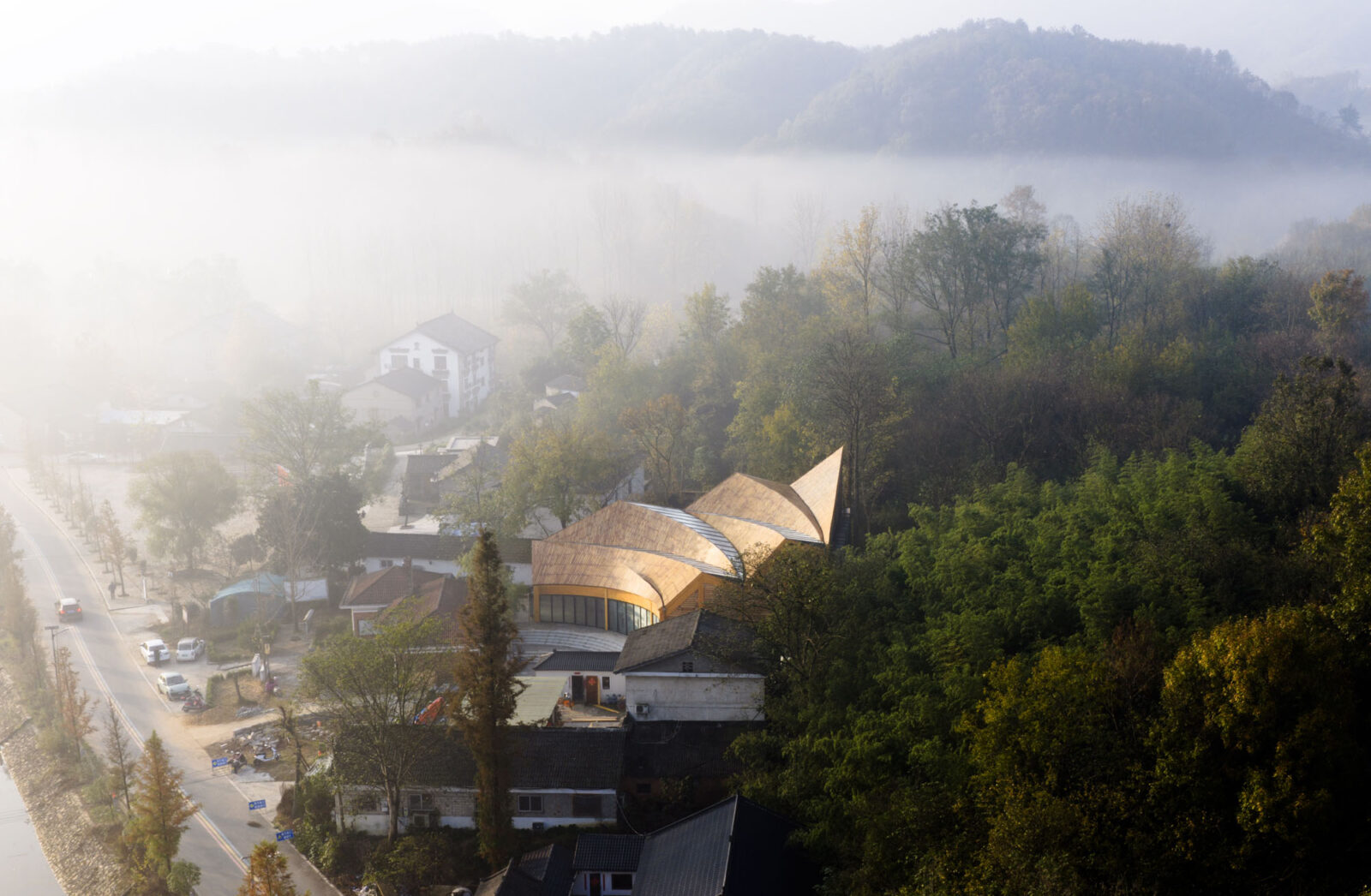
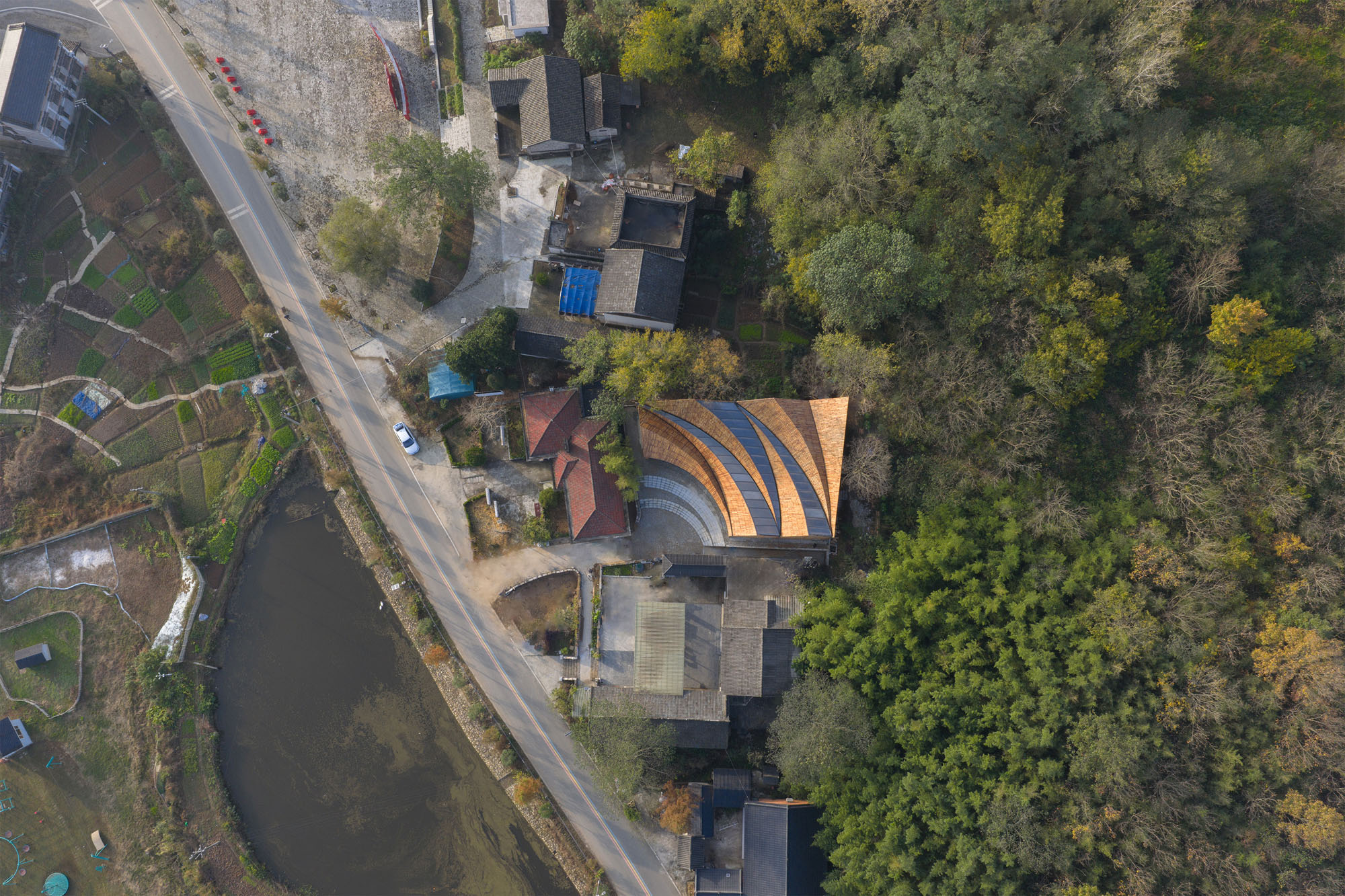
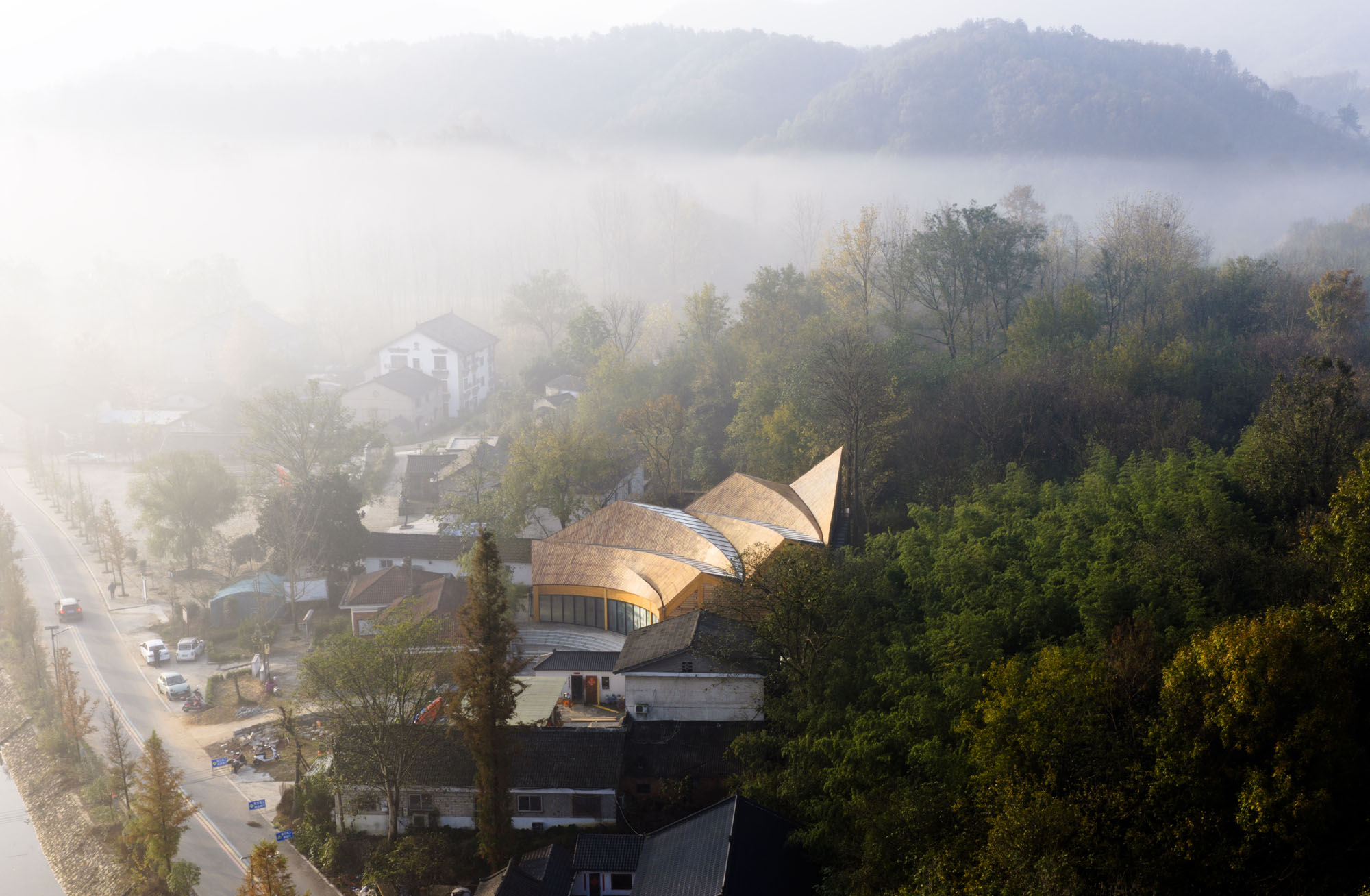
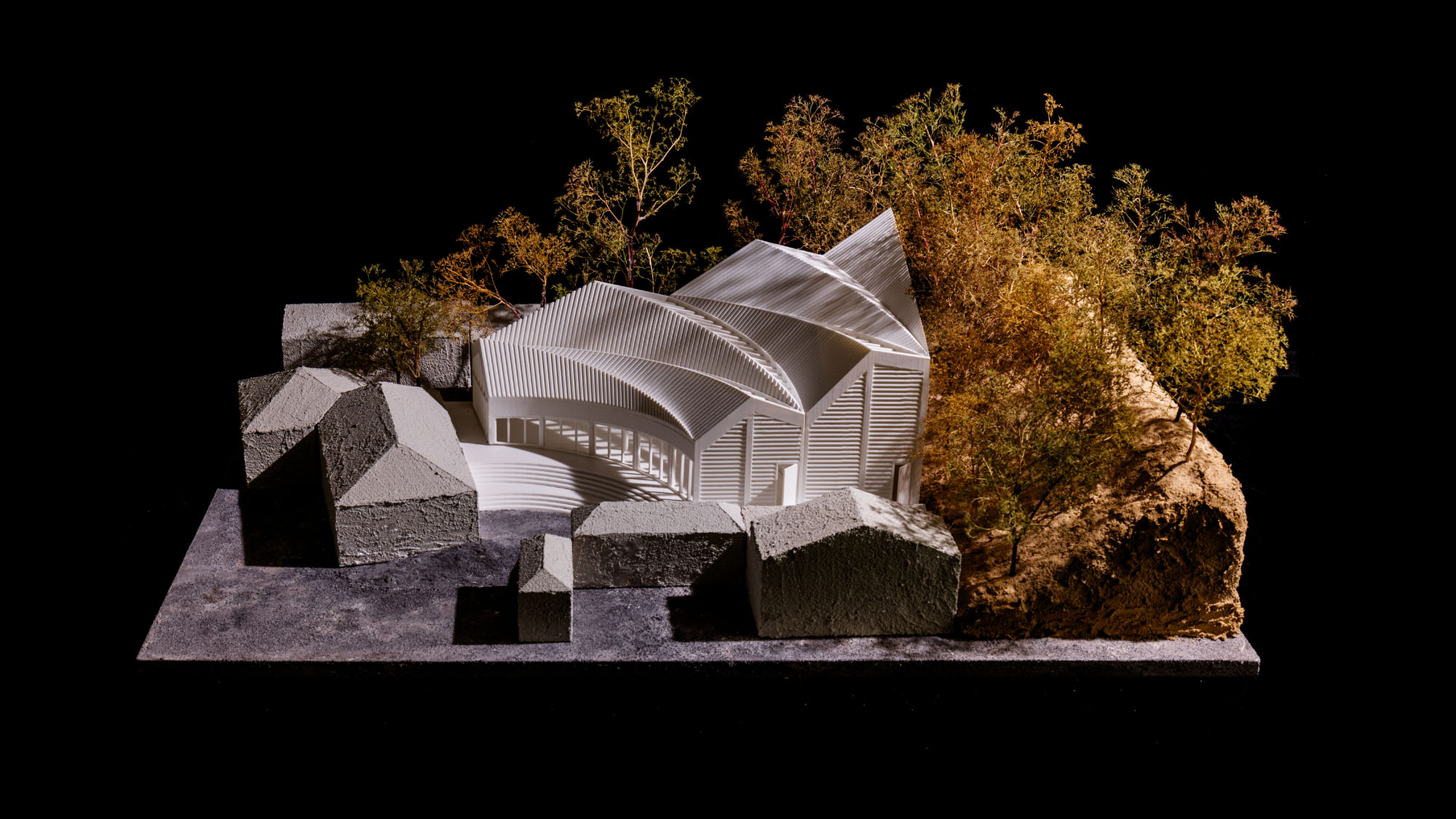
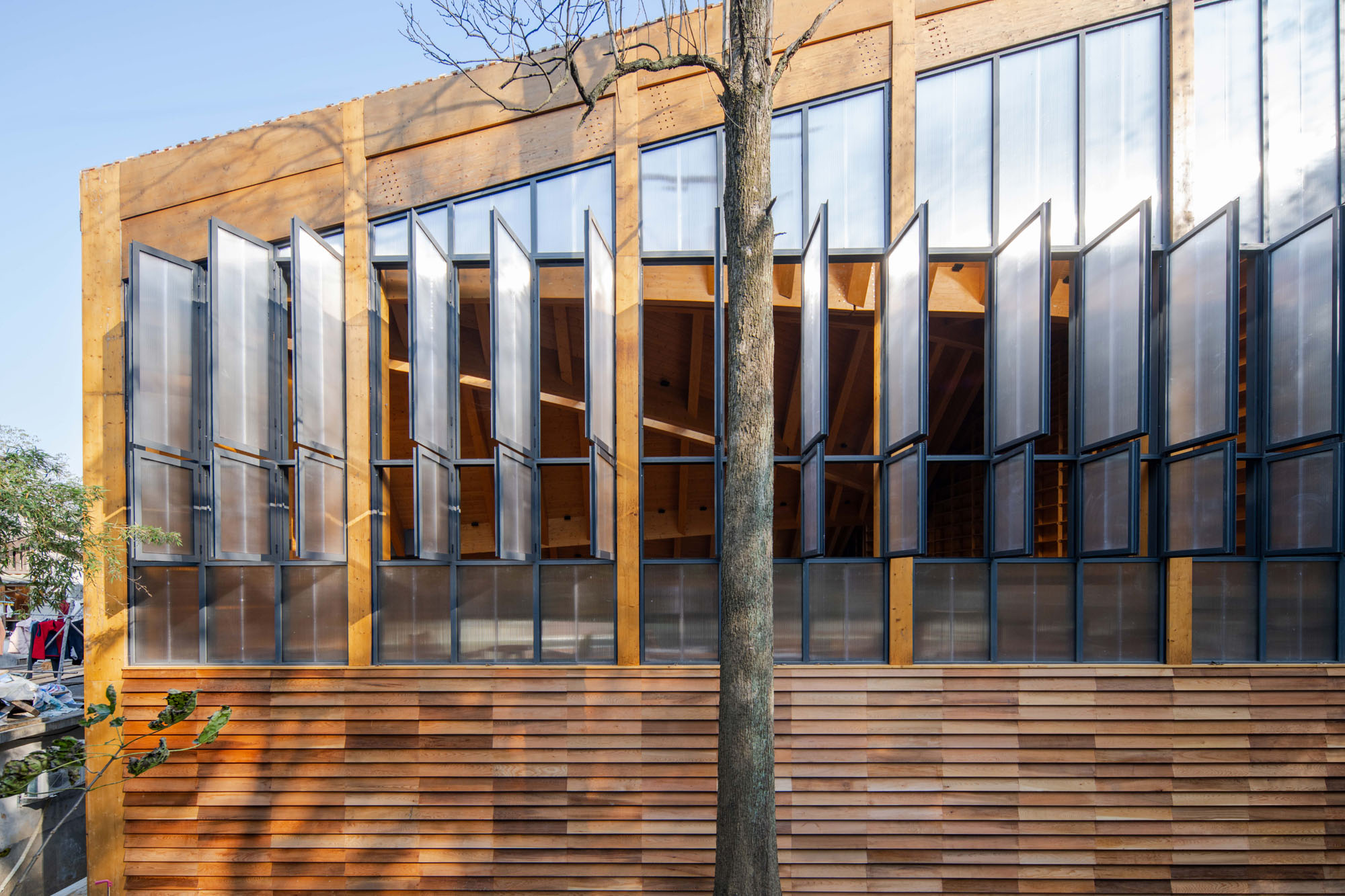
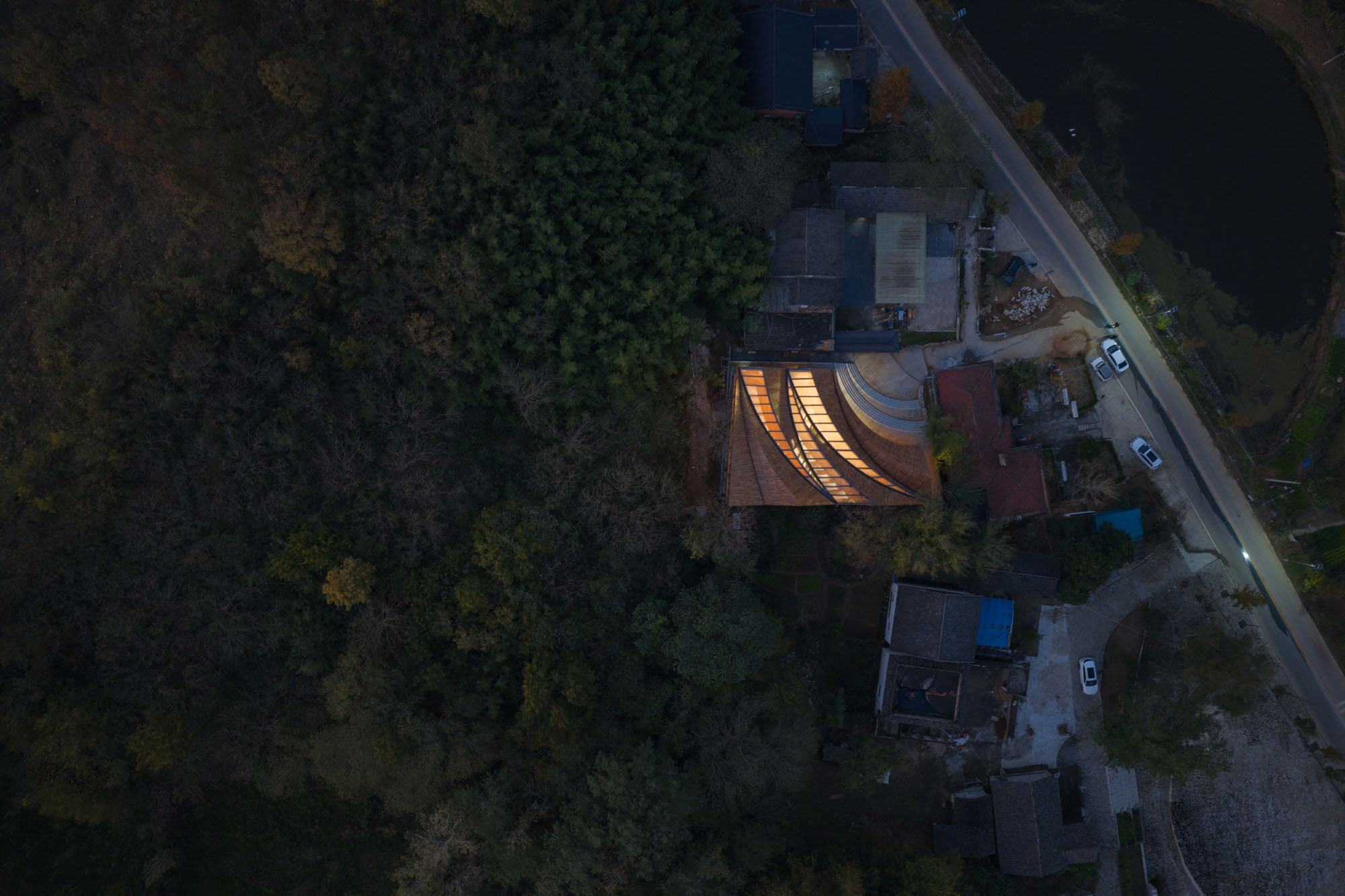
控えめな佇まいをもつこの建物は、村の空間的文脈に溶け込んでいる。南北両側には農家が隣接しており、建物は境界を定義しつつ、垂直な囲い壁を形成している。東側には起伏のある山地が広がり、建物はその屋根を、村へと伸びる山稜の穏やかな延長として扱うことで、自然に呼応している。
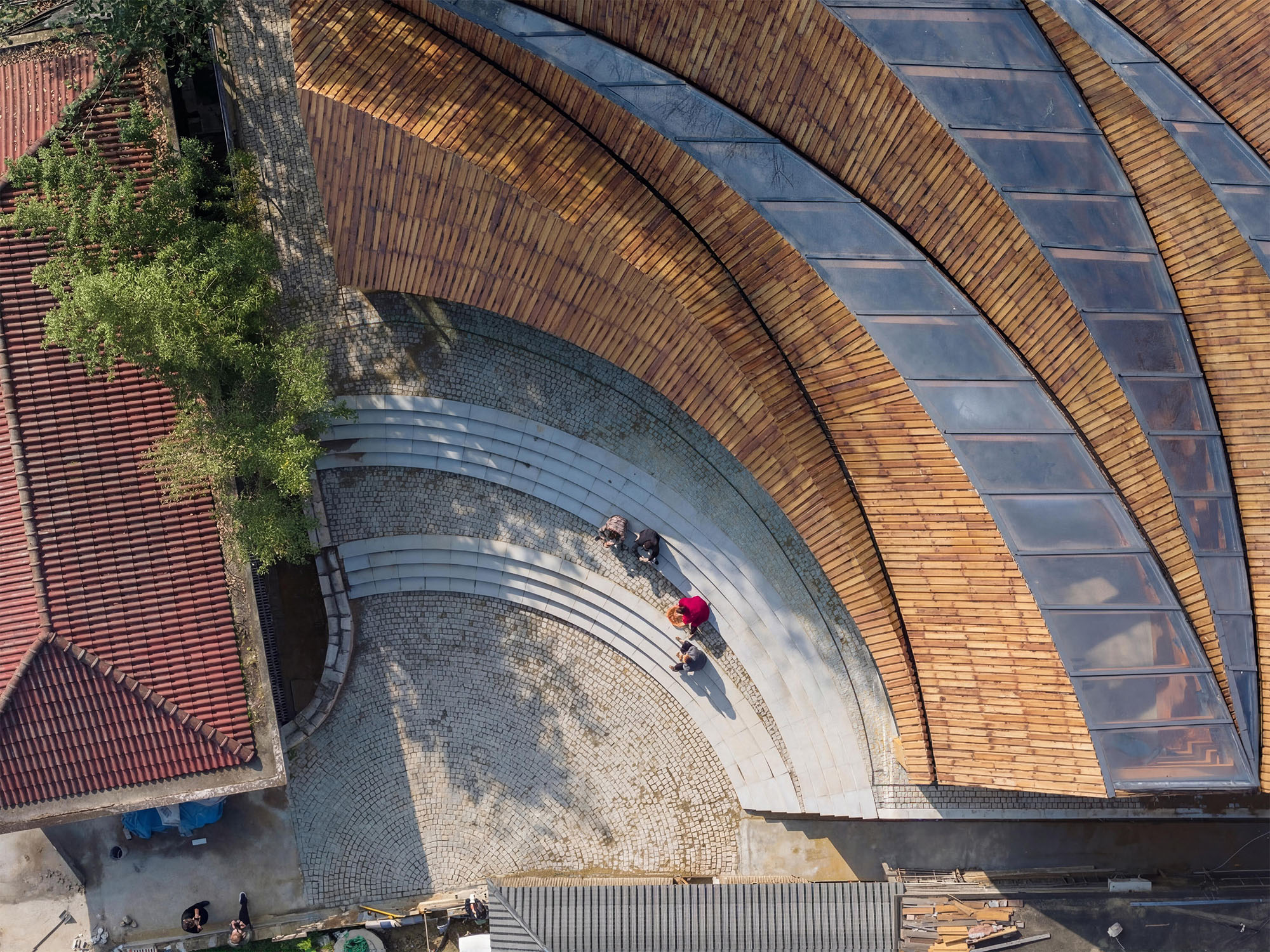
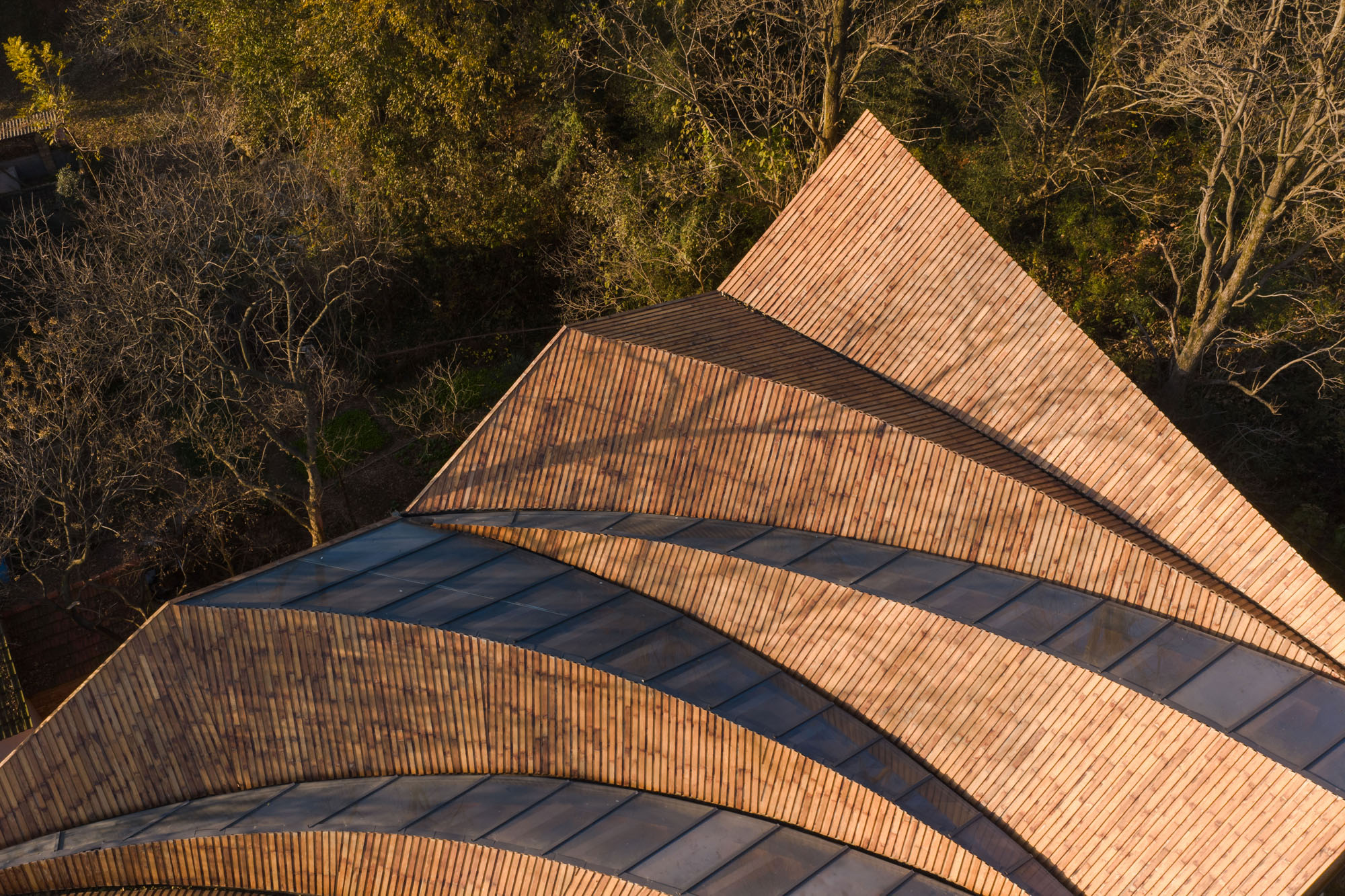
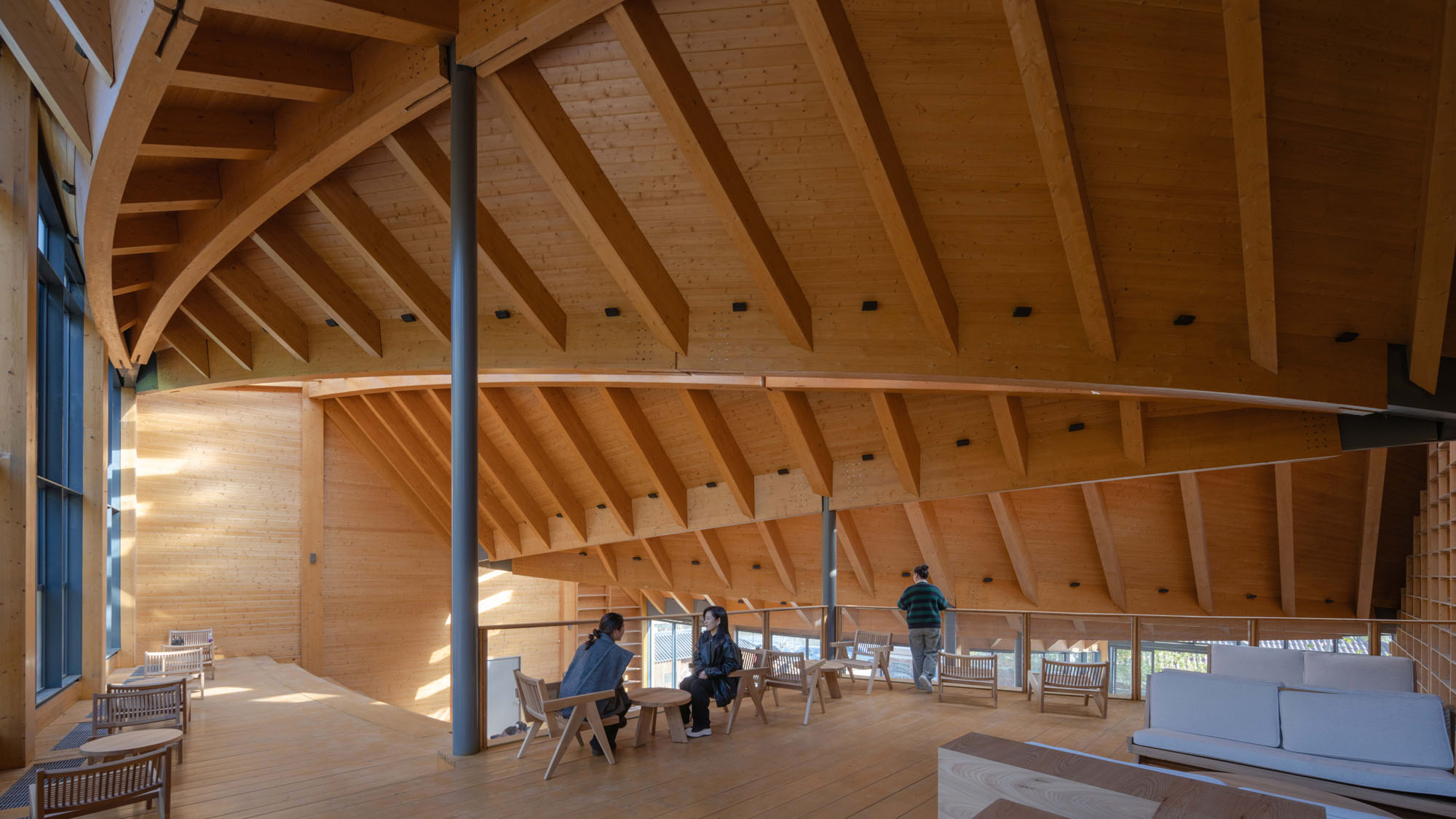
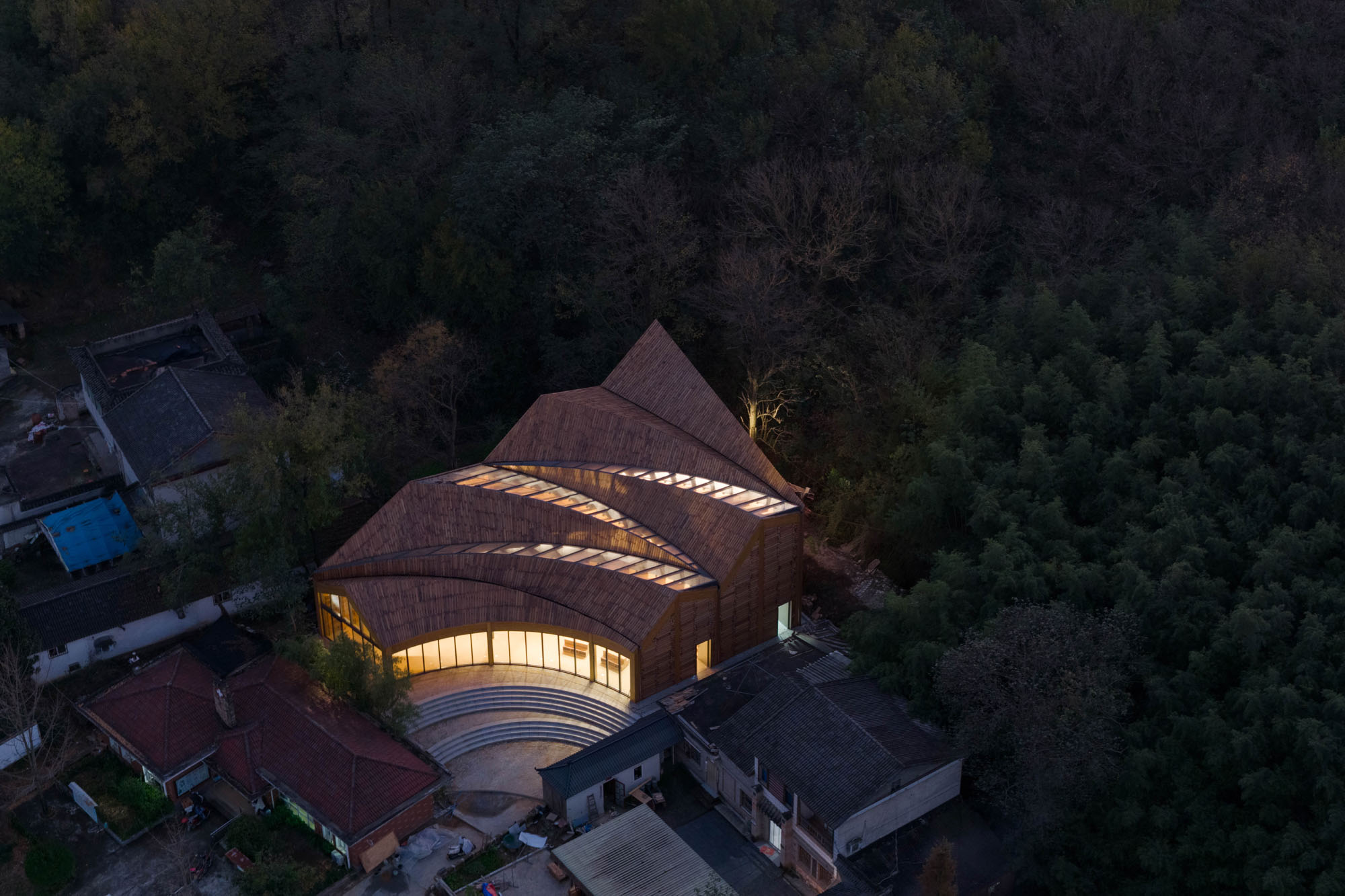
12本の曲げ集成材が東から西へと徐々に下降し、連続的で流れるような空間のリズムを生み出している。これらは西側の村の保健センターとの高低差を調和させ、建物が山、村、そして周囲の環境との間に調和のとれた空間的関係を築くことを可能にしている。
Model ©︎ Primary Architects
Site Plan
1st Floor plan
2nd Floor plan
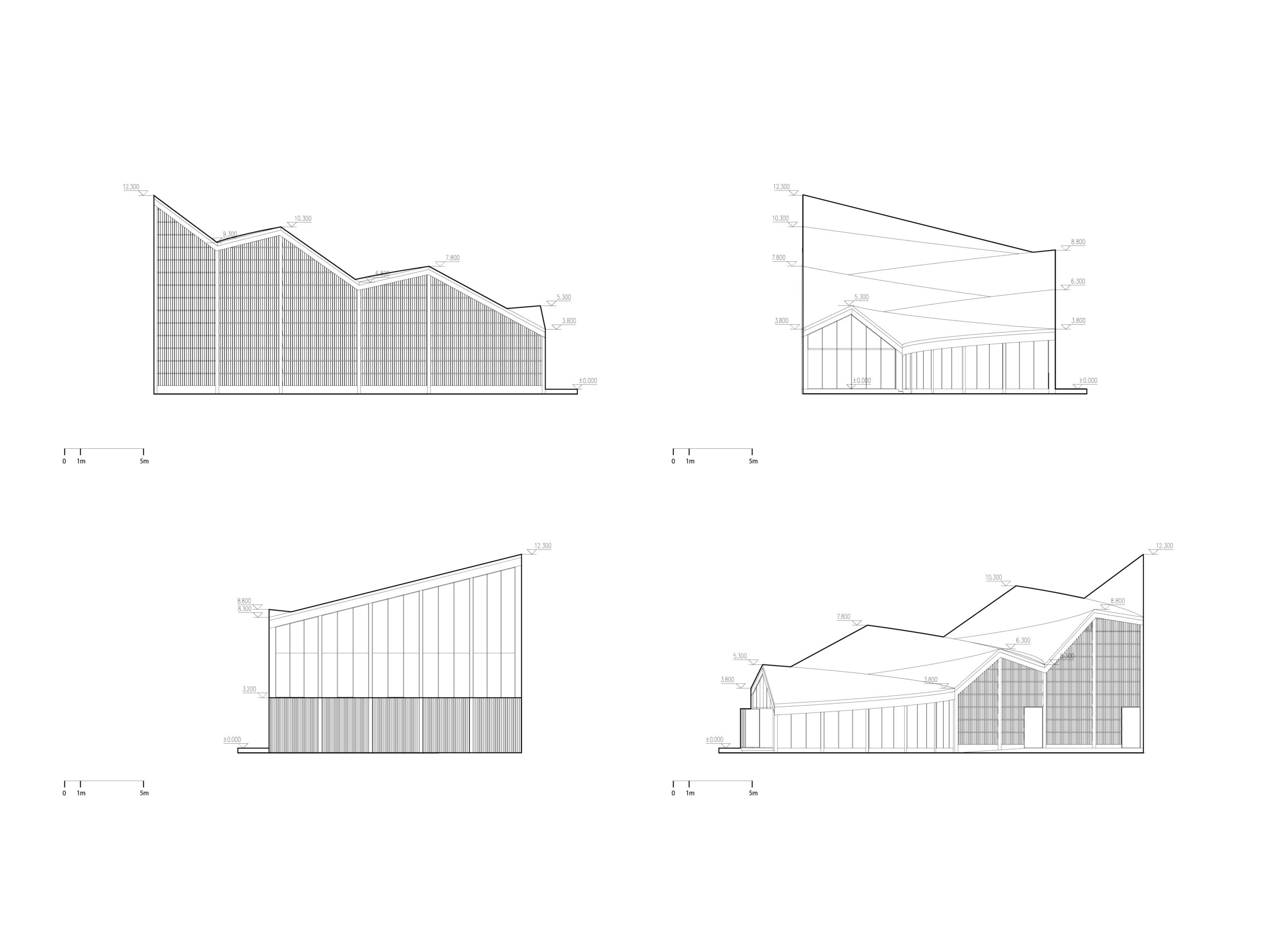
Elevation
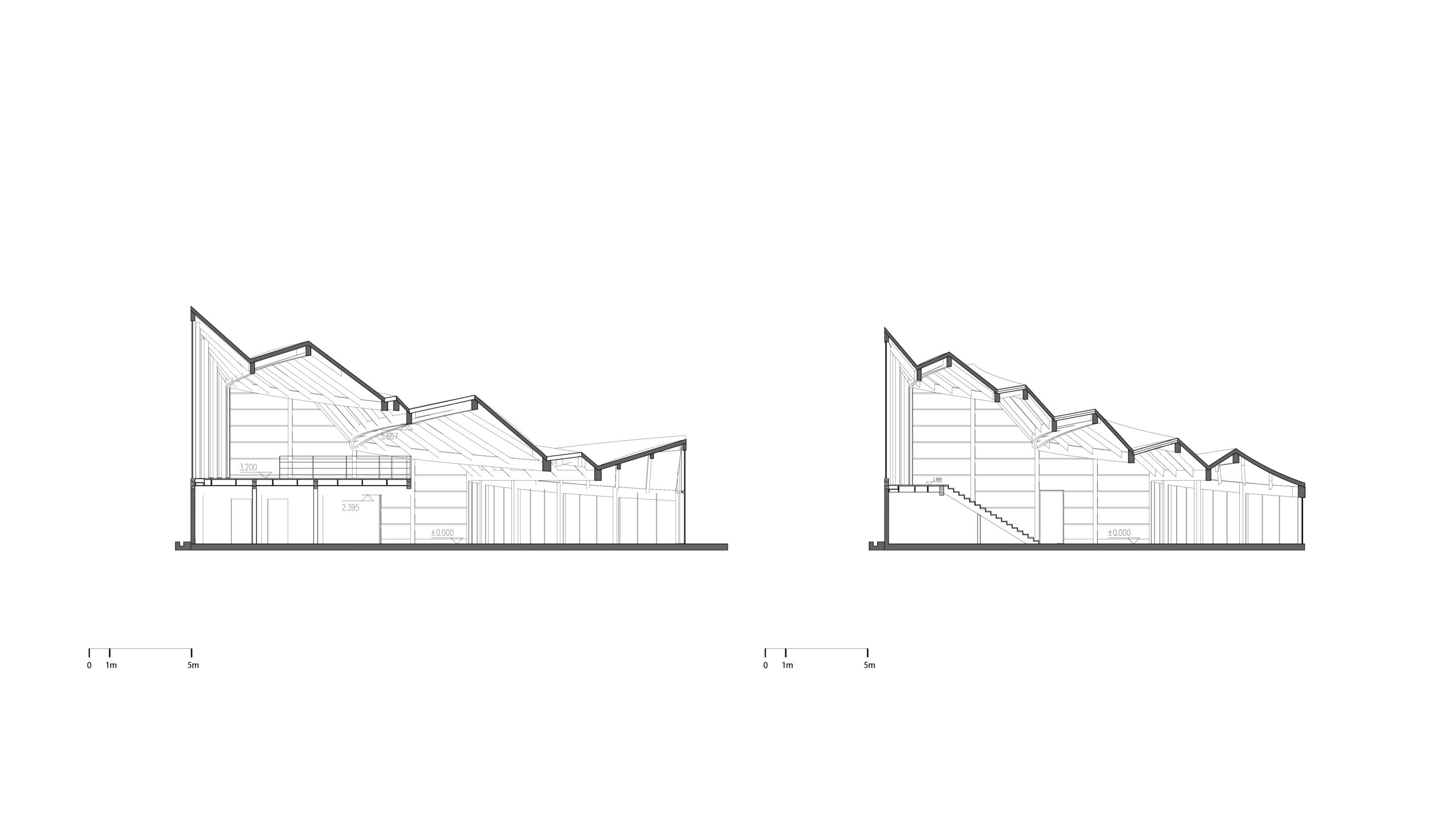
Section
双曲面集成木構造がもたらす光の空間
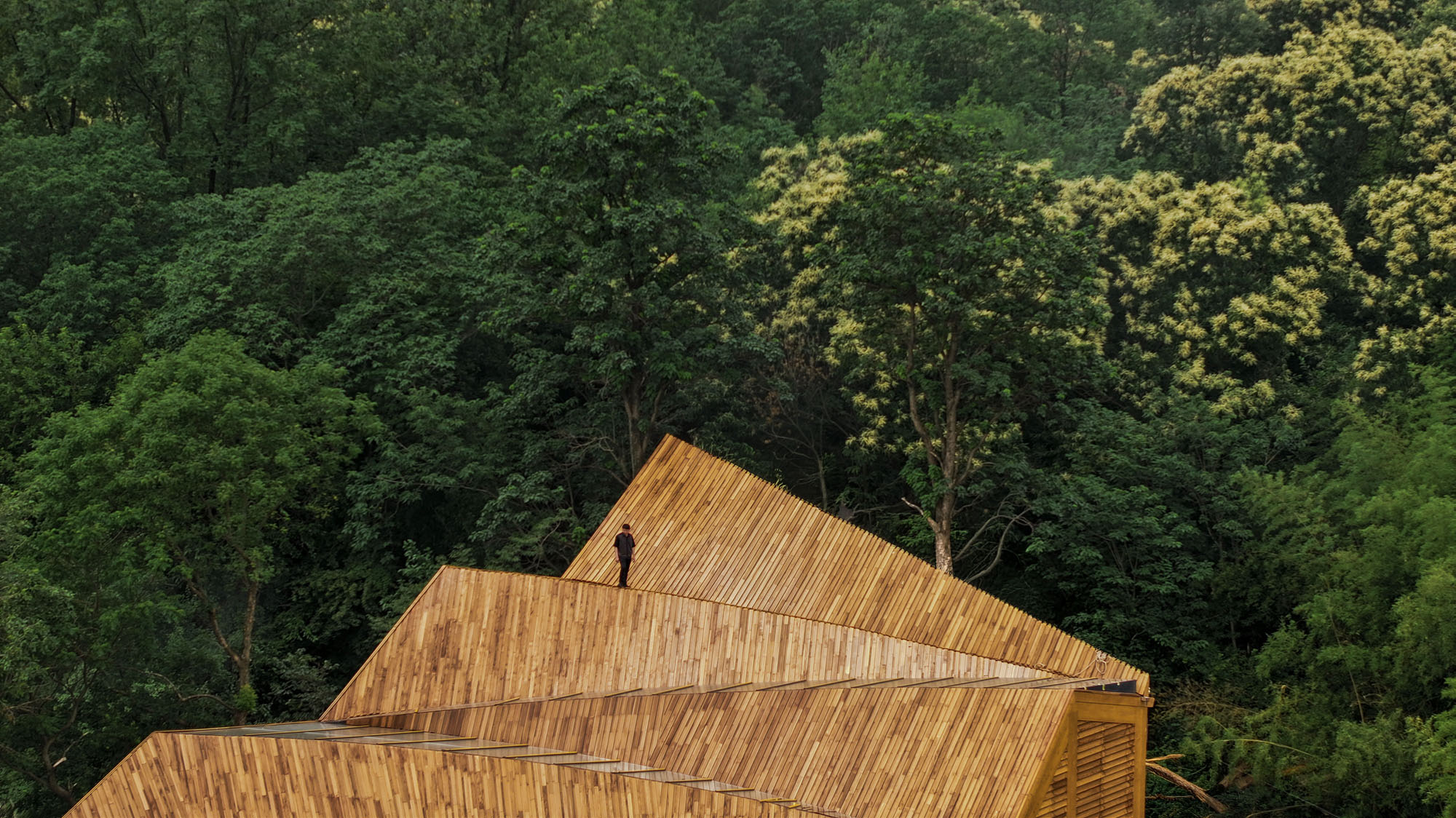
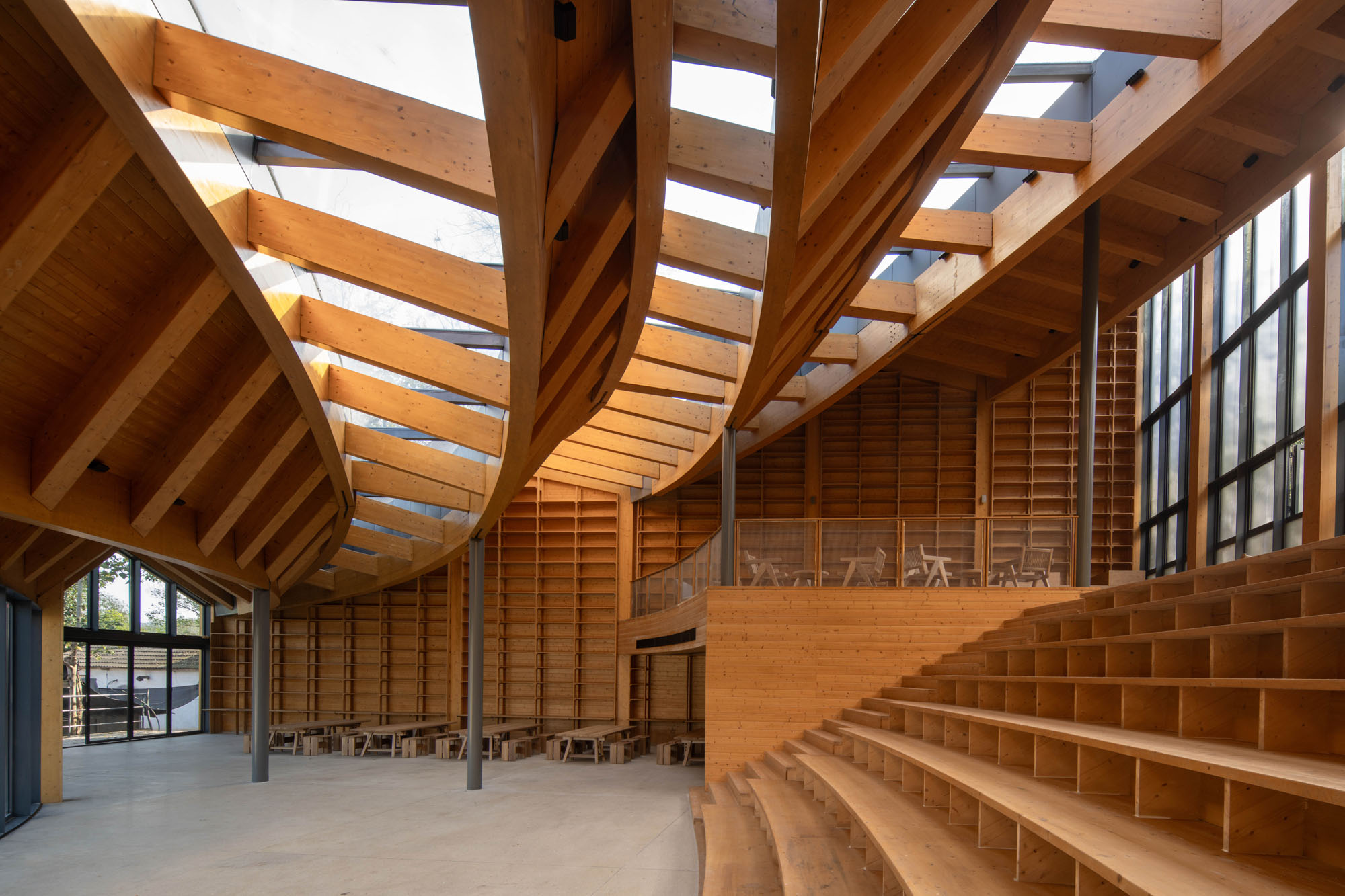
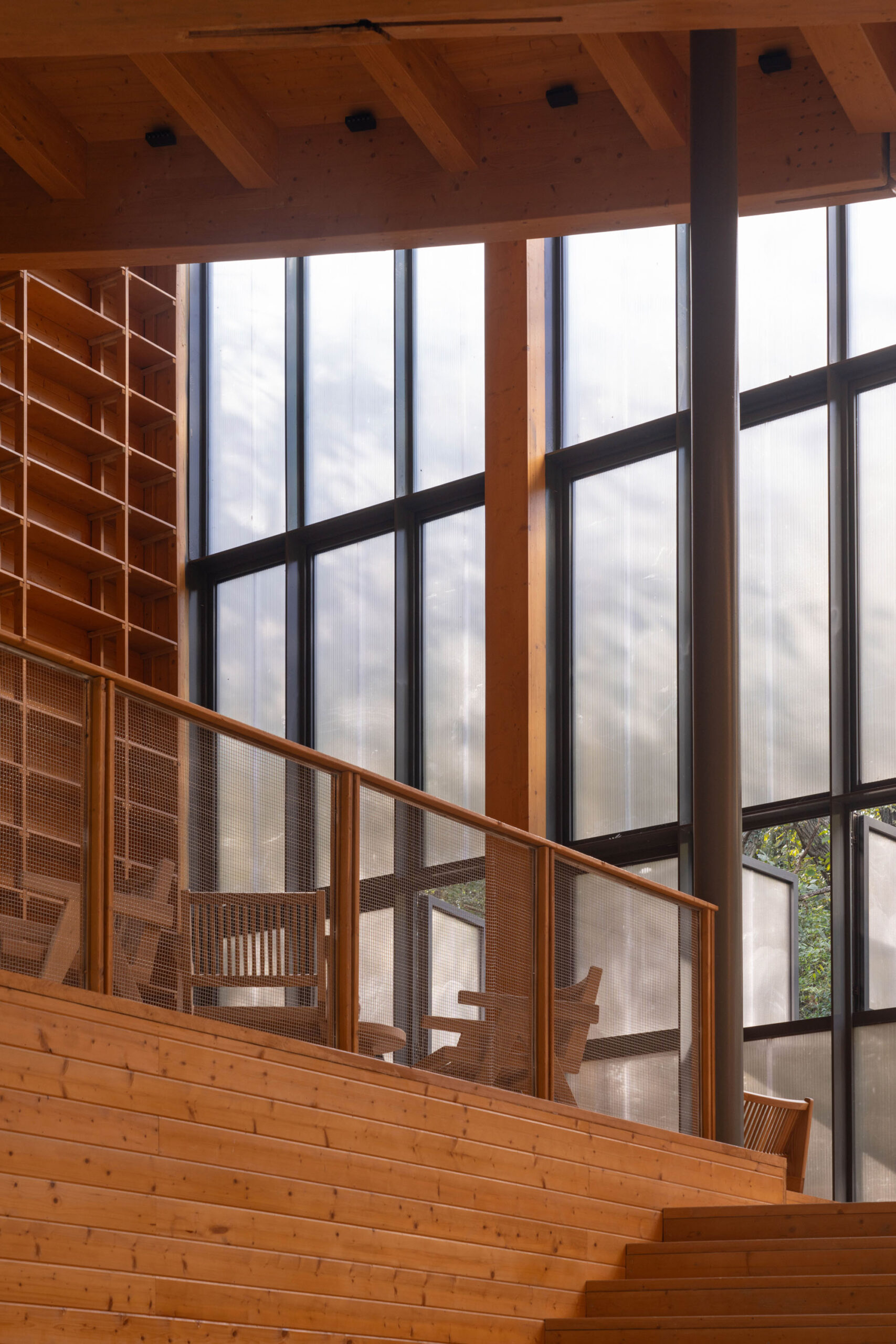
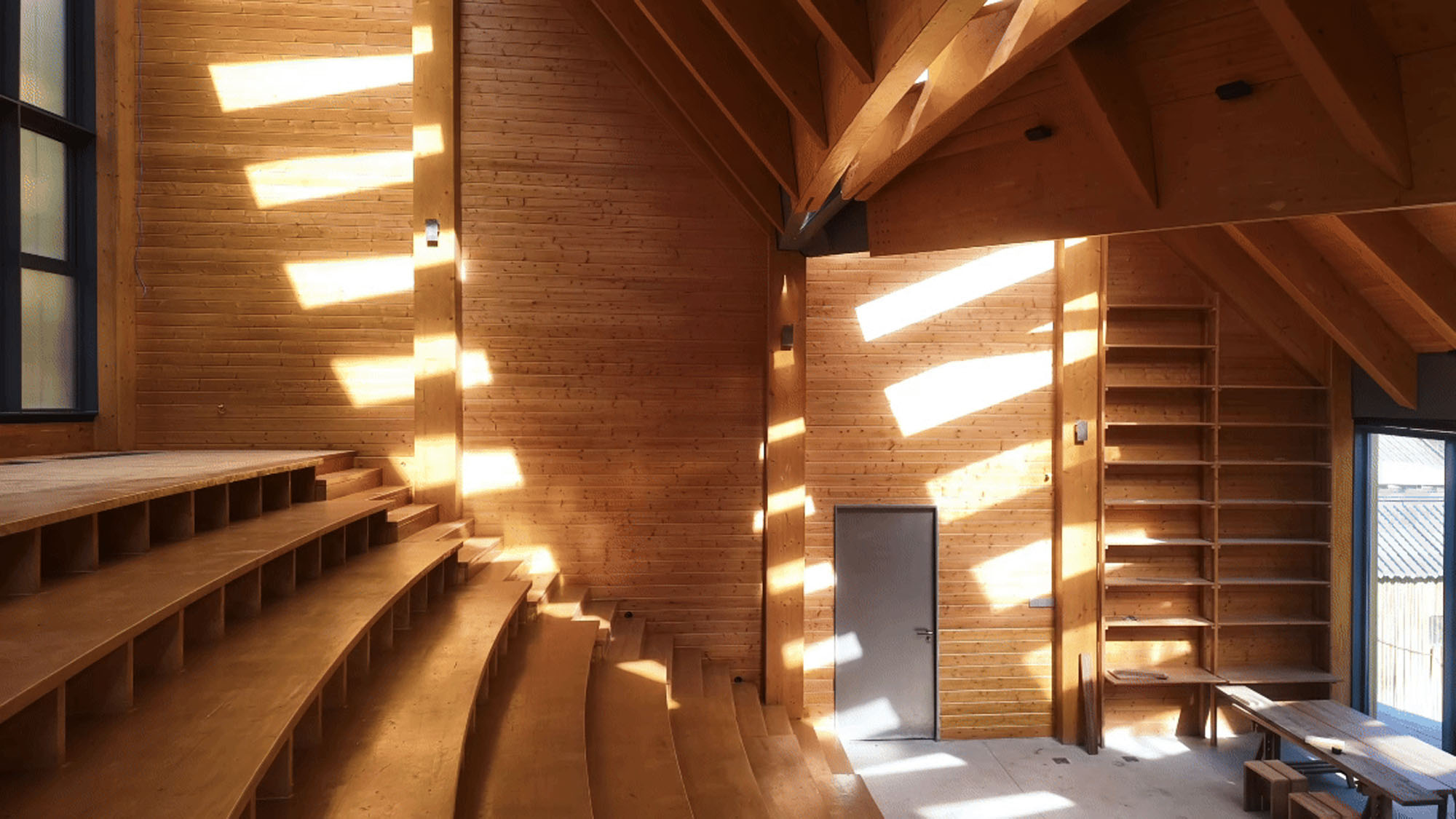
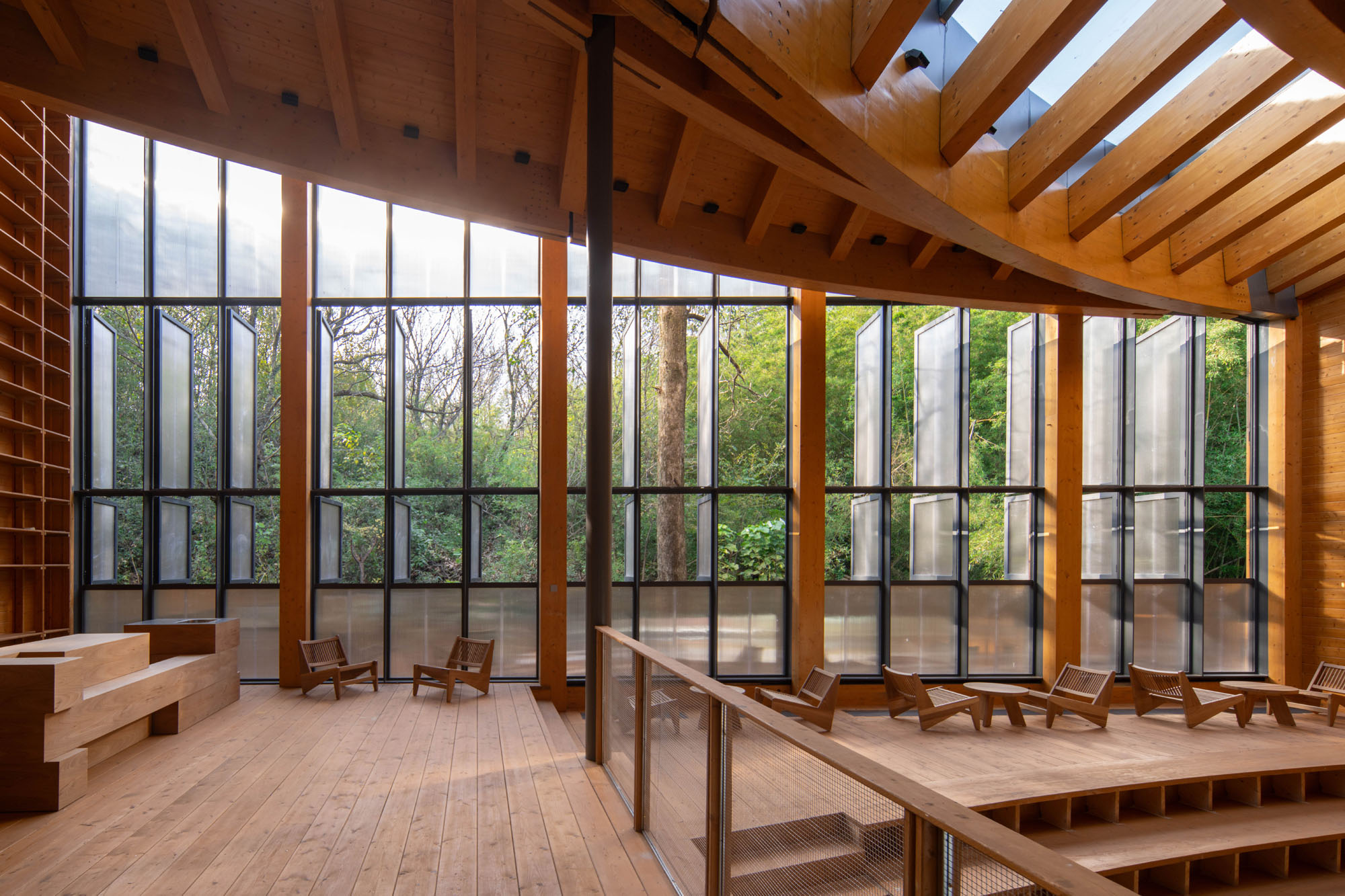
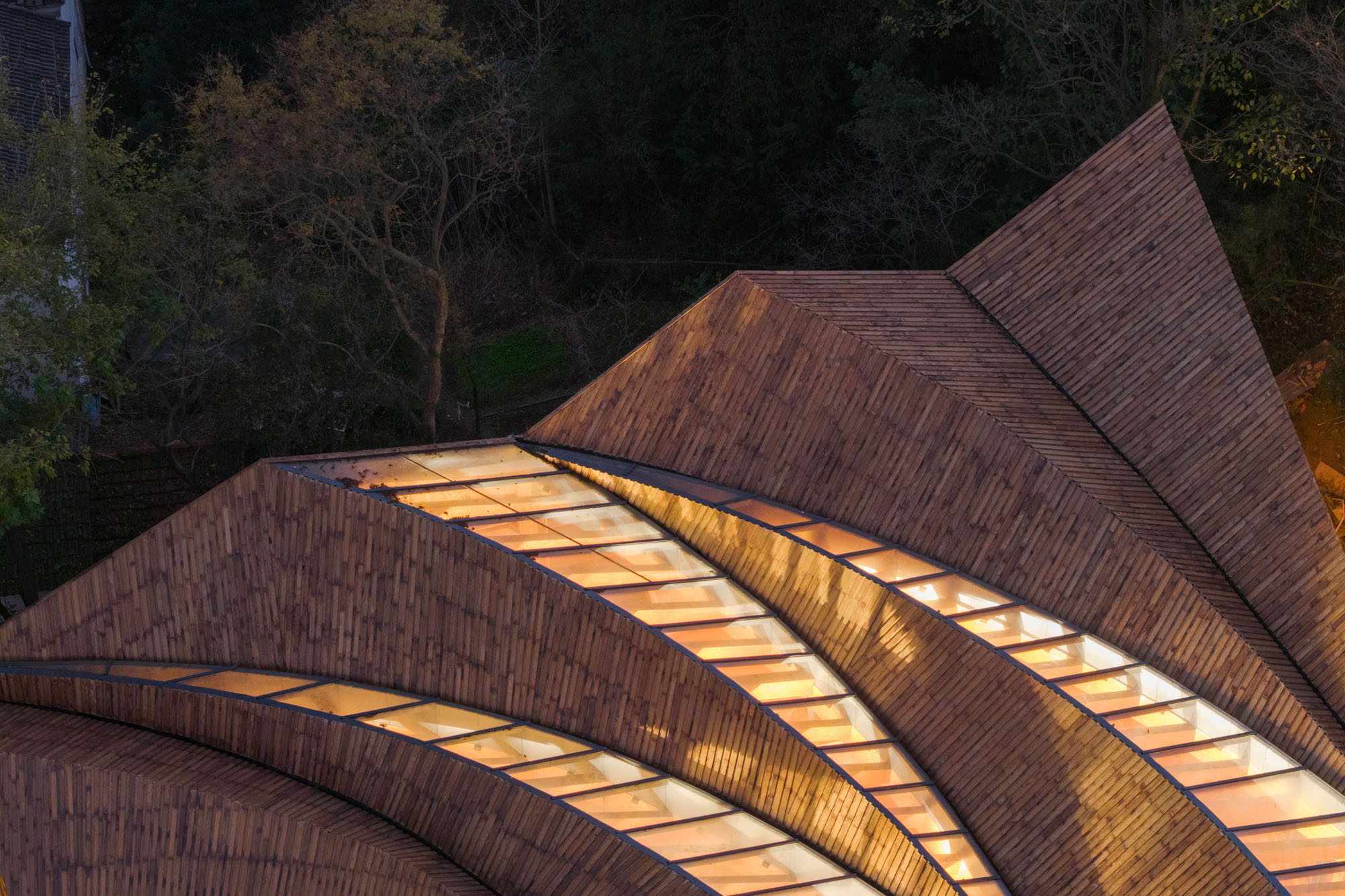
屋根には双曲面集成木構造を採用している。うねるような輪郭は周囲の山岳地形と呼応し、形は離れていても精神はつながっているかのような、遠くの山々との空間的な対話を形成している。
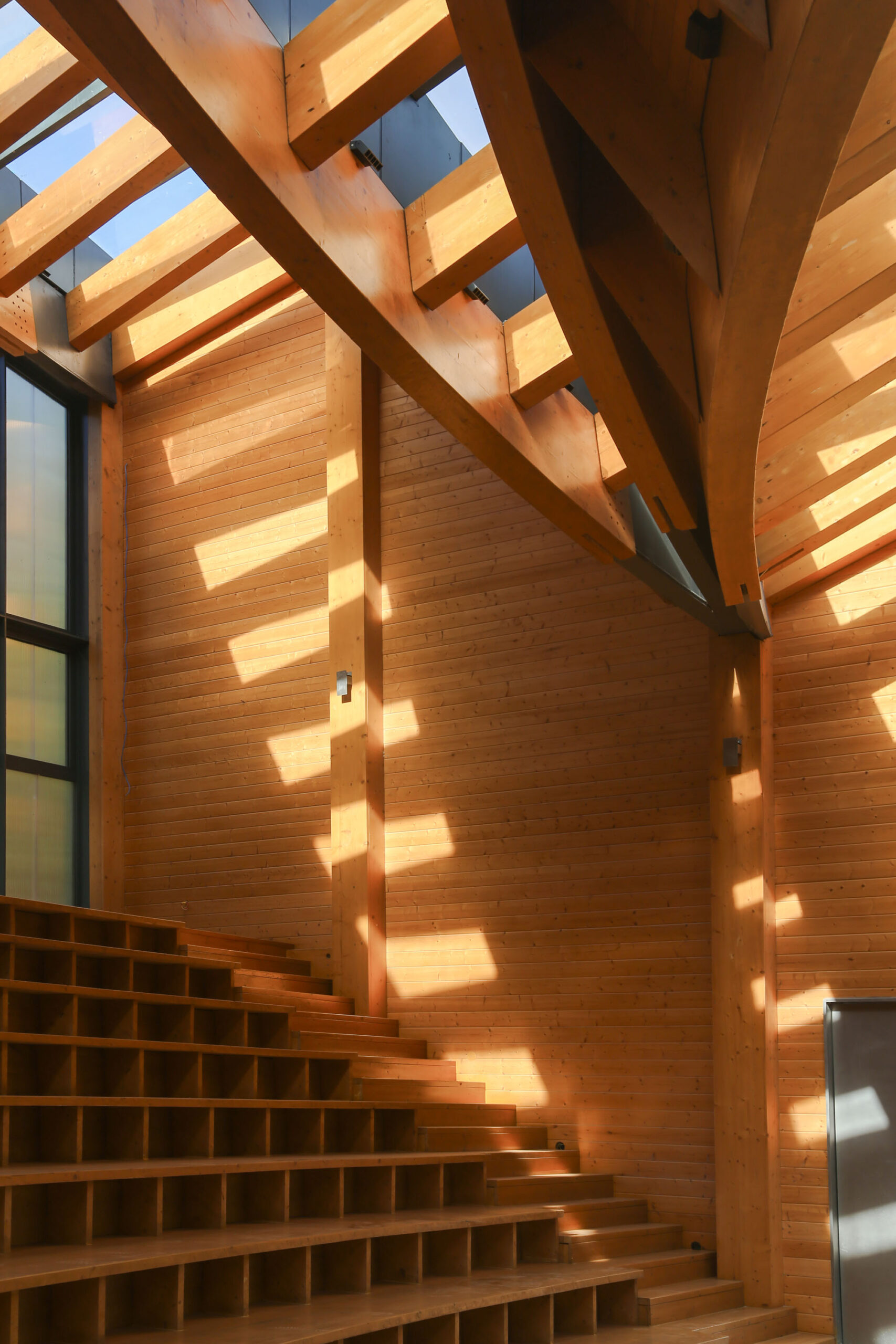
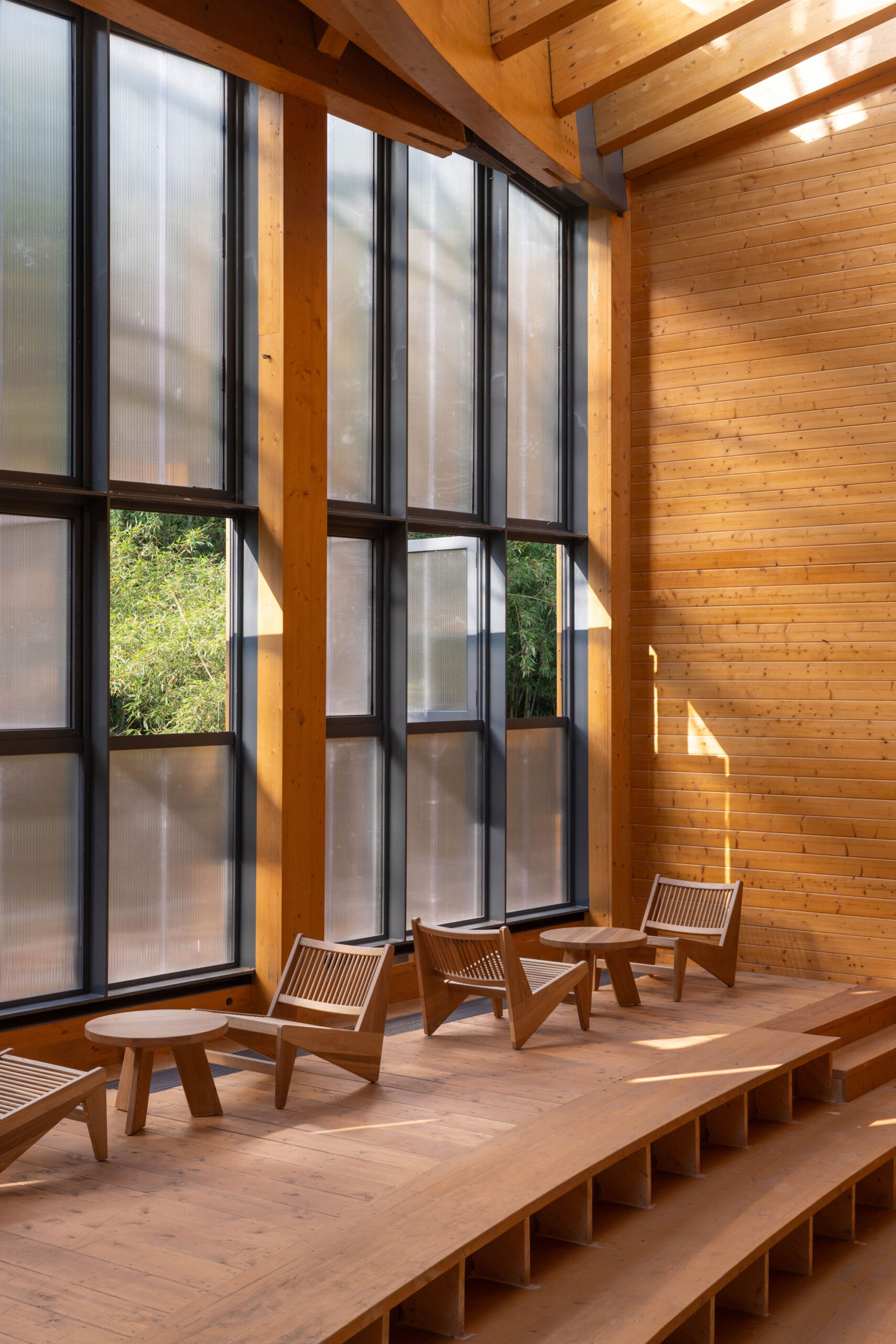
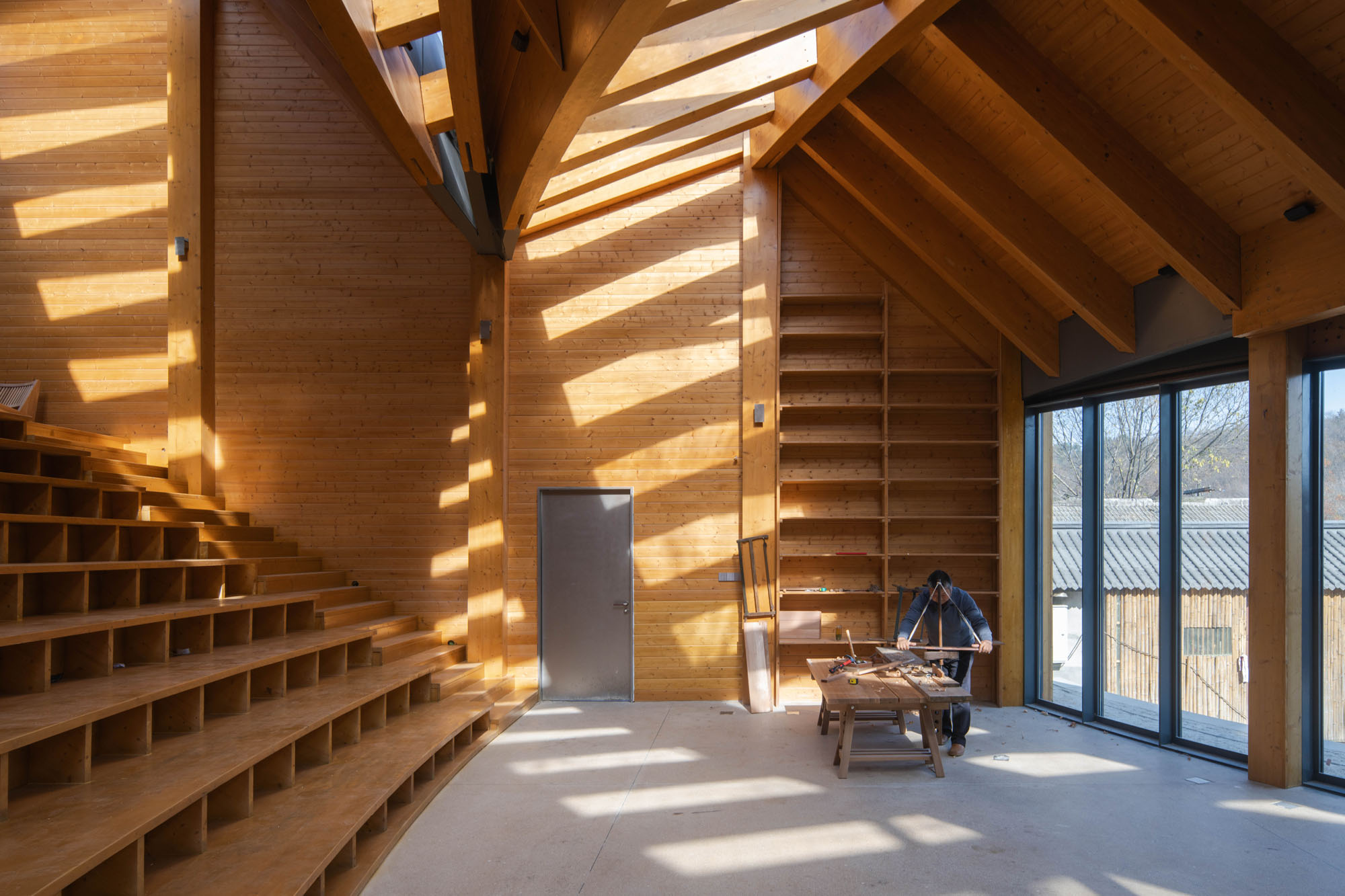
湾曲した天窓は谷間の光のスリットを思わせ、自然光を内部に取り込む。時間の経過とともに移ろいゆく光と影を投げかけ、内部にいる人々に時間の流れを明確に感じさせる。日照シミュレーションによって最適化された天窓の角度により、工房は営業時間中、主に自然光に依存して運営することが可能となっている。屋根を通して濾過された光は室内で均一に拡散し、木工制作のための穏やかで静謐なクラフト空間を創出している。
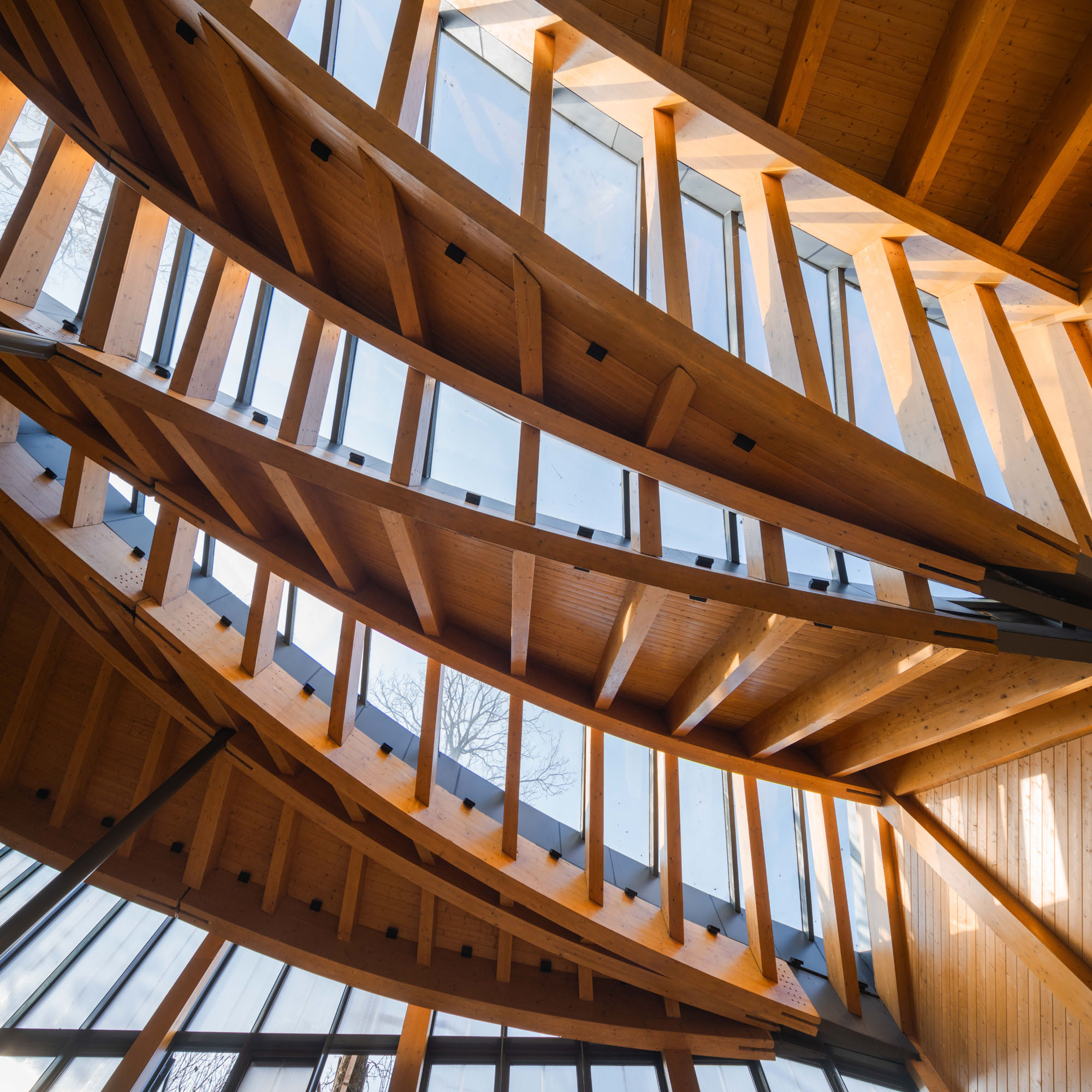
©︎ DONG Image
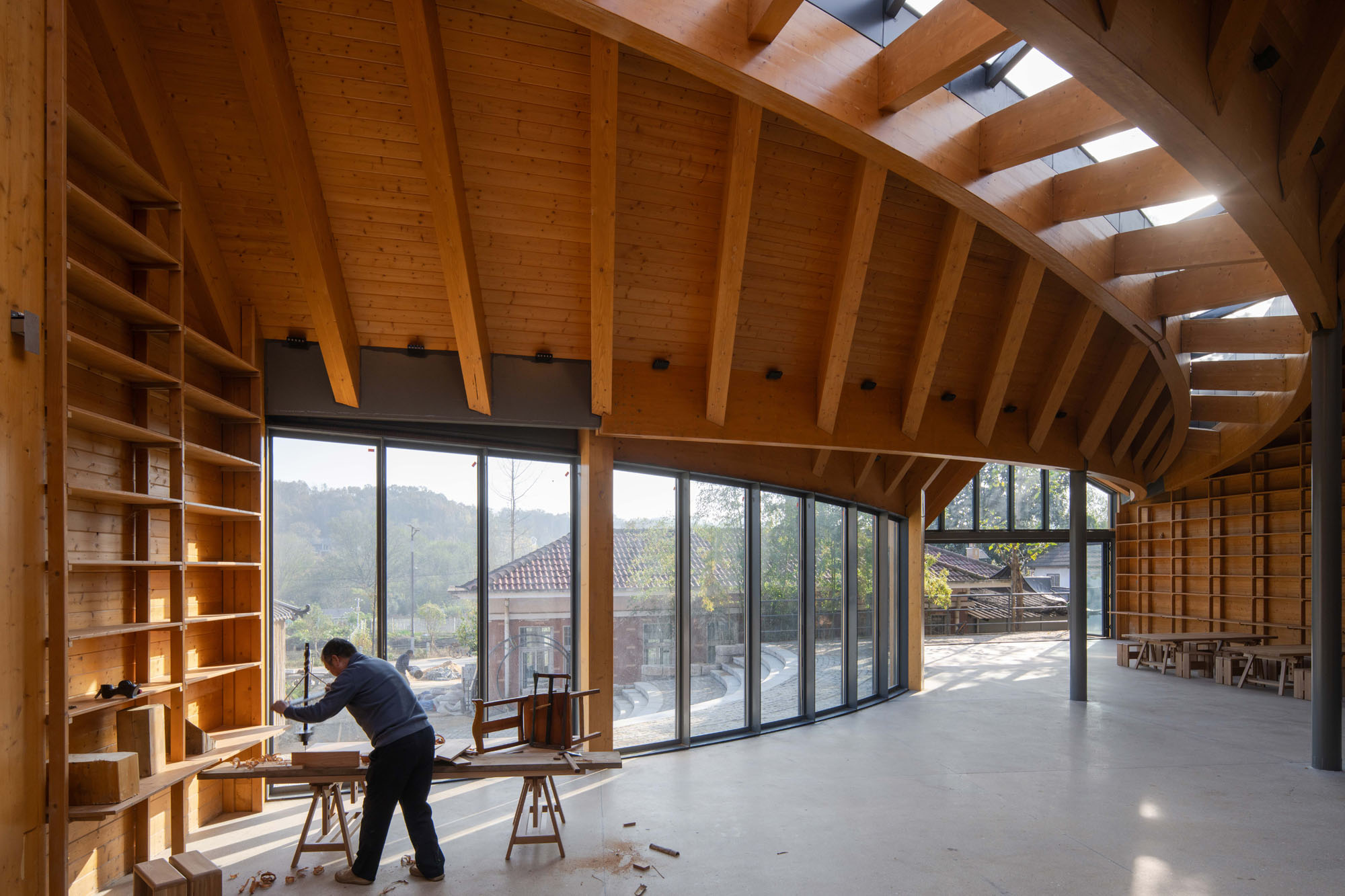
©︎ DONG Image
デジタル技術とモジュール工法の統合
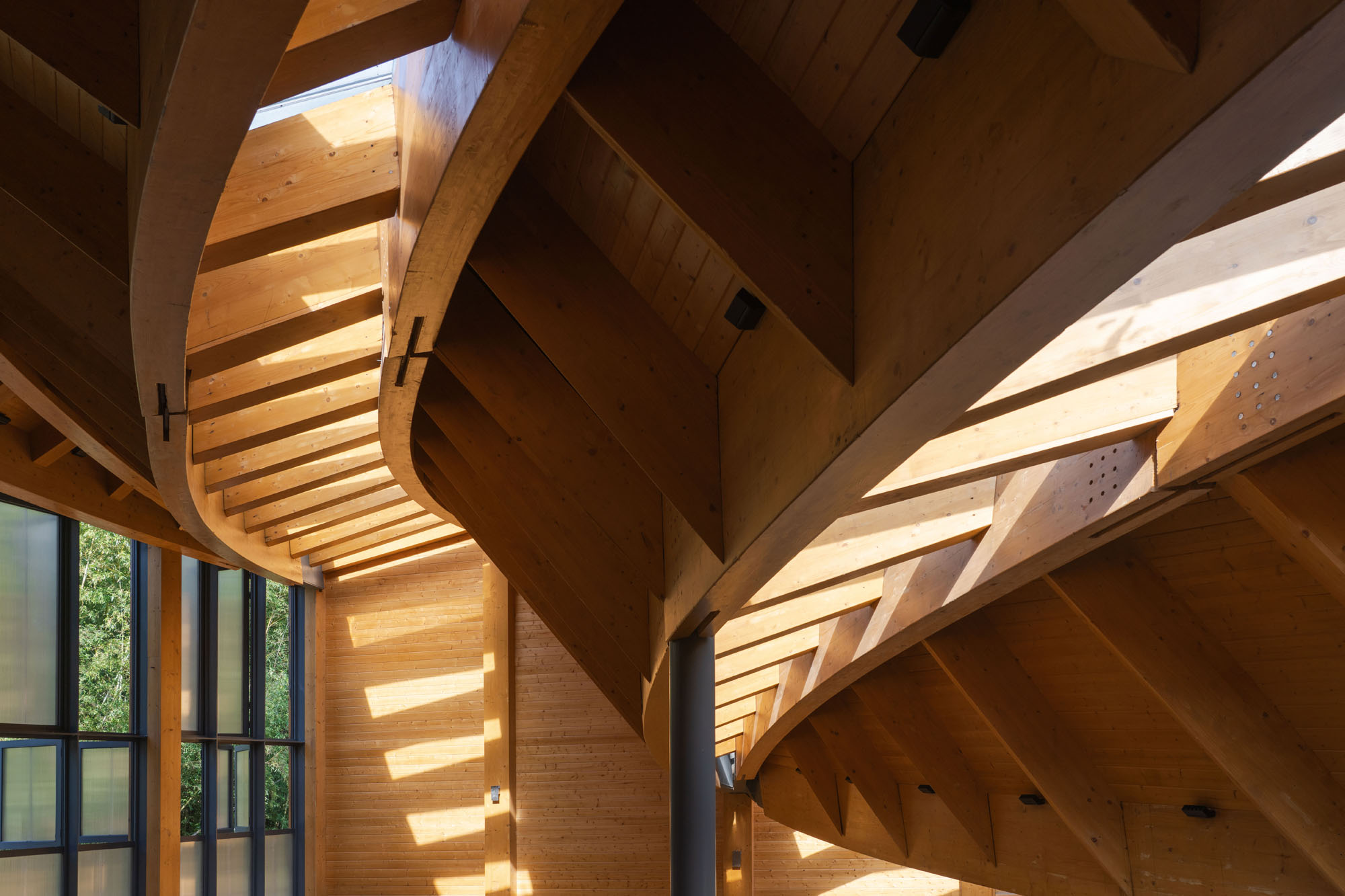
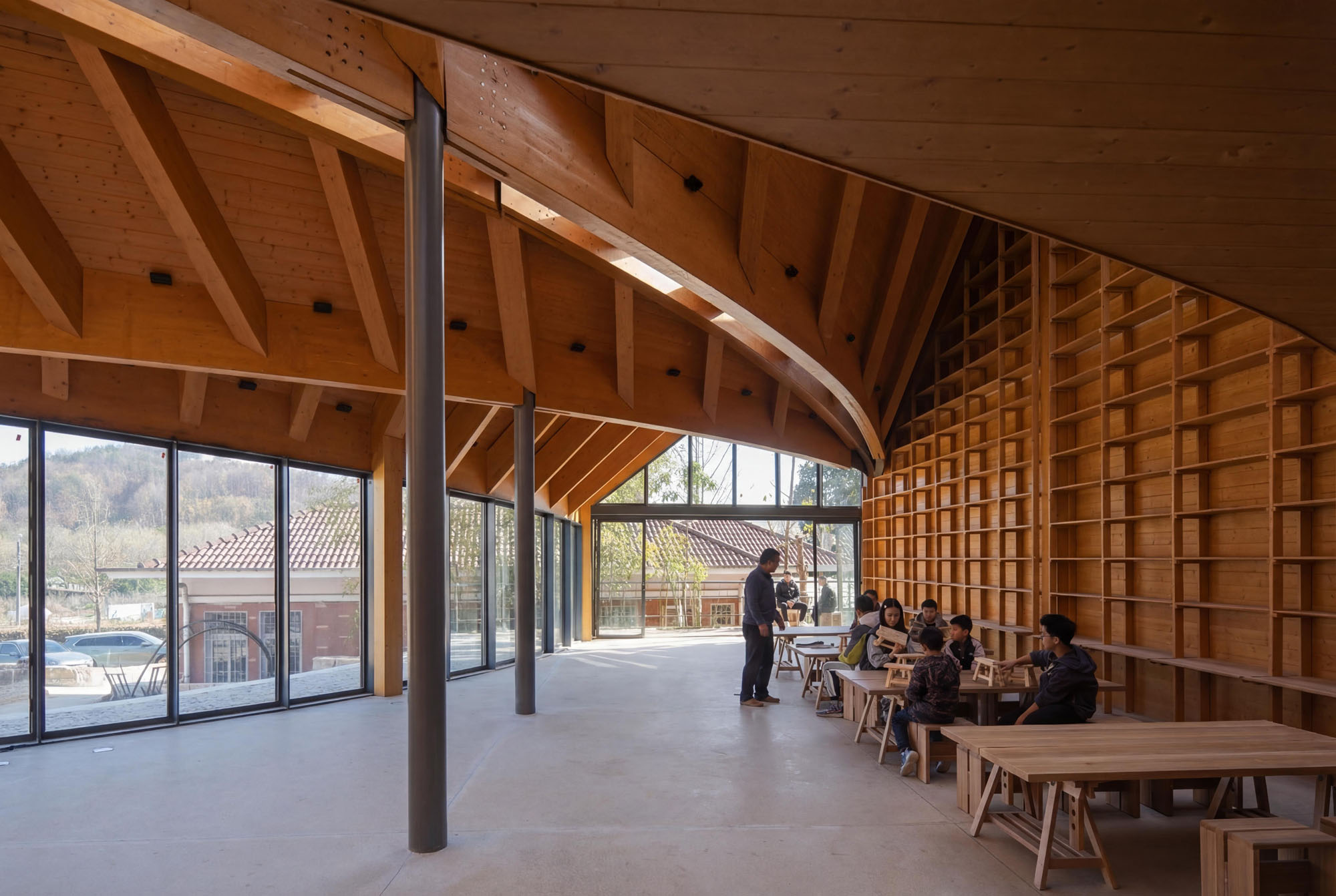
構造システムは、集成材と鋼製接合部を組み合わせたハイブリッド構造を採用しており、曲線梁の最大スパンは26mに達する。双曲面構成要素のパラメトリック制御は、デジタルモデリングによって実現されている。
すべての構成要素は工場でプレファブリケーション化され、現場でモジュール式に精密に組み立てられることで、複雑な建築形態と効率的な施工の統合を実現している。うねるような屋根は敷地の地形に対応するだけでなく、それ自体が安定した構造システムを形成し、内部の支柱が室内空間の一体性に与える影響を軽減している。
©︎ DONG Image
©︎ DONG Image
©︎ DONG Image
伝統の継承を体現する開放的なインテリア
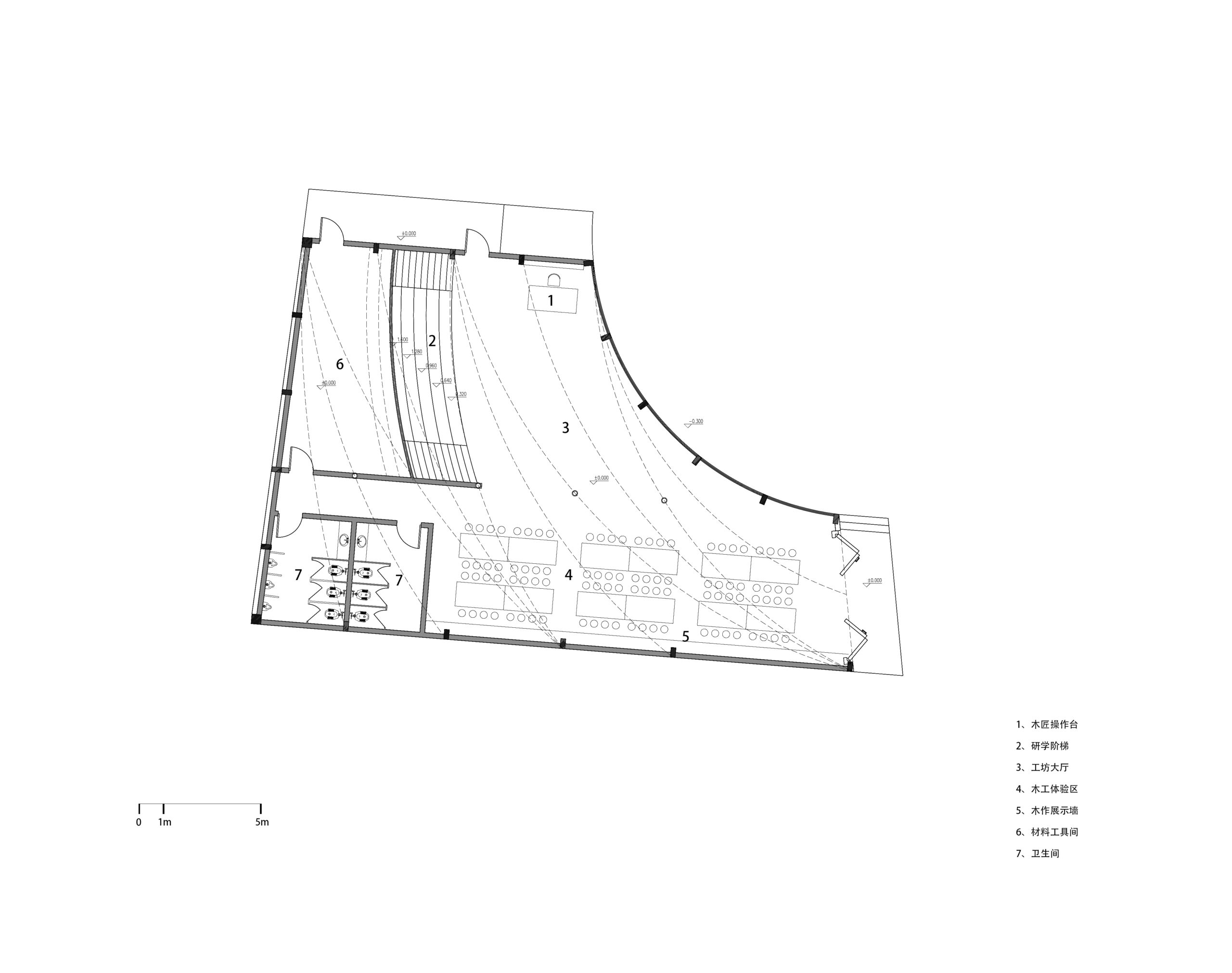
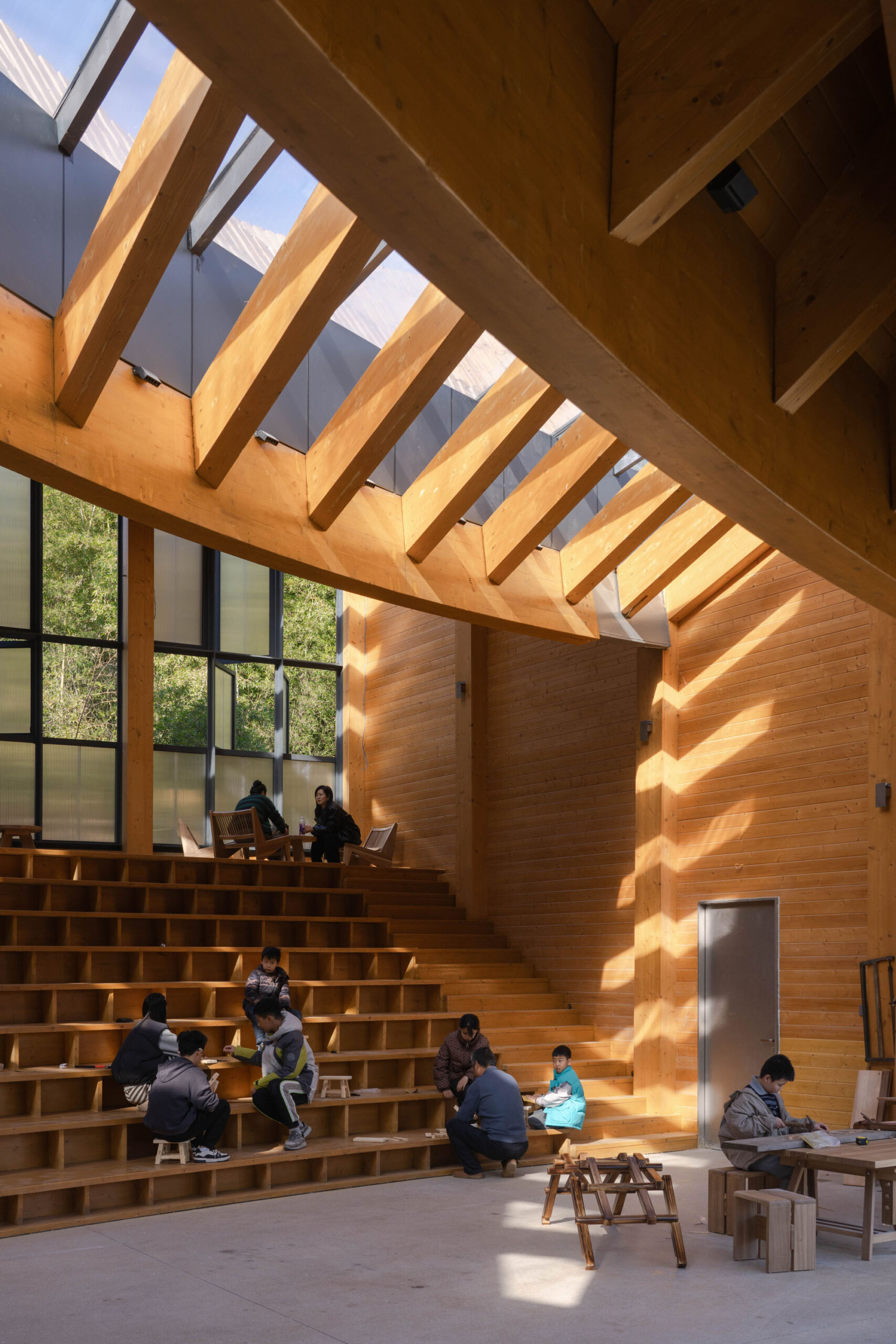
開放的な室内空間は、2つのクラスによる研究・学習活動を同時に収容でき、従来の教室の閉鎖的な形態を打破している。柔軟に組み合わせ可能な木工作業台は、伝統的なほぞ継ぎの指導から現代的な木造構造の実験に至るまで、多様なニーズに対応する。
壁面には工具や材料見本の展示システムが組み込まれており、木工用鉋、墨付け用マーカー、集成材の断面などが並べて展示されている。これは、伝統から現代へと受け継がれ、再解釈される木工技術の継承を比喩的に体現している。
©︎ DONG Image
©︎ DONG Image
©︎ DONG Image
職人の労働と村の日常が共存するレイアウト
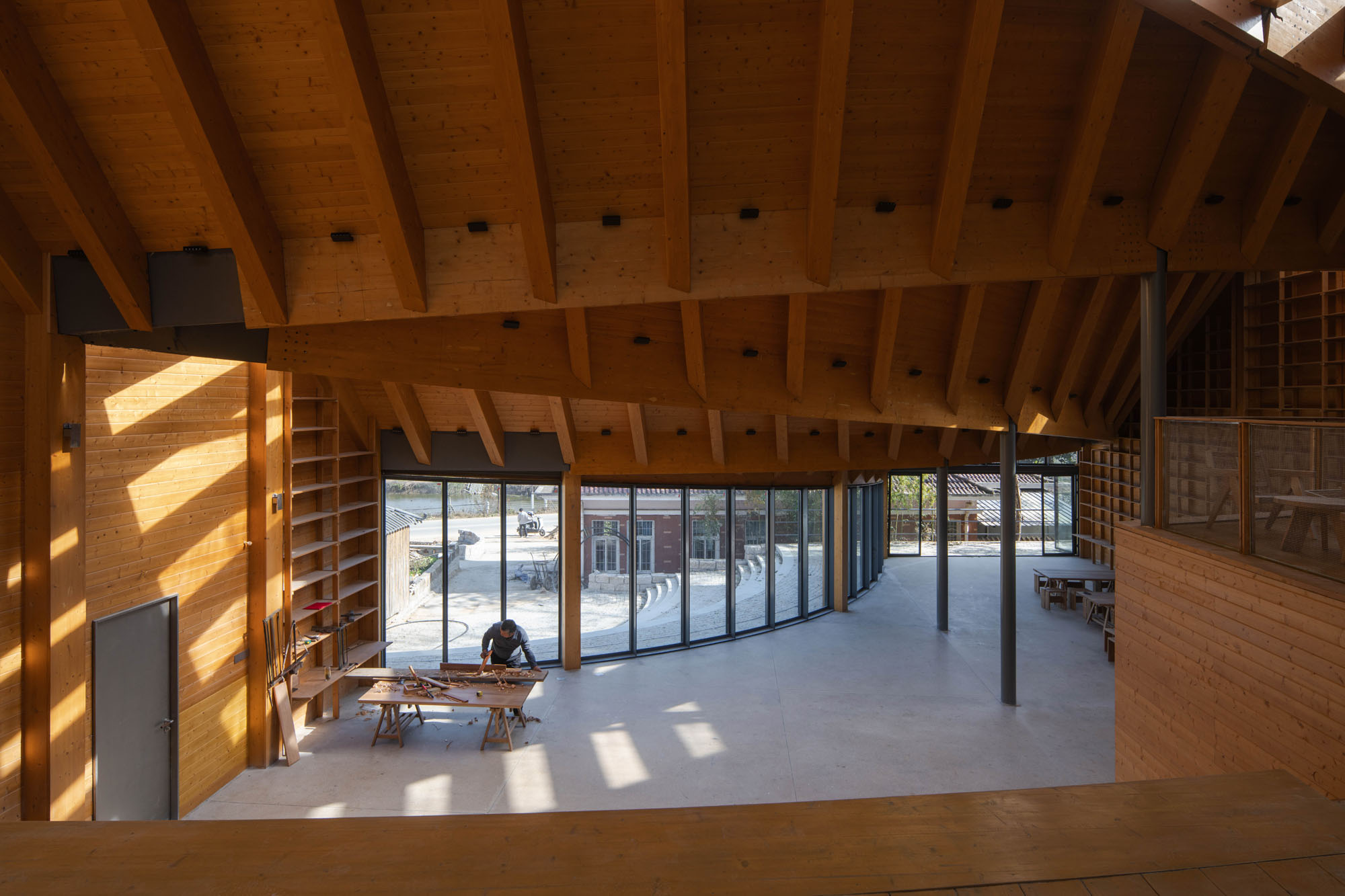
〈カーペンターズ・ホーム〉は単なる展示型の工房ではなく、日々の職人労働が行われる場である。空間のレイアウトは、老大工・張氏の日常生活を中心に構成されている。
1階の一角には、伝統的な木工生産のための作業エリアが設けられ、手づくりの職人技に必要な適切なスケールと整然とした配置が保たれている。もう一方は村人や訪問者に開放されており、学習ツアー、文化交流、展示の場として機能している。
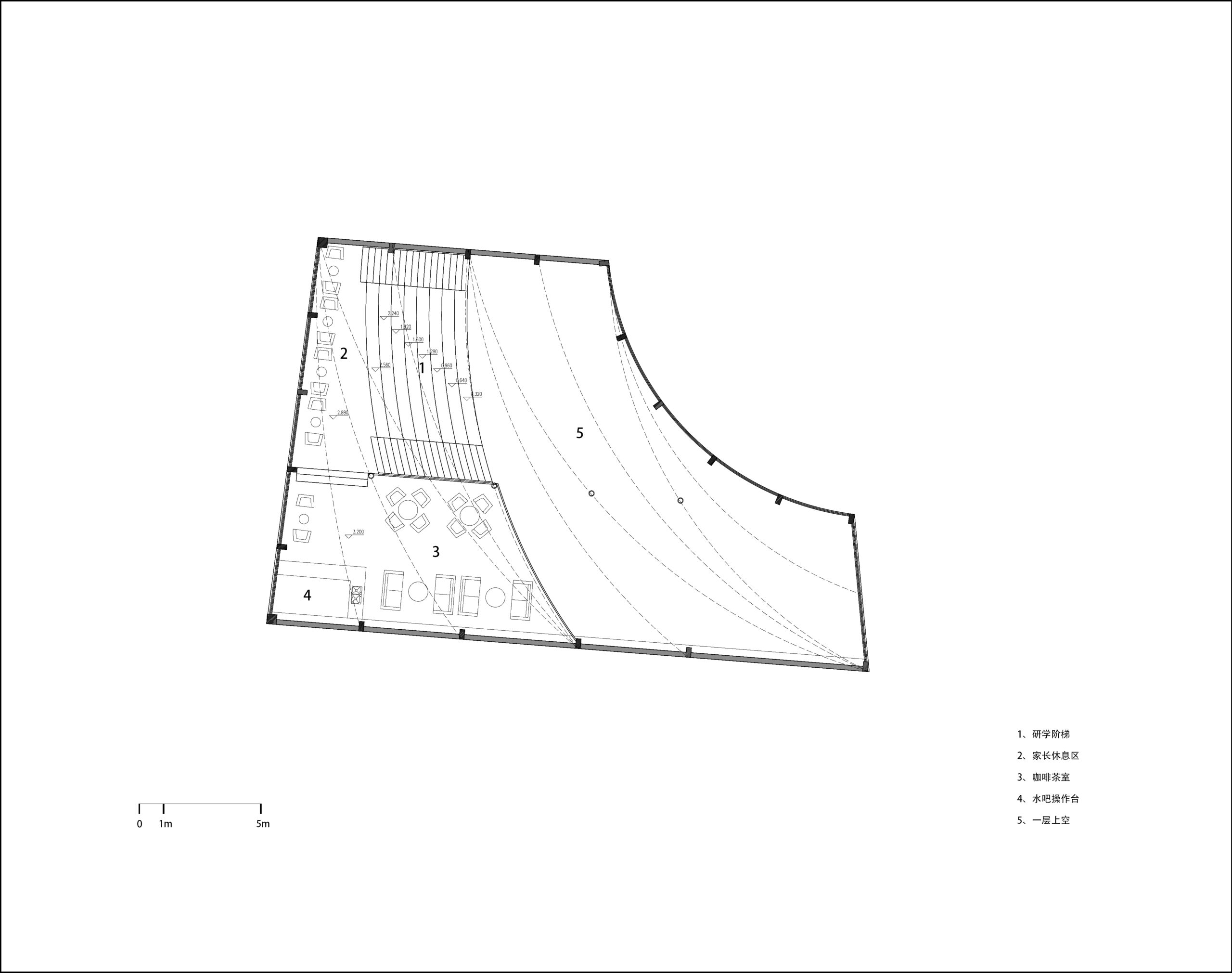
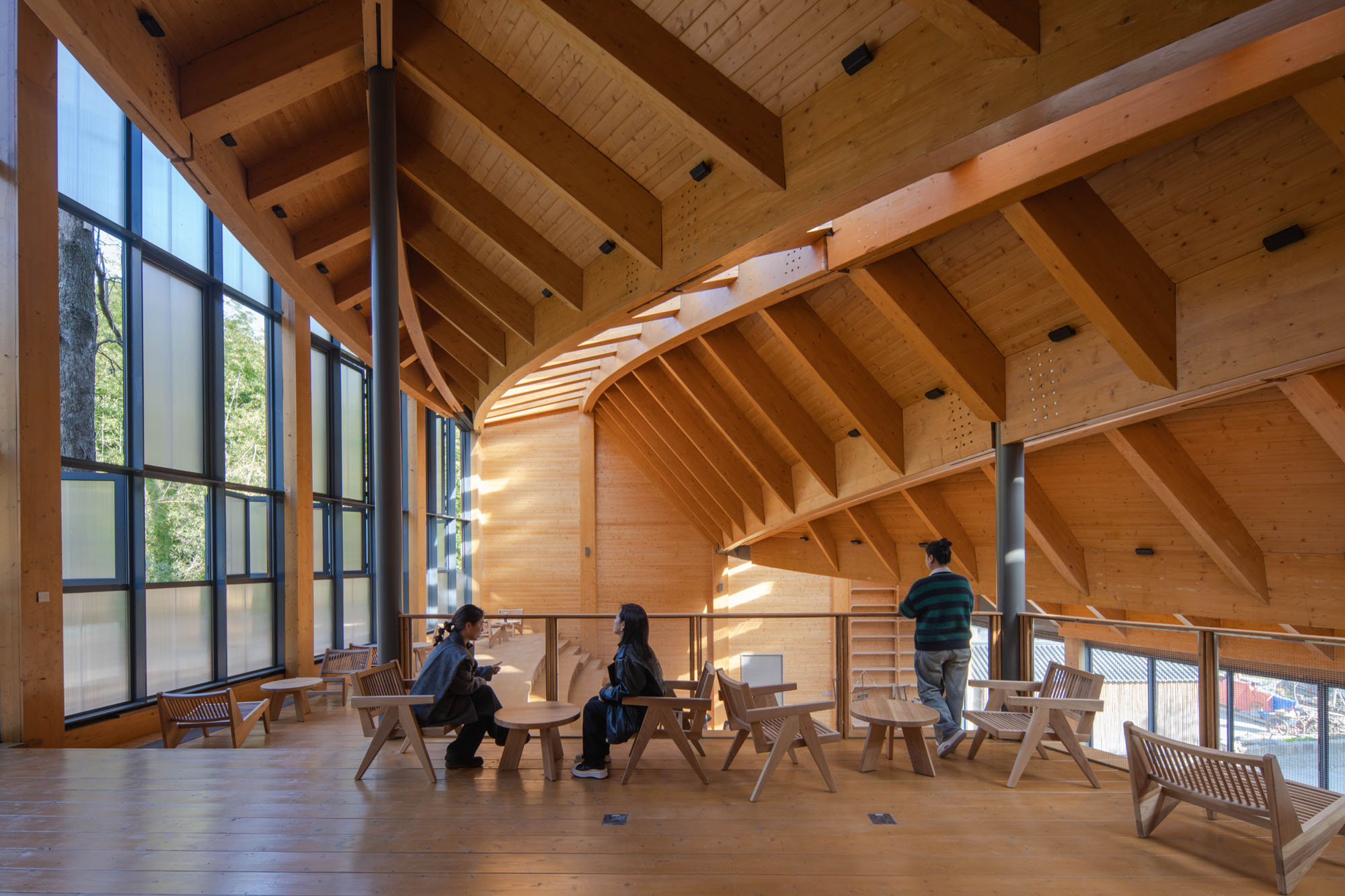
2階には茶室が設けられている。普段は一般向けの商業スペースとして機能し、見学ツアーの開催時には保護者が休憩や待機ができるラウンジへと姿を変える。木工制作、教育ワークショップ、そして日常生活が同じ屋根の下で共存し、この工房に固有の生産機能と、誰もが参加できる開放性を兼ね備えている。
©︎ DONG Image
©︎ DONG Image
音と体験が紡ぐ世代間のつながり
大工の張氏が慣れ親しんだ作業台に戻ると、木材を鉋で削る音、定規で測る音、墨線を引く音が、再びこの空間の日常のリズムとなる。一方、子供たちは木工台を取り囲み、ほぞ継ぎを学び、素材に触れ、構造の理屈を理解していく。
伝統的な職人技は、もはや展示されるだけの文化遺産ではない。それどころか、本物の手作業を通じて受け継がれ、体験され、現代の農村生活に自然に溶け込んでいる。その結果、この工房は世代をつなぐ場へと進化し、実践的な経験と理論的な知識を結びつけ、職人技、教育的な継承、そして日常生活が調和のとれた秩序の中で共存することを可能にしている。
©︎ DONG Image
©︎ DONG Image
未来の農村像を体現する木造の器
〈カーペンターズ・ホーム〉は、農村建築の既存の形式的なパラダイムを打ち破り、土地、職人技、そして日常生活に対して、より想像力豊かな方法で応えることを目指している。
現代的な木造構造を媒体として、伝統的な木工技術を農村の日常生活へと回帰させ、この建物を単なる活動の場としてだけでなく、絶えず展開し続けるライフスタイルそのものとする。ハオタン村にとって、ここは単なる工芸工房ではなく、地域の記憶、職人の精神、そして未来の農村像を体現する木造の器なのである。
©︎ DONG Image
©︎ DONG Image
©︎ DONG Image
©︎ DONG Image
©︎ DONG Image
©︎ DONG Image
©︎ DONG Image
©︎ DONG Image
以下、プライマリー・アーキテクツのリリース(英文)です。
Origins
As a demonstration village for rural revitalization, Haotang Village is committed to reviving local traditional craftsmanship. It has launched the Eight Traditional Crafts Revival Program and partnered with local artisans such as carpenters, blacksmiths and bamboo weavers. By combining the micro-renovation of old residential houses with the construction of new spaces, a series of characteristic craft workshops have been fostered. This initiative brings scattered rural handicraft skills back into daily life and rejuvenates them. The workshops serve as venues for craft exhibition and cultural tourism sales, and regularly organize craft research and study activities for schools. While inheriting the context of local craftsmanship and preserving the collective memory of the village, they also explore a sustainable income growth path for villagers.Site
During the site reconnaissance of the Carpenter’s Workshop plot, we entered the village along the path. The site features the typical hilly and landscape texture of southern Henan, with mountain terrain extending from the northern foot vein of the Dabie Mountains. Carpenter Zhang’s residence stands at the village entrance, built in harmony with the natural mountain terrain. To the south of his self-built three-story house lies the original woodworking shed. It has long served as a storage place for traditional tools and timber, as well as a daily workshop where Carpenter Zhang used to ply his craft.The original woodworking shed had fallen into disrepair over years and become a dilapidated building, and Carpenter Zhang had not engaged in woodworking for many years. Stepping into the courtyard, one can truly feel the enclosed terrain of the southern Henan hilly landscape. The site is embraced by hills on the east, adjacent to village dwellings on the south, and sheltered by the village health center building on the west. It forms an introverted and tranquil precinct. This inspires the design concept: the new workshop shall follow the mountain context, take natural texture as the base, reconcile the height difference of the site, and achieve a natural transition from the mountain hinterland to the village front road. The building is conceived as a lightweight timber structure vessel gently embedded into the village.
As a core practice of the “Eight Crafts” Initiative, the Carpenter’s Workshop undertakes a dual mission. It serves not only as a spatial carrier for traditional woodworking production and research study, but also blends deeply into the craftsman’s daily life, functioning as a public node connecting the village, nature and visiting tourists.
Shaped by the Mountain
With a modest posture, the building is embedded into the spatial texture of the village. Closely adjacent to rural houses on its north and south sides, it defines its boundaries and forms vertical enclosing walls. To the east lies rolling mountain terrain, to which the building responds naturally by treating its roof as a gentle extension of the mountain ridge stretching into the village. Twelve glued curved timber beams gradually descend from east to west, creating a continuous and flowing spatial rhythm. They also reconcile the elevation difference with the village health center on the west, enabling the building to establish a harmonious spatial relationship among the mountain, the village and the surrounding environment.Timber Construction
The roof adopts a hyperbolic glued timber structure. Its undulating outline echoes the surrounding mountain terrain, forming a spatial dialogue of disconnected form yet connected spirit with distant mountains. The curved skylight resembles a light slit in the valley, introducing natural light into the interior. It casts shifting light and shadow over time, allowing people inside to clearly perceive the passage of time. Optimized through sunlight simulation, the skylight angle enables the workshop to rely mainly on natural daylight during operating hours. The light filtered through the roof diffuses evenly indoors, creating a mild, tranquil craft light realm for woodworking creation.The structural system adopts a hybrid composition of glued timber and steel joints, with the maximum span of the curved beam reaching 26 meters. Parametric control of the hyperbolic components is realized through digital modeling. All components are prefabricated in the factory and precisely assembled on site in a modular manner, achieving the integration of complex architectural form and efficient construction. The undulating roof not only responds to the site terrain, but also forms a stable structural system by itself, reducing the interference of internal supports on the integrity of interior space.
The open interior space can accommodate research and study activities for two classes simultaneously, breaking the enclosed mode of traditional classrooms. Flexibly combined woodworking workbenches meet diverse needs ranging from traditional mortise and tenon teaching to modern timber structure experiments. The walls are embedded with a display system for tools and material samples, where wooden planes, ink markers and glued timber sections are placed side by side. It metaphorically embodies the inheritance and reinterpretation of woodworking craftsmanship from tradition to the contemporary era.
Work & Daily Life
The Carpenter’s Home is not merely a display-oriented workshop, but a genuine place of daily craft labor. The spatial layout revolves around the daily life of Old Carpenter Zhang. On the ground floor, one side retains the operational area for traditional woodworking production, preserving the proper scale and orderly layout required for handmade craftsmanship. The other side is open to villagers and visitors, serving the functions of study tours, cultural communication and exhibition. A tea room is arranged on the second floor. It operates as a public commercial space on ordinary days and transforms into a lounge for parents to rest and wait during study tour events. Woodworking creation, educational workshops and everyday life coexist under one roof, endowing the workshop with both inherent production attributes and inclusive public openness.When Carpenter Zhang returns to his familiar workbench, the sounds of planing wood, measuring with rulers and snapping ink lines once again become the daily rhythm of the space. Meanwhile, children gather around the woodworking benches to learn mortise-and-tenon joints, touch raw materials, and comprehend the logic of construction. Traditional craftsmanship is no longer merely a cultural heritage on display. Instead, it is passed down and experienced through authentic manual labor, naturally integrating into contemporary rural life. As a result, the workshop evolves into a public venue bridging generations, as well as connecting practical experience and theoretical knowledge, allowing craftsmanship labor, educational inheritance and daily life to coexist in harmonious order.
Conclusion
The Carpenter’s Home seeks to break through the existing formal paradigms of rural construction, responding to the land, craftsmanship and daily life in a more imaginative way. With contemporary timber structure as its medium, it brings traditional woodworking back to rural daily life, making the building not only a space for accommodating activities, but also a continuously unfolding lifestyle. For Haotang Village, it is not only a craft workshop, but also a timber vessel embodying local memory, artisan spirit and the vision of the future countryside.Project Name: Carpenter’s Home
Design Firm: Primary Architects
Chief Architects: Xiang Huang, Songyan Mao
Architectural Design Team: Cong Liu, Zhiyan Lin, Xiaoxia Wang, Junjie Liu, Xiaofeng Zhang, Yao Lu
Grade A Design Institute: Zhongke Architectural Planning and Design Research Institute
Wood Structure Detailed Design: Bowen Li
Construction Company: Shanxi Junchen Construction Co., Ltd.
Client: Xinyang Pingqiao District Juxing Agricultural Investment and Development Co., Ltd.
Project Location: Haotang Village, Pingqiao District, Xinyang City, Henan Province
Building Area: 405 square meters
Photographer: DONG Image
Video Production: Primary Architects
Design Time: January 2025
Completion Time: October 2025
プライマリー・アーキテクツ 公式サイト
http://www.primary-architects.com/

![[Interview]廃墟から地域資産へ、石と建築の時間軸を再統合する〈大谷グランド・センター〉。建築家・針谷將史氏が語る再生のプロセス](https://magazine-asset.tecture.jp/wpcms/wp-content/uploads/2026/06/07172730/003_ASA4434-900x600.jpg)