すべての住戸が道路に面する「ロの字型形式」のコーポラティブハウス。地主の「良好なまちの環境を保ちたい」という強い想いの詰まった稀有な東南の角地に対し、ボリューム感を抑え、環境を損なうことなく地域の形成要素として「まちに住まう場」を設定することが主要なテーマである。
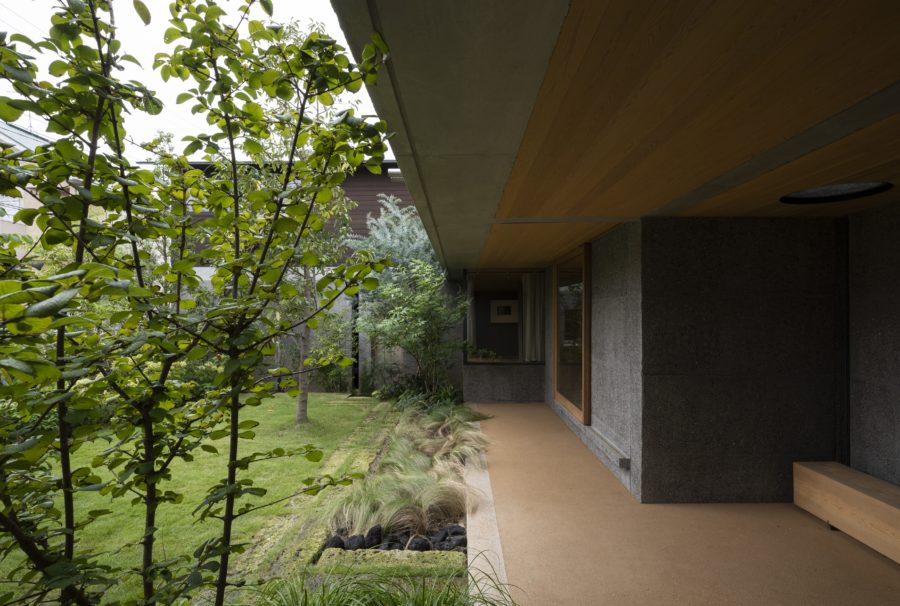
武家屋敷で有名なボロ市通り周辺には大きなお屋敷や町家の面影が残る。車の往来、人通りの少ない静かな住宅地の一角で庭木や緑も多く、北西方向に保存樹木のケヤキを望む。一方で、辺りは狭小住宅や分譲マンションなどに建て替わり、地域は徐々におおらかさを失いつつある。隣地の将来計画を見据え、互いに行き来できるように3方向に抜ける「通り庭形式の中庭」を据え、道との凹凸の隙間にテラス・ドライエリア・樹木を設けることで外に対して距離を保ちつつ積極的な関係を築こうとした。さらに「建築の構成形式」を内包し細かく分節した「スケールの小さな集合体」は、周辺の習慣に従って前庭を伴い敷地内で完結することなく「みち」を介して「まち」を巻き込む。おおらかに広がりが展開できる「断片の反復的な構造」を伴うことで、場のイメージを共有し、外部との連続性を示唆している。
本計画では、内外の広がりの中に住まう場を求めた。内外が同じ構成要素の反復構造の内で、複数の住民が近くに居ながら隔たり暮らす。それぞれに住人の好みを反映したインテリアは楽しく多彩であり、かつ4方向に散らばる開口のレイアウトがつくる明るく風通しの良い光景は共通している。開口を通して、道路や通り庭を往来する人々を垣間見、外側の景色が入り込む。外に出ることが制限されている現在、失われつつある共同性に対し、建築の構成・場のイメージが互いの共有感や安心感を抱くことに繋がる。そして小さな単位の集まりによる断片化した全体像が、まちの構成要素として根付き社会との繋がりを感じさせる関係を育む。断片の反復的な構造により建築の可能性を見出そうとしたと言える。
ある一定の大きさ、規模を持ってしまう集合住宅(ビルディングタイプ)に対し、小さな単位の集まりでできた建築を設計してきた。その都度、さまざまな方法(グリッドでの分割、箱の分散、塔の連結、雛壇の積層など)で周辺環境と住環境との対応関係を考えてきたが、新たに、まちに潜在している最小単位である「部屋」の大きさを構成のきっかけにする。さらに中庭・テラス・ドライエリア・吹き抜け・トップライトなど建物をつくる外部やヴォイドの空間要素も加えて「筒」と捉え共通の構成要素とした。「筒」は箱、部屋、塔などと違い蓋(覆い)がない。内外の枠を超えてすべてをヴォイドの「筒」と仮定する。スケールの異なるたくさんの筒状の直方体が寄せ集まり、同一パターンの繰り返しでできる拡がりを構想する。共通の要素が内外反転しつつ反復する。住まう場では「筒」のそれぞれで自在に床が設定されヴォイドを通じて縦横に連なる。当初設定した筒の構成は視覚的に徐々に崩され、内と外・「いえ」と「まち」が、ひと繋がりになった環境をつくる。(若松 均)*初出 2020年8月
A cooperative house on a street corner where a collection of tubes engages the town
A “L-shaped” style cooperative house with street-faceing units. The main theme of the project is to create a “place to live in the town” as an element of community formation without compromising the environment. The volume is kept low, on a rare southeast corner lot filled with the landowner’s strong desire to “maintain a favorable town environment.
The area around Boroichi Street, famous for its samurai residences, retains the appearance of large mansions and town houses. The area is a quiet residential area with few cars and pedestrians, and with many trees and greenery. On the other hand, the area is gradually losing its openness due to the replacement of small houses and condominiums. Taking in considerration of the future plans of the neighbor lots, a “courtyard in the form of a street garden” was set up in three directions that allows flexible circulation. A terrace, dry area, and trees were placed in the gap between the unevenness of the road and the courtyard to maintain a distance from the outside while building a positive relationship with it. Furthermore, the “small-scale aggregate,” which contains the “compositional form of architecture” and is finely divided, and not completed within the site but involves the “town” through the “street” with a front yard in accordance with the surrounding customs. The “repetitive structure of fragments,” which allows a generous expansion, is accompanied by a shared image of the place, suggesting a continuity with the outside world.
In this project, we sought a place to live within the expanse of the interior and exterior. Within the repetitive structure of the same components inside and outside, multiple residents live in close proximity but separated from each other. The interiors, each reflecting the tastes and preferences of the residents, are fun and varied, but they also share a light and airy scene created by the layout of openings scattered in four directions. Through the openings, one can catch glimpses of people passing by on the street or in the courtyard, letting views of the outside world enter the house. The architectural composition and the image of the place lead to a sense of mutual sharing and security in the face of the community that is being lost in today’s world of restricted access to the outside. The fragmented whole of the building, made up of a collection of smaller units, will take root as a constituent element of the town, fostering a sense of connection with society. It can be said that the repetitive structure of the fragments is an attempt to discover the possibilities of architecture.
In contrast to housing complexes (building type), which have a certain size and scale, I have designed buildings made up of a collection of smaller units. In each case, I have considered the correspondence between the surrounding context and the living environment in various ways (division by grid, dispersion of boxes, connection of towers, stacking of platforms, etc.), and now I will use the size of the “room,” the smallest potential unit in the town, as a trigger for composition. In addition, the spatial elements of the exterior and voids of the building, such as courtyards, terraces, dry areas, stairwells, and top lights, are also considered as “cylinders” as common elements of the composition. Unlike a box, room, or tower, a “tube” has no lid (cover). We assume that everything is a “cylinder” of the void, transcending the boundaries of interior and exterior. The idea is to create an expansion by using the repetition of the same pattern of many cylindrical rectangles of different scales gathered together. Common elements are repeated while inverting inside and outside. In the living space, each of the “tubes” can be freely set up as a floor, and are connected vertically and horizontally through the voids. The initial composition of the tubes is gradually disrupted visually, creating an environment in which the inside and outside, the “house” and the “town” are connected as one. (Hitoshi Wakamatsu)
【セタガヤテラス】
所在地:東京都世田谷区
用途:共同住宅
竣工:2020年
設計:若松均建築設計事務所
担当:若松 均、片岡篤史、中山由稀、横山伊織、浅野智史、今村奈美
企画:織山和久、黒岩哲郎、池澤竜哉(アーキネット)
構造設計:森部康司(yAt構造設計事務所)
設備設計:山田浩幸、欠端朋子(yamada machinery office)
施工:朝倉幸子、坂本修一、渡邉幸治(TH-1)
設備:柳 正明(エー・エム・シー)
電気:苅北泰稔(アーム)
撮影:鈴木研一
工事種別:新築
構造:RC
規模:地上4階、地下1階
敷地面積:251.44m²
建築面積:167.95m²
延床面積:582.57m²
設計期間:2018.06-2019.03
施工期間:2019.04-2020.06
【Setagaya Terrace】
Location: Setagaya-ku, Tokyo, Japan
Principal use: Housing complex
Completion: 2020
Architects: Hitoshi Wakamatsu Architect & Associates
Design team: Hitoshi Wakamatsu, Atsushi Kataoka, Yuki Nakayama, Iori Yokoyama, Satoshi Asano, Nami Imamura
Planning: Archinet
Structural design: yAt structural design office
Facilities design: yamada machinery office
Construction: TH-1
Equipment: AMC In charge
Electric: Arm
Photographs: Kenichi Suzuki
Construction type: New building
Main structure: RC
Building scale: 4 stories and 1 below
Site area: 251.44m²
Building area: 167.95m²
Total floor area: 582.57m²
Design term: 2018.06-2019.03
Construction term: 2019.04-2020.06