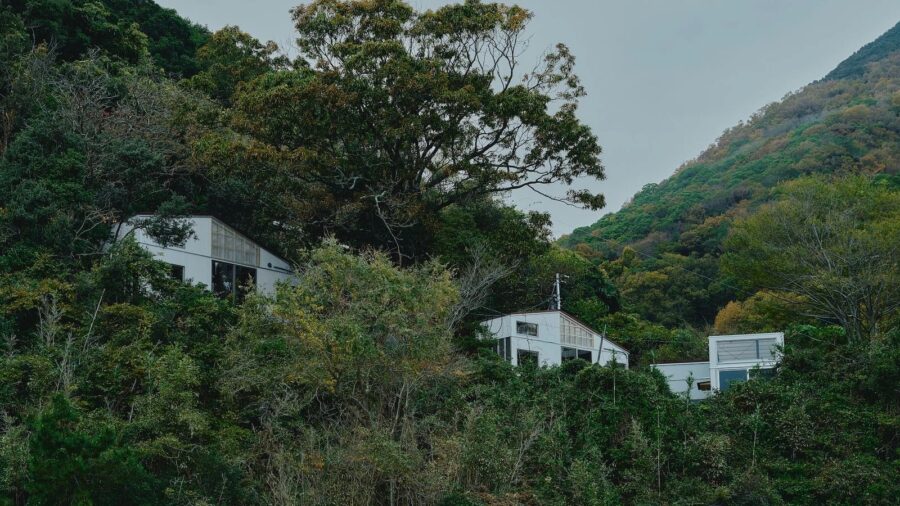
クライアントは旧松山市で唯一の30代の米農家である。自然農法による地域に寄り添った新しい農業を取り組み、地域の山林から平野、海までの自然環境を整えることが農業活動の大事な基盤になると考え、林業の支援もされている。
クライアントとの会話を通して私たちが感じたことは「農業とは自然環境と社会を束ねるヒトの営みの1つ」ということだった。農家さんたちは片方で気候や地形を読み、寄り添いながら、もう片方で地形を造成して水路を通し水の流れを変え、時には草木を焼払い灰として有機物/無機物の循環の流れを変え自らの方へ手繰り寄せる。「そうした知恵を後世に引継ぎながら先人は地域を守ってきた」ということだった。
現代の農業は機械化され、核家族化した家庭が地域を支える。必要な広さや労力は機械によって圧縮されて、半分にも満たない。敷地も建物もコンパクト化した中に先人の知恵をどのように引き継ぐか、が課題となった。
この地域の古い農家住宅を調べた。最初に東西を庭と広場に挟まれた続き間があることが分かった。これは地域の夏の卓越風を取り込むための配置であることが推定された。次に北西の角に大きな閉じた納屋があることが分かった。これは南に面する農作業場の冬の北風からの防風対策であると推定された。最後に大きさである。大家族で営まれていたと思われる巨大な家屋は、地域の象徴のような存在だったのだろう。
まず東西軸に吹く卓越風への対応の仕方を取り入れることにした。建物全体を東西に開口をもった大きな風洞と見立て、収納やトイレなどの閉じたボリュームを端に寄せ、開いた空間を東西軸に並べ通風経路を確保し、風の流れを整えた。東西の大開口には格子を設けることで、夏の朝日、西日はカットし、外部からの視線を和らげながら、風を取りいれている。農作業スペースは先人に習い、東側へ配置して冬の北西からの風に備え、その配置を起点に、内部の間取りは決定された。
外壁には瀬戸内で多くみられる焼杉を採用した。焼杉は木材を人工的に焼くことで耐候性を高めている。人工的でありながら、自然循環の一部にある姿は自然を手繰り寄せる農業に似ている。
焼杉の杉は松山の上流の久万高原町から切り出されてくる。原材は集成材に使わる板を削いで製作されて、無駄な廃棄物が生まれていることが分かった。削ぐ工程をなくしてラミナーをそのまま焼いて30mm厚さの焼杉を製作した。雨掛かりの大きくなる大開口を設けた東西切妻の妻面にこの30mmの焼杉を使うことで耐候性を補いつつ、地域の木材利用を促進させている。
焼杉は木材が燃焼することで化学的に組成が変化し、その性質を獲得する。その中身は炭素Cと酸素Oと水素Hである。そのもとは空気中にある二酸化炭素CO₂と水H₂Oであり、植物の光合成を通して、木材とし人の手に届き、人為的に炭化させて、やがて風化して再び二酸化炭素CO₂と水H₂Oとして循環の輪に戻っていく。火(技術・文化)と環境との歴史がそこにはある。
この住宅が地域の農業の担い手にふさわしい暮らしの形とはなにか。地域の中で進歩・進化していく、とはどういうことか。そうした問いを考える一助になれば幸いである。
(池内 健)
Living adapting nature and modifying nature
The client is the only rice farmer in his thirties in the former Matsuyama City. He practices new, community-focused agriculture using natural farming methods. Believing that nurturing the natural environment—from the region’s mountains and forests to the plains and sea—is a vital foundation for farming, he also supports forestry.
Through conversations with the client, we came to understand that “agriculture is one of humanity’s endeavors that binds together the natural environment and society.” Farmers read and adapt to the climate and terrain; on the other hand. At the same time, they shape the land, build waterways to alter water flow, and sometimes burn vegetation, using the ashes to shift the flow of organic and inorganic matter cycles to benefit their fields. “Our ancestors protected the region by passing down this wisdom to future generations.”
Modern agriculture is mechanized, and nuclear families now support the community. The required land area and labor have been compressed by machinery to less than half. The challenge became how to inherit the wisdom of our ancestors within compacted plots and buildings.
We studied old farmhouses in this region. First, we noted the presence of a continuous room, flanked by a garden and a plaza on the east and west sides, respectively. This layout was presumed to capture the prevailing summer winds of the area. Next, we observed a large, enclosed barn in the northwest corner. This was supposed to be a windbreak against the winter north winds for the south-facing farm workshop. Finally, there was the sheer size. These enormous houses, likely occupied by large families, were likely symbols of the region.
We decided to incorporate the approach to dealing with the prevailing east-west winds. We conceptualized the entire building as a large wind tunnel with east-west openings. Closed volumes, such as storage and toilets, were placed at the edges, while open spaces were arranged along the east-west axis to ensure ventilation pathways and regulate airflow. Latticework was installed on the large east-west openings to block the summer morning and afternoon sun, soften external views, and allow wind to enter. Following the wisdom of predecessors, the farming workspace was positioned on the east side to prepare for the winter northwest winds. This placement became the starting point for determining the internal layout.
The exterior walls feature charred cedar, a standard material in the Seto Inland Sea region. Charring enhances the wood’s weather resistance. Though artificial, its appearance as part of a natural cycle resembles agriculture’s practice of drawing nature closer.
The cedar for the charred panels is sourced from Kumakogen Town, upstream of Matsuyama. It was discovered that the raw material was produced by shaving boards intended for laminated wood, generating unnecessary waste. To eliminate this shaving process, laminated wood was burned directly to produce 30 mm-thick charred cedar. Using this 30mm charred cedar on the east-west gable ends of the roof, which features large openings exposed to rain, enhances weather resistance while promoting the use of local timber.
Charred cedar acquires its properties through chemical changes in the wood’s composition during combustion. Its core elements are carbon (C), oxygen (O), and hydrogen (H). These originate from atmospheric carbon dioxide (CO₂) and water (H₂O). Through plant photosynthesis, they become wood accessible to humans. Artificially carbonized, the wood eventually weathers back into CO₂ and H₂O, returning to the cycle. Here lies the history of fire (technology and culture) and the environment.
What form of living is appropriate for the agricultural leaders of this region? What does it mean to progress and evolve within the community? We hope this home catalyzes contemplating these questions.
(Takeshi Ikeuchi)
【風と火と農家住宅】
所在地:愛媛県
用途:戸建住宅
クライアント:個人
竣工:2021年
設計:studio colife3
担当:池内 健
構造設計:三野建築構造研究所
施工:土居建築
撮影:宮畑周平、studio colife3
工事種別:新築
構造:木造
規模:地上2階
敷地面積:715.30m²
建築面積:89.04m²
延床面積:132.50m²
設計期間:2019.08-2020.08
施工期間:2020.08-2021.04
【Farm House of Wind and Fire】
Location: Ehime, Japan
Principal use: Residence
Client: Individual
Completion: 2021
Architects: studio colife3
Design team: Takeshi Ikeuchi
Structural design: Mino Structural Engineers
Construction: Doi Kensetsu
Photographs: Shuhei Miyahata, studio colife3
Construction type: New Building
Main structure: Wood
Building scale: 2 stories
Site area: 715.30m²
Building area: 89.04m²
Total floor area: 132.50m²
Design term: 2019.08-2020.08
Construction term: 2020.08-2021.04