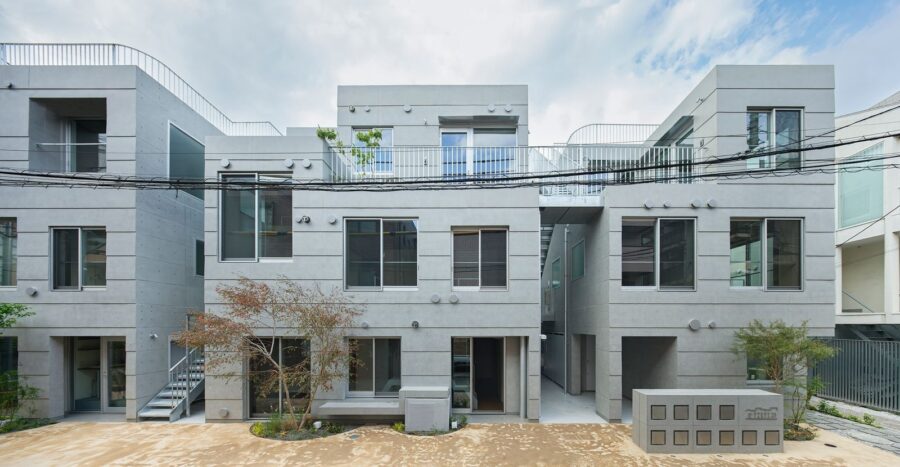
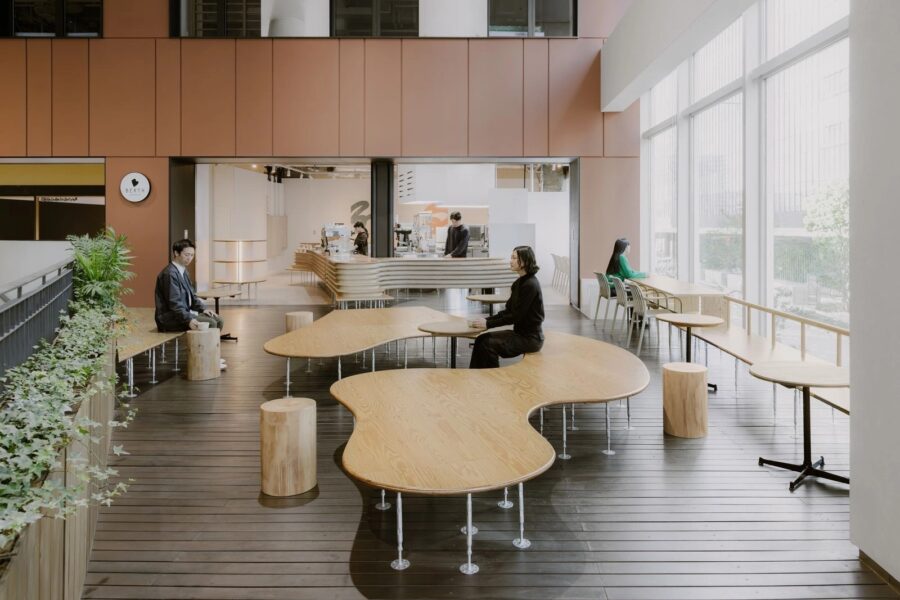
設計者の自邸である。
私たち家族は非常にマイペースである。各々の趣味を持ち、それらはほとんど関係しない。どこかでギターの音が響けば別のどこかで映画の音が聞こえてくるなど、同時多発的にことが起こる。よく喋る日もあればあまり喋らない日もある。ものも多い。本、玩具、植栽、楽器、器など、統一感なくバラバラに買い物をする。しかしバラバラながらゆるく馴染んでいて、何故か心地よいのである。
建物はみなし道路や路地など、幅員の異なるみちが入り混じる地域にある。都心に近く、美術館や劇場などさまざまな文化に触れやすい場所でありながら、下町の雰囲気漂う町だ。車の交通量は少ないが、地域住民以外の人も多く往来する。密集市街地であり、ほとんどの住宅が道路ギリギリまで建てられているためか、日常的にみちを介した住民同士の交流を見ることができる。新陳代謝が激しい土地柄、古い長屋や新築住宅だけでなく、商店や社寺など、多様な建物が混在した独特の景観が形成されている。私がこの町に心地よさを感じたのは、なんとなく自分たちに似ていると感じたからなのかもしれない。そして、この場所になじむ住居をつくりたいと漠然と考えた。
なじむとは何か。自然性や時間性、主観性や客観性などの多様な要素を含み、論理的に説明するのは難しい。本質的でありながら人の気持ちで揺らぐ程不安定なのだ。パブリックとプライベートが混在する都市においてはなおさら複雑化する。しかし、人の基盤を成す重要な要素である。そこで、人・住居・都市が気持ちのゆらぎと共に、都度関係を築ける住居を目指した。
まず街と住居の関係を検討した。三方位を道路に囲まれた不整形地で必要面積を確保するため、建物を境界際まで寄せる構成とした。街との距離が近くなるため、公共と私的の関係を慎重に整えた。街と連続し人が親しみやすいスケールや、歳月を重ねる自然素材の採用など、時間が形となるデザインを心がけ、互いが圧迫感を与えないよう配慮した。開口部は各辺の環境を読み取り、プライバシーを守りながらも道路と繋がり、生活の気配がにじむよう配置と寸法を決めた。
そのうえで、環境や人との対話を通じて感覚的に要素を配置した。感覚的であるがゆえに日ごとに更新されていくのだが、その更新の痕跡を可視化しながら調整を重ねた。すると、大きな窓とそれを隠す垂れ壁、堅牢なRC壁と迎え入れるベンチ、透過性の高い手摺りと遮蔽性の高い手摺り、外を切り取る下地窓と内部を拡張する鏡面壁など、相反する要素が内外で反復し、関わり合いながら平衡を目指す空間が生まれた。
多様な関係は内部構成にも表れる。天井高さや床レベル、スケールの異なる領域が連なる。環境を意識しながらも、繋がりたいが繋がりたくないなどといった、アンビバレントな情味のある感覚を否定することなく計画に織り込んだ結果である。それらを吟味した素材や納まりがほどよい緊張感を与えながら拠り所として横断する。素材、納まり、構成は支配的になるのではなく、ありのままの良さを活かしている。各エレメントが絶えず関わり合う様は、お喋りしているようで楽しい。
結局、関わることでしかなじむことはない。日々のゆらぎに合わせて空間との関係を選択し、持続的に関わることで、少しずつ街になじんでいく住居を目指した。
(辻林政憲)
A House that blends into the neighborhood as relationships evolve
This is the architect’s own home.
Our family moves at our own pace. We each have our own hobbies, and they rarely overlap. Things happen simultaneously—for instance, if the sound of a guitar echoes from one room, the sound of a movie might be heard from another. Some days we talk a lot; other days, not so much. We also have a lot of stuff. Books, toys, plants, musical instruments, tableware—we buy things haphazardly, with no sense of cohesion. Yet, despite the chaos, everything blends loosely, and for some reason, it feels comfortable.
Our building is located in an area where roads of varying widths—including de facto roads and alleys—intermingle. It’s close to the city center, making it easy to access various cultural venues like art museums and theaters, yet it retains the atmosphere of a traditional downtown neighborhood. While there isn’t much car traffic, many people who aren’t residents pass through here as well. As a densely populated urban area where most homes are built right up to the road, one can frequently observe daily interactions between residents across the street. In this rapidly evolving neighborhood, a unique landscape has formed where old row houses and new homes coexist alongside shops, shrines, and temples. Perhaps the reason I felt at ease in this town was that I sensed a vague resemblance to ourselves. And so, I began to vaguely envision creating a home that would blend into this place.
What does it mean to “blend in”? It encompasses diverse elements such as naturalness, temporality, subjectivity, and objectivity, making it difficult to explain logically. It is both essential and unstable, fluctuating with human emotions. In an urban environment where public and private spaces coexist, this becomes even more complex. Yet, it is a crucial element that underpins human life. Therefore, I aimed to create a residence where people, dwellings, and the city can build relationships anew each time, in harmony with the fluctuations of human emotion.
First, I examined the relationship between the street and the dwelling. To secure the necessary floor area on an irregularly shaped lot surrounded by roads on three sides, I designed the building to sit right up against the property line. Since this brings the building closer to the street, I carefully balanced the relationship between the public and the private. We strove for a design where time takes shape—through a scale that connects with the street and feels approachable to people, and the use of natural materials that age gracefully—while ensuring neither the building nor the street creates a sense of oppression. We determined the placement and dimensions of the openings by reading the environment on each side, maintaining privacy while connecting to the street, and allowing the atmosphere of daily life to seep through.
Building on this, we arranged the elements intuitively through a dialogue with the environment and people. Because this approach is intuitive, the design evolves day by day; we made repeated adjustments while visualizing the traces of these changes. As a result, a space emerged where opposing elements—such as large windows and the drop-down walls that conceal them, sturdy reinforced concrete walls and welcoming benches, highly transparent handrails and highly opaque handrails, and small windows that frame the exterior alongside mirrored walls that expand the interior—repeat and interact both inside and out, striving for balance.
This diversity of relationships is also reflected in the interior composition. Areas with varying ceiling heights, floor levels, and scales are strung together. This is the result of weaving into the design—without denying—an ambivalent sensibility that is both conscious of the environment and yet captures the feeling of wanting to connect while also not wanting to. Carefully selected materials and finishes traverse these spaces, providing a sense of support while maintaining a subtle tension. Materials, finishes, and composition do not dominate; rather, they make the most of their inherent qualities. The way each element constantly interacts with the others is like a cheerful conversation.
Ultimately, one can only become accustomed to a place through engagement. We aimed to create a residence that gradually blends into the neighborhood by allowing residents to choose their relationship with the space in response to daily fluctuations and through sustained engagement.
(Masakazu Tsujibayashi)
【如ノ屋】
所在地:大阪府大阪市
用途:戸建住宅
クライアント:個人
竣工:2025年
設計:辻林政憲建築設計事務所
担当:辻林政憲
構造設計:三宅敏充(隆建築設計事務所)
施工:小坂英彰(小坂工務店)
撮影:大竹央祐
工事種別:新築
構造:木造
規模:地上2階
敷地面積:81.88m²
建築面積:53.70m²
延床面積:105.80m²
設計期間:2022.01-2023.09
施工期間:2024.04-2025.06
【Jonoya House】
Location: Osaka-shi, Osaka, Japan
Principal use: Residence
Client: individual
Completion: 2025
Architects: Masakazu Tsujibayashi Architects
Design team: Masakazu Tsujibayashi
Structure engineer: Ryu Architect’s Office
Construction: Kosaka Komuten
Photographs: Yosuke Ohtake
Construction type: New building
Main structure: Wood
Building scale: 2 stories
Site area: 81.88m²
Building area: 53.70m²
Total floor area: 105.80m²
Design term: 2022.01-2023.09
Construction term: 2024.04-2025.06