
CULTURE
©︎ CHEN Hao
©︎ CHEN Hao
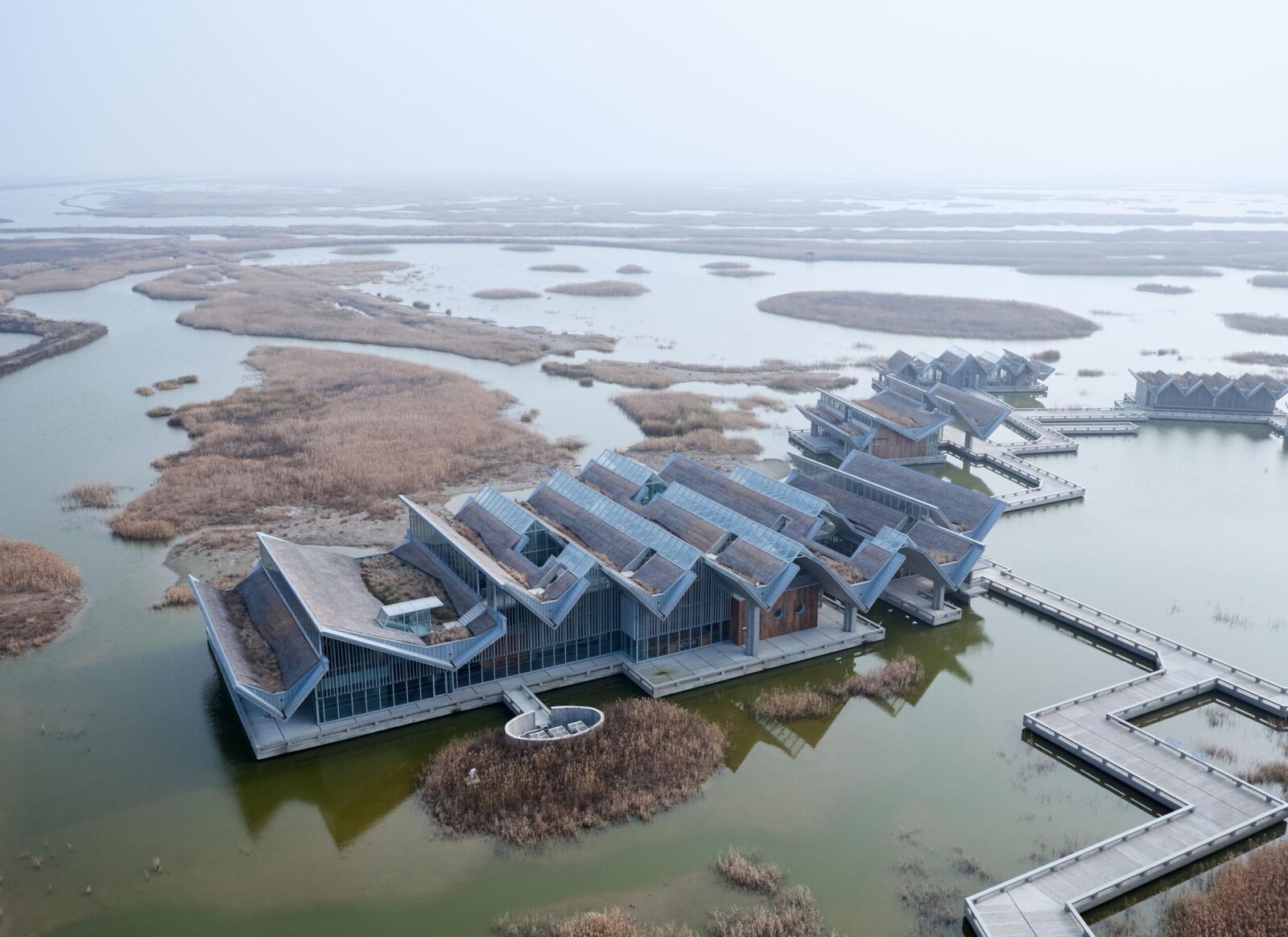
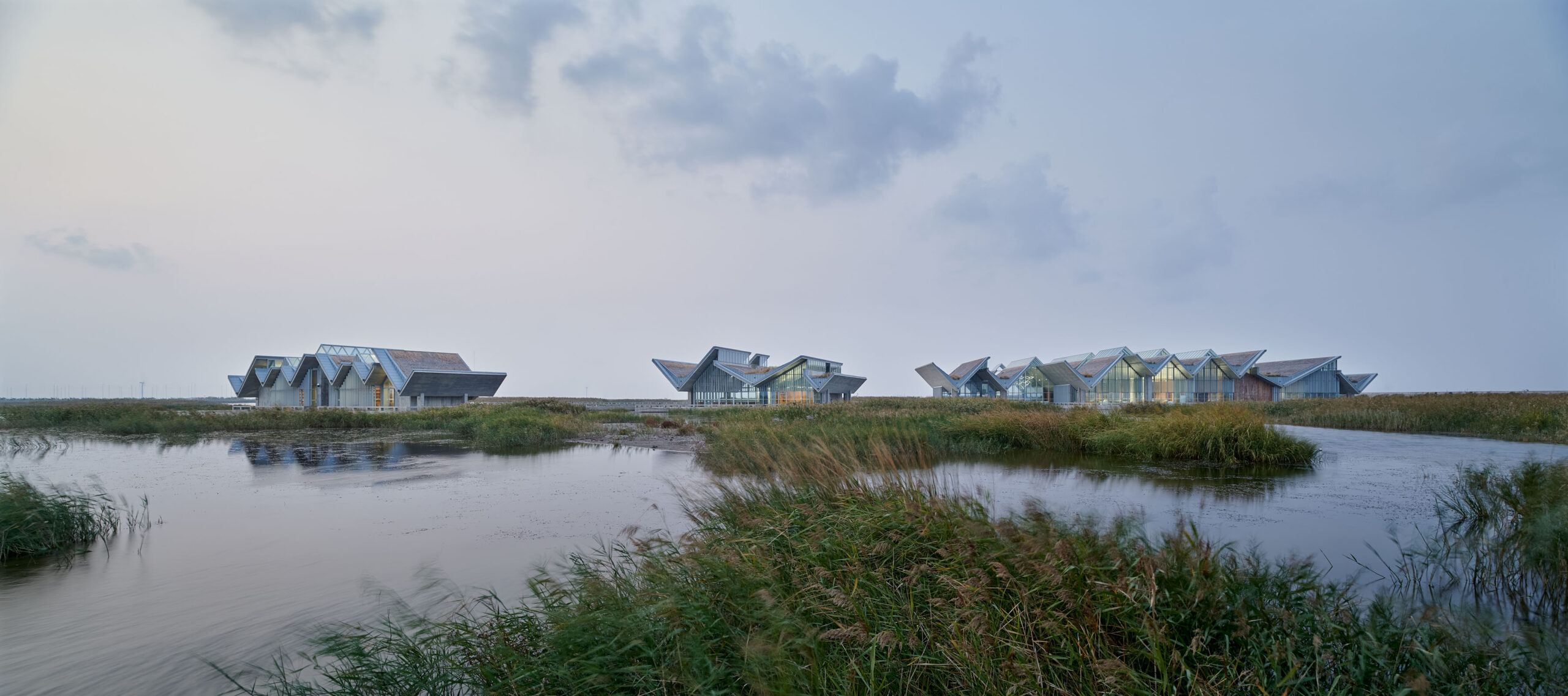
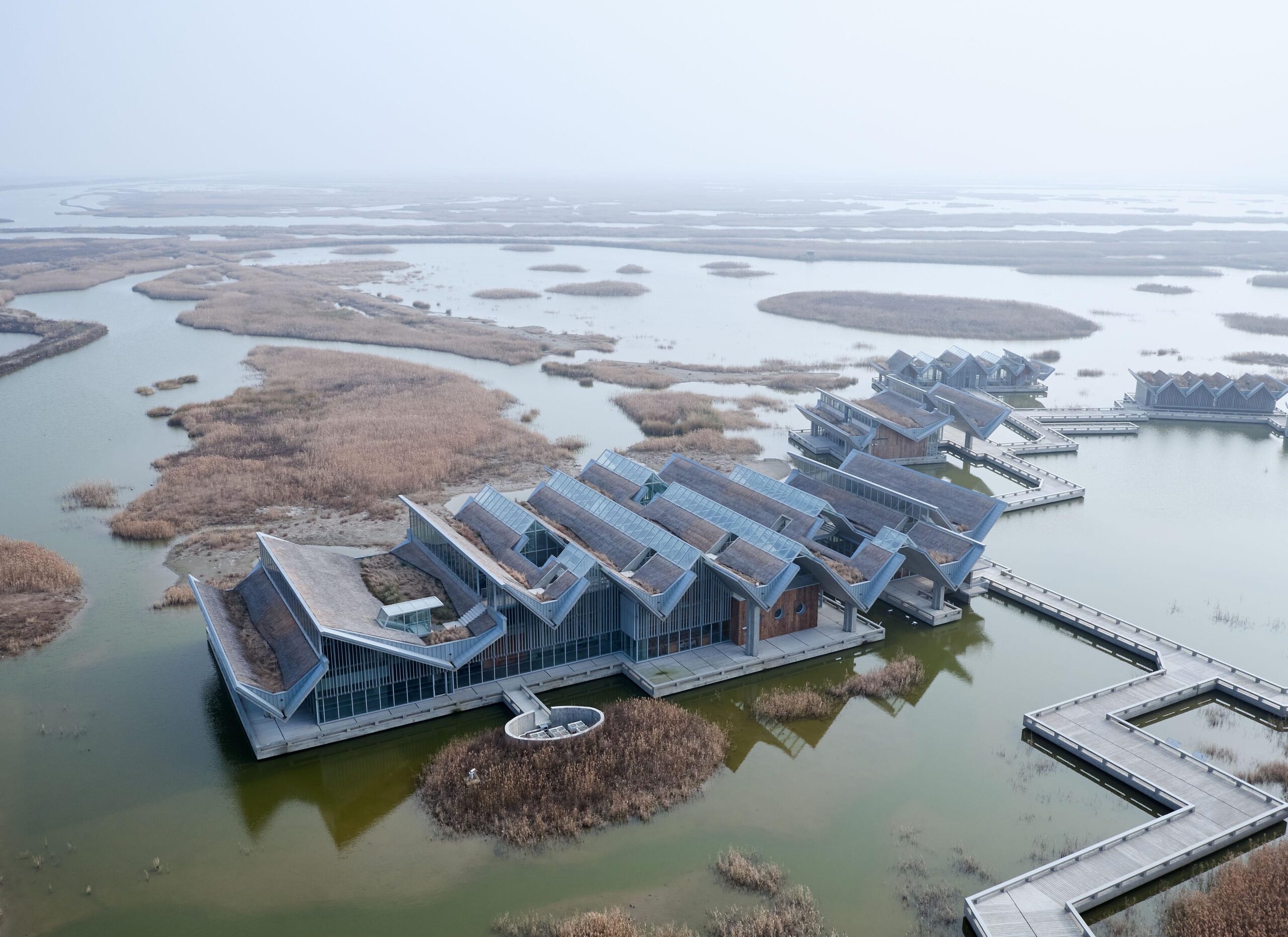
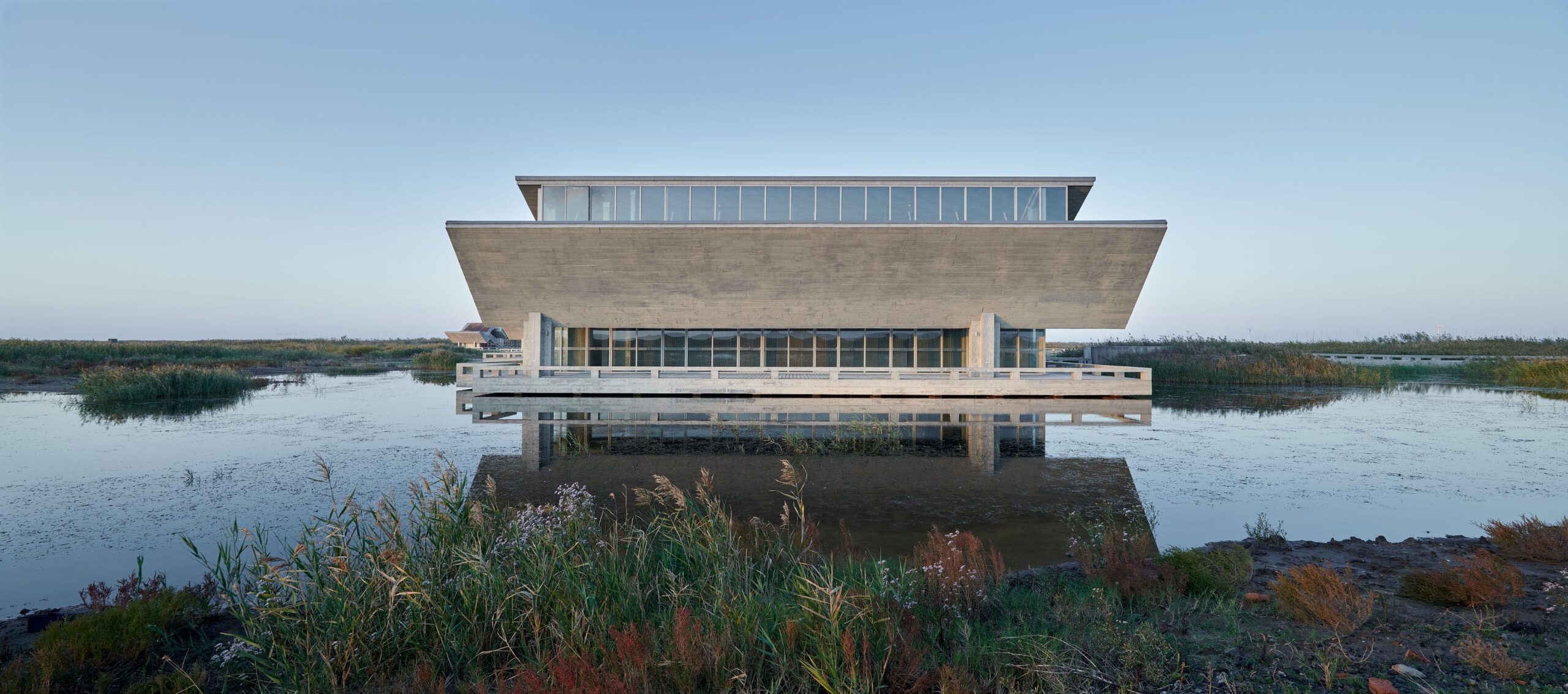
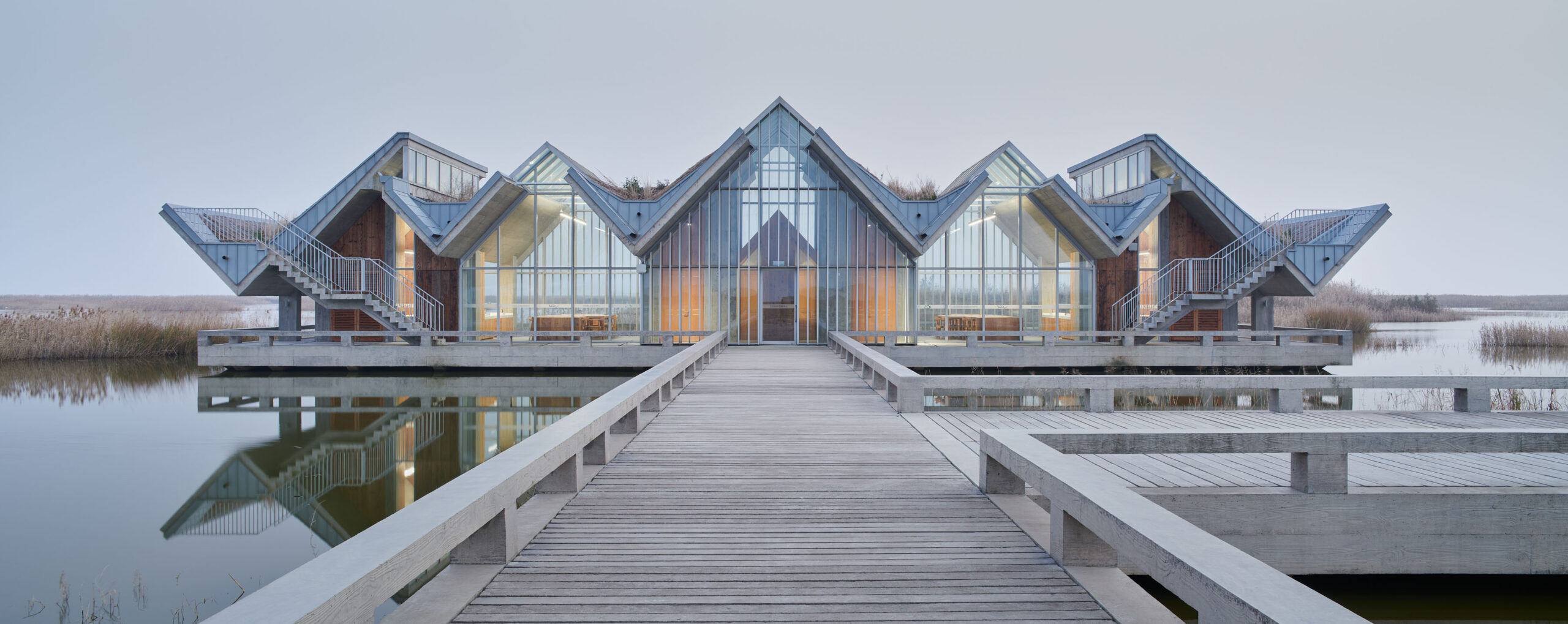
中国・上海の崇明島に建つ〈湿地研究教育センター(Wetland Research and Education Center)〉は、世界的に重要な渡り鳥ルートに位置する湿地に設計された、自然環境の再生プロジェクトを支える研究教育センターです。
上海を拠点とするAtelier Z+が設計しました。
注目ポイント
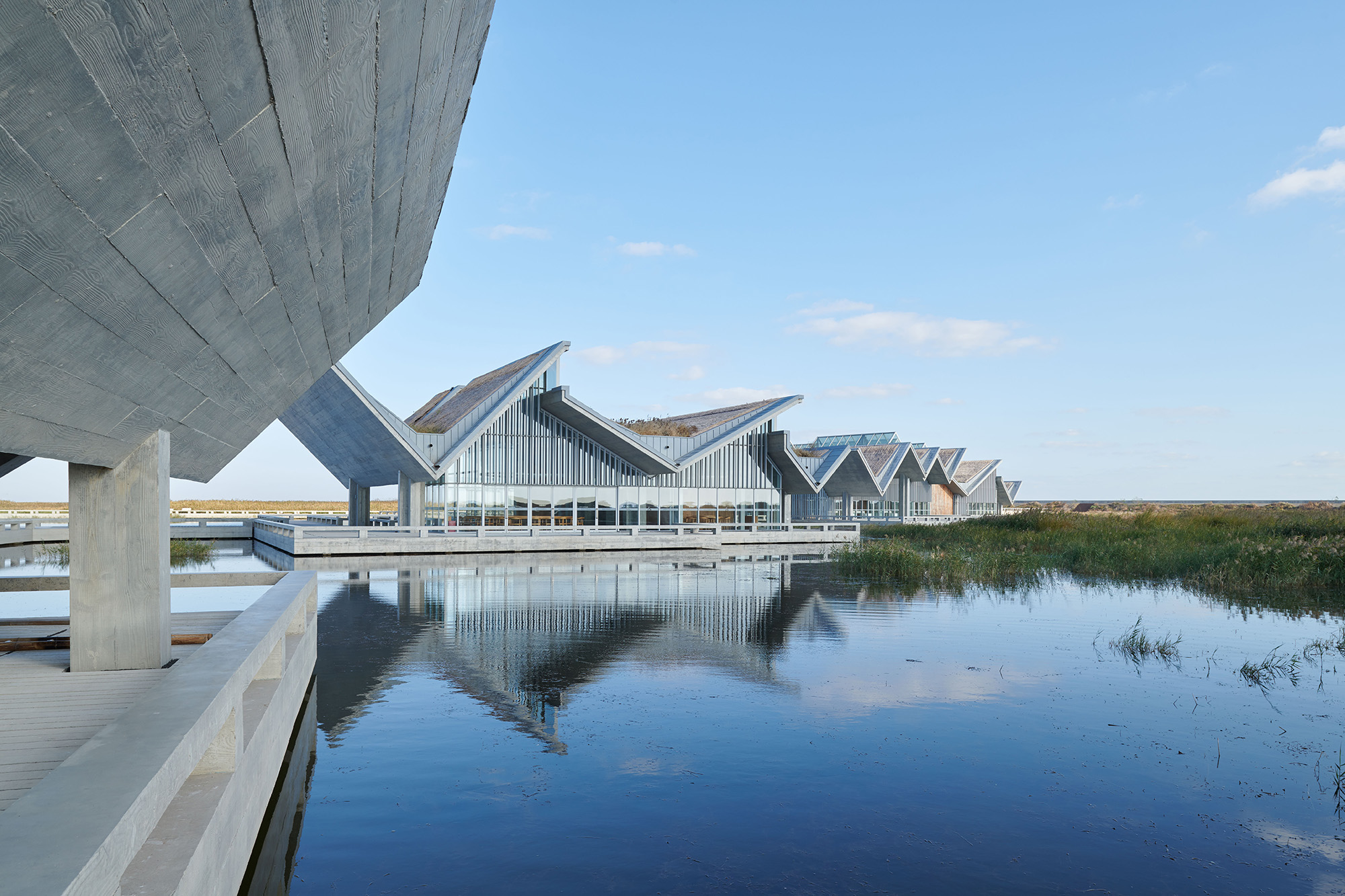
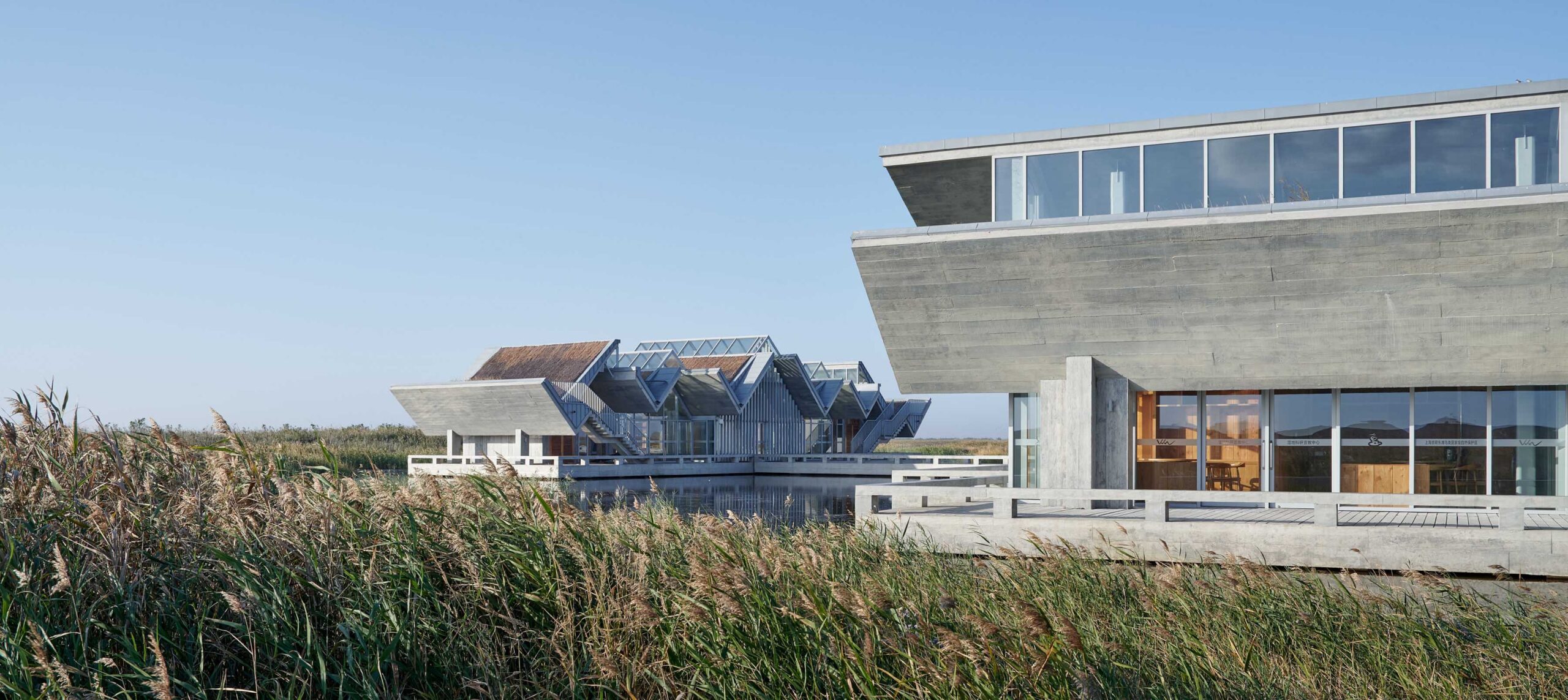
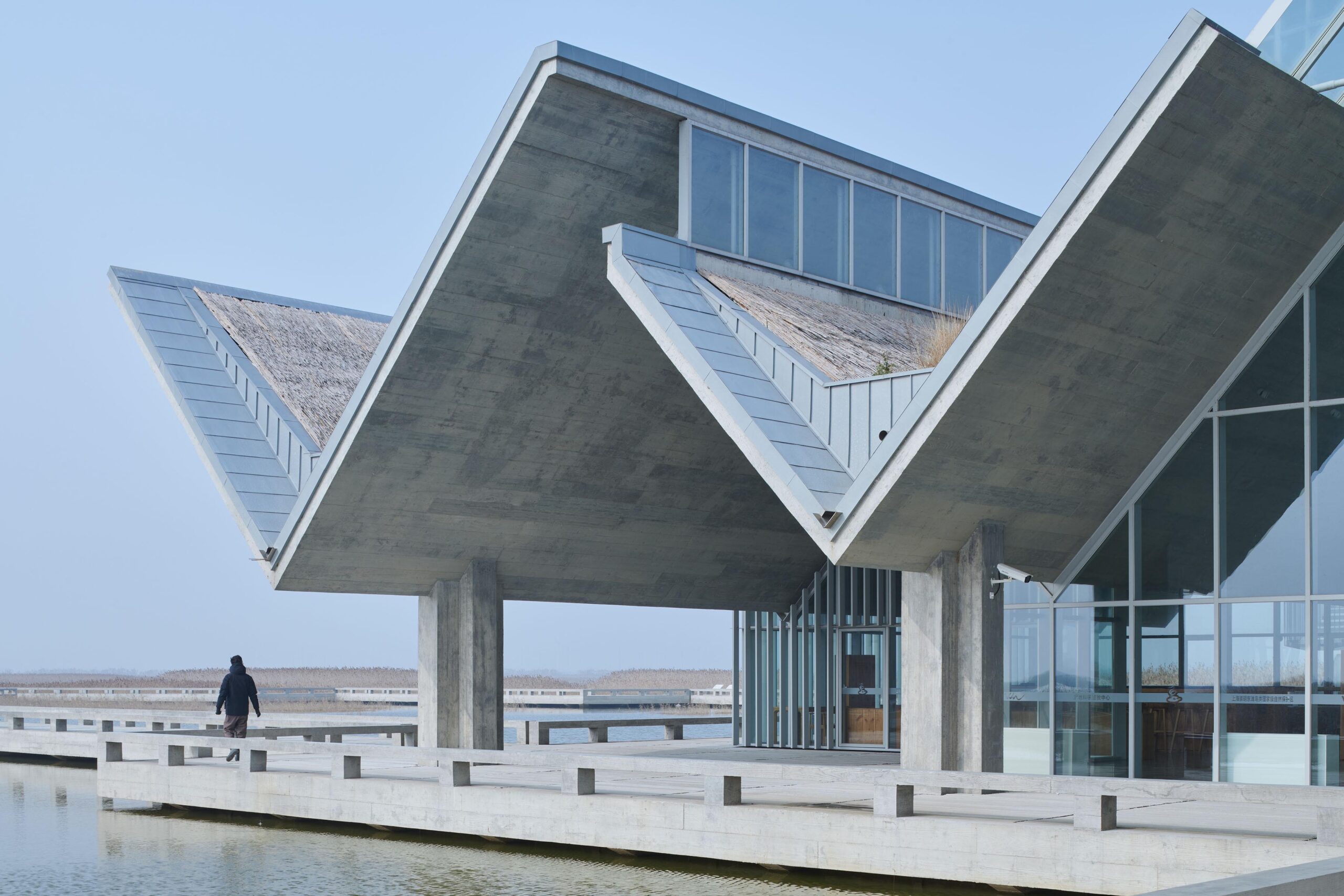
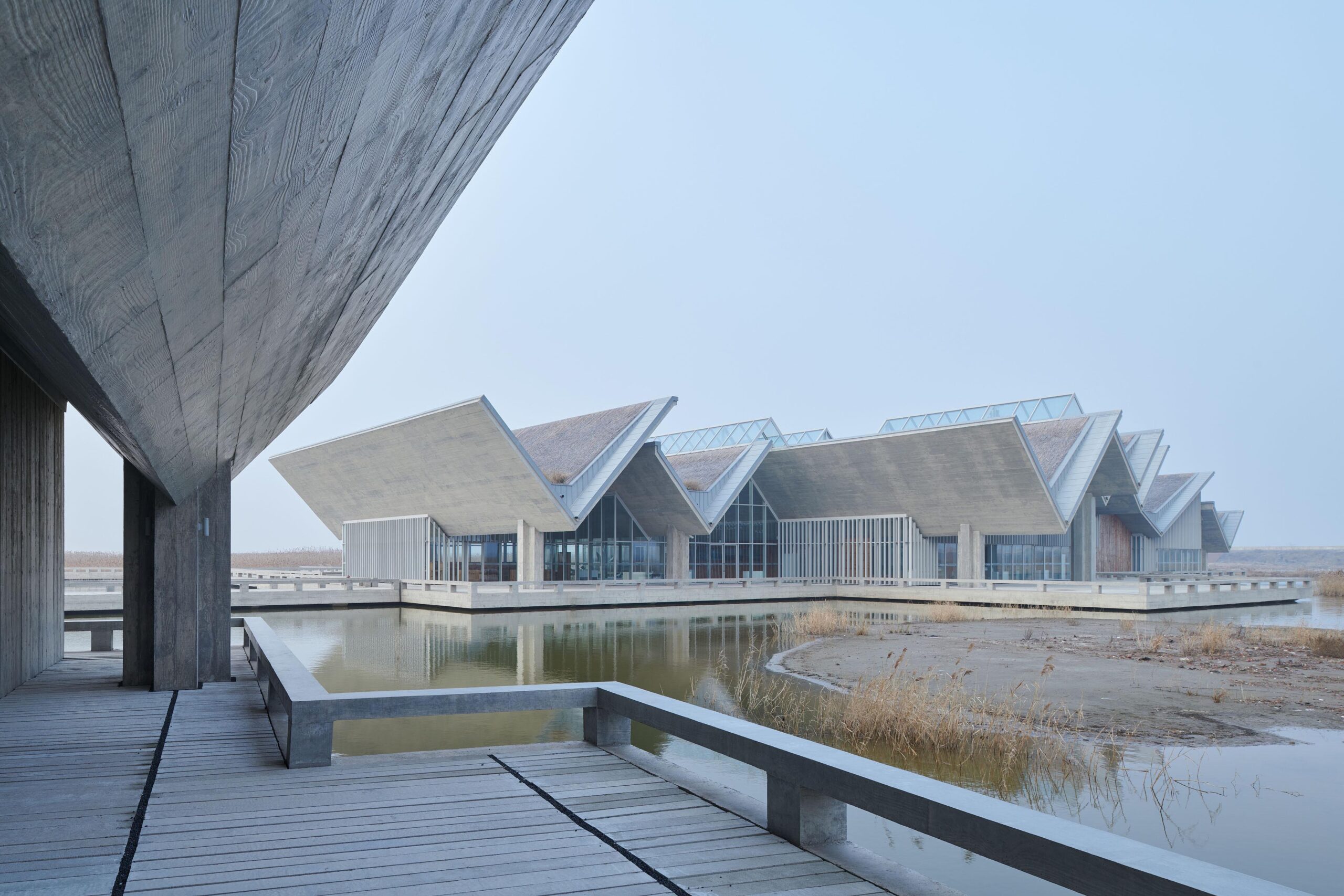
- 切妻屋根を反転させた「Y字形」の片持ち構造と葦葺き屋根
- 水面や葦原に溶け込む分割・分散された建築ボリューム
- 湿地を見渡す遠景と室内を俯瞰する近景を組み合わせた空間体験
(以下、Atelier Z+から提供されたプレスキットのテキストの抄訳)
©︎ CHEN Hao
©︎ CHEN Hao
渡り鳥の中継地「東灘湿地」
上海の崇明島の最東端、長江河口に位置する東灘湿地は、河口干潟湿地の一種である。この湿地は、渡り鳥の渡りルート「東アジア・オーストラリア地域フライウェイ」の中間に位置し、世界8大渡り鳥ルートの1つとして知られている。
アジア太平洋地域における水鳥の重要なルートとして、東灘湿地は野生鳥類にとって最も重要な集結地・生息地となっている。
©︎ CHEN Hao
©︎ CHEN Hao
1990年代、干潟強化のために外来植物ススキ(Spartina alterniflora)が導入されたが、それは湿地生態系の悪化を招いた。この問題に対処するため、上海崇明東灘国家自然保護区では2013年よりススキの生態的制御と鳥類生息環境の最適化を開始し、2019年に全プロジェクトが完了した。
本事業の支援施設として建設されたこの研究教育センターは、科学調査モニタリング、鳥類標識調査、管理保護の法執行、科学教育のための重要なプラットフォームであり、生態環境保護に関する啓発や展示、さらには国際協力・交流の促進にも貢献している。
©︎ CHEN Hao
©︎ CHEN Hao
自然と共生する建築理念
〈湿地研究教育センター〉は、自然保護区北東部の再生葦湿地に位置する。
水と空が同色に溶け合い、人の足跡が少なく、鳥たちが群れをなすこの地で、建築は謙虚さと敬意をもって自然と調和することを意図している。着想源は、14世紀の山水画家・王蒙が描いた山水の間に点在する隠遁の小屋である。
Axonometric ©︎ Atelier Z+
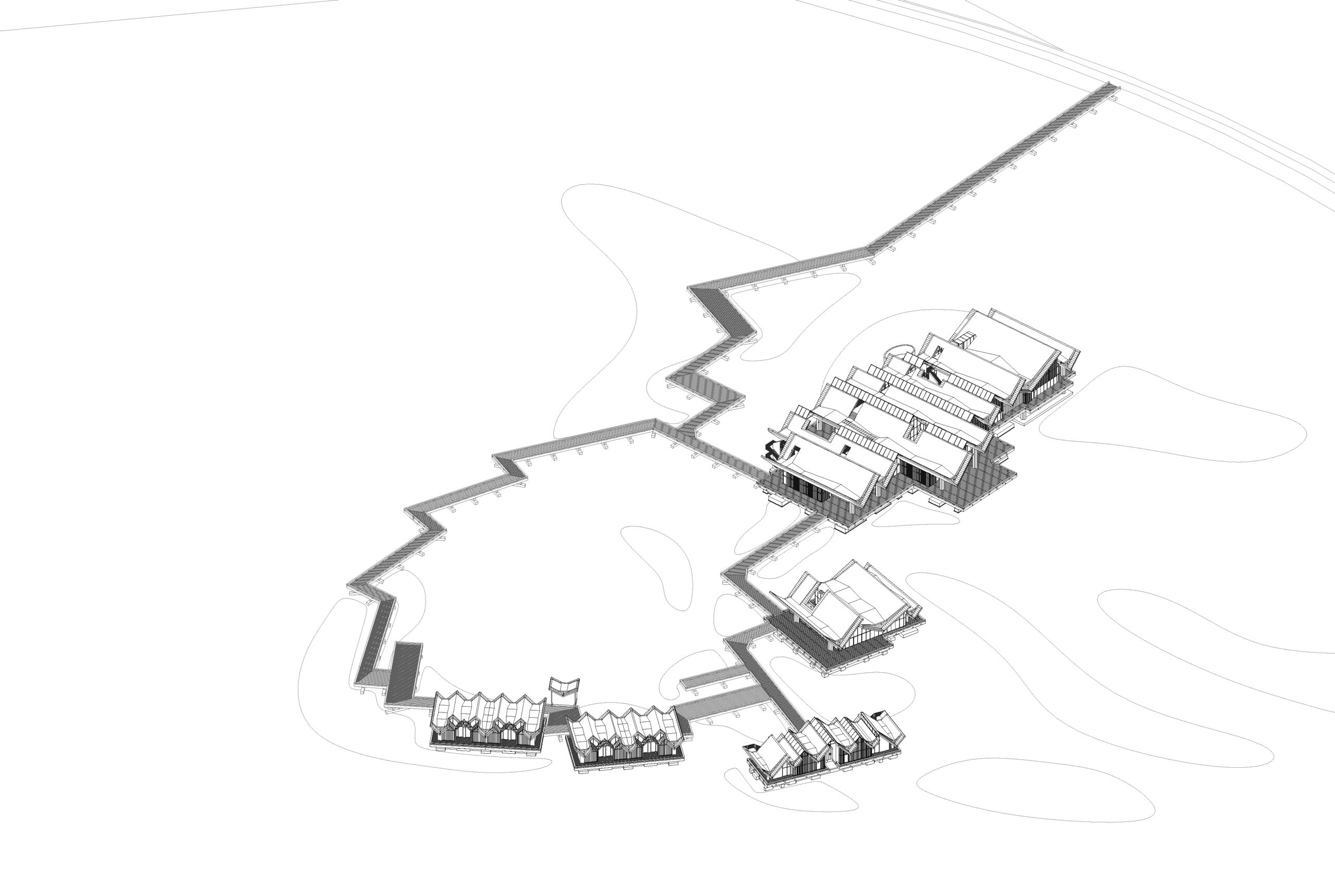
建設・使用時の生態系への影響を最小限に抑えるため、建築ボリュームは分割・分散され、杭基礎の上に浮かぶ集落群として計画された。
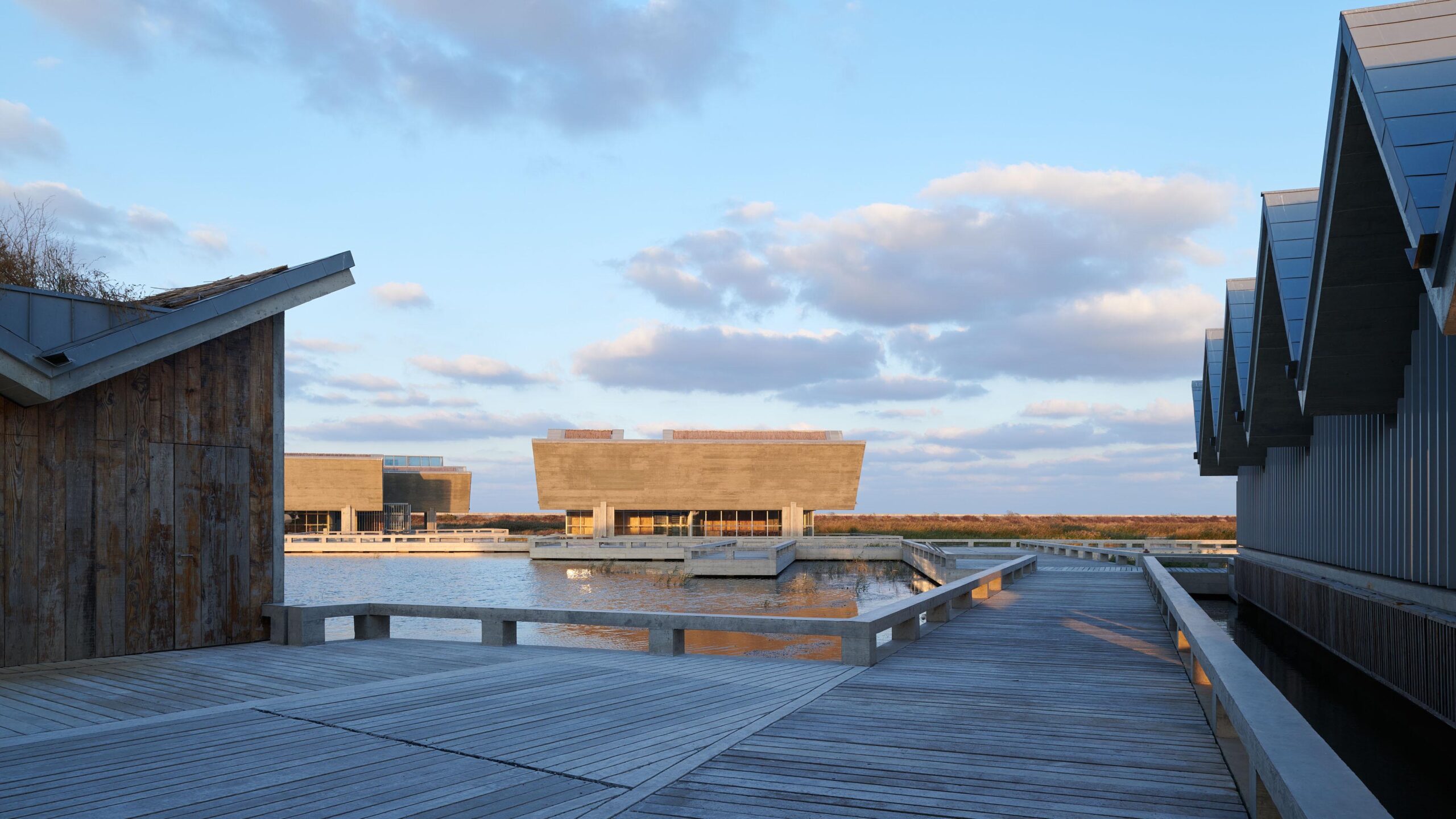
会議展示棟、食堂、研究棟、寮棟など異なる規模の5棟がジグザグの架橋で相互接続され、水面に浮かび葦原に溶け込むように配置されている。
©︎ CHEN Hao
©︎ CHEN Hao
切妻屋根の転化と「Y字形」の発想
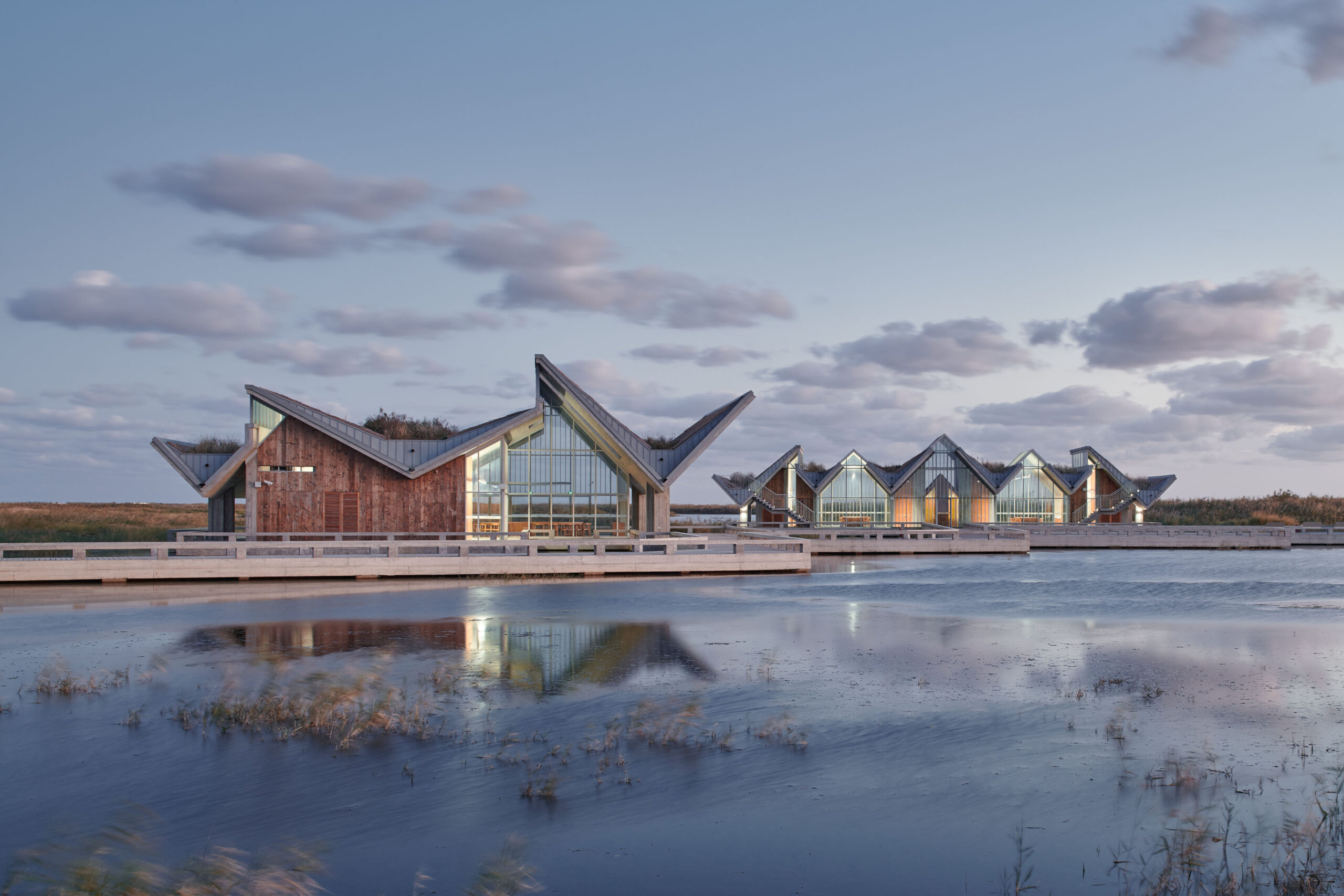
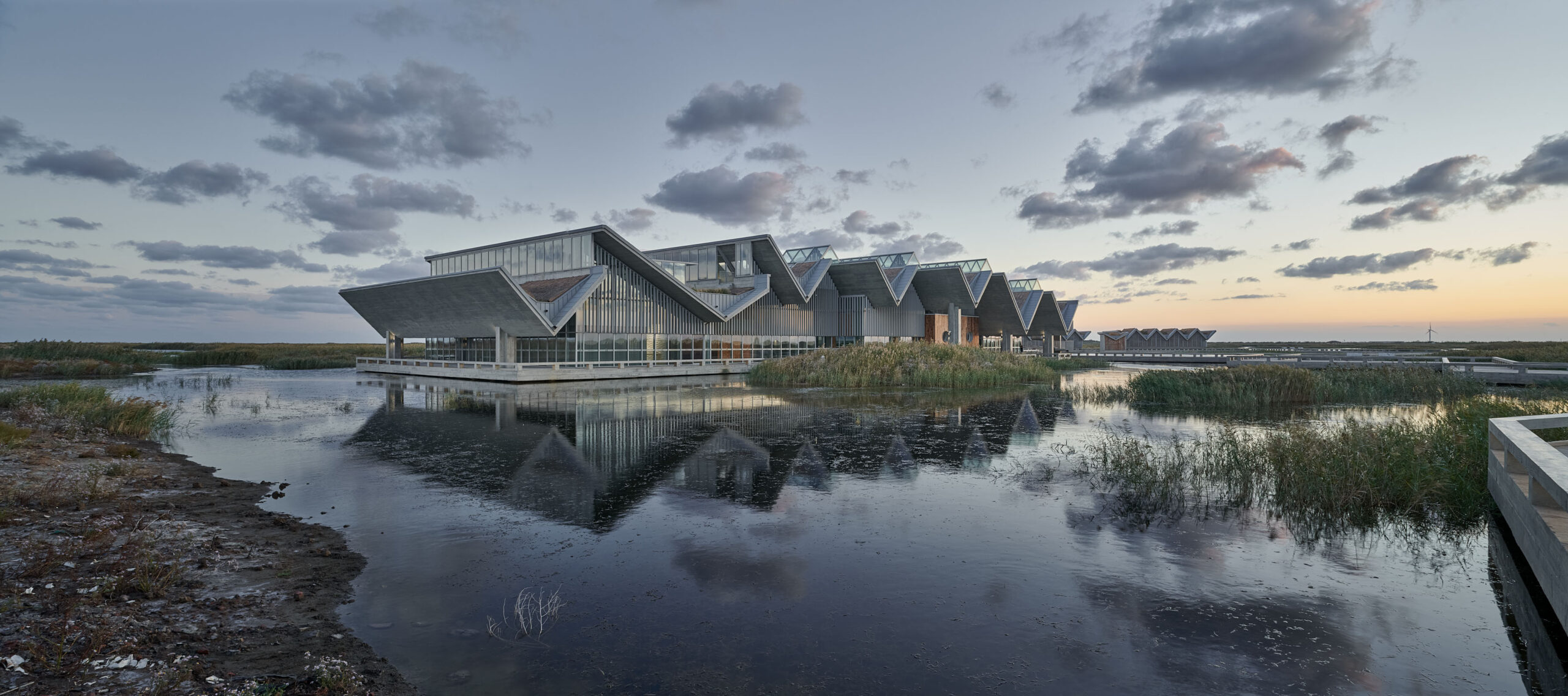
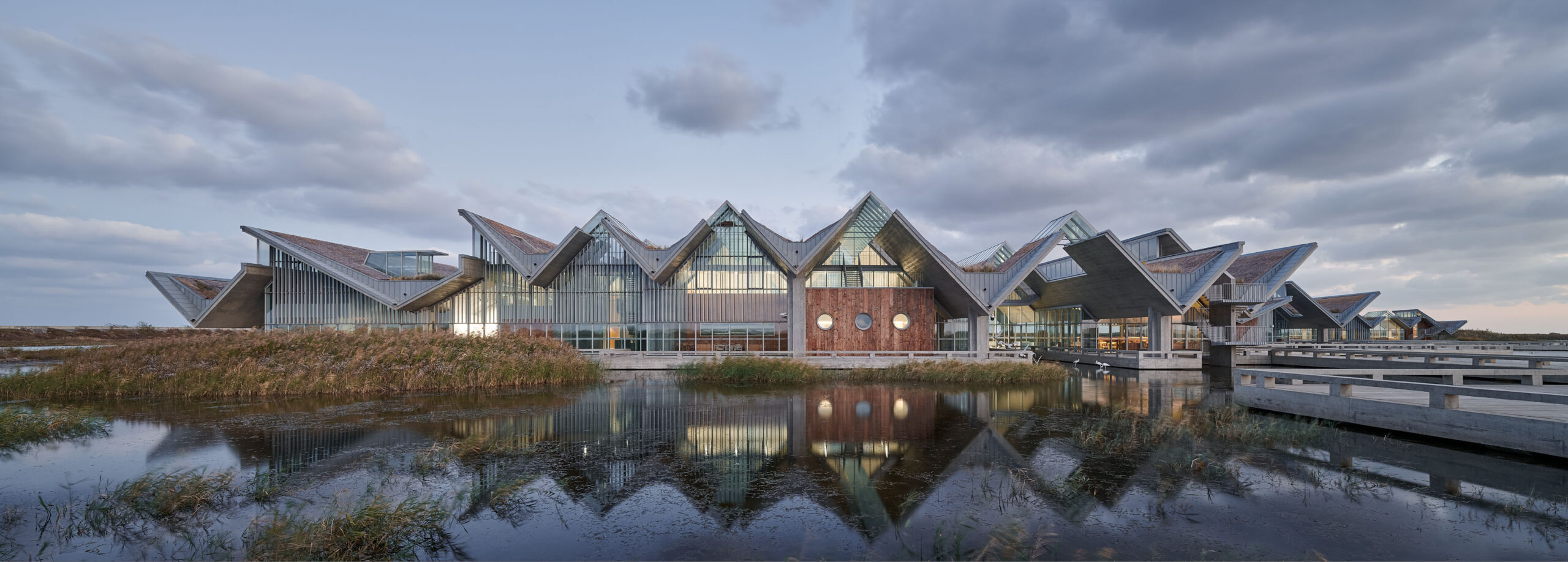
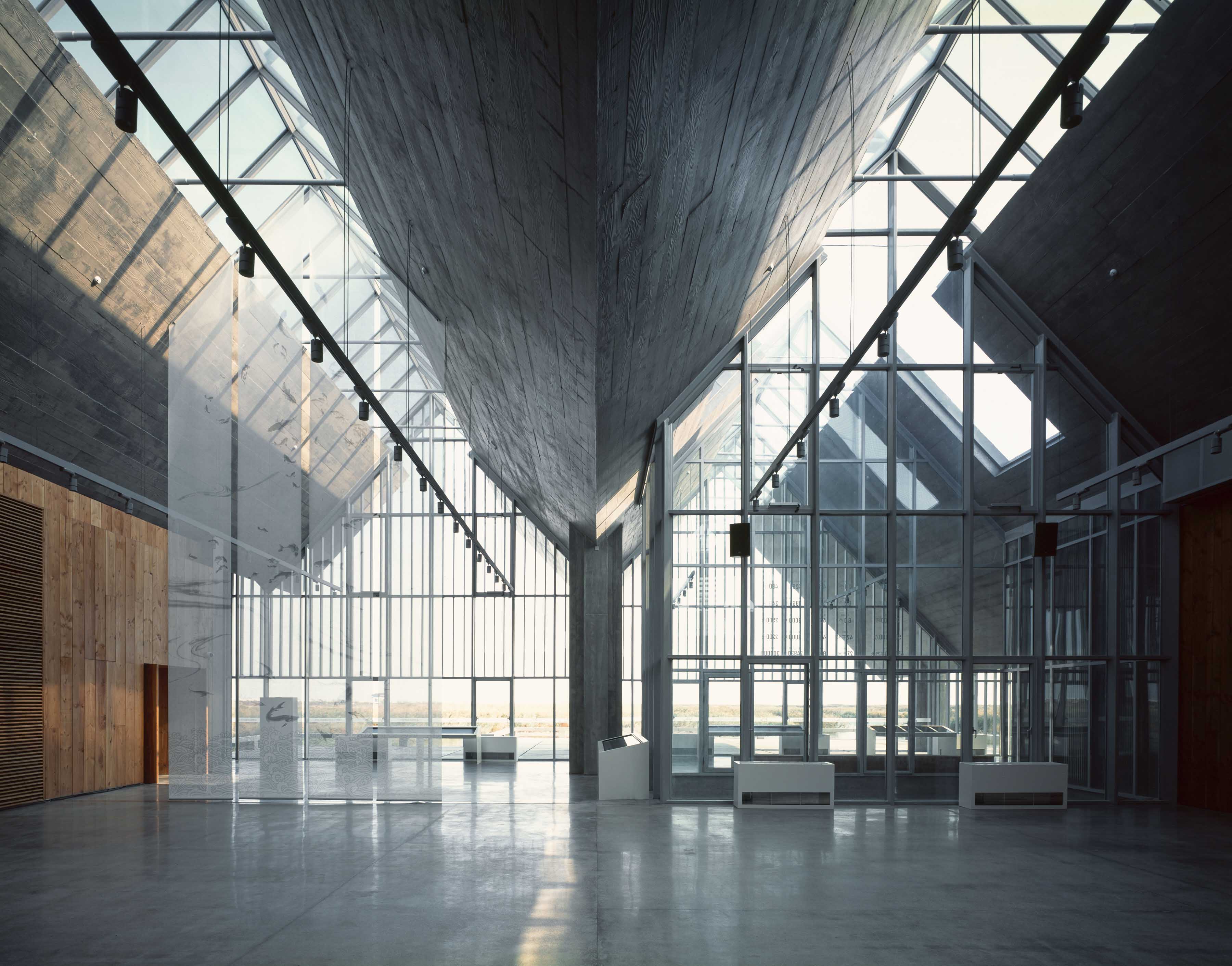
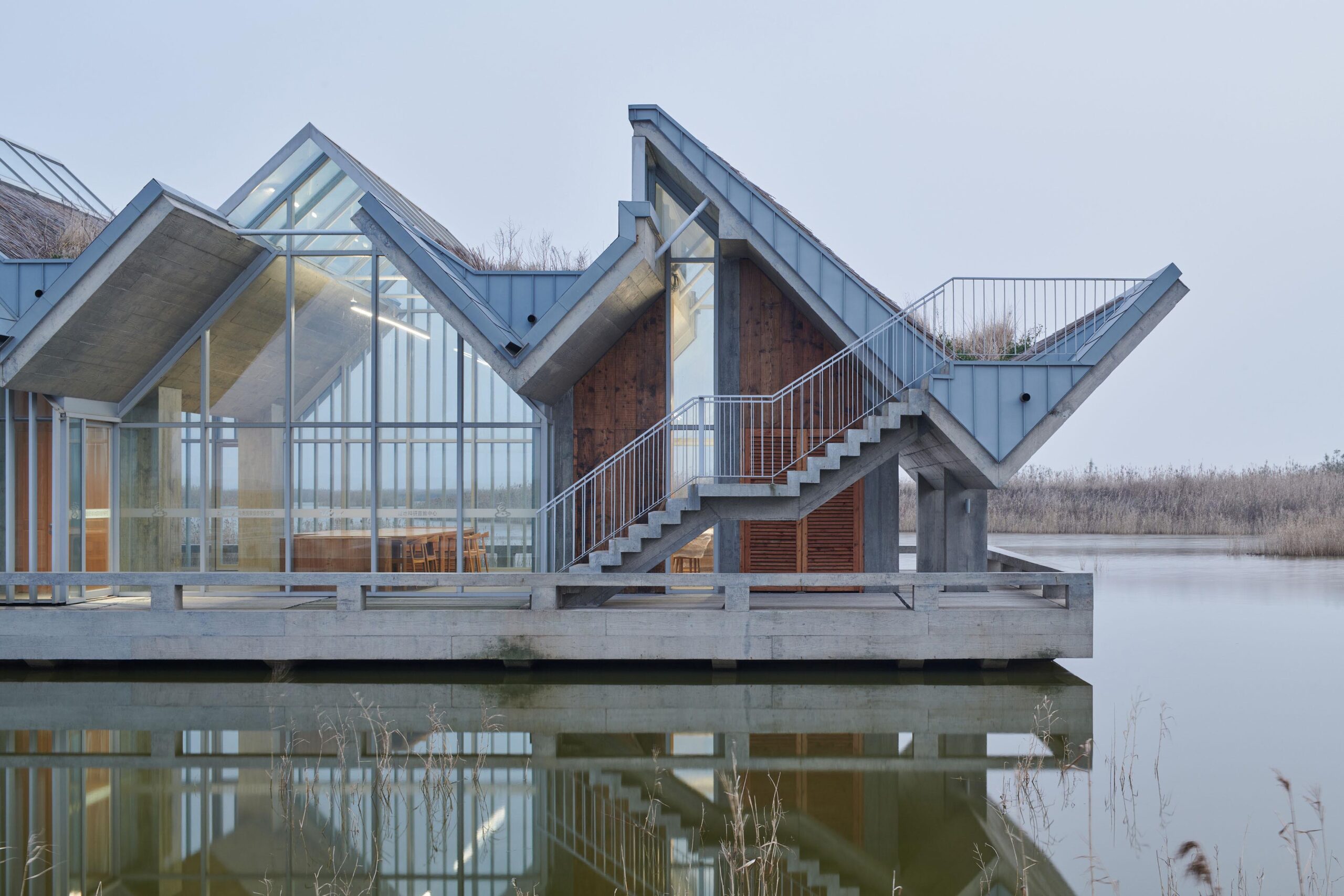
元末期の画家 王蒙(おうもう)の絵画に描かれた「切妻屋根の小屋」を原型とし、その屋根を反転させて「Y字形」の片持ち構造を開発した。
2つの独立したY字形ユニットを並置することで、新たな二重Y字形空間を形成した。この構造は原型に新たな空間的意味を与えている。
©︎ CHEN Hao
©︎ CHEN Hao
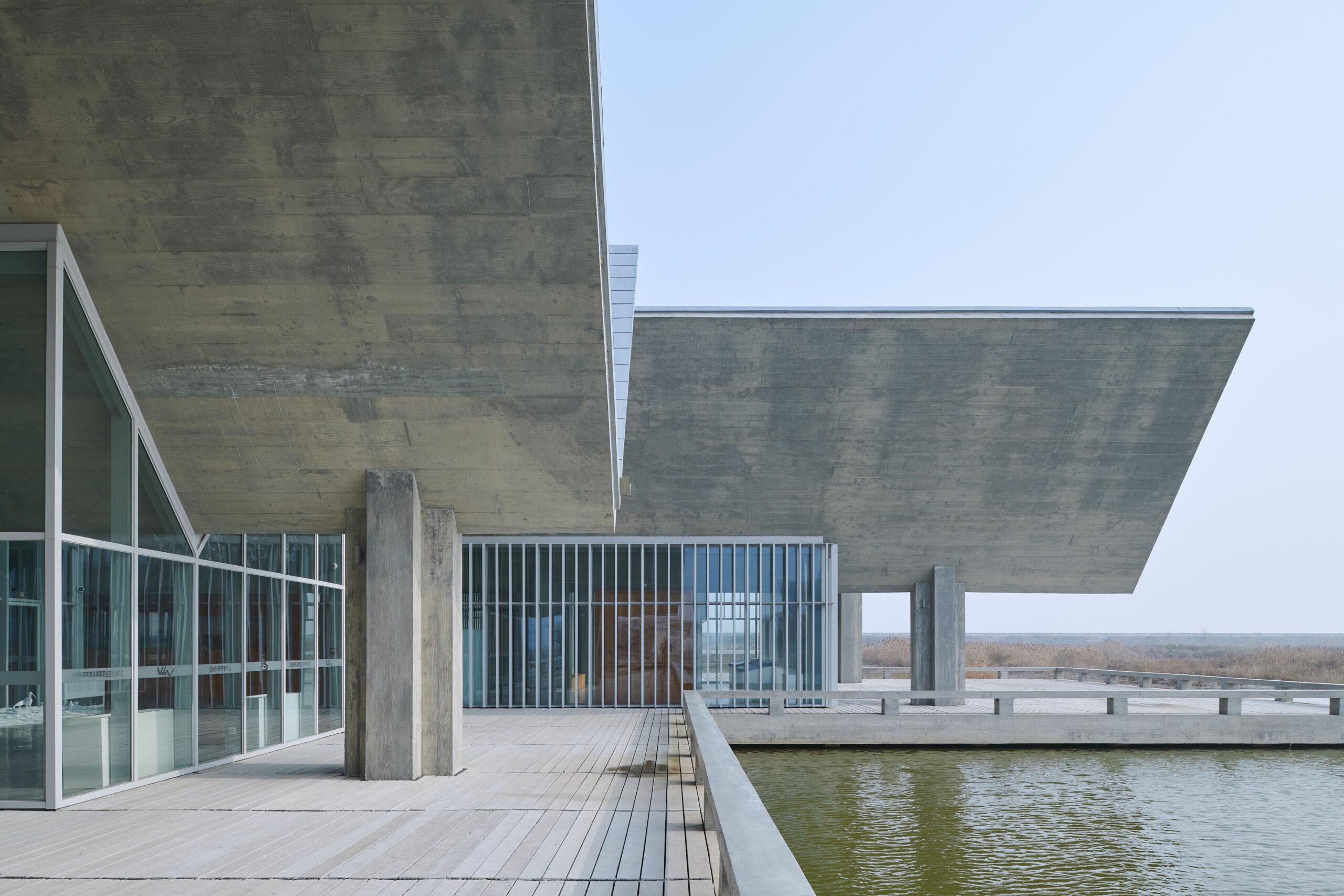
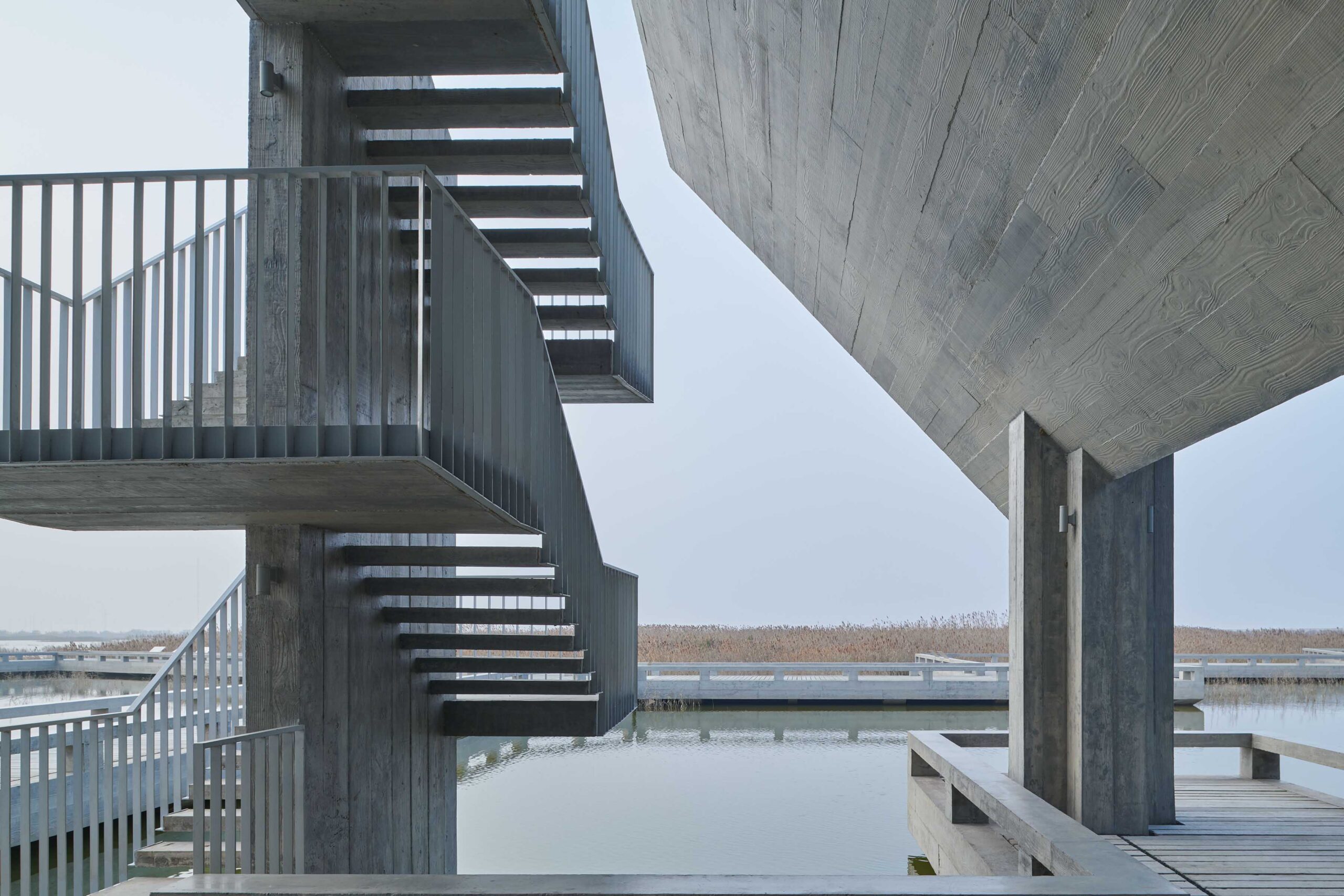
第1に、2つのY字構造が覆う空間は庇護感をもたらし、湿地に向かう水平視界を固定しつつ、棟の開放性を空へと拡張する。
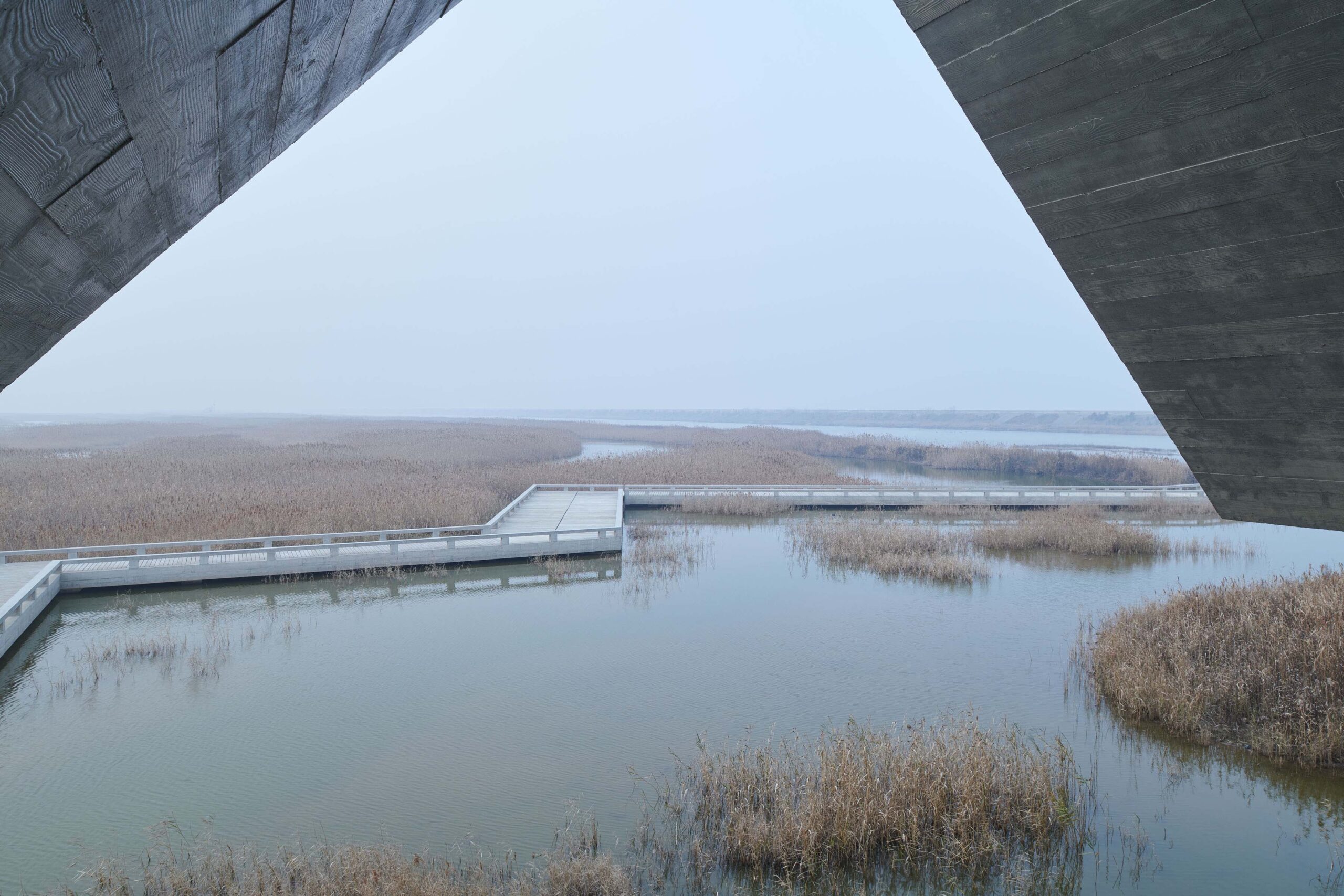
第2に、屋根上の逆勾配空間は谷間に住む感覚を提供し、訪問者は広範な水平視界の切り取りと再構成を体験できる。また、切妻屋根の側廊下型ベランダと比較して、新たなベランダは空間が一度押し下げられ、その後持ち上げられることで、環境へ開かれる感覚を生み出している。
©︎ CHEN Hao
©︎ CHEN Hao
動線と空間体験の設計
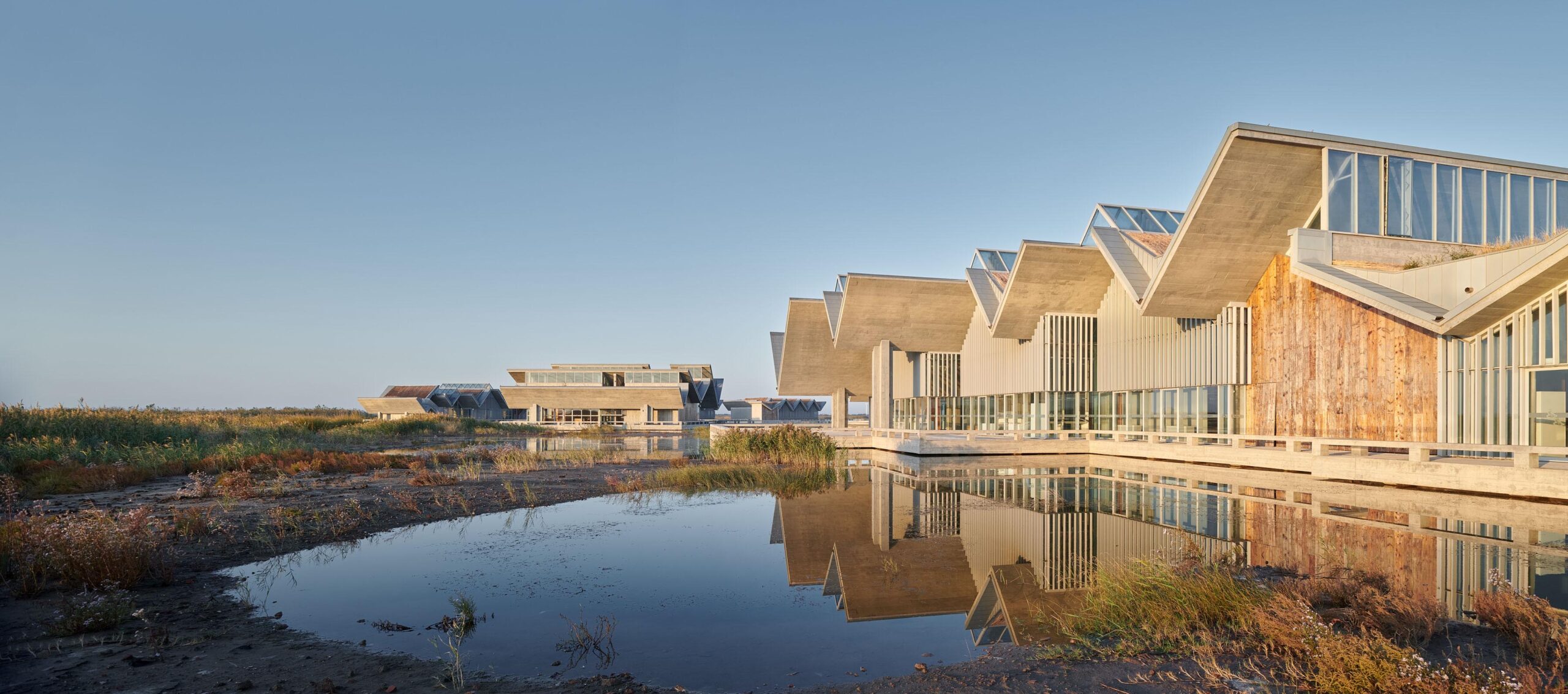
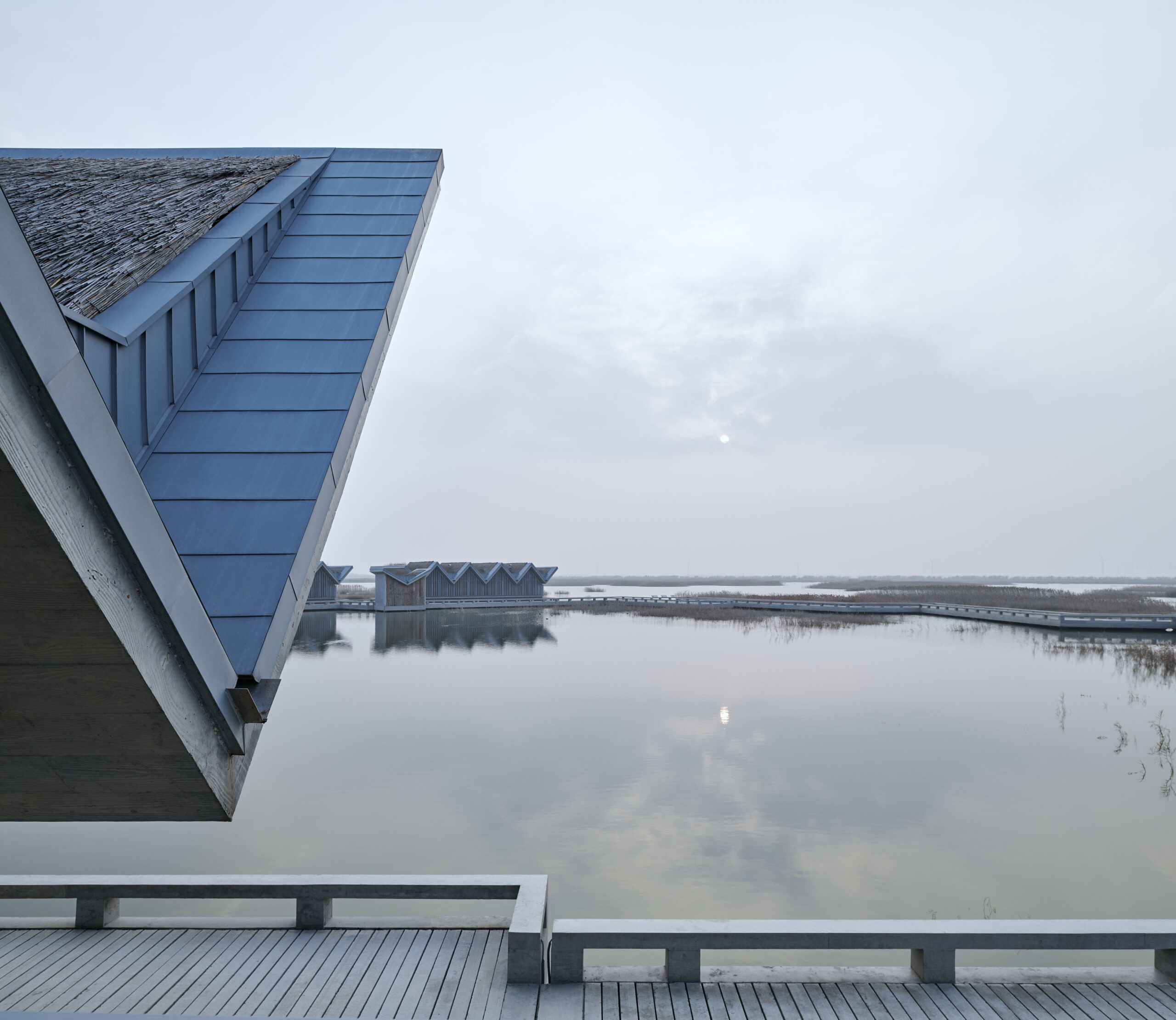
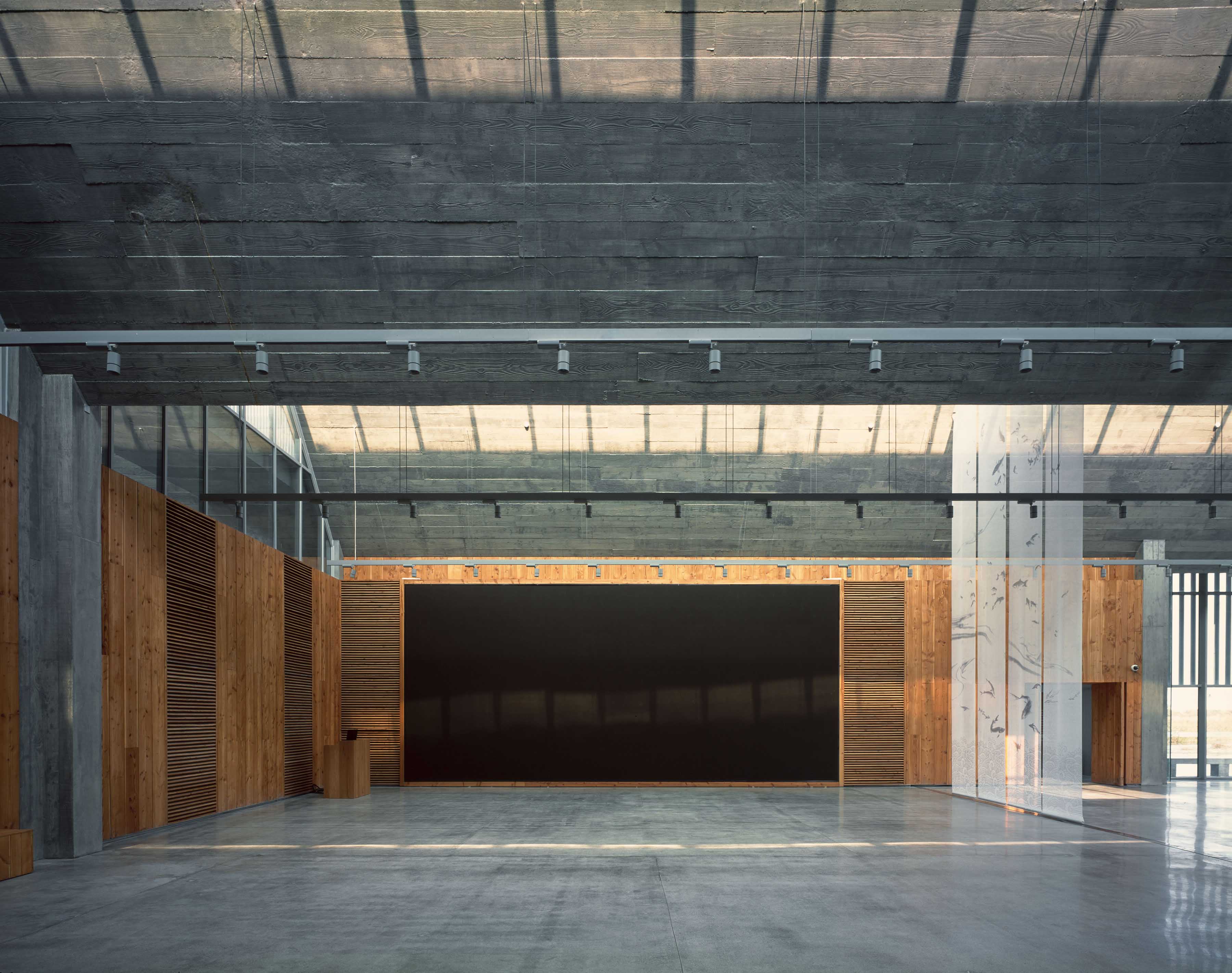
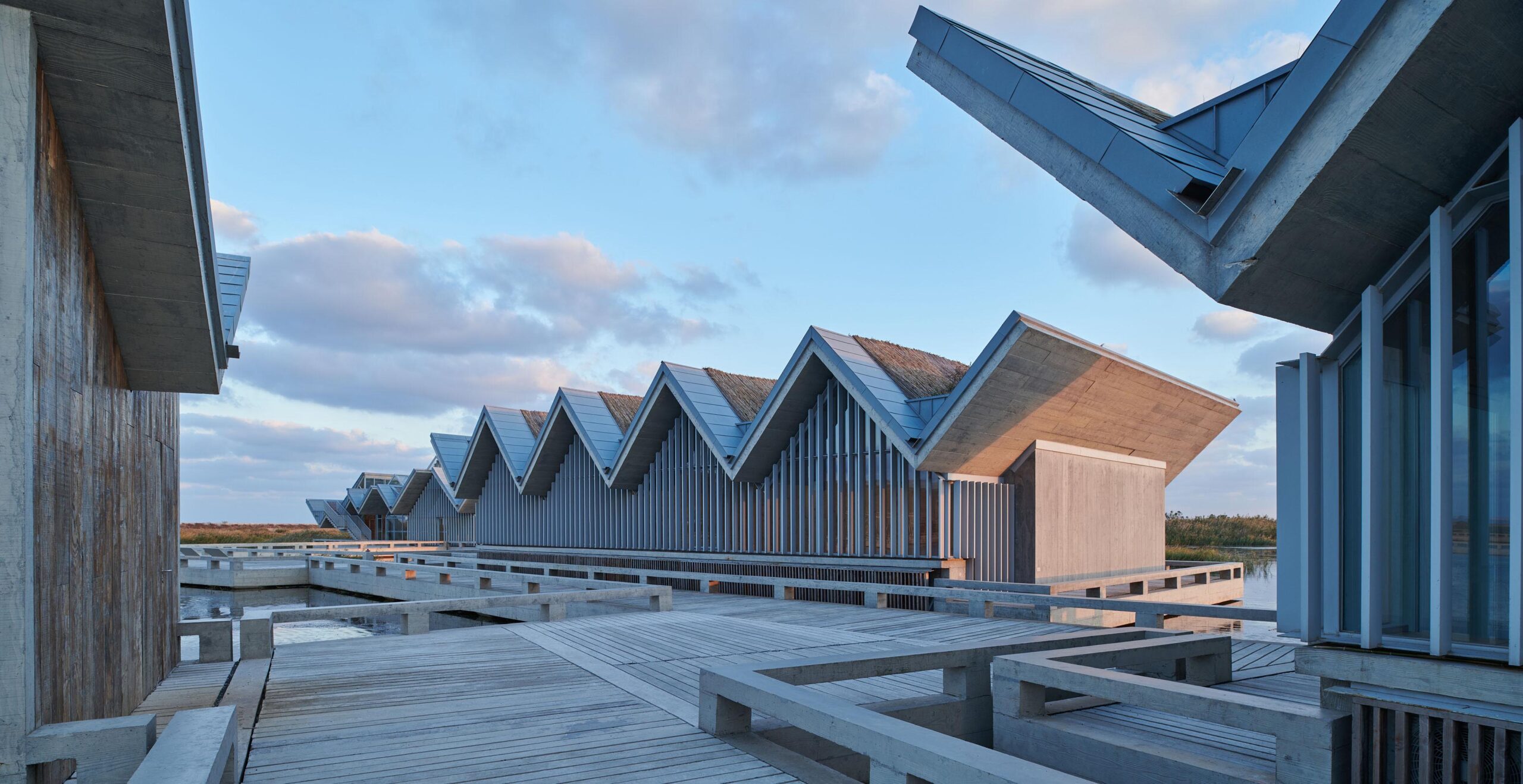
Y字形ユニットの並置と変形によって、連続した鋸歯状屋根が設計され、スケール差のある覆われた空間が生まれた。
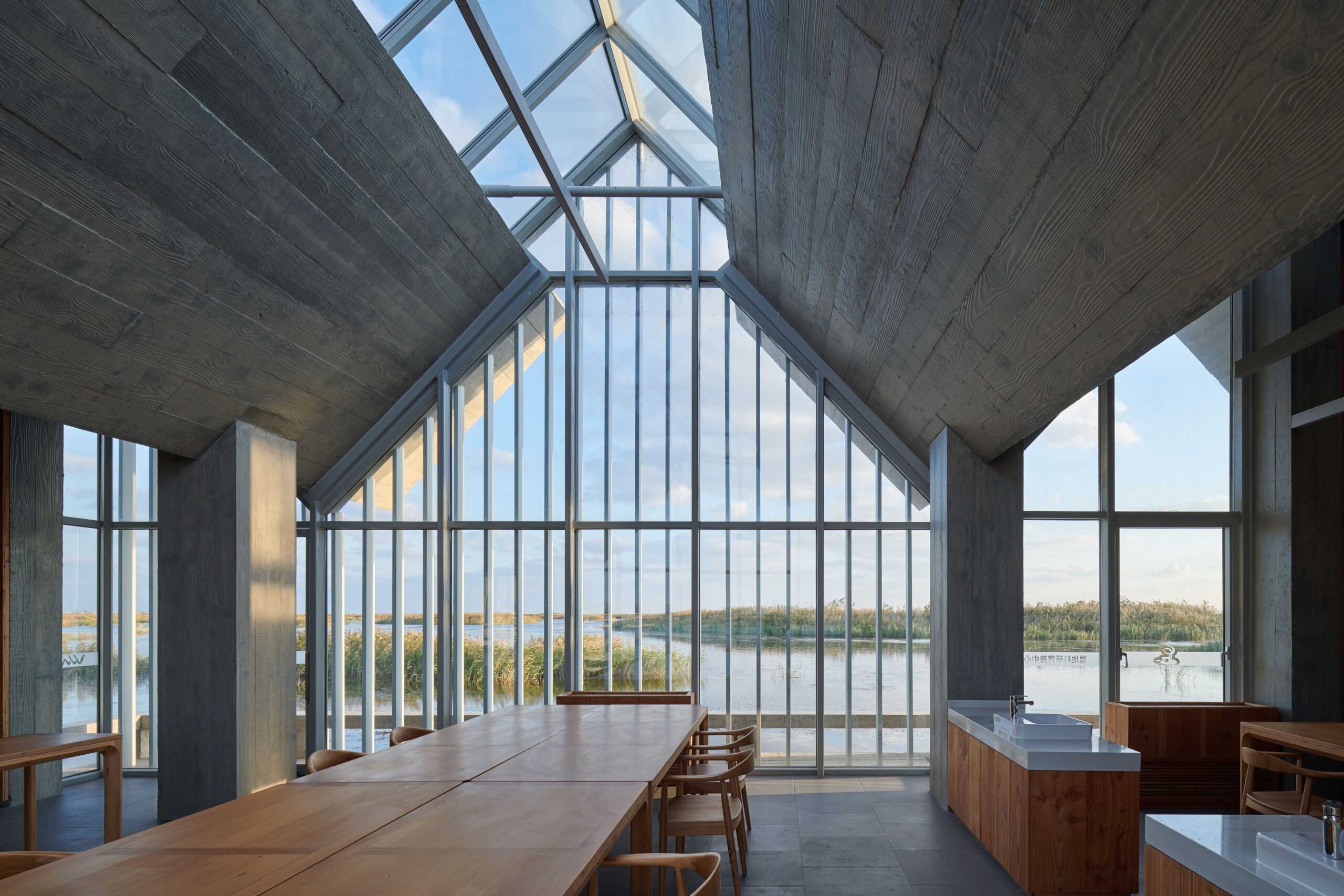
動線の組織、中庭の配置、囲いの透明度の変化、構造スパンや高さの差異、棟天窓と高窓の組み合わせにより、空間間に明確な境界は存在せず、人々は柔軟な利用を促される。
©︎ CHEN Hao
©︎ CHEN Hao
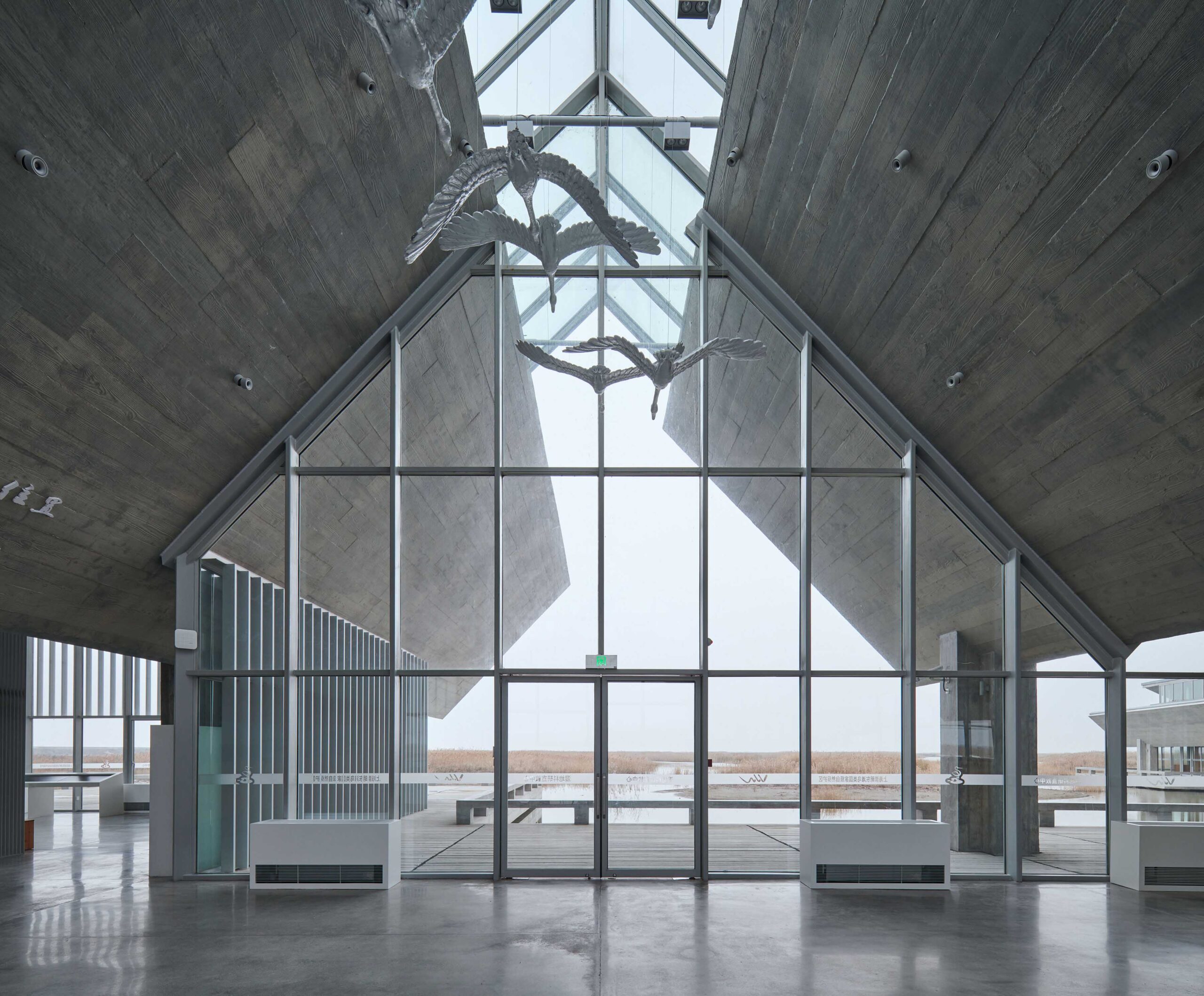
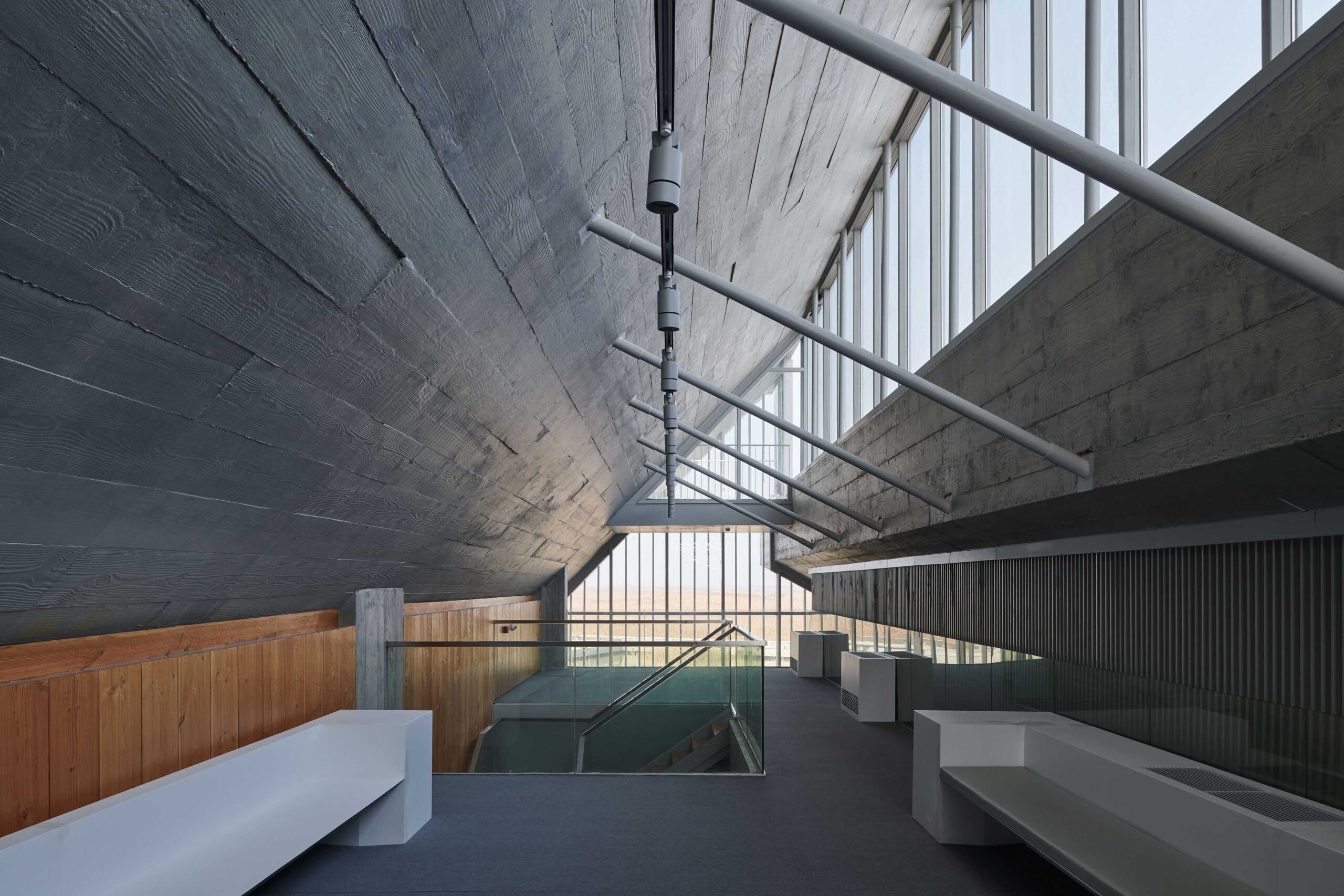
この直線的な空間構成は、静止時と移動時に異なる視覚体験をもたらす。特定の空間ユニットに滞在すると、屋根に包み込まれる感覚の中で外部景観を享受でき、移動時には高さや光の変化に伴い庭園式中庭住宅を散策する感覚を得る。
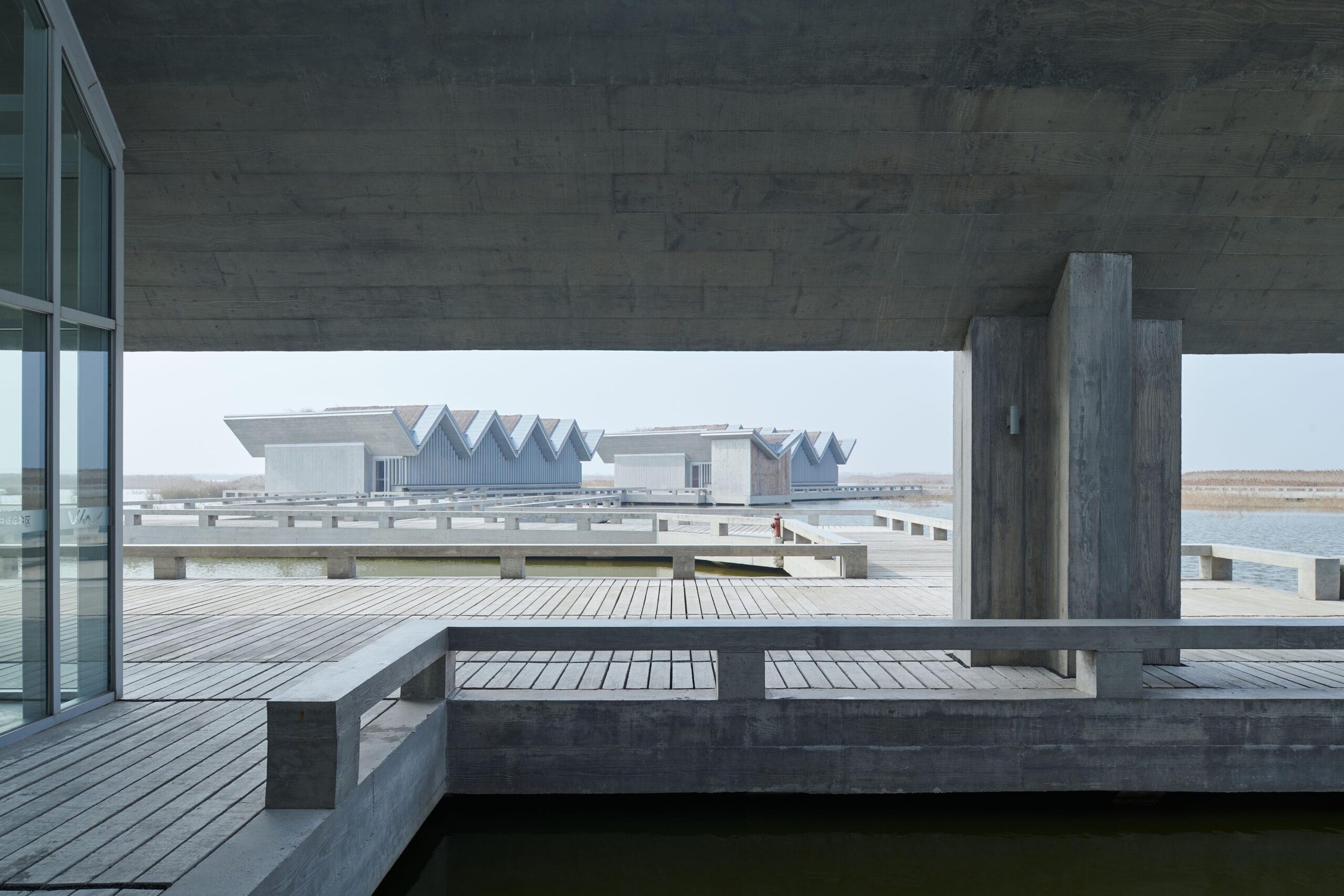
この体験は会議・展示棟の屋上で最も強調される。屋上の「谷」からは湿地を見渡す遠景が、スカイウォークからは室内景観を俯瞰する近景が交互に現れ、フラッシュバック的な解釈を喚起する。鋸歯状の屋根は分散した建築を断片化し、重なり合う影と水面反射によって輪郭は曖昧に溶け込む。
©︎ CHEN Hao
©︎ CHEN Hao
構造の選択と素材表現
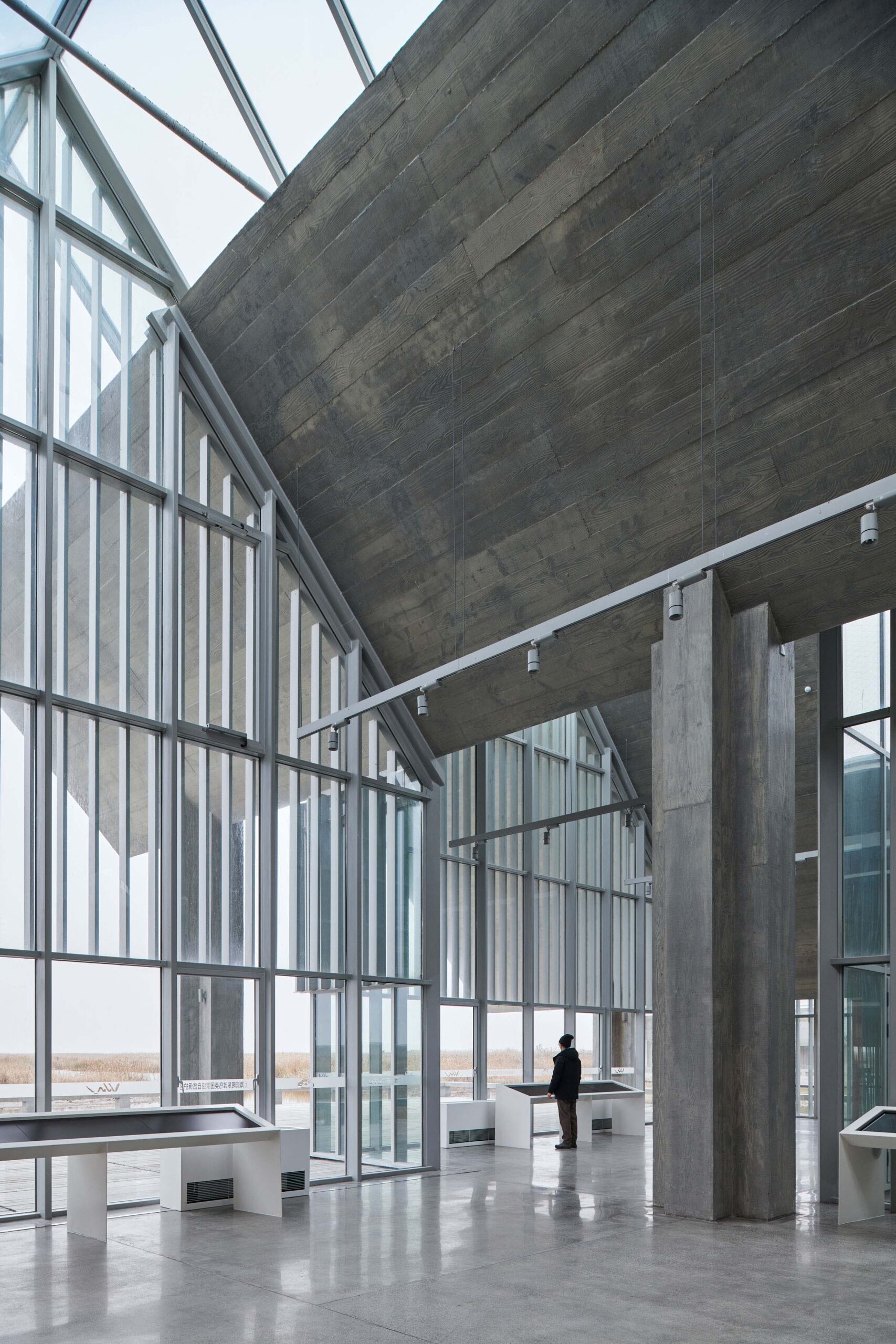
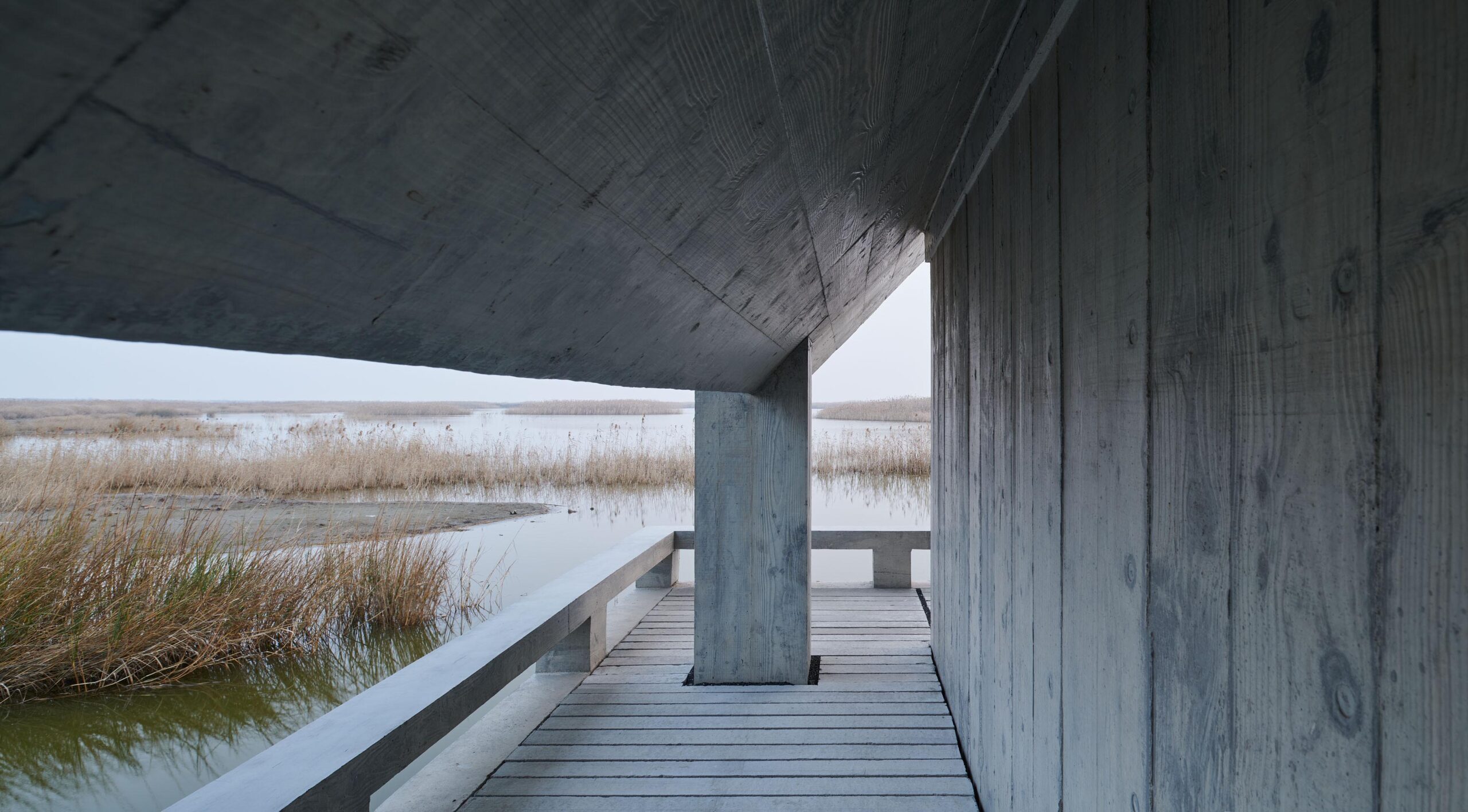
高湿度・高塩分環境に対応するため、軽量鉄骨や木造ではなく、鉄筋コンクリート構造を採用した。
A棟・B棟・C棟はY字型片持ち鉄筋コンクリート曲げ枠構造とし、A棟は大規模な片持ちを有するため全体を鉄筋コンクリートで構築し、一部に鋼製の中2階を設けた。D棟とE棟はコンクリート折り曲げ板構造である。
©︎ CHEN Hao
©︎ CHEN Hao
松材の型枠を使用することで、打ち放しコンクリートの仕上げに自然な木目を再現した。非構造壁にも再生型枠材を利用して素材表現を統一した。
さらに、深い軒下を活かし、鳥類に配慮した床から天井までの窓(垂直グリル付き)を外装に採用した。架橋や水辺プラットフォームには隙間を設けたプレキャストコンクリート製板を敷設し、水上を歩く感覚と葦の生育空間を両立させた。
©︎ CHEN Hao
©︎ CHEN Hao
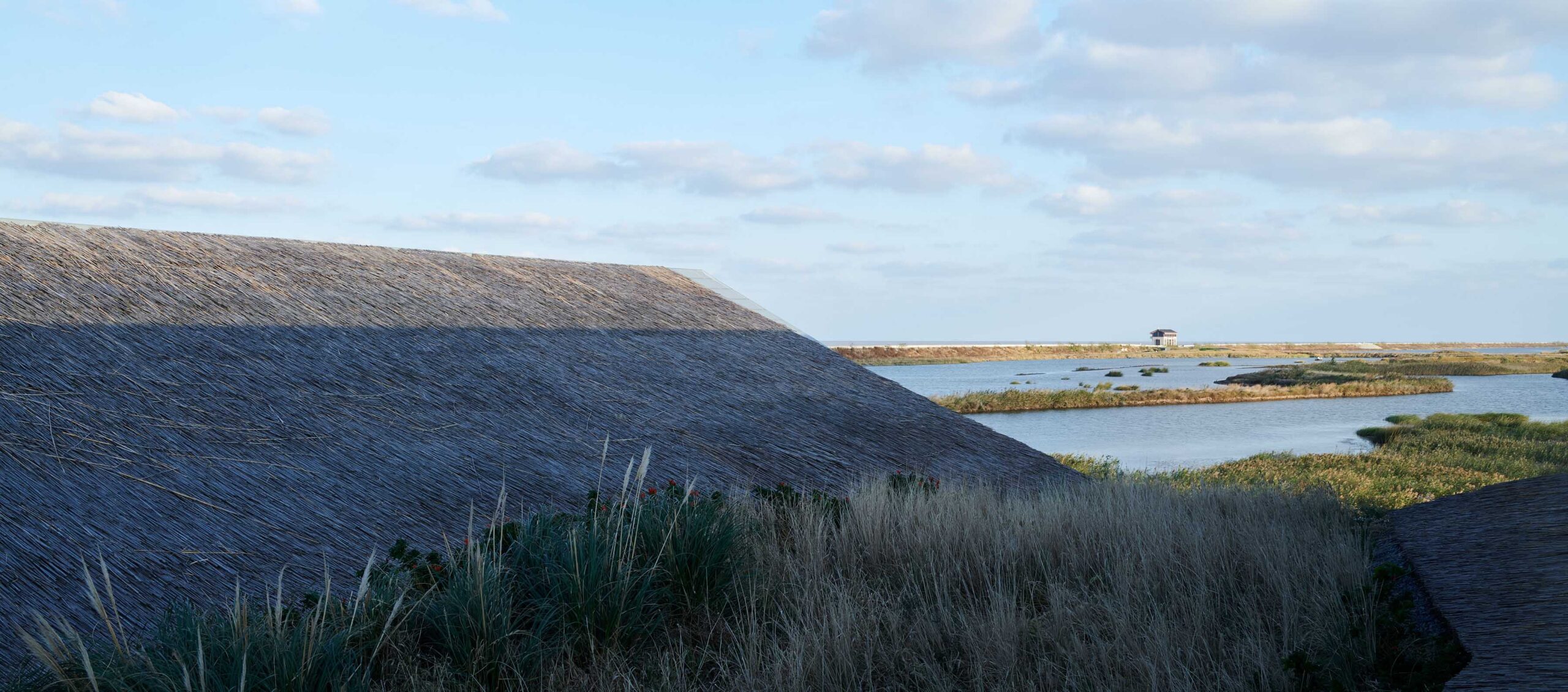
屋根の谷部分には、わずかに起伏のある土壌に手入れが容易なススキや低木を植えられている。
すべての傾斜屋根は、環境との調和と将来の持続可能なリサイクルを目的としてチタン亜鉛板で縁取られ、在来種の葦葺きで仕上げた。葦葺きは地元の熟練職人の監督のもとで施工され、環境との調和と持続可能な循環を実現している。
©︎ CHEN Hao
©︎ CHEN Hao
©︎ CHEN Hao
©︎ CHEN Hao
©︎ CHEN Hao
©︎ CHEN Hao
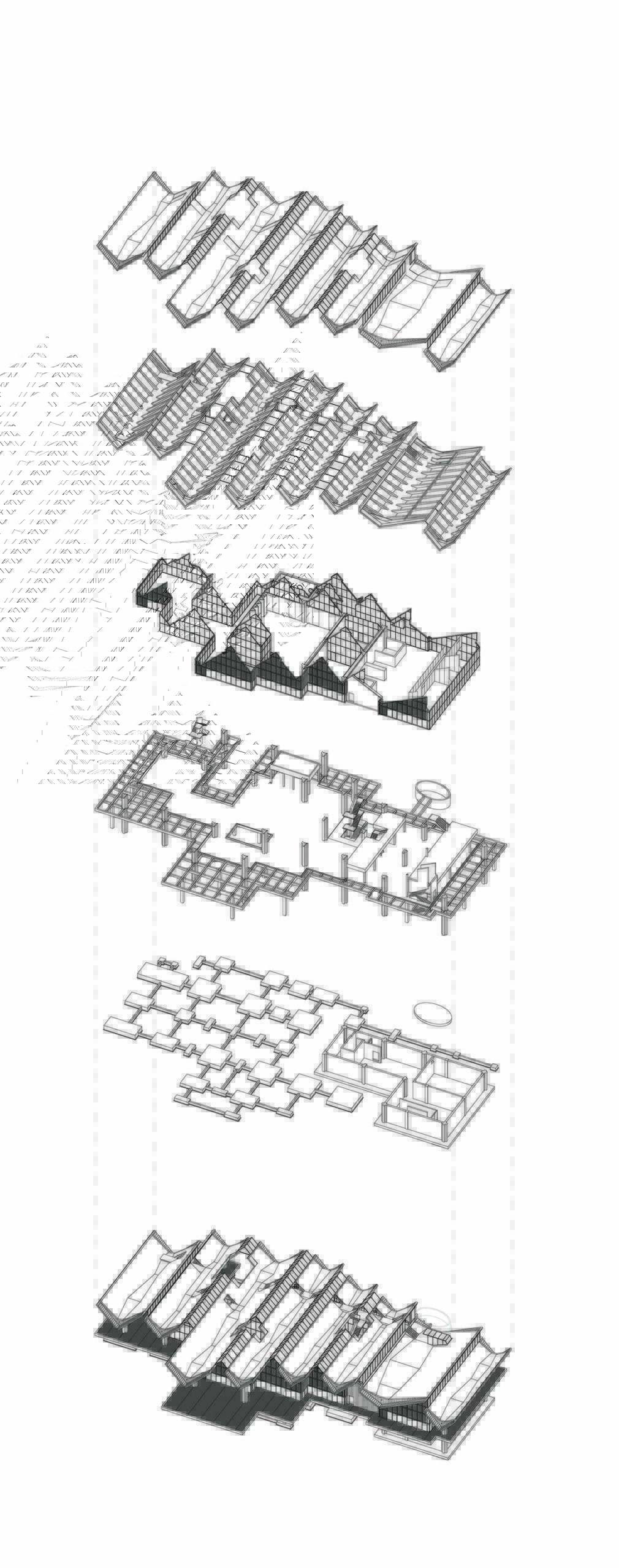
Axonometric analysis of structure ©︎ Atelier Z+
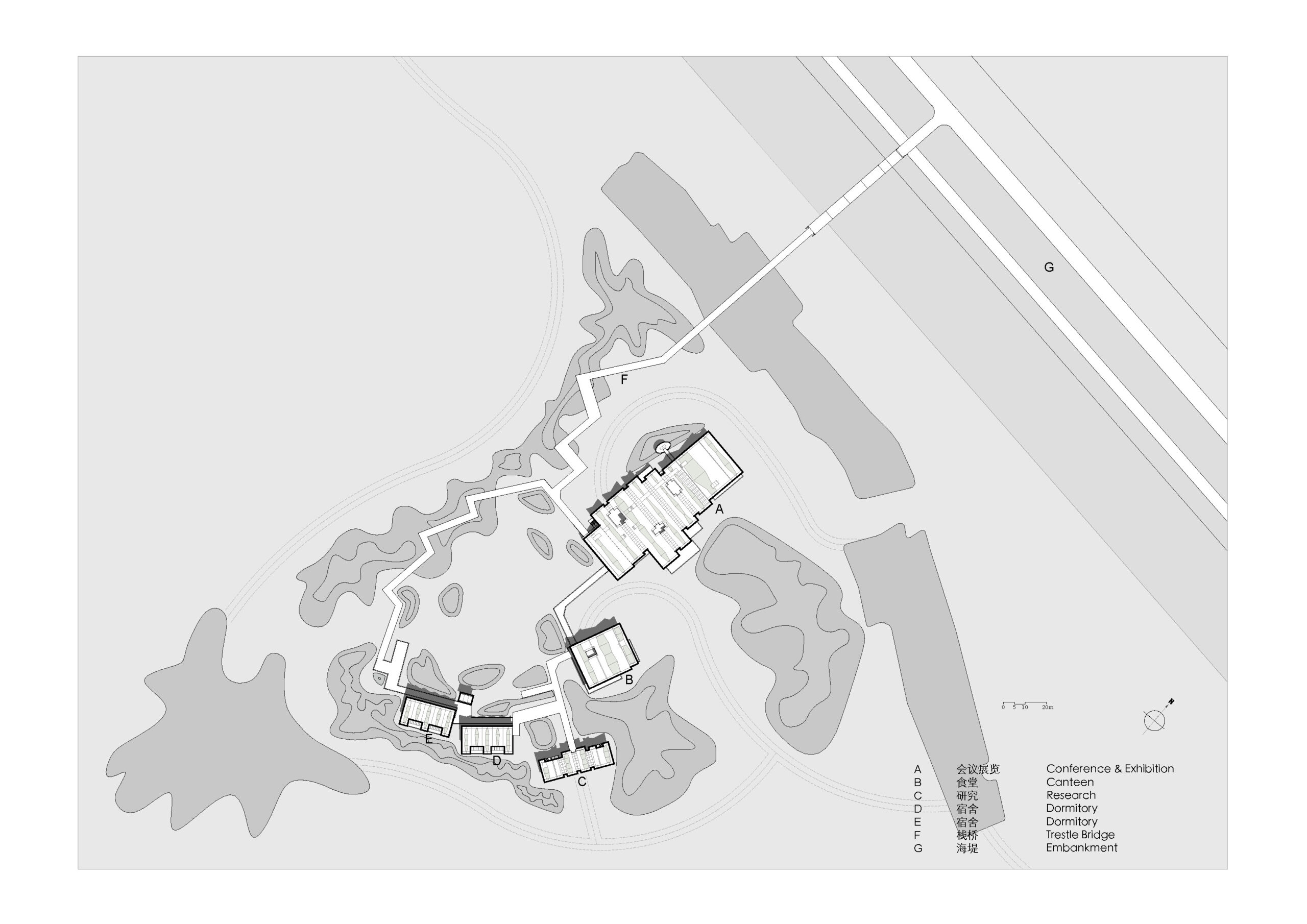
Site plan ©︎ Atelier Z+
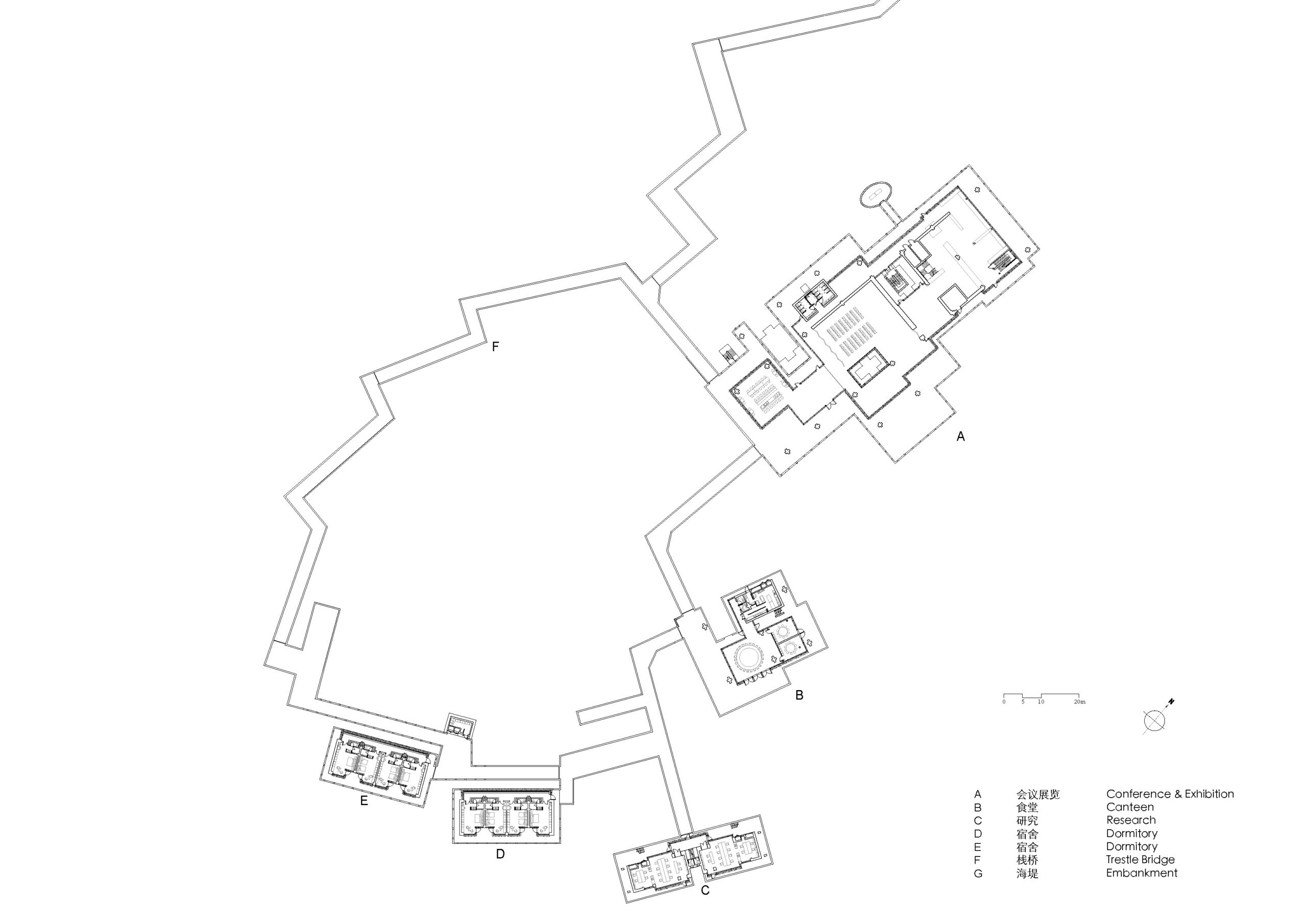
Ground plan ©︎ Atelier Z+
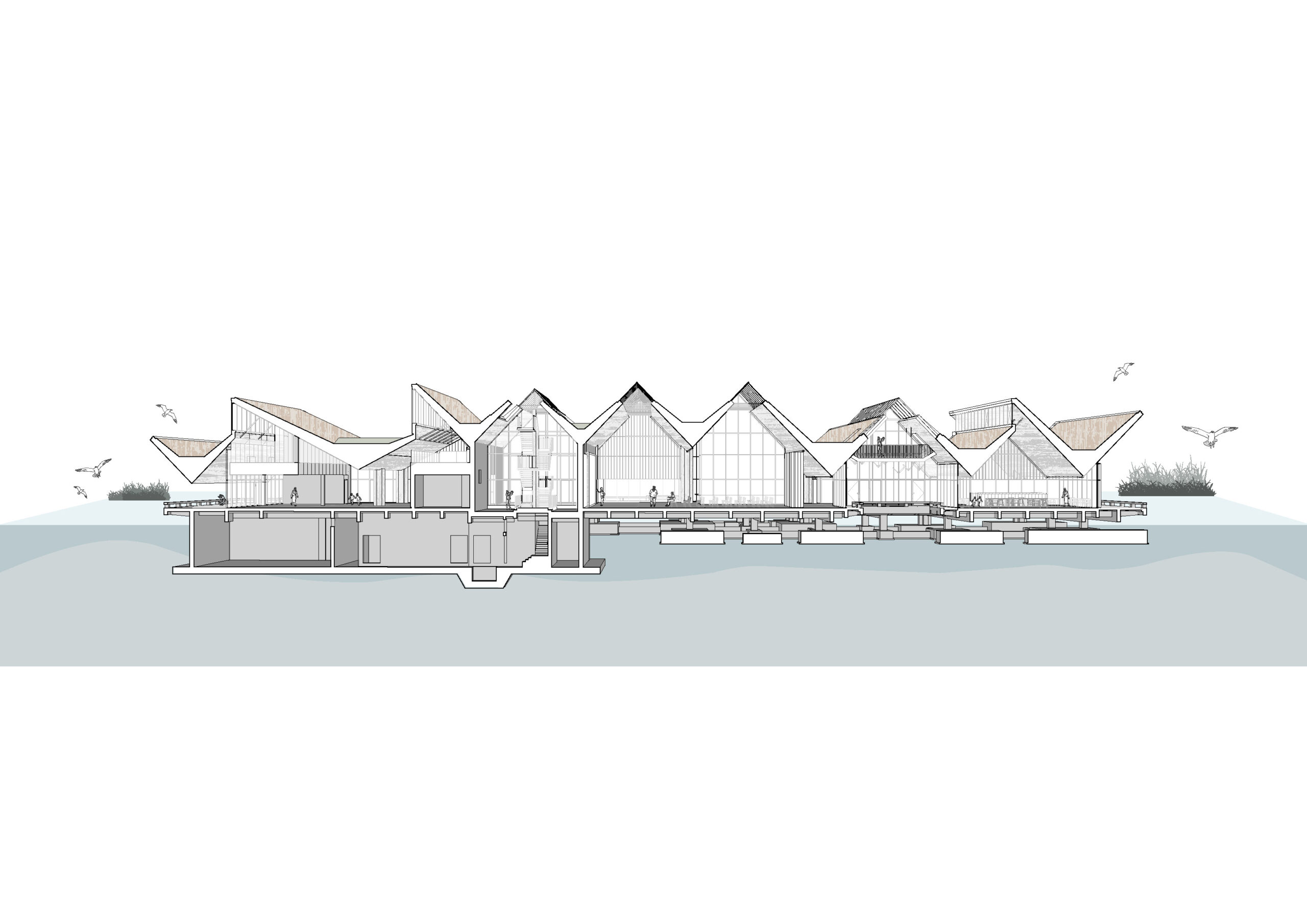
Building A -Perspective Section- ©︎ Atelier Z+
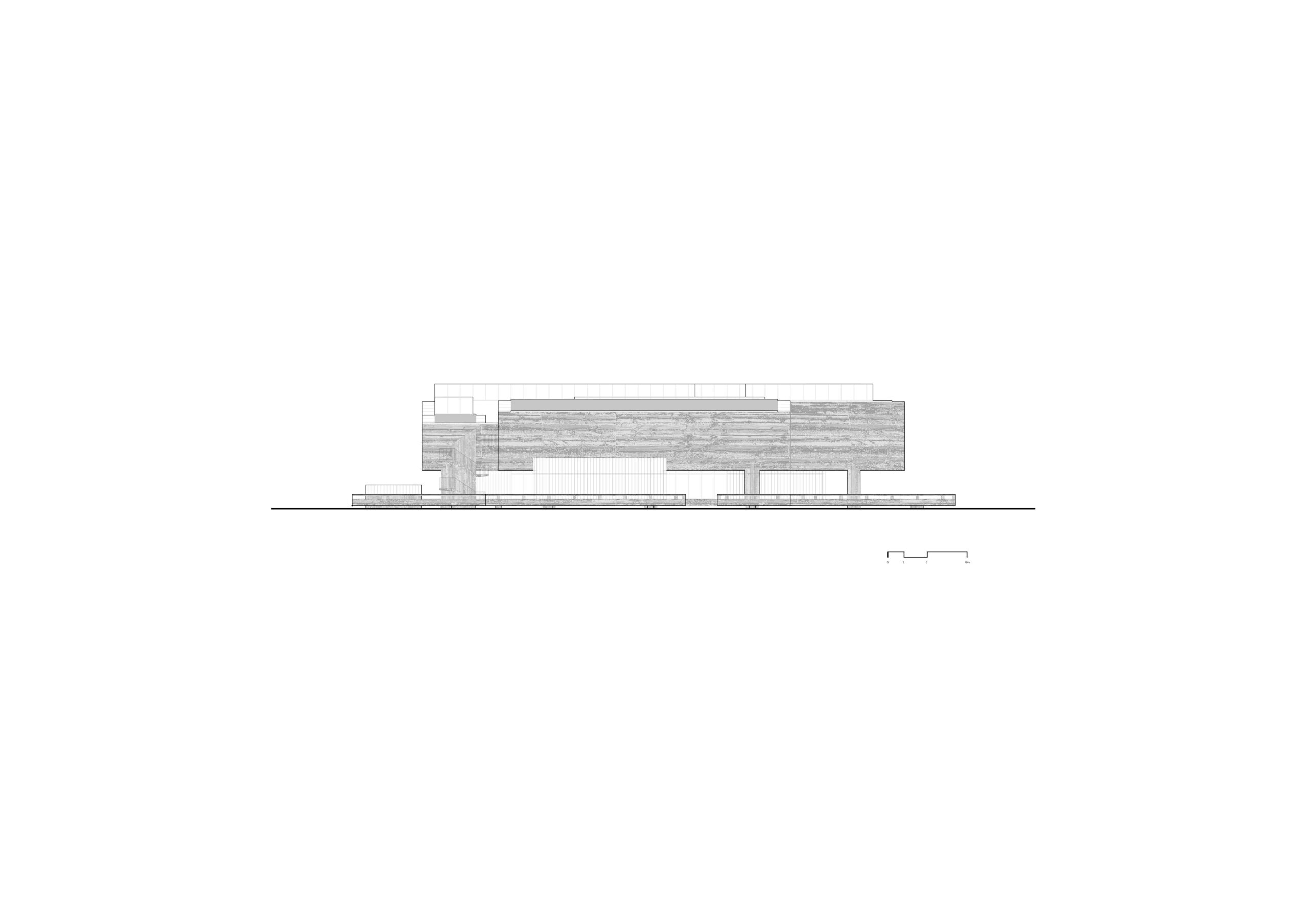
building A east elevation ©︎ Atelier Z+
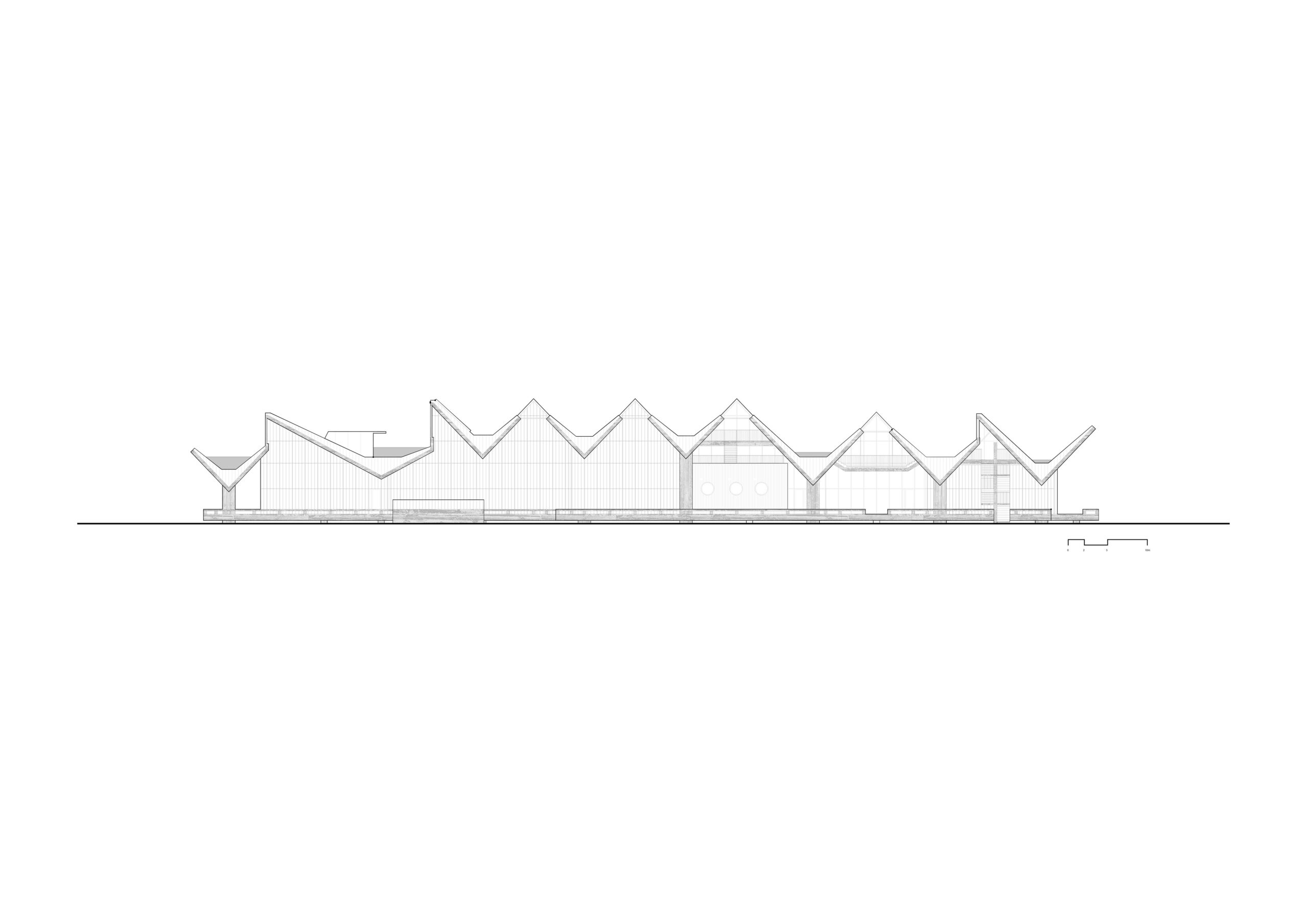
building A north elevation ©︎ Atelier Z+
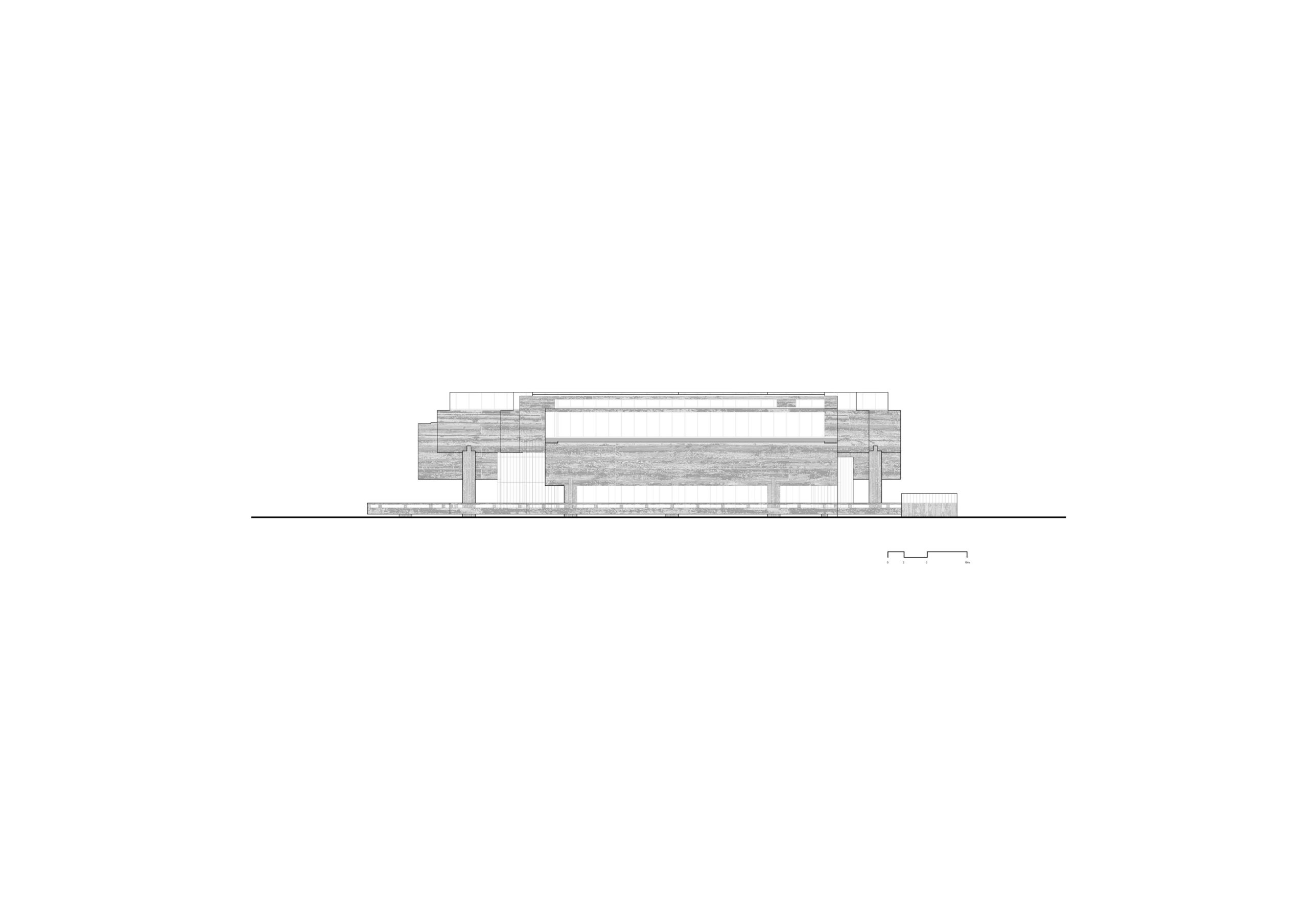
building A west elevation ©︎ Atelier Z+
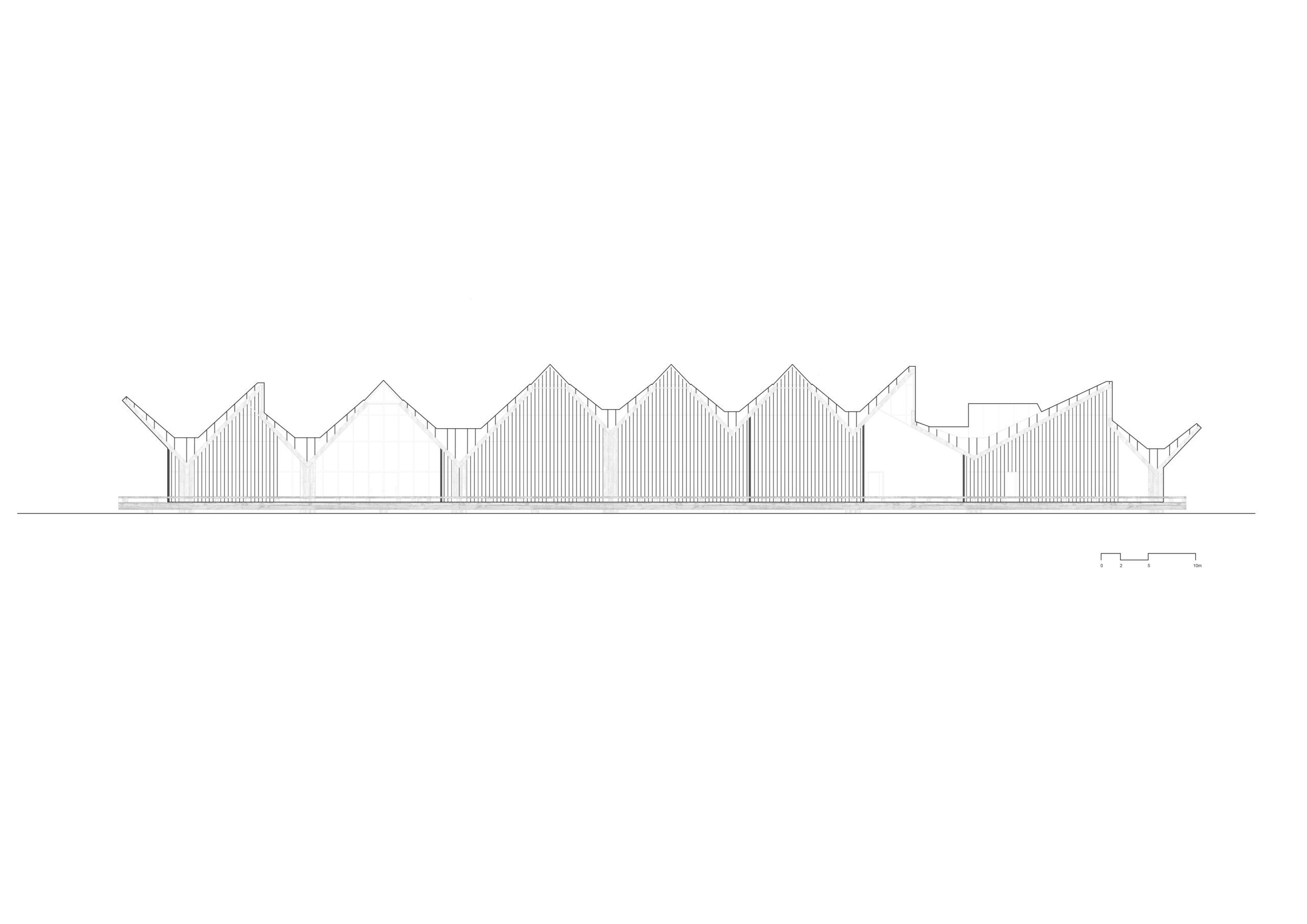
building A south elevation ©︎ Atelier Z+
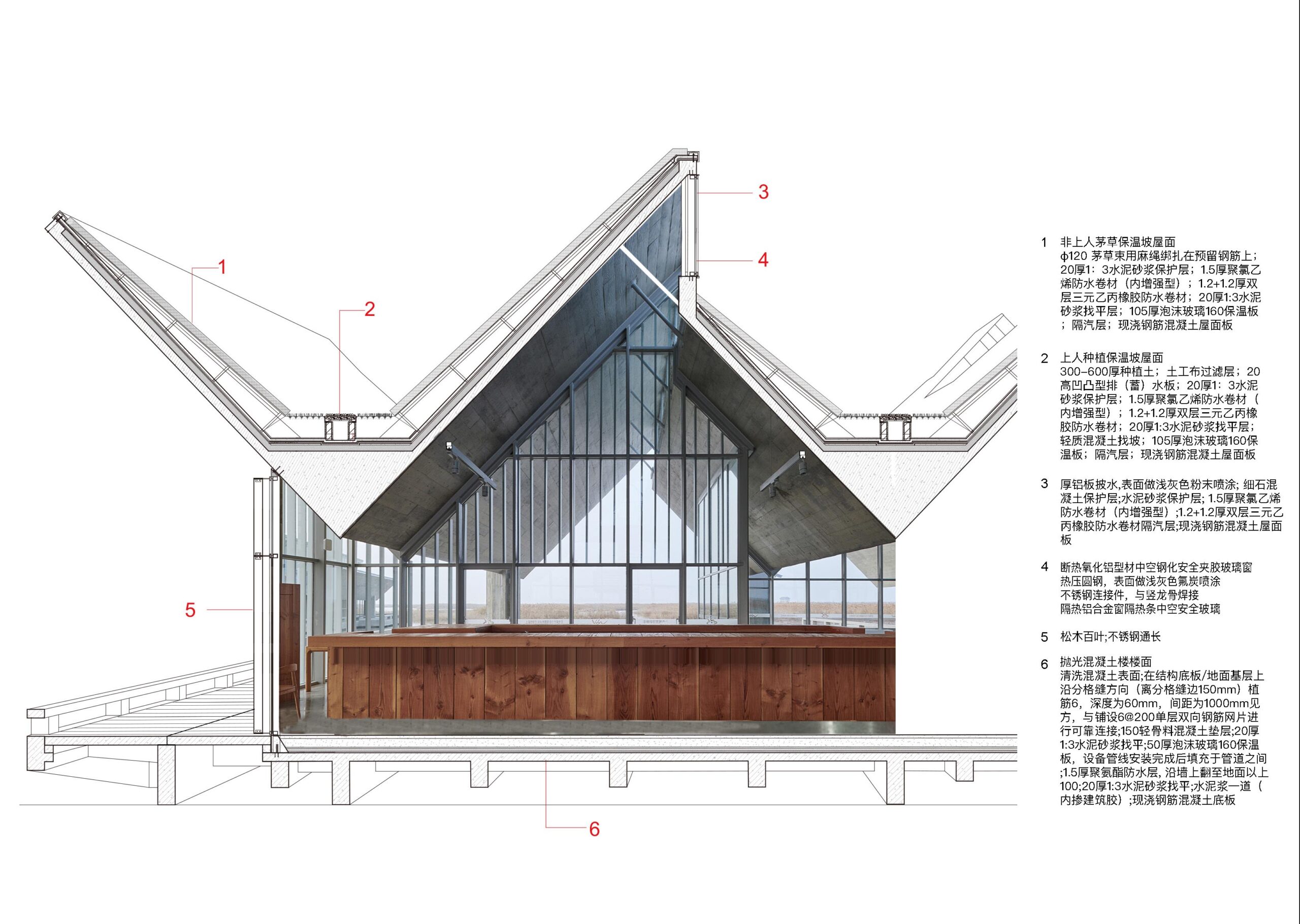
Conference Detail ©︎ Atelier Z+
以下、Atelier Z+のリリース(英文)です。
Wetland Research and Education Center, Dongtan, Chongming, Shanghai
Credits and Data
Project Name: Wetland Research and Education Center, Dongtan, Chongming, Shanghai
Architect: ZHOU Wei + ZHANG Bin / Atelier Z+
Partners in Charge: ZHOU Wei, ZHANG Bin
Project Architects: JIN Yanlin(Schematic Design, Developing Design, & Construction Design), XU Yue(Construction Coordination)
Project Team: WANG Jiaqi, HU Liyao, LIU Yi, ZHANG Yanan, SUN Jiaqiu, YANG Min, XUE Chujin
Structure Consultant: ZHANG Zhun(AND Office)
Design Cooperation: Shanghai Investigation, Design & Research Institute Co., Ltd. Location: Shanghai Chongming Dongtan National Nature Reserve
Client: Management Office of Shanghai Chongming Dongtan National Nature Reserve
General Contractor: Shanghai Hydraulic Engineering Group Co., Ltd.
Design Period: Jul.2013-Mar.2015
Construction Period: Mar.2015-Jun.2019
Building Area: 2,771 m2
Gross Floor Area: 4,092 m2
Structure: Concrete Bent Frame Structure with Cross Section Colume & Partial Folded Plate, Partial Steel Structure (Building A, B, C); Concrete Folded Plate Structure(Building D, E); 1 Story, Partial Mezzanine, Partial 1 Basement,
Principal Use: Conference, Exhibition, Research, Canteen, Dormitory
Primary Materials: Water Based Silane Coating Pine Molding Concrete, itanium-Zinc Sheeting, Reed Straw,Slab Glass, Pre-coated Aluminum Sheeting and Profile, Steel Profile, Pine Timber, Resistant Concrete Pavement,
Cost: About 51,440,000 Yuan RMB
Photography: CHEN HaoLocated at the easternmost point of Chongming Island, at the mouth of the Yangtze River, Dongtan Wetland is a sort of estuary tidal flat wetland. This wetland sits on the middle of “East Asia – Australia” route which is known as one of the eight migration routes for birds of the world. As a very important migration corridor for waterfowl in the Asian-Pacific region, Dongtan Wetland also becomes one of the most significant gathering places and habitats for wild birds. In the 1990s, an invasive plant spartina alterniflora was introduced to reinforce the tidal flat, which then result in the ecological deterioration of the wetland. To deal with the issue, Shanghai Chongming Dongtan National Nature Reserve started ecological control on spartina alterniflora and environment optimization of bird habitats in 2013. The whole project was completed in 2019. As a supporting facility of this project, the Research and Education Center was built as an important platform of scientific research monitoring, bird banding, law enforcement of management and protection, science education. Besides, it serve for raising both awareness and display of ecological and environmental protection as well as promoting worldwide cooperation and exchange.
The site is situated in a restored reed wetland in the northeast of the Nature Reserve, where the water and the sky merge in one colour, few people tread, flocks of birds perch. With modesty and respect, we suppose the building would be in harmony with the natural area. The inspiration is from secluded shacks scattering between the mountains and waters, which described by the ancient Chinese landscape painter Wang Meng in fourteenth century. With the intention of minimizing the impact on the local ecosystem whenever this place is under construction or in use, the architectural volume is divided and scattered, forming a group of settlements above the pile platform, floating on the water and hidden among the reeds. Five buildings of different volume including the conference and exhibition, the canteen, the research, and the dormitory are cross-connected by a zigzag trestle bridge. Through the conversion of prototype and the control of scale, the atmosphere of indoor and outdoor spaces could be in response to the environment specificity such as sky, wetland, reeds and flying birds. Enlightened by the “shack with double pitched roof” in Wang Meng’s painting, we turned the double pitched roof over, made a “Y-shape” cantilever structure, juxtaposed these two “Y-shape” independent units and created a new double Y shape space (YY). This creative idea has brought this prototype new spatial meaning. Firstly, the space covered by these two Y-shape structures is given a sense of shelter and created a fixed horizontal vision towards the vast wetland, while the openness of ridge is made extend towards sky. Secondly, the counter-slope space above the roof offers the feeling of living in a micro-valley, where visitors can enjoy the cropping and re-composition of broader horizontal vision. Moreover, compared with the veranda of lateral eaves gallery of the double pitched roof prototype, the veranda of the new structure has the space firstly pressing down and then lifting up, creating the feeling of opening to the environment.
With a series of juxtapositions and variations of Y-shape unit structure, we designed a series of continuous saw-tooth roofs and created covered spaces with scale difference where multi-functional programs are available. With the organization of circulation, distribution of courtyards, variation of transparency of enclosures, differentiation of structural span and height, and the combination of ridge skylights and clerestories, there is none clear boundary between different functional spaces, peoples are encouraged to use them in a flexible way. Besides, this special linear pattern of space organization has brought unique indoor experience between in-position view and in-motion view. When staying in a certain space unit, peoples are able to enjoy a body-enveloping experience under the roof with the view parallel to the structural unit, and the external natural scenery in front of the eye; while walking through different space units, with the rhythm of variation in height and light, they will feel as walking in a garden-courtyard house. This unique experience is strongly intensified on the roof of conference & exhibition building: In response to the site features, we have evocated a flashback interpretation through alternating and combining the distant eye-level view of wetland from the “valley” on the roof and the close overlooking view of indoor scene from the skywalk under the roof. The scattered building volumes are fragmented by the overhanging saw-tooth roofs with deep eave which successfully eliminate the scale difference between buildings, and also are blurred by overlapped deep shadows and reflection above the water.
Considering that weather-proof and maintenance of this facility are quit challenging work in high humidity and salinity conditions, the light steel or wooden structure was abandoned in our design. Instead, reinforced concrete is selected to build with the simplicity of tectonics. Building A, B, C were built by Y-shaped cantilevered reinforced concrete bent frame structure with crisscross section and partial folded-plate. Among these buildings, the cantilever of building A was so large that the whole structure had to be constructed by steel reinforced concrete and the exhibition hall was partly designed with steel mezzanine; building D and E were constructed with concrete folded-plate structure. In order to expose the crudeness from the concrete structure in wetland, long pine timber formworks were used in the as-cast-finish concrete construction to obtain natural wood texture. The non-structural enclosure and partition walls were also coated with refurbished recycled timber formworks to unify the material expression. Since sheltered from long overhang eaves, bird-friendly floor-to-ceiling windows with vertical grilles which provide the visitors maximum of field view are used for most external envelop. The trestle bridge and the water platform were paved with precast concrete battens with crack left between each other, which not only enhanced the feeling of walking over water but also made room for reed growth. Moreover, all the “valleys” bottom on the roof were covered with slightly undulating soil and low-maintenance planted miscanthus and shurbs. For the purpose of environment integration and sustainable recycling in the future, all the pitched roofs which trimmed with titanium-zinc sheet were covered with indigenous reed straw reaped and processed under the supervision of local experienced reed weavers.
Atelier Z+ 公式サイト
http://www.atelierzplus.com/
【購読無料】空間デザインの今がわかるメールマガジン TECTURE NEWS LETTER
RECOMMENDED ARTICLE



