上海の湖畔に現れた「波」の建築 - 3層のコンクリートシェルが水のうねりと建築を融合する〈Wave Cube〉
© SU Shengliang
© SU Shengliang
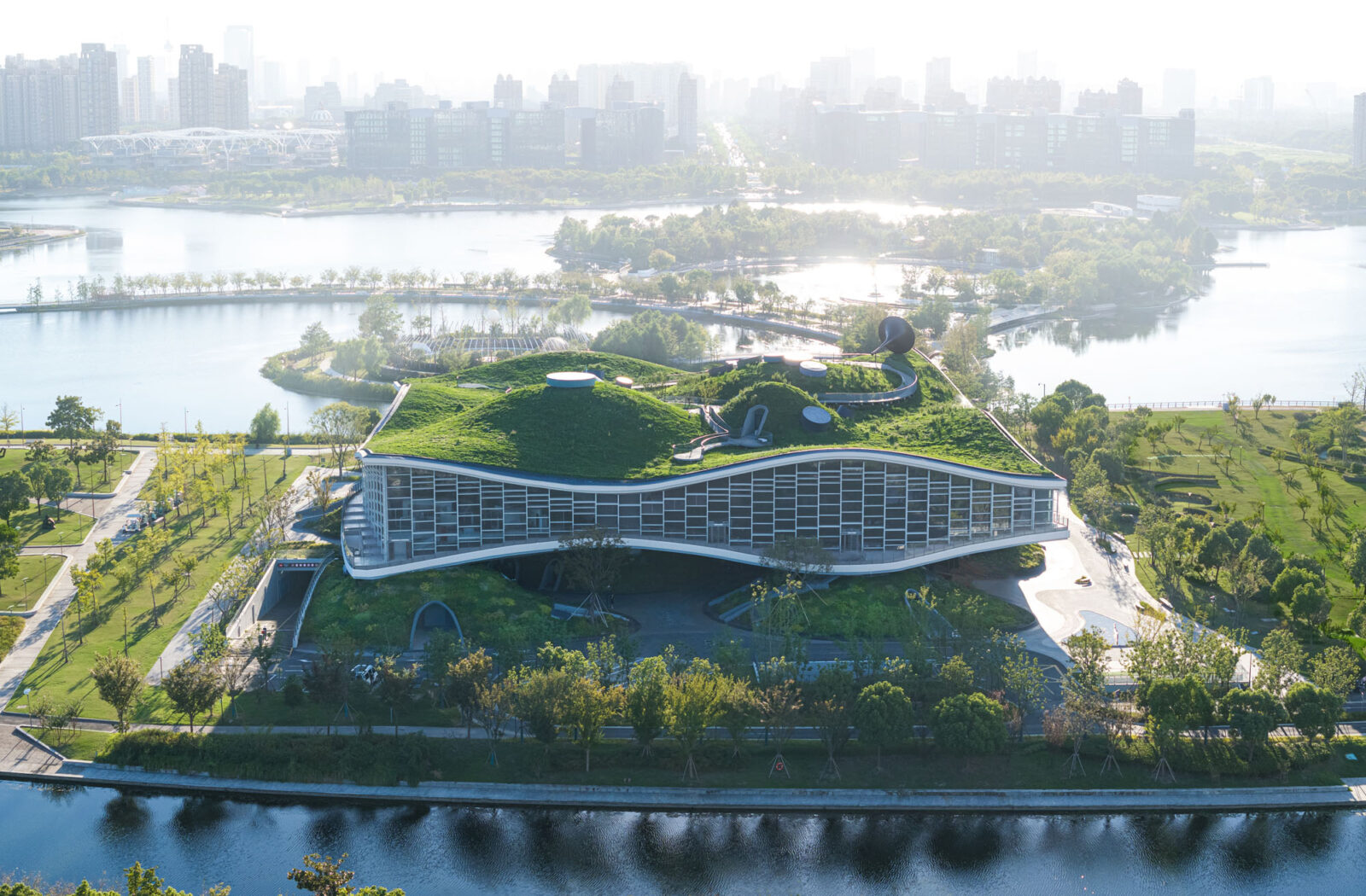
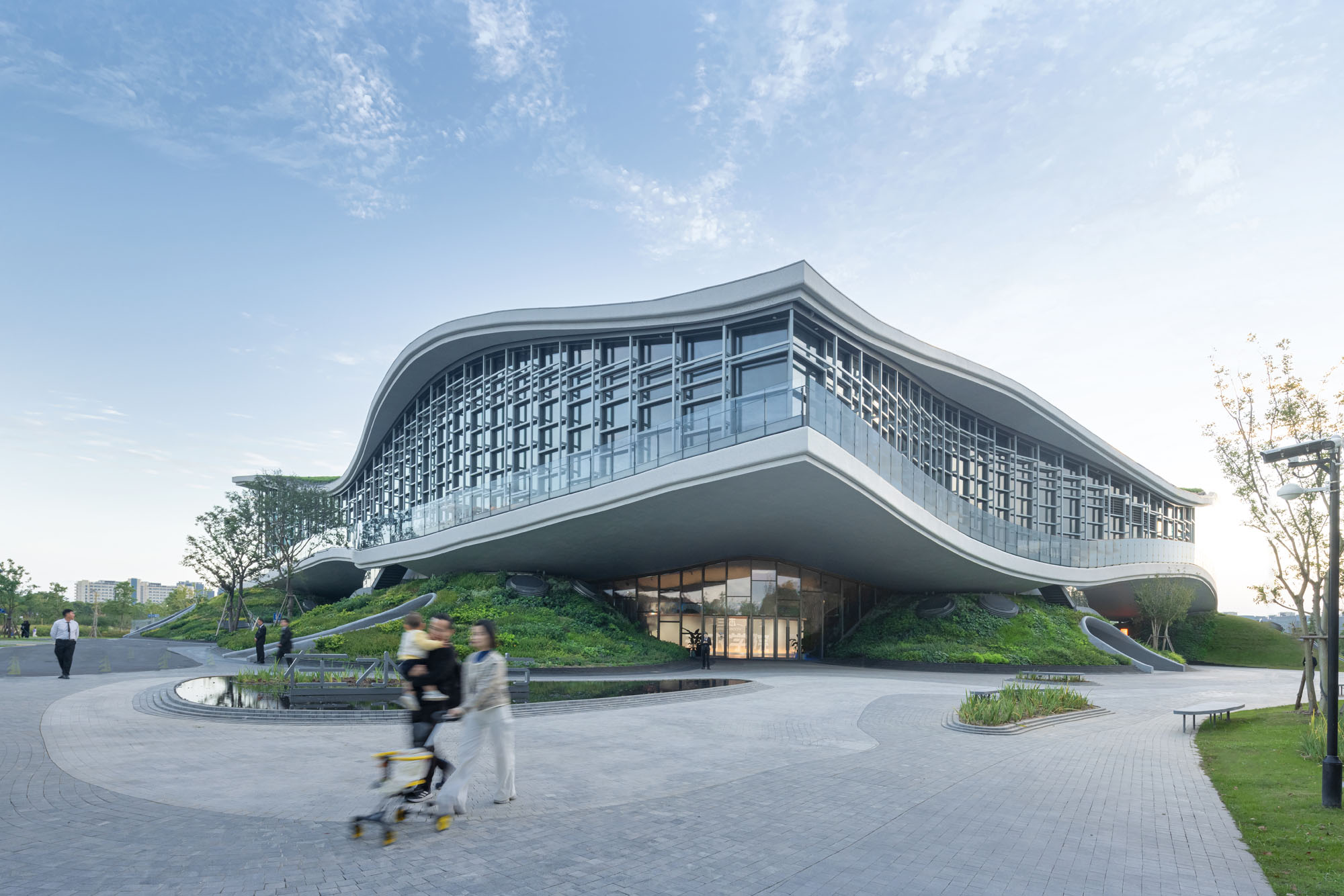
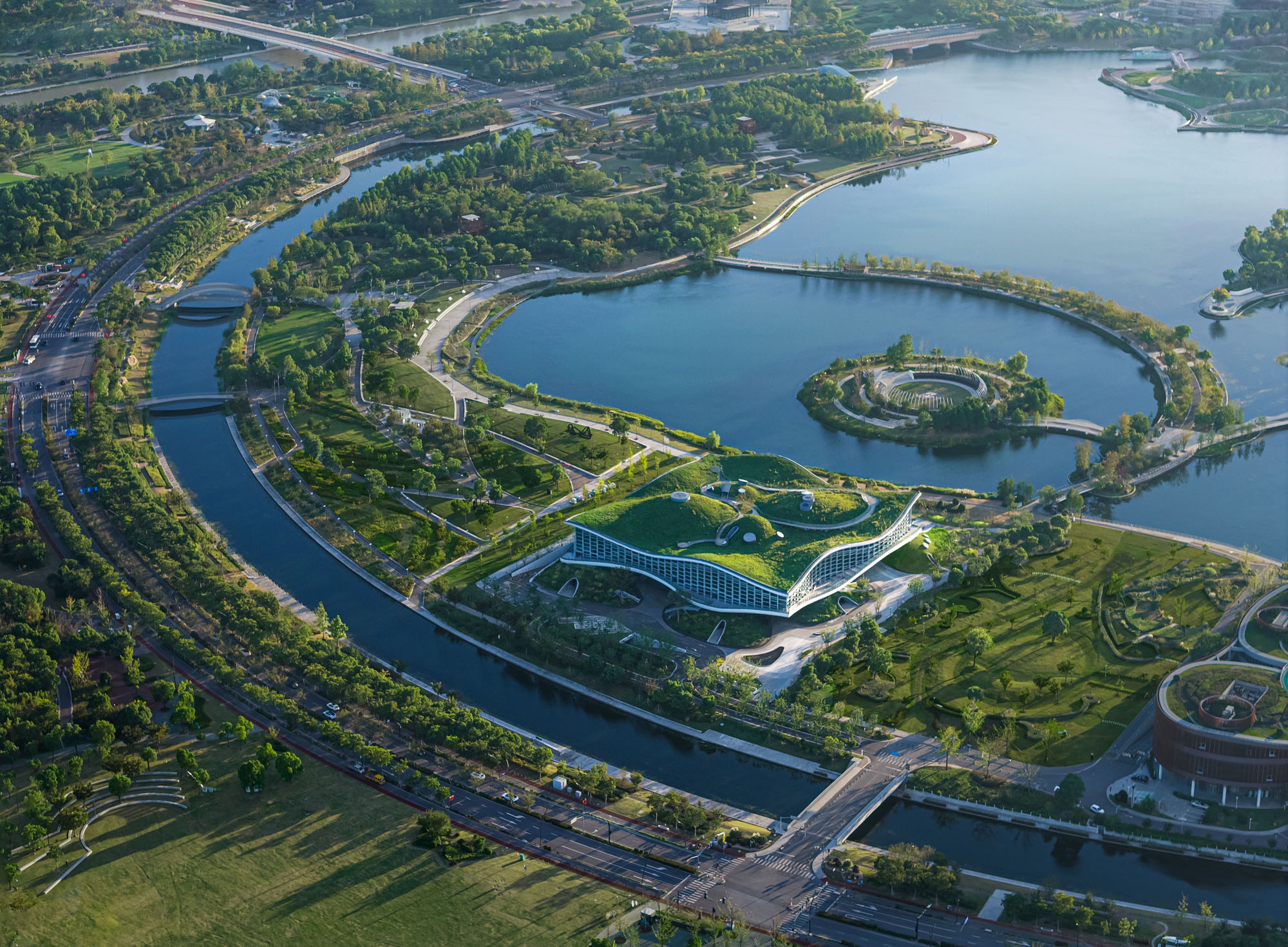
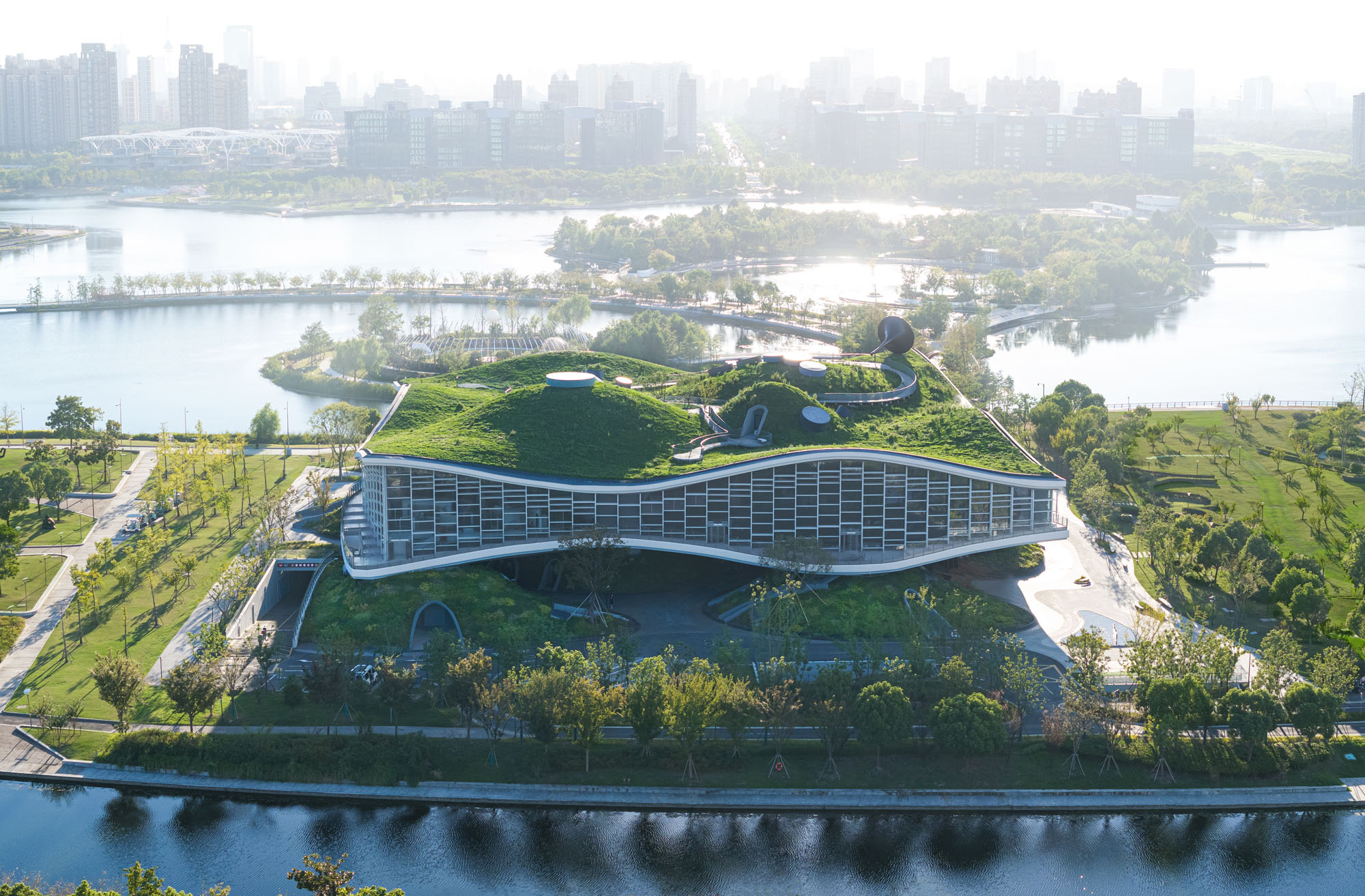
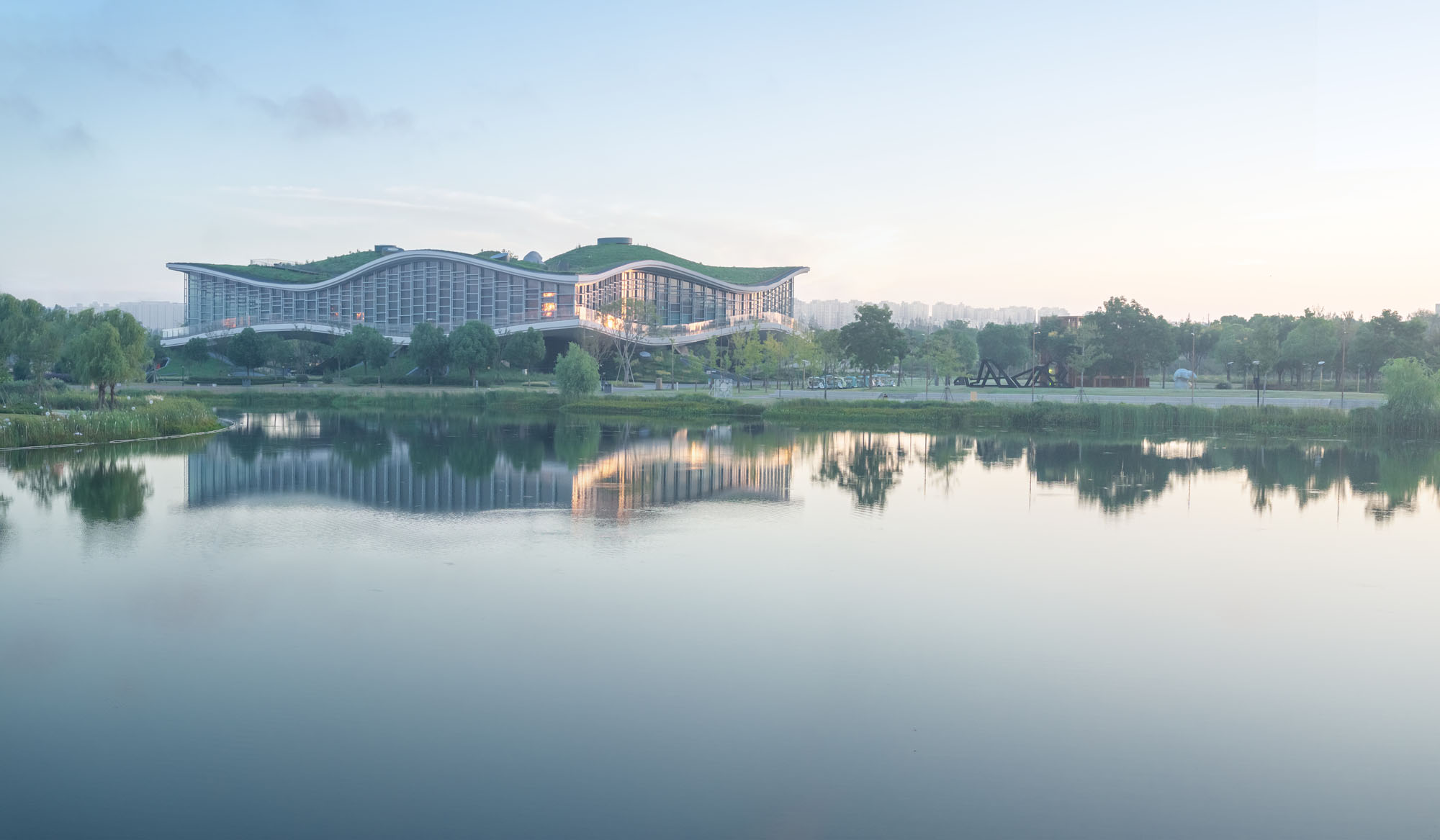
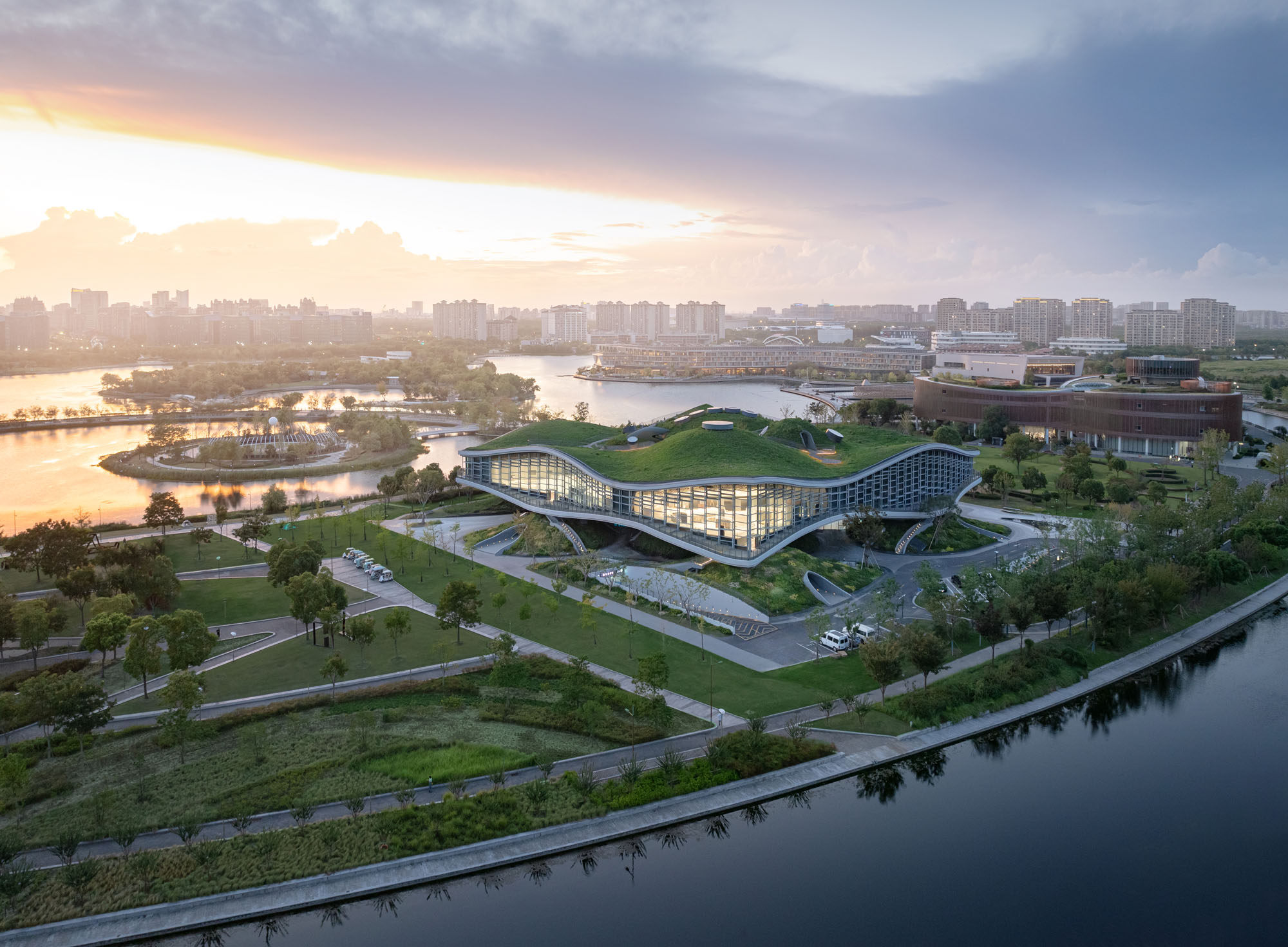
中国・上海市奉賢区の金海湖の畔に誕生した〈Wave Cube〉は、上海を拠点とする建築事務所 Scenic Architecture Office(SAO)が設計を手がけた多機能文化ランドマークです。
SF(サイエンス・フィクション)をテーマとした建築であり、自然界の動的な「波」のうねりを抽出・抽象化し、3次元の静的な建築空間へと変換した、大スケールの複合シェル構造で構築されています。
注目ポイント
- 湖のほとりに現れた「波」の建築
- 下部「グリーンヒルズ」、中央「ヴォールトド・ヴォイド」、上部「ウェーブパビリオン」の3層構造
- 3層の波状シェルによる壮大な流動空間
- 形態と構造を融合した複合システムとBIM統合
(以下、SAOから提供されたプレスキットのテキストの抄訳)
©︎ Schran Images
波の形態と建築の融合〈Wave Cube〉
「波」という字は古代中国の詩に頻繁に登場する。その語源には幾つかの解釈がある。音韻的に(古代音の「水」と「皮」)、象徴的に(水と斜面)、あるいは連想的に(王安石が述べた「水の皮」として)などである。
しかし波が体現する水のうねりと、自然界におけるその非凡な動的伝播は、古来より文人たちに愛でられてきた。彼らは文学言語という媒体を通じて、波のより普遍的な含意、広大な空間的スケール、そして伝播という観点における次第に抽象化される意義を絶えず表現し続けてきたのである。
© SU Shengliang
© SU Shengliang
波の想像力:古代文学から現代物理学まで
張若韜の代表作『春夜河上月』において、「彼女は波のうねりに従い万里を旅する/川が流れるところ、そこには彼女の光があふれる」という句は、波を遍在する媒体として描き、月の幽玄な輝きを海河の果てしない広がりへと伝導している。同様に、王官の『占いの歌』における「さざ波の流れる川は輝く瞳、山々のように高くそびえる眉」という対句は、水と峰が単一のうねりを共有する瞬間を確立し、風景を人間の感情の伝達路としての視線に結びつけるものである。
現代物理学の分野において、波は連続媒体内における最も重要な運動形態の一つである。空気中の音波、水面の波紋、地震波、光波、電波、重力波、細胞振動波などは、いずれも連続媒体の波動的挙動を示す。波を記述する基本物理量は振幅、位相、周波数である。
© SU Shengliang
© SU Shengliang
建築における「波」の探求:動的システムから静的空間へ
文学であれ科学であれ、波は遍在しつつも神秘的である。地球の日常環境において、目に見える連続媒体が生み出す観測可能な波は水波などごくわずかであり、人間スケールでの体験はさらに稀である。サーファーは海洋波の内部に進入できる数少ない存在と言えるだろう。
人工構造物としての建築は、平坦な面内に人間の活動や休息のニーズを満たす固定空間を創出する、静的システムによって形成される。したがって、波のような動的システムとの直接的な比較は困難である。スケートボードプールのような固定された場所のみが、動的なうねりを体験できる例外である。
© SU Shengliang
© SU Shengliang
SAOの近年の作品では、「中庭集落」「住居の拡張」「自由細胞」という3つの方向性に一貫して焦点を当てている。このうち「自由細胞」は、技術と空間体験の統合を通じて新たな建築形態を探求するものである。
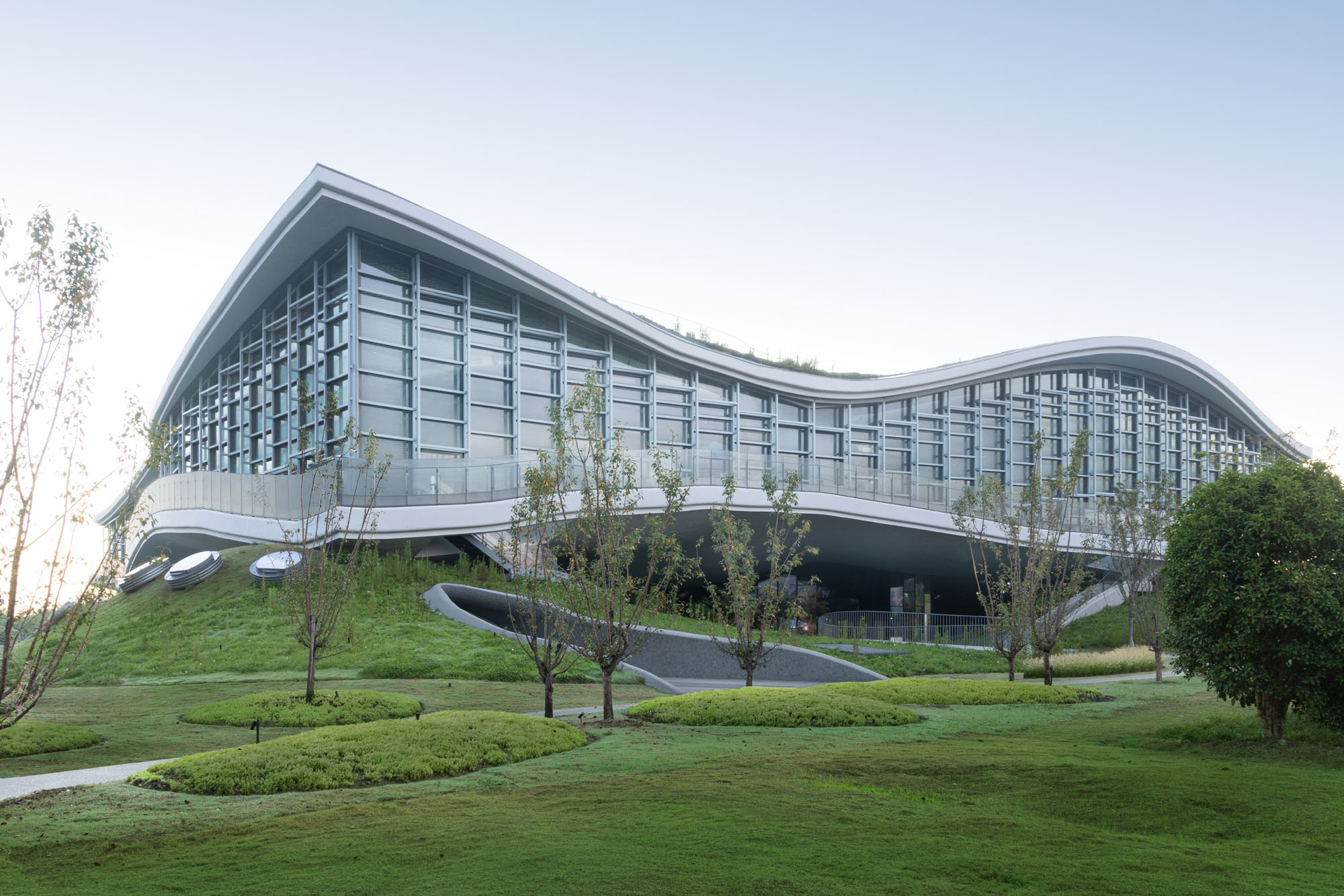
山水の連続的なうねり、建築屋根の伝統的な集積、細胞の複製、情報の伝達、これらすべてが波動と形態的連関をもつ。我々は波動の形態が建築の未来にさらなる示唆を与え得るか、継続的に考察してきた。金海湖の〈Wave Cube〉プロジェクトは、その探求のための稀有な機会を提供したのである。
© SU Shengliang
© SU Shengliang
折り畳まれたうねり:〈Wave Cube〉の形態生成
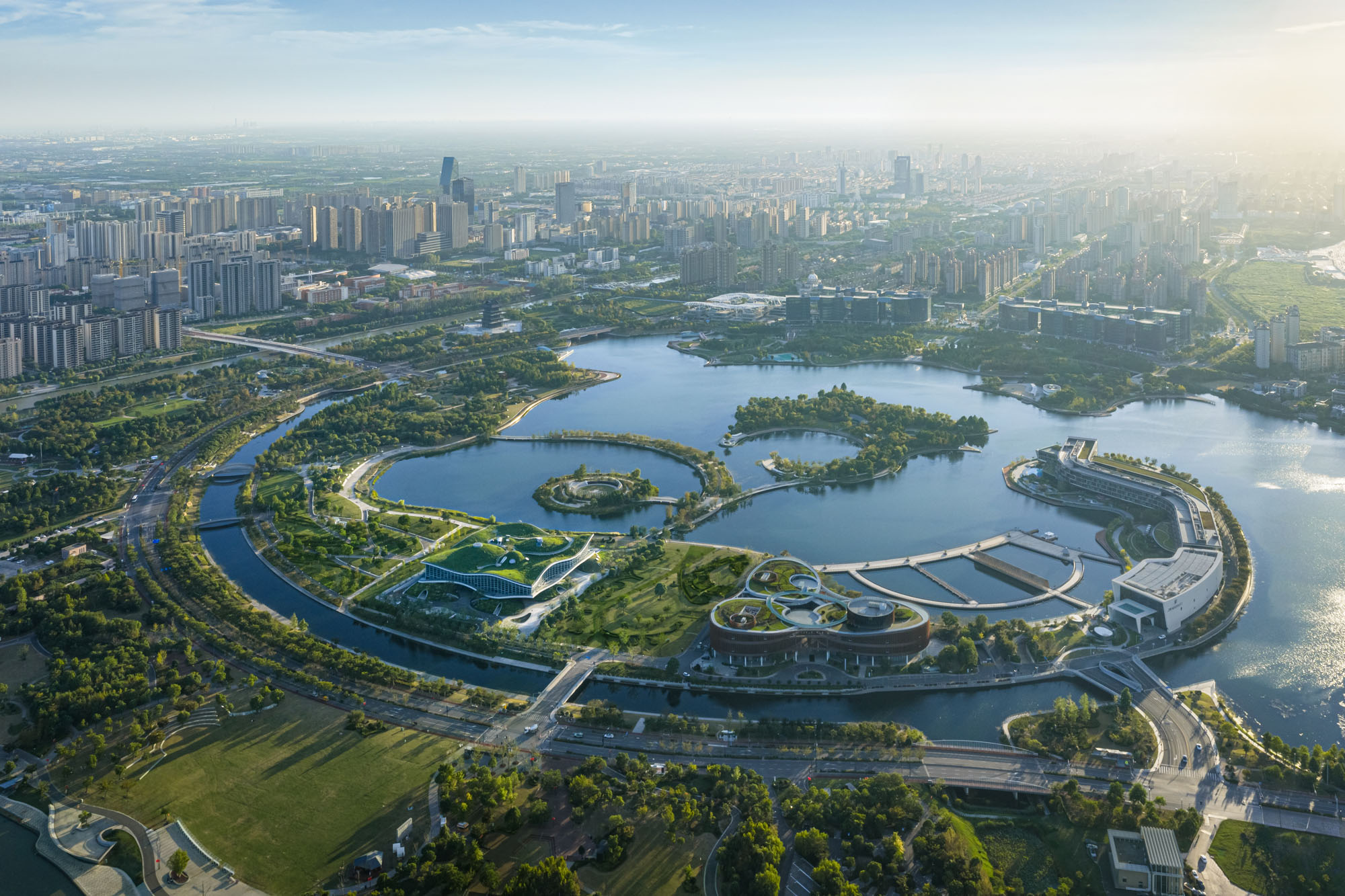
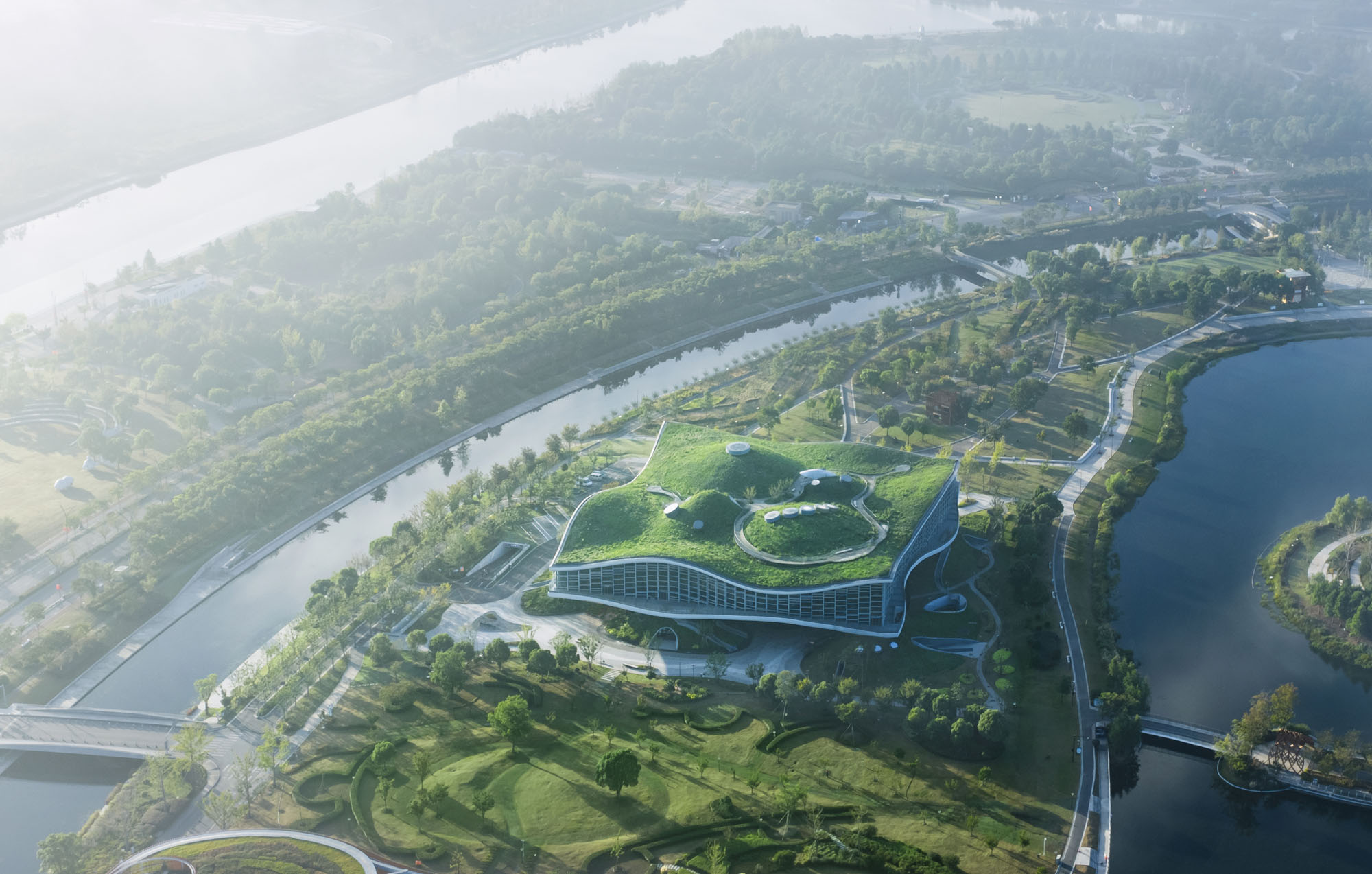
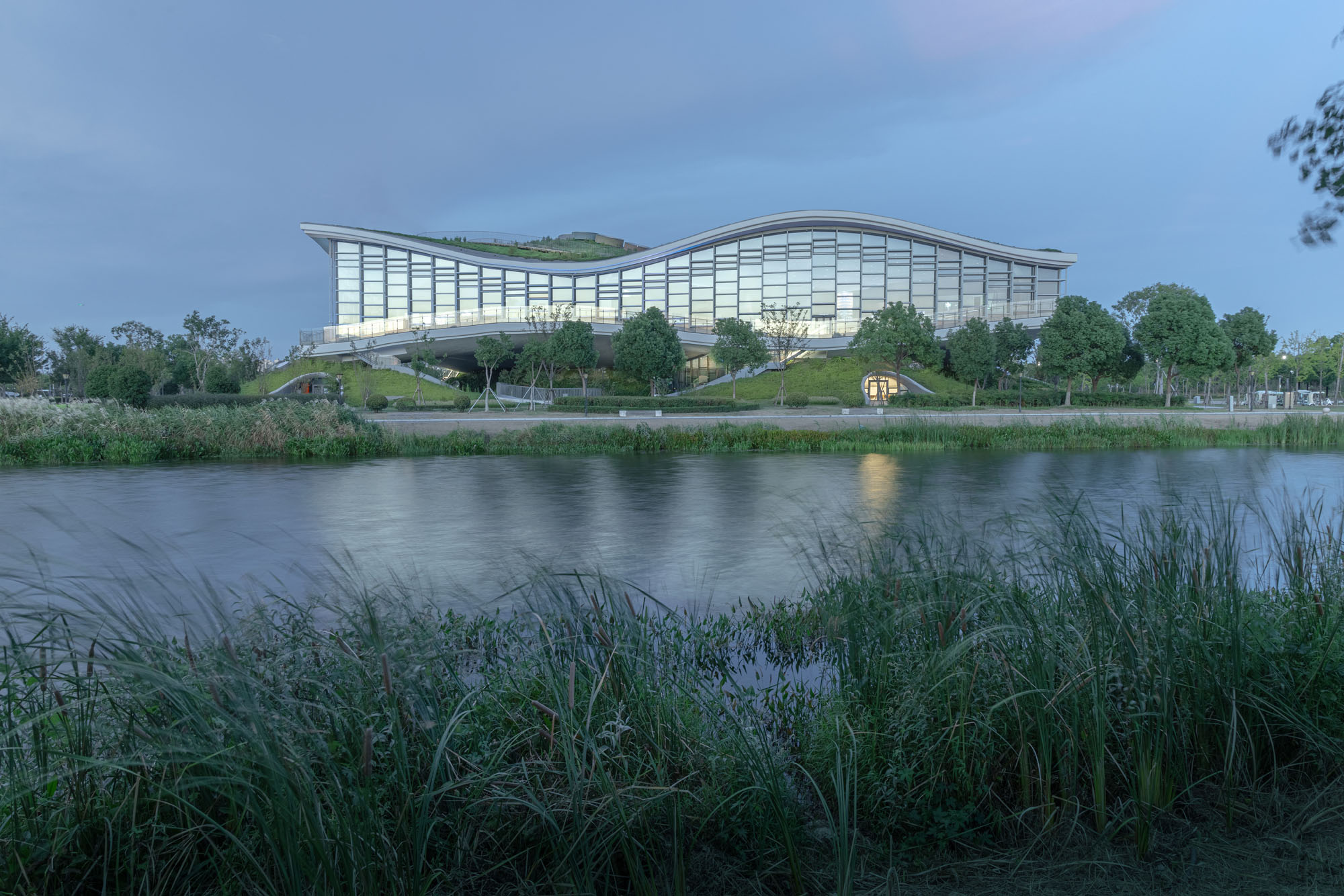
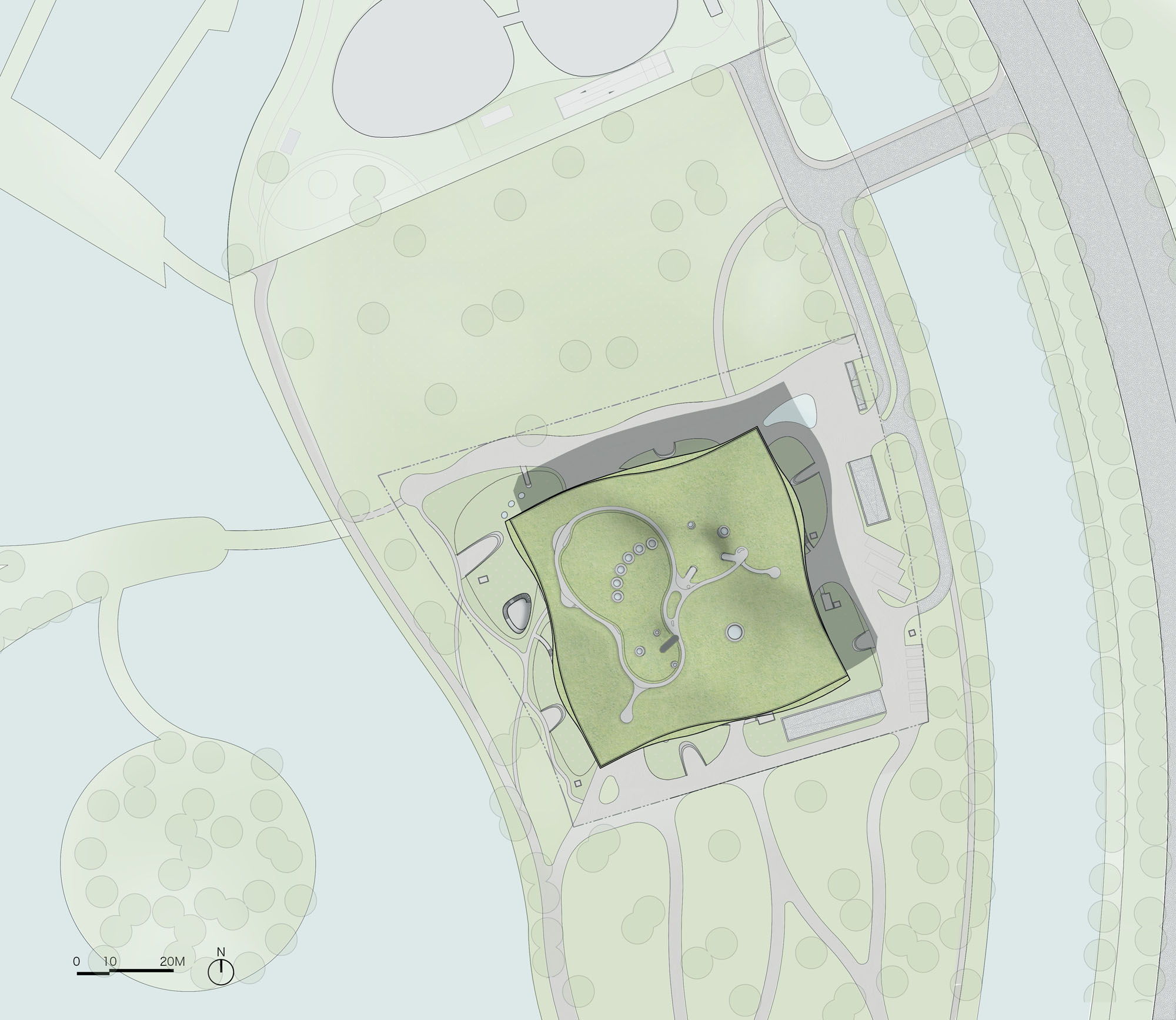
上海五新都市計画において、奉賢区にある金海湖は新都市の中核的な景観をになっている。本プロジェクト〈Wave Cube〉の敷地はほぼ正方形を呈し、湖の東側に位置する円形半島上にあり、東西両側を水に囲まれている。
この多機能文化ランドマークは「SF」をテーマとしている。設計の方向性は、敷地の立地と機能的ポジショニングに由来する。建物は景観統合の観点から周囲の湖畔緑地帯と調和するだけでなく、内部体験と外観の両面で独自の個性を確立することを目指している。
© SU Shengliang
© LIU Guowei
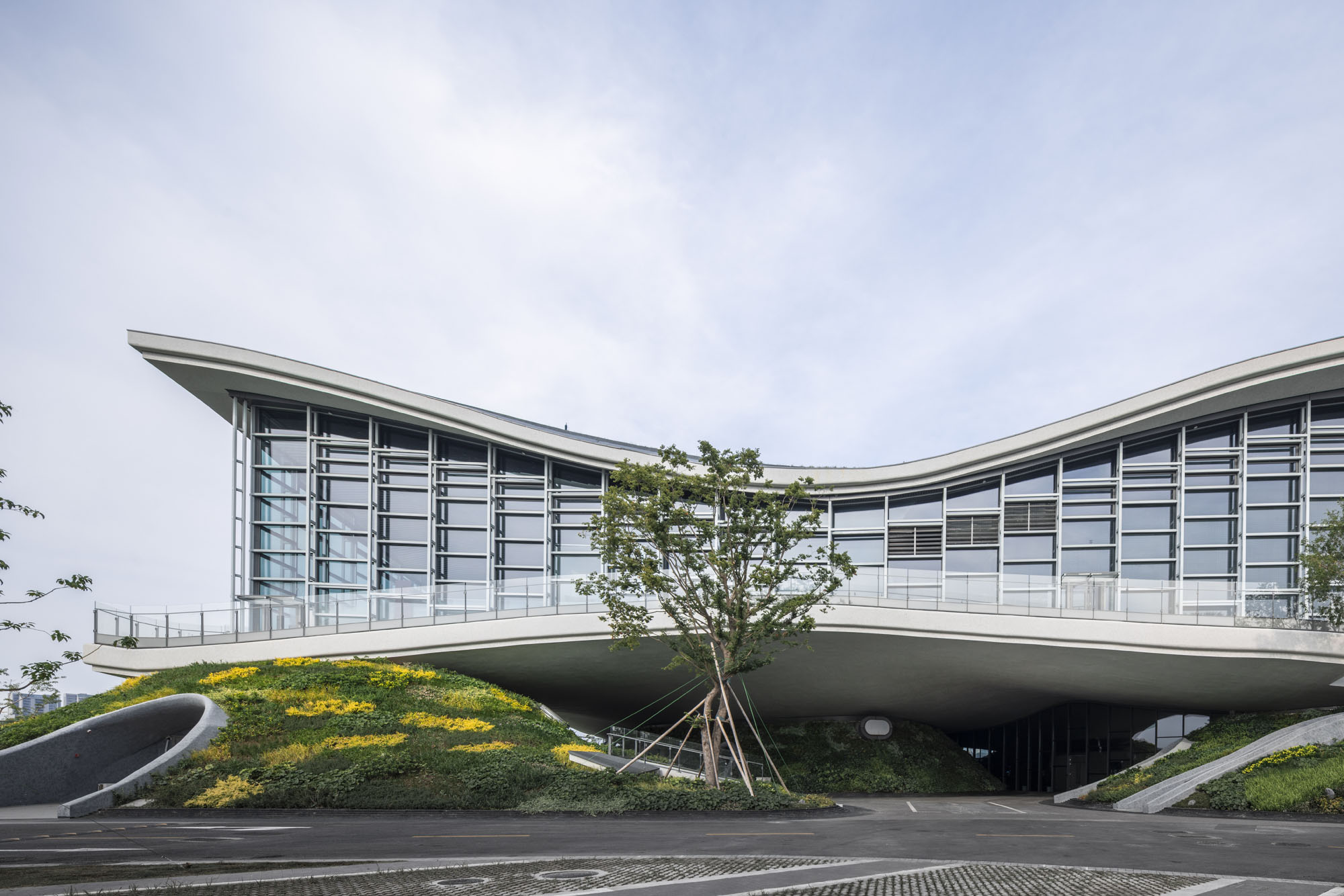
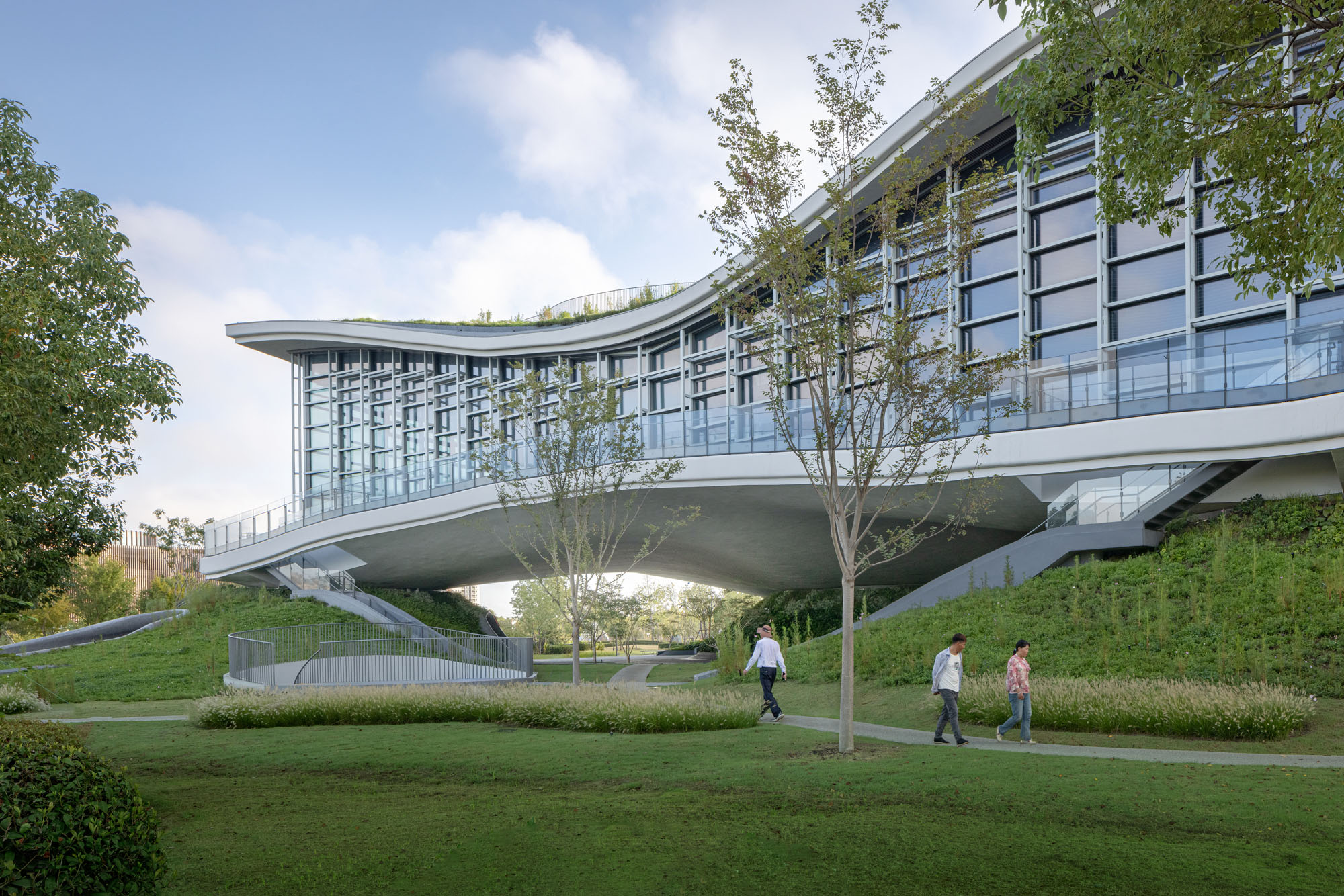
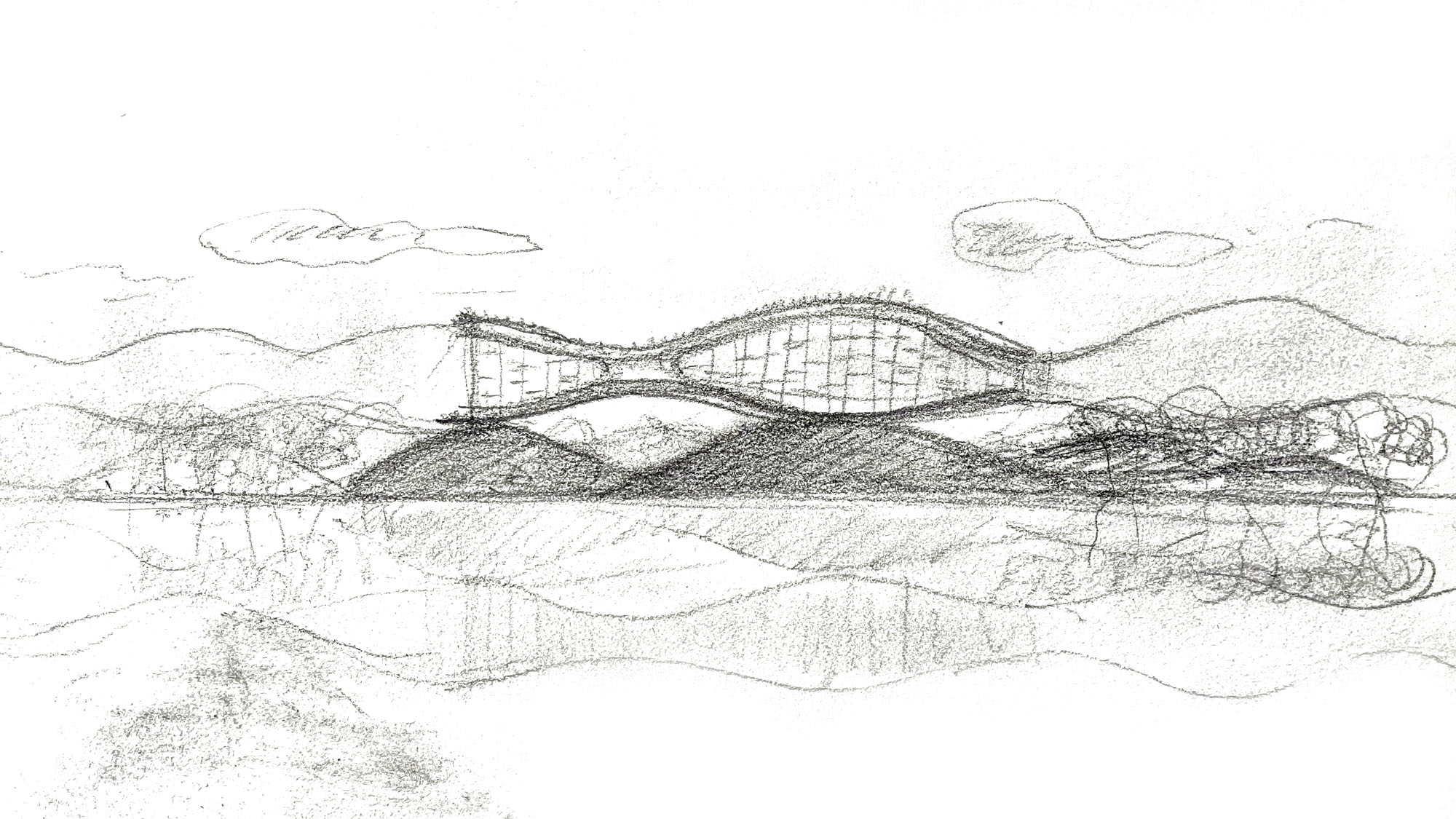
上海は水豊かで山が少ないという特徴をもち、特に奉賢区は広大で平坦な肥沃な土地が広がっている。この地形を起点に、自然でありながら力強いデザイン方向性が生まれ、人工丘のコンセプトが早い段階で設計の核心となった。
この基盤をもとに、外部イメージとして機能するだけでなく、内部空間に独特の体験をもたらすうねりの形態を追求し、SFテーマの斬新な解釈の可能性を広げたのである。
© SU Shengliang
© LIU Guowei
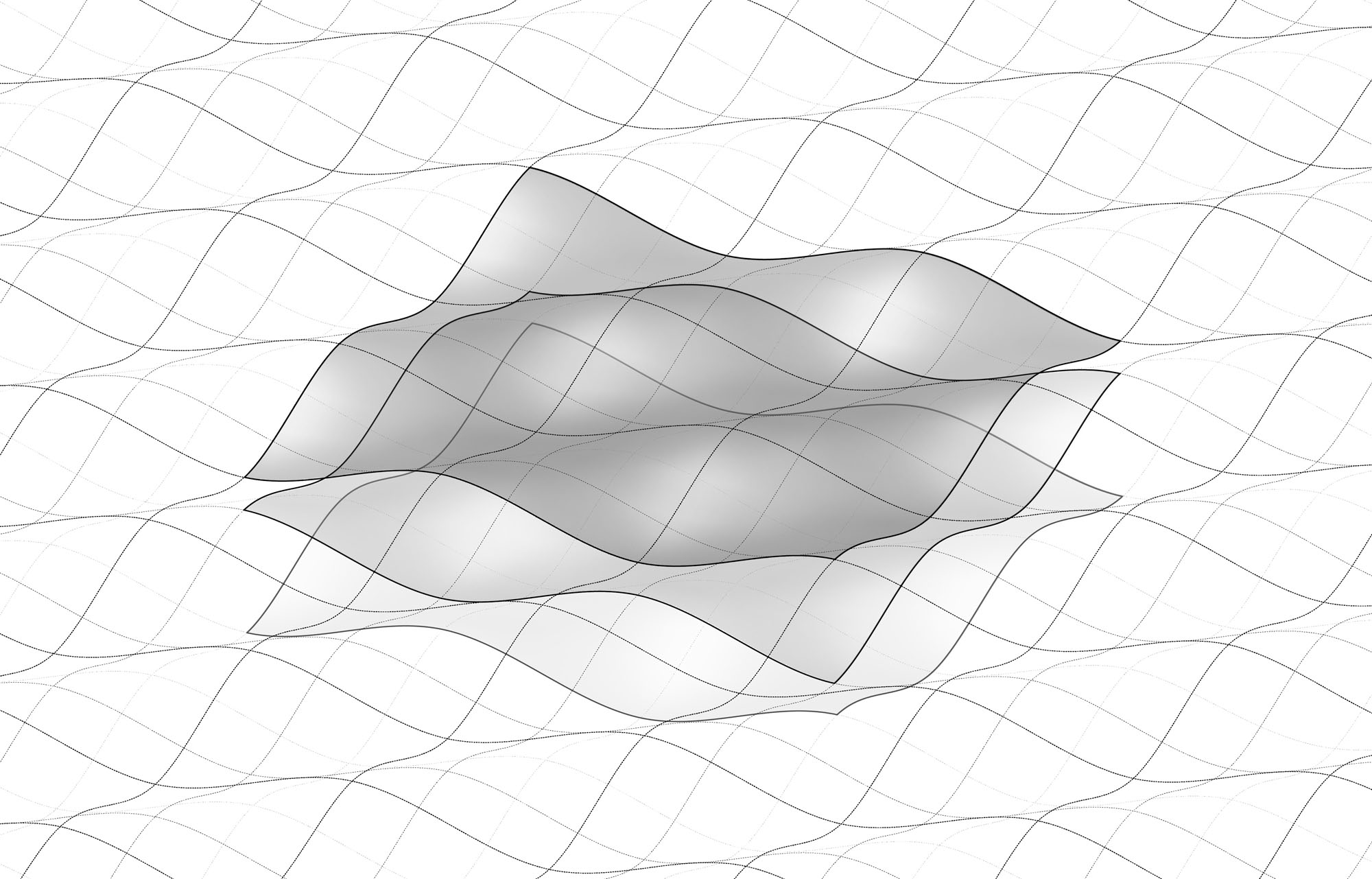
景観・象徴性・空間体験という3要素の交点において、3次元空間に無限に拡張可能な波状ユニットで構成される集落を構想した。その波形の一部を抽出し、建築に応用したのである。さまざまなスケールを検討した結果、抽出範囲は約80m×80m×20mと決定した。
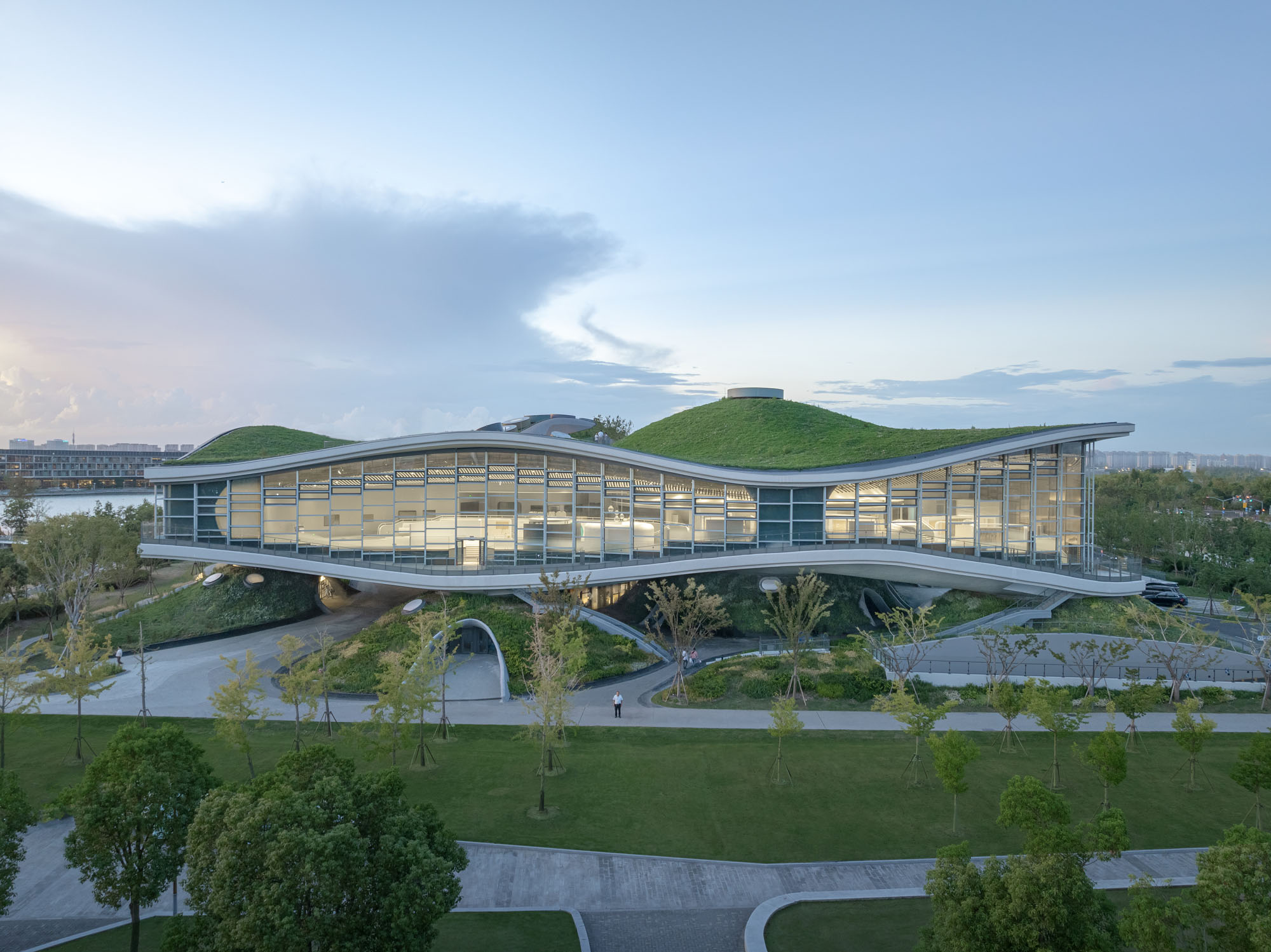
3層の波面が重なり、三層構造の積み重ねられたうねり空間を形成する。波の振幅と位相は三次元九宮格で定義され、上部大空間における波ユニットの頻度は「完全ユニット2つ、半ユニット4つ、四分の一ユニット2つ」と決定した。これにより、振幅約12m、スパン約54m、片持ち約27mの波状構造が実現した。これはSAOの「自由細胞」シリーズにおける最大規模のセル配置と言える。
© SU Shengliang
© SU Shengliang
アーチと波の媒介:複合構造システムへの昇華
正弦曲線に基づく初期3Dモデル生成後、構造コンサルタントの張鈞氏チームに実現可能性調査を依頼した。我々の目的は、波の形態とアーチ型シェル構造の力学原理を同期させ、実現可能な構造形態を導き出すことであった。
議論の中で、標準的な正弦波シェルはアーチとは全く異なる応力伝達モードをもつことに気づいたのである。従来の構造学的観点では、これほどの大スパンと片持ち梁を実現する圧縮シェルアーチは、当初想定していたよりも予想外に高いリフトと厚いシェルを必要とするのである。
© SU Shengliang
その結果、シェルと波形の中間に位置し、圧縮と引張の両方に耐える空間構造形態が、共通の探求目標となった。構造技術者は簡略化された折り畳み平面を用いて、重力荷重と横方向荷重の主要な経路を特定した。多面体表面から曲面シェルへのトポロジカル変換を通じ、重力・横方向力伝達・片持ち荷重の課題を洗練された手法で解決したのである。
これにより鉄筋コンクリートの圧縮性能とプレストレスの引張能力を極限まで引き出した。反復的な対話と相互の形態探求を通じて、最終的にアーチ状シェルと折り畳み平面を仲介する複合構造システムが開発された。それが下部の「グリーンヒルズ」、中央の「ヴォールトド・ヴォイド」、上部の「ウェーブパビリオン」である。
Design Sketche of Wave Cube © Zhu Xiaofeng
Generation of the Triple-layered Wave Surfaces
波型シェルの内面性:地と呼応する「グリーンヒルズ」
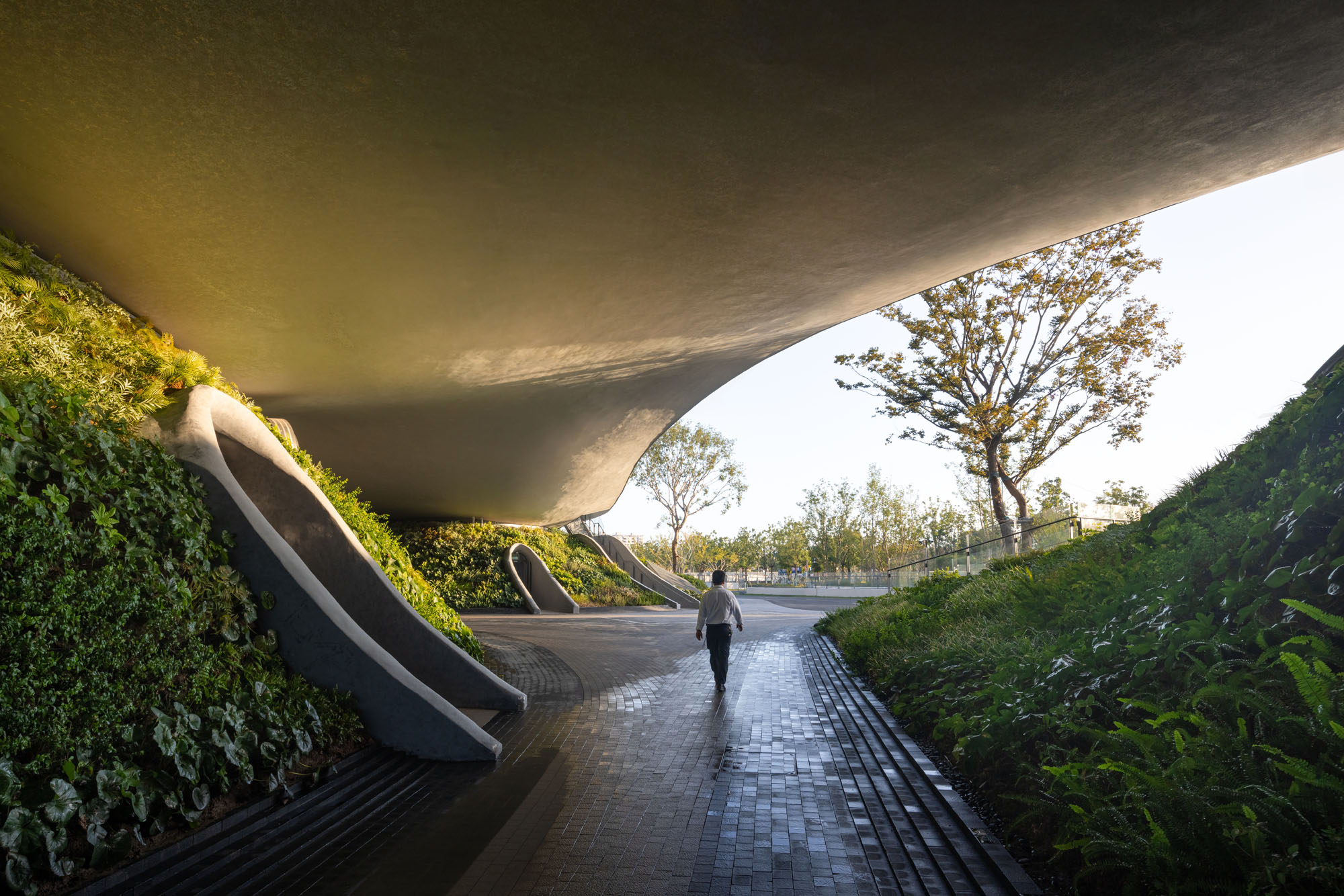
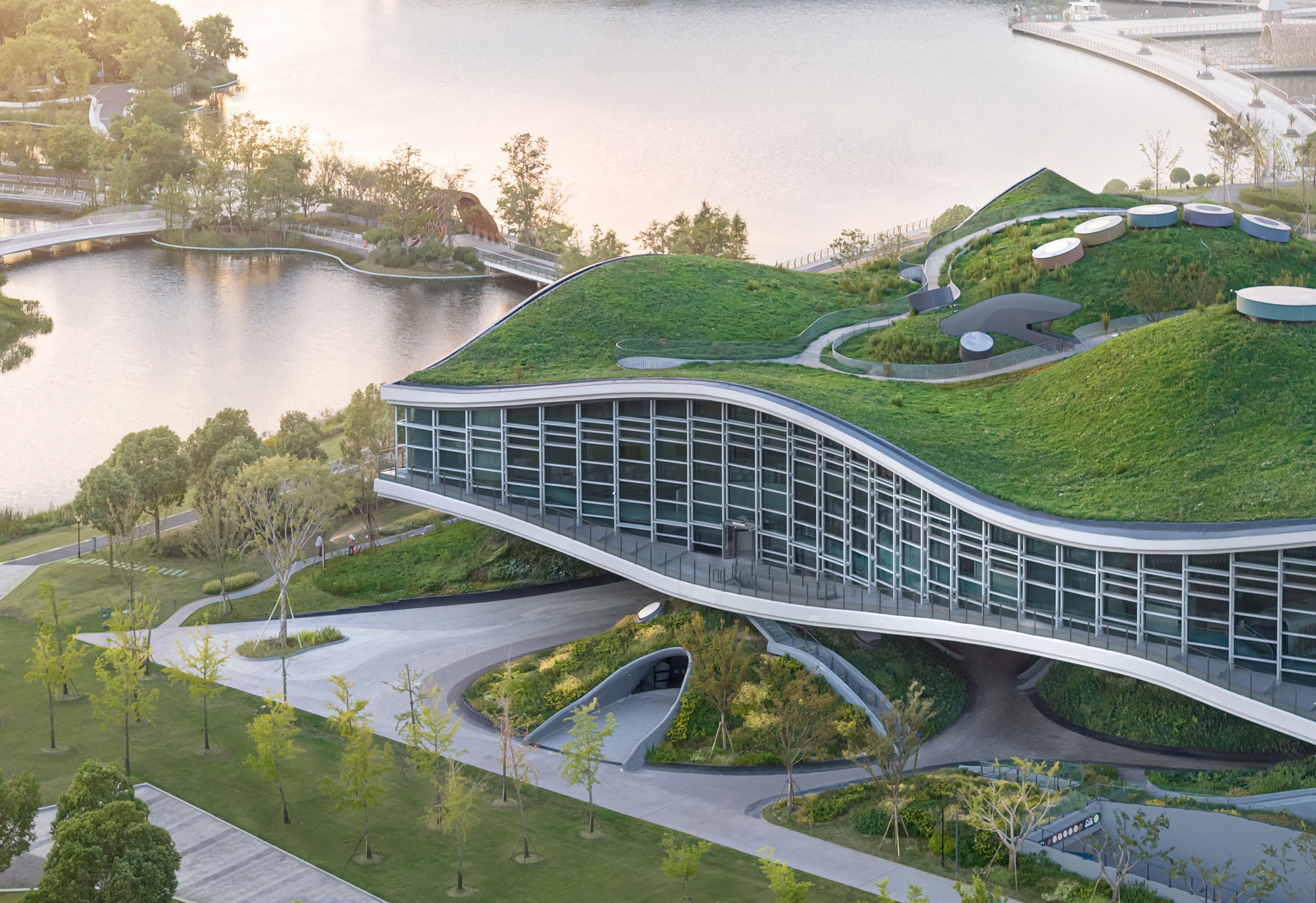
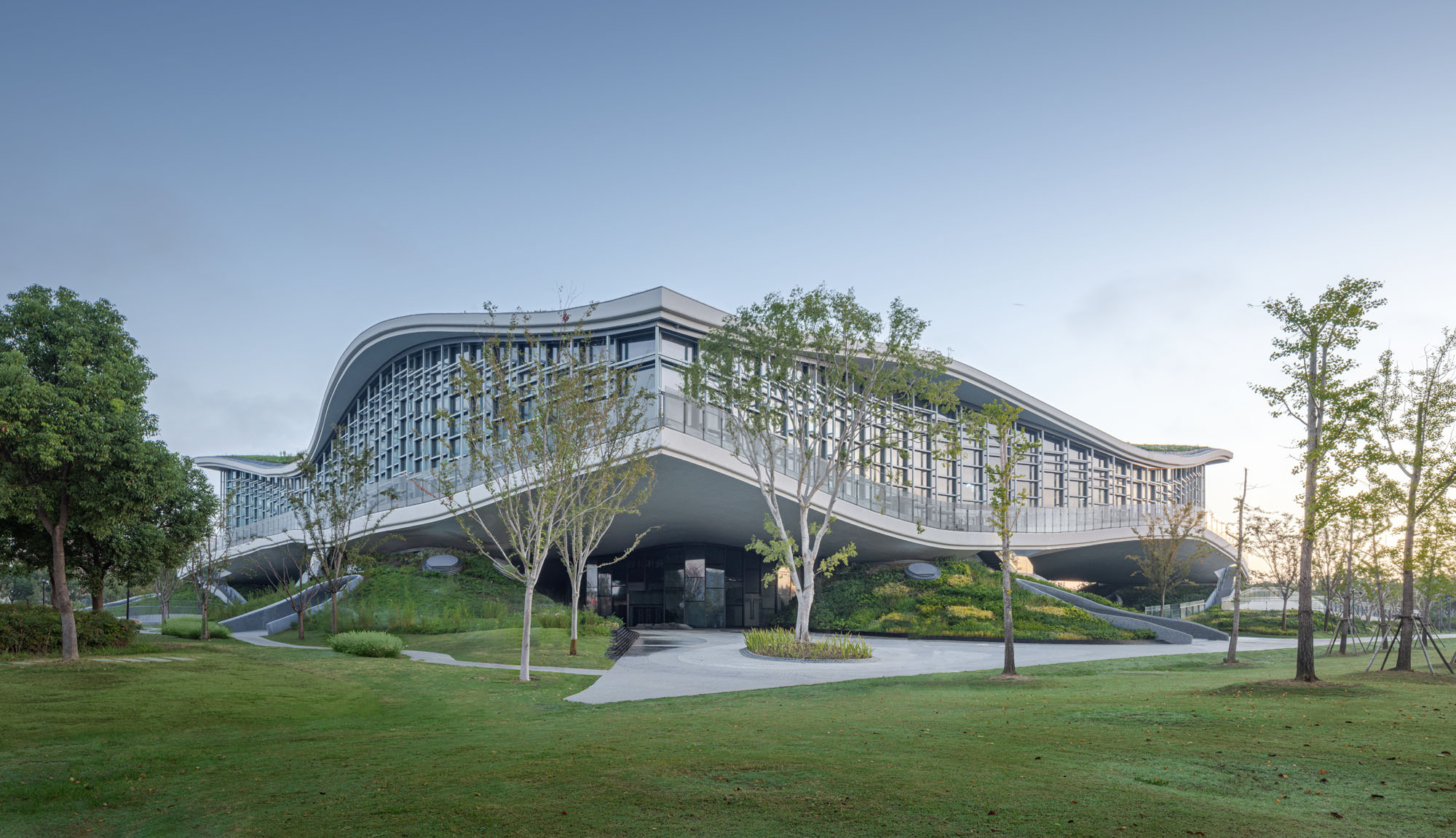
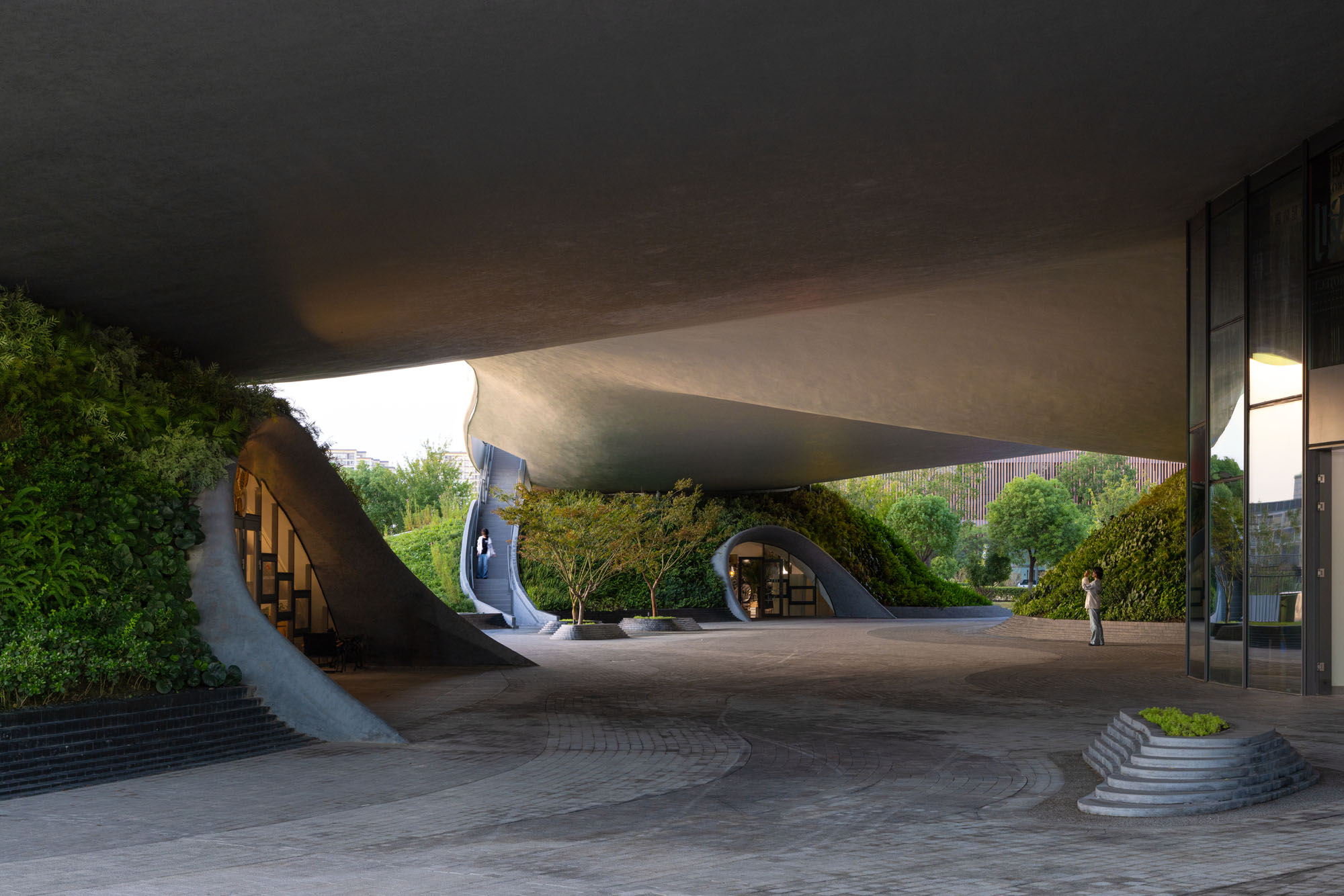
下部「グリーンヒルズ」は大地から現れる8つのコンクリートシェルで構成され、展示ホール、カフェ、バー、文化創造店舗、機械室を収容する。周囲の6つのグリーンヒルズと2つの構造コアが上部構造を支える。下降荷重は各シェルの頂点で分割される。重力はキノコ状柱が支え、横方向の力は丘シェルを通じて地盤と地下室屋根スラブへ伝達される。
© SU Shengliang
© LIU Guowei
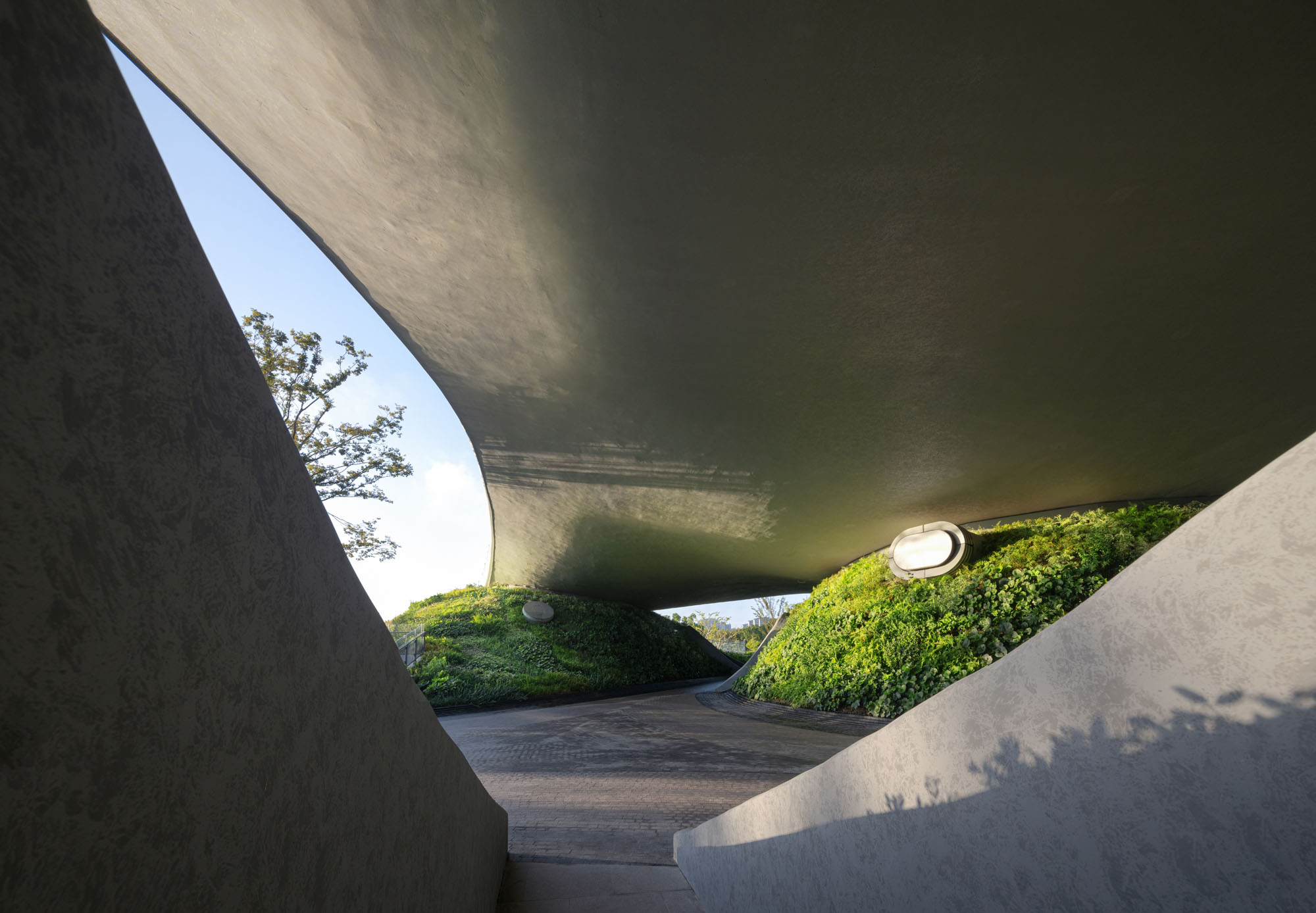
中央の2つの「グリーンヒルズ」は、ウェーブパビリオンから下降する逆さシェルと繊細な接触で合流し、その接合部は2つの円形開口部を形成する。ここはエスカレーターとリフトステージのための連続した垂直空間を提供する。
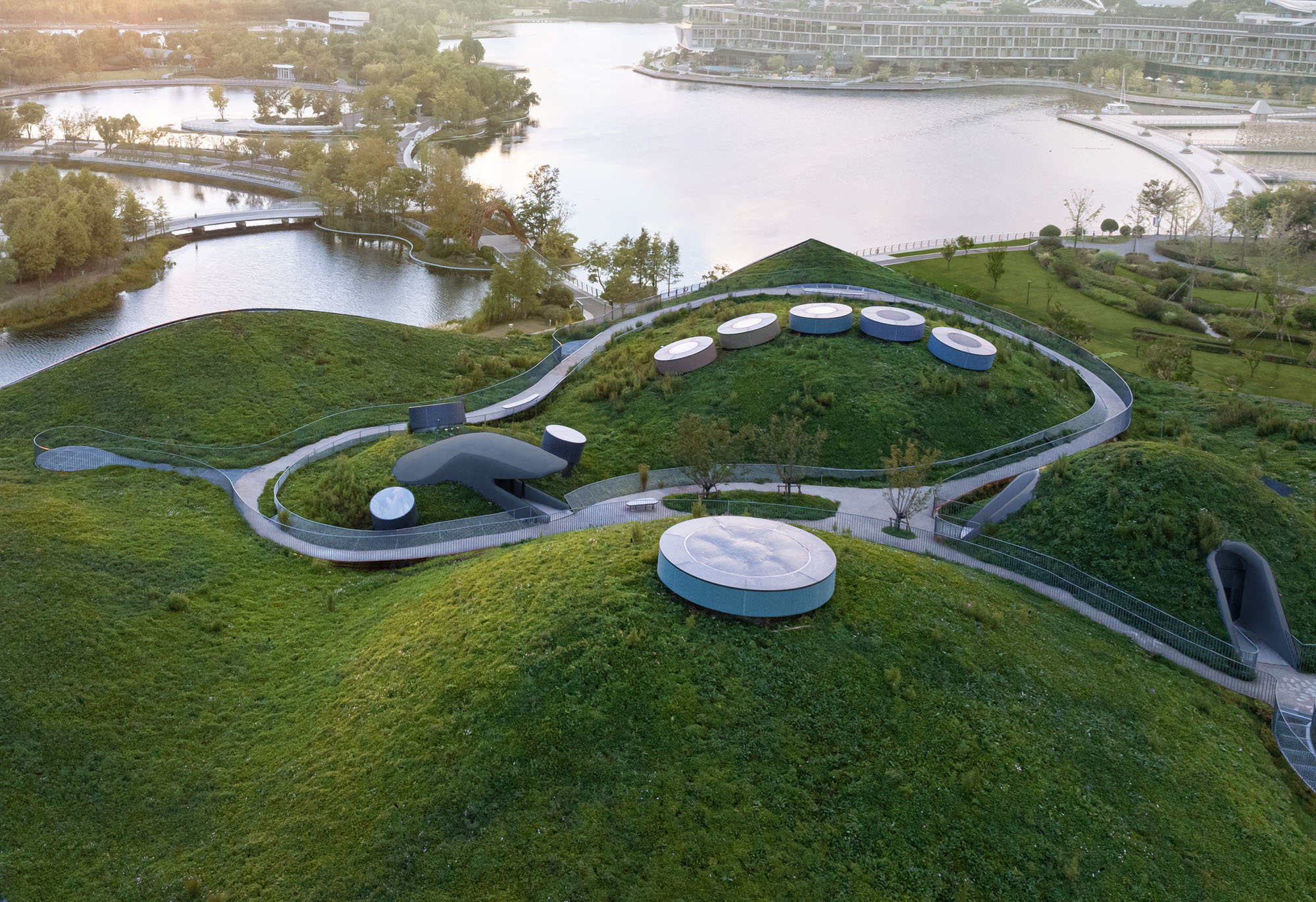
丘の外側では、斜面の表土を保持するグリッドが設置され、日陰区域では耐陰性の地被植物を育む局所的な人工照明が補完する。内部では、排煙と自然換気の二重機能をもつ円形天窓が洞窟のような空間に日光を導き、柔らかく神秘的な雰囲気を醸し出している。
© SU Shengliang
© LIU Guowei
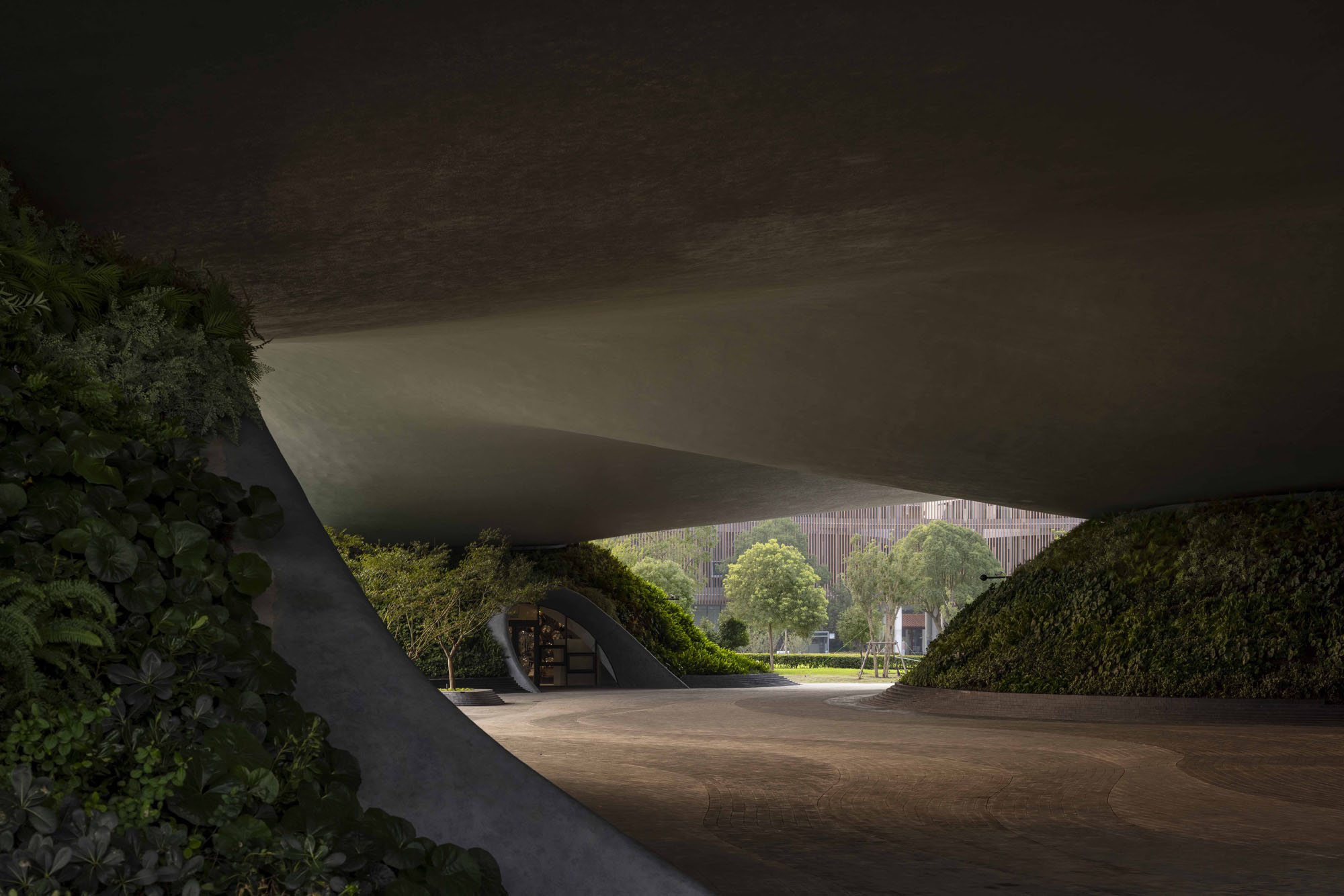
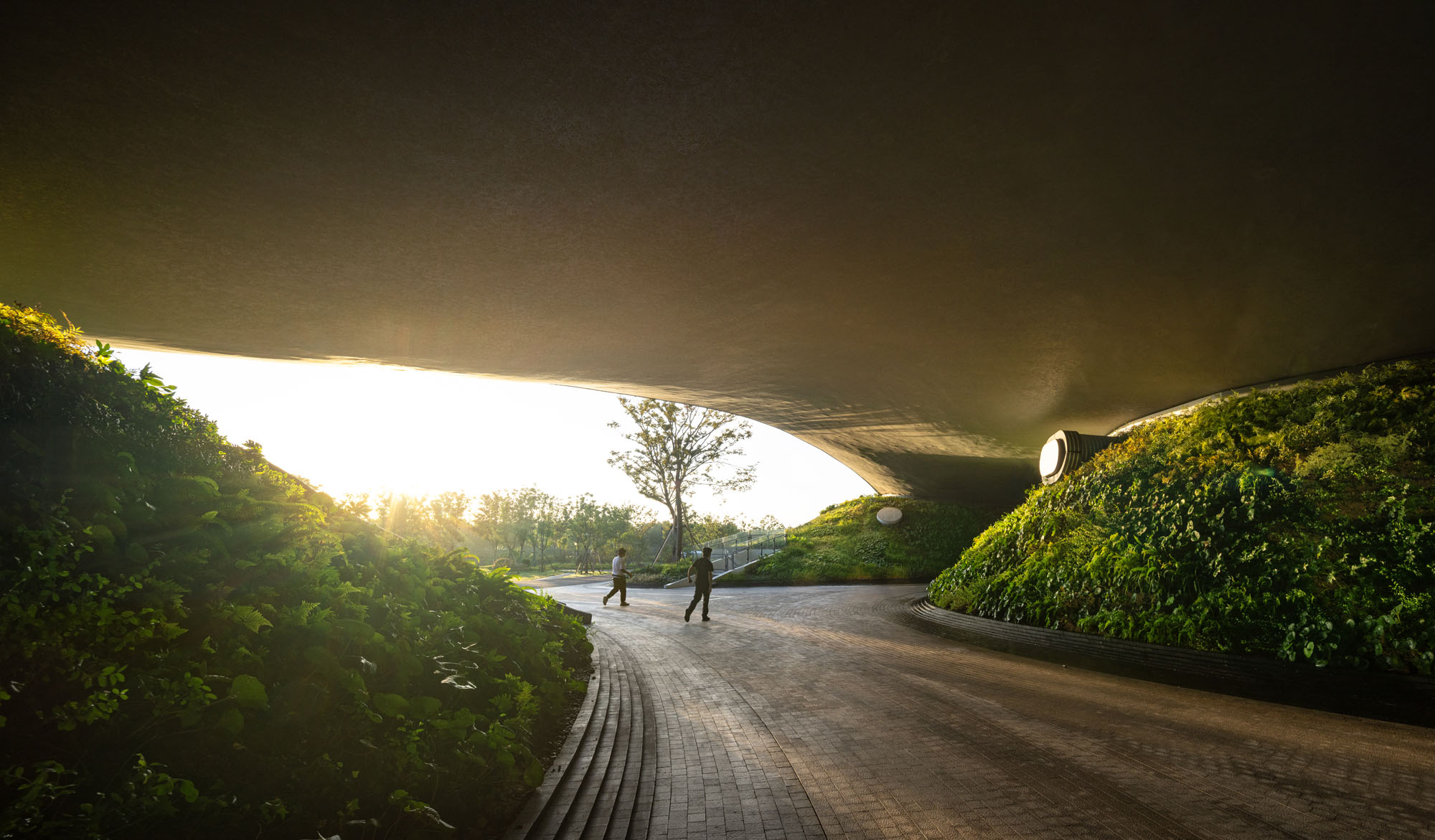
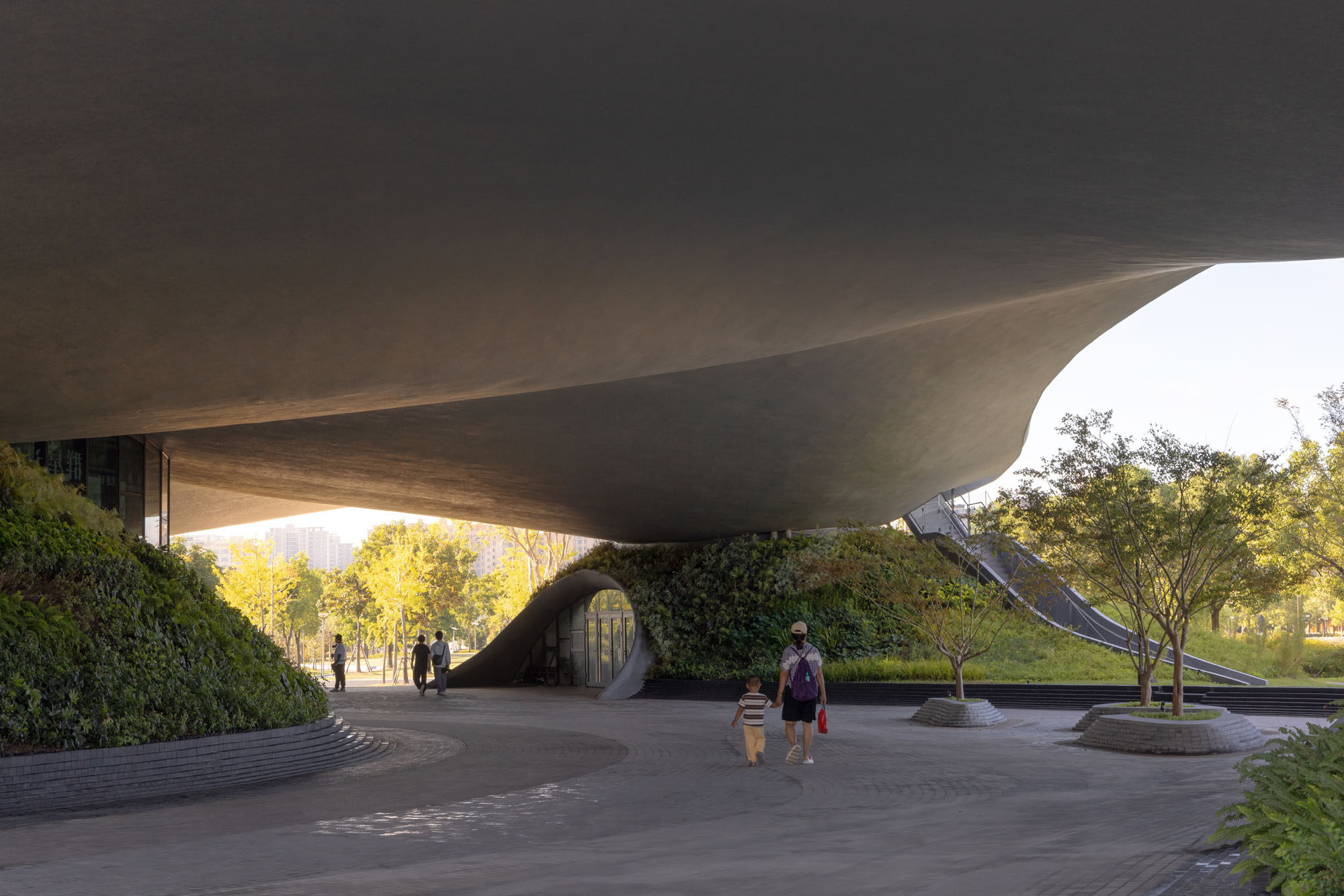
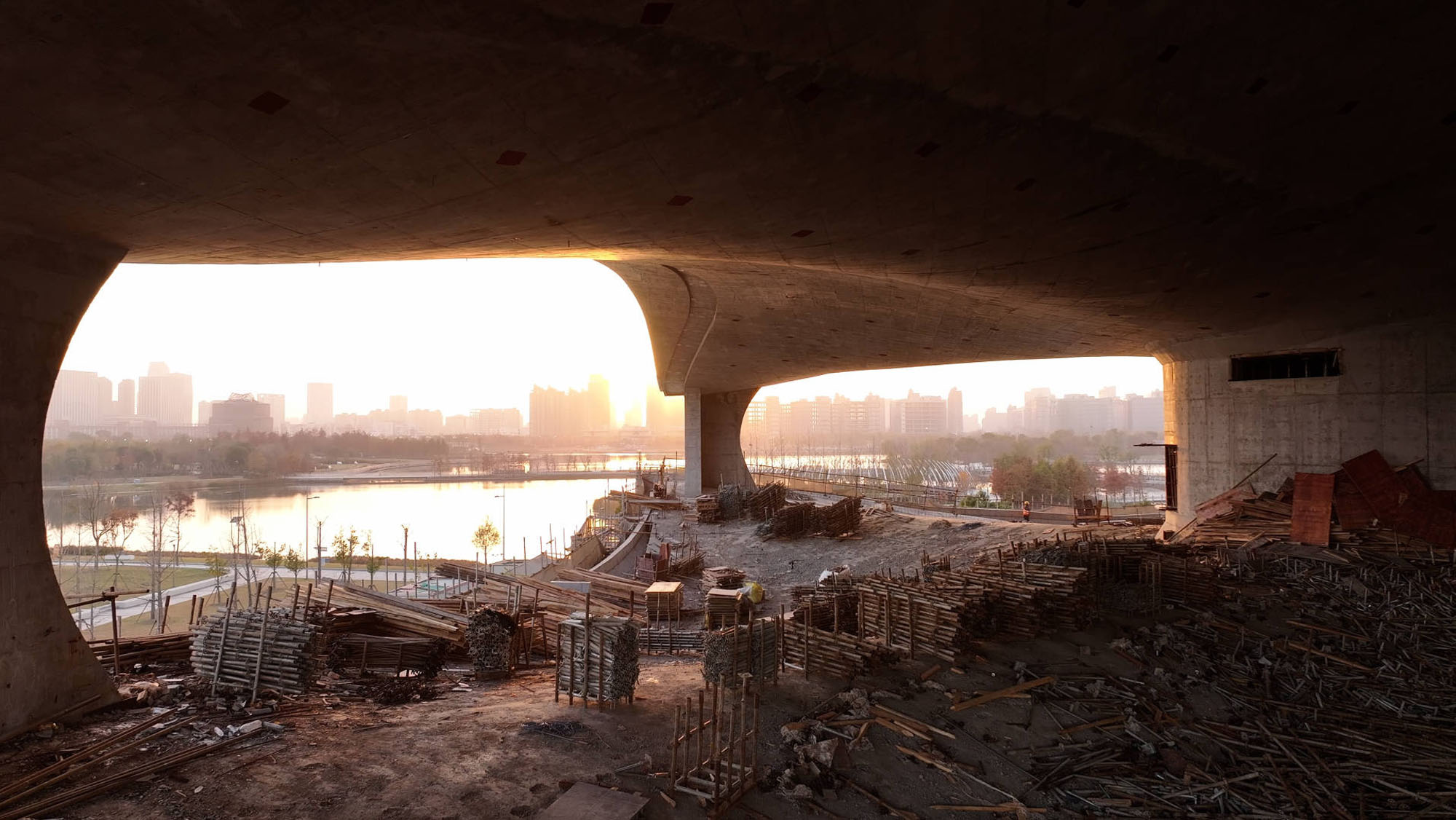
個々の「グリーンヒルズ」は独立しているが、その間隙空間は全体を覆う「ウェーブパビリオン」の下に保護され、中央に連続した「ヴォールト状の空洞(ヴォールトド・ヴォイド)」を形成している。周囲には高架化された半屋外空間が設けられ、周辺景観を導きつつ湖畔遊歩道を建物下部に通過させる。
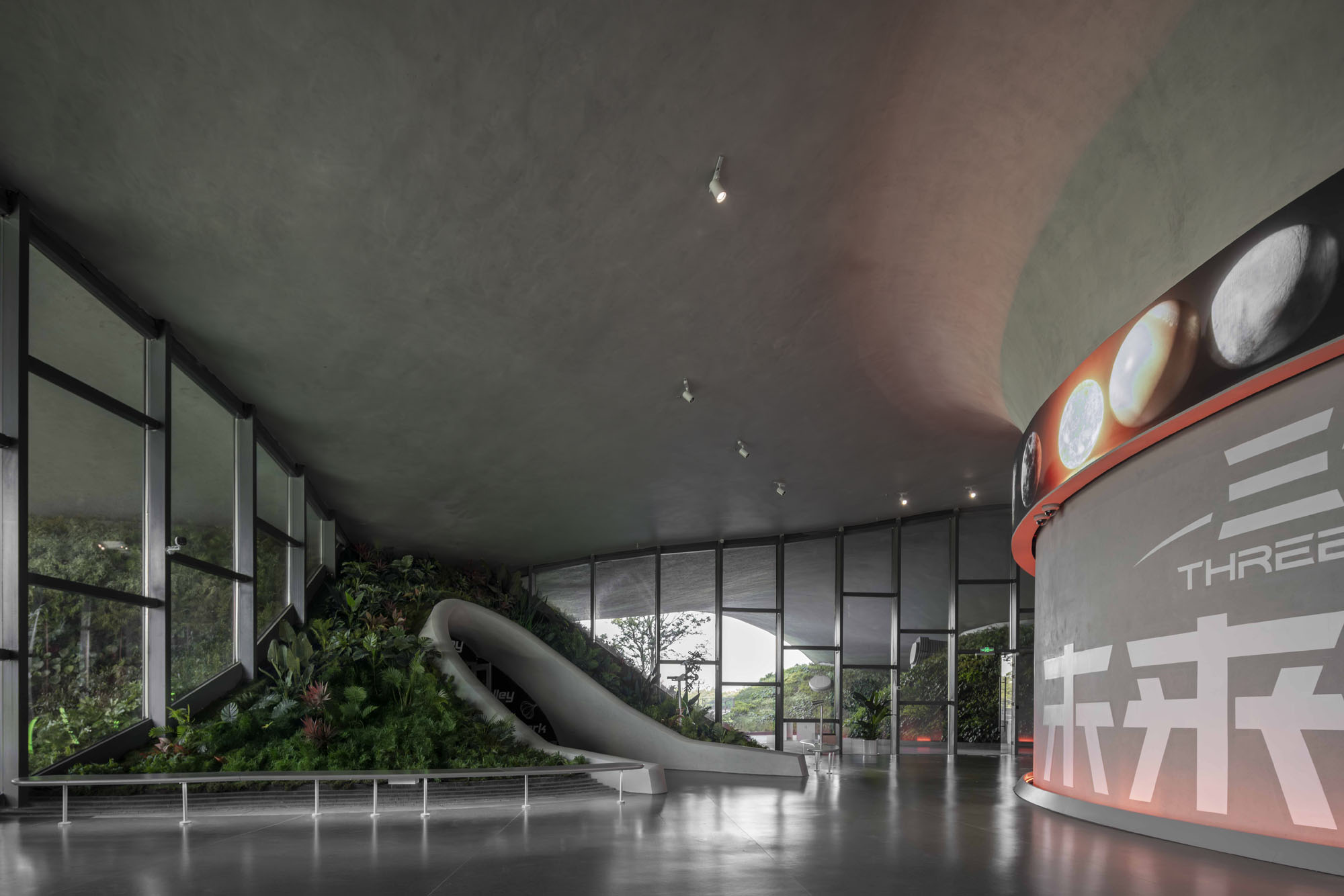
中心部ではガラスカーテンウォールに囲まれた1階ロビーが、グリーンヒルズに抱かれるように建物の内部動線の中核・集結点として機能する。2つの構造コアが建物全体を垂直に貫通し、構造支持・垂直動線・設備シャフトの機能を統合する。「ヴォールトド・ヴォイド」の連続的にうねる天井と、丘の間を小川のように流れる床舗装が相まって、内外の境界を溶解させ、地上階に全体として開放的な公共空間を生み出している。
© SU Shengliang
© LIU Guowei
浮遊する巨大空間:「ウェーブ・パビリオン」の構築
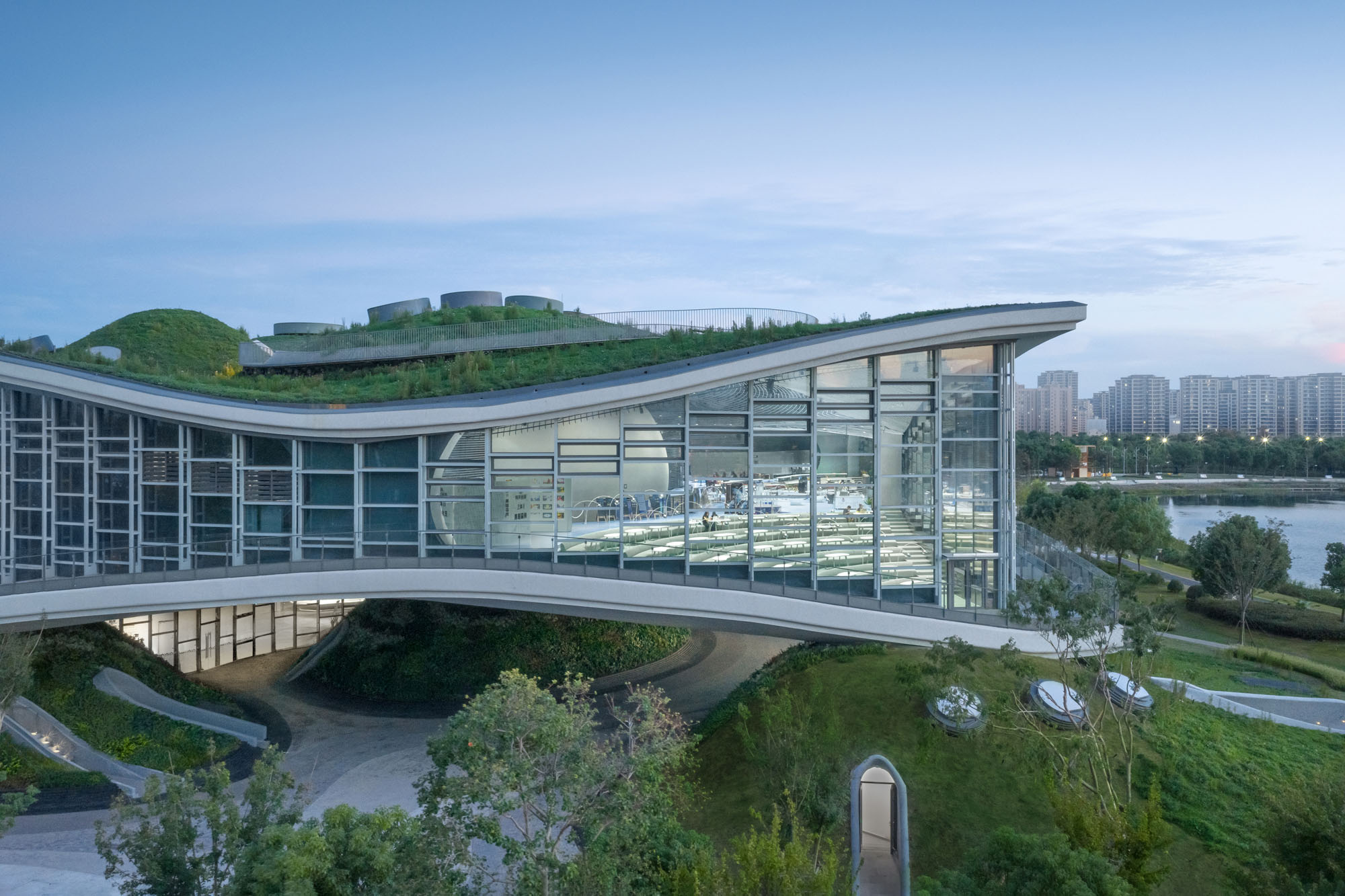
「グリーンヒルズ」と「ヴォールトド・ヴォイド」の上に浮かぶ巨大な「ウェーブ・パビリオン」。プレストレストコンクリートで打設された上下のシェルが、垂直対称の「ウェーブ・パビリオン」外殻を形成する。波状モジュールのリズミカルなうねりに沿い、8つの交点に位置する2本の構造コアと6本の周辺せん断壁が支持力と片持ち梁強度を提供する。
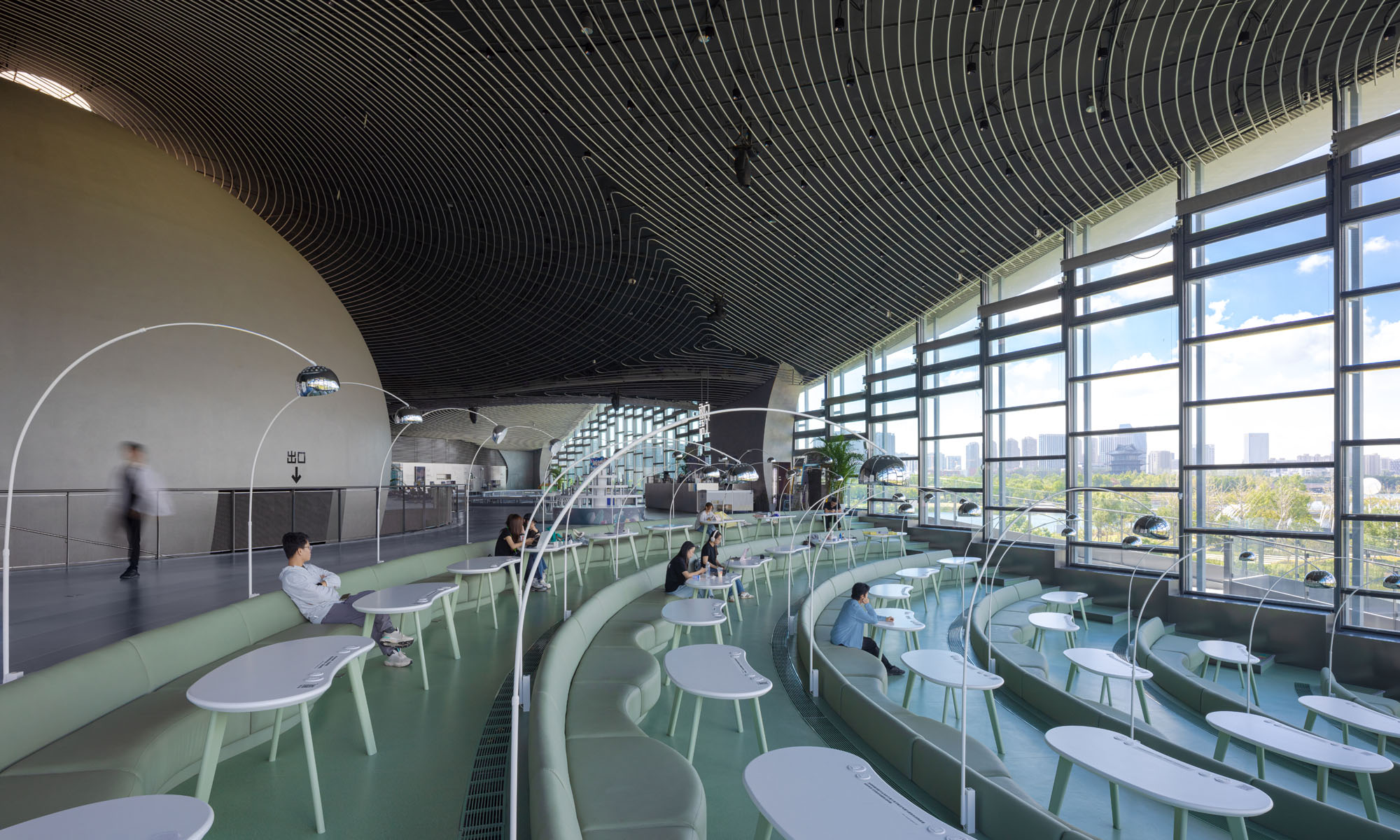
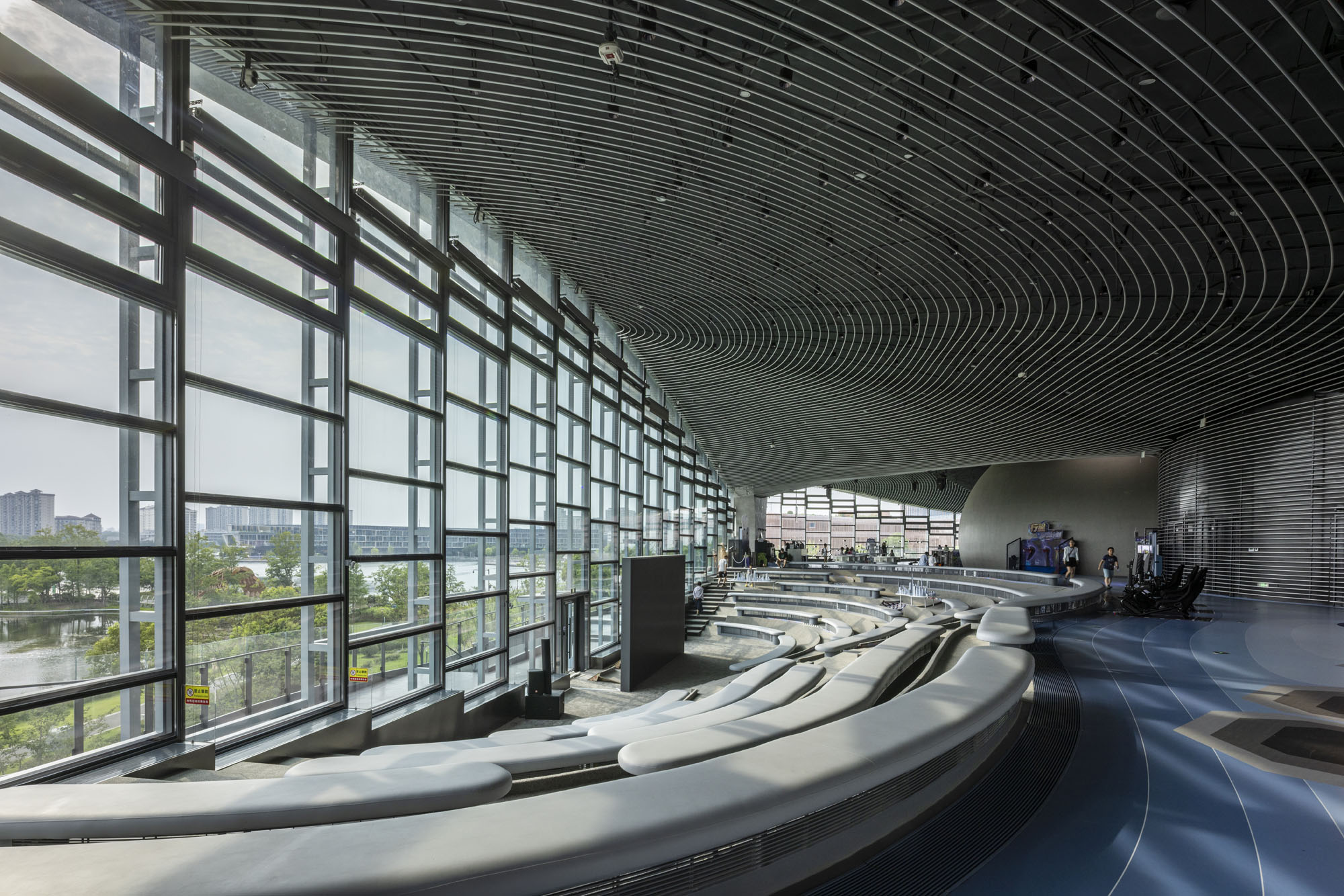
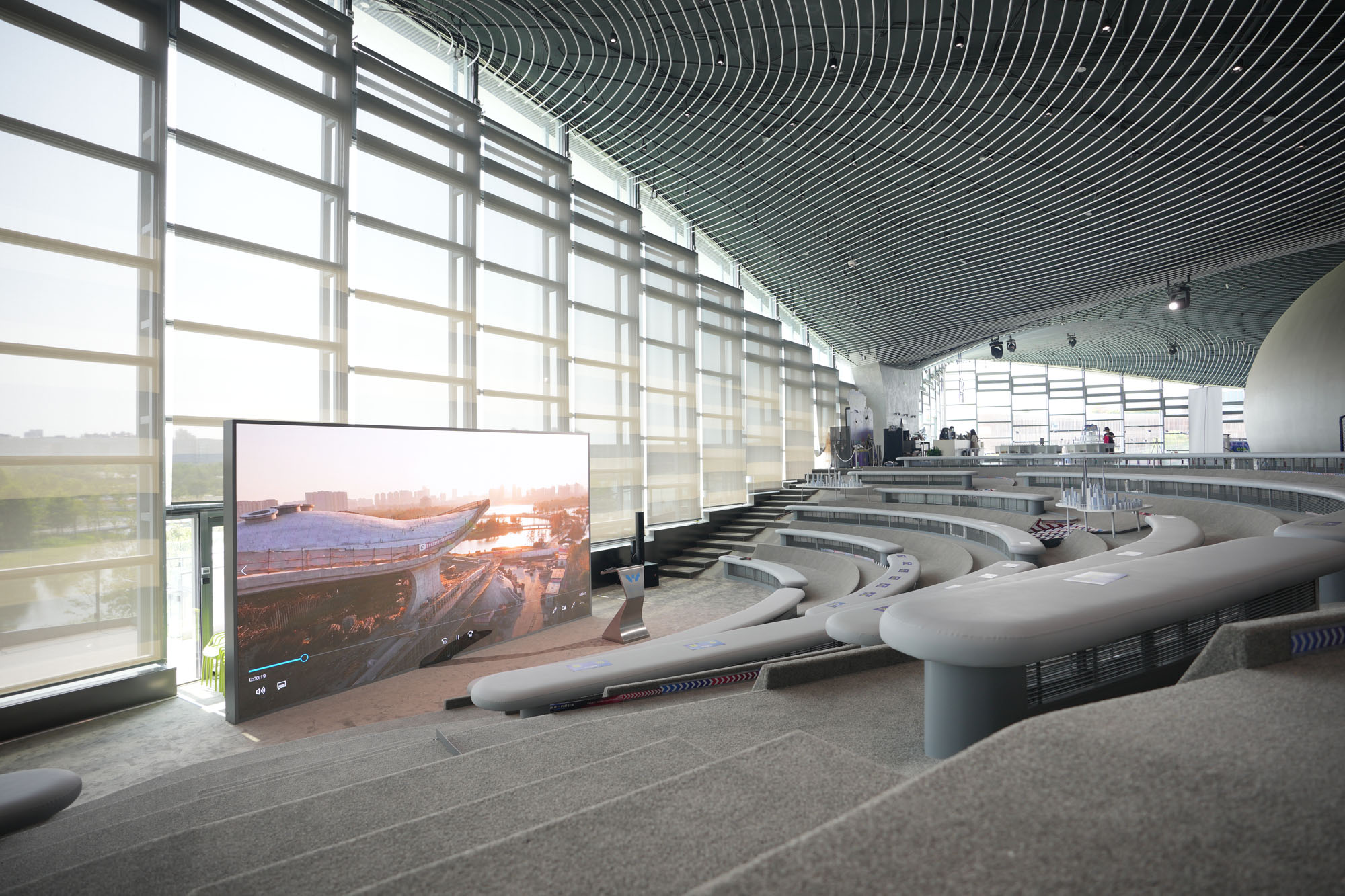
この構造的論理により、約6,400m²の流動的な波形空間が生まれ、4.5mから12.5mまで変化する天井高が、建築内に「屋内公園」を効果的に創出する。+9.1mレベルにある平面は、この屋内公園を貫く水平プロムナードとして機能し、形状の異なる8つの沈み込んだ空間を囲む。これらの空間は抽出された波の幾何学に基づき、完全円形・半円形・四分円形に分類され、それぞれが上部のアーチ状ドームと共鳴する。
© SU Shengliang
© SU Shengliang
空調システムは下部シェルと高床式の床の間に配置され、低層部用スプリンクラーと高層部用水砲を組み合わせることで、上部構造の視覚的明快性を高めている。2つの完全な波空間のドーム部には、排煙と換気を確保しつつ太陽光を取り込むため、単一の大型天窓と五つの小型天窓が設置されている。
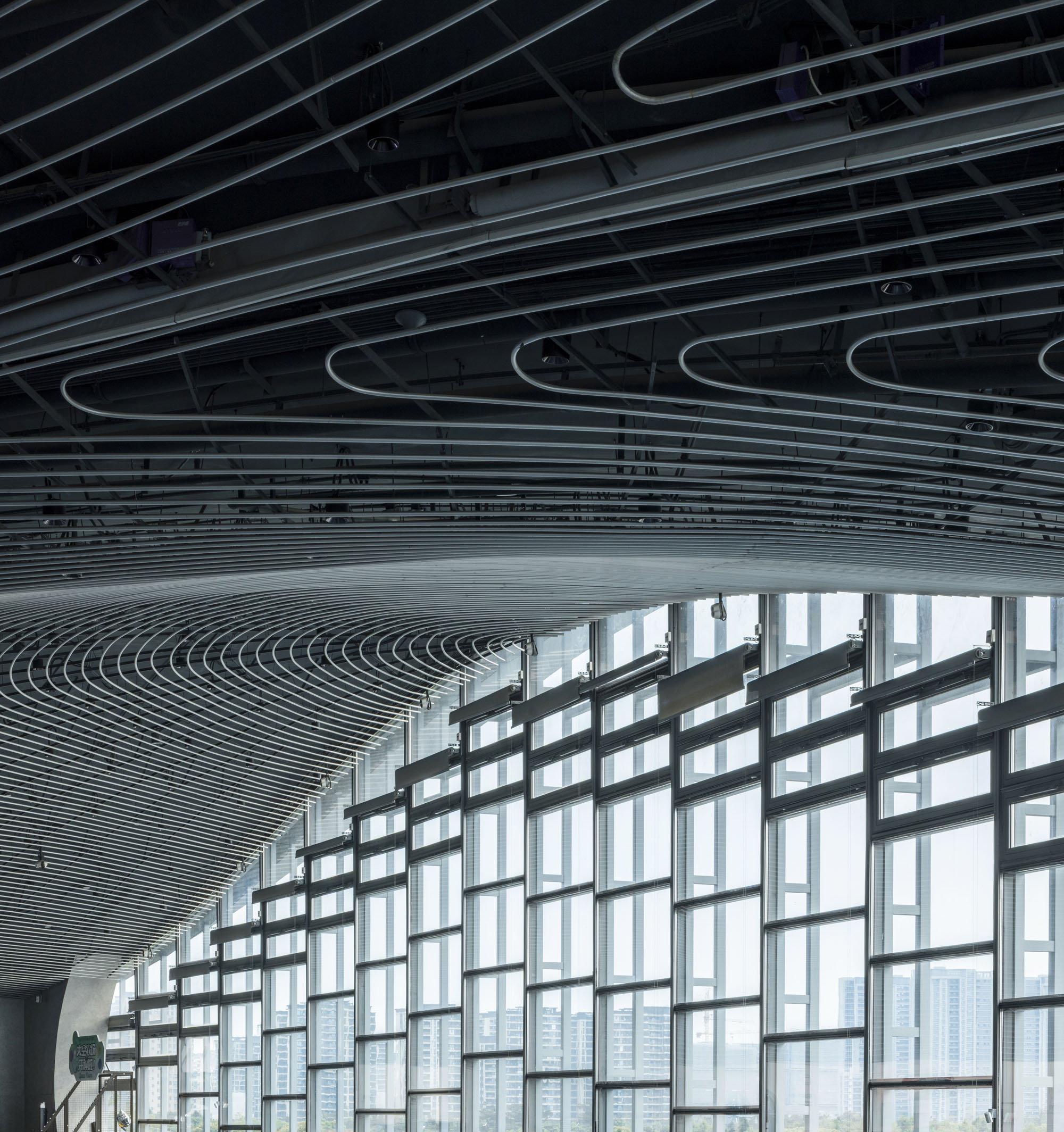
ウェーブ・パビリオンの外周は、露出したトラス構造で支えられたガラスカーテンウォールで覆われ、都市に面した連続的な透明インターフェースを形成し、うねる空中歩道を生み出している。
© SU Shengliang
© SU Shengliang
力学への挑戦:高密度な構造統合と精密な施工制御
正弦波の数学的純粋性を、実体化した耐荷重構造へと変換することが、設計・施工段階における最大の課題であった。
3つの波殻面が垂直に重層した複合空間構造内部では、荷重伝達機構が垂直方向と斜め方向の両モードを統合している。建築的には、波の形態が体現する斜め方向の力の流れが表現の焦点であり、構造コアとキノコ柱による垂直方向の力伝達は意図的に解消されている。
© SU Shengliang
実際には、一見純粋な波形の中に高密度の構造システムが凝縮されている。施工には複雑で高度に連動する多システム接合部の緻密な組織化が要求された。コアを囲む空間曲線のプレストレステンドン、テーパー形状の鉄筋コンクリート梁、せん断壁内の構造用鋼フレーム、そして密集した埋設MEP配管群である。
これらの要素が制約された断面内で「干渉なし」に保たれるよう、設計・施工チームはBIMベースの空間検証を活用した。これにより補強メッシュが複数ソースの構成要素を精密に包み込み、衝突のないシームレスな統合を実現したのである。
© ZHANG Haobo
© SU Shengliang
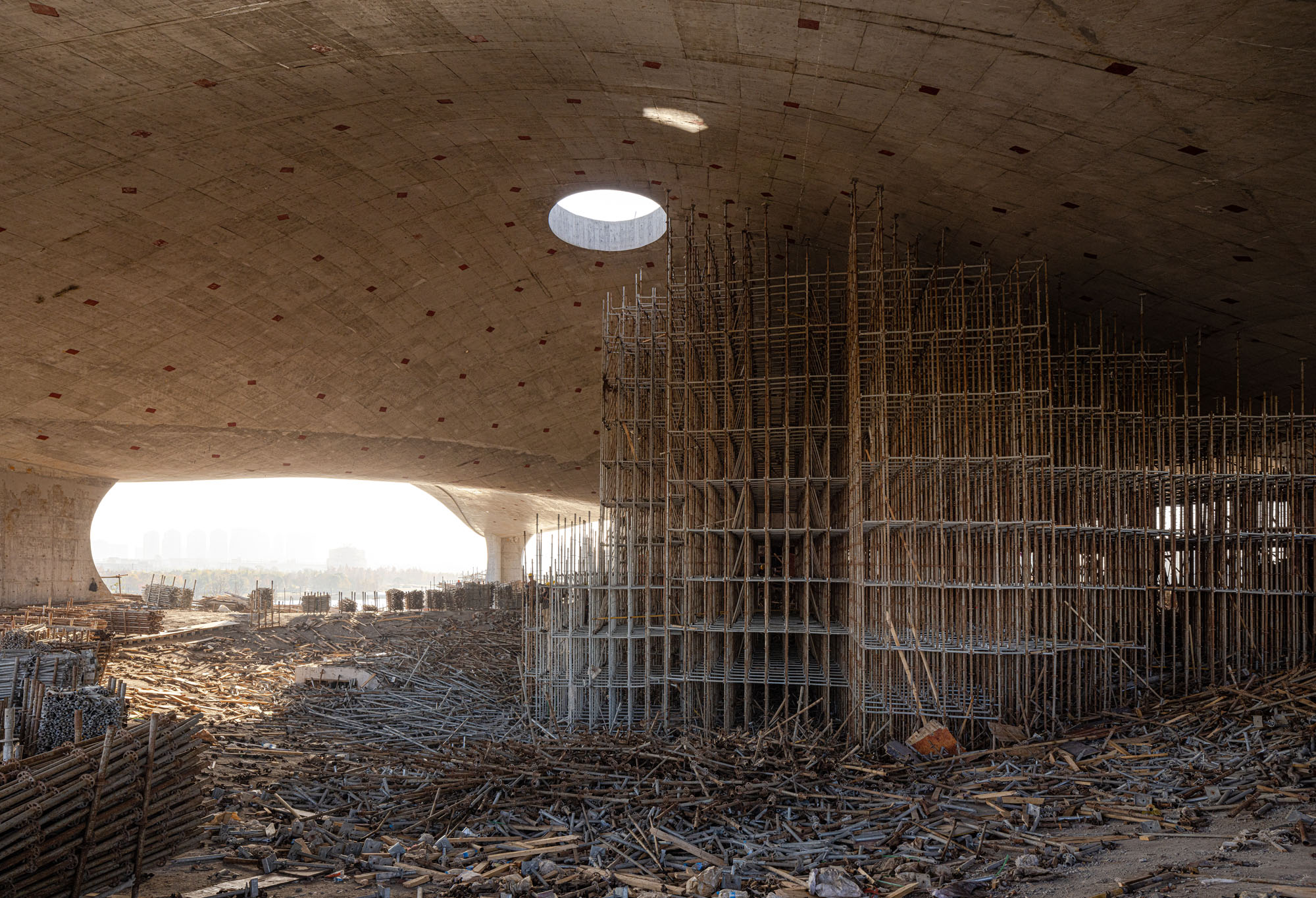
複雑な空間配置と非標準型枠の精密制御は、もう1つの主要な技術的障壁となった。コスト制約により3Dプリント型枠は採用されず、代わりに高密度足場グリッド(600mm×600mm、複雑部では300mm×300mmに縮小)が現場打ち型枠の支持システムとして活用された。
荷重下で円形鋼製成形パイプが変位する問題を解決するため、施工チームは特注の適応型制限部品(「グリッパー」)を開発した。これによりパイプを足場支柱の中心軸に精密に固定し、コンクリート打設時の型枠変形を効果的に抑制し、うねる空間曲線の幾何学的形状を高精度で実現したのである。
© LIU Guowei
施工詳細設計の微視的観点から、この革新は建築構造論理の厳密な整合性を維持した。構造が閉鎖される前は、密な足場と仮設ブレースに依存する卵殻のように脆弱な状態であった。
打設完了とプレストレスケーブルの張力付与を経て初めて構造は「閉鎖」を達成する。その瞬間、すべての構成要素が瞬時に役割を果たす。それはまるで電源スイッチが切り替わるように、応力流が内部全体に循環・統合され、この「卵殻」全体が構造的剛性を獲得するのである。
型枠と足場が撤去されると、打ち放しコンクリートの本来の質感が光と影の戯れの中でうねる表面を流れ始め、建築の生命力が遂に顕現した。
© SU Shengliang
© SU Shengliang
巨大キャンティレバーの制御とコンクリートの質感
建物の北東と南西の角では、27mの大規模な片持ち梁(キャンティレバー)が変形に関して厳しい課題を提示した。コンクリートのクリープ特性により、構造は動的な移行を経験した——屋根土の初期荷重による即時たわみから、1年以内に安定化する漸進的な沈下へ、である。
ひび割れ幅の制御とカーテンウォール上部スリーブの変位限界を満たすため、片持ち梁端部には垂直荷重専用に2本の格子鋼柱を設置した。視覚的統一性のため、これらの柱はカーテンウォールのマリオンのスケールと構成を反映し、異質なシステムを全体の中に視覚的に溶け込ませている。モニタリングデータは最終沈下が設計限界内に正確に収まることを確認している。
© SU Shengliang
ガラスカーテンウォールと芝生斜面を除き、建物は内外装表面に打ち放しコンクリートの質感を最大限に露出させ、空間の雰囲気を区別するために微妙なディテールのみを用いている。ウェーブパビリオンのファサード、周辺のせん断壁、コアには半透明のコンクリートシーラーが塗布された。
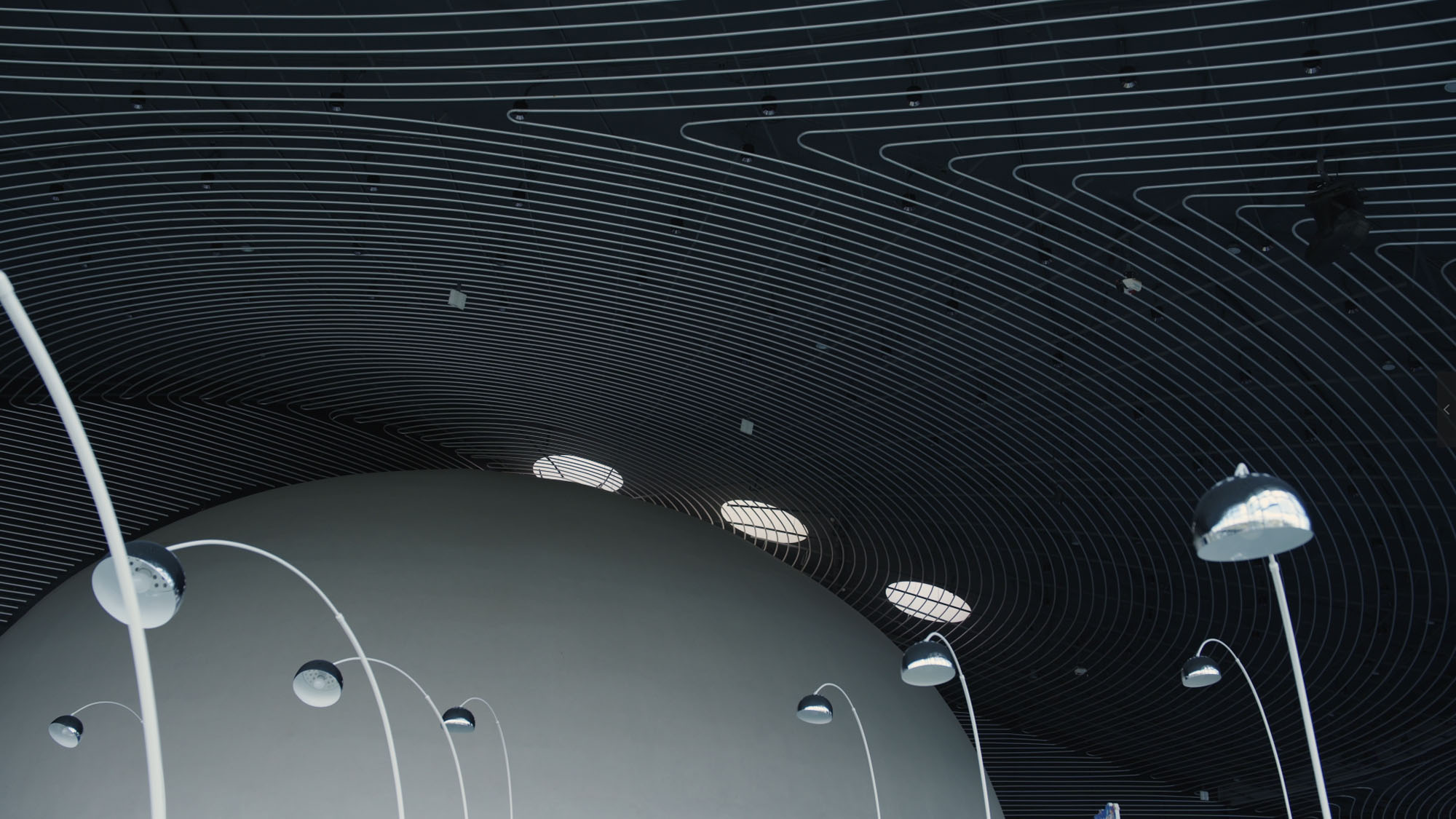
上部シェルでは、暗灰色の保護コーティングが裏面とMEP配管を均一に覆い、銀白色のアルミニウムパイプで形成された「流線型」天井を際立たせている。下部シェルの裏面には、多段階プロセスで実現した虹色保護コーティングを施し、連続する曲面が反射する光と影を、薄暗い「ヴォールトド・ヴォイド」空間に動的に導入している。
© SU Shengliang
没入型体験:『三体』宇宙と交錯する三次元フィールド
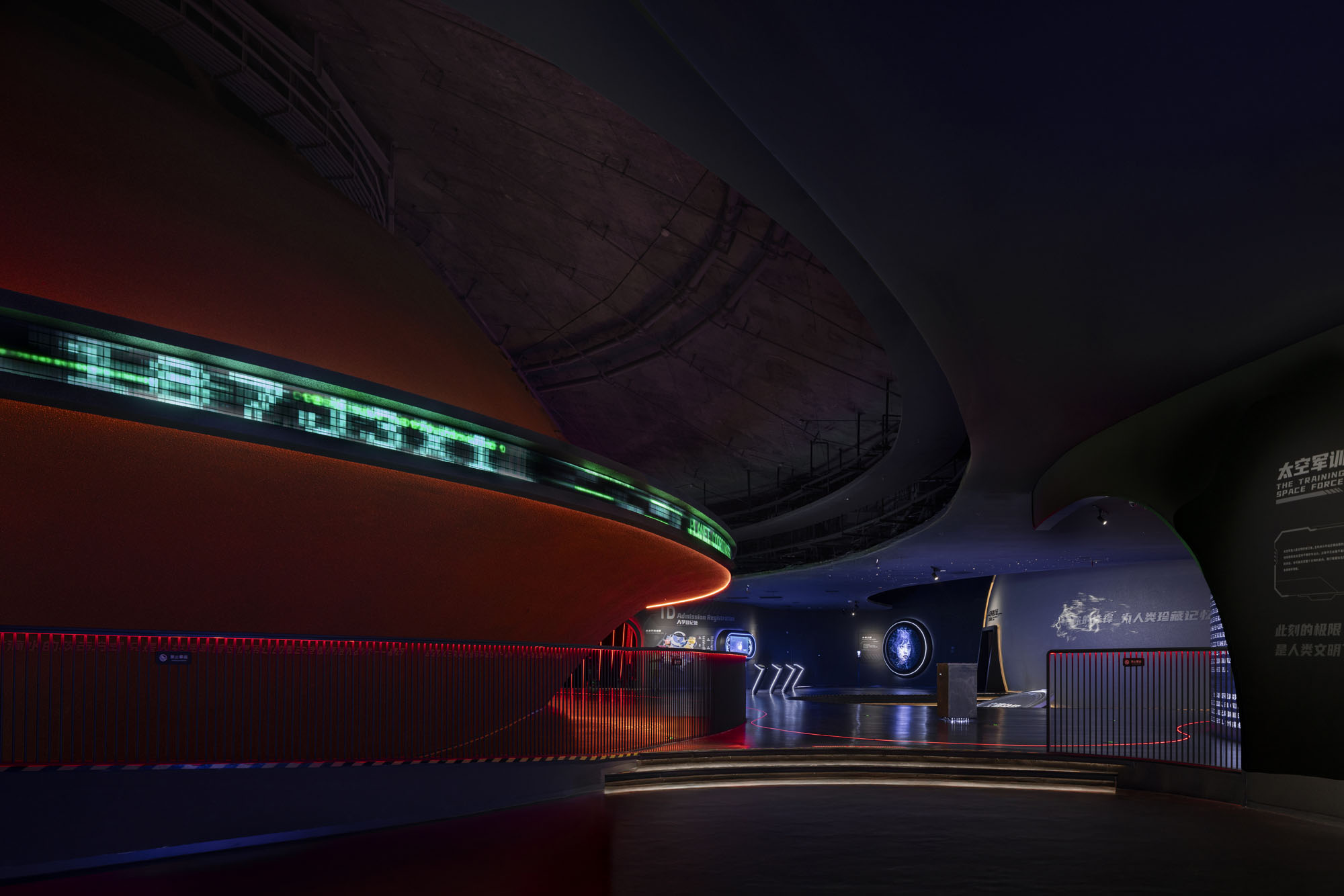
空間操作計画は、3度にわたる多者間精緻化を経て最終合意に至った。2階は3つの領域に分かれる。北東には核心となる「ダークゾーン」が位置し、完全密閉型の『ブラックボックス』として『三体』の深遠なSF物語を定着させる。
西側には「ライトゾーン」が金海湖に向かい、その広がりを公共活動に開放する。暗と光の領域はいずれも風雨竹がキュレーション・管理を担う一方、南側区域は柔軟な空間予備地として、将来の展示可能性を静かに待ち受ける。
© SU Shengliang
© LIU Guowei
建物の三重の波状シェル構造は3次元空間フィールドを形成し、壮大なSF物語とその多様なシナリオに、包み込むような解放感と神秘的な動的変化をもたらす。
メインエントランスは北東隅の張り出しシェル構造下部に位置する。「グリーンヒルズ」に包まれたガラスカーテンウォールから1階ロビーへ進むと、内外の景観がシームレスに連続する。
© SU Shengliang
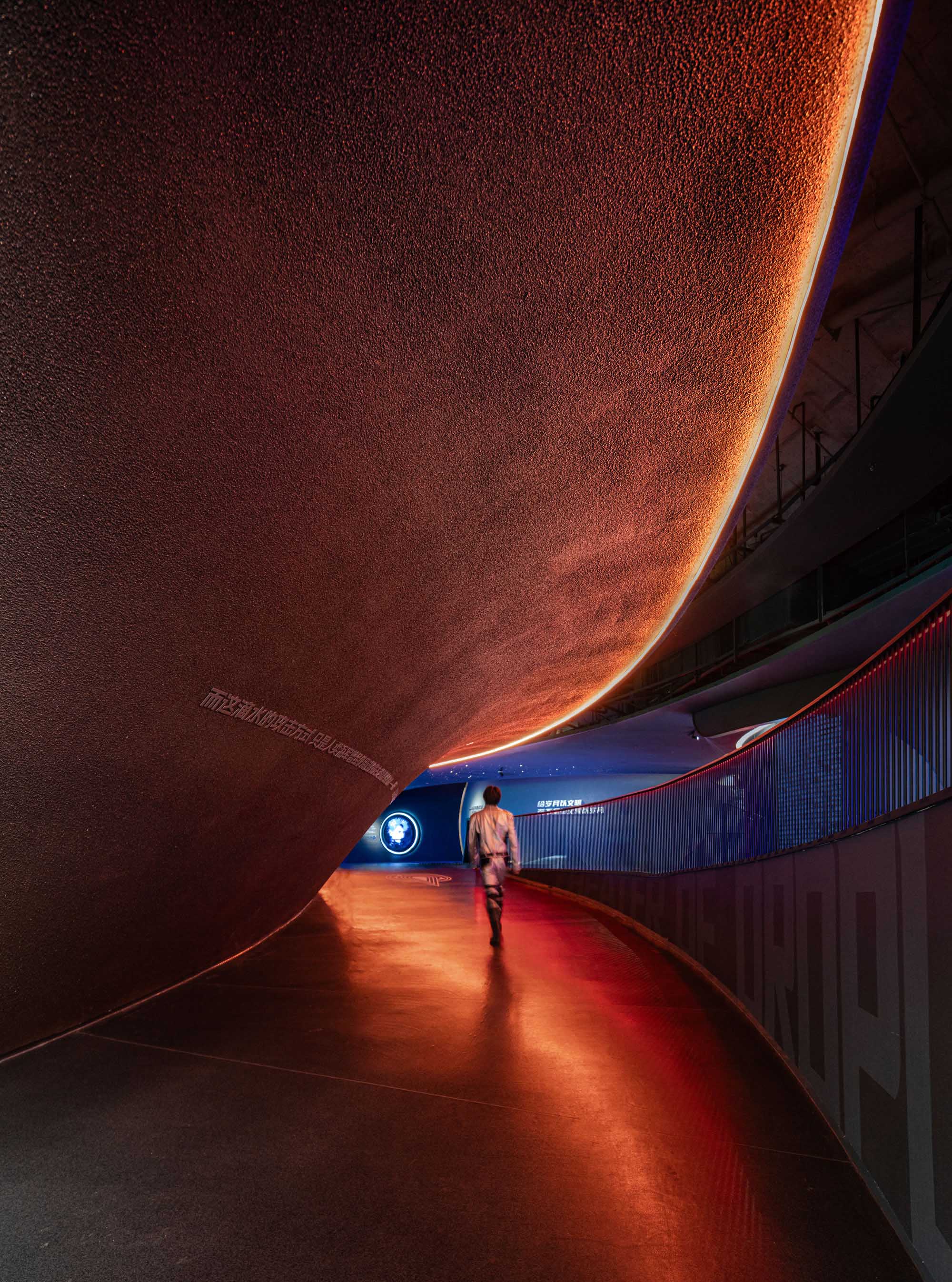
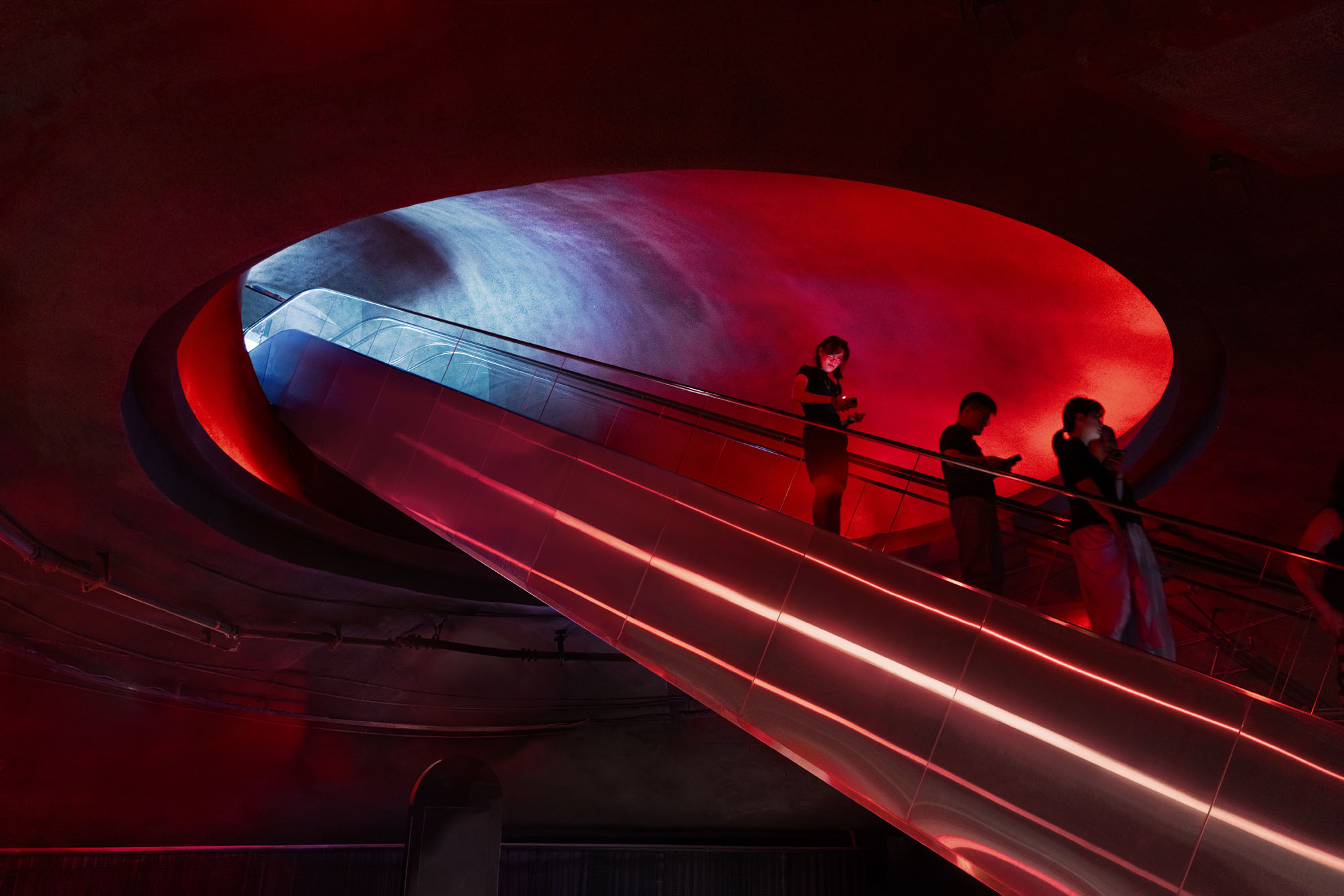
砂が散らばる「砂丘の虚空」へ入ったり、卵形のコアを通過したりした後、訪問者はエスカレーターで暗い回廊を上昇する。SFを思わせる「ワームホールの跳躍」は、現実から三体宇宙の深淵への移行を象徴する。
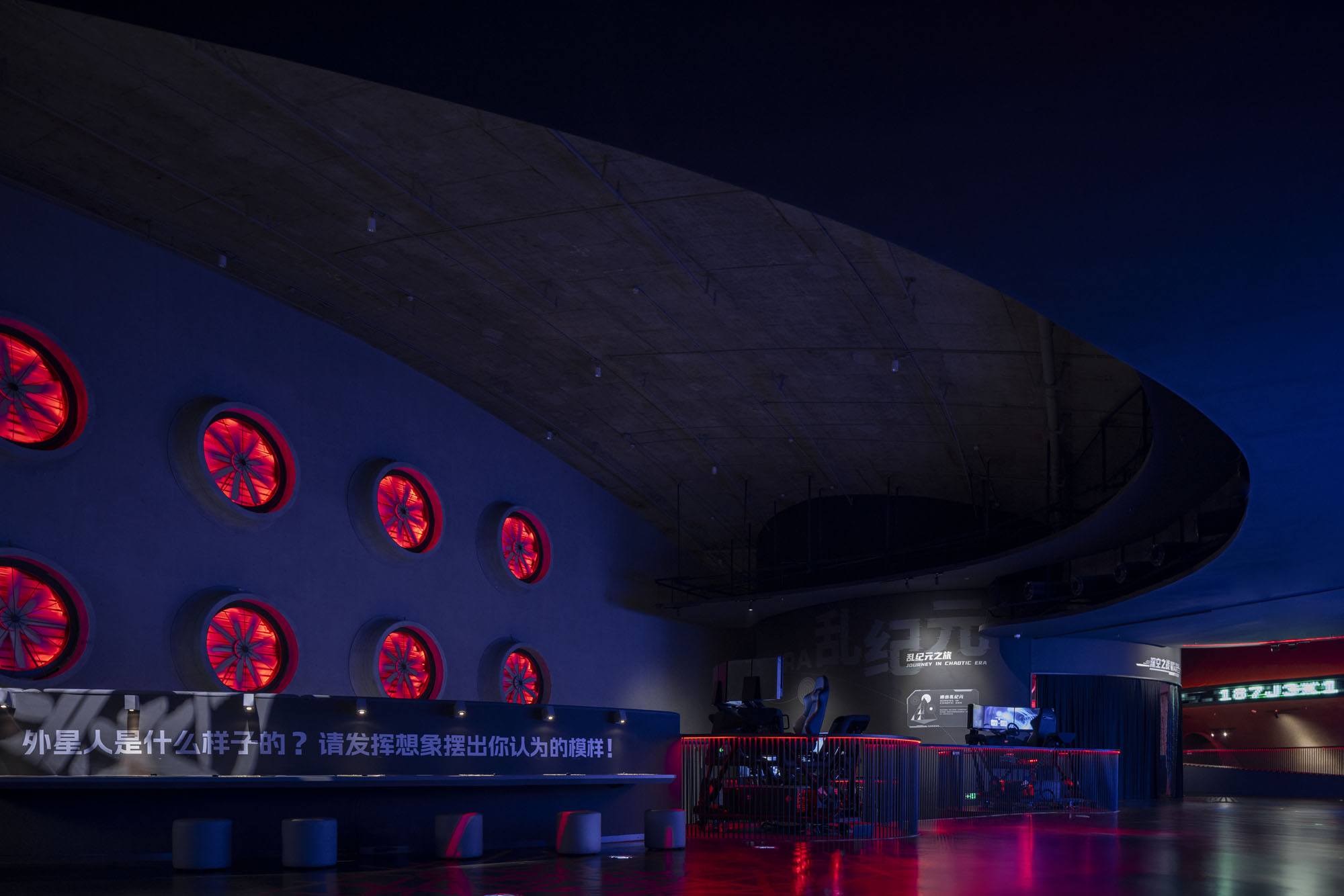
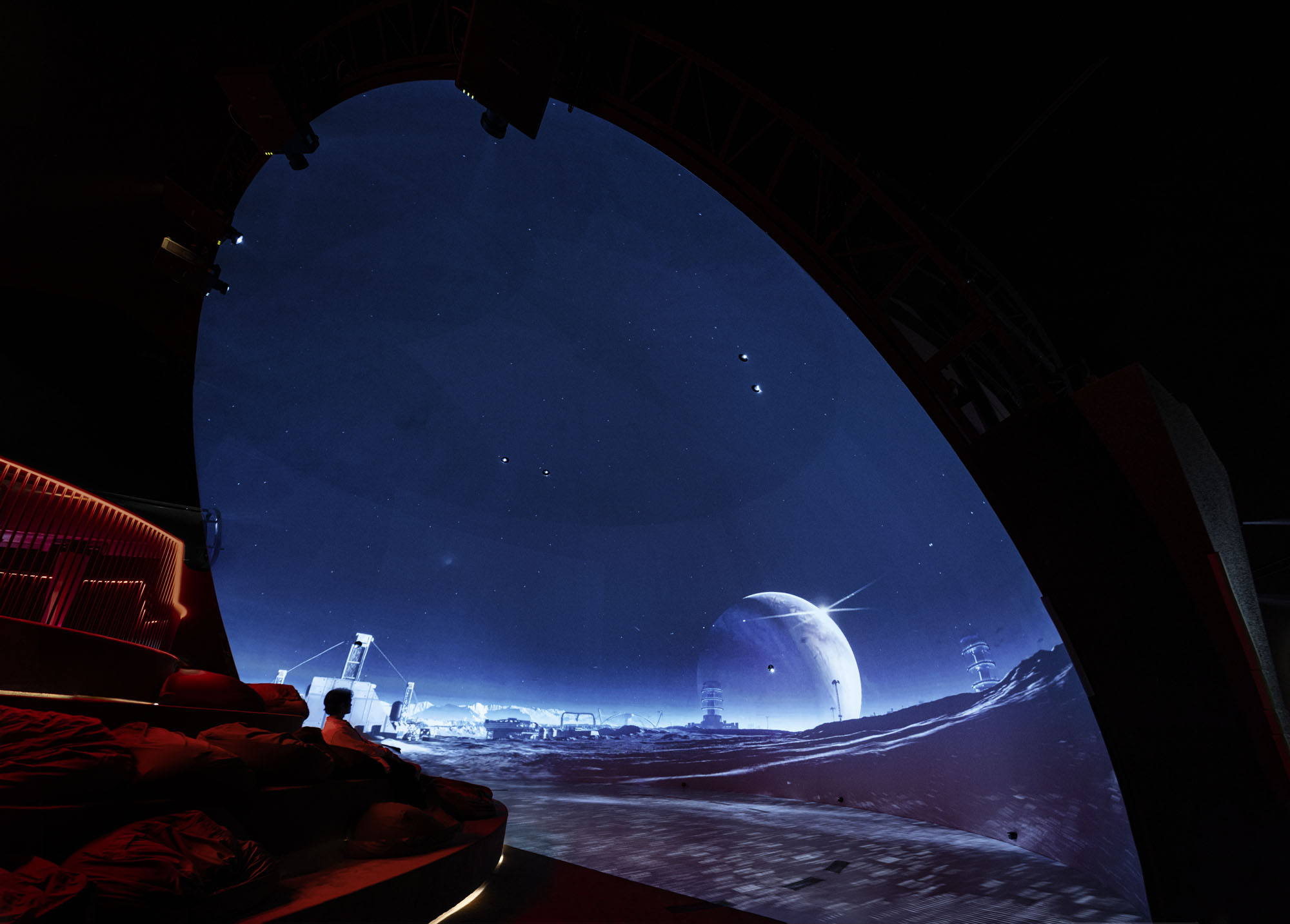
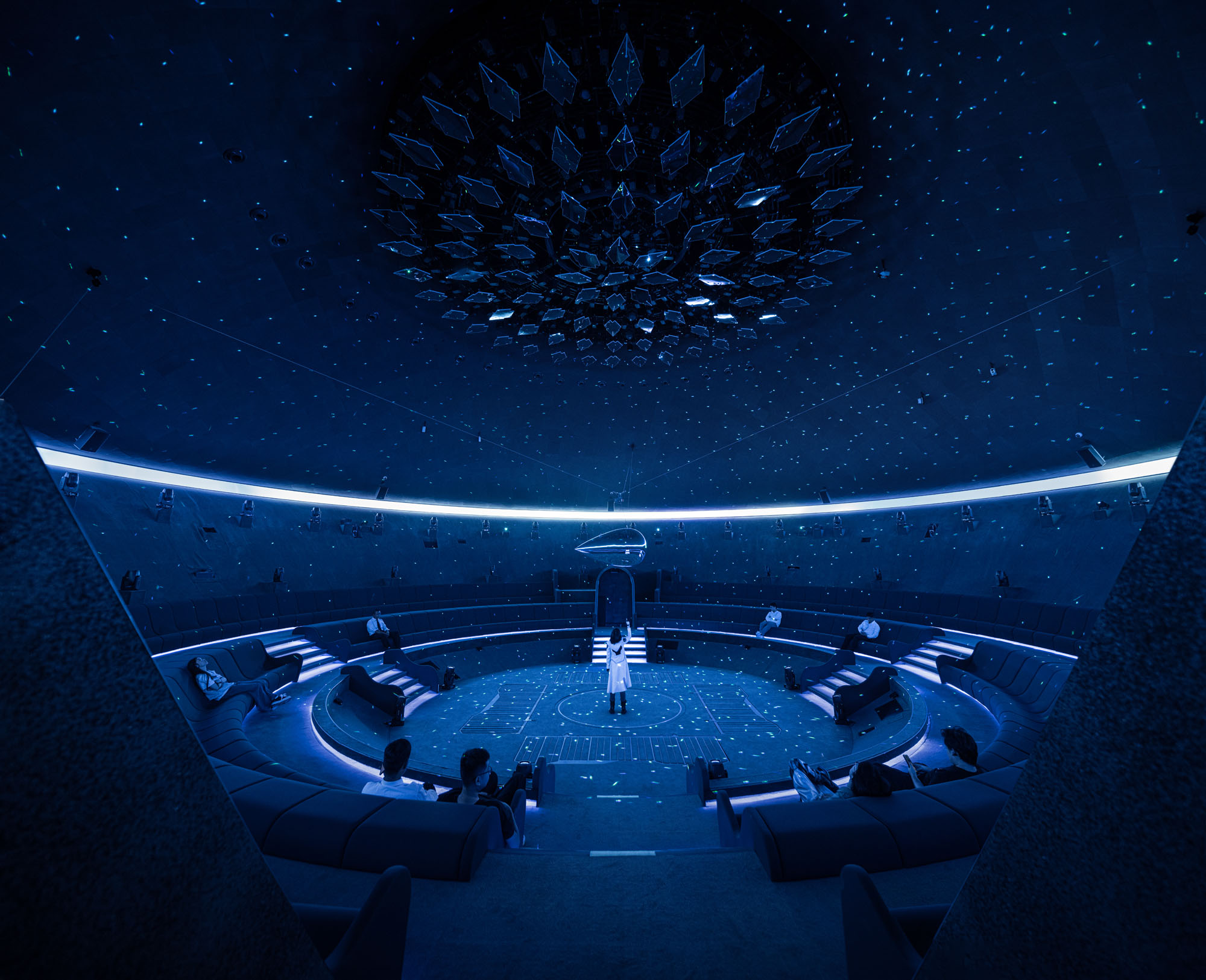
ここでは歩行は彷徨いとなる。さまざまな距離に配置された惑星群、宙に浮かぶ「自然選択」宇宙船、「壁面探査プロジェクト」、深宇宙の戦い、終末探査車、そしてドームシアターが天井のアーチ下に散りばめられ、うねる暗闇空間内を自由に探索するよう誘う。鉢状の「水滴劇場」の内外を貫く水平の環状亀裂が、パフォーマンス空間全体に無限の地平線を提供する。
© SU Shengliang
ダークゾーンの境界を越えると「ライトゾーン」の世界が広がる。巨大な天体、「SFシードバンク」、レジャーとフォーラムのための2つの沈下エリアが連続して現れ、すべてがリボンのような開放的な遊歩道で結ばれている。金海湖のきらめく波紋に向かい合うこの空間は、異星に降り立った宇宙船の内部にいて、地球の風景を覗き見ている感覚を呼び起こす。
© SU Shengliang
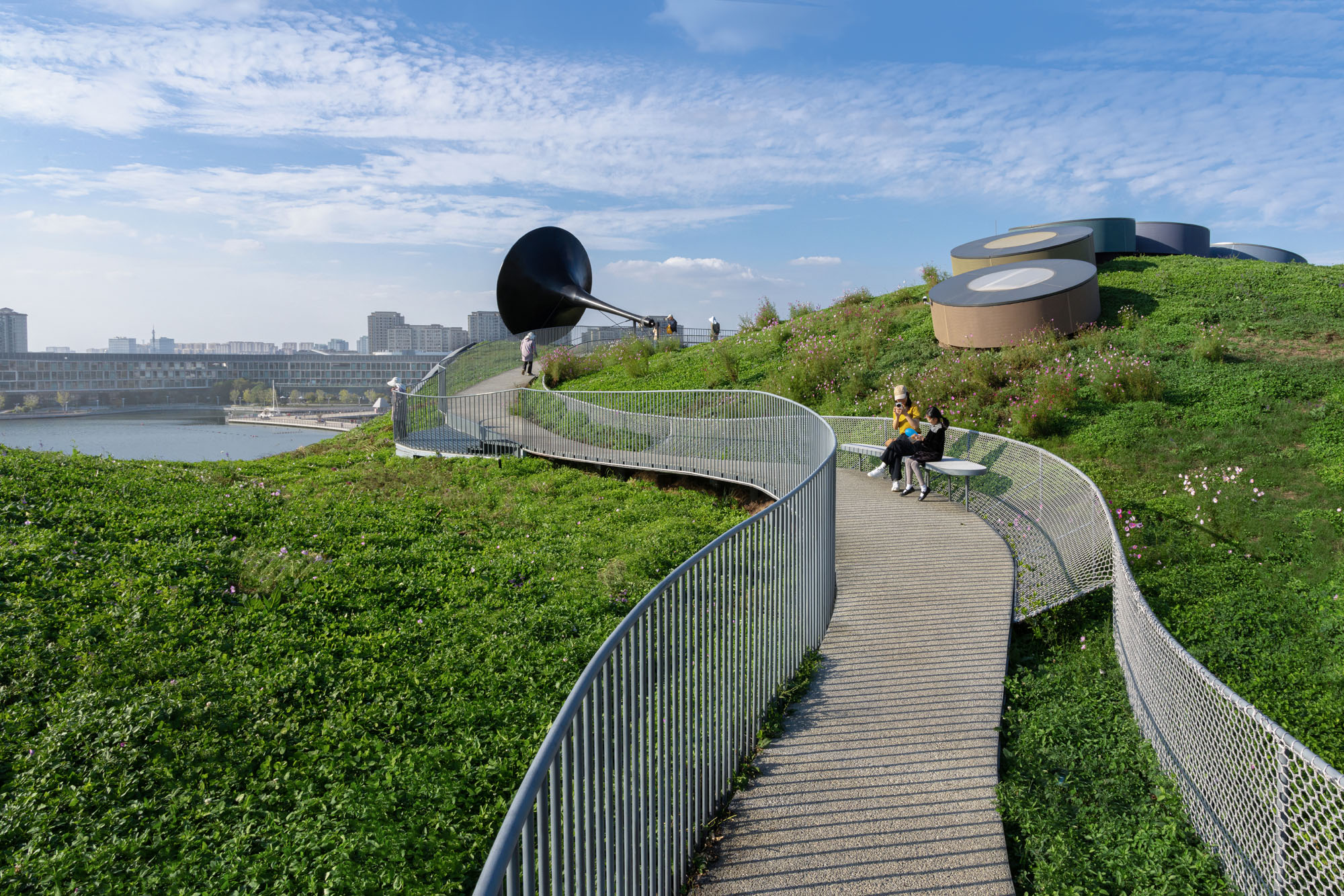
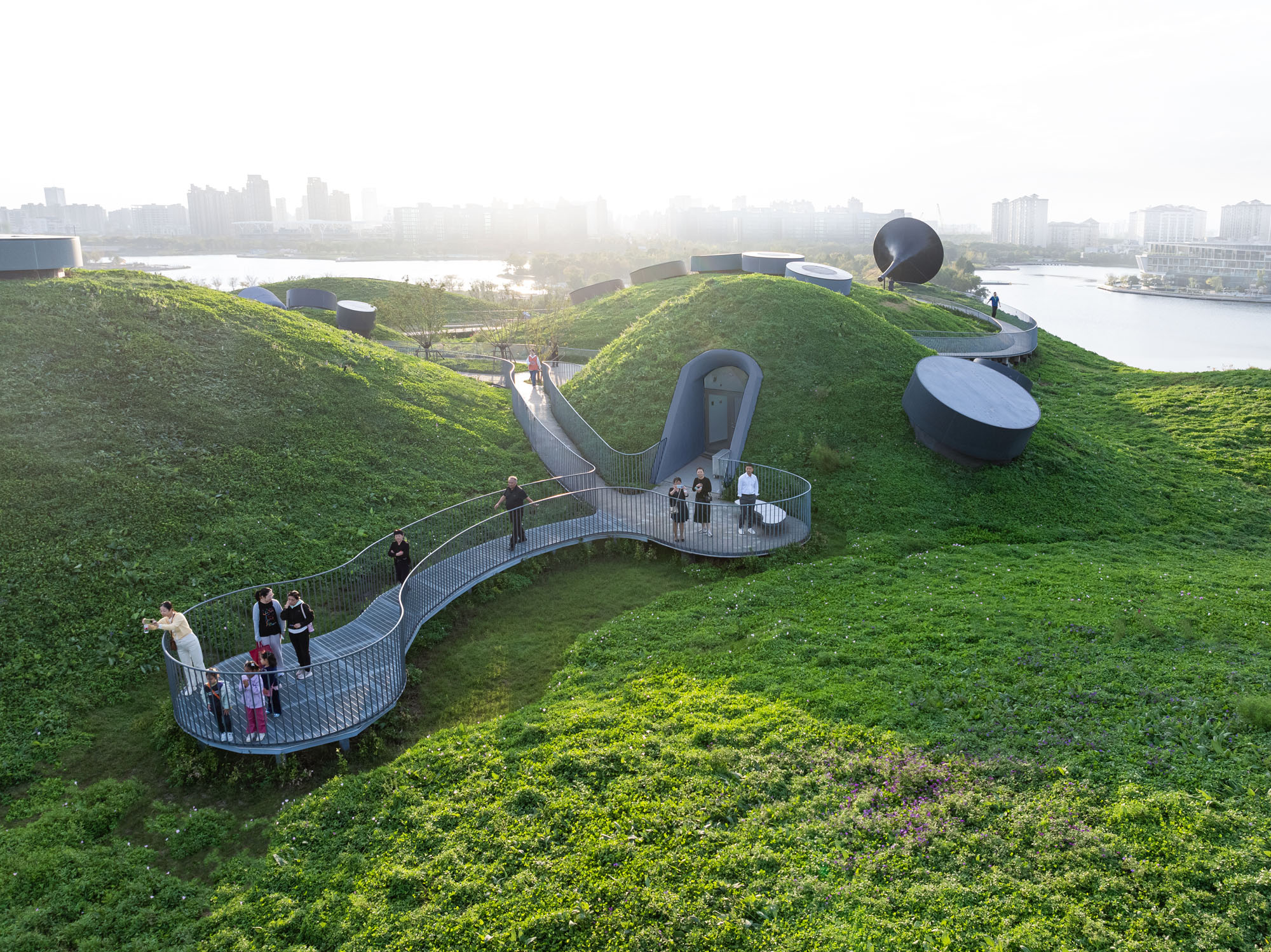
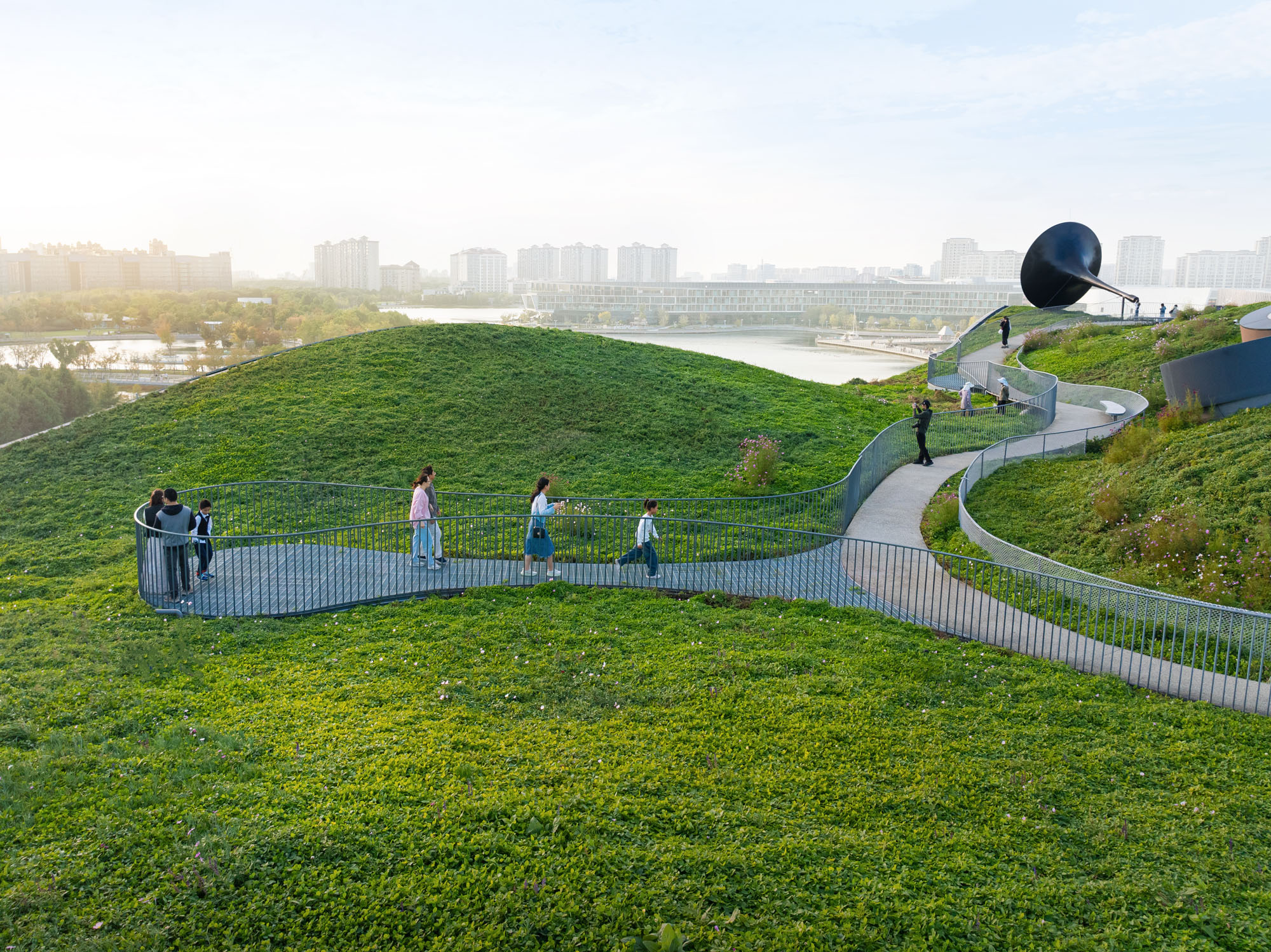
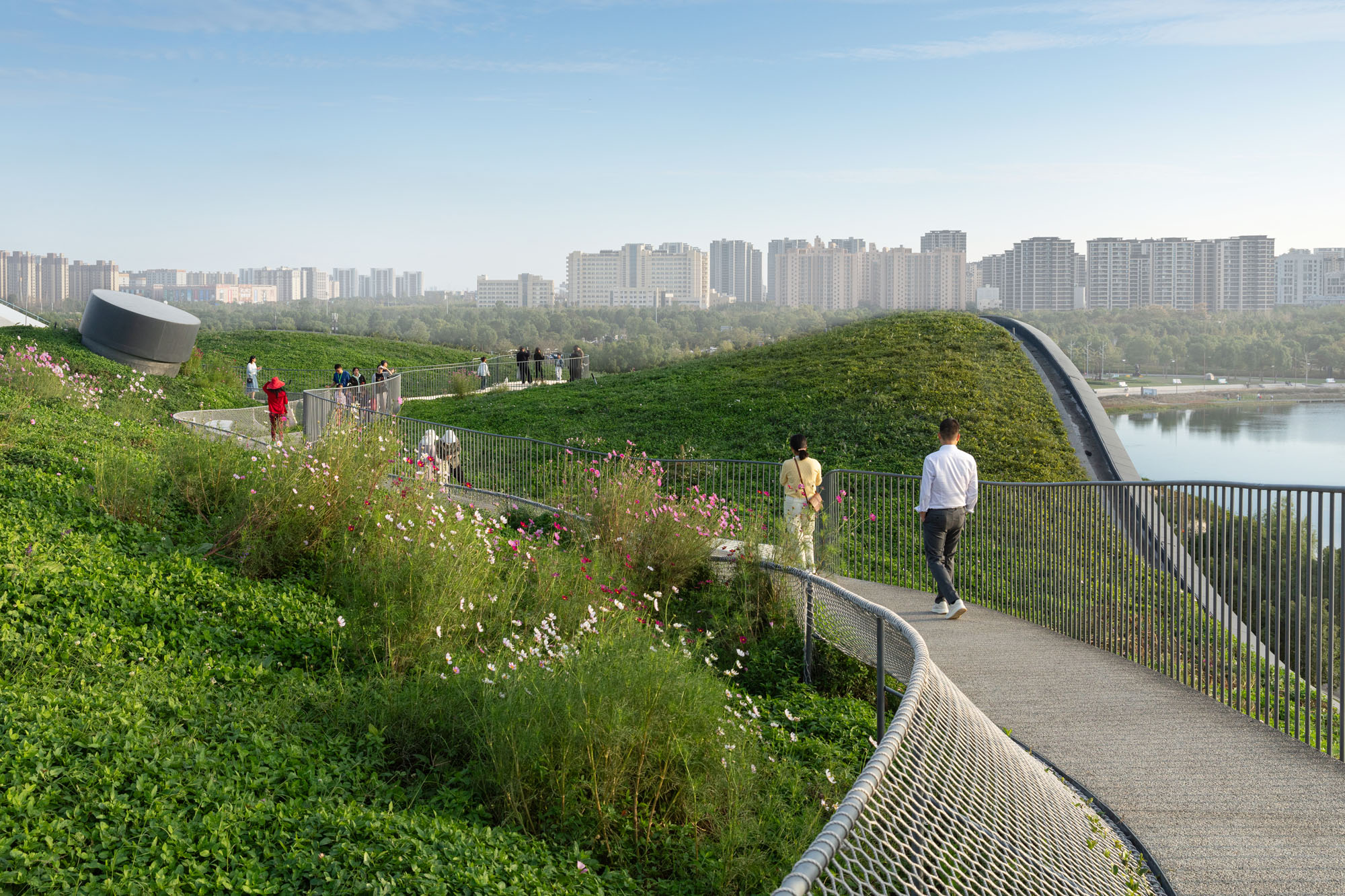
三重構造のシェル頂部には、草花が生い茂る起伏ある草原「波上の草原」が広がる。構造的負荷最適化とパノラマ視界の要求を両立させるため、屋根上の動線は固定された8の字ループに限定され、休憩や展望のための戦略的ノードで幅が広がる。
草の丘と周囲の景観が交互に現れる中、訪問者は緩やかな上昇と無限の深淵を体感する。うねる層の間に、湖畔の「波の立方体」は緑の波が織りなす立方体へと変容するのである。
Master Plan © SAO
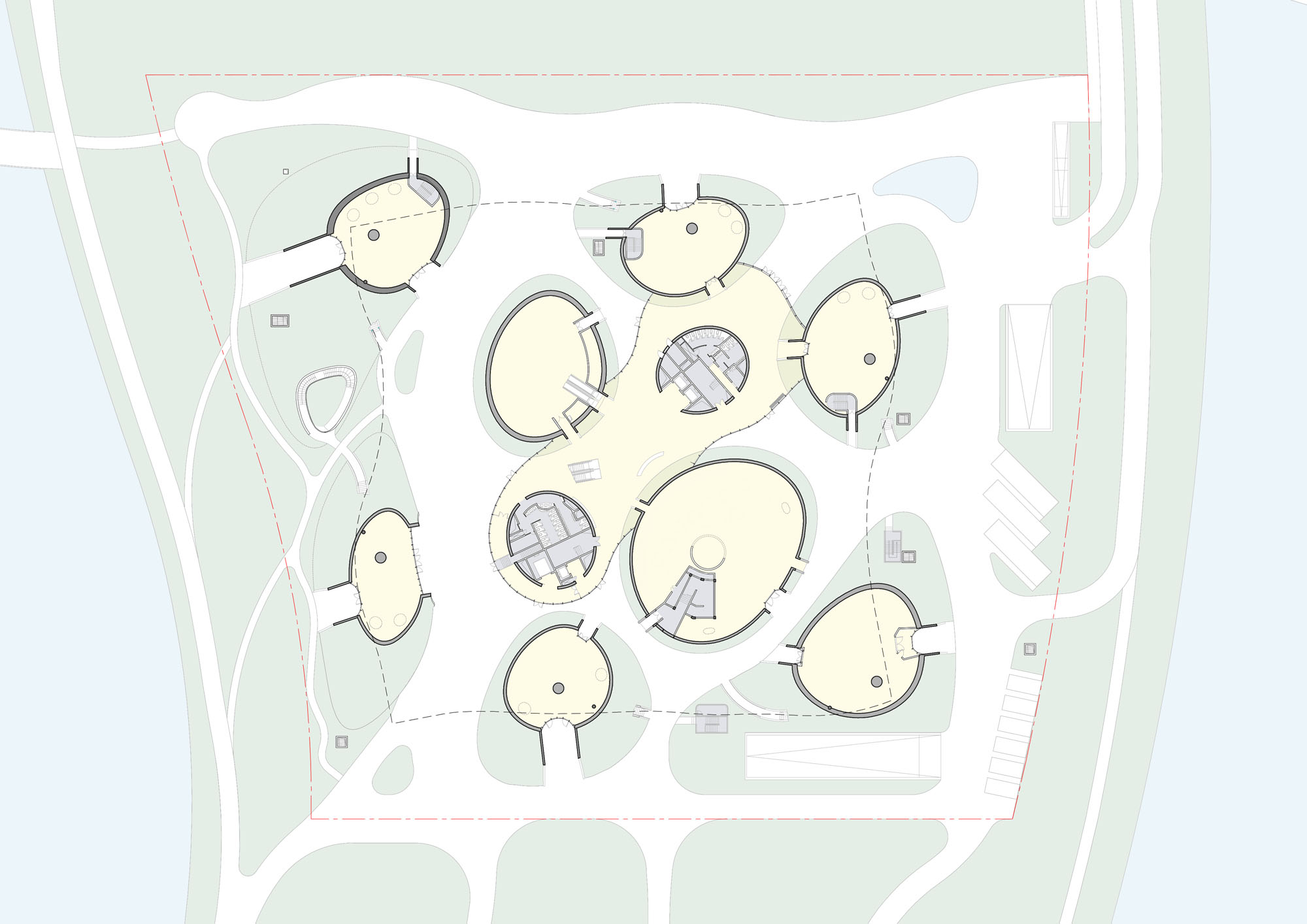
Ground Floor Plan © SAO
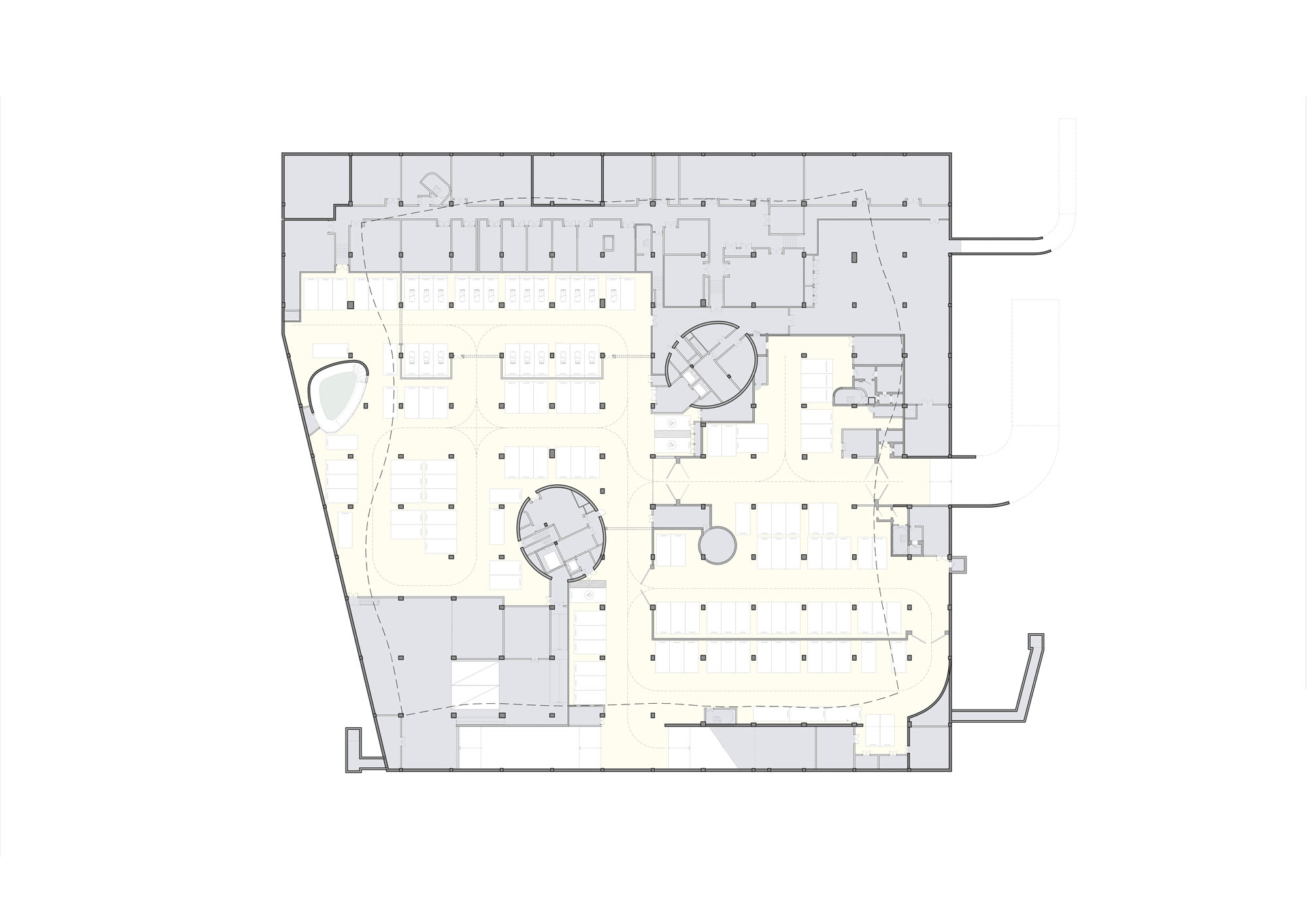
Basement Floor Plan © SAO
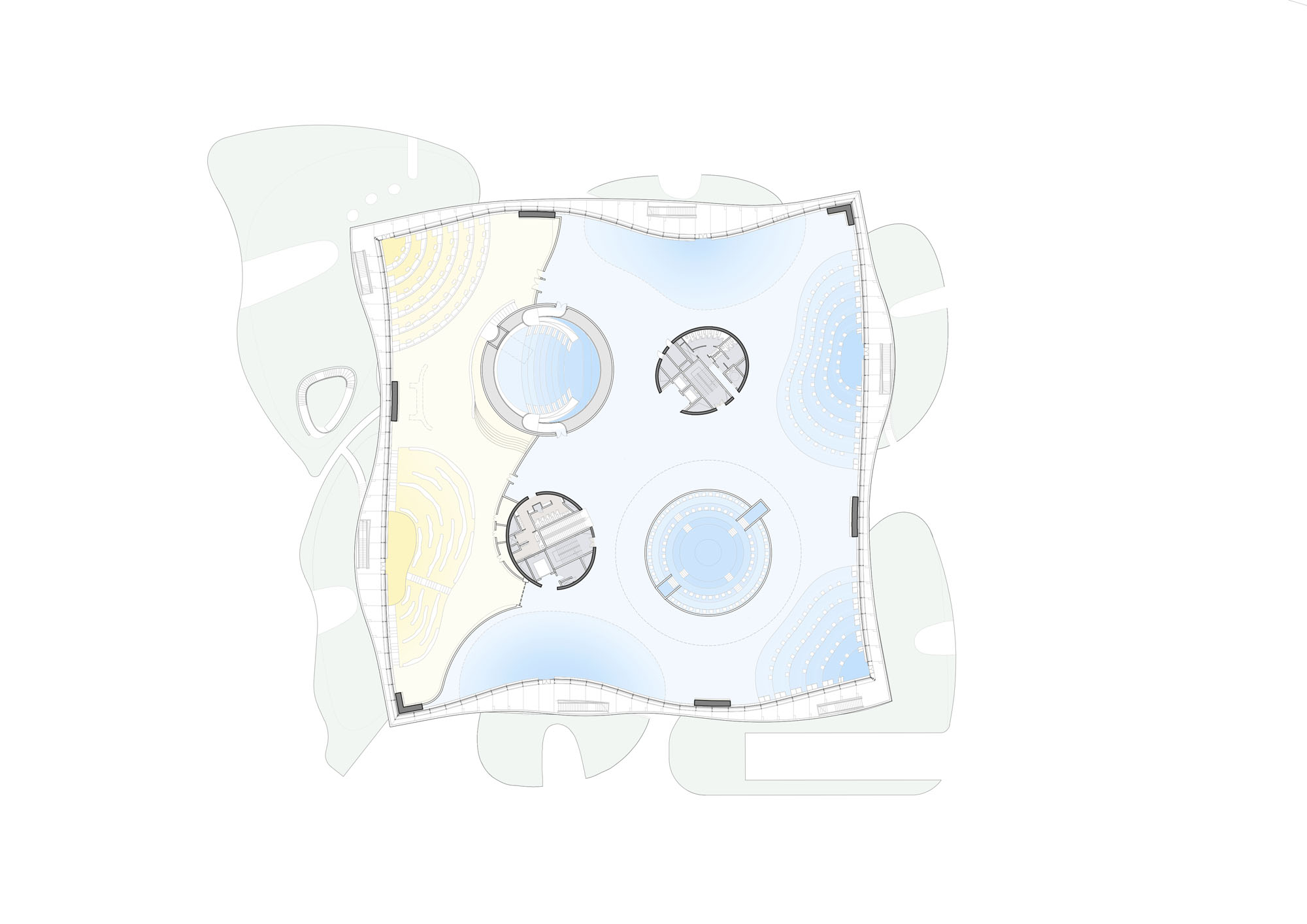
Second Floor Plan © SAO
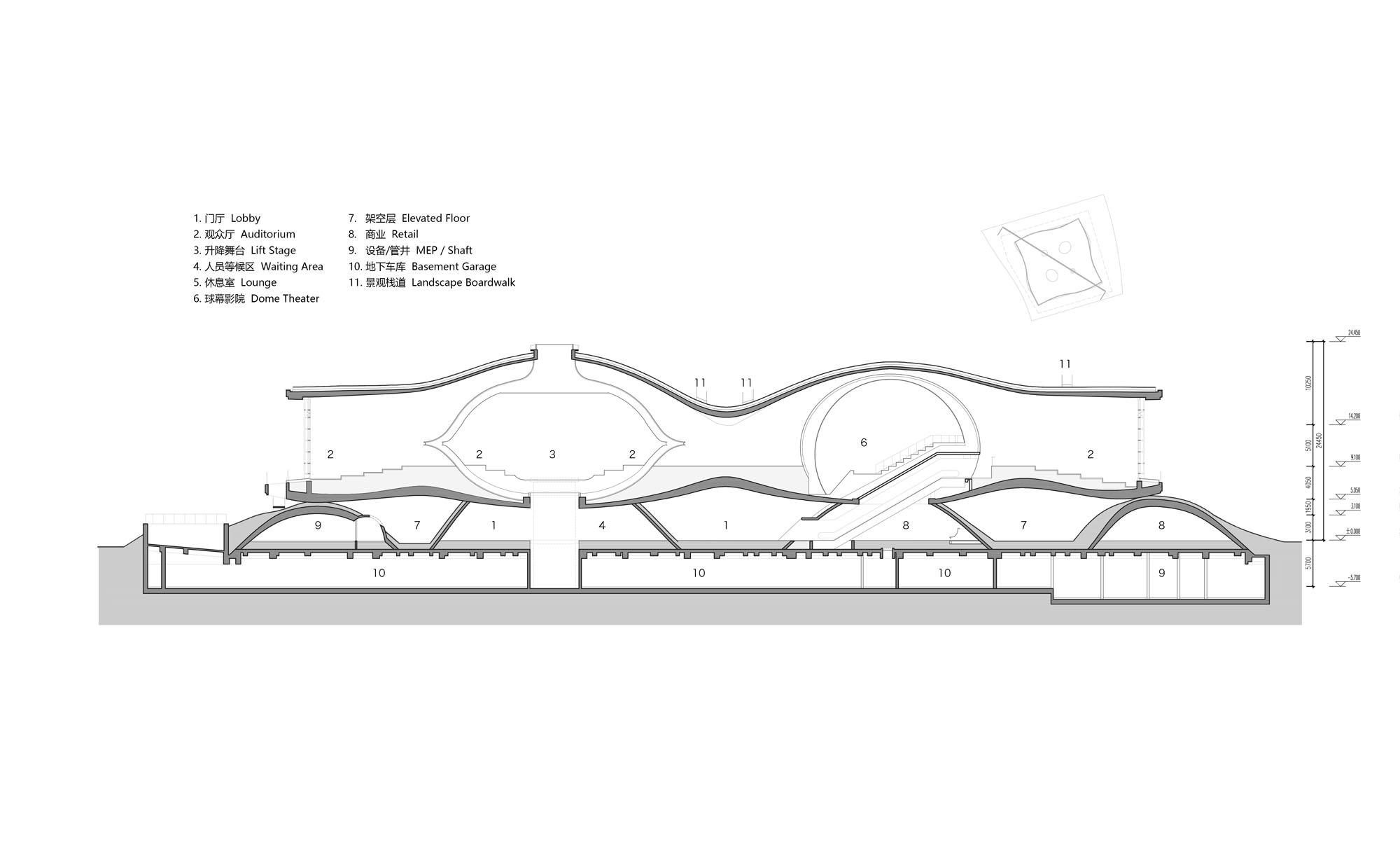
Section 1 © SAO
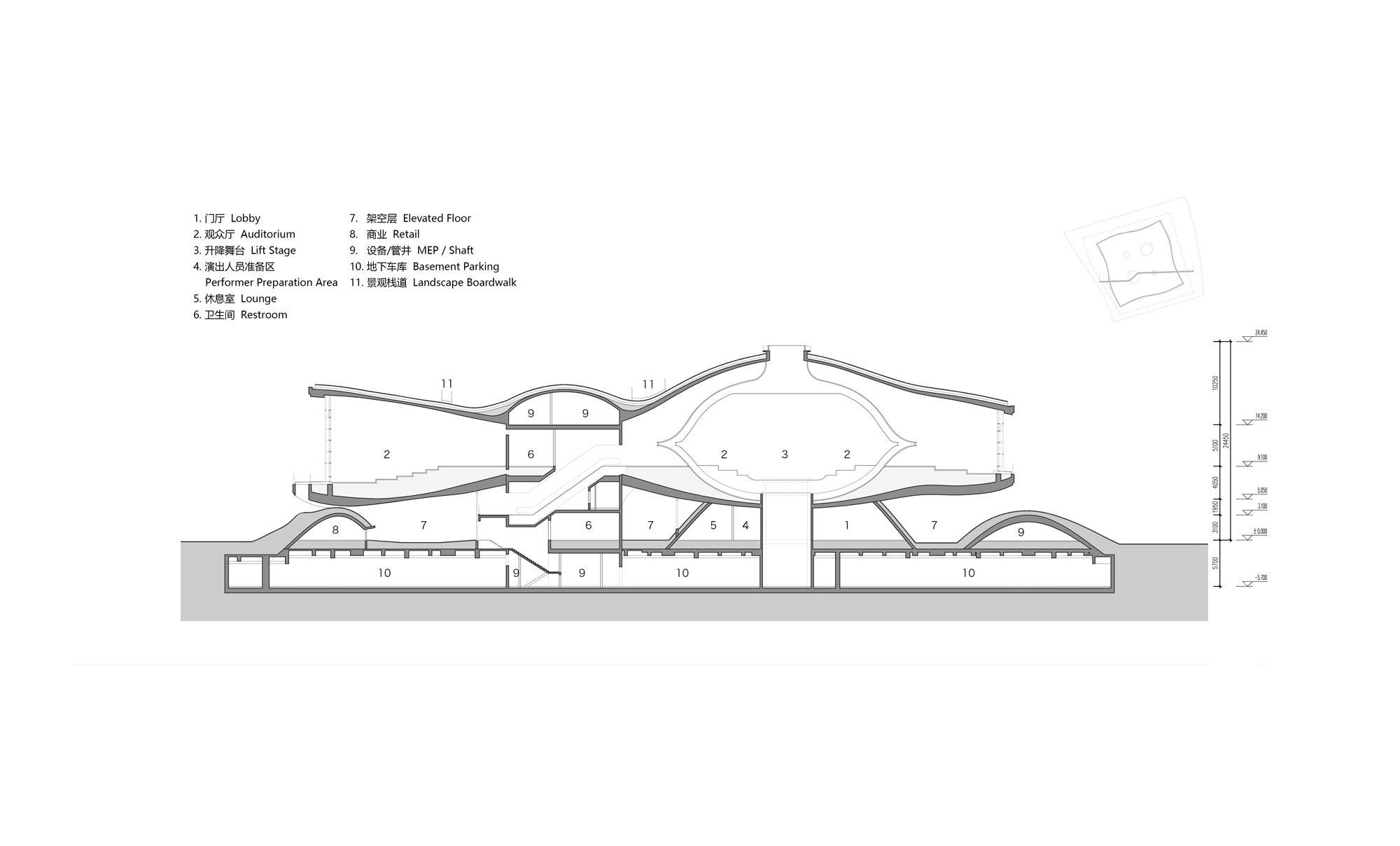
Section 2 © SAO.jpg
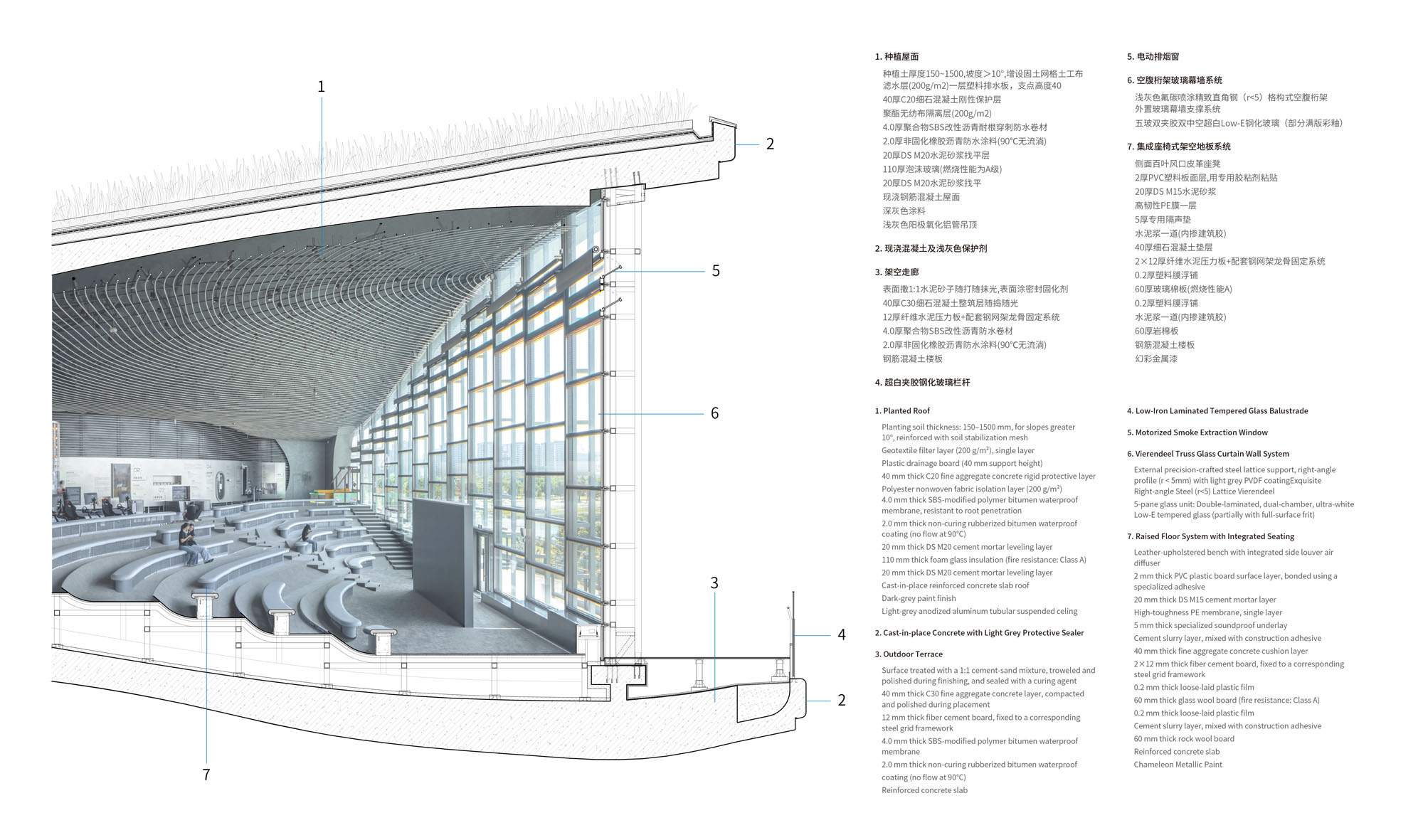
Sectional Perspective Detail © SAO
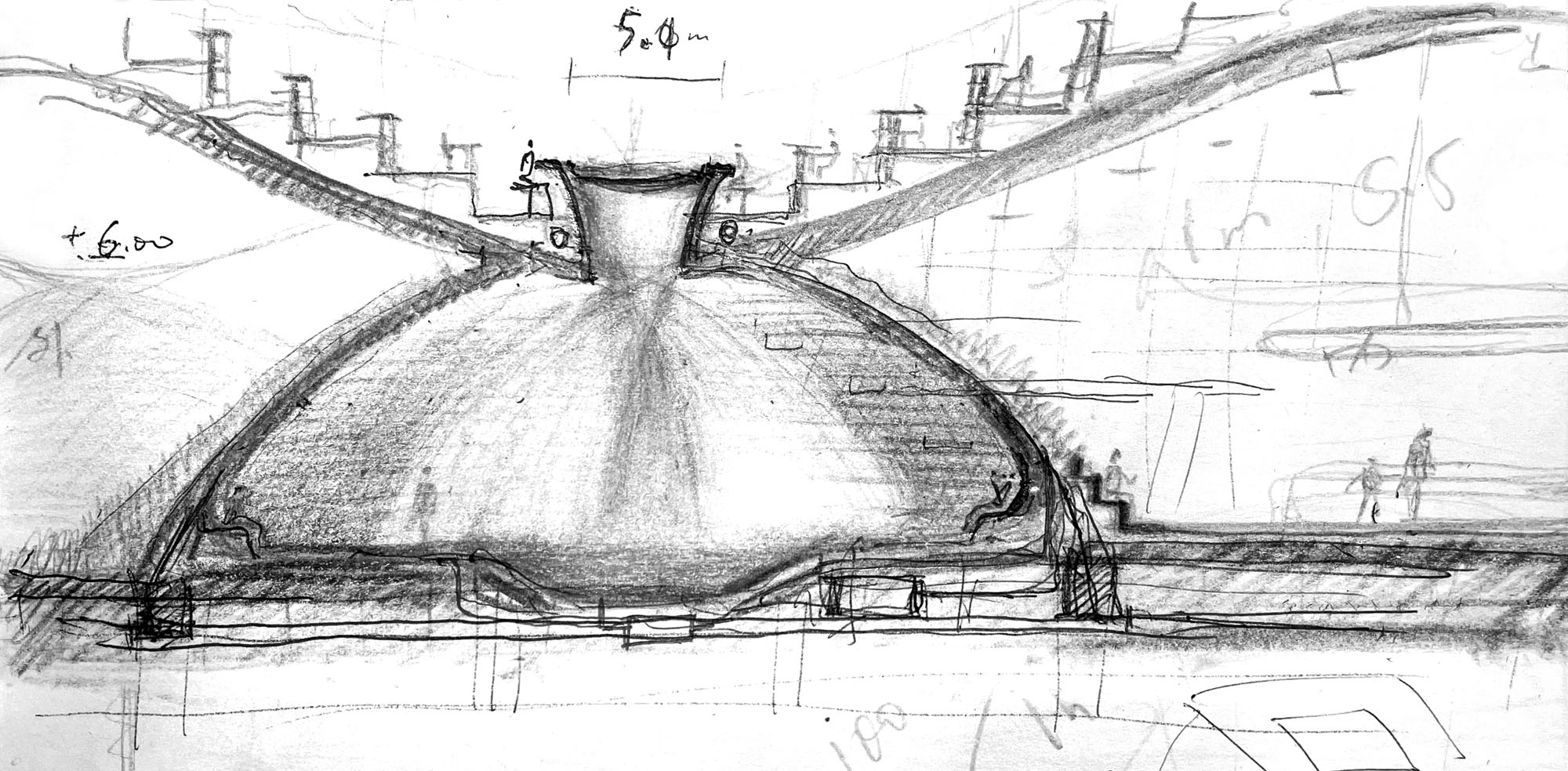
Sketch of the Overlapping Zone Between the Green Hills and the Wave Pavilion © Zhu Xiaofeng
以下、SAOのリリース(英文)です。
Wave Cube · The Future Academy of Three-Body Problem
Scenic Architecture Office (SAO)Wave Cube on Green Hills
Text by Zhu Xiaofeng, Zhang XuanWave Imaginary
The character bō (波, wave/ripple) is commonly found in ancient Chinese poetry. While its etymology has been interpreted in several ways—phonetically (the ancient sounds of “water” and “skin”), symbolically (water and slope), or associatively (as described by Wang Anshi, “the skin of water”). However, the undulation of water embodied by the wave, along with its extraordinary dynamic propagation within the natural world, has long been cherished by the literati. Through the medium of literary language, they have continuously articulated its more universal connotations, its expansive spatial scales, and its increasingly abstract significance in terms of transmission. In Zhang Ruoxu’s seminal The Moon over the River on a Spring Night, the lines “She follows the rolling waves for ten thousand li; Where the river flows, there overflows her light” frame the wave as a pervasive medium that conducts the moon’s ethereal luster across the boundless reach of rivers and seas. Similarly, in Wang Guan’s Song of Divination, the couplet “The rippling stream’s a beaming eye; The arched brows are mountains high” establishes a moment where water and peak share a singular undulation, tethering the landscape to the gaze as a conduit for human emotion.In the field of modern physics, waves represent one of the most important forms of motion within continuous media. Sound waves in air, ripples on water, seismic waves, light waves, radio waves, gravitational waves, and cell vibration waves, among others, all exemplify the wave-like behavior of continuous media. The fundamental physical quantities used to describe waves are amplitude, phase, and frequency.
Whether in literature or science, waves are both ubiquitous and mysterious. In the everyday environment of Earth, only a few visible continuous media generate observable waves, such as water waves, while experiences at the human scale are even rarer, with surfers being among the few who can enter the interior of ocean waves. As a man-made structure, architecture is formed through static systems that create fixed spaces to meet human needs for activities and rest within flat surfaces. Consequently, it is challenging to draw direct comparisons with dynamic systems like waves. Only fixed locations such as skateboarding pools provide an experience of dynamic undulation. In recent works by Scenic Architecture Office, the focus has consistently been on three directions: “courtyard settlement,” “extension of homes,” and “free cell.” Among these, “free cell” explore new architectural forms through the integration of technology and spatial experience. The continuous undulation of mountains and waters, the traditional clustering of architectural rooftops, the reproduction of cells, and the transmission of information all share a morphological connection to waves. We have been continuously thinking whether the morphology of waves could offer further insights for the future of architecture. The “Wave Cube” project by Jin Hai Lake has provided us with a rare opportunity for exploration.
The Wave of Folded Undulation
In the planning of Shanghai’s five new towns, Jin Hai Lake in Fengxian serves as the central landscape of the new town. The site of “Wave Cube” is almost square in shape, located on a circular peninsula on the eastern side of the lake, with water on both the east and west sides. This multifunctional cultural landmark is themed around science fiction. The design direction stems from the site’s location and functional positioning: the building not only aligns with the surrounding lakeside green belt in terms of landscape integration but also strives to establish its own distinctiveness in both internal experience and external appearance.Shanghai is characterized by abundant water and scarce mountains, and Fengxian is particularly a vast, flat expanse of fertile land. Starting from the terrain, a design direction that is both natural and powerful emerged, and the concept of artificial hills became an integral part of the design early on. Building upon this foundation, we sought to create a form of undulation that not only serves as the external image but also provides a unique experience for the interior space, offering more possibilities for groundbreaking interpretations of the sci-fi theme. Landscape, iconicity, and spatial experience: at the intersection of these three elements, we conceptualized a settlement composed of wave-like units that could infinitely extend in three-dimensional space. A portion of this wave form was then extracted for use in the building. After considering various scale options, the final selected range for extraction was approximately 80m x 80m x 20m, consisting of three layers of wave surfaces to form a three-tiered, stacked undulating space. The amplitude and phase of the wave were defined using a three-dimensional nine-square grid, and the frequency of the wave units in the upper large space was determined: two full units, four half units, and two quarter units. This resulted in a wave-like structure with an amplitude of approximately 12 meters, a span of about 54 meters, and a cantilever of about 27 meters. This can be considered the largest cell settlement in the “Free Cell” series of Scenic Architecture Office.
Following the generation of an initial 3D model derived from sinusoidal curves, we invited structural consultant Zhang Zhun and his team to conduct a feasibility study. Our objective was to synchronize the wave morphology with the principles of vaulted shell mechanics to derive a viable structural form. During the discussions, we realized that the standard sine wave shell has a completely different force transfer mode compared to an arch. In traditional structural terms, a compressed shell arch capable of spanning such large dimensions and cantilevering would require an unexpectedly high rise and thicker shell than originally anticipated.
Consequently, a spatial structural form, positioned between a shell and a wave, capable of both compression and tension, became the common goal for exploration. The structural engineers utilized simplified folded planes to identify the primary paths for gravitational and lateral forces. Through a topological transformation from faceted surfaces to curved shells, they elegantly resolved the challenges of gravity, lateral force transmission, and cantilevered loads, thereby pushing the compressive potential of reinforced concrete and the tensile capacity of prestressing to their absolute limits. Through iterative dialogue and mutual form-finding, the final composite structural system that mediates between vaulted shell and folded plane was developed: the lower “Green Hills,” the central “Vaulted Void,” and the upper “Wave Pavilion.”
The Interiority of Wave Shell
The lower “Green Hills” consist of eight concrete shells emerging from the earth, housing exhibition halls, cafes, bars, cultural and creative shops, and mechanical rooms. The six surrounding Green Hills and two structural cores support the upper structure. The descending forces are partitioned at the crest of each shell: gravity is borne by mushroom columns, while lateral forces are transferred through the hill shells to the ground and the basement roof slab. The two central Green Hills meet in a delicate “kissing” contact with the inverted shells descending from the Wave Pavilion, where the junction forms two circular openings, providing continuous vertical voids for the escalators and a lift stage. On the exterior of the hills, retaining grids secure the topsoil on the slopes, complemented by localized artificial lighting to nourish shade-tolerant groundcover in the shadowed zones. Within the interior, circular skylights—serving dual functions of smoke extraction and natural ventilation—introduce daylight into the cavernous volumes, imbuing the space with a soft, mysterious atmosphere.The individual “Green Hills” are discrete, yet their interstitial spaces are sheltered beneath the overarching “Wave Pavilion,” together creating a continuous “Vaulted Void” in the middle. Along the perimeter, elevated semi-outdoor spaces introduce the surrounding landscape and allow the lakeside promenade to pass beneath the building. At the center, the ground-floor lobby, enclosed by a glass curtain wall, serves as a hub and gathering point for the building’s internal circulation, embraced by the Green Hills. Two structural cores vertically penetrate the entire building, integrating the functions of structural support, vertical circulation, and MEP shafts. The continuously undulating ceiling of the “Vaulted Void,” paired with a floor paving that flows like a stream between the hills, dissolves the threshold between interior and exterior, resulting in a holistically open public space at the ground level.
Suspended above the “Green Hills” and the “Vaulted Void” is the massive “Wave Pavilion.” The upper and lower shells, cast in prestressed concrete, form the vertically symmetrical envelope of the “Wave Pavilion.” Adhering to the rhythmic undulation of the wave modules, two structural cores and six peripheral shear walls—positioned at the eight convergence points—provide the support and cantilevered strength. This structural logic engenders a fluid wave-form field of approximately 6,400 square meters, with clearances varying between 4.5 and 12.5 meters, effectively creating an “interior park” within the architecture. The plane at the +9.1m level serves as the horizontal promenade through this indoor park, encircling eight sunken voids of varying shapes. These spaces are categorized into full circles, semi-circles, and quarter-circles based on the extracted wave geometries, each resonating with the vaulted domes above. The air conditioning system is arranged between the lower shell and the raised floor, employing a combination of low-zone sprinklers and high-zone water cannons to enhance the structural clarity of the overhead structure. At the domes of the two complete wave spaces, single large skylights and five smaller skylights are installed to ensure smoke exhaust and ventilation, while inviting the solar radiance within. The outer perimeter of the Wave Pavilion is encased in a glass curtain wall supported by exposed trusses, forming a continuous transparent interface facing the city, and creating an undulating aerial walkway.
The Challenge of Force Dynamics
Translating the mathematical purity of a sine wave into a tangible, load-bearing reality was the paramount challenge of both the design and construction phases. Within this composite spatial structure formed by three vertically superimposed wave-shell surfaces, the load-transfer mechanism integrates both vertical and diagonal modes. Architecturally, the diagonal force flow embodied by the wave morphology is the focal point of our expression, while the vertical conduction of the structural cores and mushroom columns is intentionally dissolved. In reality, a high-density structural system is concentrated within the seemingly pure wave forms. Construction required the meticulous organization of complex, highly coupled multi-system junctions: spatially curved prestressing tendons encircling the cores, tapering steel-reinforced beams, structural steel frames within the shear walls, and dense embedded MEP conduits. To ensure these elements remained ‘interference-free’ within constrained cross-sections, the design and construction teams utilized BIM-based spatial verification. This enabled the reinforcing mesh to precisely encapsulate the multi-source components, ensuring seamless integration without conflict.Complex spatial positioning and the precision control of non-standard formwork presented another major technical barrier. Due to cost constraints, 3D-printed formwork was declined; instead, a high-density scaffolding grid—measuring 600 mm × 600 mm reduced to 300 mm × 300 mm in complex areas—was utilized as the support system for the cast-in-place formwork. To solve the issue of circular steel shaping-pipes shifting under load, the construction team developed a customized adaptive limiting component (a “gripper”) to lock the pipes precisely onto the central axis of the scaffolding poles. This technical innovation effectively suppressed formwork deformation during the concrete pour, ensuring a high-precision geometric realization of the undulating spatial curves. From the microscopic perspective of construction detail design, this innovation maintained the rigorous integrity of the building’s structural logic: before the structure was closed, it remained as fragile as an eggshell, relying on dense scaffolding and temporary bracing for stability. Only upon the completion of the pour and the tensioning of the prestressing tendons did the structure achieve “closure”. At that moment, every component instantaneously assumed its role—as if a power switch were flipped, the stress flow circulates and integrates throughout the interior, allowing the entire ‘eggshell’ to attain its structural rigidity. As the formwork and scaffolding were struck, the authentic texture of the fair-faced concrete began to flow across the undulating surfaces in the play of light and shadow, and the vitality of the architecture was finally revealed.
At the northeast and southwest corners of the building, large-scale cantilevers of 27 meters presented rigorous challenges regarding deformation. Due to the creep characteristics of concrete, the structure underwent a dynamic transition—from immediate deflection during the initial loading of roof soil to a gradual settlement that stabilized within a year. To control crack widths and meet the displacement limits of the curtain wall’s top sleeves, two lattice steel columns were installed at the cantilever ends to bear vertical loads exclusively. For visual unity, these columns mirror the scale and composition of the curtain wall mullions, allowing the heterogeneous system to be visually concealed within the whole. Monitoring data confirms that the final settlement falls precisely within the design limits.
Except for the glass curtain walls and grass slopes, the building maximizes the exposure of its cast-in-place concrete texture across both interior and exterior surfaces, using only subtle detailing to differentiate spatial atmospheres. A translucent concrete sealer was applied to the Wave Pavilion’s facades, peripheral shear walls, and cores. On the upper shell, dark grey protective coating uniformly covers the underside and MEP conduits, highlighting a “streamlined” ceiling formed by silver-white aluminum pipes. For the underside of the lower shell, an iridescent protective coating achieved through a multi-stage process leverages the reflections of the continuous curved surfaces to introduce dynamic light and shadow into the dimly lit “Vaulted Void.”
Immersive Experience
The spatial operation scheme culminated in a final consensus after three successive iterations of multi-party refinement. The second floor is organized into three distinct realms: to the northeast lies the pivotal “Dark Zone,” a fully enclosed ‘black box’ designed to anchor the deep sci-fi narrative of The Three-Body Problem; to the west, the ‘Light Zone’ faces Jinhai Lake, opening its expanse to public activities. While both the dark and light realms are curated and managed by Fengyuzhu, the southern sector remains a flexible spatial reserve, held in quiet anticipation for future exhibition possibilities.The building’s triple-layered wave shells establish a three-dimensional spatial field, offering a profoundly mysterious and dynamically shifting experience of enclosure and release for the grand sci-fi narrative and its manifold scenarios. The main entrance to this ‘Three-Body Future Academy’ is located beneath the cantilevered shell at the northeast corner. Moving from the “Green Hill”-wrapped glass curtain wall into the ground-floor lobby, one perceives a seamless extension between the interior and exterior landscapes. Entering the sand-strewn ‘Dune-Void’ or passing through the ovoid core, visitors ascend via escalators through a dark corridor—a ‘wormhole leap’ reminiscent of science fiction, marking the passage from reality into the depths of the Three-Body universe. Here, walking is wandering: planets at varying distances, the suspended Natural Selection starship, the Wall-facer Project, the Battle of Deep Space, the Doomsday Rover, and a dome theater are scattered beneath the vaults, inviting visitors to explore freely within this undulating dark space. Inside and outside the bowl-like ‘Droplet Theater,’ a horizontal ring-fissure pierces through the structure, offering an infinite horizon for the entire performance space. Beyond a threshold from the Dark Zone lies the world of the ‘Light Zone’: colossal celestial bodies, a ‘sci-fi seed bank,’ and two sunken areas for leisure and forums appear in succession, all linked by a ribbon-like open promenade. Facing the shimmering ripples of Jinhai Lake, the space evokes the sensation of being inside a starship landed on an alien world, peering out at the landscape of Earth.
Atop the triple-layered shells, a rolling meadow of grass and wildflowers creates a “Grassland upon the Waves.” To balance structural load-optimization with panoramic needs, the roof circulation is confined to a fixed figure-eight loop, widening at strategic nodes for rest and observation. As grassy mounds and surrounding vistas alternate, visitors are immersed in an experience of measured ascent and boundless depth. Amidst these undulating layers, the “Wave Cube” is transformed into a cube of verdant wave by the lake.
Project Data
Project Name: Wave Cube
Location: East Shore of Jin Hai Lake, Fengxian New City
Program: Sci-Fi Themed Experience Center
GFA: 29,700 m²
Building Height: 19.8 m
Design/Completion: 2020/2025
Client: Shanghai Fengxian New City Construction and Development Co., Ltd.
General Contractor: Shanghai Construction Group Co., Ltd.
Design Principal: Zhu Xiaofeng
Structural Principal: Zhang Zhun
Architectural and Interior Design: Scenic Architecture Office (SAO)
Project Manager: Li Qitong
Design Team: Zhang Xuan (Project Architect), Song Yixuan, Chen Xuanxiang, Su Kaiqiang, Sun Jianong, Zhu Xiaoye, Geng Yutong, Hu Siyuan, Shen Ziwei, Zhang Chi
Interns: Hu Chenghai, Chen Xi, Xu Youlu, Sun Yihan, Li Jing
Local Design Institute: Tongji Architectural Design (Group) Co. Ltd
Structural Consultant: AND Office/ Cai Yanming, Pan Jun
Structural System: Stacked Prestressed Concrete Shell + Core Tube
Landscape Design: Growdesign Co.Ltd.
Operations and Interior Planning: Shanghai Fengyuzhu Culture Technology Co., Ltd.
Photography: SU Shengliang, LIU Guowei, ZHANG Haobo
SAO 公式サイト
http://www.scenicarchitecture.com/index.html